
Personal Trainer SEO: The Complete Guide (2026)
Learn how to rank your personal training business on Google. Covers local SEO, GBP optimization, keywords, content, and reviews. Updated for 2026.
Siddharth Gangal • 2026-04-02 • Local SEO
In This Article
Most personal trainers rely on referrals and Instagram to get new clients. That works until it stops working. And when it stops, your calendar goes empty fast.
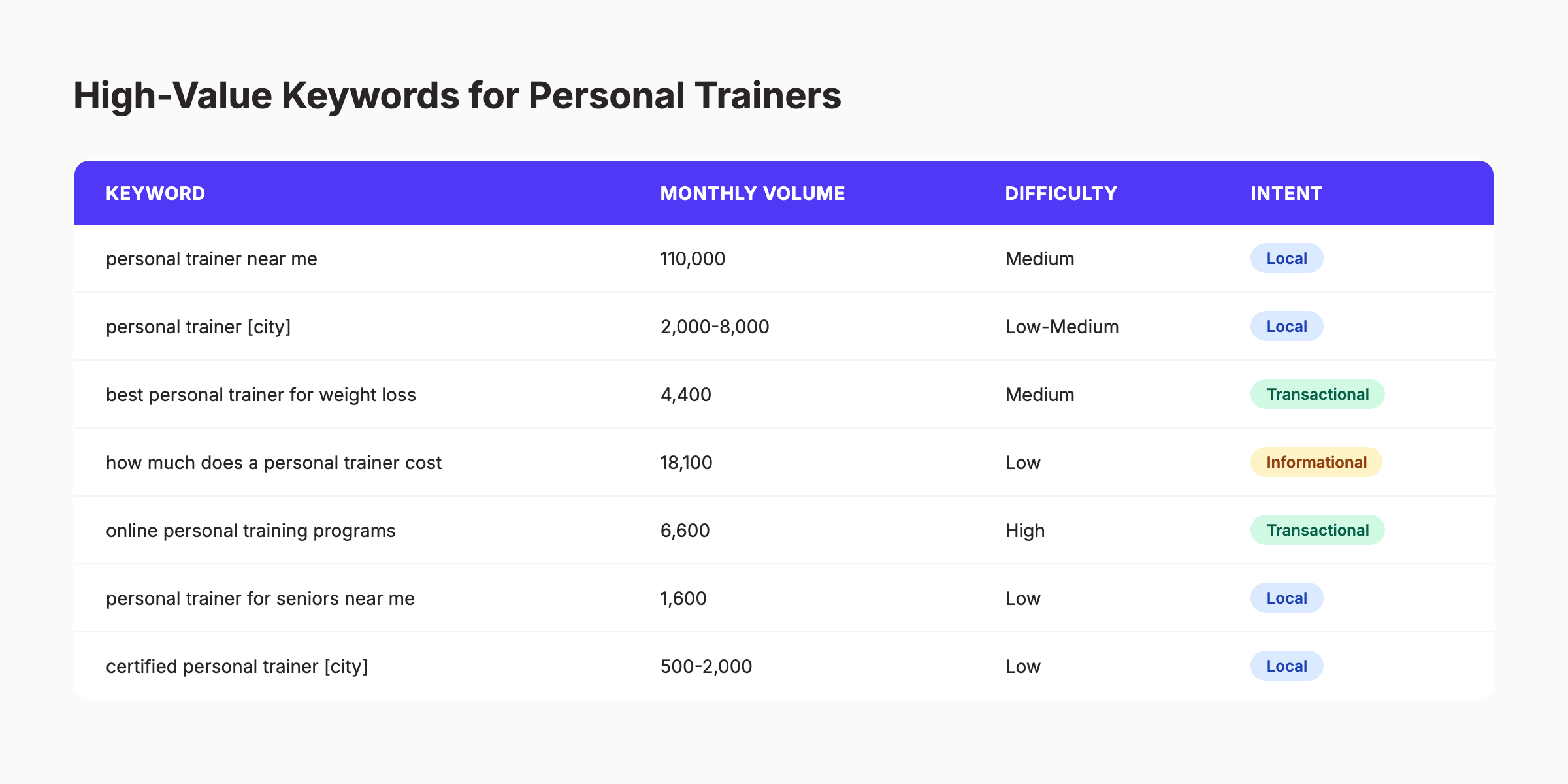
The trainers filling their books every month have something the rest do not. They show up on Google when someone searches “personal trainer near me.” That single query gets over 110,000 monthly searches in the U.S. alone.
This personal trainer SEO guide covers everything you need to rank your fitness business in local search, attract clients on autopilot, and stop depending on word-of-mouth alone.
We publish 3,500+ blog posts across 70+ industries, and fitness is one of the fastest-growing verticals we work in. This guide distills what actually works for personal trainers in 2026.
Here is what you will learn:
- How to find the exact keywords your future clients search for
- How to optimize your Google Business Profile to dominate the Map Pack
- The on-page SEO elements every trainer website needs
- Content ideas that attract local clients through search
- How to get more reviews and turn them into ranking signals
- Link building tactics specific to the fitness industry
- Technical fixes that most trainer websites miss
Why SEO Matters More Than Social Media for Personal Trainers
Social media is rented ground. You do not own the algorithm, and organic reach on Instagram dropped below 10% in 2025. SEO is different. A blog post or Google Business Profile listing can send you clients for years.
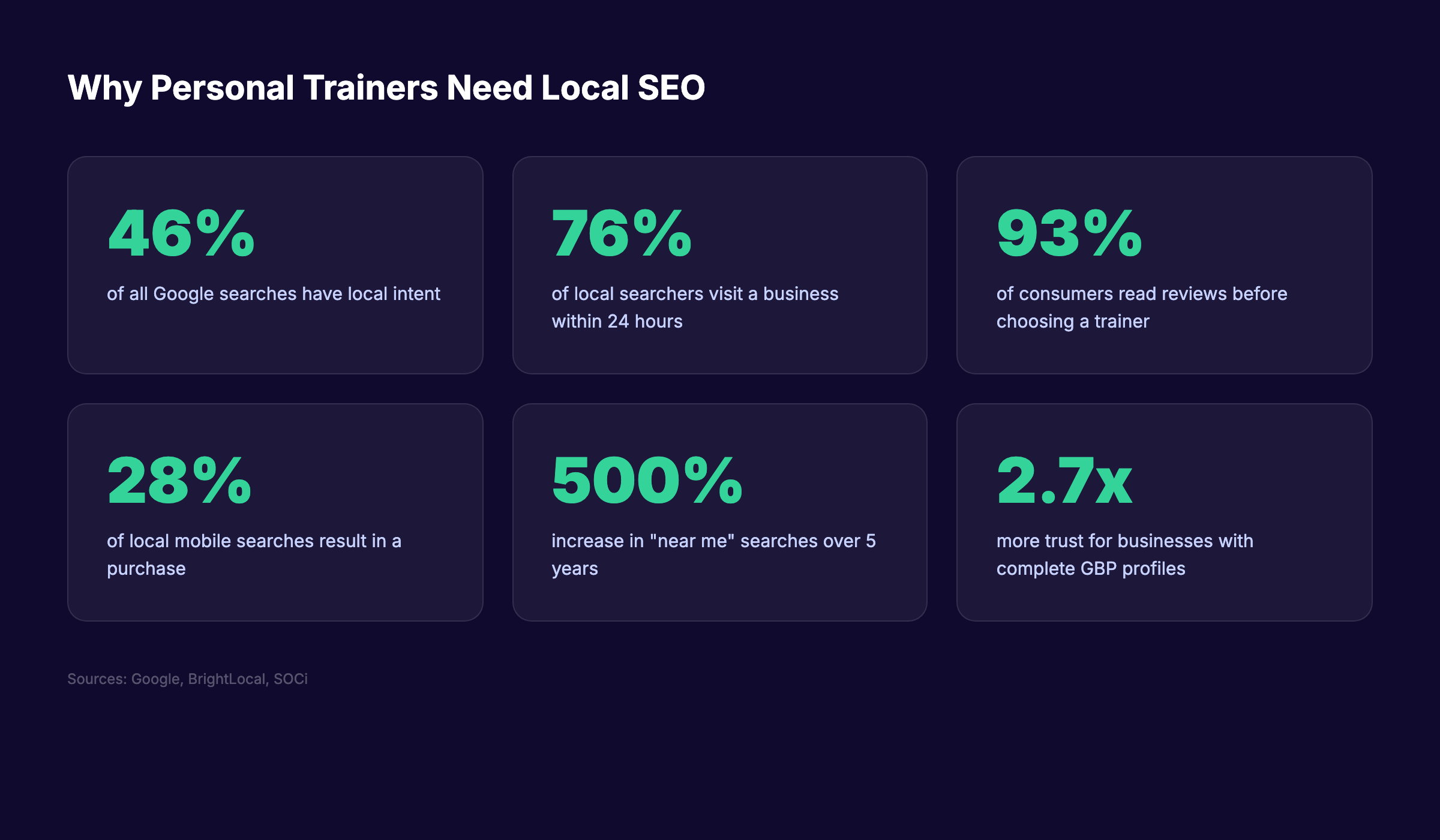
Here are the numbers that matter. 46% of all Google searches have local intent. 76% of people who search for a local service visit a business within 24 hours. And 28% of those searches end in a purchase.
For personal trainers, that means someone searching “personal trainer in Denver” is not browsing. They are ready to book a session.
The Local Search Advantage
Personal training is a hyper-local business. Your clients live within 10 to 15 miles of where you train. That makes local SEO your single highest-ROI marketing channel.
Unlike paid ads, local SEO results compound over time. Every review, every blog post, every citation builds on the last. A trainer who starts publishing content today will outrank a competitor who waits 6 months. That gap only widens.
What Your Competitors Are Missing
Most personal trainers have no website at all. Those who do rarely optimize it. A 2025 BrightLocal study found that 58% of local businesses have not claimed their Google Business Profile.
That means the bar is low. A trainer who follows this guide will outperform 90% of local competitors within 3 to 6 months. The strategies here are not complex. They just require consistency.
Chapter 1: Local Keyword Research for Personal Trainers
Every SEO strategy starts with keywords. For personal trainers, keywords fall into 3 categories: local intent, informational, and transactional.
Location-Based Keywords
These are your bread-and-butter search terms. They combine your service with your city or neighborhood.
| Keyword Pattern | Example | Monthly Volume |
|---|---|---|
| personal trainer + [city] | personal trainer Austin | 2,000-8,000 |
| personal trainer near me | personal trainer near me | 110,000 |
| [specialty] trainer + [city] | weight loss trainer Dallas | 500-1,500 |
| certified personal trainer + [city] | certified personal trainer Miami | 500-2,000 |
| fitness coach + [city] | fitness coach Chicago | 1,000-3,000 |
Target your city name first. Then expand to neighborhoods, suburbs, and adjacent cities. A trainer in Austin should also target Round Rock, Cedar Park, and Pflugerville.
For a deeper walkthrough on finding local terms, read our local keyword research guide.
Long-Tail Service Keywords
Long-tail keywords have lower volume but higher conversion rates. Someone searching “personal trainer for seniors in Portland” knows exactly what they want.
Examples of high-converting long-tail keywords:
- “personal trainer for beginners [city]”
- “postpartum fitness coach [city]”
- “personal trainer for weight loss [city]”
- “in-home personal trainer [city]”
- “online personal trainer for busy professionals”
These terms face less competition. A single optimized page can rank within weeks for a long-tail keyword.
Informational Keywords That Build Authority
Not every search is ready to buy. Many potential clients start with questions. Answering those questions earns their trust before they ever contact you.
High-volume informational queries for trainers:
- “how much does a personal trainer cost” (18,100/mo)
- “is a personal trainer worth it” (6,600/mo)
- “what to expect at first personal training session” (2,400/mo)
- “how often should you see a personal trainer” (1,900/mo)
Each of these deserves its own blog post. The person reading “how much does a personal trainer cost” is 1 step away from booking. Answer their question well, and they will call you instead of scrolling to the next result.
Use keyword research tools to find the exact terms your audience searches for in your area.
Stop guessing which keywords matter. Stacc publishes 30 SEO-optimized blog posts per month targeting the exact terms your clients search for. Start for $1 →
Chapter 2: Google Business Profile Optimization for Personal Trainers
Your Google Business Profile is the most important ranking factor for the Map Pack. The Map Pack appears above organic results for local searches. It gets 42% of all clicks on local search pages.
A complete GBP profile makes customers 2.7 times more likely to trust your business. An incomplete profile makes them scroll past you.
Claim and Verify Your Profile
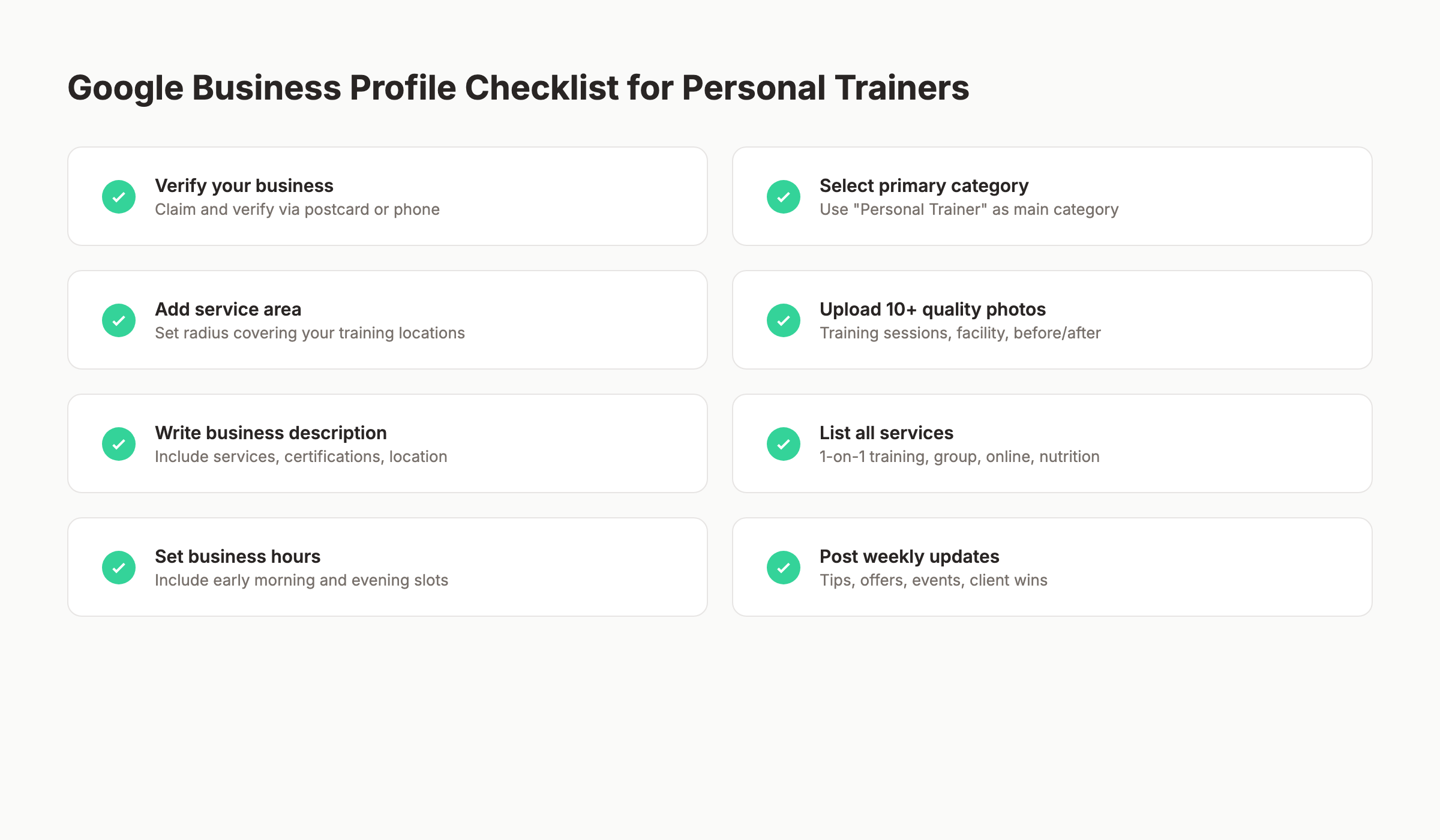
If you have not claimed your GBP listing yet, do it today. Go to business.google.com and follow the verification steps. Google will send a postcard or allow phone verification.
Select “Personal Trainer” as your primary category. Add secondary categories like “Fitness Center,” “Weight Loss Service,” or “Sports Club” if they apply to your business. Our GBP categories guide covers the full list of options.
Optimize Every Field
Incomplete profiles lose to complete ones. Fill in every section:
- Business name (exact match to your real business name)
- Address or service area (set a radius if you travel to clients)
- Phone number (local number, not toll-free)
- Website URL
- Business hours (include early morning and evening availability)
- Business description (750 characters with keywords and services)
- Services list with descriptions and prices
- Attributes (wheelchair accessible, women-led, LGBTQ-friendly)
Photos That Drive Engagement
GBP listings with photos get 42% more direction requests and 35% more website clicks than those without. For a personal trainer, the right photos do serious work.
Upload at least 10 photos across these categories:
| Photo Type | What to Show | Why It Works |
|---|---|---|
| Training sessions | You coaching a client through an exercise | Shows expertise in action |
| Facility | Your gym, studio, or training space | Builds trust and familiarity |
| Before/after | Client transformations (with permission) | Social proof that converts |
| Headshot | Professional photo of you | Personal connection |
| Equipment | Your training setup and tools | Shows professionalism |
Add new photos every week. Fresh photos signal an active business to Google. Read our GBP photos guide for the full strategy.
Post Weekly Updates
Google Business Profile posts keep your listing active and give you more real estate in search results. Post at least once per week.
Post ideas for trainers:
- Client success stories (anonymized or with permission)
- Workout tips for the current season
- Special offers or free consultation promos
- Event announcements (boot camps, challenges, workshops)
- Health and nutrition tips
Each post should include a photo, a call to action, and relevant keywords. Our research on GBP posting frequency shows that businesses posting weekly see 2x more profile interactions.
Get 30 GBP posts per month without writing a word. Stacc handles your Google Business Profile content on autopilot. Start for $1 →
Chapter 3: On-Page SEO for Your Personal Training Website
Your website is the foundation of your entire SEO strategy. If your site does not follow basic on-page SEO principles, nothing else in this guide will work at full capacity.
Title Tags and Meta Descriptions
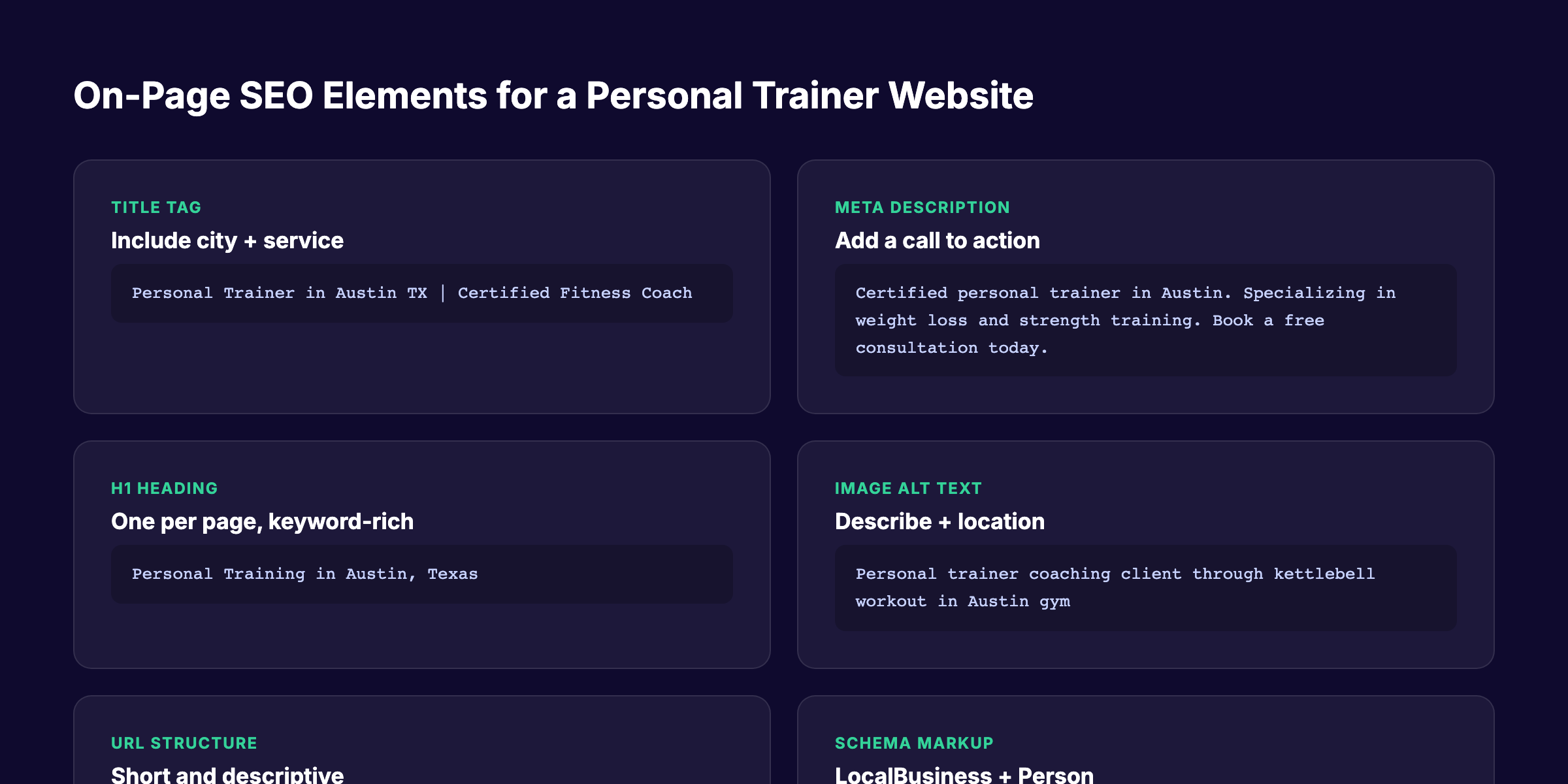
Every page on your site needs a unique title tag under 60 characters. Include your primary keyword and your city name.
Good title tag examples:
- “Personal Trainer in Austin TX | Certified Fitness Coach”
- “Weight Loss Training in Denver | [Your Name] Fitness”
- “Online Personal Training | Certified Strength Coach”
Your meta description should be 145 to 155 characters. Include a benefit and a call to action. This is your sales pitch in the search results.
Page Structure and Headings
Use one H1 tag per page. Make it clear and keyword-rich. Then organize your content with H2 and H3 subheadings.
A strong homepage structure for a personal trainer:
- H1: Personal Training in [City], [State]
- H2: Training Programs
- H2: About [Your Name]
- H2: Client Results
- H2: Pricing
- H2: Service Areas
- H2: Contact
Every service you offer deserves its own page. Do not cram weight loss training, sports performance, and senior fitness onto one page. Each page targets different keywords and serves a different audience.
Location Pages
If you serve multiple areas, create a dedicated page for each city or neighborhood. A trainer based in Houston should have pages for:
- /personal-training-houston
- /personal-training-katy
- /personal-training-sugar-land
- /personal-training-the-woodlands
Each page needs unique content. Do not duplicate the same text with only the city name swapped. Mention local landmarks, gyms, parks, and community details that prove you actually serve that area.
Schema Markup
Schema markup tells Google exactly what your business does. For personal trainers, use LocalBusiness schema with these properties:
- @type: LocalBusiness (or HealthAndBeautyBusiness)
- name, address, telephone
- geo (latitude and longitude)
- openingHours
- priceRange
- aggregateRating (if you have reviews)
- areaServed
Our local business schema guide walks through the full implementation step by step. Adding schema does not guarantee a ranking boost. But it gives Google cleaner data about your business, and cleaner data means better visibility.
Mobile Optimization
60% of local searches happen on mobile devices. If your site loads slowly or looks broken on a phone, you lose clients before they ever see your services.
Run your site through Google PageSpeed Insights. Aim for a mobile score above 80. The most common issues for trainer websites:
- Oversized images (compress to WebP format)
- No viewport meta tag
- Buttons too small to tap
- Text too small to read without zooming
For the full mobile optimization checklist, see our mobile SEO guide.
Chapter 4: Content Marketing That Attracts Training Clients
Publishing blog content is the fastest way to rank for informational keywords and build topical authority in your niche. Trainers who blog consistently get 67% more leads than those who do not, according to HubSpot research.
Blog Topics That Drive Local Traffic
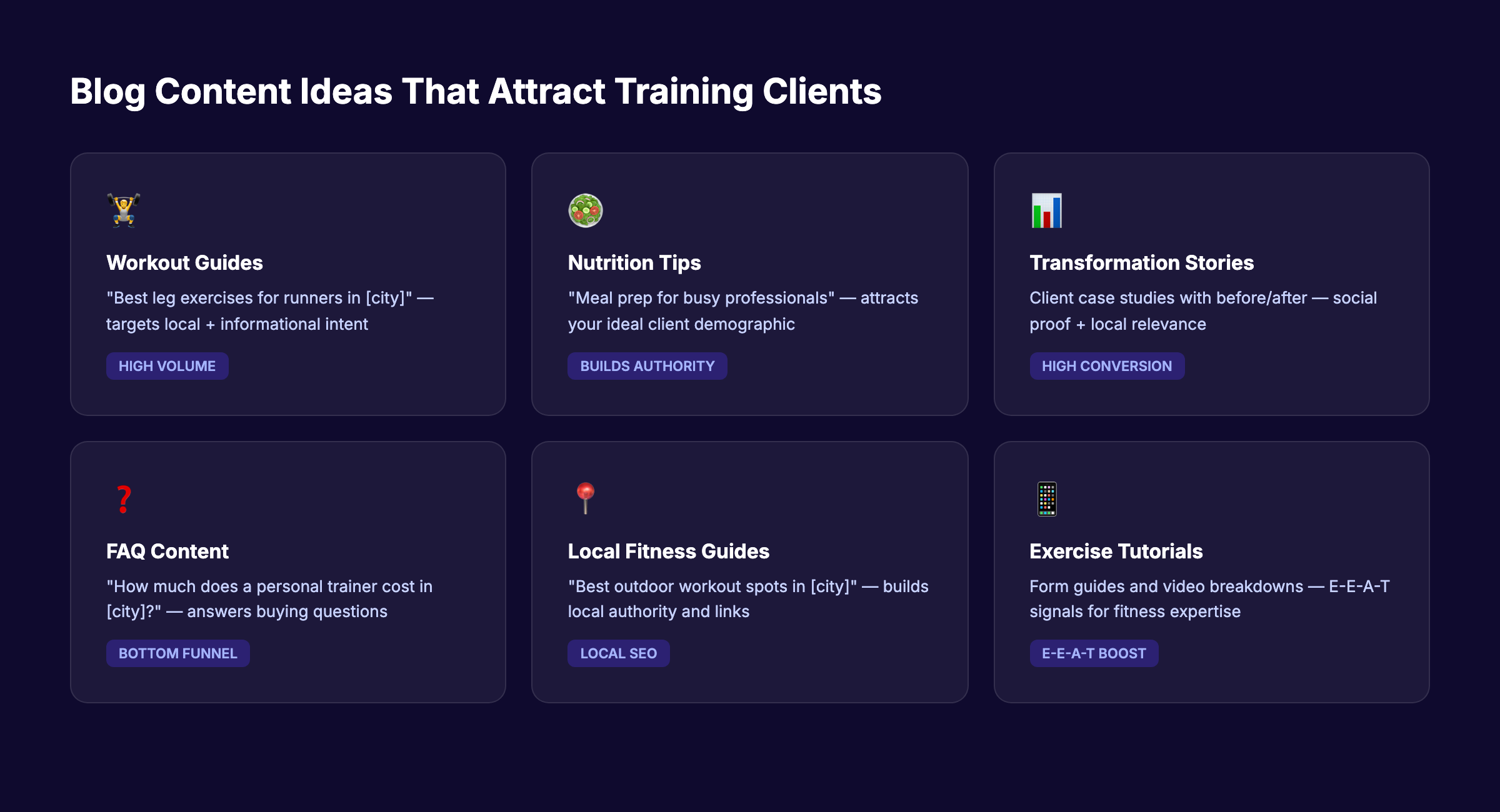
The best content for personal trainers answers real questions from real potential clients. Here are 10 blog post ideas that work:
- “How Much Does a Personal Trainer Cost in [City]?” — bottom-funnel, high intent
- “5 Best Gyms in [City] for Strength Training” — local authority builder
- “What to Expect at Your First Personal Training Session” — reduces anxiety, builds trust
- “Home Workout Routine for Beginners (No Equipment)” — high volume, broad reach
- “Best Outdoor Workout Spots in [City]” — local content that earns links
- “How to Lose 20 Pounds Safely: A Trainer’s Honest Guide” — high volume
- “Personal Training vs. Group Fitness: Which Is Right for You?” — comparison content
- “How Often Should You Work Out? A Personal Trainer Explains” — E-E-A-T signal
- “The Best Pre-Workout Meals for Morning Gym Sessions” — nutrition content
- “Client Spotlight: How [Name] Lost 30 Pounds in 4 Months” — social proof
Aim to publish at least 4 blog posts per month. Each post should be 1,000 to 2,000 words, target a specific keyword, and include a call to action to book a session.
For a complete content planning framework, read our content marketing guide for small businesses.
Video Content for SEO
YouTube is the second-largest search engine. Personal trainers have a natural advantage here because fitness content performs well in video format.
Create short exercise tutorials (2 to 5 minutes) and embed them on your blog posts. This keeps visitors on your page longer, which Google tracks as a positive engagement signal.
Video ideas that rank:
- Exercise form tutorials (“how to deadlift properly”)
- Client Q&A sessions
- Day-in-the-life content
- Workout follow-along videos
Embed each video on a relevant blog post. A video on “proper squat form” lives on your blog post about “best leg exercises for beginners.” The blog post captures Google traffic. The video captures YouTube traffic. Both point back to your website.
E-E-A-T: Prove Your Expertise
Google evaluates fitness content through the lens of E-E-A-T: Experience, Expertise, Authoritativeness, and Trustworthiness. As a certified trainer, you already have the credentials. You just need to display them.
- Add your certifications to your About page (NASM, ACE, ISSA, NSCA)
- Include your author bio on every blog post
- Link to your certifying body’s directory listing
- Show real client results with permission
- Display years of experience prominently
Google takes fitness and health content seriously. A blog post from a certified personal trainer with 10 years of experience outranks generic content from a content mill every time.
Publish 30 SEO blog posts per month without writing a single one. Stacc creates, optimizes, and publishes content for your personal training business. Start for $1 →
Chapter 5: Review Management and Reputation SEO
Reviews are a top 3 local SEO ranking factor. Google uses review quantity, recency, rating, and response rate to determine your Map Pack position.
93% of consumers read online reviews before choosing a local business. For personal trainers, reviews carry even more weight because clients are trusting you with their health and body.
How to Get More Reviews
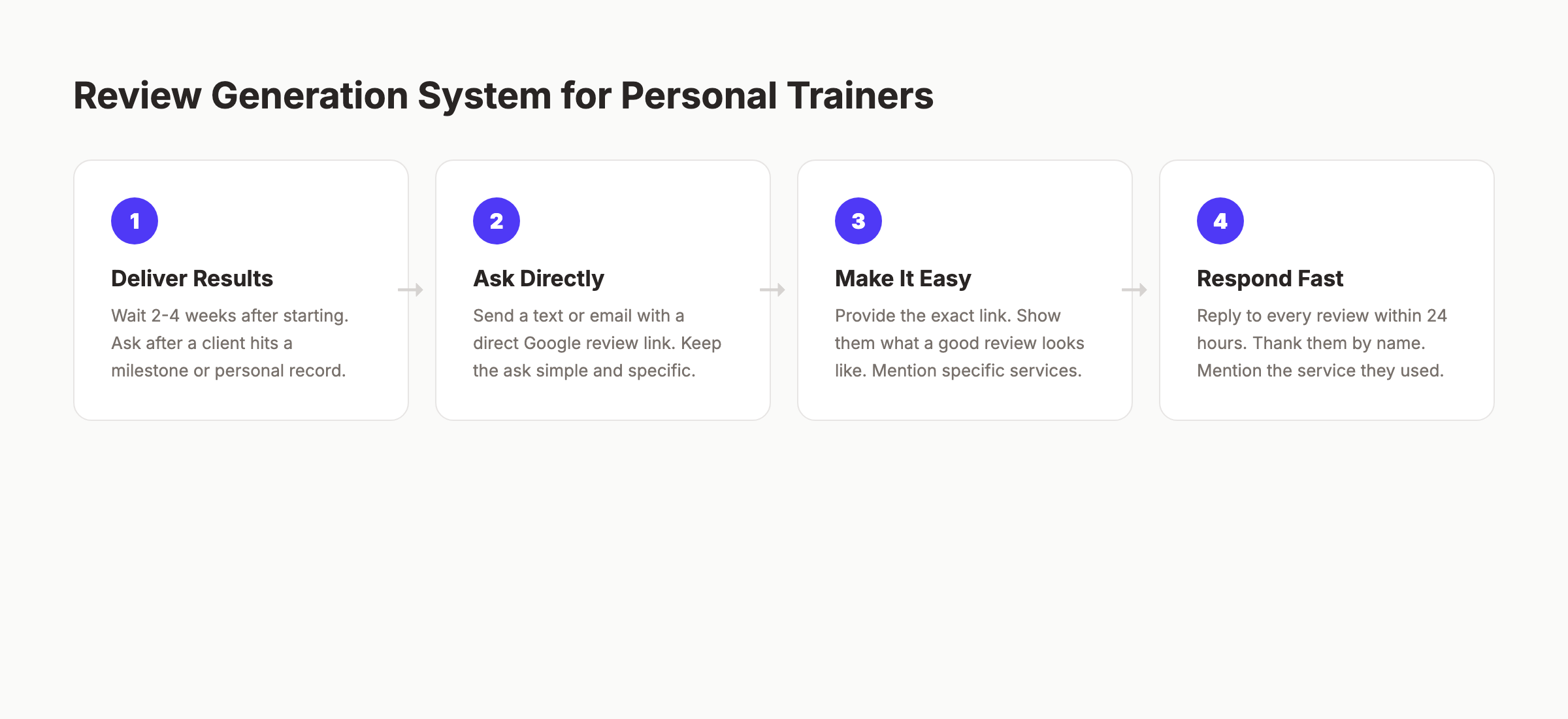
The biggest mistake trainers make is waiting for reviews to happen organically. They will not. You need a system.
The best time to ask for a review is 2 to 4 weeks after a client starts training. Ask after a specific milestone: their first 10-pound loss, a new personal record, or completing their first month.
Steps to build your review pipeline:
- Create a direct Google review link (search “Google review link generator”)
- Send a text message after a milestone moment
- Keep the ask simple: “Would you mind leaving a quick review about your experience?”
- Follow up once if they do not respond within a week
- Never offer incentives for reviews (Google prohibits this)
Our guide on how to ask customers for reviews covers scripts and templates you can copy.
Responding to Every Review
89% of consumers say they are more likely to choose a business that responds to all reviews. Response speed matters too. Reply within 24 hours.
For positive reviews:
- Thank the reviewer by name
- Mention the specific service or result
- Invite them to try another service or refer a friend
For negative reviews:
- Acknowledge the issue without being defensive
- Take the conversation offline (“Please call us at…”)
- Show future readers that you handle problems professionally
Read our full Google reviews guide for response templates and advanced strategies.
Review Diversity
Google is not the only platform that matters. Build reviews across multiple platforms:
| Platform | Priority | Why It Matters |
|---|---|---|
| Google Business Profile | Essential | Directly impacts Map Pack ranking |
| Yelp | High | High domain authority, trusted by consumers |
| Medium | Social proof for referral traffic | |
| Thumbtack | Medium | Lead generation platform for trainers |
| Trustpilot | Low | Good for general trust signals |
Aim for 5 new reviews per month across platforms. Consistency matters more than volume spikes.
Chapter 6: Link Building and Off-Page SEO for Personal Trainers
Backlinks remain one of Google’s strongest ranking signals. For local businesses, the quality and relevance of your links matter more than raw quantity.
Local Citations
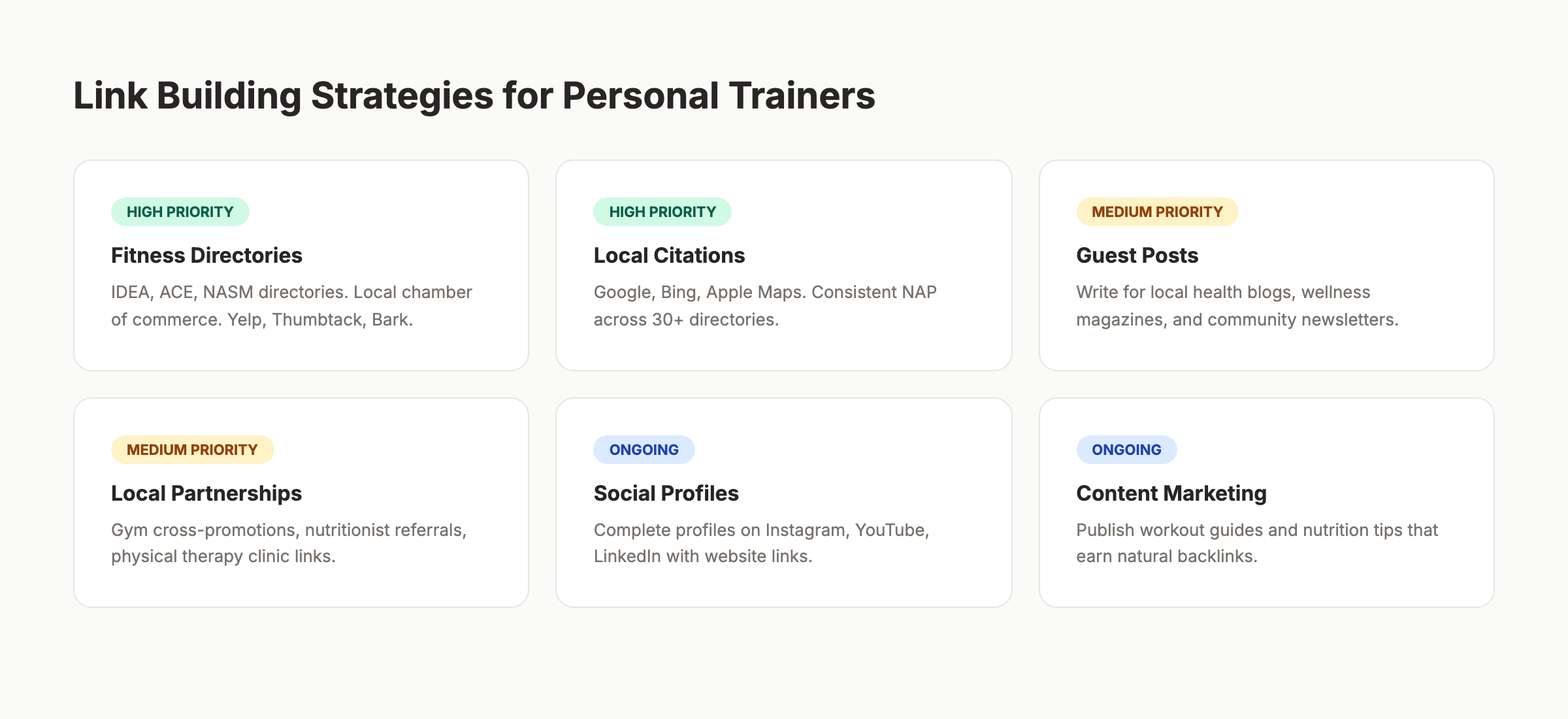
Citations are online mentions of your business name, address, and phone number (NAP). Consistent citations across directories build trust with Google.
Submit your business to these directories first:
- Google Business Profile
- Bing Places for Business
- Apple Maps
- Yelp
- Facebook Business
- Thumbtack
- Bark
- NextDoor
- Yellow Pages
- Local chamber of commerce
NAP consistency is critical. Your business name, address, and phone number must be identical across every listing. “123 Main St” and “123 Main Street” count as inconsistencies. Pick one format and use it everywhere.
For the full citation building playbook, see our link building for local SEO guide.
Industry-Specific Directories
Personal trainers have access to directories that other local businesses do not. These fitness-specific listings carry extra relevance signals.
- IDEA Health & Fitness Association directory
- ACE Fitness professional finder
- NASM trainer locator
- NSCA coach finder
- PrecisionNutrition certified coach directory
If you hold a certification, make sure your profile is listed and links back to your website. These are high-authority, relevant backlinks that most trainers never claim.
Local Partnership Links
Build relationships with complementary local businesses. A personal trainer can partner with:
- Nutritionists and dietitians
- Physical therapy clinics
- Chiropractors
- Yoga and Pilates studios
- Local running clubs
- Supplement shops
Offer to write a guest blog post for their website, co-host an event, or create a referral program. Each partnership can generate a relevant local backlink and a stream of referral clients.
Content-Driven Link Building
The blog content from Chapter 4 does double duty. A well-written “Best Outdoor Workout Spots in [City]” post earns links from local blogs, tourism sites, and community pages.
Create content that local publications want to reference:
- Original fitness survey data from your clients
- Local fitness event roundups
- Seasonal workout guides specific to your city
- Free downloadable workout plans or meal prep templates
Our guide on building your online presence as a local business covers more strategies for earning links naturally.
Build your online presence on autopilot. Stacc handles blog content, GBP posts, and social media publishing for personal trainers. Start for $1 →
Chapter 7: Technical SEO and Tracking Your Results
Technical SEO ensures Google can crawl, index, and understand your website. Most personal trainer websites have basic technical issues that silently hurt rankings.
Technical SEO Checklist for Trainers
- SSL certificate installed (HTTPS, not HTTP)
- XML sitemap submitted to Google Search Console
- Robots.txt file allows search engine crawling
- No duplicate content across pages
- All images compressed and in WebP format
- Page load time under 3 seconds on mobile
- No broken links (run a crawl with Screaming Frog or Ahrefs)
- Canonical tags on all pages
If you are on WordPress, install a free SEO plugin like Yoast or Rank Math. These handle most technical SEO basics automatically.
For trainer websites on Squarespace or Wix, the technical SEO options are more limited. But both platforms handle sitemaps, SSL, and basic meta tags out of the box.
Set Up Google Search Console
Google Search Console is free and essential. It shows you exactly which queries bring traffic to your site, which pages rank, and where technical issues exist.
Set it up in 3 steps:
- Go to search.google.com/search-console
- Add your website property
- Verify ownership via DNS, HTML tag, or Google Analytics
Check Search Console weekly. Look for:
- Queries where you rank on page 2 (positions 11 to 20) — these are easy wins
- Pages with high impressions but low clicks — improve your title tags
- Mobile usability errors — fix immediately
- Index coverage issues — submit affected URLs for re-indexing
Track What Matters
Do not obsess over vanity metrics. Track the numbers that connect SEO activity to revenue.
| Metric | Tool | Target |
|---|---|---|
| Map Pack position | BrightLocal or Whitespark | Top 3 for primary keywords |
| Organic traffic | Google Analytics | 10% month-over-month growth |
| GBP profile views | GBP Insights | 200+ monthly views |
| Review count | Google Business Profile | 5+ new reviews per month |
| Phone calls from search | Google Analytics + call tracking | Increasing monthly |
| Form submissions | Google Analytics goals | Increasing monthly |
Review these metrics monthly. SEO is a 3 to 6 month game. Expect meaningful ranking improvements in 60 to 90 days if you follow this guide consistently.
For a complete tracking setup, read our local SEO audit guide.
Frequently Asked Questions
How long does SEO take to work for a personal trainer?
Most personal trainers see initial ranking improvements within 60 to 90 days. Meaningful traffic growth typically happens between 3 and 6 months. Local SEO tends to produce results faster than organic SEO because the competition is lower. A trainer who optimizes their GBP, publishes weekly content, and collects reviews consistently will outrank most competitors within one quarter.
Do personal trainers need a website for SEO?
Yes. While a Google Business Profile alone can rank in the Map Pack, a website unlocks organic search results, blog content, location pages, and conversion tracking. A simple 5-page website (Home, About, Services, Blog, Contact) is enough to start. Build it on WordPress for the most SEO flexibility.
How much should a personal trainer spend on SEO?
DIY SEO costs nothing but your time. Hiring an agency typically runs $1,000 to $5,000 per month. A middle path is using a service like Stacc, which publishes 30 SEO-optimized blog posts for $99 per month. The right investment depends on your revenue goals and how many hours you can dedicate to marketing each week.
What are the best keywords for personal trainers?
Start with “[your service] + [your city]” combinations. “Personal trainer Austin,” “weight loss coach Denver,” and “fitness trainer near me” are foundational terms. Then target long-tail keywords like “personal trainer for seniors in [city]” or “best personal trainer for weight loss [city].” Use Google Keyword Planner or Ubersuggest to find volume data.
Should personal trainers blog for SEO?
Blogging is one of the highest-ROI activities for personal trainer SEO. Each blog post targets a new keyword, builds topical authority, and gives you content to share on social media. Trainers who publish at least 4 posts per month see 67% more leads than those who do not blog. Focus on answering client questions, creating workout guides, and writing local content.
How important are Google reviews for personal trainer SEO?
Reviews are a top 3 ranking factor for the local Map Pack. Google considers review quantity, recency, rating, and your response rate. A trainer with 50 reviews and a 4.8 rating will outrank a trainer with 5 reviews and a 5.0 rating. Aim for 5 new reviews per month and respond to every single one within 24 hours.
Start Ranking Your Personal Training Business Today
SEO is not a one-time project. It is a system that compounds over time. Every blog post, every review, every citation builds on the one before it.
The trainers winning on Google right now did not start with a big budget. They started with a complete Google Business Profile, a handful of blog posts, and a consistent review strategy. You can do the same.
Get blog SEO, local SEO, and social media handled for your fitness business. Stacc publishes content that ranks, so you can focus on training clients. Start for $1 →
Written and published by Stacc. We publish 3,500+ articles per month across 70+ industries. All data verified against public sources as of March 2026.
