19 SEO client reporting practices used by top agencies. Stop sending vanity metrics; start showing the ROI that keeps clients on retainer.
This is a list of 19 SEO client reporting best practices. SEO agencies carry a 38% annual churn rate. And poor reporting is the leading cause. Clients do not cancel because results are slow. They cancel because the reports they receive do not help them understand what is happening or whether the work is worth the investment. Each practice below fixes a specific reporting failure that causes cancellations. Let's get started.
Report on Business Metrics, Not SEO Metrics
The fastest way to lose a client is to send a report they cannot connect to their own business. Clients do not run their operations on Domain Authority or crawl error counts. They run on leads, revenue, and cost per acquisition. Every section of every SEO report should answer one question: what does this mean for our business? Shifting from technical metrics to business outcomes is the single highest-impact change most agencies can make to their reports.
Tip #1: Lead with Revenue, Not Rankings
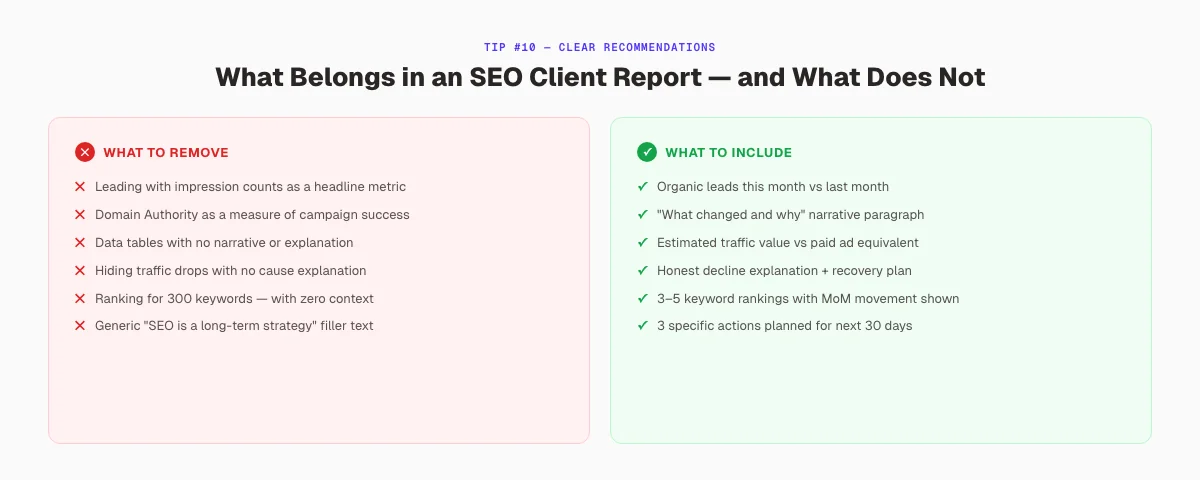
Rankings are a means to an end. A client whose homepage moved from position 9 to position 4 wants to know what that movement means in dollars. Not in ranking points. Start every SEO report with a revenue or lead section: organic leads this month, estimated value of organic traffic using average deal size, and month-over-month change. If you cannot calculate exact revenue attribution, use the SEO ROI calculator to estimate based on traffic volume and conversion rate. "We drove 28 organic leads at an estimated value of $14,000 this month, up from 21 leads last month" is a lede. "Organic traffic increased 18%" is not. Agencies that frame reports around revenue see measurably higher retention because clients understand what they are paying for.
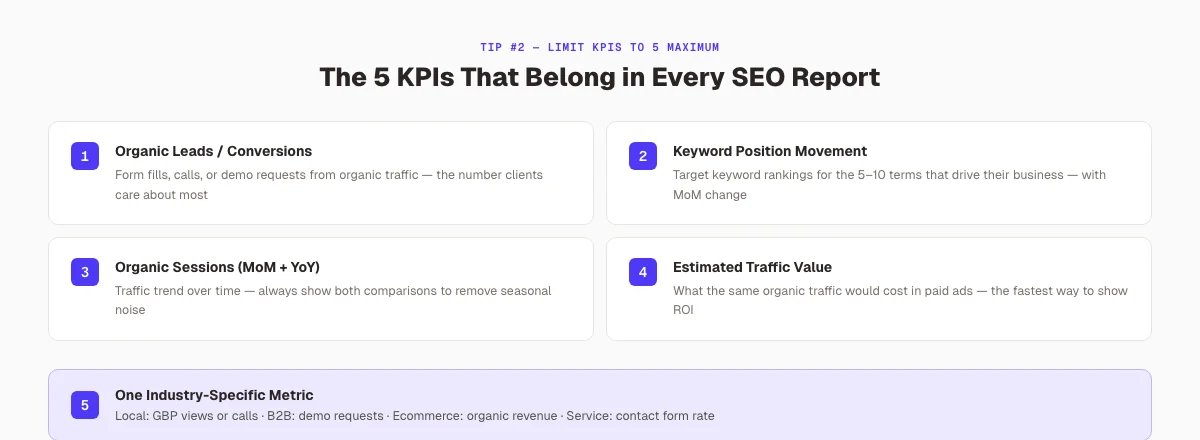
Tip #2: Limit KPIs to 5 Maximum per Report
Most agencies include every available metric in their reports: impressions, clicks, CTR, keyword positions, backlink count, crawl errors, page speed scores, engagement rate, bounce rate, and 20 more. Clients skim to the number they recognize and ignore everything else. Pick 5 KPIs that connect directly to the client's business goals and report those consistently every month. For a local service business: organic leads, keyword rankings for core service terms, GBP views, form submissions, and call volume from organic. For a B2B company: organic sessions, demo request conversions, blog keyword rankings, and domain authority trend. Every extra metric dilutes attention from the metrics that actually inform decisions. Organizations with high SEO maturity. The ones with the lowest churn. Measure and report on a focused set of goal-driven KPIs rather than every data point available.
Tip #3: Add a "What Changed and Why" Narrative Section
Numbers without context are noise. If organic traffic drops 12% this month, the client needs to know whether that is because of a Google algorithm update, a seasonal pattern, a technical error on your part, or the loss of one high-traffic page. Write a 2-3 paragraph narrative in plain language after every major metric section. Label it "What Changed and Why." This converts the report from a data export into a management briefing.
The narrative does not need to be long. Three sentences per metric section is enough: what happened, why it happened, and what changes as a result. "Organic traffic fell 12% this month. Google released a broad core update on [date] that affected informational content across most industries. Not just your site. We are monitoring your top 10 pages and will update the 3 that show the largest impression drop before the next report." That is a complete narrative. It demonstrates expertise, prevents panic, and eliminates the follow-up call. Clients who understand what is driving their numbers are far less likely to cancel because of a temporary dip they interpret as failure. A clear narrative also distinguishes your agency from every other vendor sending a raw dashboard screenshot.
Tip #4: Show the Funnel From Click to Close
Organic traffic alone does not tell the full story. Show the funnel: organic sessions → landing page views → form fills → qualified leads → closed deals (if the client has CRM data). Even a partial funnel. Sessions to conversions. Is more compelling than traffic numbers alone. Clients who see where their funnel is strong and where it leaks understand exactly what SEO contributes to their pipeline. This prevents the "we are getting traffic but no leads" conversation, because the report shows whether the bottleneck is traffic volume, landing page conversion rate, or lead quality downstream.
To build the funnel section, ask for access to Google Analytics 4 (for session and conversion data) and the client's CRM or form submission tool (for lead counts). Map each step explicitly. If the traffic-to-conversion rate is low (under 1%), the problem is the landing page. Not the SEO. If traffic is low but conversion rate is strong, the problem is rankings. And the SEO work is the right priority. This distinction is the most useful insight an SEO report can deliver. Pair this with the SEO for lead generation framework to identify which landing pages to prioritize first.
Tip #5: Never Use Vanity Metrics as Your Lead Section
Impressions, total keywords ranked, and Domain Authority are legitimate supporting metrics. They are not headline numbers. Starting a report with "We achieved 820,000 impressions this month" impresses nobody who has looked at a Google Search Console account. Impressions record that a page appeared in search results. Not that anyone clicked, read, or converted. A business ranking for 1,200 keywords that generate zero leads has a worse SEO program than one ranking for 12 keywords that fill a sales pipeline. Save vanity metrics for an appendix section or a "Technical Health" summary. Lead with what the client earns, not what the algorithm registers.
Stop writing. Start ranking. theStacc publishes 30 SEO-optimized articles per month automatically. No writers, no briefs, no delays. Give clients consistent content that compounds.
Structure Reports for the Right Audience
A report built for an SEO specialist confuses a business owner. A report built for a CEO frustrates an in-house marketing team managing the campaign day-to-day. The same underlying data needs entirely different framing depending on who reads it. Matching report structure to audience is one of the most commonly skipped practices in SEO client reporting. And one of the highest-impact changes an agency can make.
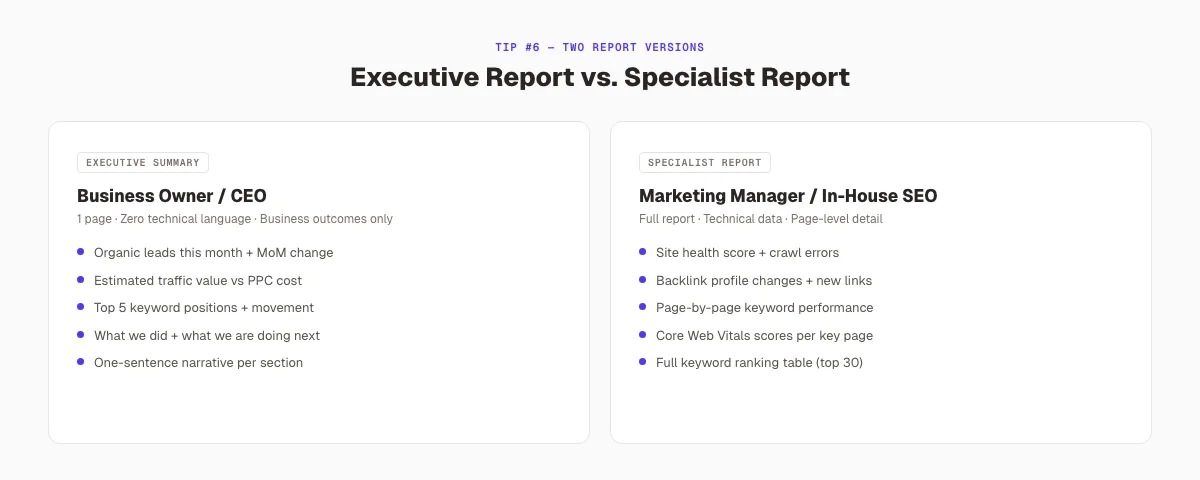
Tip #6: Build Two Report Versions. Executive and Specialist
Create a 1-page executive summary covering revenue impact, keyword position trends for the 5 most important terms, and organic lead volume. Zero technical language. Create a separate detailed report for internal marketing teams or in-house SEO staff that covers crawl health, backlink profile changes, site audit scores, and individual page performance. Most agencies send one report to all stakeholders. The CEO gets confused by crawl budget analysis. The marketing manager gets bored by the high-level traffic graph with no supporting context. Splitting the report into two versions takes 15 extra minutes per month and dramatically increases how useful each version feels to its specific recipient. Clients who feel their reports are relevant are clients who renew.
Tip #7: Match Report Stage to Campaign Phase
Early-stage clients (months 1-3) need education-heavy reports. Rankings do not move much in month 1. The report should explain what was completed, why organic SEO takes time, and what leading signals. Indexation rate, crawl health improvements, page speed gains. Indicate the campaign is on track. Mid-stage clients (months 4-9) need results-focused reports: keyword position movement, first traffic increases, initial conversion data. Established clients (12+ months) need ROI and competitive benchmarking reports showing ranking dominance, cost savings relative to paid alternatives, and year-over-year growth. Sending the same template in month 1 and month 18 misaligns what the client expects to see with what the report shows. The report format should evolve with the campaign.
Tip #8: Use Month-Over-Month AND Year-Over-Year Comparisons
MoM comparisons show momentum. YoY comparisons remove seasonal bias. A 20% traffic drop in January looks alarming in a month-over-month view. In a year-over-year view, it is often normal for January across most industries. Show both comparisons in every traffic and conversion section. And label clearly which comparison is displayed in each chart. Clients who only see MoM data panic at seasonal dips that are entirely normal. Clients who only see YoY data miss short-term changes that need immediate action. Both views together eliminate unnecessary follow-up questions and build confidence in the data. This takes two extra minutes to set up in any reporting tool.
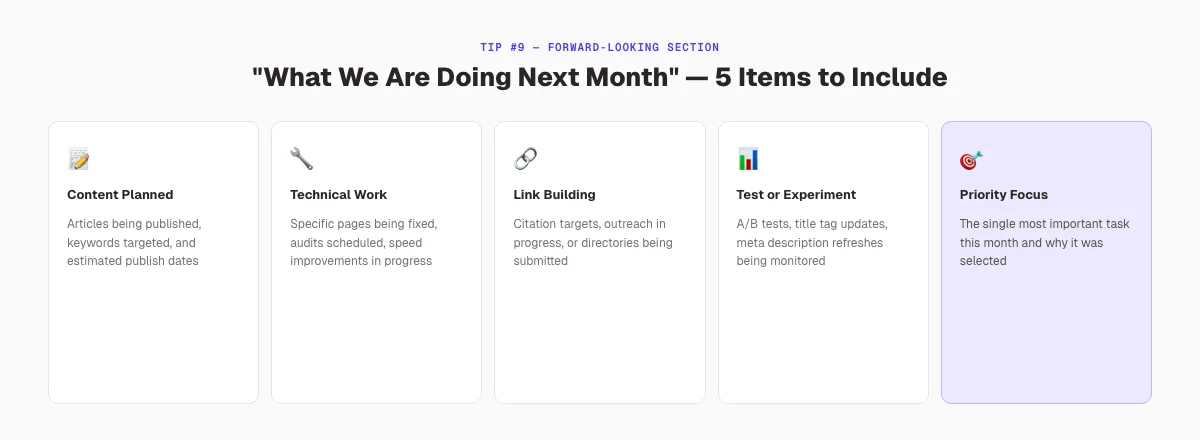
Tip #9: Add a "What We Are Doing Next Month" Section
Every report should end with 3-5 specific actions planned for the next 30 days. This signals that work is ongoing, creates accountability between reports, and gives the client a reason to anticipate the next update. "Next month: publishing 8 blog posts targeting our top 5 keyword gaps, running a technical audit on the 3 slowest service pages, and building 6 local citations for the new service area" is more reassuring than a report that ends with last month's traffic graph. Clients who see a forward-looking plan do not spend the month wondering what they are paying for. For clients on SEO monitoring retainers specifically, this section also demonstrates ongoing proactive management.
Tip #10: Include One Clear Recommendation Per Metric Section
Data without a recommended action leaves the client unsure what to do with the information. After every major metric section, add a single concrete recommendation: "Organic traffic is down 8% month-over-month. We are investigating the 3 pages that lost the most impressions and will prioritize a content update on the highest-value page before the 15th." This shows active management, not passive tracking. It trains clients to trust your judgment rather than second-guess every number they see. Agencies that include forward-looking recommendations in every metric section reduce client mid-month check-in emails significantly. Because the report already answers the question "what are you doing about this?"
Set Cadence, Context, and Communication Standards
When a report arrives, how it arrives, and what is communicated between reporting periods determines whether the client feels informed or anxious. These practices address the structural habits that separate high-retention agencies from high-churn ones. Agency clients in retainer relationships have nearly 3× better retention than project-based clients. And consistent, structured communication is the primary driver.
Tip #11: Set Reporting Cadence in the Service Contract
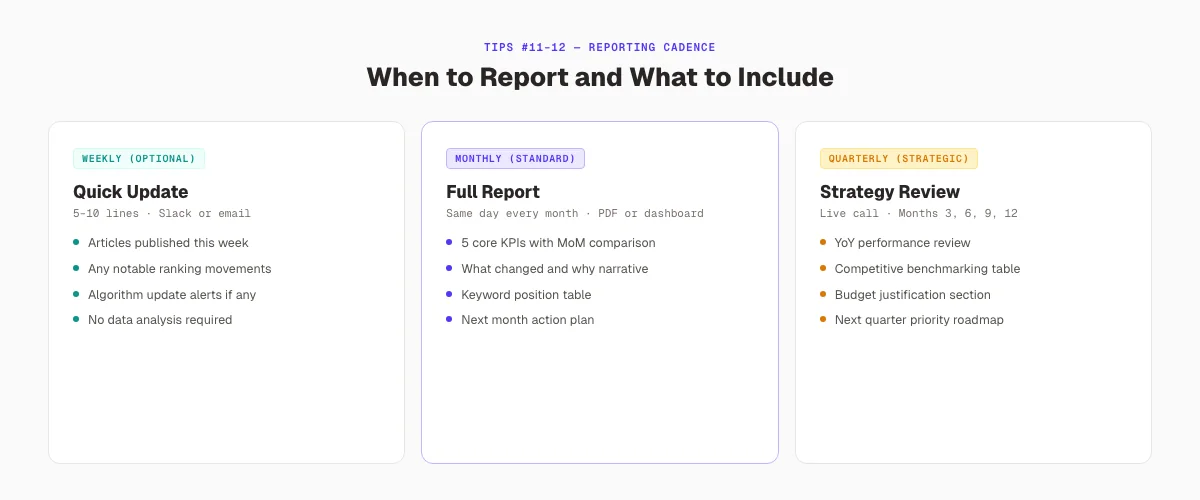
Do not let reporting frequency be an afterthought or a client request. Define it in the service agreement before work begins: monthly reports delivered on the first Friday of each month, with a quarterly strategy call in months 3, 6, 9, and 12. According to agency retention research, agencies that establish realistic KPIs and explicit reporting schedules during onboarding achieve 15-20 percentage points better retention than the industry average. When clients know exactly when to expect data, they stop sending "any update?" emails mid-month and stop creating anxiety about what is happening to their rankings between reports.
The contract language does not need to be elaborate. Include 3 specifics: the exact day reports arrive (not just the week), the format (PDF, live dashboard, or email summary), and what meeting time is reserved for questions. Written expectations also protect the agency when a client claims they were promised weekly check-ins. A common source of scope disputes at the 90-day mark. The SEO KPIs guide covers how to set realistic benchmarks that make these conversations smoother.
Tip #12: Send Reports at a Consistent Time, Not Just Consistently
Monthly reporting is the standard for the majority of marketing agencies. But consistency means more than frequency. Send the report on the same day, at the same time of day, every single month. A report arriving on the first Friday at 10 AM every month becomes expected and trusted. A report that sometimes arrives on the 7th, sometimes on the 14th, and once on the 23rd creates a perception of organizational disorder. Even if the content is excellent. Use automation to schedule delivery so that human delays never affect the reporting rhythm. Predictable delivery is a trust signal. Erratic delivery is a churn signal.
Tip #13: Explain Algorithm Updates Proactively
When Google releases a major update. Core update, helpful content update, spam update, review update. Email clients before they see their data change in the next report. A brief 2-sentence note: "Google released a core update on [date]. We are monitoring your site closely and will include a full impact assessment in your report this month." This one habit prevents panic calls. Clients who receive no communication about algorithm changes and then see a traffic drop in their monthly report conclude one of two things: either the agency caused the problem, or the agency is hiding it. Proactive communication is the single most impactful habit in client retention. Research from retention studies shows that clear, proactive communication cuts agency churn by approximately 22%.
Tip #14: Never Hide Declines. Frame Them Accurately
The instinct to minimize bad news creates larger problems 60 days later. When traffic or rankings decline, acknowledge the drop directly, explain the cause accurately, and show the recovery plan. A 15% traffic drop caused by a Google core update that affected your client's entire industry is entirely different from a drop caused by a technical error you introduced. Clients can handle accurate information. They cannot handle feeling that they were misled. According to a Forbes Agency Council survey, lack of transparency in reporting is one of the top complaints clients cite about former agency relationships. Transparent SEO reporting, particularly during difficult periods, is the strongest long-term retention tool available.
Your SEO team. $99/month. theStacc publishes 30 SEO-optimized articles per month for your clients, automatically. No writers, no briefs, no missed deadlines. See what theStacc publishes →
Use Data to Proactively Manage Expectations
The gap between what clients expect from SEO in the first 6 months and what organic search actually delivers in that window is where most cancellations originate. These practices use reporting data. Including baseline snapshots, competitive context, and budget math. To close that gap before it becomes a churn conversation.
Tip #15: Create an Onboarding Report With Baseline Benchmarks
Before any optimization work begins, deliver a detailed baseline report. Document the client's current organic traffic (last 12 months), keyword rankings for their top 20-30 target terms, backlink profile count and quality distribution, site health score, Core Web Vitals data, and top-performing pages. This creates a documented "before" snapshot that every future report compares against. Without a baseline, agency wins become invisible. "Your organic traffic grew 45% since we started" only means something when there is a documented starting point. The SEO forecasting process also becomes far more credible when it is anchored to real baseline data rather than industry estimates. Deliver the baseline report in week 1. Before the first full month of work.
Tip #16: Show Competitor Rankings Alongside Client Rankings
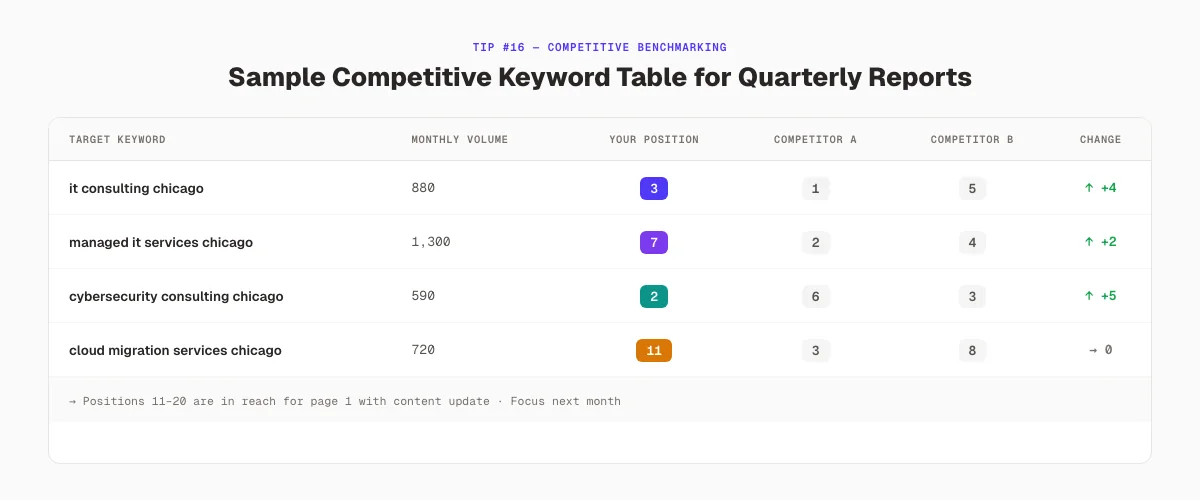
Clients contextualize their own performance relative to competitors far more readily than they evaluate it in isolation. A client ranking 4th for their core keyword wants to know where the top 3 competitors rank. And what the realistic path to ranking above them looks like. Include a competitive keyword table in every quarterly report: 5-10 primary keywords, client's current position, and top 2 competitor positions. This serves two functions: it shows progress in context (the client may have moved from 7th to 4th while a competitor dropped from 1st to 3rd, which is a compound win) and it surfaces the next strategic target. For competitive research methodology, the SEO competitor analysis guide covers how to build and maintain a reliable ranking comparison.
Tip #17: Translate Keyword Rankings into Traffic Opportunity
Ranking movement without a traffic implication is difficult for clients to evaluate intuitively. When a client moves from position 8 to position 3 for a keyword with 800 monthly searches, show the estimated traffic impact explicitly: position 8 captures roughly 3% of searches (24 visits/month), while position 3 captures roughly 10% (80 visits/month). That is a 56-visit-per-month increase from one keyword movement alone.
Multiply that math across 5-10 keyword improvements and show the cumulative traffic gain as a monthly estimate. Apply the site's average conversion rate to arrive at projected additional leads. Apply average deal size to arrive at a projected revenue impact. This three-step calculation. Ranking gain → traffic gain → revenue gain. Converts abstract position tables into a number the client's finance team recognizes. Include the keyword volume source (Ahrefs, Semrush, or Google Keyword Planner) so clients know the estimate is based on verified search data, not guesswork. A client who can see that their current rankings are worth $4,200/month in estimated organic traffic value thinks about their retainer very differently than one who just sees a position-change table.
Tip #18: Include a Budget Justification Section in Quarterly Reports
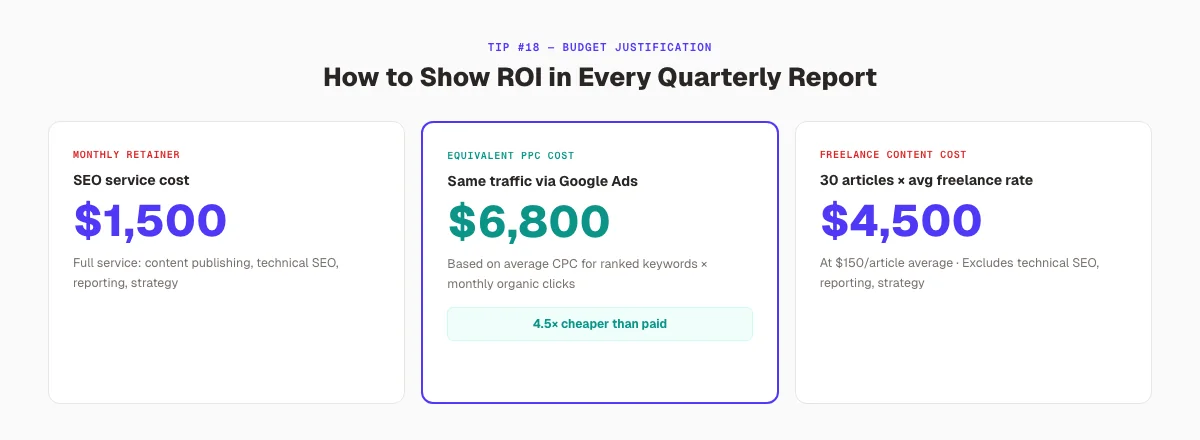
Every 90 days, show clients exactly what their investment is generating. A budget justification section compares three things: the monthly retainer cost versus the estimated value of organic traffic (using Google Ads CPC data to value the same keywords if they were run as paid search); organic lead volume versus what PPC would cost to generate the same number of leads; and content published versus the freelance writer cost for equivalent output. According to SEO ROI research, the median return on SEO investment is 748%. Show clients their specific ROI calculation. Not just the industry benchmark. A client who sees "your $1,500/month SEO retainer is generating traffic equivalent to $6,800/month in Google Ads spend" will not cancel. That comparison is more persuasive than any sales conversation. For a full breakdown of SEO budget frameworks, the guide covers how to structure cost comparisons for different business types.
Automate and Scale Without Losing the Narrative
Manual reporting introduces errors, creates inconsistency, and does not scale past 10-15 clients. These final two practices address the operational side of reporting. How to deliver high-quality reports consistently across a growing client base without proportionally increasing manual hours.
Tip #19: Automate Data Collection. Not Report Interpretation
Manual reporting for 15-20 clients consumes 20-30 hours per month in data pulling alone. That is time that should go into analysis, strategy, and account management. Automation solves the data collection problem without introducing the risk of generic, uncustomized reports that clients recognize and distrust.
There is a critical distinction between automating data collection (scalable and reliable) and automating the narrative (dangerous and transparent to clients). Platforms like Semrush, Ahrefs, and SEO automation tools can pull keyword rankings, traffic data, backlink changes, and site health scores on a fixed schedule without manual work. They should handle all data aggregation and report assembly. But the "What changed and why" narrative, the recommendations section, the competitor context, and the budget justification section require human judgment. Clients pay for interpretation, not data retrieval. A fully automated report without a human analysis layer is something clients learn to recognize within 2-3 months. And it signals that nobody is actually managing their campaign. Automate everything up to the narrative layer. Write that layer yourself.
What practitioners are saying on X
Systems and fundamentals still compound; AI search adds new KPIs.
- @jakezward (Feb 2026): 2026 SEO predictions emphasize AI Overview share-of-SERP, schema for LLM token efficiency, brand mentions in AI answers as a KPI, proprietary data as a moat, and content refresh beating net-new AI slop. See the post on X.
- @hridoyreh (Mar 2026): Widely shared SEO skill tree: foundations, research, technical, on-page, content, links, AI SEO/GEO, analytics, UX, brand, programmatic — useful map for stats and how-to posts. See the post on X.
- @HlynurStefDev (Jul 2026): Public case: niche site traffic jumped from ~18 to 4,162 Google visits/month after focused technical/on-page SEO work (GSC screenshots claimed) — reminds that fundamentals still move numbers. See the post on X.
Grok, AI Overviews, and multi-engine visibility
For “seo client reporting best practices”, multi-engine visibility still starts with clear definitions, sourced numbers, and extractable section answers. Grok additionally factors live X discussion — keep public claims consistent with this page.
- Google AI Overviews: Use passage-ready answers, tables, and FAQ schema where relevant.
- ChatGPT / Perplexity: Cite named sources next to key claims.
- Grok: Maintain accurate entity facts on-site and in high-signal X posts.
Frequently Asked Questions
Every SEO client report should include 5 core elements: organic traffic data with MoM and YoY comparison, keyword position movement for target terms, conversion and lead data from organic channels, a plain-language narrative explaining what changed and why, and 3-5 specific actions planned for the next reporting period. Avoid more than 5-7 primary KPIs in the main report body. Additional metrics belong in an appendix or a separate technical audit document.
Monthly is the best-known option. Over 50% of marketing agencies report monthly. For clients in active build phases or with high content velocity, add a brief weekly update covering rankings and content published. Reserve quarterly reports for strategic reviews covering year-over-year performance, competitive benchmarking, and budget justification. Define the exact cadence in the service contract before work begins. Agencies that do this achieve 15-20% better retention than those that define reporting informally.
Leading with vanity metrics. Impressions, total keywords ranked, Domain Authority. Instead of business outcomes. A report showing 820,000 impressions and rankings for 340 keywords tells the client almost nothing about whether SEO is generating leads or revenue. The second-most common mistake is sending the same report format in month 1 as in month 18. The questions, benchmarks, and comparisons that matter change entirely as a campaign matures.
Focus on leading indicators: crawl health improvements, indexation growth, page speed gains, and keyword position movement within positions 10-30. Pages that are close to page 1 but not yet there. These demonstrate momentum before traffic results arrive. Add a section explaining the compounding nature of content: articles published in month 2 regularly begin ranking in month 5 or 6, as Google assesses authority over time. Show the client the asset being built, not only the short-term traffic number.
Every quarterly report should include competitive keyword data showing client position versus top 2 competitors across primary target terms. Monthly reports can include a simplified version. Did the client gain or lose ground relative to competitors on their top 5 terms? Competitive context helps clients evaluate their own progress accurately. A client who moved from 6th to 4th might feel disappointed seeing only their own data. But feels different about the same movement knowing that the competitor who was 2nd dropped to 5th in the same period.
SEO reports are not data deliverables. They are relationship management tools. The agencies with the lowest churn rates are not necessarily the ones with the strongest results; they are the ones whose clients understand and trust what is happening to their campaigns month after month. These 19 practices close the gap between what the data shows and what the client believes is happening.
Every practice here addresses a documented reason clients cancel SEO retainers. Vanity metrics create confusion. Inconsistent delivery creates doubt. Hidden declines destroy trust. Agencies that fix these reporting habits. Even before fixing campaign performance. Retain clients through the difficult early months when results are still building. The compound effect of 6-12 months of consistent, well-communicated SEO work is where the real results appear. The report is what keeps clients in the room long enough to see them.
For a complete SEO monitoring framework to pair with these reporting practices, the guide covers the tracking cadence and alert setup that catches problems before they show up in client reports.
3,500+ blogs published. Every article is SEO-scored before publish. Give your clients consistent, optimized content every month. Automatically. No writers to manage. No briefs to write. Try theStacc for free →
Related Tools & Resources
Free SEO Tools:
Best Lists:
Sources & references
- [1] Princeton / Georgia Tech et al. — GEO research (arXiv:2311.09735)
- [2] @hridoyreh on X — Widely shared SEO skill tree: foundations, research, technical, on-page, content, links, AI SEO/GEO, analytics, UX, bran
- [3] @jakezward on X — 2026 SEO predictions emphasize AI Overview share-of-SERP, schema for LLM token efficiency, brand mentions in AI answers
- [4] Referenced source — seoprofy.com

Plan topics, review article drafts, and publish to a connected CMS.
Weekly local SEO teardowns
One practical email a week. Map Pack, GBP, AI Overviews. No fluff. Unsubscribe anytime.