SEO for lead generation: choose keywords by intent, build pages that capture contact details, and track rankings through to qualified leads and revenue.
SEO for lead generation connects rankings to contact details and closed deals. This guide covers choosing keywords by buying intent, building pages that capture leads, matching offers to each stage, and tracking organic search through to qualified leads and revenue rather than raw traffic.
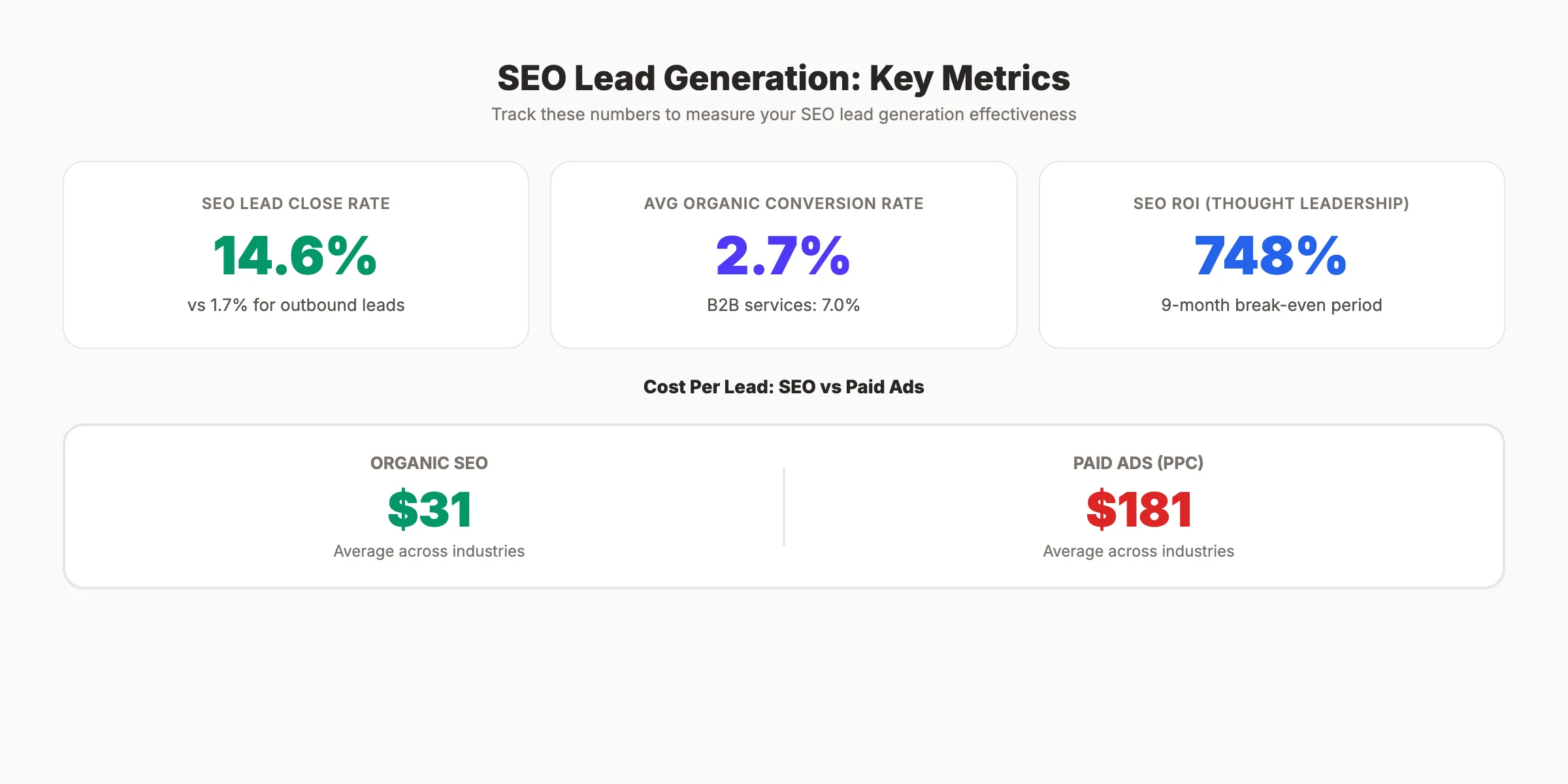
SEO leads close at a 14.6% rate. Outbound leads close at 1.7%. That gap is not small. It is the difference between a marketing channel that drives revenue and one that burns budget.
Most businesses treat SEO for lead generation as an afterthought. They publish blog posts, chase rankings, and hope traffic converts. It rarely does. The problem is not SEO itself. The problem is SEO without a conversion strategy. Traffic without a path to leads is just a vanity metric.
Organic search costs roughly $31 per lead on average. Paid search costs $181 per lead (First Page Sage). SEO delivers 748% ROI through thought leadership content. These numbers tell you where to invest. But the numbers only work when you combine ranking strategy with conversion optimization.
We have published 3,500+ blog posts across 70+ industries. The pattern is clear: companies that align their SEO strategy with their sales funnel generate 3 to 5 times more leads per 1,000 visitors than companies that optimize for traffic alone.
Here is what you will learn in this guide:
- How SEO generates leads (direct and indirect methods)
- The keyword strategy that targets buyers, not browsers
- How to turn ranking pages into lead-generating assets
- Technical foundations that prevent conversion leaks
- SEO vs paid ads with real cost-per-lead data
- How to measure SEO lead generation with proper attribution
- Common mistakes that generate traffic but zero leads
What Is SEO Lead Generation
SEO lead generation is the practice of using organic search traffic to attract, engage, and convert visitors into qualified leads. It combines search engine optimization with conversion rate optimization to turn rankings into revenue.
There are 2 types:
Direct lead generation targets transactional keywords where the searcher is ready to buy or inquire. Examples: "commercial plumber near me," "CRM software pricing," "SEO agency for law firms." These pages convert visitors into leads immediately through forms, phone calls, or chat.
Indirect lead generation targets informational keywords where the searcher is researching. Examples: "how to fix a leaking pipe," "best practices for sales automation," "local SEO guide." These pages build trust and authority over time, moving readers into your funnel through CTAs, lead magnets, and email capture.
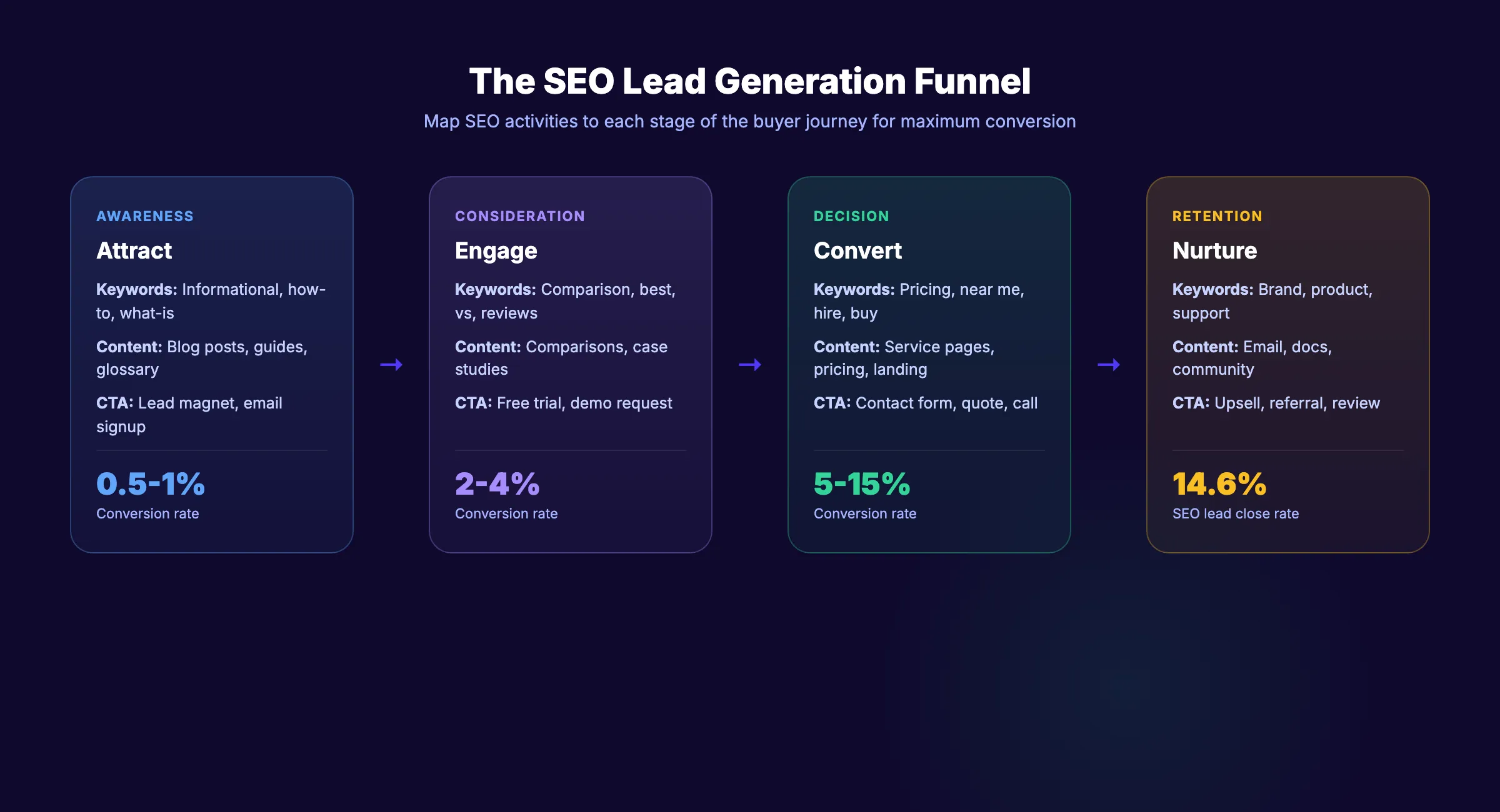
Both types work. The best SEO lead generation strategies use both in combination. Direct pages convert the ready buyers. Indirect pages capture the future buyers who are not ready yet.
Why SEO Works for Lead Generation
The numbers are hard to ignore:
| Metric | SEO / Organic | Paid Ads / Outbound |
|---|---|---|
| Average cost per lead | $31 | $181 |
| Lead close rate | 14.6% | 1.7% |
| ROAS | 19.9x | 4.4x |
| Content marketing ROI | $3 per $1 spent | $1.80 per $1 spent |
| Sustainability | Compounds over time | Stops when spend stops |
Sources: First Page Sage, Search Engine Journal, Genesys Growth
68% of online experiences begin with a search engine. If your business is not visible in search results, you are invisible to 68% of potential buyers. Content marketing generates 3x more leads than outbound marketing at 62% lower cost.
Keyword Strategy: Target Buyers, Not Browsers
Most SEO traffic does not convert because most keyword strategies target the wrong intent. Ranking for "what is project management" brings researchers. Ranking for "project management software for construction teams" brings buyers.
Map Keywords to the Buyer Journey
Every keyword sits somewhere on the buyer journey. Your strategy should target keywords across all stages, with the highest priority on bottom-of-funnel terms.
| Funnel Stage | Keyword Intent | Example | Conversion Rate |
|---|---|---|---|
| Awareness (Top) | Informational | "how to improve team productivity" | 0.5 to 1% |
| Consideration (Middle) | Comparative | "Asana vs Monday.com for small teams" | 2 to 4% |
| Decision (Bottom) | Transactional | "Monday.com pricing plans" | 5 to 10% |
| Action (Bottom) | Commercial | "best project management tool free trial" | 8 to 15% |
Start with bottom-of-funnel keywords. They generate leads faster. Then expand upward to build the pipeline. Use our keyword research guide to find the right terms for each stage.
Target High-Intent Modifiers
Add these modifiers to your seed keywords to find terms with buyer intent:
- Pricing/cost modifiers: "pricing," "cost," "how much," "plans"
- Comparison modifiers: "vs," "compared to," "alternative to," "better than"
- Location modifiers: "near me," "[city] + [service]," "local"
- Action modifiers: "hire," "buy," "get quote," "free trial," "demo"
- Problem modifiers: "fix," "repair," "troubleshoot," "why is my"
These modifiers signal commercial intent. Pages targeting these terms convert at 3 to 10 times the rate of generic informational keywords.
Match Search Intent to Content Format
Google rewards pages that match search intent. The wrong format for the right keyword kills conversions:
- "Best ✓ " queries need ranked list posts with pros, cons, and pricing
- "How to ✓ " queries need step-by-step guides with visuals
- "✓ near me" queries need location pages with contact info and reviews
- "✓ vs [Y]" queries need comparison tables with a clear verdict
- "✓ pricing" queries need transparent pricing pages with feature breakdowns
Check the SERPs before creating any page. The format that ranks is the format Google has confirmed matches intent for that query.
Stop writing. Start ranking. theStacc publishes 30 SEO-optimized articles per month for $99. Every post targets keywords with lead generation potential.
Content That Converts: Building Lead-Generating Pages
Ranking is step 1. Converting that traffic into leads is step 2. Most SEO strategies fail at step 2 because the content has no conversion mechanism.
Every Page Needs a CTA Strategy
The call to action should match the page intent and funnel stage:
| Page Type | Best CTA | Expected Conversion |
|---|---|---|
| Blog post (awareness) | Email signup, lead magnet download | 1 to 3% |
| Comparison page (consideration) | Free trial, demo request | 3 to 7% |
| Service page (decision) | Contact form, phone call, quote request | 5 to 15% |
| Tool page (action) | Free tool usage with email gate | 5 to 20% |
| Case study (consideration) | Consultation booking | 3 to 8% |
Do not put a "Contact Us" button on an awareness blog post. The reader is not ready. Instead, offer a lead magnet related to the topic. A free checklist, template, or calculator converts 3 to 5 times better than a generic contact form on informational content.
Create Lead Magnets for Each Topic Cluster
Lead magnets capture email addresses from visitors who are not ready to buy. Pair each content cluster with a relevant lead magnet:
- SEO topic cluster → Free SEO audit checklist (PDF)
- Content marketing cluster → Editorial calendar template
- Local SEO cluster → GBP optimization checklist
- Email marketing cluster → Email sequence templates
Gate the lead magnet behind an email form. Deliver it immediately. Add the contact to your nurture sequence. This converts informational visitors into leads you can follow up with over weeks and months.
Optimize Landing Pages for Conversion
For bottom-of-funnel pages that target transactional keywords, conversion rate optimization is critical:
- ✓ Headline matches the search query exactly
- ✓ Form is above the fold on desktop and mobile
- ✓ Form fields are minimal (name, email, phone = maximum for first contact)
- ✓ Social proof visible near the CTA (reviews, logos, case studies)
- ✓ Page loads in under 2.5 seconds (LCP threshold)
- ✓ No navigation distractions on dedicated landing pages
- ✓ Mobile form is easy to complete with thumbs
The average organic conversion rate is 2.7% across industries (Databox). B2B services convert at 7.0% organic. If your conversion rate is below these benchmarks, the problem is your landing page, not your SEO.
Technical SEO Foundations for Lead Generation
Technical issues silently kill lead generation. A page that ranks well but loads slowly, breaks on mobile, or has a non-functional form generates zero leads despite strong traffic.
Page Speed Directly Affects Conversion
Every second of load time costs conversions. Pages that load in 1 second convert 3 times higher than pages that load in 5 seconds. Run a Core Web Vitals audit and fix anything outside the "Good" thresholds:
- LCP under 2.5 seconds
- INP under 200 milliseconds
- CLS under 0.1
Mobile Experience Is Non-Negotiable
Over 60% of searches happen on mobile. If your forms are hard to fill on a phone, your CTAs are too small to tap, or your page requires horizontal scrolling, you are losing more than half of your potential leads.
Fix Conversion Leaks
Common technical issues that prevent lead generation:
- Broken contact forms (test monthly)
- SSL errors on form submission pages (browser warnings = instant bounce)
- Slow server response on thank-you pages (leads abandon mid-conversion)
- Chat widgets that cover CTAs on mobile
- Cookie consent banners that block form fields
- Redirect chains that add load time to high-value pages
Set up Google Analytics 4 event tracking on every conversion action. If you cannot measure form submissions, phone clicks, and chat initiations, you cannot optimize them.
Schema Markup for Lead Generation Pages
Add structured data to your key conversion pages:
- LocalBusiness schema on service area pages (shows phone, address, reviews)
- FAQ schema on comparison and guide pages (earns SERP real estate)
- Product/Service schema on pricing pages (shows offers in search)
- Review schema on case study pages (builds trust in search results)
Schema does not directly affect rankings. But it increases click-through rate from search results. Higher CTR means more visitors reaching your conversion pages.
Your SEO team. $99 per month. 30 optimized articles, published automatically. Build the organic pipeline that generates leads while you sleep.
SEO vs Paid Ads for Lead Generation
This is not an either-or decision. But understanding the economics helps you allocate budget correctly.
Cost Per Lead by Channel
First Page Sage publishes the most detailed cost-per-lead data by industry. Here are the highlights:
| Industry | Organic CPL | Paid CPL | Savings with SEO |
|---|---|---|---|
| HVAC | $69 | $126 | 45% |
| Legal Services | $193 | $613 | 69% |
| Real Estate | $97 | $161 | 40% |
| SaaS / Software | $164 | $310 | 47% |
| Financial Services | $183 | $461 | 60% |
| Healthcare | $173 | $395 | 56% |
| Home Services | $66 | $118 | 44% |
Organic search produces leads at 40 to 69% lower cost than paid search across every industry in the data set.
The Compounding Effect
Paid ads stop producing the moment you stop spending. A $5,000/month ad budget generates leads for exactly as long as you spend $5,000/month.
SEO content compounds. A blog post that costs $200 to produce can generate leads for years. First Page Sage projects that a consistent SEO program generates $385,000 in revenue in year 1, $1.2 million in year 2, and $3.3 million in year 3 (First Page Sage ROI data).
The best approach: use paid ads for immediate lead flow while building your SEO pipeline. Once organic traffic reaches critical mass (usually 12 to 18 months), shift budget from paid to organic and keep the leads flowing at a fraction of the cost.
Publishing Frequency Matters
Companies publishing 16 to 20 blog posts per month generate 3 times more leads than companies publishing 4 or fewer (WPForms). Brands with active blogs generate 68% more leads overall.
Volume alone is not the answer. Quality and intent targeting matter. But frequency accelerates the compounding effect. More indexed pages = more keyword coverage = more entry points for potential leads. Use a content marketing strategy that balances quantity with quality.
Measuring SEO Lead Generation
You cannot optimize what you do not measure. Most businesses track traffic and rankings. Few track leads and revenue from organic search.
Set Up Conversion Tracking
Before measuring anything, configure these in Google Analytics 4:
- ✓ Form submissions as key events (contact forms, demo requests, quote forms)
- ✓ Phone click tracking (tel: link clicks)
- ✓ Chat initiation events
- ✓ Lead magnet downloads
- ✓ Email signup events
- ✓ Conversion page views (thank-you pages)
The Metrics That Matter
| Metric | What It Tells You | Benchmark |
|---|---|---|
| Organic traffic to conversion pages | Pipeline volume | Should grow monthly |
| Organic conversion rate | Landing page effectiveness | 2 to 5% is good, 7%+ is excellent |
| Cost per organic lead | Budget efficiency | $30 to $200 depending on industry |
| Lead-to-customer rate | Lead quality | 14.6% for SEO leads (average) |
| Revenue from organic | Business impact | Track monthly in CRM |
| Pages generating leads | Content effectiveness | Top 10% of pages should drive 80% of leads |
Attribution Models
SEO leads rarely come from a single touchpoint. A typical buyer journey looks like this:
- First visit from a blog post (awareness)
- Return visit from a comparison page (consideration)
- Direct visit to pricing page (decision)
- Form submission (conversion)
If you only track last-click attribution, step 4 gets the credit. The blog post that started the journey gets zero. Use multi-touch attribution to understand which content actually drives leads.
Google Analytics 4 uses data-driven attribution by default. This distributes credit across touchpoints based on modeled conversion paths. It is a better starting point than last-click, but review the data regularly to understand your actual buyer journey.
7 SEO Lead Generation Mistakes
These mistakes are why most SEO programs generate traffic but not leads.
Mistake 1: Targeting Traffic Keywords Instead of Lead Keywords
Ranking for "what is digital marketing" brings students and researchers. Ranking for "digital marketing agency for ecommerce" brings buyers. Every keyword should map to a buyer journey stage with a corresponding conversion action.
Mistake 2: No CTA on Blog Posts
A blog post that ranks, gets traffic, and has no CTA is a missed opportunity. Every page needs at least one clear next step. For informational content, that step is an email signup or lead magnet download, not "Contact Us."
Mistake 3: Forms That Ask Too Much
An 8-field form on a first-touch page converts at under 1%. A 3-field form (name, email, company) converts at 3 to 5%. Ask for the minimum on initial contact. Qualify leads later through email or sales calls.
Mistake 4: Ignoring Middle-of-Funnel Content
Most SEO strategies produce top-of-funnel awareness content and bottom-of-funnel service pages. The middle is empty. Comparison pages, case studies, and "how we helped [client type]" content bridge the gap between awareness and purchase.
Mistake 5: Not Tracking Conversions by Page
If you do not know which pages generate leads, you cannot optimize. Set up per-page conversion tracking. Find the 10% of pages that drive 80% of leads. Double down on those topics and formats.
Mistake 6: Slow Follow-Up on SEO Leads
A lead that fills out a form at 2 PM expects a response within hours, not days. SEO leads have a 14.6% close rate when followed up quickly. That rate drops significantly after 24 hours. Connect your forms to CRM automation workflows for instant follow-up.
Mistake 7: Treating SEO as a One-Time Project
SEO compounds. But only if you keep publishing. A 6-month SEO sprint followed by nothing produces a traffic spike that fades within 90 days. Consistent publishing builds topical authority that compounds leads over years.
3,500+ blogs published. Every article is SEO-scored before publish. See what theStacc can do for your site. Turn organic traffic into qualified leads on autopilot.
SEO Lead Generation by Business Type
Different businesses need different SEO lead generation approaches.
B2B Companies
59% of B2B marketers say SEO is their primary lead source. B2B services convert at 7.0% organic. The key difference: B2B buyers complete 67% of their journey before contacting sales.
Priority tactics:
- Thought leadership content targeting research-phase keywords
- Comparison and "best [software]" pages for consideration-phase
- Case studies with measurable results for decision-phase
- Lead magnets (whitepapers, ROI calculators) at every content touchpoint
- Read our B2B SEO guide for the full framework
Local Service Businesses
28% of local searches result in a purchase. Local SEO lead generation centers on Google Business Profile and location-based keywords.
Priority tactics:
- Google Business Profile optimization (posts, reviews, photos)
- Service area pages targeting "[service] in [city]" keywords
- Review generation and response strategy
- Local citation building
- Read our local SEO guide for step-by-step instructions
Ecommerce and D2C
Ecommerce converts at 4.0% organic. The approach differs because the "lead" is often a direct purchase rather than a form submission.
Priority tactics:
- Product category pages optimized for commercial keywords
- Buying guide content targeting comparison queries
- Email capture through discount popups and loyalty programs
- Blog content driving traffic to product pages through internal links
What practitioners are saying on X
AI search advice ages quickly. Here is high-signal public discussion from SEO and growth operators — context for your roadmap, not a substitute for primary data.
- @hridoyreh (Mar 2026): Widely shared SEO skill tree: foundations, research, technical, on-page, content, links, AI SEO/GEO, analytics, UX, brand, programmatic — useful map for stats and how-to posts. See the post on X.
- @jakezward (Feb 2026): 2026 SEO predictions emphasize AI Overview share-of-SERP, schema for LLM token efficiency, brand mentions in AI answers as a KPI, proprietary data as a moat, and content refresh beating net-new AI slop. See the post on X.
Grok, AI Overviews, and multi-engine visibility
For “seo for lead generation”, multi-engine visibility still starts with clear definitions, sourced numbers, and extractable section answers. Grok additionally factors live X discussion — keep public claims consistent with this page.
- Google AI Overviews: Use passage-ready answers, tables, and FAQ schema where relevant.
- ChatGPT / Perplexity: Cite named sources next to key claims.
- Grok: Maintain accurate entity facts on-site and in high-signal X posts.
Publish content built for Google and AI citations. theStacc’s Content SEO module ships SEO-scored articles structured for rankings and generative engines — including clearer entity pages models like Grok can quote.
FAQ
SEO lead generation is the practice of using organic search traffic to attract potential customers and convert them into leads through forms, calls, or email signups. It combines keyword targeting with conversion optimization to turn rankings into revenue. SEO leads close at 14.6%, compared to 1.7% for outbound.
Quick wins from optimizing existing pages can produce leads within 30 to 60 days. New content targeting low-competition keywords typically generates leads within 90 to 120 days. A full SEO lead generation program reaches consistent lead flow within 6 to 12 months, with results compounding over time.
SEO delivers 19.9x ROAS compared to 4.4x for paid ads. Organic cost per lead averages $31 versus $181 for paid. The tradeoff is time. Paid ads produce leads immediately. SEO takes months to build but compounds and costs less per lead long-term. The best strategy uses both.
Target keywords with commercial or transactional intent. Add modifiers like "pricing," "near me," "best," "vs," "hire," or "free trial" to your seed keywords. Bottom-of-funnel keywords convert at 5 to 15%. Top-of-funnel informational keywords convert at 0.5 to 1%. Prioritize bottom-of-funnel, then expand.
Track form submissions, phone clicks, chat initiations, and lead magnet downloads as key events in Google Analytics 4. Measure organic conversion rate, cost per organic lead, lead-to-customer rate, and revenue attributed to organic traffic. Use multi-touch attribution to credit the full buyer journey instead of the last click alone.
Companies publishing 16 to 20 blog posts per month generate 3 times more leads than companies publishing 4 or fewer. Frequency accelerates topical authority and keyword coverage. But quality and intent targeting matter more than raw volume. Ten well-targeted posts outperform 50 generic ones.
SEO lead generation is the highest-ROI marketing channel available to most businesses. The data proves it. The math works. But only when you combine ranking strategy with conversion strategy. Target the right keywords. Build pages that convert. Measure everything. The leads will compound.
Related Tools & Resources
Free SEO Tools:
Best Lists:
Sources & references
- [1] Princeton / Georgia Tech et al. — GEO research (arXiv:2311.09735)
- [2] @hridoyreh on X — Widely shared SEO skill tree: foundations, research, technical, on-page, content, links, AI SEO/GEO, analytics, UX, bran
- [3] @jakezward on X — 2026 SEO predictions emphasize AI Overview share-of-SERP, schema for LLM token efficiency, brand mentions in AI answers
- [4] Referenced source — firstpagesage.com

Plan topics, review article drafts, and publish to a connected CMS.
Weekly local SEO teardowns
One practical email a week. Map Pack, GBP, AI Overviews. No fluff. Unsubscribe anytime.
Explore this topic: Lead Generation.