
B2B SEO: The Complete Guide for 2026
Learn how to build a B2B SEO strategy that drives leads and revenue. Covers keywords, content funnels, technical SEO, and link building. Updated March 2026.
B2B SEO generates 44.6% of all B2B revenue. No other marketing channel comes close. Yet most B2B companies approach SEO the same way consumer brands do. They target high-volume keywords, write generic blog posts, and wonder why traffic does not convert to pipeline.
B2B SEO is a different discipline. The keywords have lower volume but higher value. The buying cycle is longer. The decision involves 6-10 people. And the content must serve every stage of a complex sales funnel.
We have published 3,500+ blog posts across 70+ industries, including IT consulting, staffing, accounting, legal, and logistics. This guide covers the complete B2B SEO strategy from keyword research to content creation to technical execution.
Here is what you will learn:
- How B2B SEO differs from B2C and why the strategy must change
- A keyword research framework built for long sales cycles
- Content strategy mapped to the B2B buying funnel (TOFU, MOFU, BOFU)
- Technical SEO priorities for B2B websites
- Link building tactics that work for B2B companies
- How to measure B2B SEO ROI beyond traffic
How B2B SEO Differs from B2C
The fundamentals of SEO apply to both B2B and B2C. Google ranks pages the same way regardless of audience. But the strategy behind keyword selection, content creation, and conversion differs significantly.
| Factor | B2B SEO | B2C SEO |
|---|---|---|
| Keywords | Low volume, high value, technical | High volume, broad, emotional |
| Buying cycle | 3-12 months, multiple stakeholders | Minutes to days, individual |
| Content goal | Educate and qualify leads | Drive immediate purchases |
| Conversion | Form fills, demos, contact requests | Add to cart, purchase, subscribe |
| Decision makers | 6-10 people per purchase | 1-2 people |
| Avg deal size | $10K-$500K+ | $10-$500 |
| Content format | Whitepapers, case studies, guides | Product pages, reviews, listicles |
The biggest mistake B2B companies make: targeting keywords by volume instead of value. A keyword with 200 monthly searches that brings in qualified enterprise leads is worth more than a keyword with 20,000 searches that brings in unqualified traffic.
Intent over volume. That is the core principle of B2B SEO.
B2B SEO Statistics That Matter
The data backs this up. According to BrightEdge, organic search drives 53.3% of all website traffic and 44.6% of B2B revenue. SEO leads close at 14.6% compared to 1.7% for outbound marketing. And 81% of B2B marketers say SEO generates higher-quality leads than PPC.
B2B SaaS companies specifically see 702% average ROI from SEO with a 7-month breakeven period. Companies publishing 16+ blog posts per month generate 4.5x more leads than those publishing 4 or fewer.
The numbers are clear. SEO is not just a traffic channel for B2B. It is a revenue channel. And it compounds. Content published in month 1 still generates leads in month 24.
B2B Keyword Research: Targeting Decision Makers
B2B keyword research starts with your sales team, not a keyword tool. The best B2B keywords come from the questions your prospects ask during sales calls.
Step 1: Map Your Buyer Journey
Identify the questions buyers ask at each stage:
- Awareness: “What is [problem]?” “How to solve [pain point]?”
- Consideration: “[Solution] vs [alternative]” “[Product category] comparison”
- Decision: “[Product] pricing” “[Product] reviews” “[Product] demo”
Each stage requires different keywords and different content.
Step 2: Build Keyword Clusters Around Solutions
B2B buyers search for problems, not products. A time-tracking software company should target:
- “how to track employee hours remotely”
- “time tracking software for agencies”
- “employee productivity monitoring tools”
- “billable hours tracking automation”
Group these into topical clusters. Each cluster needs a pillar page (guide) surrounded by supporting content (blog posts, comparisons, case studies).
For a detailed process, read our keyword research guide.
Step 3: Prioritize by Business Value
Score each keyword on 3 factors:
| Factor | Weight | How to Evaluate |
|---|---|---|
| Purchase intent | 40% | Does the searcher want to buy or just learn? |
| Deal value | 35% | What is the average contract value for this keyword? |
| Ranking difficulty | 25% | Can you realistically rank in 6-12 months? |
Target keywords where your product directly solves the searcher’s problem. A B2B SaaS company ranking for “project management software comparison” reaches buyers ready to evaluate. That keyword is worth more than “what is project management” even if the latter has 10x more searches.
Step 4: Analyze Competitor Keywords
Use Ahrefs or Semrush to identify keywords your competitors rank for that you do not. Filter for high-intent commercial keywords. These gaps represent immediate content opportunities.
Pay special attention to keywords where competitors rank on page 2 or 3. These indicate topics with demand where no one has published definitive content yet. You can win those positions with a single well-written article.
For detailed techniques, read our SEO competitor analysis guide.
Stop writing. Start ranking. Stacc publishes 30 SEO articles per month for $99. Start for $1 →
B2B Content Strategy: Mapping Content to the Funnel
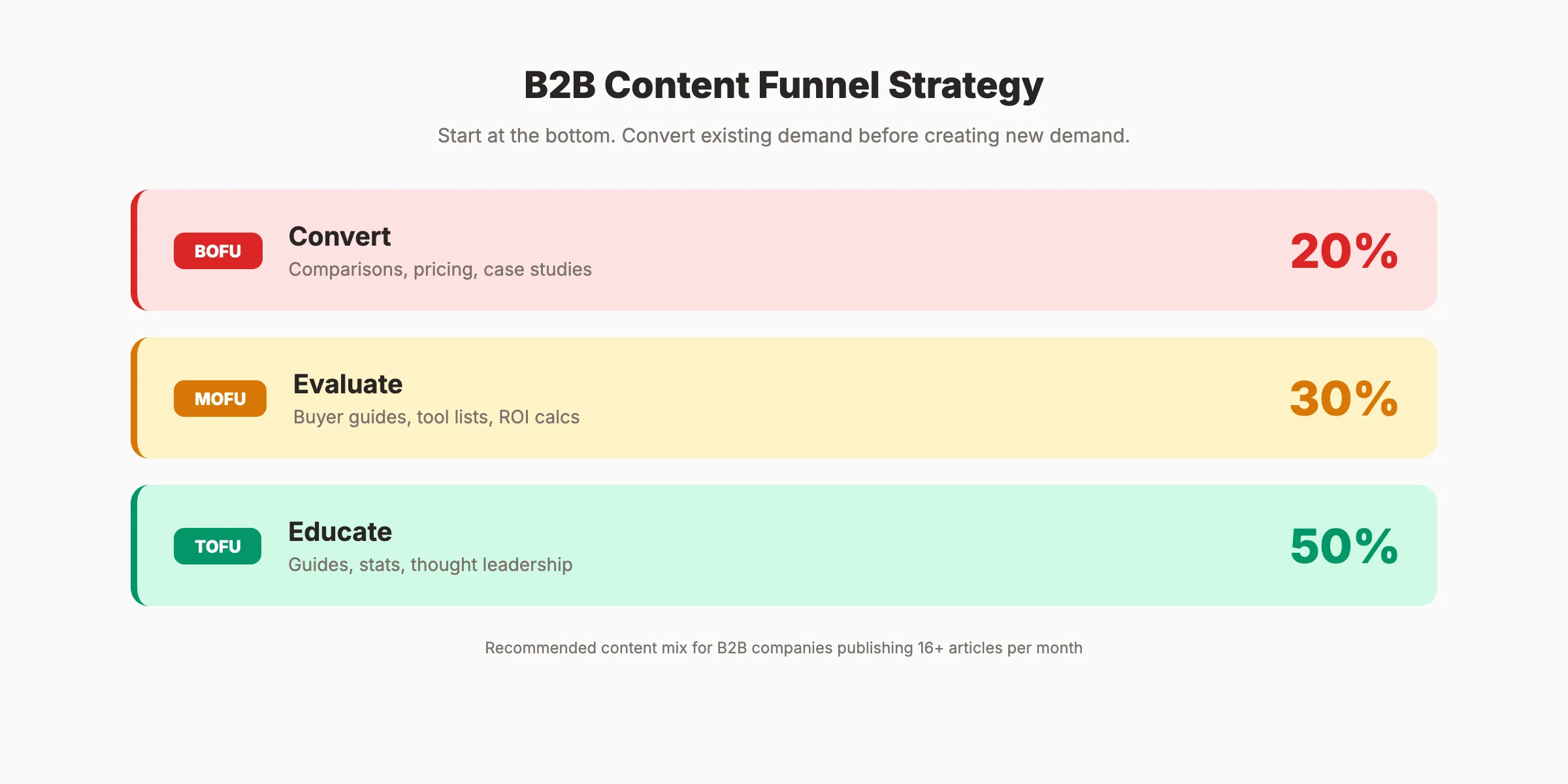
The most effective B2B content strategy starts at the bottom of the funnel and works upward. Convert existing demand before trying to create new demand.
Bottom of Funnel (BOFU). Convert
BOFU content targets buyers who are ready to purchase. These pages generate the highest-value leads.
Content types:
- Competitor comparison pages (“[Your Product] vs [Competitor]”)
- Pricing pages with transparent cost breakdowns
- Case studies with specific results and ROI data
- Product demo landing pages
- Customer testimonial compilations
Keywords: “[product] pricing,” “[product] alternatives,” “[product] vs [competitor],” “[product] review”
BOFU content has the lowest traffic but the highest conversion rate. A comparison page with 500 monthly visits that converts at 8% generates more pipeline than a blog post with 10,000 visits converting at 0.1%.
Middle of Funnel (MOFU). Evaluate
MOFU content helps prospects compare options and evaluate approaches.
Content types:
- Buyer guides and selection frameworks
- ROI calculators and assessment tools
- Industry reports with original data
- Webinar recordings and workshop content
- Best-of lists and tool comparisons
Keywords: “best [solution] for [industry],” “how to choose [product category],” “[solution] buyer guide”
For more on building comparison content, see our content marketing strategy guide.
Top of Funnel (TOFU). Educate
TOFU content attracts prospects who do not yet know your brand. This content builds authority and captures early-stage search demand.
Content types:
- Educational guides and how-to articles
- Industry statistics and data reports
- Glossary pages defining industry terms
- Problem-focused blog posts
- Thought leadership and opinion pieces
Keywords: “what is [concept],” “how to [solve problem],” “[industry] statistics,” “[topic] guide”
B2B marketers who blog generate 67% more leads than those who do not. Consistent TOFU publishing builds the topical authority that lifts MOFU and BOFU pages.
Content Mix for B2B
The ideal publishing mix for most B2B companies:
| Funnel Stage | % of Content | Publishing Frequency |
|---|---|---|
| TOFU (Educate) | 50% | 2-3 posts per week |
| MOFU (Evaluate) | 30% | 1-2 posts per week |
| BOFU (Convert) | 20% | 2-4 pages per month |
Companies publishing 16+ blog posts monthly generate 4.5x more leads than those publishing fewer. Volume matters. But only when every piece targets a specific keyword with clear intent.
Technical SEO for B2B Websites
B2B websites face specific technical challenges. Enterprise sites often have complex architectures, gated content, and JavaScript-heavy pages.
Site Architecture
Organize your site by solution, not by internal department. Buyers do not care about your org chart. They care about their problem.
Good structure:
/solutions/[problem-area]/
/resources/[content-type]/
/customers/[case-studies]/
/pricing/
Bad structure:
/about-us/departments/marketing/resources/
/library/assets/2024/q3/whitepaper-v2/
Clean URL structures help Google understand your site hierarchy. They also help users find what they need. For more on URL best practices, read our URL structure guide.
Page Speed and Core Web Vitals
B2B sites frequently underperform on Core Web Vitals. Heavy images, unoptimized JavaScript, and third-party tracking scripts slow page loads.
Priority fixes:
- Compress images to WebP format
- Defer non-critical JavaScript
- Reduce third-party scripts (chat widgets, analytics, marketing tools)
- Implement lazy loading for below-the-fold content
- Use a CDN for global delivery
Sites that pass Core Web Vitals see 24% fewer page abandonment. For B2B, every lost visitor is a potential $50K+ deal walking away.
Crawlability and Indexation
Common B2B crawl issues:
- Gated content: Google cannot read content behind login walls. Provide ungated summaries or teaser content.
- JavaScript rendering: Heavy SPA frameworks (React, Angular) cause indexation problems. Use server-side rendering or pre-rendering.
- Faceted navigation: Product pages with filters create duplicate content. Use canonical tags and
noindexon filtered pages. - Thin resource pages: PDF-only pages with no HTML content rank poorly. Add summary text to every resource page.
Run a technical SEO audit quarterly to catch these issues before they impact rankings.
Schema Markup for B2B
B2B sites benefit from specific schema types:
- Organization schema. Company name, logo, contact information, social profiles
- Article schema. For blog posts and resource content
- FAQ schema. For product pages and support content
- HowTo schema. For implementation guides and tutorials
- SoftwareApplication schema. For SaaS product pages
Pages with schema markup achieve 20-40% higher click-through rates in search results. For B2B, where every click represents a potential enterprise deal, that CTR improvement translates directly to pipeline. Learn more in our schema markup guide.
Your SEO team. $99 per month. 30 optimized articles, published automatically. Start for $1 →
B2B Link Building That Works
Link building drives authority. Authority drives rankings. But B2B link building operates differently than consumer SEO.
Tactics That Work for B2B
1. Original research and data reports. Publish proprietary data. Survey your customers. Analyze your product usage data. Original research earns backlinks passively as journalists and bloggers cite your findings.
2. Industry expert contributions. Contribute guest articles to industry publications. Not SEO blogs. Your industry publications. An accounting SaaS company should publish in accounting journals, not marketing blogs.
3. Tool and resource creation. Build free tools (calculators, templates, assessments) that your target audience needs. A free SEO ROI calculator earns backlinks from every blog post that discusses SEO budgeting.
4. Partnership and co-marketing content. Co-create content with complementary B2B companies. Joint webinars, co-authored reports, and shared research studies double your link acquisition from a single effort.
5. HARO and journalist requests. Respond to journalist queries with expert commentary. B2B executives have unique expertise that journalists need for articles about business trends, technology, and industry developments.
6. Customer success stories as linkable assets. Turn your best case studies into standalone data stories. “How [Client] Reduced Customer Acquisition Cost by 63% in 9 Months” is more linkable than a generic case study PDF. Include specific numbers, timelines, and methodology that other sites want to reference.
7. Industry conference and event content. Recap key takeaways from industry conferences. Interview speakers. Publish data shared at events. Conference content earns links because attendees share it and non-attendees reference it as the next best thing to being there.
What Does NOT Work for B2B
- Mass guest posting on irrelevant blogs
- Paid link placements in directories
- Comment spam or forum link drops
- Reciprocal link exchanges
- Press release link farming
The common thread: manipulative tactics fail in B2B because B2B buyers and Google both evaluate trustworthiness carefully. One backlink from a respected industry publication outperforms 100 links from generic blogs.
For a complete strategy, read our link building guide.
Measuring B2B SEO ROI
Traffic is not the right metric for B2B SEO. Revenue is.
The B2B SEO Measurement Framework
| Metric | What It Tells You | Tool |
|---|---|---|
| Organic traffic | Reach and visibility | Google Analytics 4 |
| Keyword rankings | Search position progress | Ahrefs, Semrush |
| Organic leads | Pipeline contribution | CRM + GA4 |
| Lead-to-opportunity rate | Lead quality from SEO | CRM |
| Organic revenue | Actual ROI | CRM + attribution |
| Customer acquisition cost | Efficiency vs other channels | Finance + marketing data |
The ROI Math
B2B SEO delivers a median ROI of 748%. Here is how to calculate yours:
SEO ROI = (Revenue from Organic Leads - SEO Investment) / SEO Investment x 100
Example:
- Monthly SEO investment: $5,000 (content + tools + team time)
- Organic leads per month: 50
- Lead-to-customer rate: 5%
- Average deal value: $25,000
- Monthly revenue from SEO: 50 x 0.05 x $25,000 = $62,500
- Monthly ROI: ($62,500 - $5,000) / $5,000 = 1,150%
The compounding effect makes this even stronger. Content published in month 1 still generates leads in month 12. SEO customer acquisition cost decreases 60% over 2 years.
For more on tracking SEO performance, see our SEO KPIs guide.
B2B SEO and AI Search in 2026
B2B SEO now extends beyond Google. AI search platforms (ChatGPT, Perplexity, Google AI Overviews) are changing how buyers research solutions.
What Changed
AI Overviews and generative search reduce clicks for informational queries. But they increase the value of being cited as a trusted source. When ChatGPT recommends your product in response to “best project management software for agencies,” that recommendation carries more weight than a page-1 ranking.
How to Optimize for AI Search
- Publish authoritative, well-sourced content. AI models cite content that demonstrates expertise and includes verifiable data.
- Use clear, structured formatting. Tables, numbered lists, and FAQ sections make content easier for AI to parse and cite.
- Build entity authority. Consistent brand mentions across trusted sites teach AI models to recognize your brand as a topic authority.
- Maintain a strong on-page SEO foundation. AI search still indexes from the same web. Pages that rank well in Google get cited more in AI answers.
The B2B companies winning in 2026 optimize for both traditional rankings and AI citations. The strategy is the same: publish expert-level content consistently. The distribution channels have expanded.
B2B SEO Checklist
Use this before launching or auditing your B2B SEO strategy:
Keyword Research:
- Map keywords to each buyer journey stage
- Prioritize by deal value, not search volume
- Build 4-6 topical clusters around core solutions
- Include competitor comparison keywords
Content Strategy:
- Start with BOFU content (comparisons, pricing, case studies)
- Publish 16+ articles per month for maximum impact
- Create pillar pages for each topical cluster
- Include original data or research in at least 20% of content
Technical SEO:
- Pass Core Web Vitals on all key pages
- Ensure JavaScript content is server-rendered
- Fix all crawl errors and broken links
- Implement proper canonical tags on filtered pages
Link Building:
- Publish 1 original research piece per quarter
- Contribute to 2-3 industry publications per month
- Build 1 free tool or resource per quarter
- Respond to 5+ journalist queries per month
Measurement:
- Track organic leads in CRM (not just traffic)
- Calculate organic revenue attribution monthly
- Compare organic CAC to paid CAC quarterly
- Report pipeline contribution, not just rankings
3,500+ blogs published. 92% average SEO score. See what Stacc can do for your B2B site. Start for $1 →
FAQ
What is B2B SEO?
B2B SEO is search engine optimization for businesses that sell to other businesses. It focuses on low-volume, high-value keywords that attract decision makers during a 3-12 month buying cycle. Organic search generates 44.6% of all B2B revenue, making it the single most valuable marketing channel for B2B companies.
How is B2B SEO different from B2C SEO?
B2B SEO targets technical, problem-focused keywords with lower search volume but higher deal values ($10K-$500K+). B2C targets broad, emotional keywords with high volume. B2B content serves a 6-10 person buying committee across months. B2C content drives individual purchases in minutes.
How long does B2B SEO take to show results?
Most B2B SEO campaigns show measurable results in 6-12 months. B2B SaaS companies reach breakeven in approximately 7 months. Content published in month 1 continues generating leads in month 12 and beyond. SEO ROI accelerates as your content library and domain authority grow.
What content should B2B companies publish for SEO?
Start with bottom-of-funnel content: competitor comparisons, pricing pages, and case studies. Then build middle-funnel content: buyer guides and tool comparisons. Finally, scale top-of-funnel educational content. Companies publishing 16+ blog posts per month generate 4.5x more leads.
What is a good ROI for B2B SEO?
The median B2B SEO ROI is 748%. B2B SaaS companies see 702% ROI with a 7-month breakeven period. A “good” ROI depends on your deal size and sales cycle, but anything above 300% after 12 months indicates a healthy program. Real estate, medical devices, and financial services see the highest returns.
How much should a B2B company spend on SEO?
B2B SMBs typically invest $2,000-10,000 per month on SEO (content, tools, and team time). Enterprise B2B companies invest $10,000-50,000+ monthly. Stacc offers 30 SEO articles per month at $99/mo, making consistent publishing accessible for B2B companies at any budget.
B2B SEO is a pipeline generation engine. Every article, comparison page, and case study creates a new entry point for qualified buyers to find your business. The companies that invest in consistent, expert-level content today will own the organic search results their competitors fight over tomorrow.

Written by
Siddharth GangalSiddharth is the founder of theStacc and Arka360, and a graduate of IIT Mandi. He spent years watching great businesses lose organic traffic to competitors who simply published more. So he built a system to fix that. He writes about SEO, content at scale, and the tactics that actually move rankings.
30 SEO blog articles published every month
Keyword-optimized, scheduled, and live on your site. Automatically.
30-day trial · Cancel anytime
theStacc
Stop writing SEO content manually
30 blog articles, 30 GBP posts, and social media content. Published every month. Automatically.
Start Your $1 Trial$1 for 3 days · Cancel anytime