
SEO Competitor Analysis (2026): Strategies, Tactics & Examples
Practical seo competitor analysis strategies for 2026: step-by-step tactics, real examples, and tools to improve rankings and drive organic traffic.
Your competitors already rank for the keywords you want. They have backlinks you do not. They publish content on topics you have not covered. And every day you skip SEO competitor analysis, that gap widens.
Most businesses build SEO strategies in a vacuum. They pick keywords based on intuition, write content based on what they think matters, and wonder why results are slow. SEO competitor analysis replaces guessing with data. It shows you exactly what works in your market and where the opportunities are.
We have published 3,500+ articles across 70+ industries. Every successful SEO campaign we have seen starts with understanding the competition. This guide covers the complete process.
Here is what you will learn:
- How to identify your real SEO competitors (they are not always who you think)
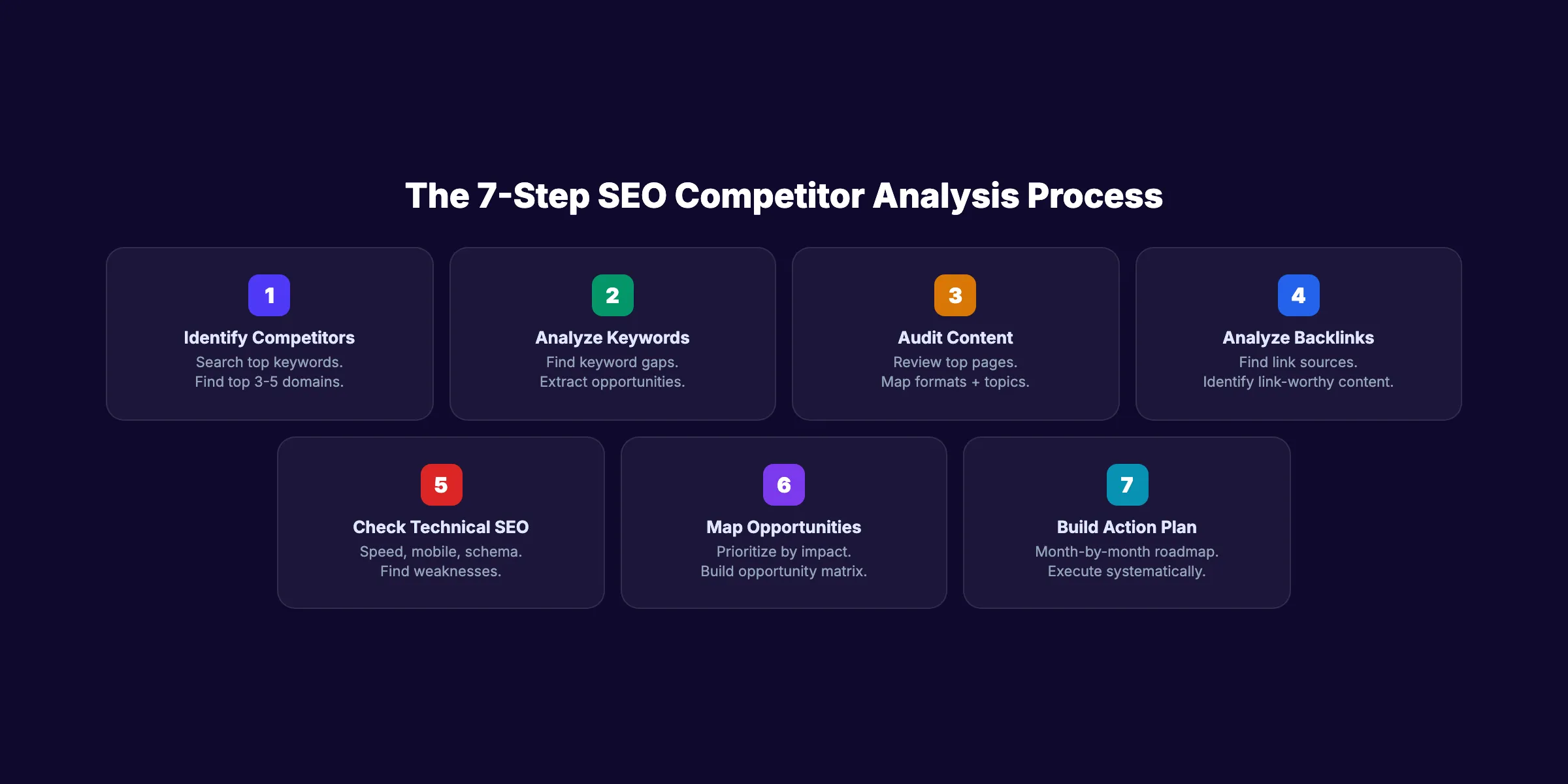
- The 7-step process for a complete competitor analysis
- How to steal your competitors’ best keywords, content ideas, and link sources
- Free and paid tools for competitor research
- How to turn competitor data into an actionable SEO strategy
- Common mistakes that waste time and produce misleading data
What Is SEO Competitor Analysis?
SEO competitor analysis is the process of researching your competitors’ search performance to identify opportunities for your own site. You analyze their rankings, content, backlinks, and technical SEO to find gaps you can exploit and strategies you can replicate.
The goal is not to copy competitors. It is to understand what Google rewards in your market and find the fastest path to outranking them.
Your SEO Competitors Are Not Your Business Competitors
This is the most important distinction in competitor analysis. Your business competitors and your SEO competitors are often different.
A local plumber’s business competitors are other plumbers in town. But their SEO competitors include Angi, HomeAdvisor, Yelp, and national home improvement blogs that rank for the same keywords.
To find your real SEO competitors:
- Search your top 5 target keywords on Google
- Note which sites appear on page 1 for multiple keywords
- Those sites are your SEO competitors
A business you have never heard of might outrank you for every keyword you care about. That business is your primary SEO competitor, regardless of whether they sell the same product.
The 7-Step SEO Competitor Analysis Process
Follow these steps in order. Each step builds on the previous one.
Step 1: Identify Your Top 3 to 5 SEO Competitors
Search your 10 most important keywords. Track which domains appear most frequently in the top 10 results.
| Keyword | #1 Result | #2 Result | #3 Result |
|---|---|---|---|
| [keyword 1] | competitor-a.com | competitor-b.com | competitor-c.com |
| [keyword 2] | competitor-b.com | competitor-a.com | your-site.com |
| [keyword 3] | competitor-c.com | competitor-b.com | competitor-a.com |
The domains appearing most often across your keyword set are your primary SEO competitors. Focus on the top 3 to 5. Analyzing more than 5 creates noise without adding insight.
You can also use Ahrefs’ Competing Domains report or Semrush’s Organic Competitors tool to automate this identification.
Step 2: Analyze Competitor Keywords
This is the highest-value step. Your competitors’ keyword data reveals exactly what Google considers relevant in your market.
For each competitor, extract:
- Total organic keywords (how many keywords they rank for)
- Top 10 keywords (their highest-traffic terms)
- Keywords you share (terms both you and the competitor rank for)
- Keywords they rank for that you do not (the opportunity gap)
The “keywords they rank for that you do not” list is gold. These are proven, rankable keywords in your market that you have not targeted yet.
Use Ahrefs Content Gap or Semrush Keyword Gap to generate this list automatically. Filter for keywords with 100+ monthly searches and a keyword difficulty under 40 for the fastest wins.
Step 3: Audit Competitor Content
Content analysis shows you what formats, lengths, and topics perform best in your niche.
For each competitor, review their top 20 pages by organic traffic. Document:
| Page URL | Target Keyword | Estimated Traffic | Word Count | Content Format | Last Updated |
|---|---|---|---|---|---|
| /blog/topic-1 | keyword 1 | 5,000/mo | 3,200 | Guide | Jan 2026 |
| /blog/topic-2 | keyword 2 | 3,500/mo | 2,800 | Listicle | Nov 2025 |
Look for patterns:
- What is the average word count of their top-performing pages?
- Which content formats dominate (guides, lists, how-tos, comparisons)?
- How often do they update existing content?
- Do they use tables, images, videos, or interactive elements?
- What topics do they cover that you do not?
The content gap between your site and your competitors’ sites is your content roadmap. Every topic they cover that you do not is a potential article for your content calendar.
Step 4: Analyze Competitor Backlinks
Backlinks are votes of confidence. Analyzing where your competitors get links reveals where you can get them too.
For each competitor, extract:
- Total backlinks and referring domains
- Top linking domains (which sites link to them most)
- Most linked-to pages (which content earns the most links)
- Link type breakdown (guest posts, mentions, directories, resources)
Focus on referring domains, not total backlinks. A site with 500 links from 200 domains is stronger than a site with 5,000 links from 50 domains.
Use the “most linked-to pages” data to identify content formats that naturally attract links. If your competitor’s data study has 150 referring domains but their blog posts average 5, that tells you data-driven content earns links in your market.
Step 5: Evaluate Competitor Technical SEO
Technical SEO determines how efficiently Google crawls and indexes a site. Weaknesses here are opportunities for you.
Check each competitor for:
- Page speed (use Google PageSpeed Insights)
- Mobile-friendliness (use Google Mobile-Friendly Test)
- Core Web Vitals scores
- HTTPS implementation
- Schema markup usage
- Site structure and URL patterns
- XML sitemap presence
If a competitor ranks well despite slow page speed, that tells you their content and authority are strong enough to overcome technical weaknesses. If you match their content quality AND have better technical SEO, you gain an edge.
Your SEO team. $99 per month. 30 optimized articles, published automatically. Built on competitor research and keyword data. Start for $1 →
Step 6: Map Content Gaps and Opportunities
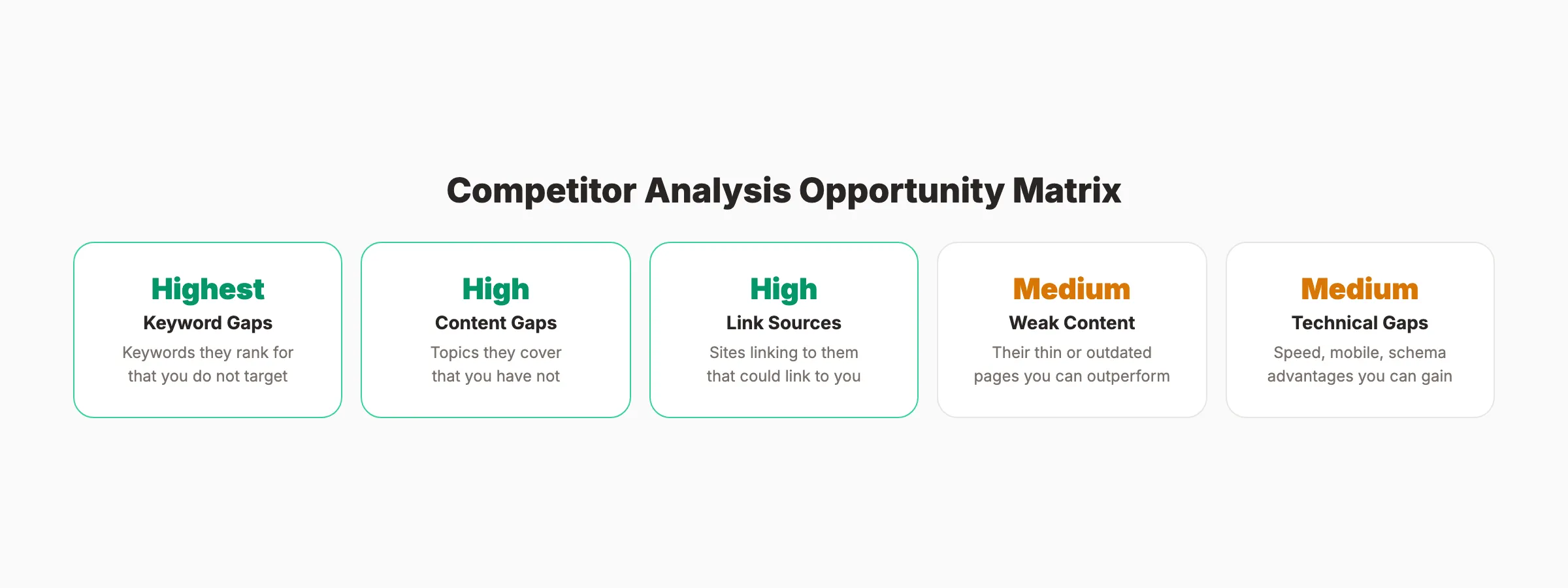
Combine the data from steps 2 through 5 into an opportunity matrix.
| Opportunity Type | What It Means | Priority |
|---|---|---|
| Keywords they rank for, you do not | Untapped keyword opportunities | Highest |
| Topics they cover, you do not | Content gaps to fill | High |
| Sites that link to them, not you | Link building targets | High |
| Weak content (thin, outdated) | Pages you can outperform | Medium |
| Technical weaknesses | Areas where you can gain an edge | Medium |
Prioritize opportunities by impact and effort:
- Quick wins: Low-difficulty keywords they rank for that you do not target. Create content and rank within 2 to 4 months.
- Content upgrades: Topics they cover with thin or outdated content. Write a better version. Skyscraper technique works here.
- Link opportunities: Sites linking to competitors that would also link to you if you had similar content.
Step 7: Build Your Action Plan
Turn the analysis into specific, prioritized actions.
Month 1-2: Quick Wins
- Target 10 to 15 low-difficulty keywords from the keyword gap analysis
- Create optimized content for each keyword
- Publish 2 to 3 articles per week targeting competitor gaps
Month 3-4: Content Upgrades
- Identify competitor pages with outdated or thin content
- Write longer, more detailed versions targeting the same keywords
- Add internal links from existing content to new pages
Month 5-6: Link Building
- Contact sites linking to competitors with your better content
- Build backlinks from the referring domains list
- Create link-worthy content (data studies, original research, tools)
Free and Paid Tools for SEO Competitor Analysis
You do not need enterprise tools to run a competitor analysis. Free tools handle the basics. Paid tools save time and provide deeper data.
Free Tools
| Tool | What It Does | Best For |
|---|---|---|
| Google Search Console | Shows your own keyword data | Finding shared keywords |
| Google Search (manual) | Shows who ranks for your keywords | Identifying competitors |
| Google PageSpeed Insights | Tests competitor page speed | Technical comparison |
| Ubersuggest (limited free) | Basic keyword and traffic data | Small-scale analysis |
Paid Tools
| Tool | Monthly Cost | Best For |
|---|---|---|
| Ahrefs | $29-$449 | Backlink analysis, content gaps |
| Semrush | $140-$500 | Keyword gaps, traffic estimates |
| Moz Pro | $49-$179 | Domain authority comparison |
| SpyFu | $16-$79 | PPC competitor data |
| SimilarWeb | $149+ | Traffic source analysis |
For most businesses, Ahrefs or Semrush alone provides enough data for a thorough competitor analysis. You do not need both. Pick one based on your primary need: Ahrefs for backlink-focused analysis, Semrush for keyword-focused analysis.
How to Run a Free Competitor Analysis
If you have zero budget for tools, here is the manual process:
- Search your top 10 keywords. Write down which domains appear on page 1 for each.
- Visit each competitor’s blog. Count their recent articles. Note topics, formats, and posting frequency.
- Check their page speed. Run each competitor through Google PageSpeed Insights. Note scores.
- Count their reviews. Check their Google Business Profile, Yelp, and Facebook for review counts and ratings.
- Search for their backlinks. Google
link:competitor.comdoes not work reliably. Use the free version of Ahrefs Webmaster Tools (for your own site) or Ubersuggest (limited free queries) for competitor data. - Read their content structure. Open their top 5 articles. Note H2 headings, word count, images, tables, and internal links.
The free process takes 4 to 6 hours per competitor. Paid tools compress the same analysis into 30 minutes. But the insights are the same.
How Often to Run Competitor Analysis
SEO competitor analysis is not a one-time event. Your competitors publish new content, earn new links, and adjust their strategies every week.
Recommended Cadence
| Analysis Type | Frequency | Time Required |
|---|---|---|
| Full 7-step analysis | Quarterly | 4-8 hours |
| Keyword gap check | Monthly | 1-2 hours |
| Content publishing monitor | Weekly | 30 minutes |
| New competitor identification | Quarterly | 1 hour |
| Backlink gap review | Monthly | 1-2 hours |
Triggers for Immediate Analysis
Run a competitor analysis outside your normal schedule when:
- A competitor suddenly outranks you for a key term
- A new competitor appears in your top 10 results
- Your organic traffic drops without explanation
- You enter a new market or launch a new service
- Google releases a major algorithm update
The businesses that monitor competitors monthly catch shifts early. The ones that analyze once per year discover problems 6 months too late.
Tracking Competitor Changes
Set up alerts to monitor competitor activity automatically:
- Google Alerts for competitor brand names (free)
- Ahrefs Alerts for new competitor backlinks ($29+/month)
- Semrush Position Tracking for shared keyword movements ($140+/month)
- Visualping for competitor page changes (free for 5 pages)
Automated monitoring reduces the manual work of competitor analysis by 60 to 70%. You get notified when something changes instead of manually checking every week.
3,500+ blogs published. 92% average SEO score. See what Stacc can do for your site. Start for $1 →
What to Do With Competitor Data
Data without action is a report. Here is how to turn competitor analysis into rankings.
Keyword Prioritization Framework
Not every competitor keyword is worth targeting. Prioritize based on 3 factors:
| Factor | Score 1-5 | Weight |
|---|---|---|
| Search volume | Higher volume = higher score | 30% |
| Keyword difficulty | Lower difficulty = higher score | 40% |
| Business relevance | More relevant = higher score | 30% |
Multiply each score by its weight. Rank keywords by total score. Target the top 20 first.
A keyword with 500 monthly searches, low difficulty (score 5), and high relevance (score 5) is a better target than a keyword with 5,000 searches, high difficulty (score 1), and moderate relevance (score 3).
Publishing Velocity Advantage
Your competitors publish at a certain pace. Match it. Then exceed it.
If your top competitor publishes 10 articles per month, you need at least 10 to match their content velocity. 15 to 20 articles per month gives you an advantage.
Every article targeting a competitor keyword gap closes one opening. At 15 articles per month, you close 15 gaps. In 6 months, you have covered 90 keyword opportunities your competitors thought they owned.
Content Quality as a Competitive Edge
Outranking a competitor requires content that is measurably better on at least 2 of these dimensions:
- Depth (more detail on the same topic)
- Freshness (updated data, current-year references)
- Structure (better headings, tables, visuals)
- Authority (more credible sources, original data)
- User experience (faster loading, better formatting, mobile-friendly)
You do not need to win on every dimension. Pick the 2 where you can clearly exceed the competition and focus there.
Common Competitor Analysis Mistakes
1. Analyzing Too Many Competitors
5 competitors maximum. Analyzing 15 creates spreadsheet paralysis. You spend weeks collecting data and never act on it. Pick the top 3 to 5. Analyze them deeply. Move to execution.
2. Copying Instead of Improving
Competitor analysis reveals what works. That does not mean copying their content word for word. Google does not need 2 identical articles. It needs a better one. Use competitor data to identify topics. Then write something original that adds value they missed.
3. Ignoring Competitor Weaknesses
Most businesses focus only on competitor strengths. Their weaknesses are equally valuable. Outdated content, slow page speed, thin articles, missing schema markup. Every weakness is an opening for you.
4. Running Analysis Once and Never Again
SEO competitor analysis is not a one-time project. Competitors publish new content weekly. Rankings shift monthly. Run a full competitor analysis quarterly. Run keyword gap checks monthly.
5. Focusing on Domain Authority Instead of Content
A competitor with a DA of 70 looks intimidating. But DA is a site-wide metric. You rank page by page. A well-optimized article on a DA 30 site can outrank a mediocre article on a DA 70 site. Focus on creating the best page for each keyword. Not on matching overall authority scores.
Skip the agency. Keep the results. Stacc starts at $99/mo. 30 articles published automatically, all targeting keywords your competitors rank for. Start for $1 →
FAQ
How often should I run an SEO competitor analysis?
Run a full analysis quarterly. Check keyword gaps monthly. Monitor competitor content publishing weekly. The competitive environment changes constantly. A quarterly cadence keeps your strategy aligned with current reality without consuming excessive time.
What is the best tool for SEO competitor analysis?
Ahrefs and Semrush are the 2 most used tools. Ahrefs excels at backlink analysis and content gap identification. Semrush excels at keyword research and traffic estimation. For most businesses, one tool is enough. Start with the free trial of each and pick the interface you prefer.
How do I find my SEO competitors?
Search your top 10 target keywords on Google. Note which domains appear on page 1 for multiple keywords. Those are your SEO competitors. They may be direct business competitors, industry publications, aggregator sites, or blogs in your niche. Use Ahrefs or Semrush for automated competitor discovery.
Can I do competitor analysis without paid tools?
Yes. Use Google Search to identify competitors manually. Use Google Search Console for your own keyword data. Use Google PageSpeed Insights for technical comparison. The process takes longer without paid tools, but the core insights are accessible for free.
How many keywords should I target from competitor analysis?
Start with 15 to 20 keywords from your gap analysis. Prioritize by low difficulty and high relevance. Publish content targeting these keywords over 2 to 3 months. Then run the gap analysis again and target the next batch. This iterative approach closes competitive gaps systematically.
Does competitor analysis work for local SEO?
Yes. For local SEO, analyze the businesses ranking in the map pack for your target keywords. Compare their Google Business Profile completeness, review counts, citation consistency, and local content. Local competitor analysis follows the same framework with emphasis on GBP and reviews instead of backlinks.
What is a keyword gap analysis?
A keyword gap analysis compares the keywords your site ranks for against the keywords your competitors rank for. The “gap” is keywords they rank for that you do not. These gaps represent proven, rankable keywords in your market that you have not targeted yet. Ahrefs Content Gap and Semrush Keyword Gap automate this comparison. The resulting list becomes your content roadmap for the next 3 to 6 months.
SEO competitor analysis is not optional. Every keyword your competitors rank for that you do not is revenue you are leaving on the table. The process takes a day to complete. The insights drive 6 to 12 months of strategic content.
Start with your top 3 competitors. Run the 7-step process. Build your keyword gap list. And if producing the content needed to close those gaps feels overwhelming, 30 optimized articles cost $99 per month when they happen automatically.
Related Tools & Resources
Free SEO Tools:
Best Lists:

Written by
Siddharth GangalSiddharth is the founder of theStacc and Arka360, and a graduate of IIT Mandi. He spent years watching great businesses lose organic traffic to competitors who simply published more. So he built a system to fix that. He writes about SEO, content at scale, and the tactics that actually move rankings.
30 SEO blog articles published every month
Keyword-optimized, scheduled, and live on your site. Automatically.
30-day trial · Cancel anytime
theStacc
Stop writing SEO content manually
30 blog articles, 30 GBP posts, and social media content. Published every month. Automatically.
Start Your $1 Trial$1 for 3 days · Cancel anytime