SEO Funnel Stages Explained (With Content Strategy)
Learn the 3 SEO funnel stages, what content to create for each, and how to map keywords to the buyer journey. Practical guide with examples.
Stacc Editorial • 2026-04-04 • Content Strategy
In This Article
Most businesses create content without a plan. They publish blog posts that all target the same type of reader at the same stage of the buying process. The result: plenty of traffic from people who are not ready to buy, and zero content for people who are.
Understanding SEO funnel stages fixes this problem. The SEO funnel maps your content to 3 stages of the buyer journey: awareness, consideration, and decision. Each stage requires different keywords, different content formats, and different calls to action.
Organizations that structure content around funnel stages see 3.2x higher conversion rates than those focused only on traffic volume, according to Content Whale’s funnel study. The traffic you already have converts better when every page serves a specific purpose in the journey.
We have published 3,500+ blog posts across 70+ industries. This guide covers how to build an SEO funnel that turns organic visitors into customers.
Here is what you will learn:
- The 3 SEO funnel stages and how they map to search intent
- Exact keyword types and content formats for each stage
- How to build internal linking paths that move visitors through the funnel
- A keyword-to-funnel mapping framework you can use today
- Common funnel mistakes that kill conversion rates
- How to measure funnel performance beyond just traffic
Chapter 1: The 3 SEO Funnel Stages
The SEO funnel follows the same logic as any sales funnel. Visitors start unaware, become interested, evaluate options, and decide. Each stage maps to a specific type of search behavior.
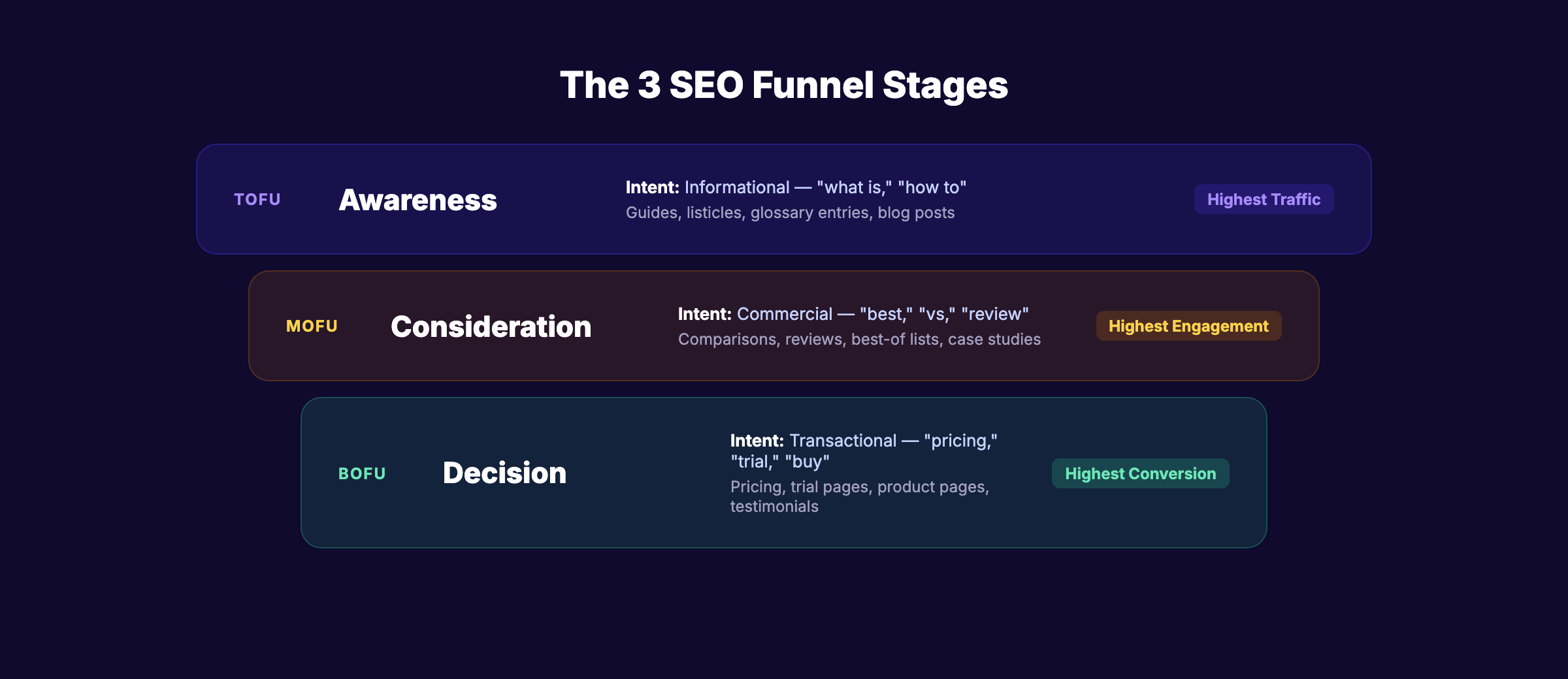
Stage 1: Top of Funnel (TOFU) — Awareness
The visitor has a problem or question. They do not know your brand. They search Google for answers, not products.
Search behavior: Informational queries. “What is,” “how to,” “why does,” “best practices for.”
User mindset: “I need to understand this topic.”
Goal: Attract visitors. Build trust. Establish your site as an authority.
Example keywords:
- “what is on-page SEO”
- “how to increase organic traffic”
- “content marketing for beginners”
- “SEO best practices”
TOFU captures the largest audience. Most of these visitors will not buy today. That is fine. The goal is to get them on your site, into your content ecosystem, and onto your email list.
Stage 2: Middle of Funnel (MOFU) — Consideration
The visitor knows their problem and is evaluating options. They compare tools, read reviews, and look for the best approach. They may know your brand from a previous TOFU visit.
Search behavior: Commercial investigation queries. “Best [tool] for,” “[tool A] vs [tool B],” “alternatives to,” “[product] review.”
User mindset: “I am comparing my options.”
Goal: Demonstrate why your approach or product is the best fit. Build preference.
Example keywords:
- “best SEO tools for small business”
- “Surfer SEO vs Clearscope”
- “alternatives to Semrush”
- “SEO agency vs doing it yourself”
MOFU content has lower volume than TOFU but much higher conversion rates. Visitors at this stage are actively shopping. Every page should include a clear next step.
Stage 3: Bottom of Funnel (BOFU) — Decision
The visitor is ready to act. They search for pricing, specific product names, demos, or signup pages. They have already done their research.
Search behavior: Transactional queries. “[Product] pricing,” “buy [product],” “[product] free trial,” “[brand] login.”
User mindset: “I am ready to buy. Show me how.”
Goal: Remove friction. Make it easy to convert. Provide the final push.
Example keywords:
- “Stacc pricing”
- “SEO service free trial”
- “[product] sign up”
- “[tool] discount code”
BOFU content has the lowest traffic volume but the highest conversion rate. Every BOFU page should have a single, clear call to action with minimal distractions.
Your SEO team. $99 per month. 30 optimized articles, published automatically. Start for $1 →
Chapter 2: Content Types for Each Funnel Stage
Not every content format works at every stage. Match the format to the stage.
TOFU Content Types
| Content Type | Why It Works | Keyword Pattern |
|---|---|---|
| How-to guides | Answers specific questions with depth | ”how to [action]“ |
| Ultimate guides | Covers a topic completely, earns links | ”[topic] guide” |
| Statistics posts | Provides quotable data, earns citations | ”[topic] statistics” |
| Glossary entries | Defines terms, captures informational queries | ”what is [term]“ |
| Listicles | Scannable, shareable, high CTR | ”[N] tips for [topic]“ |
| Educational blog posts | Builds topical authority | ”[topic] explained” |
TOFU optimization priorities:
- Target informational long-tail keywords
- Optimize for featured snippets (clear answers in 40 to 60 words)
- Build content clusters around core topics
- Include email capture CTAs (newsletter signup, lead magnet download)
- Link to related MOFU content within the article
MOFU Content Types
| Content Type | Why It Works | Keyword Pattern |
|---|---|---|
| Product comparisons | Helps buyers evaluate options side by side | ”[tool A] vs [tool B]“ |
| Alternative pages | Captures users leaving a competitor | ”alternatives to [tool]“ |
| Review articles | Builds trust through detailed analysis | ”[tool] review” |
| Best-of lists | Curates options for specific use cases | ”best [tools] for [use case]“ |
| Case studies | Proves results with real data | ”how [company] achieved [result]“ |
| Webinars and demos | Shows the product in action | ”[product] demo” |
MOFU optimization priorities:
- Target commercial investigation keywords
- Include comparison tables with clear winners
- Add social proof (testimonials, case studies, ratings)
- Link to BOFU pages (pricing, signup, free trial)
- Internal links from related TOFU content
BOFU Content Types
| Content Type | Why It Works | Keyword Pattern |
|---|---|---|
| Pricing pages | Answers the final objection (cost) | “[product] pricing” |
| Free trial landing pages | Reduces risk with a trial offer | ”[product] free trial” |
| Product/service pages | Detailed feature and benefit descriptions | ”[product] features” |
| Testimonial/results pages | Social proof at the decision point | ”[product] results” |
| FAQ pages | Removes final objections | ”[product] FAQ” |
BOFU optimization priorities:
- Target transactional and branded keywords
- Minimize distractions (consider removing navigation on landing pages)
- Single, prominent CTA above the fold
- Trust signals: reviews, security badges, guarantees
- Fast page load (every second of delay costs 7% in conversions)
Chapter 3: Keyword Mapping by Funnel Stage
The funnel only works if your keyword research accounts for all 3 stages. Most teams over-index on TOFU keywords and ignore MOFU and BOFU entirely.
The Keyword-to-Funnel Mapping Process
Step 1: List your core topics. Identify 5 to 10 broad topics your business covers. For Stacc, these include blog SEO, local SEO, content automation, and SEO tools.
Step 2: Generate keywords for each stage.
For each core topic, brainstorm keywords at all 3 levels:
| Stage | Keyword Type | Example (Topic: Blog SEO) |
|---|---|---|
| TOFU | Informational | ”how many blog posts to rank on Google” |
| TOFU | Educational | ”blog post structure for SEO” |
| MOFU | Comparison | ”best blog writing tools for SEO” |
| MOFU | Evaluation | ”AI blog writer vs human writer” |
| BOFU | Transactional | ”automated blog writing service pricing” |
| BOFU | Branded | ”Stacc blog SEO review” |
Step 3: Check search volume and intent.
Run each keyword through keyword research tools. Verify the intent by searching Google and examining the top results. If the SERP shows guides, the keyword is TOFU. If it shows product pages, the keyword is BOFU.
Step 4: Map keywords to existing or planned content.
Create a spreadsheet with columns for: keyword, search volume, intent type, funnel stage, target URL, and status (published/planned).
Step 5: Identify gaps.
Most businesses discover they have plenty of TOFU content and almost no MOFU or BOFU content. Fill the gaps. MOFU and BOFU content drives revenue directly.
Stop writing. Start ranking. Stacc publishes 30 SEO articles per month for your business, on autopilot. Start for $1 →
Chapter 4: Internal Linking Across the Funnel
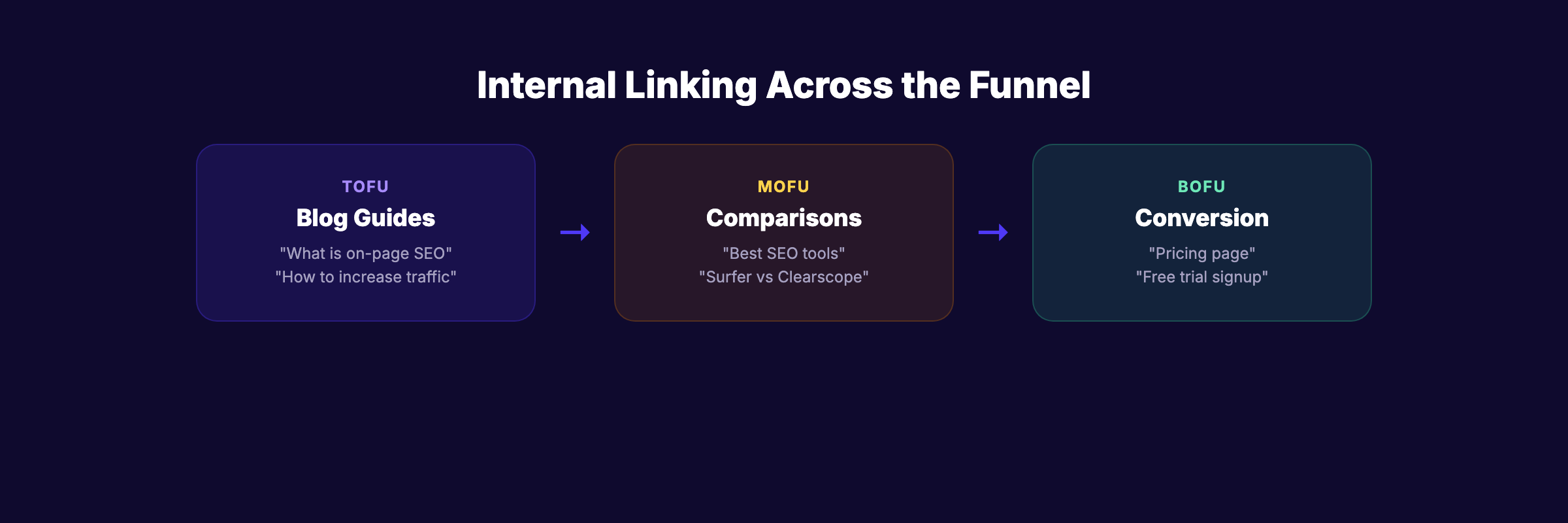
Content at different funnel stages must connect. Internal links move visitors from awareness to consideration to decision. Without them, visitors read one article and leave.
The Funnel Linking Framework
TOFU → MOFU links: Every educational blog post should link to at least 1 comparison, review, or best-of page. A post about “what is on-page SEO” should link to “best SEO tools for on-page optimization.”
MOFU → BOFU links: Every comparison or review page should link to your pricing, trial, or signup page. A “Surfer SEO vs Clearscope” post should include a CTA for your own product as an alternative.
BOFU → TOFU links: Pricing and product pages should link to educational content that supports the purchase decision. A pricing page can link to “how blog SEO works” for visitors who need more context.
Cluster linking: Within each stage, link related content together. A blog post about “content clusters” links to a post about “topical authority.” Both link to a comparison page about “best content strategy tools.” That comparison links to your pricing page.
Internal Linking Checklist
- Every TOFU post links to at least 1 MOFU page
- Every MOFU post links to at least 1 BOFU page
- Every BOFU page links back to supporting TOFU content
- Related content within the same stage links to each other
- Anchor text describes the destination page (not “click here”)
- No orphan pages (every page has at least 3 internal links pointing to it)
Chapter 5: Measuring Funnel Performance
Each stage has different success metrics. Measuring TOFU the same way you measure BOFU leads to bad decisions.
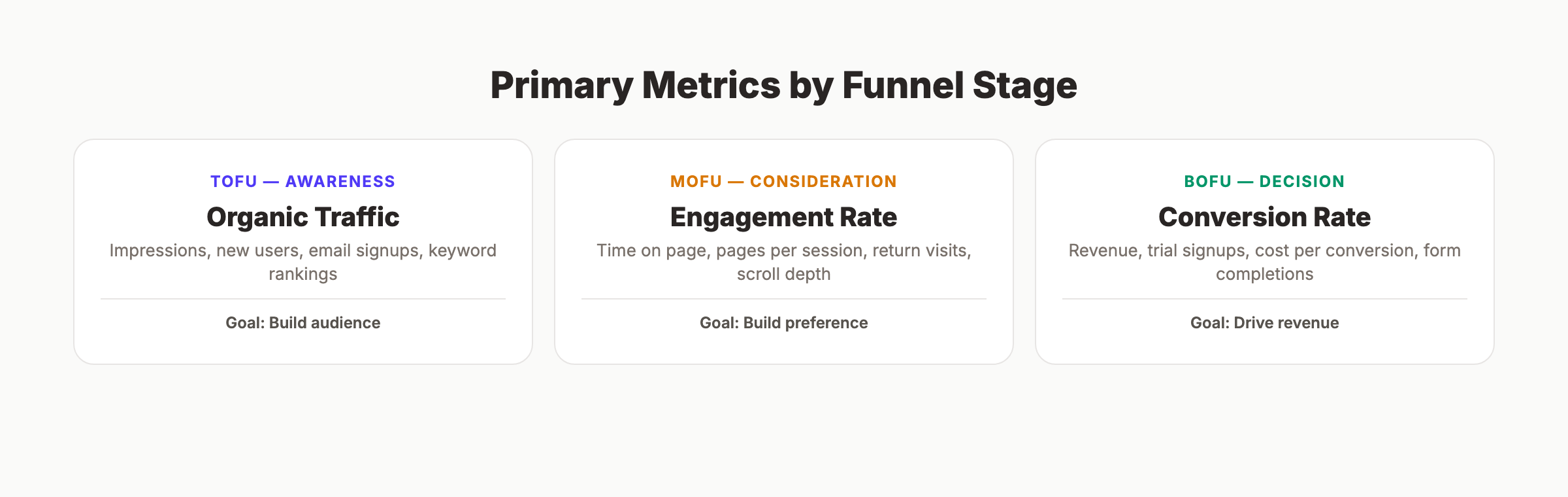
Metrics by Funnel Stage
| Stage | Primary Metric | Secondary Metrics | Goal |
|---|---|---|---|
| TOFU | Organic traffic | Impressions, new users, email signups | Build audience |
| MOFU | Engagement rate | Time on page, pages per session, return visits | Build preference |
| BOFU | Conversion rate | Revenue, cost per conversion, trial signups | Drive revenue |
Common Measurement Mistakes
Mistake 1: Judging TOFU by conversions. TOFU content attracts people who are not ready to buy. Low conversion rates on TOFU pages are normal and expected. Judge TOFU by traffic volume and email signups.
Mistake 2: Judging BOFU by traffic. BOFU keywords have low search volume. A pricing page with 200 monthly visits and a 15% conversion rate generates 30 customers per month. That is a high-performing page even though the traffic looks small.
Mistake 3: Not tracking assisted conversions. A visitor may read 3 TOFU articles over 2 weeks before visiting a MOFU comparison page and then converting on a BOFU trial page. The TOFU articles get zero credit in last-click attribution. Use multi-touch attribution or at minimum track assisted conversions in Google Analytics.
The Funnel Health Dashboard
Track these monthly to assess overall funnel health:
| Metric | Healthy Benchmark | Action If Below |
|---|---|---|
| TOFU organic traffic growth | 10%+ month over month | Publish more TOFU content, improve keyword targeting |
| TOFU to email conversion | 2 to 5% | Improve lead magnets and opt-in placement |
| MOFU time on page | Over 3 minutes | Add comparison tables, examples, and visuals |
| MOFU to BOFU click-through | 5 to 15% | Strengthen CTAs and internal links to BOFU pages |
| BOFU conversion rate | 5 to 20% (varies by business) | Reduce friction, add social proof, simplify forms |
3,500+ blogs published. 92% average SEO score. See what Stacc can do for your site. Start for $1 →
Chapter 6: Building Your SEO Funnel From Scratch
Here is the step-by-step process to build an SEO funnel for your business.
Step 1: Map Your Buyer Journey
Interview 5 to 10 customers. Ask them:
- What problem did you have before finding us?
- What did you search for when researching the problem?
- What alternatives did you consider?
- What convinced you to choose us?
Their answers reveal the exact stages, keywords, and content types your funnel needs.
Step 2: Audit Existing Content by Stage
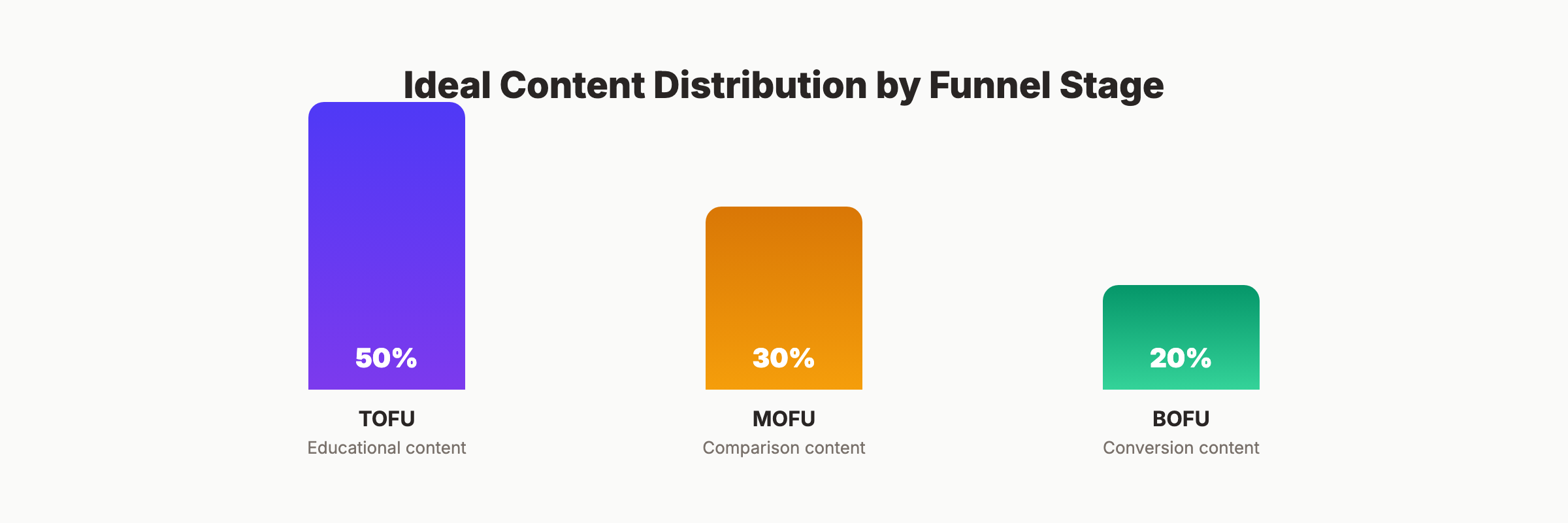
Categorize every page on your site into TOFU, MOFU, or BOFU. Most businesses discover they have 80% TOFU, 15% MOFU, and 5% BOFU. A healthy funnel is closer to 50% TOFU, 30% MOFU, and 20% BOFU.
Step 3: Fill the Gaps
Build a content calendar that prioritizes underserved stages. If you have zero MOFU content, create 5 comparison and review pages before publishing more TOFU blog posts.
Step 4: Connect Everything With Internal Links
Follow the funnel linking framework from Chapter 4. Every piece of content should point visitors toward the next stage.
Step 5: Build Conversion Paths
Every BOFU page needs a clear conversion mechanism: signup form, trial button, demo request, or contact form. Test different approaches. A/B test CTA copy, button color, and form length.
Step 6: Measure and Optimize Monthly
Review funnel metrics monthly using the dashboard from Chapter 5. Identify the weakest stage and focus improvements there. A funnel is only as strong as its weakest link.
Common Funnel-Building Mistakes
Mistake 1: All TOFU, no MOFU or BOFU. Publishing 50 educational blog posts but zero comparison pages means you attract visitors who never see your product. Balance your content mix.
Mistake 2: No internal links between stages. Content at different stages must connect. A TOFU blog post without a link to a MOFU comparison page is a dead end. Follow the linking framework from Chapter 4.
Mistake 3: Same CTA on every page. A “Start Free Trial” button on an educational blog post feels aggressive. A “Download Our SEO Checklist” CTA on a pricing page feels weak. Match the CTA intensity to the funnel stage.
Mistake 4: Ignoring multi-touch attribution. A customer may visit 5 TOFU pages, 2 MOFU pages, and 1 BOFU page before converting. If you only credit the BOFU page, you undervalue the content that started the journey. Set up multi-touch attribution in Google Analytics to see the full picture.
Mistake 5: Not refreshing content. MOFU comparison pages decay fast as products change and competitors launch new features. Review and update MOFU content every 3 to 6 months. Outdated comparisons destroy trust.
Real-World Funnel Example
Here is how a funnel works for a B2B SaaS company selling project management software:
| Stage | Content | Keyword | CTA |
|---|---|---|---|
| TOFU | ”How to Manage Remote Teams” (guide) | “remote team management tips” | Download remote work checklist |
| TOFU | ”Project Management Statistics 2026” (stats) | “project management statistics” | Subscribe for weekly insights |
| MOFU | ”Best Project Management Tools Compared” (list) | “best project management software” | Try [Product] free for 14 days |
| MOFU | ”[Product] vs Asana” (comparison) | “[product] vs asana” | See pricing comparison |
| BOFU | Pricing page | ”[product] pricing” | Start free trial |
| BOFU | Customer results page | ”[product] case studies” | Book a demo |
Each piece feeds the next. The guide links to the best-of list. The best-of list links to the comparison. The comparison links to pricing. The visitor moves from stranger to customer through content alone.
FAQ
What are the 3 SEO funnel stages?
The 3 SEO funnel stages are awareness (TOFU), consideration (MOFU), and decision (BOFU). The awareness stage attracts visitors with educational content targeting informational keywords. The consideration stage helps visitors evaluate options with comparison and review content. The decision stage converts visitors with product pages, pricing, and trial offers targeting transactional keywords.
What is the difference between TOFU, MOFU, and BOFU?
TOFU (Top of Funnel) content educates and attracts new visitors. MOFU (Middle of Funnel) content helps visitors compare and evaluate options. BOFU (Bottom of Funnel) content converts ready buyers. Each stage uses different keywords, content formats, and CTAs. TOFU targets broad informational keywords. BOFU targets specific, high-intent transactional keywords.
How do I know which funnel stage a keyword belongs to?
Search the keyword on Google and examine the top results. If the SERP shows educational guides and blog posts, the keyword is TOFU. If it shows comparison pages, reviews, and best-of lists, the keyword is MOFU. If it shows product pages, pricing pages, and signup pages, the keyword is BOFU. The SERP format reveals the intent.
How much content should I create for each funnel stage?
A healthy distribution is approximately 50% TOFU, 30% MOFU, and 20% BOFU content. Most businesses over-invest in TOFU and under-invest in MOFU and BOFU. If you publish 20 articles per month, aim for 10 TOFU guides, 6 MOFU comparisons or reviews, and 4 BOFU product or pricing pages.
Can TOFU content directly generate revenue?
TOFU content rarely converts on the first visit. Its value is in building audience, email lists, and brand awareness. However, TOFU content with strong internal links to MOFU and BOFU pages contributes to multi-touch conversions. Track assisted conversions to see the full revenue contribution of TOFU content.
How does Stacc help with the SEO funnel?
Stacc publishes 30 SEO-optimized articles per month. We produce TOFU educational content and MOFU comparison content that drives organic traffic and builds topical authority. This fills the top and middle of your funnel automatically, freeing your team to focus on BOFU conversion optimization and sales enablement.
The SEO funnel is not a theory. It is an operational framework that determines whether your organic traffic generates revenue or just vanity metrics. Map your content to all 3 stages. Build linking paths that guide visitors through the journey. Measure each stage with the right metrics. The businesses that convert organic traffic into customers are the ones that built the funnel before they built the content.
Written and published by Stacc. We publish 3,500+ articles per month across 70+ industries. All data verified against public sources as of March 2026.