AI Agent Adoption Statistics 2026: 40+ Data Points
40+ AI agent adoption statistics for 2026. Market size, enterprise deployment rates, ROI data, and industry adoption. All sourced and verified.
Siddharth Gangal • 2026-04-02 • SEO Tips
In This Article
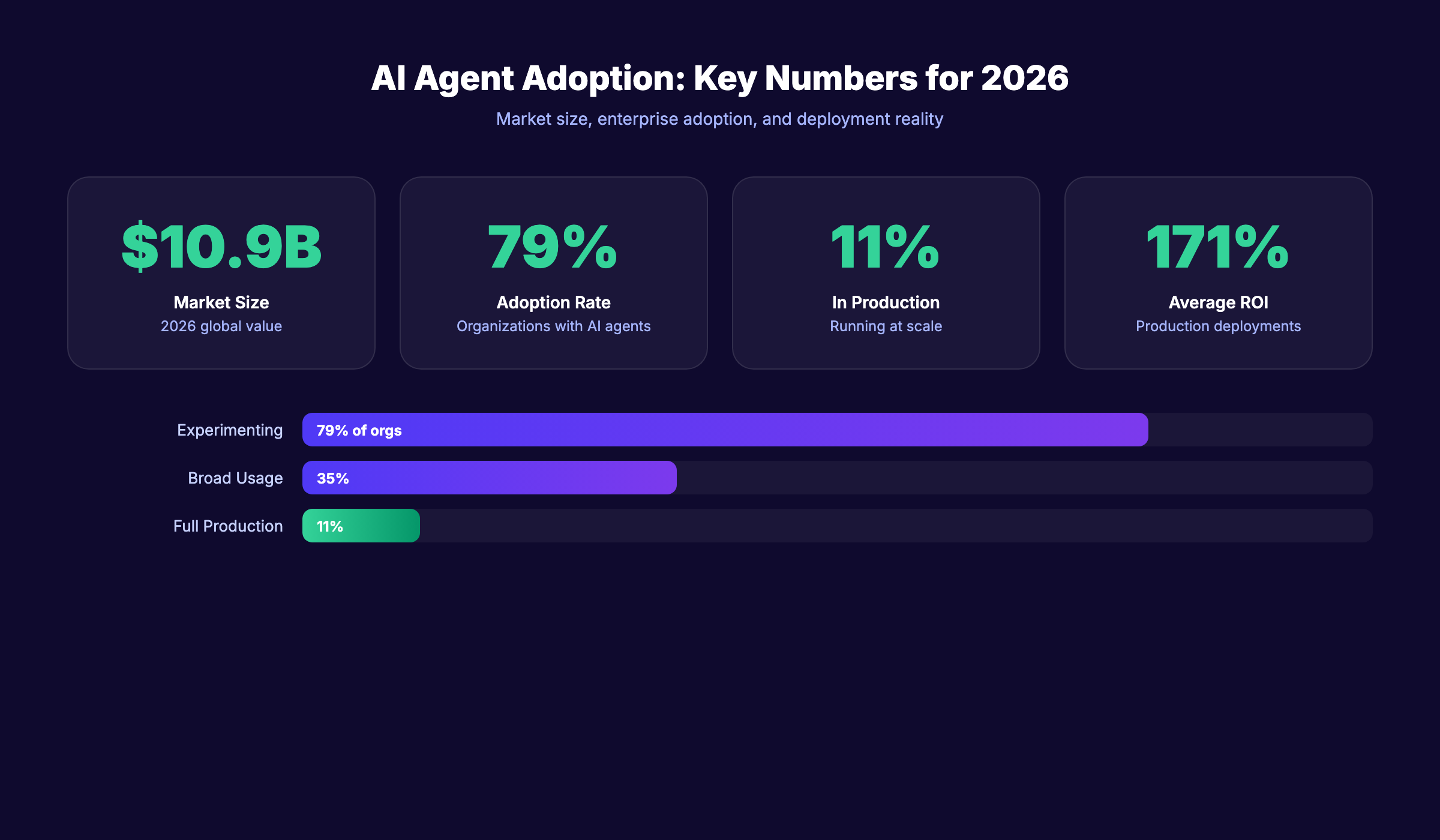
The AI agent market reached $10.9 billion in 2026. Up from $7.6 billion in 2025. 79% of organizations report some form of AI agent adoption. Yet only 1 in 9 runs agents in production.
AI agent adoption statistics reveal a market growing faster than almost any enterprise technology category. Gartner predicts 40% of enterprise applications will embed task-specific AI agents by the end of 2026. That number sat below 5% in 2025.
These AI agent adoption statistics matter for anyone building a business around content, marketing, or SEO. AI agents now handle customer service, content creation, data analysis, and marketing automation at scale. Understanding the adoption curve helps you decide where to invest.
We compiled 40+ AI agent adoption statistics from Gartner, IDC, Grand View Research, NVIDIA, and other authoritative sources. Every stat includes its source and year.
Here is what the data covers:
- AI agent market size and growth projections
- Enterprise adoption rates across industries
- ROI and business performance data
- Industry-specific deployment statistics
- Implementation costs and timelines
- Key challenges and failure rates
AI Agent Market Size Statistics
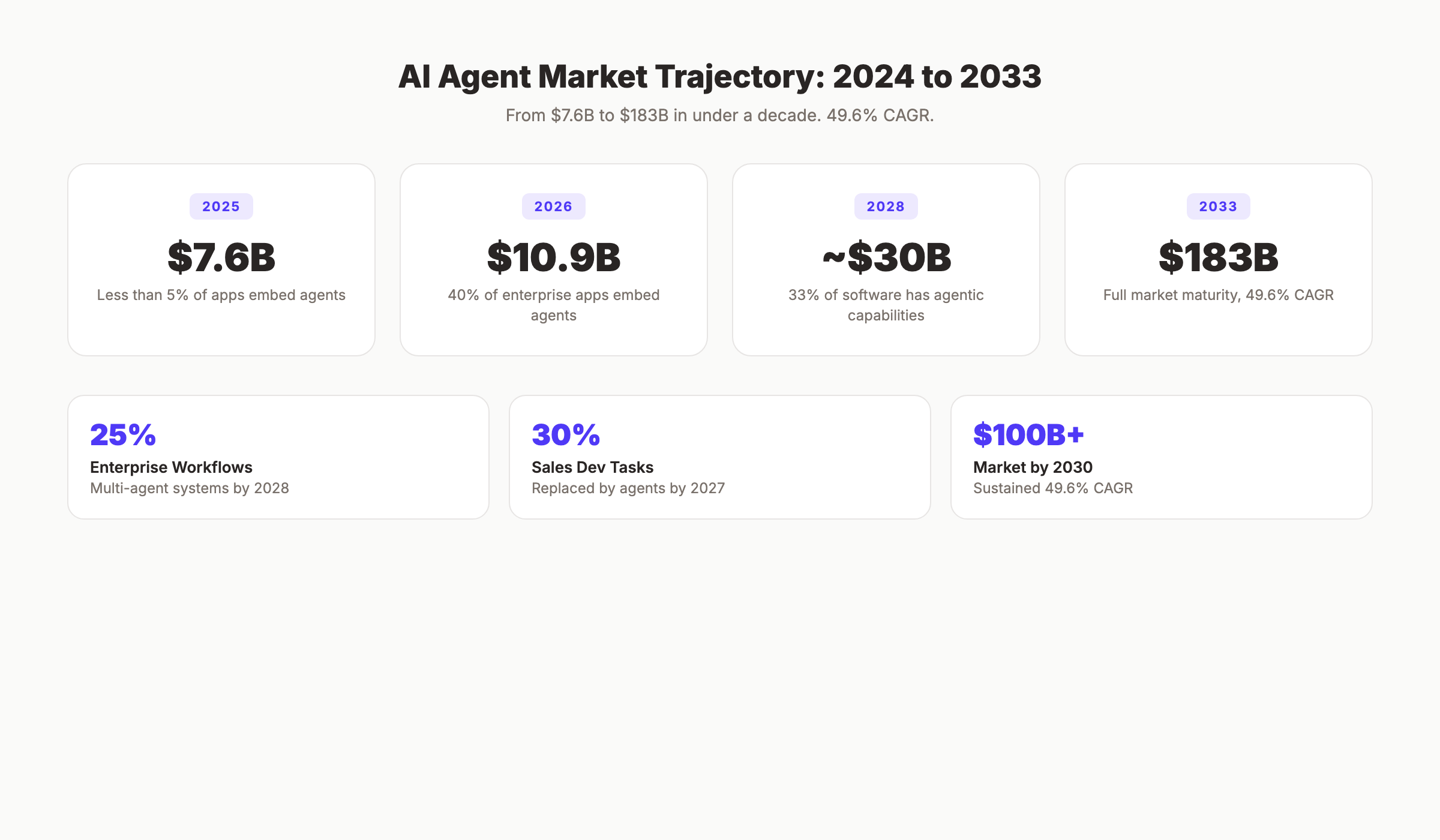
1. The global AI agent market reached $10.9 billion in 2026. (Source: Grand View Research, 2026) Up from $7.6 billion in 2025. That represents 43% year-over-year growth.
2. The AI agent market will reach $182.97 billion by 2033. (Source: Grand View Research, 2026) Growing at a 49.6% compound annual growth rate from 2026 to 2033.
3. Venture capital investment in agentic AI exceeded $8.2 billion in 2025. (Source: Warmly, 2026) Investors poured more capital into AI agent startups than into traditional SaaS categories.
4. North America holds 39.6% of the global AI agent market. (Source: Grand View Research, 2026) Advanced infrastructure and high R&D investment drive the regional lead.
5. The agentic AI market is projected to reach $89.6 billion globally in 2026 when including all adjacent categories. (Source: Axis Intelligence, 2026) The broader agentic AI market includes agents, copilots, and autonomous workflow tools.
6. Asia-Pacific is the fastest-growing region for AI agent deployment at 52% CAGR. (Source: Grand View Research, 2026) China, Japan, and India drive regional growth through government AI initiatives and manufacturing demand.
Enterprise AI Agent Adoption Statistics
7. 79% of organizations report some form of AI agent adoption. (Source: Salesmate, 2026) 4 in 5 companies are experimenting with or actively deploying AI agents.
8. Only 1 in 9 enterprises runs AI agents in production. (Source: Joget, 2026) The gap between experimentation and production deployment remains significant.
9. 40% of enterprise applications will embed task-specific AI agents by 2026. (Source: Gartner, 2025) Up from less than 5% in 2025. The fastest adoption curve Gartner has tracked in enterprise software.
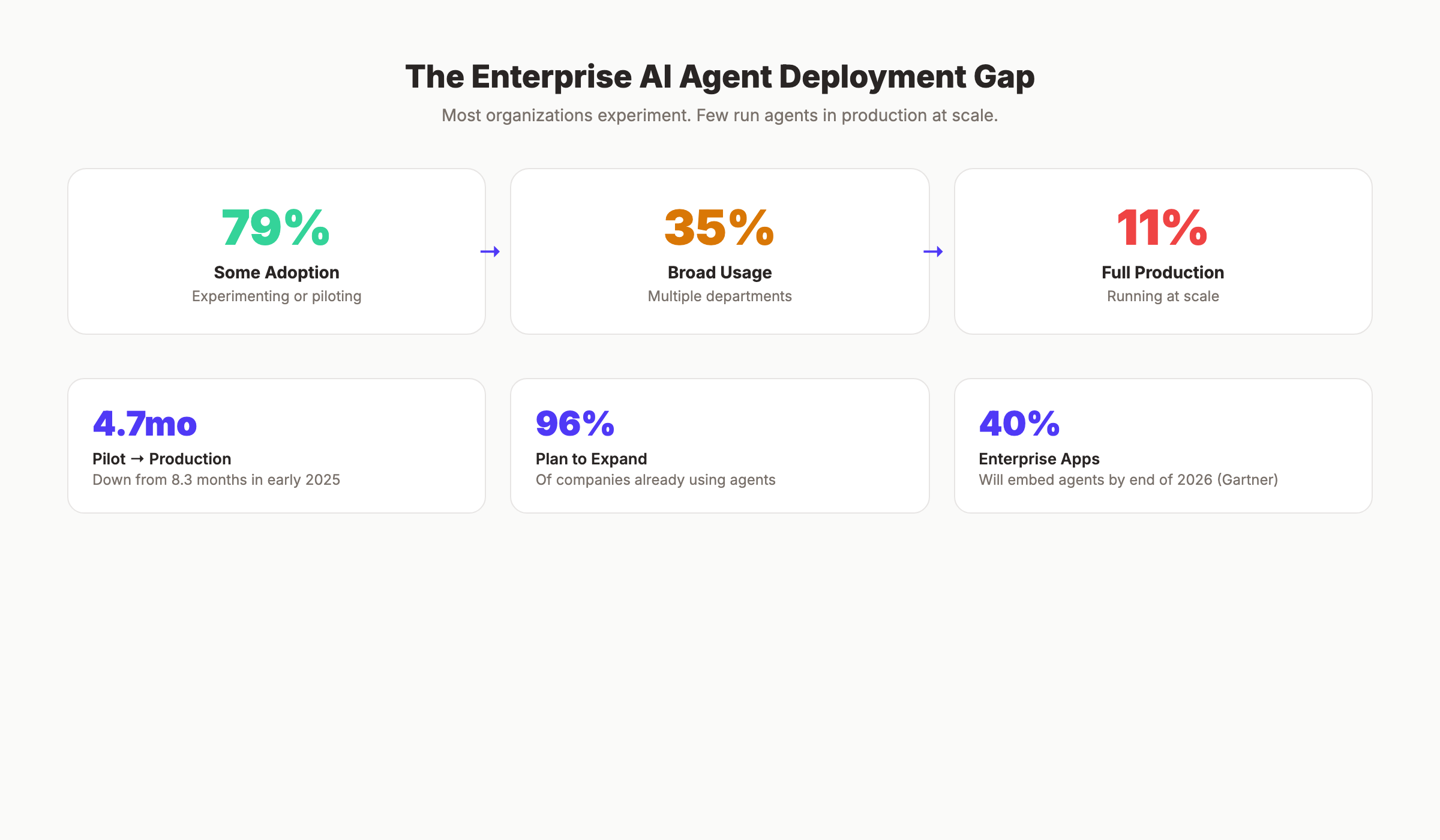
10. 35% of organizations report broad usage of AI agents across departments. (Source: Azumo, 2026) Another 27% use agents in limited or experimental capacity.
11. 96% of organizations with AI agents plan to expand usage in 2026. (Source: Warmly, 2026) Nearly every company that starts with AI agents increases their deployment.
12. 85% of enterprises planned to implement AI agents by end of 2025. (Source: DemandSage, 2026) Enterprise adoption accelerated faster than analyst predictions.
13. 78% of Fortune 500 companies have deployed AI agents in some capacity. (Source: Axis Intelligence, 2026) Up from 67% in 2025.
14. IDC expects AI copilots to embed in 80% of enterprise workplace applications by 2026. (Source: Joget, 2026) Copilots and agents are converging into a single category in enterprise software.
15. By 2028, 33% of enterprise software applications will have built-in agentic capabilities. (Source: Gartner, 2025) Up from under 1% in 2024.
Stop writing. Start ranking. Stacc uses AI agents to publish 30 SEO articles per month for $99. See how AI-driven content scales your rankings. Start for $1 →
AI Agent ROI and Business Performance Statistics
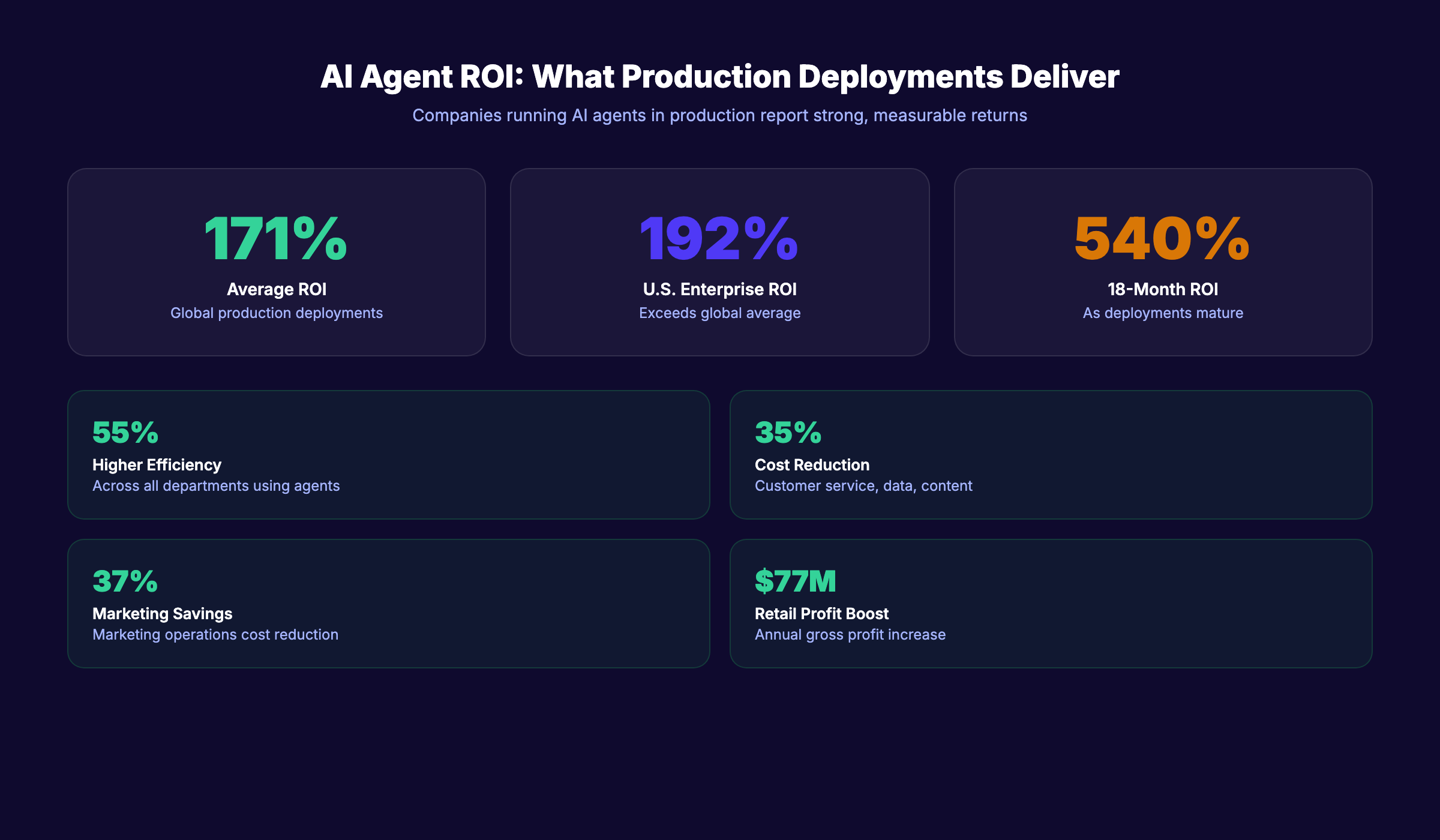
16. AI agents in production deliver an average 171% ROI. (Source: OneReach, 2026) U.S. enterprises report even higher returns at 192%.
17. Enterprise ROI averages 540% within 18 months of AI agent deployment. (Source: Axis Intelligence, 2026) As agents mature past the initial deployment phase, returns compound significantly.
18. Companies using AI agents report 55% higher operational efficiency. (Source: Salesmate, 2026) Efficiency gains come from automating repetitive tasks, reducing manual data entry, and accelerating decision-making.
19. AI agents reduce operational costs by an average of 35%. (Source: Warmly, 2026) Cost reductions concentrate in customer service, data processing, and content production.
20. Businesses using AI agents report 37% cost savings in marketing operations. (Source: Azumo, 2026) Marketing is one of the highest-ROI use cases for AI agents.
21. AI agents drive a 3 to 15% revenue uplift for companies with mature deployments. (Source: Warmly, 2026) Sales ROI specifically rises 10 to 20% with AI agent support.
22. Retailers using AI agents reported a $77 million boost in annual gross profit. (Source: Azumo, 2026) The retail sector sees some of the fastest payback periods for AI agent investments.
23. Healthcare providers using AI agents reduced documentation time by 42%. (Source: Azumo, 2026) Clinical documentation is one of the highest-value AI agent applications in healthcare.
For context on how AI is changing search and content, read our AI search statistics roundup.
AI Agent Adoption by Industry
24. Customer service leads AI agent adoption due to clear and measurable ROI. (Source: Salesmate, 2026) Chatbots and service agents show the fastest time-to-value across all use cases.
25. 68% of healthcare organizations already use AI agents. (Source: Warmly, 2026) Healthcare adoption focuses on documentation, scheduling, and clinical decision support.
26. Telecommunications leads agentic AI adoption at 48% full deployment. (Source: Axis Intelligence, 2026) Network management and customer service drive telecom adoption.
27. Retail and CPG adoption of agentic AI reached 47% in 2026. (Source: Axis Intelligence, 2026) Inventory management, pricing optimization, and customer support are primary applications.
28. 76% of retailers plan to increase AI agent investment in the next 12 months. (Source: Salesmate, 2026) Automated order tracking and customer inquiries are the priority investment areas.
29. 77% of manufacturers now use AI in some capacity. (Source: Warmly, 2026) Up from 70% in 2024. Predictive maintenance and quality control drive manufacturing adoption.
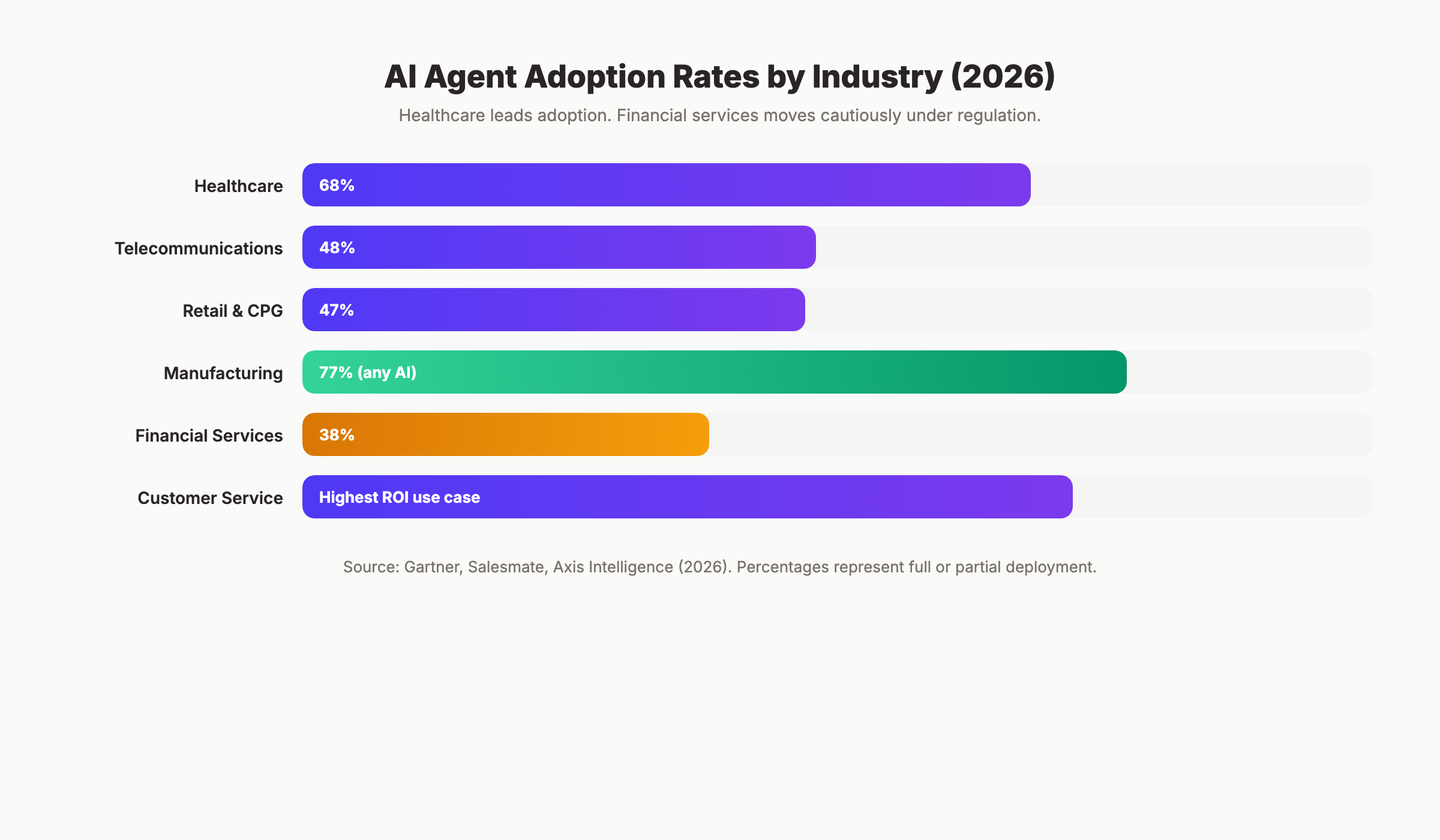
30. Financial services adoption grows cautiously at 38% full deployment. (Source: Axis Intelligence, 2026) Regulatory compliance and governance requirements slow financial sector deployment relative to retail and telecom.
31. Marketing teams using AI agents report handling 5x more campaigns with the same headcount. (Source: Azumo, 2026) Content creation, SEO optimization, and social media management are the most common marketing agent use cases. For how AI applies to content specifically, read our AI content strategy guide.
Your SEO team. $99 per month. 30 optimized articles, published automatically. AI agents doing what AI agents do best. Start for $1 →
AI Agent Implementation Statistics
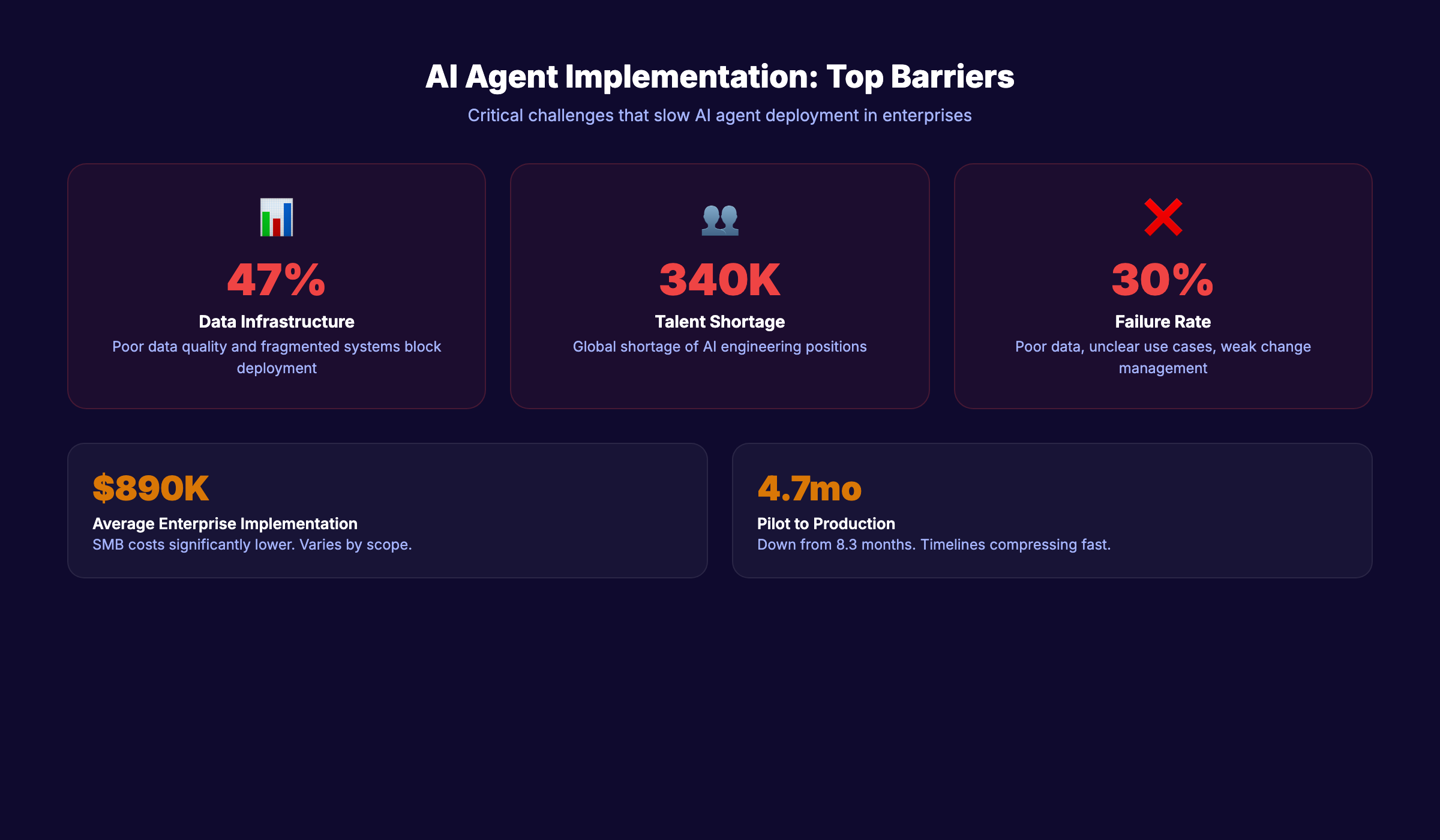
32. Average implementation cost for enterprise AI agents: $890,000. (Source: Axis Intelligence, 2026) Costs vary dramatically by scope. SMB deployments cost a fraction of enterprise rollouts.
33. Companies moving from pilot to production averaged 4.7 months in late 2025. (Source: OneReach, 2026) Down from 8.3 months in early 2025. Deployment timelines are compressing rapidly.
34. 47% of organizations cite data infrastructure inadequacy as a deployment barrier. (Source: Axis Intelligence, 2026) Poor data quality and fragmented systems remain the top blockers for AI agent adoption.
35. The global AI talent shortage stands at approximately 340,000 positions. (Source: Axis Intelligence, 2026) Hiring specialized AI engineers remains one of the biggest challenges for companies deploying agents.
36. AI agent implementation failure rate sits at approximately 30%. (Source: Azumo, 2026) Most failures stem from poor data quality, unclear use case definition, or inadequate change management.
AI Agent Content and SEO Statistics
37. AI agents now generate an estimated 15 to 20% of all new web content. (Source: Digital Applied, 2026) The volume of AI-generated content continues accelerating across blogs, product descriptions, and marketing copy.
38. AI-generated content accounts for 1.08% of total web traffic via referrals. (Source: DemandSage, 2026) AI search referral traffic grows roughly 1% month-over-month. For details on tracking this traffic, read our AI search traffic analytics guide.
39. AI search referral traffic converts at 4.4x the rate of traditional organic search. (Source: GrowthMarshal, 2026) AI-referred visitors arrive with higher intent and engage more deeply with content. See our full AI search referral traffic statistics for more data.
40. AI content agents reduce content production costs by 60 to 80% compared to freelance writers. (Source: Salesmate, 2026) A single AI content agent can produce output equivalent to a team of 5 to 10 writers.
41. Companies publishing AI-assisted content at scale report 3.5x more organic traffic. (Source: HubSpot, 2026) Volume and consistency, enabled by AI agents, drive the traffic differential.
For a comparison of AI versus human content performance, read our AI vs human content analysis. You can also explore the best AI SEO agents available today.
Future Projections for AI Agents
42. By 2028, 33% of enterprise software will include agentic capabilities. (Source: Gartner, 2025) Up from under 1% in 2024. The fastest software category expansion in enterprise history.
43. The AI agent market will exceed $100 billion by 2030. (Source: Grand View Research, 2026) Sustained 49.6% CAGR drives the market past the $100 billion mark within 4 years.
44. Multi-agent systems will handle 25% of all enterprise workflows by 2028. (Source: Digital Applied, 2026) Multiple AI agents working together on complex tasks represents the next phase of deployment.
45. AI agents will replace 30% of outbound sales development tasks by 2027. (Source: Landbase, 2026) Lead qualification, email outreach, and meeting scheduling are the first sales tasks to shift to agents.
Key Takeaways
- $10.9 billion: The global AI agent market size in 2026, growing at 49.6% CAGR toward $183 billion by 2033.
- 79% adoption, 11% production: Most enterprises experiment with AI agents but few run them at scale yet.
- 171% average ROI: AI agents in production deliver strong returns that compound over time.
- 40% of enterprise apps: Will embed task-specific agents by end of 2026, per Gartner.
- Healthcare leads at 68% adoption. Telecom follows at 48%. Financial services moves cautiously at 38%.
- 4.7 months: Average time from pilot to production. Down from 8.3 months in early 2025.
- 30% failure rate: Poor data quality and unclear use cases cause most AI agent failures.
3,500+ blogs published. 92% average SEO score. Stacc uses AI to publish the content that ranks. See what automated SEO looks like. Start for $1 →
Methodology
Sources: Grand View Research, Gartner, IDC, NVIDIA, Salesmate, Warmly, Azumo, Axis Intelligence, OneReach, DemandSage, Digital Applied, Landbase, HubSpot, GrowthMarshal.
Last updated: April 2026.
Note: We update this page quarterly to keep all statistics current. When a stat changes from its original publication, we note the update date. All statistics include source citations with links to the original research.
For related data, see our SEO statistics roundup, AI content statistics, and SEO ROI statistics.
FAQ
What is the most important AI agent adoption statistic in 2026?
Gartner’s prediction that 40% of enterprise applications will embed task-specific AI agents by end of 2026 is the most significant data point. It represents an 8x increase from less than 5% in 2025 and signals that AI agents are moving from experimentation to standard enterprise infrastructure.
How fast is the AI agent market growing?
The AI agent market grows at approximately 49.6% CAGR. It reached $10.9 billion in 2026 and is projected to exceed $183 billion by 2033. That growth rate exceeds nearly every other enterprise software category.
Which industries adopt AI agents fastest?
Healthcare leads at 68% adoption, followed by telecommunications at 48% full deployment and retail at 47%. Customer service is the most common use case across all industries. Financial services adopts more slowly at 38% due to regulatory requirements.
What is the average ROI of AI agents?
AI agents in production deliver an average 171% ROI (192% in the U.S.). Enterprise ROI averages 540% within 18 months as deployments mature. These returns exceed traditional automation ROI by approximately 3x.
How often are these statistics updated?
We update this page quarterly. Last updated: April 2026. All statistics include source citations so you can verify the original data.
How do AI agents apply to SEO and content marketing?
AI agents now handle content creation, keyword research, on-page optimization, and publishing at scale. Companies publishing AI-assisted content report 3.5x more organic traffic. Stacc uses AI agents to publish 30 optimized articles per month for $99. See the best AI SEO agents for a full comparison.
The AI agent market is still early. 79% of organizations experiment with agents. Only 11% run them in production. The gap between experimentation and deployment is where the opportunity sits. The companies that move agents into production first will capture the ROI advantages before their competitors catch up.
Written and published by Stacc. We publish 3,500+ articles per month across 70+ industries. All data verified against public sources as of March 2026.