Catering Company SEO: The Complete Guide (2026)
The complete catering company SEO guide. Covers local SEO, GBP optimization, event keywords, content strategy, and reviews for caterers. Updated April 2026.
Siddharth Gangal • 2026-04-02 • SEO Tips
In This Article
Over 90% of consumers use search engines to find local businesses. When someone searches “wedding caterer near me” or “corporate catering [city],” your company either appears or gets skipped.
The U.S. catering market reached $77.18 billion in 2025. Corporate catering is growing fast as return-to-office mandates push companies to use food as a morale tool. Event planners search Google before they call anyone. The catering company SEO strategy you build now determines whether those searches turn into bookings.
Most caterers rely on word of mouth, venue referrals, and repeat clients. Those channels work. But they do not scale on demand. SEO creates a predictable pipeline of new clients actively searching for exactly what you offer.
We have published 3,500+ blog posts across 70+ industries, including food service, event planning, and hospitality businesses. This guide covers the exact SEO playbook that drives qualified booking inquiries for catering companies.
Here is what you will learn:
- Why SEO is the highest-ROI marketing channel for caterers
- How to find the keywords event planners and clients actually search
- The local SEO playbook for dominating your service area
- How to optimize your Google Business Profile for more bookings
- A content strategy built around event types and seasons
- Technical SEO essentials for catering websites
- How to turn reviews into your strongest booking tool
Why SEO Drives More Bookings Than Any Other Channel
Catering is an event-driven business. Every booking starts with a search. “Corporate lunch catering [city].” “Wedding caterer for 100 guests.” “BBQ catering for graduation party.”
These are high-intent searches. The person searching is not browsing. They need a caterer. They need one now.
The Catering Customer Journey
| Stage | What They Search | What They Need |
|---|---|---|
| Research | ”how much does wedding catering cost” | Pricing guides. Blog content. |
| Comparison | ”best caterers in [city]“ | Reviews. Portfolio. Service pages. |
| Decision | ”catering company [city] reviews” | Google 3-Pack. Social proof. |
| Booking | ”[company name] menu” | Menu pages. Contact form. Quote request. |
Your website needs content for every stage. Most catering websites only have a homepage, an “About” page, and a contact form. That is not enough to rank for anything.
SEO vs. Other Marketing Channels
| Channel | Cost per Lead | Lead Quality | Long-Term Value |
|---|---|---|---|
| SEO (Organic) | Decreases over time | High (actively searching) | Compounds monthly |
| Google Ads | $15-50+ per click | High | Stops when budget stops |
| Social Media | Variable | Low-Medium (browsing, not searching) | Requires constant posting |
| Venue Referrals | Free (but limited) | High | Depends on relationship |
| Print/Flyers | $500-2,000+ per campaign | Low | No lasting value |
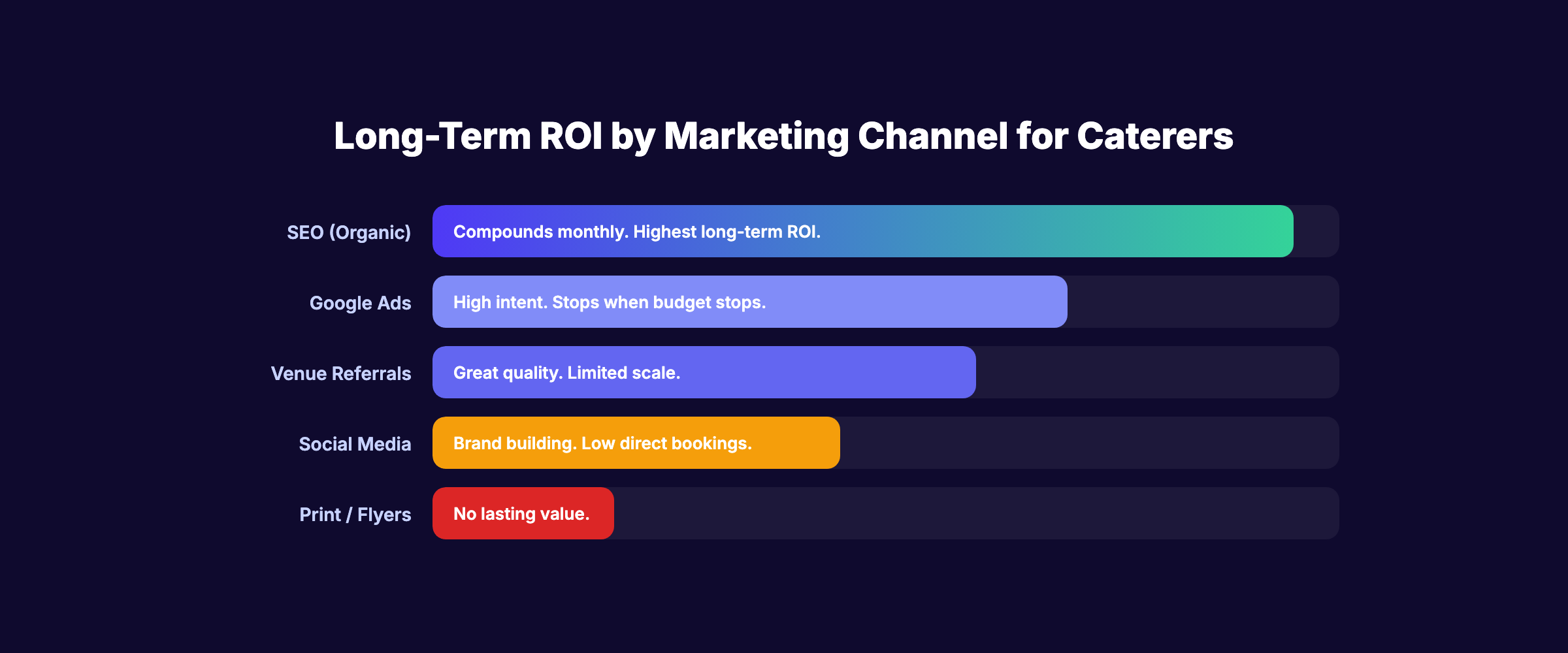
Catering companies that invest in SEO report 30%+ revenue increases compared to competitors who rely only on offline methods.
The Catering SEO Opportunity
Most catering companies do not invest in SEO. That means competition for local search rankings is lower than industries like dentistry, law, or real estate. A catering company that publishes consistent content and optimizes for local search can dominate its market within 6 months.
Stop writing. Start ranking. Stacc publishes 30 SEO articles per month for your catering company. Every post targets the keywords your clients search. Start for $1 →
Keyword Research for Catering Companies
Effective keyword research for catering focuses on 3 dimensions: event type, cuisine style, and location. Most caterers target only generic terms and miss the specific searches that actually lead to bookings.
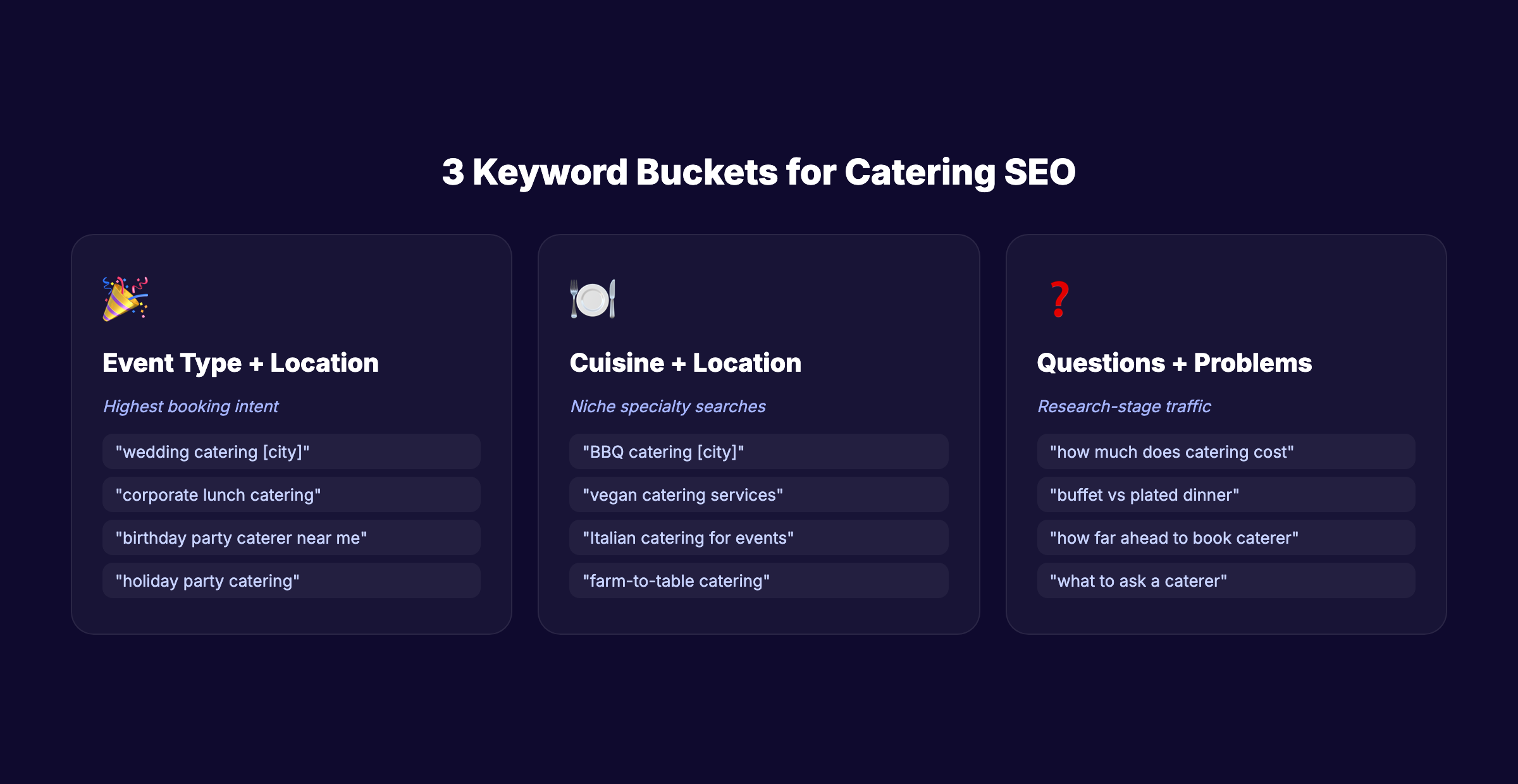
Three Keyword Buckets
Bucket 1: Event Type + Location
| Event Type | Target Keywords |
|---|---|
| Wedding | ”wedding catering [city],” “wedding caterer for 150 guests,” “wedding reception food” |
| Corporate | ”corporate catering [city],” “office lunch catering,” “corporate event catering service” |
| Private Party | ”party catering [city],” “birthday party catering near me,” “backyard party caterer” |
| Funeral/Memorial | ”funeral catering [city],” “reception catering after memorial service” |
| Holiday | ”holiday party catering [city],” “Thanksgiving catering near me,” “Christmas party caterer” |
Bucket 2: Cuisine/Style + Location
- “BBQ catering [city]”
- “Italian catering services near me”
- “vegan catering [city]”
- “Mexican food catering for events”
- “farm-to-table catering [region]”
- “kosher catering service [city]”
Bucket 3: Problem/Question Keywords
- “how much does catering cost per person”
- “how to choose a caterer for a wedding”
- “what to look for in a catering company”
- “catering vs restaurant for large party”
- “how far in advance to book a caterer”
Long-Tail Keywords Win
Long-tail keywords account for 70% of all search traffic. They are specific, less competitive, and signal high intent.
Instead of targeting “catering” (too broad, too competitive), target:
- “boxed lunch catering for office meetings [city]” (specific service + use case + location)
- “taco bar catering for 50 guests” (cuisine + format + guest count)
- “drop-off catering for corporate events [city]” (service type + event + location)
Use your keyword research process to build a list of 50-100 target keywords organized by event type and location.
Seasonal Search Patterns
Catering searches follow strong seasonal patterns tied to event seasons:
| Season | Peak Searches | Content to Publish |
|---|---|---|
| Winter (Dec-Feb) | Holiday parties, New Year events | ”Holiday party catering guide,” “New Year’s Eve menu ideas” |
| Spring (Mar-May) | Weddings, graduations, corporate events | ”Spring wedding catering trends,” “graduation party food ideas” |
| Summer (Jun-Aug) | Outdoor events, BBQs, weddings peak | ”Outdoor event catering tips,” “BBQ catering menu ideas” |
| Fall (Sep-Nov) | Corporate events, Thanksgiving, holiday planning | ”Fall corporate event catering,” “Thanksgiving catering options” |
Publish seasonal content 6-8 weeks before the peak. Wedding catering content should go live in January to rank by March.
Local SEO: Appearing Where Clients Search
Catering is a local business. Most clients want a caterer within their metro area. Local SEO determines whether you appear when they search.
Google 3-Pack Ranking Factors
The Google 3-Pack captures the majority of clicks for “catering near me” type searches. Three factors control your position:
| Factor | What Google Measures | How to Optimize |
|---|---|---|
| Relevance | Does your profile match the query? | Accurate categories, complete profile, keyword-rich description |
| Distance | How close is your business to the searcher? | List accurate address, define service areas |
| Prominence | How well-known is your business? | Reviews, citations, backlinks, brand mentions |
Citation Building
Citations are online mentions of your business Name, Address, and Phone number (NAP). Consistency across every listing is mandatory.
Priority citation sources for catering companies:
- Google Business Profile
- Yelp
- The Knot (for wedding caterers)
- WeddingWire (for wedding caterers)
- Thumbtack
- Better Business Bureau
- Local Chamber of Commerce
- LinkedIn company page
- Facebook business page
- Bing Places
- Apple Maps
- Catersource directory
Audit your NAP across every listing. Even small differences (“Suite 200” vs “Ste 200”) weaken your local signal.
Service Area Pages
If you cater events across multiple cities, create a dedicated page for each location you serve.
Each service area page needs:
- City name in the H1 and URL
- Unique content about catering in that area (local venues, popular event types)
- Specific services offered in that location
- Testimonial from a client in that city
- Embedded Google Map
- NAP consistent with all other listings
Do not create 20 pages with identical content and swapped city names. Google penalizes thin location pages. Each must offer genuinely useful, location-specific information.
Follow our local SEO guide for a full location-based ranking strategy.
Google Business Profile Optimization
Your Google Business Profile is the most important local SEO asset for a catering company. Event planners make snap judgments based on your photos, reviews, and how recently you posted updates.
Profile Setup Checklist
- Business name (exact legal name, no keyword stuffing)
- Primary category: “Caterer”
- Secondary categories: “Wedding Caterer,” “Corporate Caterer,” “Food Delivery Service”
- Full street address (or service area if you work from a commercial kitchen)
- Local phone number
- Website URL
- Business hours
- Service area (list every city you serve)
- Business description (750 characters, include services, specialties, and locations)
- Menu link (direct link to your online menu or PDF)
- Services list with descriptions
- 15+ photos (food, events, team, setup, plating)
Food Photography Is Everything
For catering companies, photos are your strongest conversion tool on Google. Businesses with photos receive 42% more direction requests and 35% more website clicks.
Upload at minimum:
- Professional photos of your signature dishes
- Full event setup shots (buffet lines, plated dinners, cocktail stations)
- Behind-the-scenes kitchen prep
- Team photos in uniform
- Venue shots from events you have catered
Update photos monthly. Seasonal menu photos keep your profile fresh and signal activity to Google.
GBP Posts
Publish 2-4 Google Business Profile posts per week. Active profiles rank higher.
Post topics for catering companies:
- Recent event highlights with photos
- Seasonal menu announcements
- Client testimonials
- Booking availability updates (“Wedding dates still open for October”)
- Event planning tips
- Behind-the-scenes kitchen content
Your SEO team. $99 per month. 30 optimized articles published automatically. Built for catering companies that want more bookings from search. Start for $1 →
Content Strategy That Books Events
Content transforms your website from a digital business card into a booking engine. Every blog post, service page, and guide creates a new entry point for potential clients to find you.
Service Pages: One Per Offering
The biggest mistake caterers make is cramming all services onto a single page. Create a dedicated page for each catering service:
- Wedding catering
- Corporate catering and office lunches
- Private party and birthday catering
- Drop-off catering
- Buffet catering
- Plated dinner service
- Cocktail party and appetizer service
- BBQ and outdoor event catering
- Holiday and seasonal event catering
Each page should be 500-1,000 words. Include sample menus, pricing ranges, what is included, photos from past events, and a clear call to action.
Blog Content Pillars
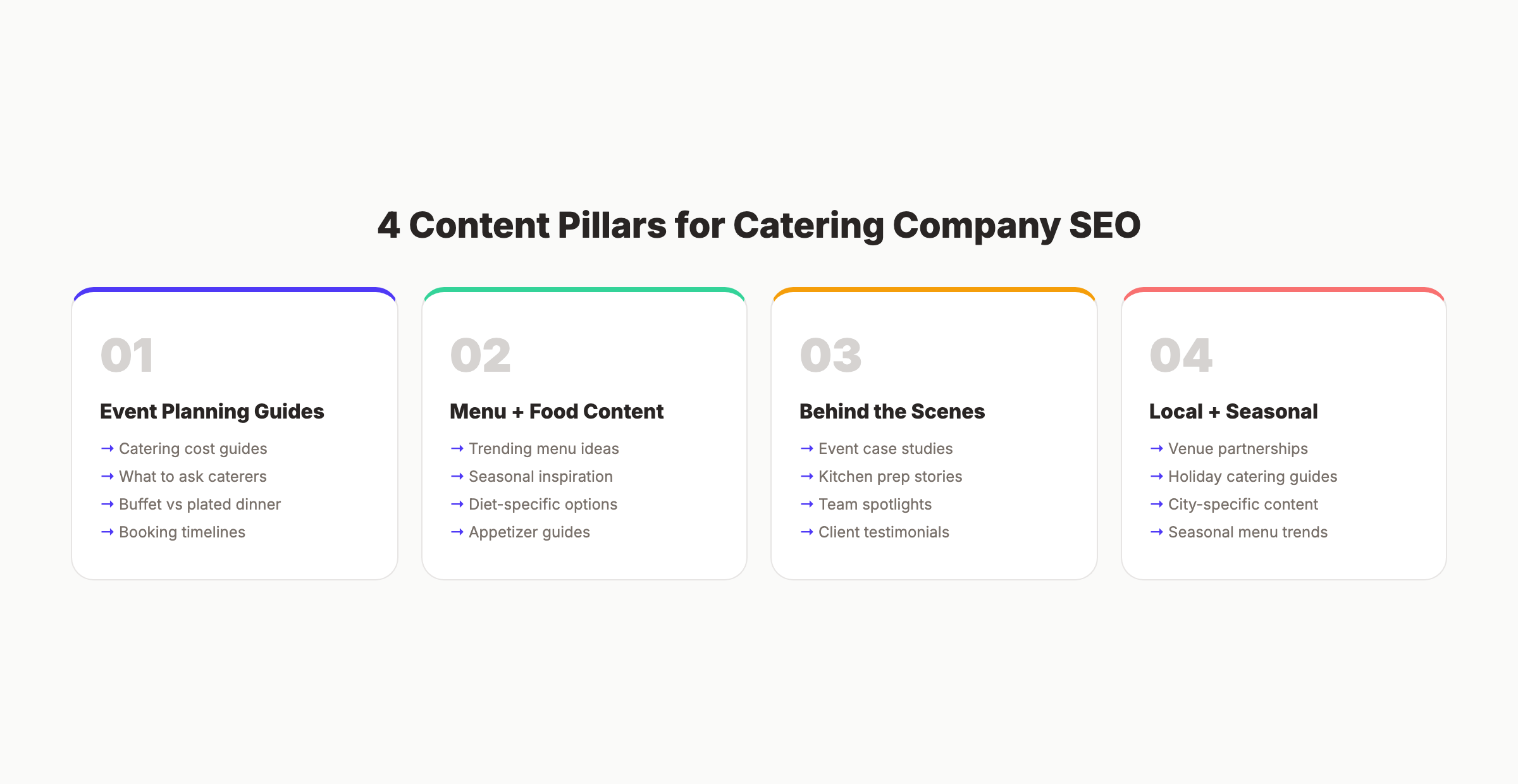
Pillar 1: Event Planning Guides Target the research stage. Position your company as a trusted expert:
- “How much does wedding catering cost per person in [city]?”
- “What to ask a caterer before booking”
- “Complete corporate event planning checklist”
- “How far in advance should you book a caterer?”
- “Buffet vs plated dinner: which is right for your event?”
Pillar 2: Menu and Food Content Showcase your expertise and attract food-focused searches:
- “Trending wedding menu ideas for 2026”
- “Best appetizers for corporate cocktail parties”
- “Vegan menu options for large events”
- “BBQ catering menu ideas for outdoor weddings”
- “Seasonal menu inspiration: fall dinner party”
Pillar 3: Behind-the-Scenes and Case Studies Build E-E-A-T signals with real examples:
- “How we catered a 300-guest wedding at [venue]”
- “Behind the scenes: corporate lunch prep for 500”
- “Event spotlight: farm-to-table dinner in [city]”
Pillar 4: Local and Seasonal Content Target location-specific and time-sensitive searches:
- “Best wedding venues in [city] (and which ones we cater)”
- “Holiday party catering options in [region]”
- “Summer outdoor event catering guide for [state]“
Publishing Frequency
| Publishing Pace | Timeline to Results | Growth Rate |
|---|---|---|
| 2-4 posts per month | 6-12 months | Slow build |
| 8-12 posts per month | 3-6 months | Strong growth |
| 20-30 posts per month | 60-90 days | Rapid authority |
Consistency builds topical authority. Google needs enough content to recognize your site as the go-to resource for catering in your market.
Technical SEO for Catering Websites
Technical issues silently prevent your content from ranking. Many catering websites run on basic builders with poor technical foundations.
Site Speed
Catering websites often load slowly due to high-resolution food photography. Target these Core Web Vitals thresholds:
| Metric | Target | Common Issue |
|---|---|---|
| LCP (Loading) | Under 2.5 seconds | Unoptimized food photos |
| INP (Interactivity) | Under 200ms | Heavy booking widgets |
| CLS (Visual Stability) | Under 0.1 | Late-loading image galleries |
Quick fixes:
- Convert all images to WebP format
- Lazy-load photo galleries and menu images
- Compress images before uploading (aim for under 200KB per image)
- Enable browser caching
- Defer non-critical JavaScript
Mobile Optimization
Most catering inquiries come from mobile devices. Event planners search while at venues, in meetings, or during commutes.
- Click-to-call button on every page
- Menu readable on mobile without pinching
- Quote request form easy to complete on phones
- Photo galleries scroll smoothly on mobile
- Navigation accessible with one thumb
Schema Markup
Schema markup helps Google understand your business. Implement these types:
- LocalBusiness (or FoodEstablishment) with NAP, hours, and service area
- Organization with sameAs links to social profiles
- Article/BlogPosting on every blog post
- FAQPage on service pages
- Menu schema if you display menus online
- Review schema for displayed testimonials
- Event schema for upcoming public events you cater
Use our Schema Markup Generator to create valid structured data.
3,500+ blogs published. 92% average SEO score. See what Stacc can do for your catering company. Start for $1 →
Reviews: Your Strongest Booking Tool
For catering companies, reviews directly influence booking decisions. Event planners trust reviews from other clients more than anything on your website.
Why Reviews Matter More for Caterers
Catering is a high-stakes service. Nobody wants mediocre food at their wedding or corporate event. Reviews provide the social proof that reduces risk in the buyer’s mind.
A caterer with 80 five-star reviews wins over a caterer with 5 reviews every time. Both in Google rankings and in client decisions.
Building a Review System
- Ask after every event. Send a personalized email within 24 hours of the event with a direct Google review link. The client is still excited about how the food turned out.
- Include the host and the planner. For corporate events, ask both the event coordinator and the company contact for reviews. For weddings, ask both the couple and the planner.
- Use a QR code. Print one on your invoices, business cards, and leave-behind materials at events.
- Respond to every review. Thank positive reviewers. Reference the specific event. Address negative reviews professionally.
- Share reviews on social media. Screenshot great reviews and post them. This encourages more clients to leave reviews.
Review Response Strategy
| Review Type | Response Approach |
|---|---|
| 5-star with event details | Thank by name, reference the event and menu highlights |
| 5-star generic | Thank them, mention the event type and location |
| 3-star with feedback | Acknowledge concern, explain your resolution, invite future collaboration |
| 1-star | Stay professional, state facts briefly, offer to discuss offline |
Target: 4-6 new reviews per month. Build review requests into your post-event follow-up workflow.
Link Building for Catering Companies
Backlinks from trusted websites signal to Google that your catering company is credible. For local businesses, local links carry the most weight.
High-Value Link Opportunities
| Source | How to Earn the Link |
|---|---|
| Wedding venues | Get listed as a preferred caterer on venue websites |
| Event planners | Partner with planners who link to vendors from their sites |
| Local business directories | Chamber of Commerce, BBB, local food associations |
| Wedding platforms | The Knot, WeddingWire, Zola vendor profiles |
| Food publications | Local food blogs, city magazines, restaurant review sites |
| Corporate event platforms | Cvent, Eventbrite vendor directories |
| Local news | Provide expert commentary for food-related stories |
Content That Earns Links
- Pricing guides: “How much does wedding catering cost in [city]?” earns links from wedding planning blogs.
- Venue partnerships: Co-create content with venues listing each other as recommended vendors.
- Event case studies: Detailed write-ups of notable events get shared by venues, planners, and clients.
- Menu inspiration: Seasonal menu guides earn links from food bloggers and event planning sites.
Common Catering SEO Mistakes
One Page for All Services
Putting all catering services on a single “Services” page limits your ranking potential. Create dedicated pages for wedding catering, corporate catering, private events, and each specialty you offer.
No Food Photography
Catering is a visual business. Stock photos or low-quality phone shots damage credibility. Invest in professional food photography. Update images seasonally.
Ignoring Google Business Profile
Your GBP is often the first thing potential clients see. An incomplete profile with no photos and no recent posts signals a dormant business. Keep it active.
Generic Location Pages
Creating 15 city pages with identical content except the city name earns a Google penalty. Each page must contain unique, useful content about catering in that specific area.
No Conversion Tracking
Ranking well means nothing without tracking which pages generate quote requests. Set up Google Analytics goals for form submissions, phone calls, and contact page visits.
Treating SEO as a One-Time Project
SEO requires ongoing effort. Update menus seasonally. Publish new content monthly. Respond to reviews weekly. The caterers who treat SEO as a continuous process outrank those who optimize once and forget.
Measuring Catering SEO Results
| Metric | Tool | Target |
|---|---|---|
| Organic traffic | Google Analytics | 20%+ growth quarter over quarter |
| 3-Pack rankings | Google Search Console | Top 3 for “[catering] + [city]“ |
| Keyword rankings | Semrush, Ahrefs, or Search Console | Page 1 for 10+ service keywords in 6 months |
| GBP profile views | GBP insights | Month-over-month increase |
| Quote requests from search | Form tracking or CRM | Track by landing page |
| Phone calls from search | Call tracking or GBP metrics | Consistent monthly increase |
| Review count and rating | GBP dashboard | 50+ reviews, 4.7+ average |
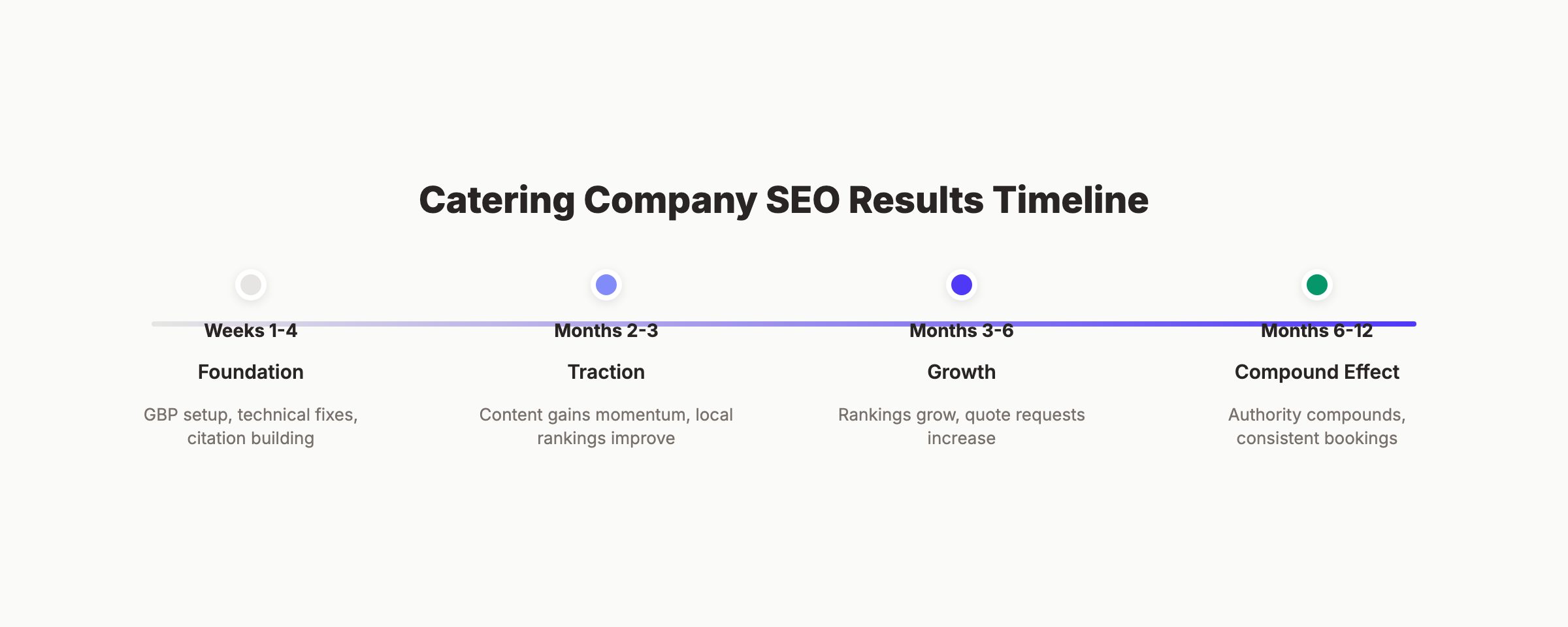
Timeline
- Weeks 1-4: Technical fixes, GBP optimization, citation building. Minor local improvements.
- Months 2-3: Content gains traction. Local rankings improve.
- Months 3-6: Rankings grow across service keywords. Quote requests increase.
- Months 6-12: Authority compounds. Consistent booking volume from organic search.
Rank everywhere. Do nothing. Blog SEO, Local SEO, and Social Media on autopilot for your catering company. Start for $1 →
FAQ
How long does SEO take for a catering company?
Most catering companies see initial local ranking improvements within 4-8 weeks. Meaningful results like consistent 3-Pack rankings and regular booking inquiries typically take 3-6 months. Start your SEO work well before your peak event season.
What keywords should catering companies target?
Focus on 3 keyword dimensions: event type (“wedding catering [city]”), cuisine style (“BBQ catering near me”), and client questions (“how much does catering cost per person”). Create separate pages for each service and event type you offer.
How much does catering SEO cost?
SEO agencies charge $1,500-5,000+ per month for local business SEO. Automated publishing services like Stacc start at $99 per month for 30 optimized articles. In-house blogging from freelance writers typically costs $80-250 per article.
Do Google reviews help catering companies get more bookings?
Yes. Reviews are one of the strongest local ranking signals and the most persuasive factor in booking decisions. Caterers with 50+ reviews and a 4.7+ average rating rank higher and convert more visitors into quote requests. Ask every client for a review within 24 hours of their event.
Should catering companies have a blog?
Absolutely. Blog content targets long-tail searches that service pages cannot cover. Posts like “trending wedding menu ideas” or “how far in advance to book a caterer” attract potential clients at the research stage. Publishing 4+ posts per month builds authority and drives consistent traffic.
What is the biggest SEO mistake catering companies make?
Putting all services on a single page. Caterers who create dedicated pages for wedding catering, corporate catering, private events, and each specialty rank for significantly more keywords and attract more qualified traffic than those with a single generic services page.
Catering company SEO comes down to being visible where event planners and clients search.
Start with your Google Business Profile and local citations. Create dedicated pages for every service you offer. Publish content that answers the questions clients ask before they book. The caterers who invest in this work now will own the local search results in their markets for years.
Written and published by Stacc. We publish 3,500+ articles per month across 70+ industries. All data verified against public sources as of March 2026.