
Email Marketing for Dentists: Fill More Chairs (2026)
Email marketing for dentists explained with 10 campaign types, HIPAA compliance rules, and real performance data. Reduce no-shows, reactivate patients.
Siddharth Gangal • 2026-03-29 • Content Strategy
In This Article
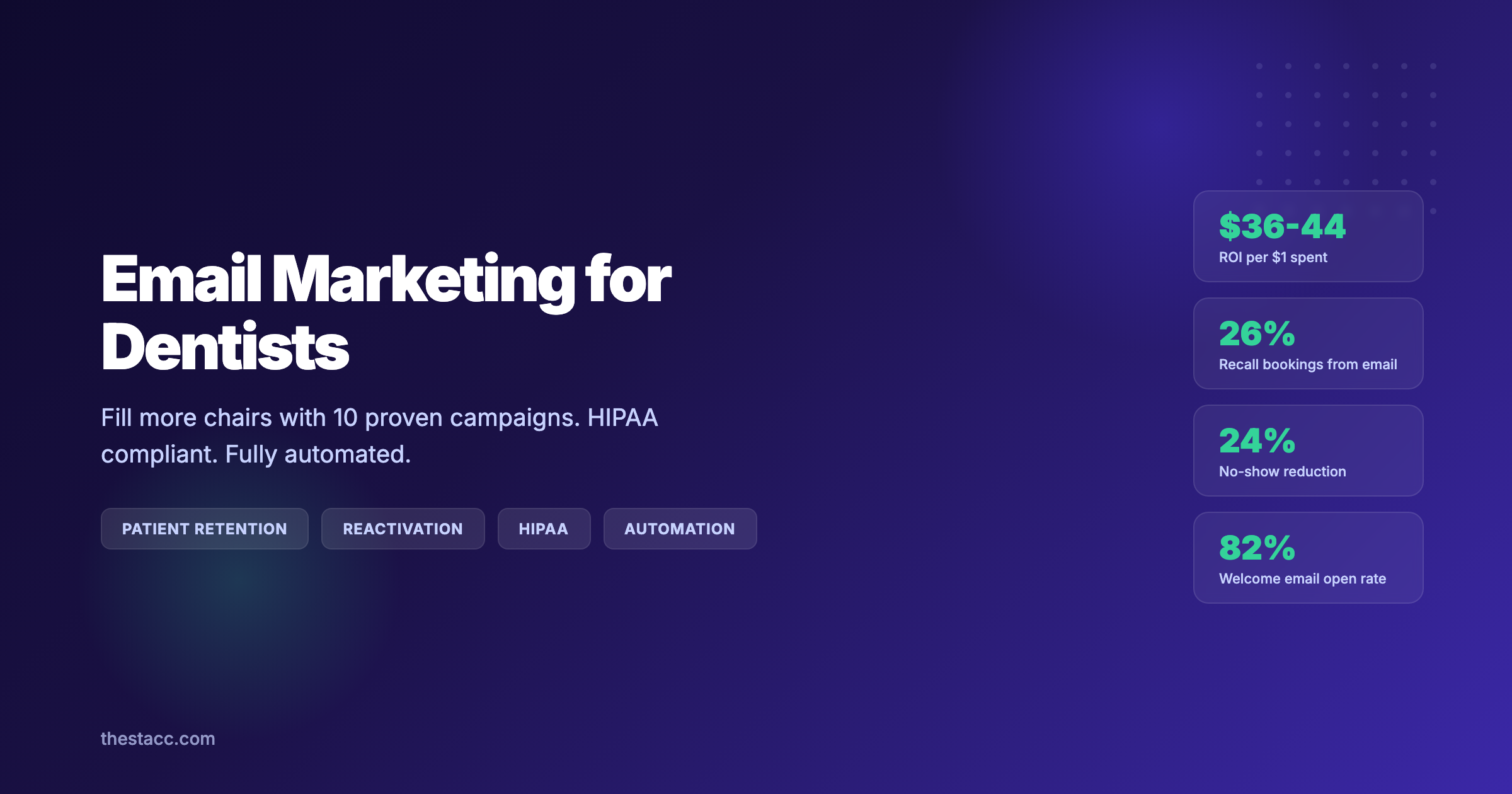
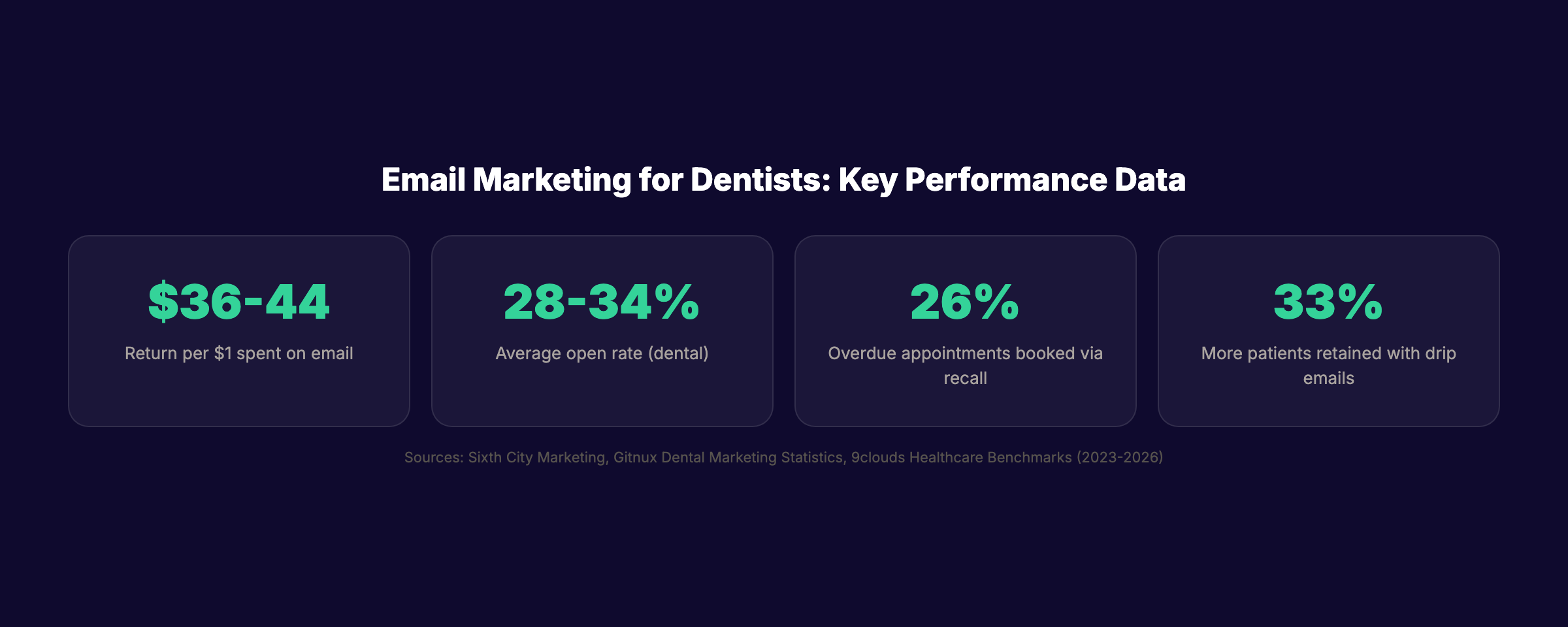
Only 20% of dental practices use email marketing. The other 80% rely on phone calls and postcards to fill chairs. Meanwhile, email marketing delivers $36 to $44 in return for every $1 spent, according to Sixth City Marketing.
Email marketing for dentists is the most cost-effective way to reduce no-shows, reactivate lapsed patients, and keep your schedule full. Hygiene recall emails alone book 26% of overdue appointments. Reactivation campaigns convert 10 to 12% of inactive patients. Drip follow-up sequences retain 33% more patients annually, per Gitnux dental marketing data.
The challenge: dental email marketing has HIPAA requirements that most marketing guides ignore. Sending the wrong type of email without proper consent can result in fines up to $50,000 per violation.
This guide covers the email campaigns that fill dental chairs, the compliance rules you must follow, and the metrics that prove ROI. We publish 3,500+ articles across 70+ industries at Stacc, including dental and healthcare practices.
Here is what you will learn:
- The 10 email campaigns every dental practice should run
- HIPAA compliance rules for dental email marketing
- How to build and segment your patient email list
- Open rate benchmarks and how to beat them
- Automation sequences that run without your involvement
- How to measure email ROI for your practice
Why Email Marketing Works for Dental Practices
Dental practices thrive on repeat visits. The average patient needs 2 cleanings per year plus any treatment work. Email keeps your practice top of mind between visits.
The Numbers
| Metric | Dental / Healthcare Benchmark |
|---|---|
| ROI | $36 - $44 per $1 spent |
| Average open rate | 28 - 34% |
| Welcome email open rate | 63 - 82% |
| Click-through rate | 1.75 - 7.31% |
| Unsubscribe rate | 0.06 - 0.25% |
| Reactivation booking rate | 10 - 12% |
| Hygiene recall booking rate | 26% |
| No-show reduction (with reminders) | 24% |
These numbers outperform most industries. Healthcare email open rates beat the all-industry average by 30 to 50%. Patients open dental emails because the content is personally relevant. Nobody ignores a message about their upcoming root canal.
Email vs Other Dental Marketing Channels
| Channel | Cost per Patient Acquired | Scalability | Retention Value |
|---|---|---|---|
| Google Ads | $50 - $200 | High | Low (one-time) |
| Direct mail / postcards | $0.50 - $2.00 per piece | Medium | Low |
| Social media | $20 - $80 per lead | Medium | Medium |
| Email marketing | $0.01 - $0.05 per email | High | Very high |
| Referral programs | $0 (organic) | Low | High |
Email costs almost nothing per send and drives the highest retention value. A patient who receives monthly emails stays active 33% longer than one who does not.
Stop writing. Start ranking. Stacc publishes 30 SEO articles per month for $99. Drive new patients to your practice with dental SEO on autopilot. Start for $1 →
The 10 Email Campaigns Every Dental Practice Should Run
1. Welcome Email Series (New Patient Onboarding)
Welcome emails earn the highest open rates of any email type. 63 to 82% of recipients open them. Send a 3-email series over 7 to 14 days after a new patient books.
Email 1 (immediate): Welcome to the practice. Introduce the dentist and team. Include what to bring to the first appointment, parking details, and office hours.
Email 2 (day 3): Share your most popular blog post or a “what to expect at your first visit” guide. Link to your Google Business Profile to encourage a follow after their visit.
Email 3 (day 7): Offer a first-visit bonus (free whitening consultation, discounted cleaning). Include a clear CTA to book.
2. Appointment Reminders
Appointment reminders are the single highest-ROI email for dental practices. They reduce no-shows by 24%.
Send reminders at 3 touchpoints:
- 7 days before the appointment
- 2 days before
- Morning of the appointment (consider SMS for this one)
Keep reminders under 100 words. Include the date, time, dentist name, and a one-click confirmation or reschedule link.
3. Hygiene Recall Emails
Patients forget to schedule their 6-month cleaning. Hygiene recall emails book 26% of overdue appointments.
Target patients who are 30 to 60 days past their recommended recall date. Send a 3-email sequence:
- Email 1 (30 days overdue): Friendly reminder
- Email 2 (45 days overdue): Emphasize importance of regular cleanings
- Email 3 (60 days overdue): Urgency message with a direct booking link
4. Patient Reactivation (Win-Back) Campaigns
Target patients with no visit in 12 to 18 months. Reactivation campaigns convert 10 to 12% of inactive patients.
Subject lines that work:
- “We miss your smile”
- “It has been a while. Your teeth miss us too.”
- “Your dental health check is overdue”
Send a 3-email drip over 2 weeks. Include a special offer in the final email (discounted cleaning, free X-rays for returning patients).
5. Educational Newsletters
Monthly newsletters keep your practice visible between visits. Educational content reduces no-shows by 24% because patients who understand the value of dental care are more likely to keep appointments.
Topics that perform well:
- Oral hygiene tips for different age groups
- “Foods that stain your teeth (and what to do about it)”
- Seasonal dental advice (summer sports mouthguard reminders, holiday candy and cavity prevention)
- New technology or service introductions
6. Post-Visit Follow-Up
Send within 24 hours of each appointment. Include aftercare instructions (if applicable), a thank-you message, and a review request.
Post-treatment check-in messages improve patient loyalty by 30%. They also create a natural opportunity to request a Google review while the positive experience is fresh.
7. Review and Referral Requests
Combine review and referral asks in a single post-visit email.
Paragraph 1: Thank them for their visit. Paragraph 2: “If you had a great experience, we would appreciate a Google review.” (Include direct link.) Paragraph 3: “Know someone who needs a dentist? Share this link for [X] off their first visit.”
Referral request emails generate 12 to 22% new patient conversion rates. Review emails build your local SEO profile.
8. Birthday and Anniversary Emails
Send a personalized birthday email with a small offer (10% off whitening, free fluoride treatment). Birthday emails earn high open rates because they feel personal, not promotional.
Also send a “1-year anniversary as our patient” email to celebrate loyalty.
9. Insurance Benefits Reminder (“Use It or Lose It”)
This is one of the highest-converting seasonal campaigns for dental practices. Send in October and November.
Subject line: “Your dental benefits expire December 31. Use them or lose them.”
Many patients have unused insurance benefits at year-end. A simple reminder drives a wave of Q4 bookings. This single campaign can fill 2 to 4 weeks of schedule in November and December.
10. New Service and Technology Announcements
Introduce new offerings: Invisalign, dental implants, same-day crowns, teeth whitening packages, sleep apnea treatment.
Frame the email around the patient benefit, not the technology. “Straighten your teeth without metal braces” beats “We now offer Invisalign clear aligners.”
Subject Lines That Get Opened
The subject line determines whether your email gets read or deleted. 64% of dental patients open emails on mobile, where only 30 to 40 characters display.
Subject line formulas that work for dental practices:
| Campaign Type | Subject Line Example |
|---|---|
| Appointment reminder | ”Your cleaning is in 2 days (Dr. Smith)“ |
| Hygiene recall | ”Your 6-month checkup is overdue” |
| Reactivation | ”We miss your smile, [First Name]“ |
| Insurance benefits | ”Your dental benefits expire Dec 31” |
| Seasonal promo | ”Whitening special: 20% off this month” |
| Birthday | ”Happy birthday, [First Name]. A gift from us.” |
| Educational | ”3 foods that secretly damage your teeth” |
| New service | ”Straighten your teeth without metal braces” |
Personalized subject lines with the patient’s first name increase open rates by 50%. Always include the most important information in the first 5 words.
Never use ALL CAPS, excessive exclamation marks, or spam trigger words like “free,” “act now,” or “limited time.” These phrases send dental emails directly to spam folders.
Your SEO team. $99 per month. 30 optimized articles, published automatically. Pair email marketing with blog SEO for a complete patient acquisition system. Start for $1 →
HIPAA Compliance for Dental Email Marketing
HIPAA divides dental emails into 2 categories with different rules.
Treatment Emails (No Special Authorization Needed)
These emails relate directly to patient care:
- Appointment reminders and confirmations
- Post-treatment care instructions
- Hygiene recall reminders
- Prescription or follow-up notifications
You can send treatment emails without separate marketing consent. They fall under the HIPAA treatment exception.
Marketing Emails (Written Consent Required)
These emails serve a commercial purpose:
- Newsletters
- Promotional offers
- Reactivation campaigns
- Birthday emails
- New service announcements
- Referral requests
Marketing emails require explicit written consent. Add an email marketing opt-in checkbox to your patient intake forms. Keep consent records for 6 years.
The HIPAA Email Checklist
- Written consent collected for all marketing email recipients
- Separate opt-in for marketing vs treatment communications
- No PHI (Protected Health Information) in email subject lines
- Email platform signs a Business Associate Agreement (BAA)
- End-to-end encryption for any emails containing PHI
- Clear unsubscribe link in every marketing email
- Physical mailing address in email footer (CAN-SPAM requirement)
- Staff trained on PHI handling in email communications
- Consent and email records retained for 6 years
HIPAA-Compliant Email Platforms
Standard email platforms are not HIPAA compliant by default. These platforms offer BAAs for dental practices:
| Platform | BAA Available | Best For |
|---|---|---|
| Mailchimp | Yes (paid plans) | General email marketing |
| Constant Contact | Yes (with add-on) | Small practices |
| Paubox | Yes (built-in) | PHI-heavy communications |
| Weave | Yes (built-in) | All-in-one practice management |
| LuxSci | Yes (built-in) | Enterprise healthcare |
Never send marketing emails through your personal Gmail or Outlook. Use a platform that signs a BAA and provides encryption.
How to Build and Segment Your Patient Email List
76% of dental practices that use email send the same message to every patient. Segmented emails outperform unsegmented emails by 41% in appointment compliance.
List Building Sources
- Patient intake forms (add email marketing opt-in checkbox)
- Practice management software export (Dentrix, Eaglesoft, Open Dental)
- Website contact forms and appointment booking forms
- Front desk verbal opt-in during check-in
- Patient portal registration
Segmentation That Matters
| Segment | Email Types to Send |
|---|---|
| New patients (first 90 days) | Welcome series, first-visit follow-up, review request |
| Active patients (visit in last 6 months) | Newsletter, seasonal campaigns, birthday emails |
| Overdue patients (6-12 months since visit) | Hygiene recall, gentle reminders |
| Inactive patients (12+ months) | Reactivation campaign, special offer |
| Treatment-specific (Invisalign, implants) | Educational content about their treatment, follow-ups |
| Families with children | Pediatric tips, back-to-school checkup reminders |
| Insurance benefit holders | Year-end “use it or lose it” campaign |
Even basic segmentation (active vs overdue vs inactive) dramatically improves results compared to sending the same email to everyone.
Email Design for Dental Practices
81% of patients open emails on smartphones. Design every email for mobile first.
Mobile-friendly email rules:
- Single column layout (no side-by-side columns)
- Font size: 16px minimum for body text
- CTA buttons: at least 44px tall and full-width on mobile
- Images: compressed, under 200KB, with alt text
- Preheader text: 40 to 90 characters that complement the subject line
- Total email length: 150 to 300 words for transactional, 300 to 500 for newsletters
Keep the design simple. A dental email does not need a complex template. Clean text with one clear call to action outperforms heavily designed emails. Use your practice logo at the top, your brand colors, and a single booking button.
Sending Frequency and Timing
55% of dentists who use email send once per month. This is a reasonable cadence for marketing emails. Appointment-triggered emails (reminders, follow-ups) are separate and do not count toward this limit.
Optimal send times for dental emails:
- Tuesday, Wednesday, or Thursday mornings (8am to 10am local time)
- 58% of people check email first thing in the morning
- Avoid Monday (inbox overload) and Friday (weekend mindset)
Automated emails trigger based on patient behavior and send at the right moment regardless of day. Only newsletters and promotional emails need manual scheduling.
Automation: Set It and Forget It
The best dental email marketing runs on autopilot. Set up these automated sequences once and they trigger based on patient behavior.
Essential Automations
| Trigger | Automated Sequence | Timing |
|---|---|---|
| New patient books | Welcome series (3 emails) | Immediate, day 3, day 7 |
| Appointment scheduled | Reminder series | 7 days, 2 days, day-of |
| Appointment completed | Post-visit follow-up + review request | 24 hours after |
| 6 months since last cleaning | Hygiene recall (3 emails) | Day 1, day 15, day 30 |
| 12 months with no visit | Reactivation campaign (3 emails) | Day 1, day 7, day 14 |
| Patient birthday | Birthday email with offer | Day of birthday |
These 6 automations cover 80% of the email marketing work a dental practice needs. Once configured, they run without manual effort.
3,500+ blogs published. 92% average SEO score. Pair blog content with email marketing for a complete patient growth system. Start for $1 →
Measuring Email Marketing ROI for Your Practice
Key Metrics to Track Monthly
| Metric | Benchmark | How to Improve |
|---|---|---|
| Open rate | 28 - 34% | Improve subject lines, send during morning hours |
| Click-through rate | 1.75 - 7% | Stronger CTAs, fewer links per email, mobile-optimized design |
| Booking rate from emails | 10 - 26% (varies by campaign) | Clearer booking CTAs, direct scheduling links |
| Unsubscribe rate | Under 0.25% | Segment properly, do not over-send |
| No-show rate change | 24% reduction target | Consistent appointment reminders |
| Reactivated patients per month | 10% of inactive list | Regular reactivation campaigns |
Connecting Email to Revenue
Track these connections:
- Email → Website visit: Use UTM parameters on all email links
- Website visit → Appointment booked: Track form submissions in Google Analytics
- Appointment → Revenue: Your practice management software shows revenue per appointment
If your average patient is worth $700 per year and a reactivation campaign brings back 20 patients, that campaign generated $14,000 in annual revenue from a single email sequence that cost under $50 to send.
A/B Testing for Continuous Improvement
Test one element at a time. Send version A to half your list and version B to the other half. Measure which performs better.
What to test:
- Subject lines (personalized vs generic)
- Send time (morning vs afternoon)
- CTA button text (“Book Now” vs “Schedule Your Cleaning”)
- Email length (short vs detailed)
- With image vs text-only
Run each test for at least 500 recipients to get statistically meaningful results. Apply the winner to future campaigns. Small improvements compound. A 5% increase in open rate across 12 monthly campaigns significantly increases annual bookings.
FAQ
What is a good email open rate for dental practices?
Dental and healthcare emails average 28 to 34% open rates. Welcome emails reach 63 to 82%. If your open rate falls below 20%, test new subject lines, send times, and list hygiene. Personalized subject lines increase opens by 50%.
How often should a dental practice send marketing emails?
Send 1 to 2 marketing emails per month (newsletters, promotions). Appointment reminders and post-visit emails are triggered by patient activity and do not count toward this cadence. Over-emailing increases unsubscribes. Under-emailing causes patients to forget your practice.
Is email marketing HIPAA compliant for dentists?
It can be. Treatment emails (reminders, care instructions) are covered under the treatment exception. Marketing emails require written consent. All emails containing PHI must use an encrypted, BAA-signed platform. Standard Gmail is not HIPAA compliant.
How do I reactivate patients who have not visited in over a year?
Send a 3-email reactivation sequence over 2 weeks. Start with a friendly “we miss you” message. Follow with an educational email about the risks of skipping dental visits. Close with a special offer (discounted cleaning, free X-rays). Expect 10 to 12% of inactive patients to book.
What email platform should a dental practice use?
Choose a platform that signs a Business Associate Agreement (BAA). Mailchimp (paid plans), Constant Contact, Weave, and Paubox all offer BAAs. Your practice management software (Dentrix, Eaglesoft) may also include built-in email features.
Do appointment reminder emails really reduce no-shows?
Yes. Automated reminder emails reduce no-shows by approximately 24%. The most effective cadence is 7 days, 2 days, and morning-of reminders. Adding SMS as a fallback channel improves results further.
Email marketing for dental practices costs almost nothing to run and delivers the highest retention ROI of any marketing channel. Start with appointment reminders and post-visit follow-ups. Add a monthly newsletter and a reactivation campaign. Automate everything. The practices filling their schedules in 2026 are the ones that built these systems early.
Written and published by Stacc. We publish 3,500+ articles per month across 70+ industries. All data verified against public sources as of March 2026.
