Email Marketing for Restaurants: Complete Guide
The complete email marketing guide for restaurants. Campaign types, list building, automation, and benchmarks with real data. Updated 2026.
Siddharth Gangal • 2026-03-29 • Content Strategy
In This Article
Email marketing for restaurants returns $36 to $42 for every $1 spent. That makes it the highest-ROI marketing channel available to restaurant owners. Higher than social media. Higher than paid ads. Higher than print.
53% of diners have visited a new restaurant because of a marketing email. 69% choose where to eat based on food photos in emails. And 67% of restaurant operators already automate their email marketing. The restaurants that are not sending emails are leaving revenue on the table.
This guide covers how to build an email list, which campaigns to send, how to automate the process, and how to measure results. Every recommendation is backed by restaurant industry data.
We have published 3,500+ SEO articles across 70+ industries, including restaurants, cafes, bars, and food service businesses. This guide reflects what drives reservations and repeat visits right now.
Here is what you will learn:
- Why email outperforms social media for restaurants
- 5 ways to build your email list starting today
- The 7 email campaigns that drive the most revenue
- How to write subject lines that get 40%+ open rates
- Automation workflows that run without your involvement
- Restaurant-specific email benchmarks to measure against
Why Email Marketing Works for Restaurants
Email is 40x more effective at acquiring customers than Facebook or Twitter combined. For restaurants, the numbers are even stronger because the relationship between emails and in-person visits is direct.
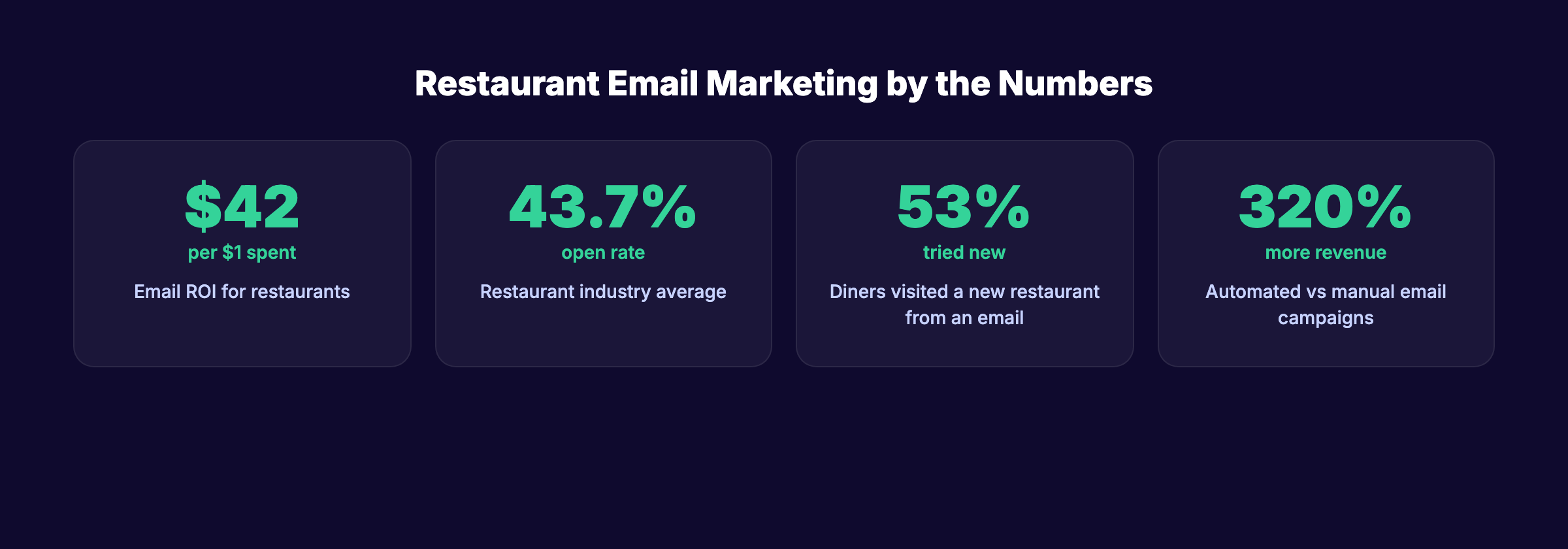
Restaurant Email Benchmarks
| Metric | Restaurant Average | All Industries Average |
|---|---|---|
| Open rate | 40% to 43.7% | 21% to 25% |
| Click-through rate | 1.1% to 2.4% | 1.0% to 2.0% |
| Unsubscribe rate | 0.17% to 0.30% | 0.26% |
| ROI | $36 to $42 per $1 spent | $36 per $1 spent |
Restaurant emails outperform most industries on open rate because food is personal. People open emails from restaurants they like. They do not open emails from software companies they signed up for once.
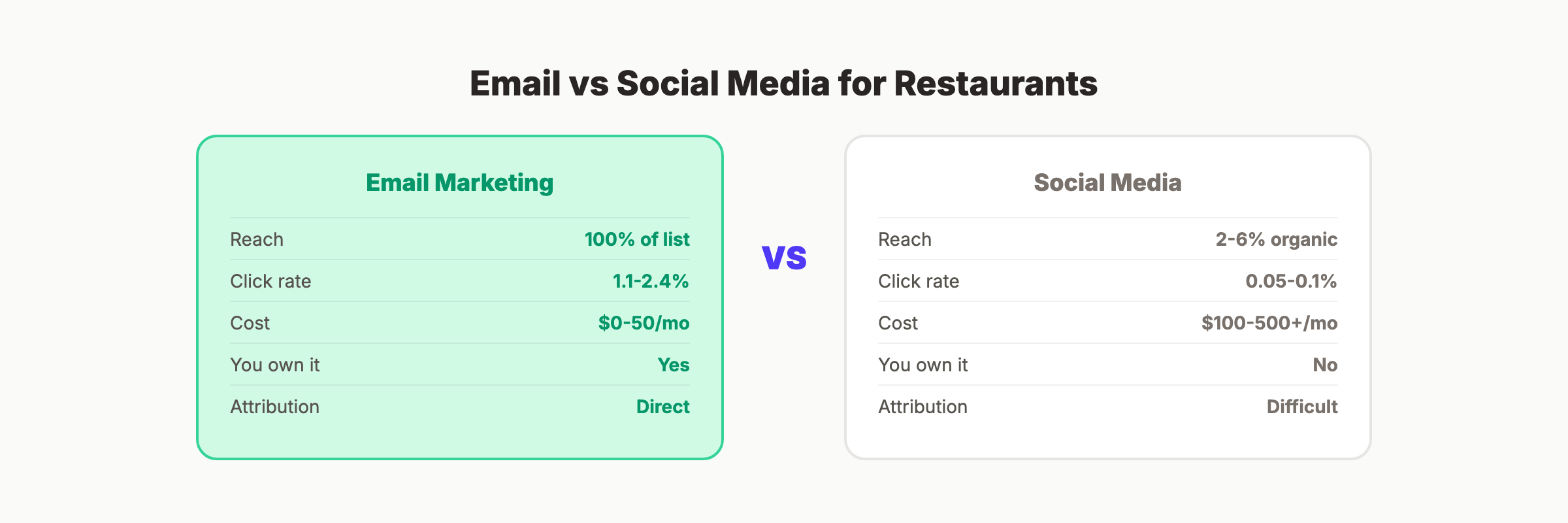
Email vs Social Media for Restaurants
| Factor | Social Media | |
|---|---|---|
| Reach | 100% of your list (deliverability permitting) | 2% to 6% organic reach on Instagram/Facebook |
| Ownership | You own the list. No algorithm changes. | Platform owns the audience. Algorithm controls visibility. |
| Click-through rate | 1.1% to 2.4% | 0.05% to 0.1% organic |
| Cost | $0 to $50/month for most restaurants | $100 to $500+/month in ad spend for comparable reach |
| Attribution | Direct tracking (opens, clicks, reservations) | Difficult to tie posts to visits |
This does not mean you should stop posting on social media. But email should be your primary owned-audience channel. Social media drives discovery. Email drives repeat business. For social strategies, see our guide on social media for restaurants.
Your SEO team. $99 per month. 30 optimized articles published automatically. Built for restaurants and local businesses. Start for $1 →
Building Your Restaurant Email List
You cannot send emails without subscribers. Most restaurants start with zero and grow slowly because they rely on a single collection method. Use all 5 of these channels simultaneously.
5 Ways to Collect Email Addresses
1. WiFi capture page. Offer free WiFi in exchange for an email address. Guests connect, enter their email, and get internet access. This is the highest-volume method for dine-in restaurants.
2. Table tents and QR codes. Print a QR code that links to a signup form. Place it on every table, at the host stand, and on the receipt. Offer a reason to sign up: “Get a free appetizer on your next visit.”
3. Online ordering and reservations. Every online order and reservation form should include an email opt-in checkbox. If you use Toast, OpenTable, Resy, or Square, enable the email collection feature in your settings.
4. Your website. Add a signup form on your homepage, menu page, and contact page. Keep the form simple: name and email only. Offer a clear incentive. “Join our email list for exclusive offers and first access to seasonal menus.”
5. In-person at checkout. Train cashiers and servers to ask: “Would you like to join our email list for a 10% off coupon?” Collect the email on a tablet or written card. Enter it into your system the same day.
List Growth Targets
| Restaurant Type | Monthly Signups (Target) | List Size After 12 Months |
|---|---|---|
| Quick-service (100+ daily customers) | 200 to 400 | 2,400 to 4,800 |
| Casual dining (50 to 100 daily) | 100 to 200 | 1,200 to 2,400 |
| Fine dining (20 to 50 daily) | 40 to 100 | 480 to 1,200 |
Even a list of 500 subscribers generates revenue if you email them consistently. Do not wait for 5,000 subscribers before starting campaigns. Start sending the day you have 50 addresses.
Segmentation: Send the Right Email to the Right Person
Once your list grows past 200 subscribers, start segmenting. Segmentation accounts for 77% of all email marketing ROI. That means the majority of your email revenue comes from sending targeted messages to specific groups, not blasting the same email to everyone.
Segment your restaurant email list by:
- Visit frequency — Regulars (weekly), occasional (monthly), lapsed (60+ days)
- Dining preference — Dine-in vs takeout vs delivery
- Spend level — High-value guests vs average-check guests
- Dietary needs — Vegetarian, gluten-free, allergies (if collected)
- Special dates — Birthdays, anniversaries
A vegetarian subscriber receiving an email about your new steak special is a wasted send. A birthday email sent to the right person on the right day generates 3.42x more revenue. Segmentation makes that difference.
For more list-building and marketing strategies, see our restaurant marketing guide and our broader guide on email marketing for local businesses.
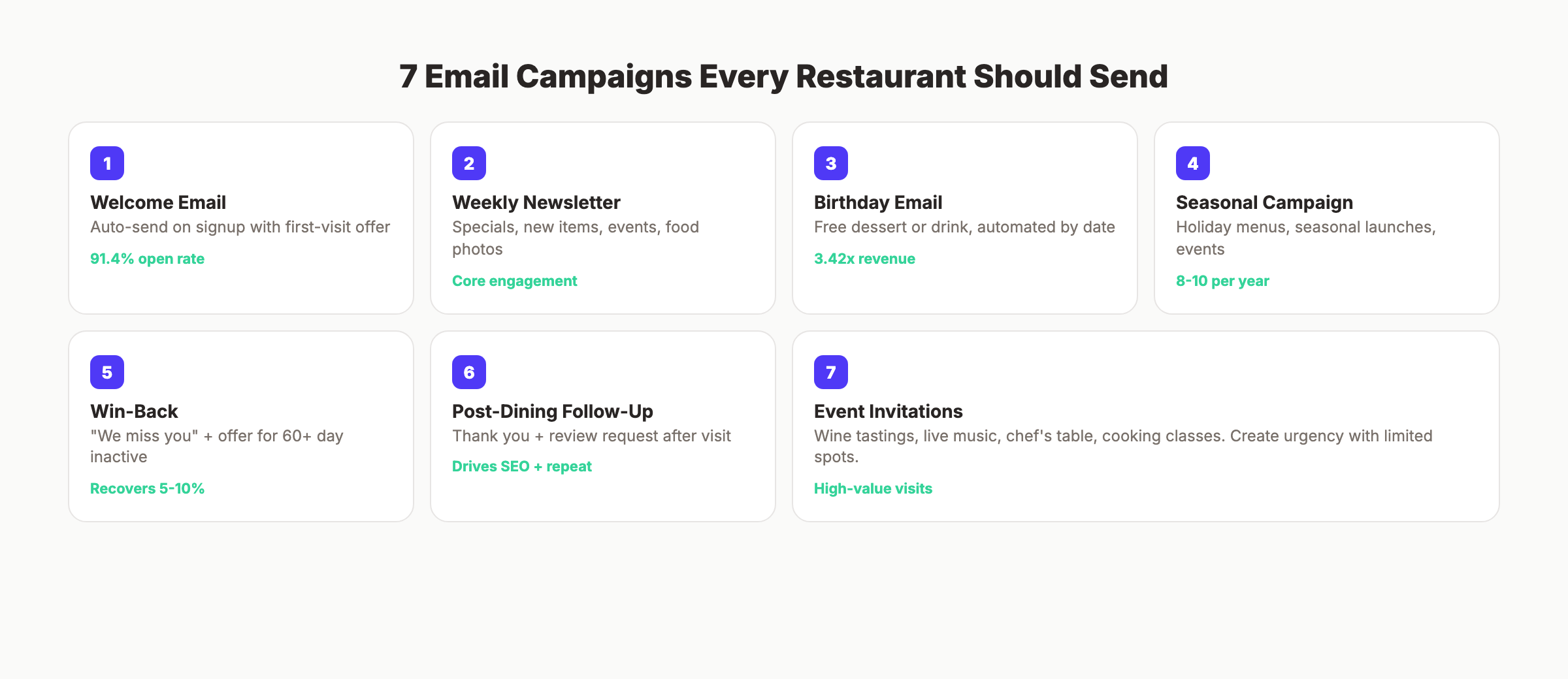
7 Email Campaigns Every Restaurant Should Send
These 7 campaign types cover the full customer lifecycle. Set them up once and they run on autopilot.
1. Welcome Email
Trigger: Immediately after someone joins your list. Open rate: 91.43% (the highest of any email type).
Thank the subscriber. Tell them what to expect (weekly specials, event invites, exclusive offers). Include a first-visit incentive. A free appetizer or 10% discount drives a fast first visit.
2. Weekly or Bi-Weekly Newsletter
Frequency: 1 to 2 times per week. Content: This week’s specials, new menu items, upcoming events, behind-the-scenes photos.
This is your core email. It keeps your restaurant top-of-mind between visits. Use high-quality food photos. 69% of diners choose restaurants based on food images in emails. For newsletter content ideas, see our guide on email newsletter ideas.
3. Birthday and Anniversary Emails
Trigger: Automated, based on the date the customer provided. Revenue impact: Birthday emails generate 3.42x more revenue per message than regular campaigns.
Offer a free dessert, a complimentary drink, or a discount. Birthday emails have the highest redemption rate of any campaign type because the offer feels personal.
4. Seasonal and Holiday Campaigns
Timing: 2 to 3 weeks before major holidays and seasonal menu changes.
Valentine’s Day prix fixe menu. Mother’s Day brunch reservations. Summer patio opening. Fall menu launch. Holiday party catering packages. Plan 8 to 10 seasonal campaigns per year.
5. Re-Engagement (Win-Back) Campaign
Trigger: Automated. Fires when a subscriber has not opened an email or visited in 60+ days.
Subject line: “We miss you at [Restaurant Name].” Include a personal offer. A free side, a 15% discount, or early access to a new menu item. Re-engagement campaigns recover 5% to 10% of inactive subscribers.
6. Post-Dining Follow-Up
Trigger: 24 hours after a reservation or online order.
Thank the guest. Ask for a Google review. Include a link to your Google review form. This single email drives both repeat business and local SEO. Reviews affect your restaurant’s local search ranking directly.
7. Event Invitations
Timing: 2 to 4 weeks before the event.
Wine tastings, live music nights, chef’s table dinners, cooking classes, holiday parties. Create urgency: “Limited to 30 guests. Reserve your spot.” Event emails build community and drive high-value visits.
Campaign Calendar: Monthly Planning
Plan your email campaigns 30 days in advance. A simple calendar prevents last-minute scrambling and ensures consistent sending.
| Week | Campaign Type | Example |
|---|---|---|
| Week 1 | Newsletter + seasonal | Weekly specials + seasonal menu preview |
| Week 2 | Newsletter + event | Weekly specials + upcoming wine tasting invite |
| Week 3 | Newsletter + promotional | Weekly specials + subscriber-exclusive 15% off |
| Week 4 | Newsletter + community | Weekly specials + local partnership or charity event |
Automated campaigns (welcome, birthday, win-back, follow-up) run in the background on top of this calendar. For content planning help, see our content calendar guide.
3,500+ blogs published. 92% average SEO score. Every article passes a 40-point quality audit before it goes live. Start for $1 →
Writing Emails That Get Opened and Clicked
The average restaurant email open rate is 40% to 43.7%. But that number only holds if your subject lines are strong and your content is worth clicking.
Subject Line Rules
| Rule | Example | Why It Works |
|---|---|---|
| Keep it short (5 to 7 words) | “New summer menu is here” | Mobile screens cut off longer subject lines |
| Use the subscriber’s name | ”Sarah, your birthday treat is ready” | Personalized subject lines get 14.68% higher open rates |
| Create urgency | ”Tonight only: 20% off dinner” | Time-limited offers drive immediate opens |
| Lead with food | ”Fresh lobster rolls, this weekend only” | Food triggers are the strongest hook for restaurant emails |
| Ask a question | ”Ready for the best brunch in [City]?” | Questions create curiosity |
Email Content Best Practices
- One primary CTA per email. “Reserve Now” or “Order Online.” Not both. Too many options reduce clicks.
- Use real food photography. Never use stock photos. Diners recognize generic food images instantly.
- Mobile-first design. 55% to 56% of restaurant emails open on mobile. Use a single-column layout. Buttons at least 44x44 pixels.
- Keep it short. 50 to 150 words for promotional emails. 200 to 300 words for newsletters. Restaurants are not publishing blog posts via email.
- Include your location and hours. Every email footer needs your address, phone number, and hours. Make it easy to find you.
Optimal Send Times for Restaurants
| Day | Open Rate | Best Use |
|---|---|---|
| Monday | 51.9% | Weekly specials, upcoming events |
| Sunday | 51.3% | Brunch promotions, week-ahead preview |
| Tuesday | 51.0% | Midweek offers, slow-night promotions |
Best time window: 3 PM to 7 PM (when people start thinking about dinner). Morning sends (8 to 9 AM) work well for breakfast and lunch promotions.
Automation: Set It Up Once, Run Forever
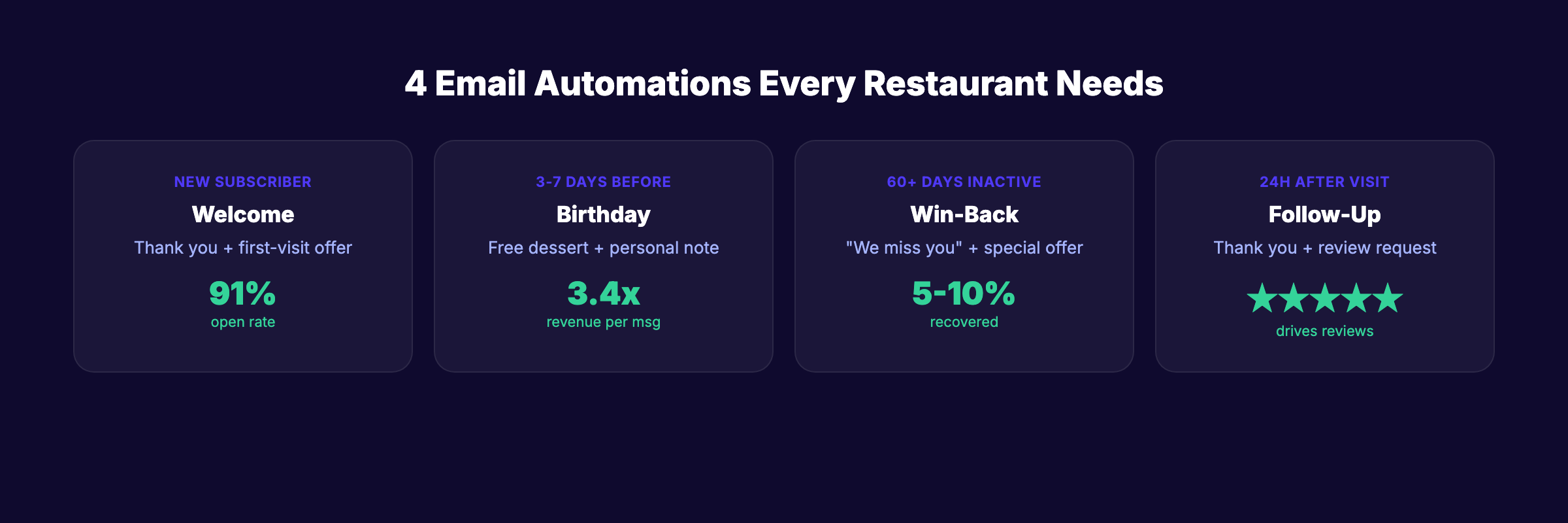
Automated emails generate 320% more revenue than manual campaigns. They also achieve a 42.1% open rate compared to 25.2% for regular sends.
The 4 Automations Every Restaurant Needs
| Automation | Trigger | Content | Expected Impact |
|---|---|---|---|
| Welcome series | New subscriber | Thank you + what to expect + first-visit offer | 91.43% open rate |
| Birthday email | 3 to 7 days before birthday | Free dessert or drink + personalized message | 3.42x revenue per message |
| Win-back campaign | 60+ days inactive | ”We miss you” + special offer | Recovers 5% to 10% of inactive subscribers |
| Post-visit follow-up | 24 hours after reservation/order | Thank you + review request + next visit incentive | Drives reviews and repeat visits |
Set these up once in your email platform. They fire automatically based on subscriber data. You do not write new emails each time. The system does the work.
For more on automating your restaurant’s marketing, see our guide on marketing automation for local businesses.
Choosing an Email Platform
Pick one platform and commit. The best platform is the one you will actually use consistently.
Platform Comparison for Restaurants
| Platform | Free Plan | Paid From | Best For |
|---|---|---|---|
| Mailchimp | 500 contacts, 1,000 sends/mo | $13/mo | Most restaurants. Easy templates. Restaurant-specific benchmarks |
| Constant Contact | 60-day trial | $12/mo | Event-heavy restaurants. Strong event management features |
| Klaviyo | 250 contacts, 500 sends/mo | $20/mo | Online ordering focused. Strong automation and segmentation |
| Toast Marketing | Included with Toast POS | Part of Toast subscription | Toast POS users. Direct integration with orders and guest data |
| Omnisend | 250 contacts, 500 sends/mo | $16/mo | Multi-channel (email + SMS). Good for quick-service chains |
For most independent restaurants, Mailchimp is the right starting point. Free for up to 500 contacts. Simple drag-and-drop editor. Pre-built automation templates. You can always upgrade or switch later.
If your restaurant uses Toast as your POS, use Toast Marketing first. The direct integration with order history and guest data makes segmentation automatic.
What to Look for in a Platform
Regardless of which platform you choose, verify these features before committing:
- Pre-built automation workflows (welcome, birthday, win-back)
- Drag-and-drop email editor with mobile preview
- Segmentation by custom fields (birthday, preferences)
- Integration with your POS or reservation system
- Reporting on opens, clicks, and revenue attribution
- Free plan or trial to test before paying
Do not overpay for features you will not use. A restaurant sending 2 emails per week to 1,000 subscribers does not need enterprise-level analytics. Start simple. Upgrade when your list and revenue justify it. For broader marketing automation guidance, see our guide on marketing automation for local businesses.
Measuring Restaurant Email Marketing ROI
Track these 5 metrics monthly. They tell you whether your email marketing is working.
The 5 Metrics That Matter
| Metric | Target | Where to Find It |
|---|---|---|
| Open rate | 35%+ (restaurant average is 40% to 43.7%) | Your email platform dashboard |
| Click-through rate | 1.5%+ | Your email platform dashboard |
| Revenue per email | Track over time, improve monthly | Coupon redemptions + online orders attributed to email |
| List growth rate | 5% to 10% monthly net growth | (New subscribers - unsubscribes) / total list |
| Unsubscribe rate | Under 0.3% per send | Your email platform dashboard |
How to Calculate Email Marketing ROI
- Track coupon redemptions from email-exclusive offers
- Track online orders that came from email links (use UTM parameters)
- Track reservations made through email CTAs
- Add up the total revenue from those actions
- Subtract your email platform cost
- Divide revenue by cost
A restaurant spending $30 per month on Mailchimp and generating 20 coupon redemptions at $40 average check earns $800 in attributable revenue. That is a 2,567% ROI.
For a broader marketing measurement framework, see our guide on local business marketing plans.
Rank everywhere. Do nothing. Blog SEO, Local SEO, and Social on autopilot. Stacc starts at $99 per month with a $1 trial. Start for $1 →
FAQ
Is email marketing effective for restaurants?
Yes. Restaurant emails achieve a 40% to 43.7% open rate, nearly double the all-industry average. 53% of diners have visited a new restaurant because of a marketing email. Email generates $36 to $42 per $1 spent, making it the highest-ROI channel for most restaurants.
How often should a restaurant send marketing emails?
1 to 2 times per week is the sweet spot for most restaurants. Weekly newsletters keep you top-of-mind without annoying subscribers. 43% of people unsubscribe when emails come too frequently. Start with 1 per week and increase based on your open and unsubscribe rates.
How do I build an email list for my restaurant?
Use 5 channels simultaneously: WiFi capture pages (guests trade email for WiFi access), QR codes on tables and receipts, online ordering/reservation forms with opt-in, website signup forms, and in-person collection at checkout. Offer an incentive for every signup. A free appetizer or 10% discount works best.
What is the best email marketing platform for restaurants?
Mailchimp for most independent restaurants (free for 500 contacts, easy templates, restaurant benchmarks). Toast Marketing if you use Toast POS (direct integration with guest and order data). Klaviyo for restaurants with strong online ordering (advanced automation and segmentation).
What types of emails should restaurants send?
The 7 essential types: welcome emails (91% open rate), weekly newsletters, birthday emails (3.42x revenue), seasonal campaigns, win-back emails for inactive subscribers, post-dining follow-ups (drives reviews), and event invitations. Automate the first 4 types so they run without manual effort.
How can restaurants reduce email unsubscribe rates?
Keep frequency to 1 to 2 emails per week. Send relevant content (not just discounts). Segment your list by dining preferences and visit frequency. Use real food photography. Personalize subject lines. And always include valuable content like menu previews, chef stories, or event invitations alongside any promotional offers.
Email marketing is the most direct line between a restaurant and its repeat customers. Every email builds the relationship. Every offer drives a visit. The restaurants that send consistent, well-designed emails fill tables that their competitors leave empty.
Skip the agency. Keep the results. Stacc starts at $99 per month with a $1 trial. 30 articles. Published automatically. Start for $1 →
Written and published by Stacc. We publish 3,500+ articles per month across 70+ industries. All data verified against public sources as of March 2026.