
Restaurant Marketing: The Complete Guide (2026)
The complete restaurant marketing guide. SEO, social media, reviews, email, and local ads. 74% of diners use social to choose restaurants. Updated March 2026.
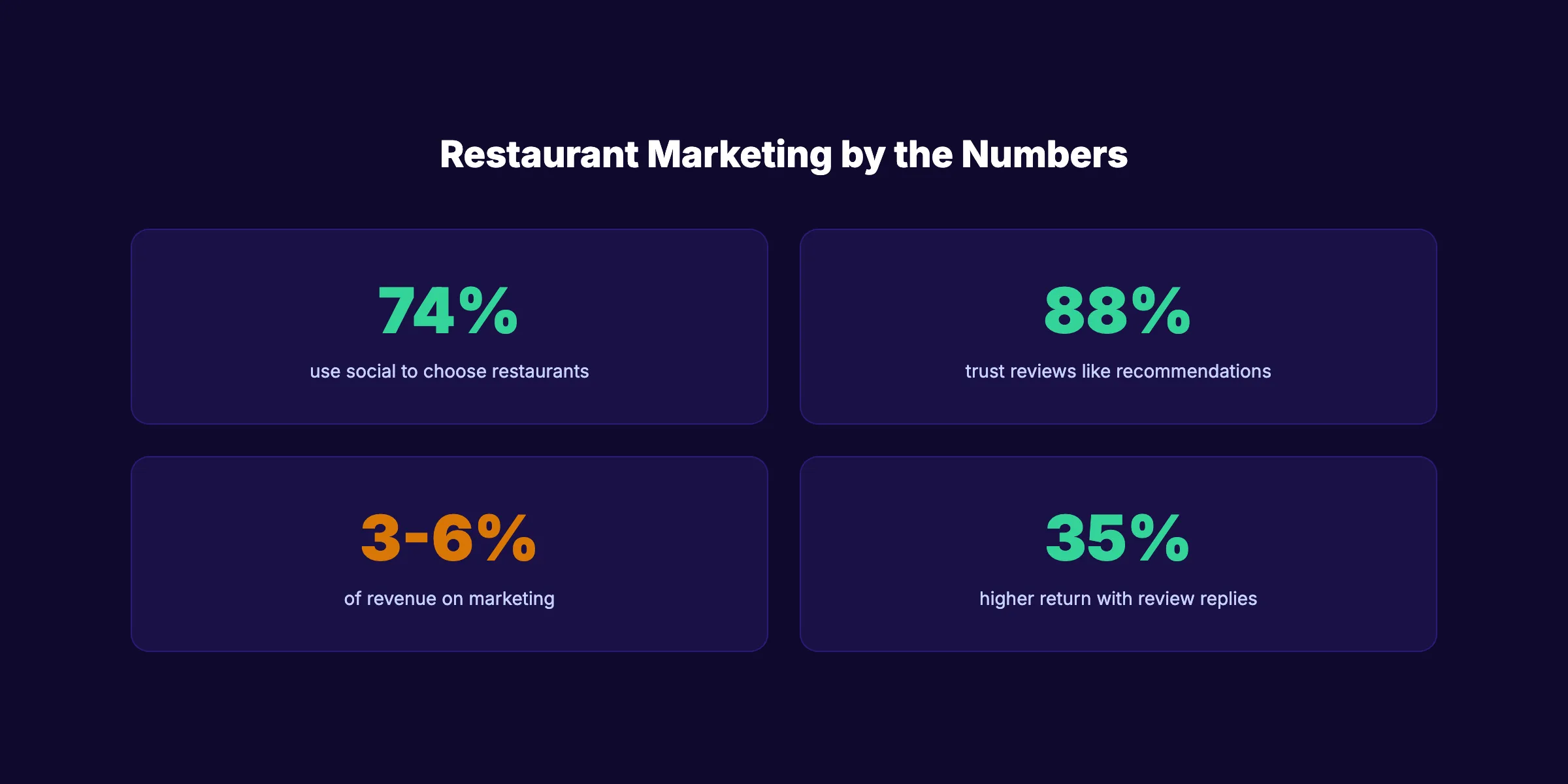
74% of diners use social media to decide where to eat. 88% trust online reviews as much as personal recommendations. Yet most restaurants spend 90% of their energy on food quality and 10% on making sure anyone knows about it.
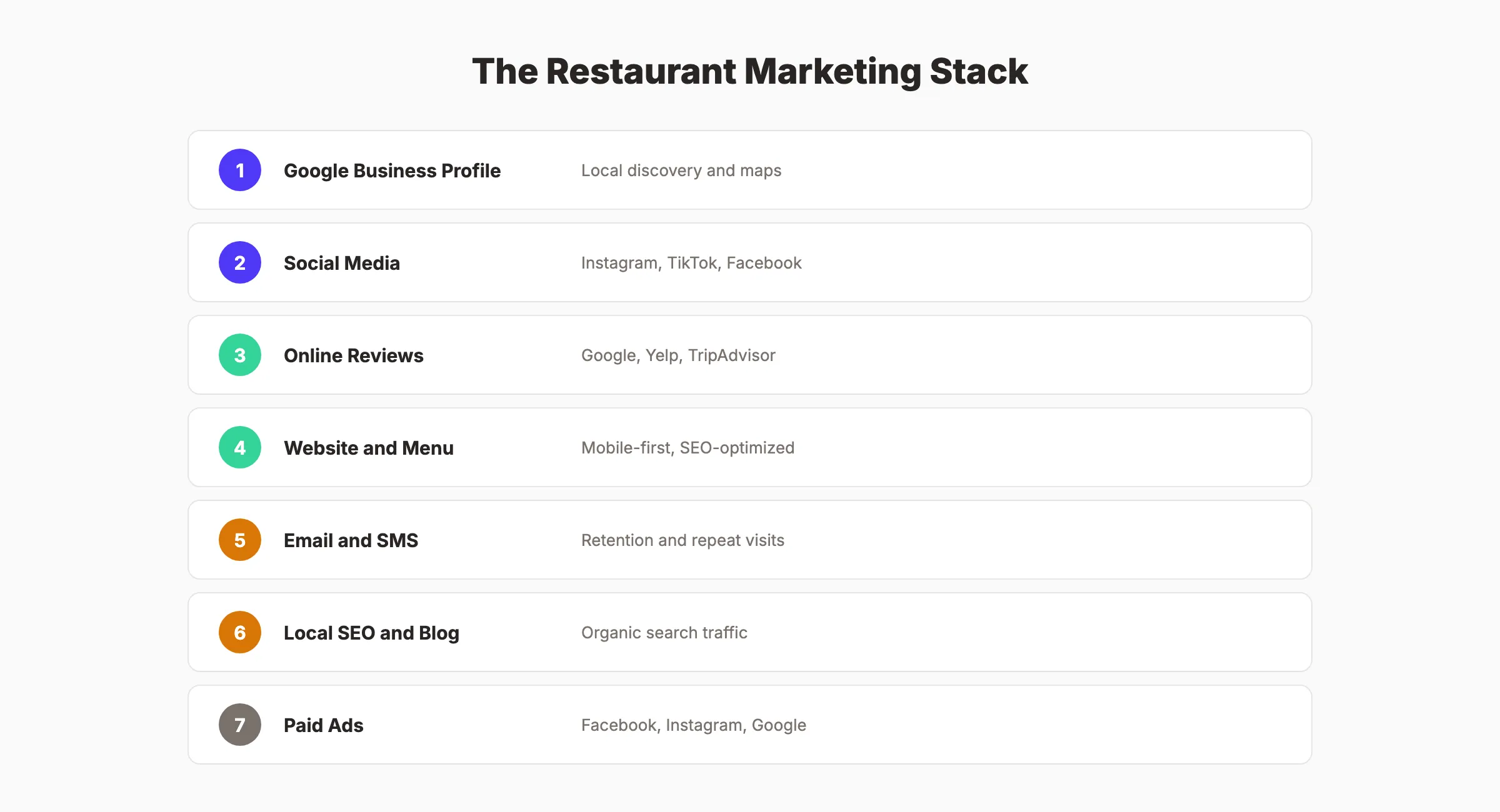
Restaurant marketing in 2026 is not complicated. It requires 7 channels working together: Google Business Profile, social media, reviews, your website, email, local SEO, and paid ads. Most restaurants already do 1 or 2 of these. The ones filling every seat do all 7 consistently.
The average restaurant spends 3 to 6% of revenue on marketing. For a restaurant doing $1 million in annual revenue, that is $30,000 to $60,000 per year. The question is not whether to spend. The question is where to spend it.
We publish content across 70+ industries including restaurants and food service. This guide covers every channel with specific actions, budgets, and timelines you can implement this week.
Here is what you will learn:
- The 7 marketing channels every restaurant needs
- How to allocate your marketing budget by channel
- A weekly content calendar built for restaurants
- How reviews, social media, and SEO work together
- Specific tactics for Instagram, TikTok, and Google
- How to automate restaurant marketing without losing authenticity
Chapter 1: Why Restaurant Marketing Matters More Than Ever
The restaurant industry generates over $1 trillion in annual sales in the US alone. Competition is intense. According to the National Restaurant Association’s 2026 report, 90% of restaurants consider social media “very or extremely important” to their marketing strategy.
The Discovery Path
Modern diners follow a predictable path before choosing a restaurant:
- Search , “best Italian restaurant near me” on Google or Google Maps
- Social proof. Check Instagram, TikTok, or Yelp for photos and reviews
- Reviews. Read Google reviews. Check the star rating.
- Menu. View the menu online. Check prices.
- Book or visit. Call, book online, or walk in
Your marketing needs to show up at every step. A restaurant with a great Google listing but no Instagram loses the diner who checks social before booking. A restaurant with a strong Instagram but 3.5 stars on Google loses the diner who reads reviews.
The Numbers That Drive Decisions
| Metric | Stat |
|---|---|
| Diners who use social to choose restaurants | 74% |
| Trust online reviews like personal recommendations | 88% |
| TikTok users who visit after seeing menu content | 55% |
| Higher return rate when restaurants reply to reviews | 35% |
| Average restaurant marketing spend | 3-6% of revenue |
| User-generated content conversion vs branded photos | 4x higher |
Chapter 2: The 7-Channel Marketing Stack
Channel 1: Google Business Profile
Your Google Business Profile is how diners find you on Google Maps and local search. When someone searches “sushi near me,” the local 3-pack shows 3 restaurants. Yours needs to be one of them.
Weekly actions:
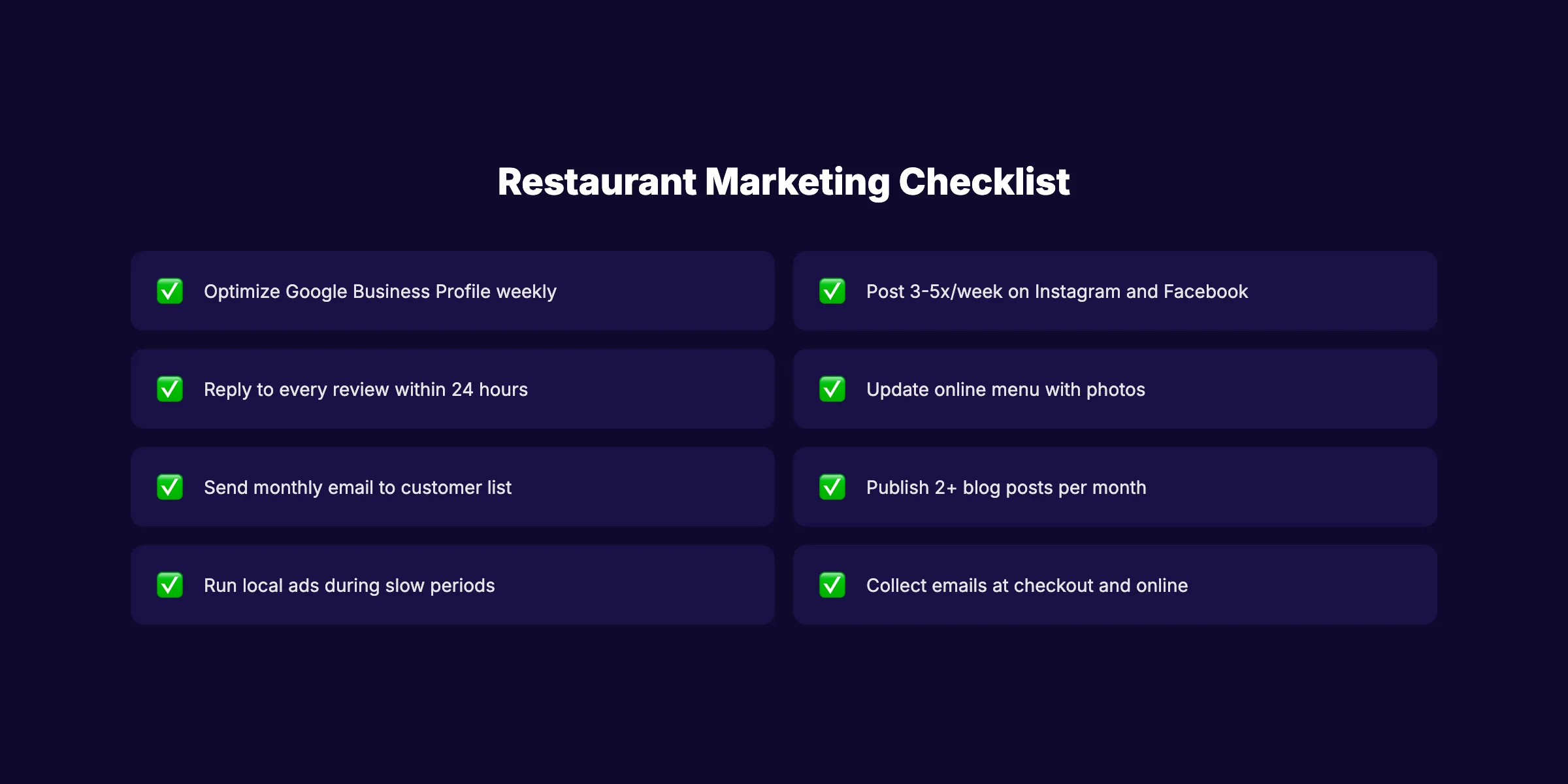
- Post 1 to 2 GBP updates (daily specials, events, new menu items)
- Upload 3 to 5 fresh food photos per week
- Respond to every review within 24 hours
- Keep hours, menu link, and phone number current
For detailed restaurant SEO tactics, see our dedicated guide.
Channel 2: Social Media (Instagram, TikTok, Facebook)
Social media is the number 1 marketing channel for restaurants in 2026. Instagram and TikTok drive the highest engagement for food businesses. Facebook remains strong for local reach and event promotion.
What works for restaurants on social:
- Short-form video of food preparation (under 12 seconds performs best)
- Behind-the-kitchen content showing chefs and prep work
- Customer photos and user-generated content (4x higher conversion)
- Menu highlights with close-up food photography
- Daily Stories showing the restaurant atmosphere
Posting frequency: 3 to 5 feed posts per week. Daily Stories. 2 to 3 Reels or TikToks per week.
Channel 3: Online Reviews
88% of diners trust reviews as much as personal recommendations. Your review strategy directly impacts foot traffic. Restaurants that reply to reviews see a 35% higher customer return rate.
Monthly actions:
- Ask every diner for a Google review
- Use QR codes on receipts, table tents, and menus
- Respond to every review (positive and negative) within 24 hours
- Share the best reviews as social media content
Channel 4: Website and Online Menu
Your website is where diners check your menu, hours, and location. 93% of consumers check Google before choosing a restaurant. If your menu is a PDF that takes 10 seconds to load on mobile, you lose customers.
Essentials:
- Mobile-first design (80%+ of restaurant searches are mobile)
- HTML menu (not PDF) with photos and prices
- Clear call-to-action: phone number, reservation link, online ordering
- Fast load time under 3 seconds
Your SEO team. $99/month. Stacc publishes 30 blog articles per month. Restaurants rank for “best [cuisine] in [city]” without writing a word. Start for $1 →
Channel 5: Email and SMS Marketing
Email marketing returns $36 to $42 for every $1 spent. For restaurants, email keeps past diners coming back. A birthday email with a free dessert offer. A weekly newsletter with the chef’s special. A holiday brunch reservation reminder.
Monthly actions:
- Send 2 to 4 emails per month (weekly specials, events, seasonal menus)
- Collect emails at checkout, through WiFi login, and online reservations
- Segment your list: regulars, first-time visitors, lapsed customers
- Include a clear CTA in every email (reserve, order, visit)
SMS for restaurants:
- Send flash deal texts for slow nights: “50% off appetizers tonight 5-7 PM”
- Reservation reminders and confirmation texts
- Birthday and anniversary messages with special offers
Channel 6: Local SEO and Blog Content
Local SEO ranks your restaurant for searches like “brunch spots in [neighborhood]” and “best pizza in [city].” A restaurant blog drives organic traffic for searches your customers make before deciding where to eat.
Blog post ideas for restaurants:
- “Best brunch spots in [neighborhood]” (your restaurant featured)
- “How to pair wine with [cuisine type]”
- “The story behind our [signature dish]”
- “What is [ingredient]? A chef’s guide”
- Seasonal menu announcements and chef interviews
Monthly actions:
- Publish 2 to 4 blog posts targeting local food keywords
- Build citations on restaurant directories (Yelp, TripAdvisor, OpenTable)
- Ensure NAP consistency across all listings
Channel 7: Paid Advertising
Paid ads fill seats during slow periods and promote events. Facebook and Instagram Ads are the most cost-effective channels for restaurants. 67% of restaurants run paid social ads.
What works:
- Facebook Ads targeting food enthusiasts within 5 to 10 miles
- Instagram Ads featuring your best food photography
- Google Ads for high-intent keywords (“dinner reservation [city]”)
- Promote events, seasonal menus, and special offers
Budget: $10 to $25/day during slow periods. Increase to $50/day for major events or holiday promotions. Track cost per reservation or cost per online order.
How the 7 Channels Work Together
The power of restaurant marketing comes from channels reinforcing each other. A diner sees your Reel on Instagram. They search your restaurant name on Google. They read your reviews. They check your menu on your website. They book a table.
Each channel covers a different stage of that journey. Remove any one channel and you lose diners at that stage. The most successful restaurants do not choose between social media and SEO. They run both. The social media drives awareness. The SEO captures intent. The reviews build trust. The email drives repeat visits. All 7 channels create a system that fills seats consistently.
Chapter 3: The Weekly Content Calendar
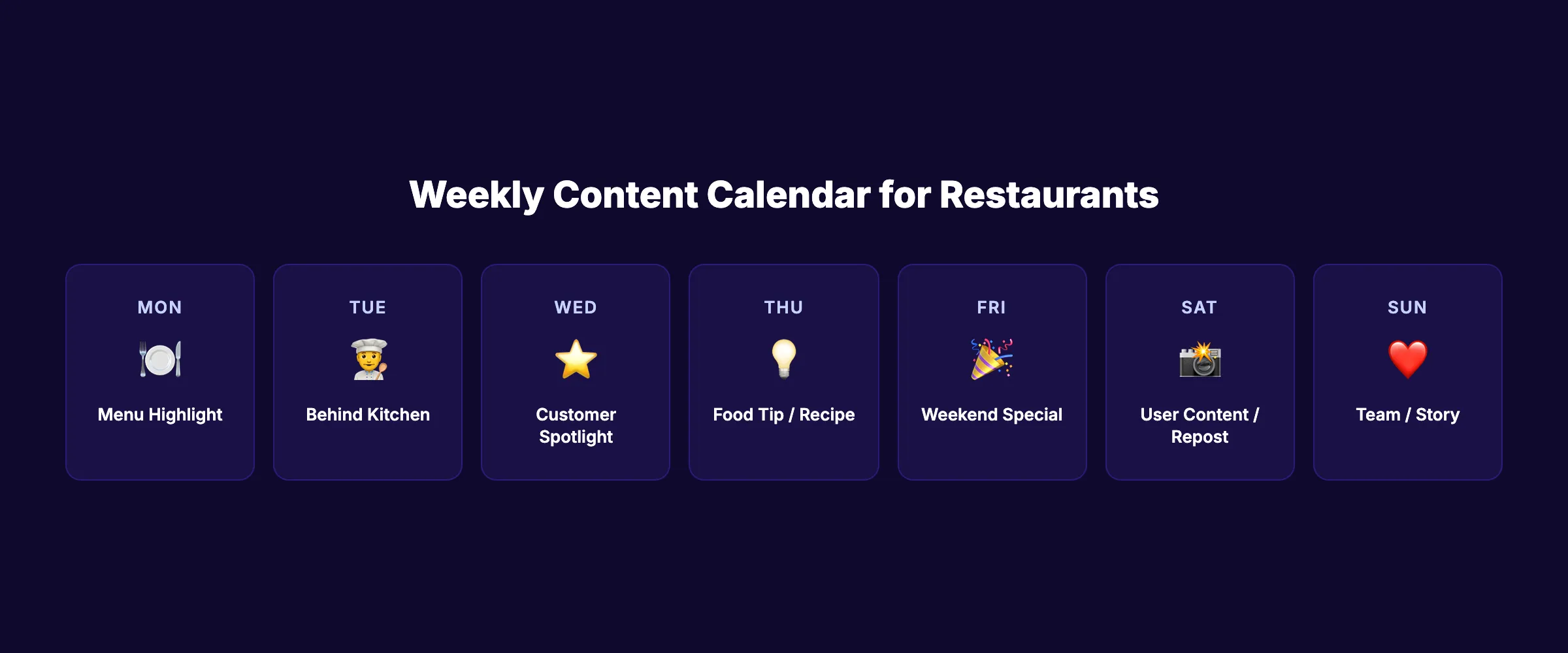
Consistency drives restaurant marketing success. Here is a weekly calendar.
| Day | Content Type | Platform | Example |
|---|---|---|---|
| Monday | Menu Highlight | Instagram, Facebook | Close-up photo of signature dish with story |
| Tuesday | Behind the Kitchen | TikTok, Instagram Reels | 12-second clip of chef preparing a dish |
| Wednesday | Customer Spotlight | Instagram, Facebook | Repost customer photo or share a Google review |
| Thursday | Food Tip or Recipe | Instagram Carousel, Blog | ”How to make our house dressing at home” |
| Friday | Weekend Special | Facebook, Instagram Stories, GBP | ”This weekend only: live jazz + 3-course prix fixe” |
| Saturday | User-Generated Content | Instagram, TikTok | Repost the best customer photos and videos |
| Sunday | Team or Personal Story | Instagram Stories | ”Meet our sous chef” or “Why we started this restaurant” |
Content That Converts for Restaurants
The content that fills seats is not polished food photography. It is authentic, messy, real kitchen content. Diners scroll past high-budget commercial content. They stop for a chef flipping a pan, a server laughing with guests, or a time-lapse of a pizza being built.
User-generated content converts 4 times higher than branded content. Encourage diners to photograph their meals. Create a branded hashtag. Repost the best content. Every customer photo is free marketing.
Seasonal Content Strategy
Restaurants have natural content rhythms tied to seasons, holidays, and menu changes. Plan content around these moments:
| Season | Content Focus |
|---|---|
| Spring | Patio opening, new spring menu, Easter brunch |
| Summer | Outdoor dining, summer cocktails, late-night specials |
| Fall | Seasonal ingredients, Halloween events, holiday catering |
| Winter | Holiday parties, gift cards, New Year’s Eve menu |
Build your content calendar 30 days in advance. Align social posts, email campaigns, and GBP updates to seasonal themes. Restaurants that plan seasonal content 4 weeks ahead outperform those that scramble day-to-day.
Influencer and Creator Partnerships
46% of restaurant marketers report that creator partnerships are the second-highest ROI tactic, behind loyalty programs. Invite local food bloggers and micro-influencers (1,000 to 10,000 followers) for a complimentary meal. Ask them to post honestly about the experience. One authentic Instagram Story from a local food creator reaches more of your target audience than a $200 Facebook Ad.
The key: work with creators who live in your area and have followers in your city. National food influencers drive vanity metrics. Local creators drive reservations.
Chapter 4: Budget Allocation
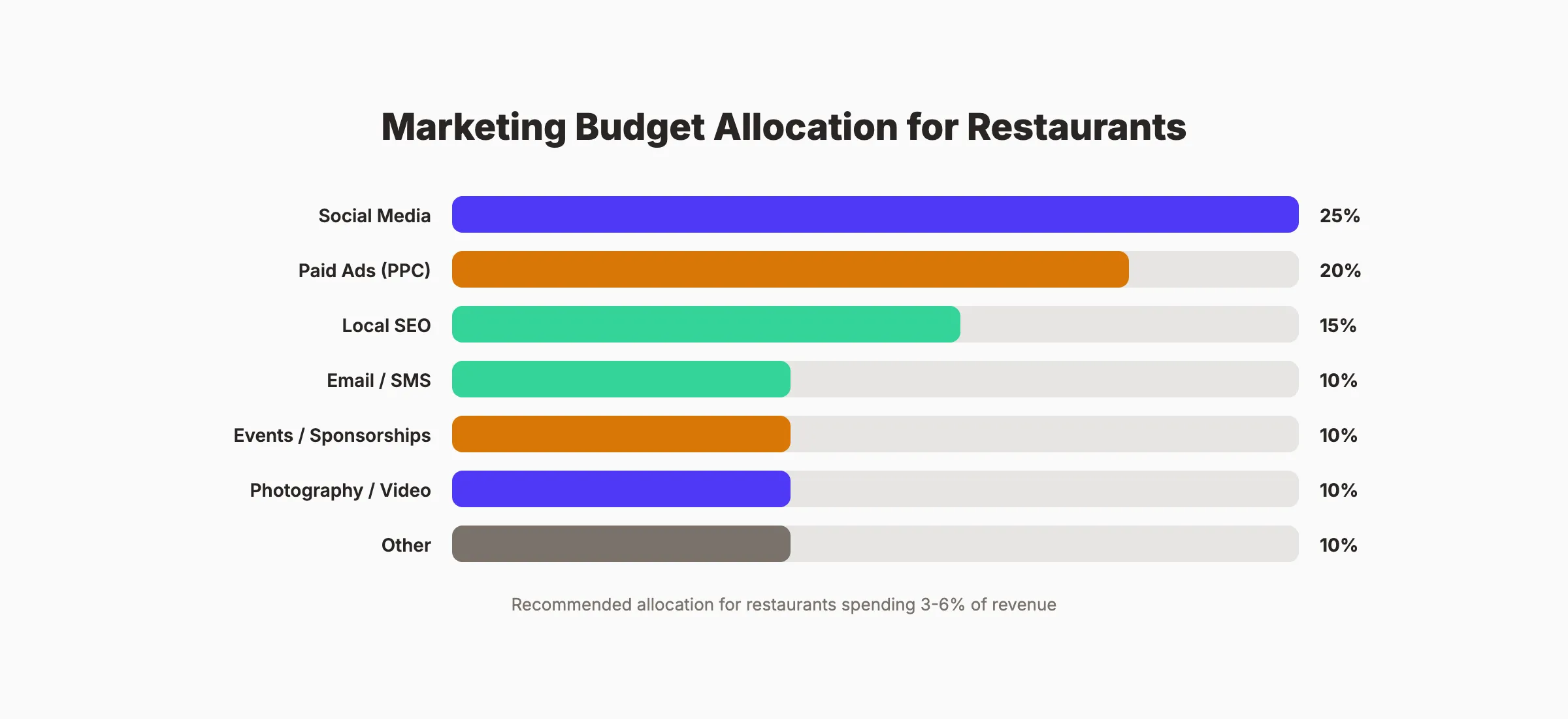
Most restaurants allocate 3 to 6% of revenue to marketing. Here is how to split that budget across channels.
Budget Breakdown by Channel
| Channel | % of Budget | Monthly Spend ($50K revenue) |
|---|---|---|
| Social Media | 25% | $375 |
| Paid Ads | 20% | $300 |
| Local SEO | 15% | $225 |
| Email / SMS | 10% | $150 |
| Events / Sponsorships | 10% | $150 |
| Photography / Video | 10% | $150 |
| Other | 10% | $150 |
The Stacc Option
Stacc handles 3 marketing channels automatically for restaurants:
- Blog SEO: 30 articles per month for $99/month
- Social Media: 30 posts across Instagram, Facebook, and X for $49/month
- Local SEO: 30 GBP posts per month for $49/month
The full bundle costs approximately $167/month with the 15% multi-module discount. That covers blog content, social media, and GBP posting. You handle reviews, email, events, and paid ads. At $167/month, Stacc costs less than most restaurants spend on a single weekend photo shoot.
Rank everywhere. Do nothing. Blog SEO, Local SEO, and Social on autopilot. 90 pieces of content per month for your restaurant. Start for $1 →
Chapter 5: Retention Over Acquisition
Acquiring a new restaurant customer costs 5 to 7 times more than retaining an existing one. Increasing retention by just 5% boosts profits by 25 to 95%. Yet most restaurant marketing focuses entirely on attracting new diners.
Build a Retention System
Loyalty programs: A simple punch card (buy 10, get 1 free) or a digital loyalty app encourages repeat visits. Loyalty and rewards programs produce the highest marketing ROI for restaurants, ahead of social media and paid ads.
Email nurturing: Send a “we miss you” email to customers who have not visited in 60 days. Include a 15% off offer or a complimentary appetizer. Lapsed customers who receive a re-engagement email return at a 12 to 18% rate.
Birthday and anniversary offers: Collect birthday data at signup. Send a free dessert or drink offer 7 days before their birthday. Birthday emails have the highest open rates of any email type.
Consistent quality: No amount of marketing overcomes bad food or bad service. Marketing fills the first seat. The experience fills the second and third. The best restaurant marketing amplifies a great dining experience. It cannot create one.
Staff as marketers: Train servers and hosts to mention your Instagram, ask for reviews, and collect email addresses. Your team interacts with every customer. Each interaction is a marketing opportunity. A server who says “tag us if you post your meal” generates more content than any scheduling tool.
Chapter 6: Common Restaurant Marketing Mistakes
Posting Only Promotions
A feed full of “20% off tonight” and “Happy Hour special” trains customers to wait for deals. Mix promotional content with storytelling, behind-the-scenes, and educational content. Keep promotions to 20% of your social posts.
Ignoring Negative Reviews
25% of diners avoid a restaurant based on negative reviews. A professional response to a negative review can reverse that impression. Acknowledge the issue. Apologize. Offer to resolve it offline. A well-handled complaint builds more trust than a perfect 5-star profile.
No Online Menu
Diners who cannot find your menu online move to the next restaurant. Your menu must be HTML (not a PDF), mobile-friendly, include prices, and show photos of key dishes. An outdated or missing menu loses customers every day.
Inconsistent Posting
Posting 5 times one week and disappearing for a month confuses the algorithm and your audience. 3 posts per week, every week, for 12 months produces more results than viral bursts followed by silence.
Not Tracking What Works
Without measurement, you cannot optimize. Track which posts drive the most reservation clicks. Track which email campaigns produce the most walk-ins. Track which paid ads generate the lowest cost per cover. Use Google Analytics and your POS data together to connect marketing spend to revenue.
Spending Everything on Acquisition
The biggest restaurant marketing mistake is spending 100% of budget attracting new diners and 0% retaining existing ones. Retention costs 5 to 7 times less than acquisition. A simple email list, a loyalty program, and consistent social media keep past customers coming back. The most profitable restaurants generate 60 to 70% of revenue from repeat visitors. Your marketing plan should reflect that ratio.
Not Optimizing for Mobile
Over 80% of restaurant searches happen on mobile devices. A website that looks good on desktop but loads slowly or displays poorly on a phone loses those searchers. Your online menu, reservation system, and contact information must work flawlessly on a 5-inch screen. Test your site on a phone. If anything takes more than 2 taps to find, fix it.
3,500+ blogs published. 92% average SEO score. Stacc handles blog content, social media, and local SEO for restaurants. Fill seats without the content grind. Start for $1 →
FAQ
What is the best marketing channel for restaurants?
Social media (Instagram and TikTok) and Google Business Profile are the 2 highest-impact channels for most restaurants. 74% of diners use social media to choose where to eat. Google Business Profile drives direct calls and direction requests from “near me” searches. Start with those 2 and add email, reviews, and paid ads as your budget allows.
How much should a restaurant spend on marketing?
3 to 6% of annual revenue. For a $1 million restaurant, that is $30,000 to $60,000 per year or $2,500 to $5,000 per month. New restaurants and those in competitive markets may invest up to 10%. Allocate 25% to social media, 20% to paid ads, 15% to local SEO, and the rest across email, events, and content production.
How often should a restaurant post on social media?
3 to 5 feed posts per week on Instagram and Facebook. Daily Stories. 2 to 3 Reels or TikToks per week. Short-form video under 12 seconds performs best for restaurant content. Use a scheduling tool to batch content and stay consistent.
How do restaurants get more Google reviews?
Ask every diner for a review using QR codes on receipts, table tents, and check presenters. Send a follow-up text or email within 24 hours with a direct Google review link. Respond to every review. The restaurants with the most reviews and the fastest response times rank highest in local search.
What type of social media content works best for restaurants?
Short-form video of food preparation, behind-the-kitchen moments, and user-generated customer content. Authentic, unpolished content outperforms professional photography on Instagram and TikTok. Customer photos convert 4x higher than branded photos. Encourage tagging and create a branded hashtag.
Can Stacc handle marketing for restaurants?
Yes. Stacc publishes 30 blog articles ($99/month), 30 social posts ($49/month), and 30 Google Business Profile posts ($49/month) for restaurants. The full bundle costs approximately $167/month. Restaurants get 90 pieces of content per month with zero time investment. Start with a $1 trial.
Restaurant marketing in 2026 runs on 7 channels working in sync. Start with your Google Business Profile and social media. Add reviews, email, and local SEO. Scale into paid ads and events as revenue grows. The restaurants filling every seat are not spending the most on marketing. They are showing up consistently across the channels that matter. For restaurants that want blog content, social media, and GBP handled automatically, Stacc starts at $99/month.

Written by
Siddharth GangalSiddharth is the founder of theStacc and Arka360, and a graduate of IIT Mandi. He spent years watching great businesses lose organic traffic to competitors who simply published more. So he built a system to fix that. He writes about SEO, content at scale, and the tactics that actually move rankings.
Automate your Google Business Profile content
30 GBP posts, local SEO articles, and review responses. Published every month automatically.
30-day trial · Cancel anytime
theStacc
Stop writing SEO content manually
30 blog articles, 30 GBP posts, and social media content. Published every month. Automatically.
Start Your $1 Trial$1 for 3 days · Cancel anytime