
Facebook for Local Business: The Complete Guide (2026)
Learn how to use Facebook to grow your local business. Covers Pages, Groups, Marketplace, ads, and organic reach. Real data included. Updated 2026.
Siddharth Gangal • 2026-03-29 • Content Strategy
In This Article
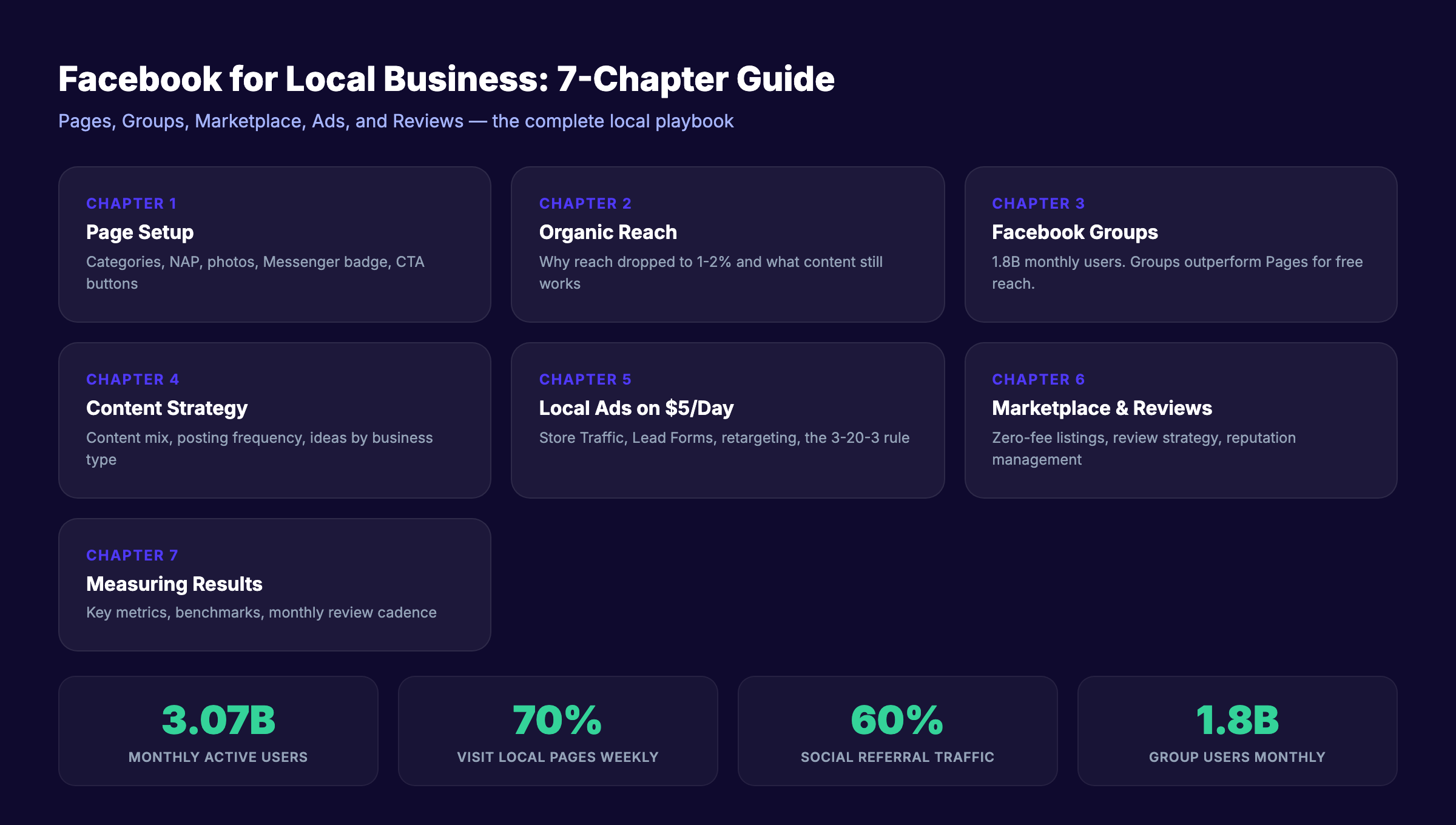
Facebook has 3.07 billion monthly active users. 70% of those users visit local business Pages at least once a week. Over 250 million small businesses use Meta platforms globally. And Facebook still drives roughly 60% of all social media referral traffic to websites.
The problem is that organic reach for business Pages has dropped to 1 to 2% of followers. Most local businesses post sporadically, get 3 likes, and conclude that Facebook for local business does not work. It does work. But the strategy that worked in 2018 is dead. The 2026 playbook requires a mix of organic content, Groups, Marketplace, paid ads, and community engagement.
This guide covers everything a local business needs to make Facebook generate actual customers. Not vanity metrics. Customers.
We have published 3,500+ SEO articles across 70+ industries. This guide distills what drives real results for local businesses on Facebook in 2026.
Here is what you will learn:
- How to set up and optimize your Facebook Business Page for local search
- Why Groups outperform Pages for organic reach and how to use them
- The content types that generate engagement for local businesses
- How to run Facebook ads on a $5/day budget with local targeting
- How Facebook Marketplace and Reviews fit into your local strategy
Chapter 1: Setting Up Your Facebook Business Page
A Facebook Business Page is the foundation. Even if your primary strategy shifts to Groups or ads, the Page is where customers check your hours, read reviews, message you, and decide whether to visit.
Page Setup Checklist
- Choose the most specific business category available (not just “Local Business”)
- Add your complete street address with local area code phone number
- Write a description in 1 to 2 sentences, under 155 characters, with your primary service and location
- Upload a profile photo (logo) and cover photo (storefront or team)
- Set accurate business hours including holidays
- Add all services you offer with descriptions
- Enable Messenger with an instant reply set up
- Add a CTA button: “Call Now,” “Get Directions,” or “Send Message”
- Complete the “About” section with your website URL and founding year
The “Very Responsive” Badge
Facebook displays a “Very Responsive to Messages” badge on Pages that reply to 90% of messages within 15 minutes. This badge builds instant trust. Customers messaging a local business expect a fast reply. A Page without this badge looks inactive.
Set up instant replies in your Page settings. The auto-reply buys you time: “Thanks for reaching out! We typically respond within 1 hour during business hours.”
Mobile Optimization Matters
98.5% of Facebook users access the platform via mobile. Your Page, cover photo, and all content must look good on a phone screen. Check your Page on mobile after every update. A cover photo designed for desktop often gets cropped awkwardly on mobile.
For a broader approach to local visibility, our local SEO checklist covers every element of local search optimization.
Chapter 2: The Organic Reach Problem (And How to Solve It)
Facebook organic reach for business Pages averaged 16% in 2012. By 2014 it dropped to 6%. In 2026, it sits at 1 to 2% of your followers.
That means if you have 1,000 followers, only 10 to 20 people see your average post. Facebook’s algorithm now prioritizes content from friends, family, and AI-recommended posts over brand content.
What Still Gets Organic Reach
Not all content types are treated equally. The algorithm rewards specific formats:
| Content Type | Organic Reach | Why It Works |
|---|---|---|
| Short-form video (Reels) | Highest | Algorithm pushes Reels to non-followers for discovery |
| Behind-the-scenes content | High | Feels personal, triggers comments and shares |
| Local community content | High | Relevant to nearby users, triggers local engagement |
| User-generated content | High | Authentic, shareable, builds social proof |
| Polls and questions | Medium-High | Drives comments, which boost algorithm visibility |
| Photo posts | Medium | Standard but reliable for consistent engagement |
| Link posts | Low | Facebook penalizes posts that take users off-platform |
| Text-only posts | Lowest | No visual hook, low engagement |
The single biggest organic reach hack for local businesses: stop posting links. Every time you share a link to your website, Facebook suppresses that post because it wants users to stay on Facebook. Instead, share the information directly in the post and put the link in the comments.
Video is the Priority
40% of all time spent on Facebook is watching video. Short-form Reels get the highest organic reach of any content format. For local businesses, a 30-second iPhone video of your team, your product, or your workspace outperforms a polished graphic every time.
You do not need a production team. Hold your phone vertically. Film something real. Add a text overlay with a hook in the first 2 seconds. Post it as a Reel.
Our guide on does social media help SEO covers how social media activity supports your broader search visibility.
Stop writing. Start ranking. Stacc publishes 30 SEO-optimized articles per month for $99. Built for local businesses. Start for $1 →
Chapter 3: Facebook Groups for Local Businesses
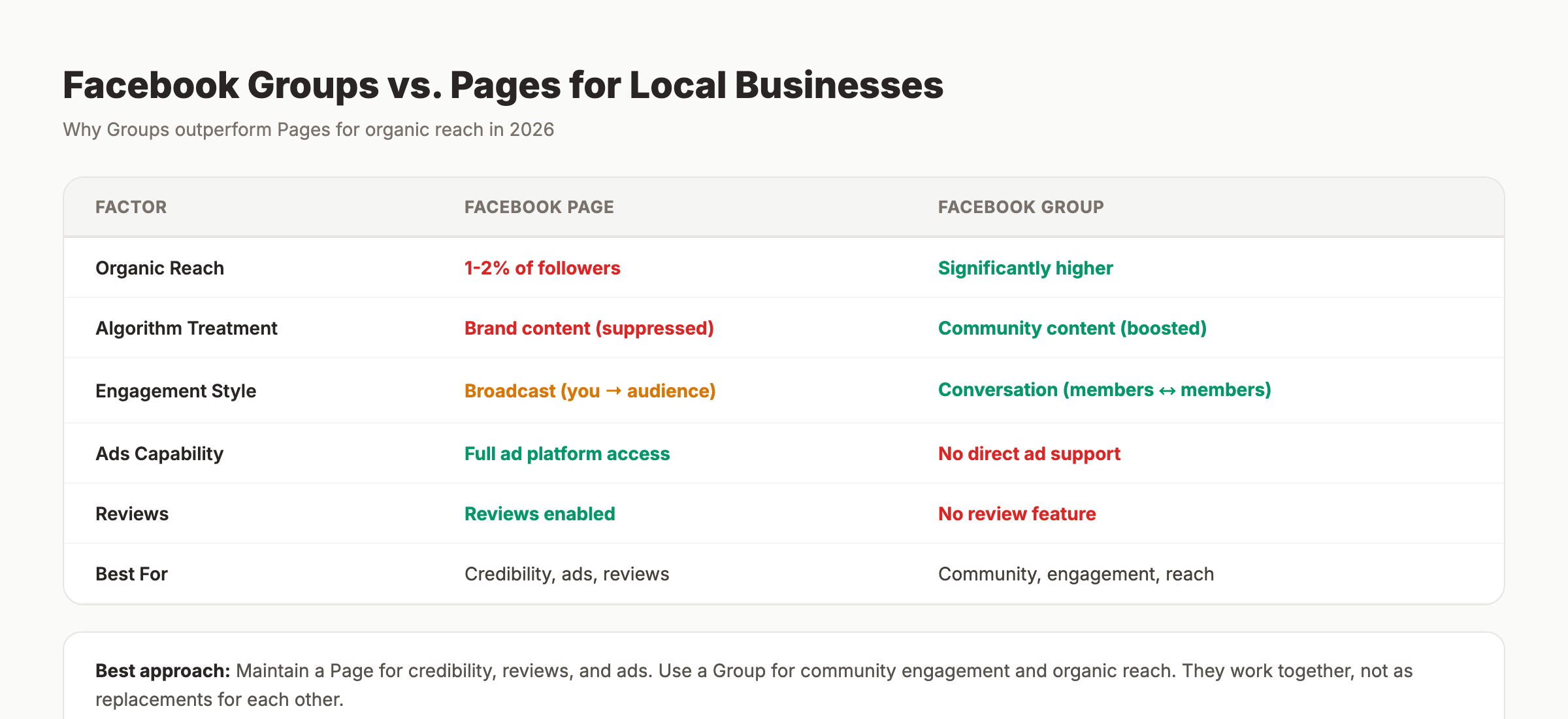
Groups are the most underused Facebook feature for local businesses. While Page organic reach sits at 1 to 2%, Group posts reach significantly more members because the algorithm treats Group content differently than Page content.
1.8 billion people use Facebook Groups monthly. 400 million engage actively in meaningful Groups. For local businesses, this is where community happens.
Two Group Strategies
Strategy 1: Join existing local Groups. Every city has community Groups. “[City Name] Community,” “[City] Buy Sell Trade,” “[Neighborhood] Neighbors.” Join these Groups and contribute value. Answer questions related to your expertise. Share relevant local information. Mention your business only when it genuinely answers someone’s question.
Strategy 2: Create your own Group. Build a Group around your niche and location. A gym creates “[City] Fitness Community.” A bakery creates “[City] Foodies.” A real estate agent creates “[City] Homebuyers and Sellers.” The Group is not about your business. It is about the community topic your business serves.
Group Rules for Local Businesses
- Contribute 10 helpful posts for every 1 that mentions your business
- Never hard-sell in Groups (you will get muted or removed)
- Offer Group-exclusive deals to drive foot traffic
- Answer questions within your expertise even when it does not lead to a sale
- Post local events, news, and community happenings
- Share templates, checklists, or resources that help Group members
Groups vs. Pages: The Key Difference
Pages are broadcast channels. You post, followers (maybe) see it. Groups are conversations. Members post, reply, and engage with each other. The algorithm rewards this interaction pattern by showing Group content more prominently in feeds.
For local businesses, the ideal setup is: maintain a Page for credibility, reviews, and ads. Use a Group for community, engagement, and organic reach.
Chapter 4: Content Strategy for Local Businesses
Most local businesses post the same thing: a promotional graphic about their sale, special, or new product. Three likes. No comments. They post the same type of content next week. Same result.
The Content Mix That Works
| Content Type | % of Posts | Examples |
|---|---|---|
| Community / Local | 30% | Local event shares, neighborhood news, weather-related tips, “support local” posts |
| Behind-the-scenes | 25% | Staff introductions, how products are made, daily routines, workspace tours |
| Educational / Tips | 20% | Quick tips related to your industry, how-to Reels, myth-busting |
| Customer stories | 15% | Reviews, testimonials (with permission), customer photos, before/after |
| Promotional | 10% | Sales, new products, special offers, seasonal deals |
Notice that promotional content is only 10%. The businesses that post 100% promotional content are the ones with 3 likes per post. The businesses that mix in community, behind-the-scenes, and educational content build the engagement that makes promotional posts actually visible.
Posting Frequency
Data from RecurPost shows Pages posting 10 times per week achieve the highest engagement rate at 1.61%. That is roughly 1 to 2 posts per day.
For most local businesses, 4 to 5 posts per week is a realistic starting point. Consistency matters more than volume. Posting 5 times per week every week outperforms posting 14 times one week and nothing the next.
Content Ideas by Business Type
| Business Type | Top Content Ideas |
|---|---|
| Restaurant / Cafe | Daily specials Reel, kitchen prep BTS, staff favorites, customer reviews |
| Salon / Spa | Before/after transformations, product recommendations, stylist spotlights |
| Retail Store | New arrival unboxings, customer styling, local event partnerships |
| Service Business | Project before/after, tips for homeowners, team at work, seasonal prep |
| Fitness / Gym | Workout tip Reels, member spotlights, class schedule reminders, nutrition tips |
| Professional Services | Industry myth-busting, FAQ answers, client success stories (with permission) |
For broader content strategy principles, our content marketing for small business guide covers planning and workflows.
Our social media for contractors guide covers industry-specific tactics for service businesses.
Chapter 5: Facebook Ads on a Local Budget
Organic reach is limited. That is a fact. Facebook ads let you reach the exact local audience you want, starting at $5 per day.
The Local Ads Framework
Objective: Use the “Store Traffic” or “Awareness” objective. These enable local CTAs like “Get Directions,” “Call Now,” and “Send Message.”
Targeting: Geo-target within 1 to 15 miles of your business. The tighter the radius, the more relevant the audience. A restaurant does not need to target people 50 miles away.
Budget: Start at $5 per day. The general rule: allocate 5% of your daily revenue to Facebook ads. A business making $1,000/day would spend $50/day on ads.
Creative: Vertical video filmed on a phone outperforms studio-produced content for local ads. The Facebook feed is informal. Content that looks like it belongs in a friend’s post gets more attention than content that looks like a billboard.
Ad Types That Work for Local Businesses
| Ad Type | Best For | Expected CPA |
|---|---|---|
| Store Traffic ads | Driving foot traffic | $0.50-$2.00 per store visit |
| Lead Form ads | Service businesses collecting inquiries | $5-$20 per lead |
| Boosted Posts | Amplifying organic content that already performs | Varies |
| Event Promotion | Local events, grand openings, sales | $0.25-$1.00 per RSVP |
| Messenger ads | Starting conversations with potential customers | $1-$5 per conversation |
The 3-20-3 Creative Rule
For local business Facebook ads, follow this structure:
- First 3 seconds: Hook with a visual that stops the scroll. Show your product, your storefront, or a result.
- Next 20 seconds: Deliver the value. What do you offer? Why should someone visit?
- Final 3 seconds: CTA. “Visit us at [address],” “Call today,” or “Message us.”
Retargeting
Set up a Facebook Pixel on your website. Then create a retargeting audience of everyone who visited your site in the last 14 days. These people already know your business. Showing them a reminder ad costs a fraction of cold advertising and converts at much higher rates.
For a detailed comparison of paid vs. organic strategies, our Google Ads vs SEO guide covers when each channel makes sense.
Your SEO team. $99 per month. 30 optimized articles, published automatically. Blog SEO, Local SEO, and Social on autopilot. Start for $1 →
Chapter 6: Facebook Marketplace and Reviews
Two Facebook features that most local businesses ignore entirely: Marketplace and Reviews. Both drive direct business with zero additional ad spend.
Facebook Marketplace
Facebook Marketplace has 64 million+ consumers expected to shop on it in 2025. It charges zero listing fees. Buyers are automatically shown listings near their location.
Marketplace works for:
- Retail stores listing individual products
- Service businesses offering fixed-price packages
- Restaurants promoting catering or meal prep
- Any business with physical products to sell
How to list effectively:
- Use high-quality photos with good lighting
- Price competitively (Marketplace buyers are price-sensitive)
- Include your business name and location in the description
- Respond to inquiries within 1 hour (speed wins on Marketplace)
- Cross-list your Marketplace inventory through Commerce Manager for broader reach
Facebook Reviews
Facebook reviews appear on your Business Page and influence both Facebook visibility and local SEO. Google indexes Facebook reviews, which means they can appear in search results alongside your Google reviews.
How to get more Facebook reviews:
- Ask satisfied customers directly: “Would you mind leaving us a review on Facebook?”
- Include a direct link to your Facebook review page in follow-up emails
- Respond to every review within 24 hours, positive and negative
- Never offer incentives for reviews (violates Facebook’s policies)
Responding to negative reviews:
- Acknowledge the issue publicly
- Apologize and offer to resolve it
- Move the conversation to Messenger or phone for resolution
- Never argue or get defensive in a public reply
Facebook reviews also function as social proof. A Page with 80+ reviews and a 4.7+ rating converts visitors to customers at significantly higher rates than a Page with 5 reviews.
Our respond to Google reviews guide covers review response templates that work across platforms.
For understanding the impact of reviews on local visibility, our GBP statistics guide covers the data.
Chapter 7: Measuring Results
Posting on Facebook without tracking results is guessing. Facebook provides detailed analytics through Meta Business Suite. Here is what to track and what the numbers mean.
Key Metrics for Local Businesses
| Metric | What It Means | Good Benchmark |
|---|---|---|
| Reach | How many unique people saw your content | Growing month-over-month |
| Engagement rate | (Likes + Comments + Shares) / Reach | 1-3% for local Pages |
| Link clicks | People who clicked through to your website | Depends on post type |
| Messages received | People who started a conversation | Indicator of purchase intent |
| Page followers | Total audience size | Steady growth (not vanity metric) |
| Store visits (ads) | People who visited after seeing an ad | Track weekly trend |
| Cost per result (ads) | How much each outcome costs | Compare to customer lifetime value |
What Good Looks Like
The average Facebook business Page engagement rate is 0.15% across all industries. For local businesses that follow the content mix in this guide, 1 to 3% is achievable. That is 7 to 20x the average.
If your engagement rate is below 0.5%, your content needs to change. Stop posting promotional graphics. Start posting Reels, behind-the-scenes content, and community-relevant posts.
Monthly Review Cadence
Check Facebook analytics once per week. Review these questions monthly:
- Which 3 posts got the most engagement? Create more content like them.
- Which posts got zero engagement? Stop making that type of content.
- Is reach growing or declining? Declining reach means your content quality needs work.
- Are messages and inquiries increasing? That is the metric that matters most for revenue.
- What is the cost per lead from ads? Is it profitable based on your average customer value?
For a full approach to tracking marketing results, our SEO reporting guide covers metrics and dashboards.
3,500+ blogs published. 92% average SEO score. See what Stacc can do for your business. Start for $1 →
Common Mistakes Local Businesses Make on Facebook
Posting only promotional content. A feed of nothing but “20% off” graphics trains Facebook’s algorithm to suppress your posts. Mix in community, educational, and behind-the-scenes content.
Ignoring messages. A potential customer who messages your Page and gets no response for 48 hours is already at your competitor. Set up instant replies and respond within 1 hour during business hours.
Sharing links in every post. Facebook penalizes posts that drive users off-platform. Share the information directly in the post. Add the link in the first comment if needed.
Not using video. 40% of time on Facebook is spent watching video. A business posting only static images misses the format that gets the most reach and engagement.
Neglecting Facebook Reviews. A Page with 5 reviews looks abandoned. Ask every satisfied customer for a review. Respond to every one.
Spending money before understanding the basics. Running ads without a properly optimized Page, good creative, or clear targeting wastes budget. Get organic content working first. Then amplify what works with paid.
Treating Facebook as your only marketing channel. Facebook is one channel. It works best alongside Google Business Profile, SEO, and email marketing. Our SEO small business guide covers how to build a multi-channel approach.
FAQ
Is Facebook still worth it for local businesses in 2026?
Yes. Facebook has 3.07 billion monthly active users. 70% visit local business Pages weekly. Organic reach is low, but Groups, Marketplace, and targeted ads still drive real local customers. The businesses that say Facebook does not work are posting promotional content 3 times a month and expecting results.
How much should a local business spend on Facebook ads?
Start at $5 per day. A general rule is 5% of daily revenue. A business making $500/day would allocate $25/day to Facebook ads. With local targeting within 5 to 15 miles, even $5/day reaches thousands of nearby potential customers weekly.
What type of content works best for local businesses on Facebook?
Short-form video (Reels) gets the highest organic reach. Behind-the-scenes content, local community posts, and customer stories drive the most engagement. Promotional content should be no more than 10% of your total posts.
Are Facebook Groups better than Pages for local businesses?
Groups get significantly better organic reach because the algorithm treats Group posts as community content rather than brand content. The best approach: maintain a Page for credibility, reviews, and ads. Use a Group for community engagement and organic reach.
How do I increase organic reach on my Facebook business Page?
Post short-form video (Reels), stop sharing external links in posts, post consistently (4 to 5 times per week minimum), engage with comments within 1 hour, share community-relevant local content, and use polls and questions to drive comments.
Does Facebook help with local SEO?
Indirectly, yes. Facebook reviews are indexed by Google. A consistent NAP (Name, Address, Phone) on your Facebook Page acts as a citation for local SEO. And social media activity sends engagement signals that correlate with higher search rankings.
Rank everywhere. Do nothing. Blog SEO, Local SEO, and Social on autopilot. Stacc starts at $99/mo with a $1 trial. Start for $1 →
Facebook for local businesses works when you stop treating it like a billboard and start treating it like a community. Post content that people actually want to see. Join the conversations happening in Groups. Use ads to reach the right local audience. And measure what matters: messages, inquiries, and customers. That is the entire playbook.
Written and published by Stacc. We publish 3,500+ articles per month across 70+ industries. All data verified against public sources as of March 2026.
