
Content Marketing for Small Business (2026)
Content marketing for small business generates 3x more leads than paid ads at 62% less cost. See the strategy, channels, and budget that work.
70% of small businesses invest in content marketing. Only 24% describe their strategy as “successful.” The gap exists because most small businesses publish content without a plan. They write a blog post when they have time, share it on social media, and hope something happens.
Content marketing for small business works differently than enterprise content marketing. You do not have a 10-person team. You do not have a $50,000 monthly budget. You need a strategy that produces results with limited resources and limited time.
We have published 3,500+ articles across 70+ industries, most of them for small and mid-sized businesses. This guide covers the exact content marketing strategy that works when your team is small and your budget is smaller.
Here is what you will learn:
- Why content marketing outperforms paid advertising for small businesses
- The 5 content types that generate the most leads with the least effort
- How to build a content calendar that takes 2 hours per week
- Budget breakdowns for content marketing at every level
- How to measure content marketing ROI without enterprise tools
- The biggest content marketing mistakes small businesses make
Why Content Marketing Works for Small Businesses
Content marketing generates 3 times more leads than outbound marketing at 62% less cost. For small businesses with tight budgets, that math changes everything.
According to HubSpot’s 2025 marketing report, companies that blog consistently get 67% more leads per month than those that do not. The effect is strongest for businesses with under 200 employees.
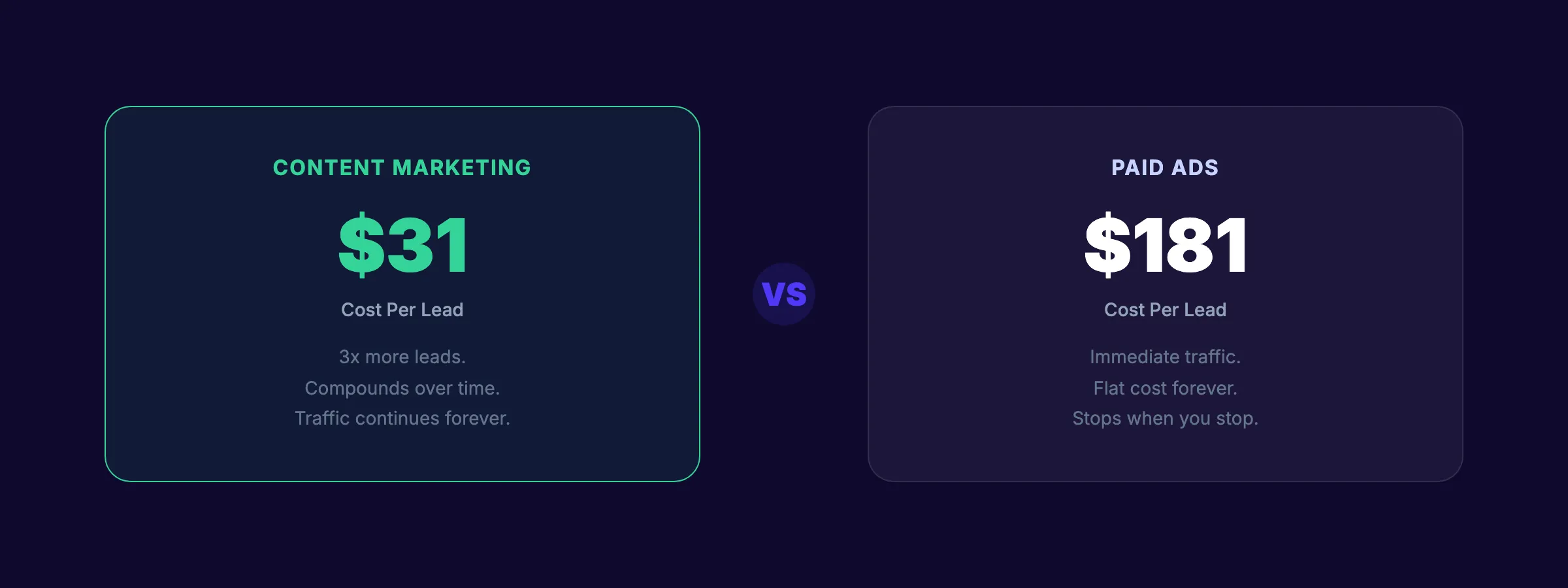
Content Marketing vs Paid Ads for Small Business
| Factor | Content Marketing | Paid Ads (PPC) |
|---|---|---|
| Cost per lead | $31 (average) | $181 (average) |
| Traffic when you stop | Continues for months/years | Stops immediately |
| Trust level | High (educational content) | Lower (marked as ads) |
| Time to results | 3-6 months | Hours to days |
| Compounding effect | Yes (each article builds on the last) | No (flat cost per click) |
| Best for | Long-term growth | Immediate leads |
The critical difference for small businesses is compounding. A blog post you publish today still drives traffic 2 years from now. A Google Ad you run today stops producing the moment you stop paying.
After 12 months of consistent content marketing, your cost per lead drops 50 to 70% because existing content continues ranking while new content adds incremental traffic. Paid ads never get cheaper.
The Small Business Advantage
Small businesses have a content marketing advantage most do not recognize. You have specific expertise that large companies water down through corporate review processes.
A local plumber writing about “how to fix a leaky faucet in 5 minutes” has more credibility than a national brand publishing the same content. Google rewards specificity. Readers trust practitioners over corporations.
Your niche expertise, local knowledge, and direct customer relationships create content that large competitors cannot replicate.
Your SEO team. $99 per month. 30 optimized articles, published automatically. Built for small businesses that need results without a content team. Start for $1 →
5 Content Types That Generate Leads for Small Businesses
Not all content types produce equal results. Small businesses need high-ROI content that converts with minimal production effort.
1. Blog Posts (Highest ROI for SEO)
Blog posts are the foundation of small business content marketing. They target keywords, build topical authority, attract organic traffic, and create opportunities for internal linking.
What makes a good small business blog post:
- Targets a specific keyword with commercial or informational intent
- Answers a real question your customers ask
- Includes a clear call to action
- Links to your service or product pages
- Is at least 1,500 words for informational topics
Publishing frequency matters. Businesses that publish 16+ blog posts per month get 3.5 times more traffic than those publishing 0 to 4. For small businesses, 8 to 15 posts per month is a realistic starting target.
2. Email Newsletters (Highest Conversion Rate)
Email converts at 4.29% on average. Social media converts at 1.81%. Email is 2.4 times more effective at turning readers into customers.
A weekly email newsletter keeps your business top of mind with existing leads and customers. The content does not need to be original. Summarize your best blog posts, share a quick tip, and include one CTA.
Keep it simple. 300 to 500 words. 1 topic. 1 call to action. Send it the same day and time every week.
3. Google Business Profile Posts (Best for Local)
GBP posts are free, take 5 minutes to write, and directly impact your local search rankings. For small businesses that serve a local market, GBP posts are the highest-ROI content type per minute of effort.
Post 4 to 8 times per month. Share promotions, new blog posts, tips, and customer wins. Every post keeps your profile active and sends freshness signals to Google.
4. Case Studies (Best for B2B)
Case studies convert at 2 to 3 times the rate of standard blog posts for B2B businesses. They show specific results for specific clients in specific situations.
The format is simple. Problem. Process. Result. Include numbers.
“We helped a Dallas law firm increase organic traffic by 340% in 6 months by publishing 25 articles per month targeting personal injury keywords.”
That one sentence does more selling than 10 pages of marketing copy.
5. Social Media Posts (Best for Brand Awareness)
Social media does not directly drive SEO rankings. But it drives traffic, builds brand recognition, and amplifies content reach.
For small businesses, focus on 2 platforms maximum. Post 3 to 4 times per week. Repurpose blog content into social media posts. A single blog post can become 5 to 8 social posts across platforms.
How to Build a Small Business Content Calendar
A content calendar prevents the “post when we have time” trap. It turns content marketing from a sporadic activity into a predictable system.
The 2-Hour Weekly Content Plan
| Day | Task | Time | Output |
|---|---|---|---|
| Monday | Write or review 2 blog posts | 45 min | 2 SEO articles |
| Wednesday | Schedule social media posts | 30 min | 6-8 social posts |
| Thursday | Write email newsletter | 20 min | 1 email |
| Friday | Post GBP update + respond to reviews | 15 min | 1 GBP post |
| Total | ~2 hours | 2 blogs + 6-8 social + 1 email + 1 GBP |
This schedule assumes you use AI or a content service for first drafts of blog posts. Writing 2 quality blog posts from scratch takes 6 to 10 hours, not 45 minutes. The 45-minute window covers reviewing, editing, and publishing pre-written content.
Monthly Content Themes
Organize your content around monthly themes. One topic per month keeps your content focused and builds topical authority faster than random topics.
Example monthly themes for a small accounting firm:
| Month | Theme | Blog Topics | Social Topics |
|---|---|---|---|
| January | Tax preparation | Tax deadline guide, deduction tips | Tax prep checklist, deadline reminders |
| February | Small business finances | Cash flow guide, expense tracking | Budgeting tips, financial health check |
| March | Tax filing | Filing tips, common mistakes | Last-minute tax tips, FAQ answers |
| April | Business growth | Revenue strategies, hiring guide | Growth metrics, milestone posts |
Each month produces 8 to 15 blog posts, 12 to 16 social posts, 4 email newsletters, and 4 GBP posts. All focused on one theme. That cluster of related content builds stronger ranking signals than scattered topics.
Content Planning Tools
| Tool | Best For | Cost |
|---|---|---|
| Google Sheets | Simple editorial calendar | Free |
| Trello | Visual content pipeline | Free |
| Notion | All-in-one content workspace | Free (personal) |
| Asana | Team content workflows | Free (basic) |
You do not need expensive project management software. A Google Sheet with columns for topic, keyword, status, publish date, and author handles content planning for most small businesses.
Stop writing. Start ranking. Stacc publishes 30 SEO articles per month for $99. No content team required. Start for $1 →
Content Marketing Budget for Small Businesses
Most small businesses have no idea what content marketing should cost. They either spend $0 (doing everything themselves) or $5,000+ (hiring an agency). Both extremes produce suboptimal results.
Budget Tiers
| Budget Level | Monthly Spend | What You Get |
|---|---|---|
| DIY ($0) | $0 + your time | 2-4 blog posts, self-published |
| Starter ($100-$500) | $100-$500 | 8-15 AI-assisted articles + tools |
| Growth ($500-$2,000) | $500-$2,000 | 15-30 articles + SEO tools + social scheduling |
| Agency ($2,000-$10,000) | $2,000-$10,000 | Full-service content + SEO + social |
Where to Spend Your First $500
If you have $500 per month for content marketing, here is the highest-ROI allocation:
| Expense | Monthly Cost | Why |
|---|---|---|
| Content production (15-30 articles) | $99-$199 | Blog content is the foundation |
| SEO tools | $0-$100 | Keyword research + tracking |
| Email platform | $0-$50 | Newsletter distribution |
| Social scheduling | $0-$30 | Consistent social posting |
| Total | $99-$379 |
The single highest-ROI spend is content production. More articles mean more keywords, more internal links, and more organic traffic. Everything else supports the content.
ROI Timeline
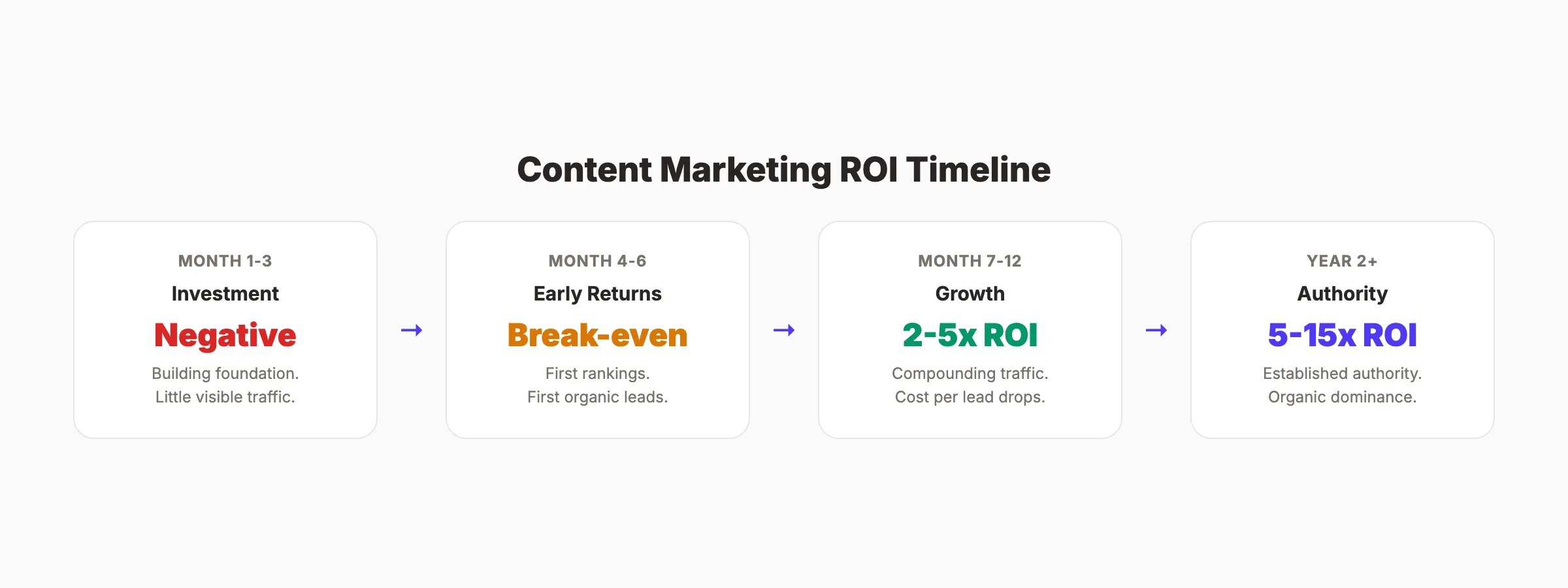
Content marketing ROI follows a predictable curve:
| Timeline | What Happens | Expected ROI |
|---|---|---|
| Month 1-3 | Building foundation. Little visible traffic. | Negative (investment phase) |
| Month 4-6 | Early rankings. First organic leads. | Break-even for some keywords |
| Month 7-12 | Compounding traffic. Lead volume increases. | 2-5x return on investment |
| Year 2+ | Authority established. Cost per lead decreases. | 5-15x return on investment |
According to Content Marketing Institute, the median content marketing ROI is 748%. But that ROI takes 6 to 12 months to materialize. The businesses that quit after 3 months never see the payoff.
Measuring Content Marketing ROI
Small businesses need simple metrics. Not 47-field dashboards. Track these 6 numbers monthly.
The 6 Metrics That Matter
| Metric | What It Tells You | Tool |
|---|---|---|
| Organic traffic | Content visibility growth | Google Analytics |
| Keywords ranking top 100 | Keyword coverage expansion | Google Search Console |
| Leads from organic | Business impact | Google Analytics goals |
| Email subscribers | Audience growth | Email platform |
| Content published | Output consistency | Your content calendar |
| Revenue from organic | Dollar ROI | CRM or manual tracking |
The Simple ROI Formula
Content Marketing ROI = (Revenue from organic leads - Content costs) / Content costs x 100
Example: You spend $200 per month on content. After 6 months, organic traffic generates 10 leads per month. 3 convert at $2,000 average value. That is $6,000 per month from a $200 investment. ROI = 2,900%.
Track content marketing ROI quarterly, not monthly. Monthly fluctuations create false signals. Quarterly trends show the real trajectory.
Common Content Marketing Mistakes Small Businesses Make
1. Publishing Without Keyword Targeting
Every article needs a target keyword. Publishing content without keyword research is blogging for fun, not marketing for results. Identify the keyword before writing. Include it in the title, first 100 words, and at least 1 heading.
2. Quitting After 3 Months
Content marketing compounds over time. The first 3 months are the investment phase. Most small businesses quit during the investment phase because they expected immediate results. Commit to 12 months before evaluating ROI.
3. Writing for Search Engines Instead of Customers
Keywords matter. But the content must answer real questions from real customers. Start every article with “What does my customer want to know?” Then optimize it for SEO. Not the other way around.
4. Ignoring Content Distribution
Publishing a blog post and waiting for traffic is not a strategy. Every article should be distributed through email, social media, GBP posts, and internal links from existing content. A great article with zero distribution gets zero readers.
5. Trying to Do Everything at Once
A small business starting content marketing does not need a podcast, a YouTube channel, a TikTok account, and a blog. Start with blog + email. Add social media. Master those before expanding to new channels.
6. Not Updating Old Content
Content decays. Statistics become outdated. Competitors publish better versions. Rankings drop. Allocate 20% of your content time to updating old articles. A refreshed article often regains rankings faster than a new article earns them.
Content Distribution: Getting Eyes on Your Content
Publishing is half the job. Distribution is the other half. A great article with zero distribution gets zero readers.
The Distribution Stack for Small Businesses
Every new blog post should go through this distribution sequence:
- Publish to your website (the blog post itself)
- Share on social media (LinkedIn, Facebook, X) with a custom caption for each platform
- Email your list (include the post in your weekly newsletter or send a dedicated email)
- Post to Google Business Profile (link back to the full article on your site)
- Add internal links from 3 to 5 existing articles that reference the same topic
- Repurpose into social content over the following 2 weeks (quotes, stats, tips extracted from the post)
This sequence takes 30 minutes per article. It multiplies the reach of every piece of content by 5 to 10 times compared to publishing and hoping for organic discovery.
Building an Email List From Scratch
Email is the highest-converting distribution channel. But you need a list first.
For small businesses starting from zero:
- Add a newsletter signup form to every page of your website
- Offer a lead magnet (free checklist, template, or guide) in exchange for an email
- Collect emails at point of sale (retail) or during client intake (services)
- Run a simple Facebook lead ad ($5 to $10 per day) targeting your local area
- Add a signup link to your email signature
Most small businesses can build a list of 500 to 1,000 subscribers in 3 to 6 months. A list of 500 engaged subscribers generates more revenue than 5,000 social media followers.
Repurposing Content Across Channels
One blog post creates 5 to 8 pieces of derivative content:
| Source | Derivative Content | Platform |
|---|---|---|
| 1 blog post | 3 quote graphics | Instagram, LinkedIn |
| 1 blog post | 1 email newsletter | |
| 1 blog post | 1 GBP post | |
| 1 blog post | 1 short video (tips) | TikTok, Reels |
| 1 blog post | 2 Twitter/X posts | X |
Repurposing is the only way small businesses can maintain presence on multiple channels without spending 20 hours per week creating content.
3,500+ blogs published. 92% average SEO score. See what Stacc can do for your small business. Start for $1 →
FAQ
How much should a small business spend on content marketing?
Most small businesses see strong results spending $100 to $500 per month on content. The minimum viable investment is $99 per month for automated article production. Larger budgets ($500 to $2,000) add SEO tools, email platforms, and social scheduling. The key is consistency over size.
How often should a small business publish content?
8 to 15 blog posts per month is the target for meaningful organic growth. Businesses publishing 16+ posts per month get 3.5 times more traffic than those publishing 0 to 4. If 15 posts feels impossible, start with 4 per week and scale with automation.
How long does content marketing take to show results?
Most small businesses see measurable ranking improvements in 60 to 90 days. Meaningful traffic growth appears at 4 to 6 months. Full ROI materializes at 9 to 12 months. Content marketing is a long-term investment with compounding returns.
What type of content works best for small businesses?
Blog posts targeting SEO keywords deliver the highest long-term ROI. Email newsletters have the highest conversion rate (4.29%). GBP posts provide the best ROI per minute of effort for local businesses. Use all 3 together for maximum impact.
Can a small business do content marketing without a team?
Yes. A solo business owner can manage content marketing in 2 hours per week using AI-assisted content production, email automation, and social scheduling tools. Automated SEO services produce 30 articles per month at $99 without requiring any writing from your team.
Is content marketing better than paid advertising for small businesses?
For long-term growth, yes. Content marketing generates leads at $31 each vs $181 for paid ads. The advantage compounds over time. Paid ads are better for immediate leads. The best strategy uses both channels: ads for short-term revenue and content for long-term growth.
Content marketing for small business is not about producing more content than your competitors. It is about producing the right content, consistently, for 12 months or more. The compounding effect does the rest.
Start with blog posts and email. Add GBP posts and social media. Measure quarterly. And if producing 30 articles per month feels impossible for a small team, it costs $99 when it happens automatically.
Related Tools & Resources
Free SEO Tools:
Best Lists:

Written by
Siddharth GangalSiddharth is the founder of theStacc and Arka360, and a graduate of IIT Mandi. He spent years watching great businesses lose organic traffic to competitors who simply published more. So he built a system to fix that. He writes about SEO, content at scale, and the tactics that actually move rankings.
30 SEO blog articles published every month
Keyword-optimized, scheduled, and live on your site. Automatically.
30-day trial · Cancel anytime
theStacc
Stop writing SEO content manually
30 blog articles, 30 GBP posts, and social media content. Published every month. Automatically.
Start Your $1 Trial$1 for 3 days · Cancel anytime