
Local SEO Checklist: 40 Steps to Rank (2026)
The complete local SEO checklist for 2026. 40 actionable steps covering GBP, reviews, citations, on-page, content, and links. Updated March 2026.
46% of all Google searches have local intent. That is billions of searches per day from people looking for businesses near them. The companies that show up in the local pack and Google Maps capture 75% of those clicks. Everyone else splits the rest.
Most local businesses know SEO matters but do not know where to start. They optimize one thing, skip ten others, and wonder why nothing changes. A local SEO checklist fixes that. It gives you every step in order, with nothing missed.
This local SEO checklist covers 40 actionable steps across 8 categories. Every item is something you can complete yourself or hand to your team. We built this from our experience publishing 3,500+ blog posts across 70+ industries with a 92% average SEO score.
Here is what this checklist covers:
- Google Business Profile optimization (the single biggest ranking factor)
- On-page SEO for local keywords
- Citation building and NAP consistency
- Review generation and management
- Local content strategy
- Technical SEO fundamentals
- Link building for local businesses
- Tracking and measurement
Google Business Profile Checklist
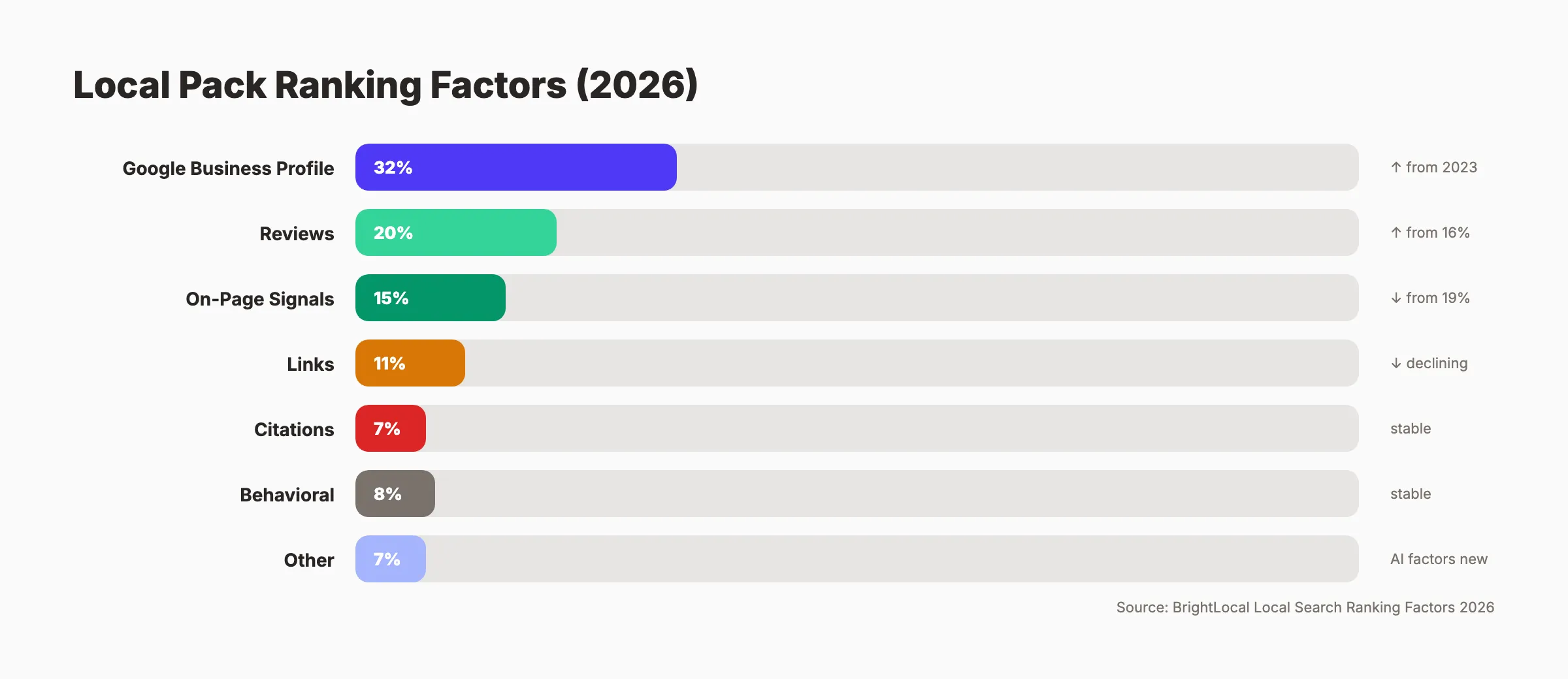
Your Google Business Profile accounts for 32% of local pack ranking factors. This is the single most impactful category. Start here.
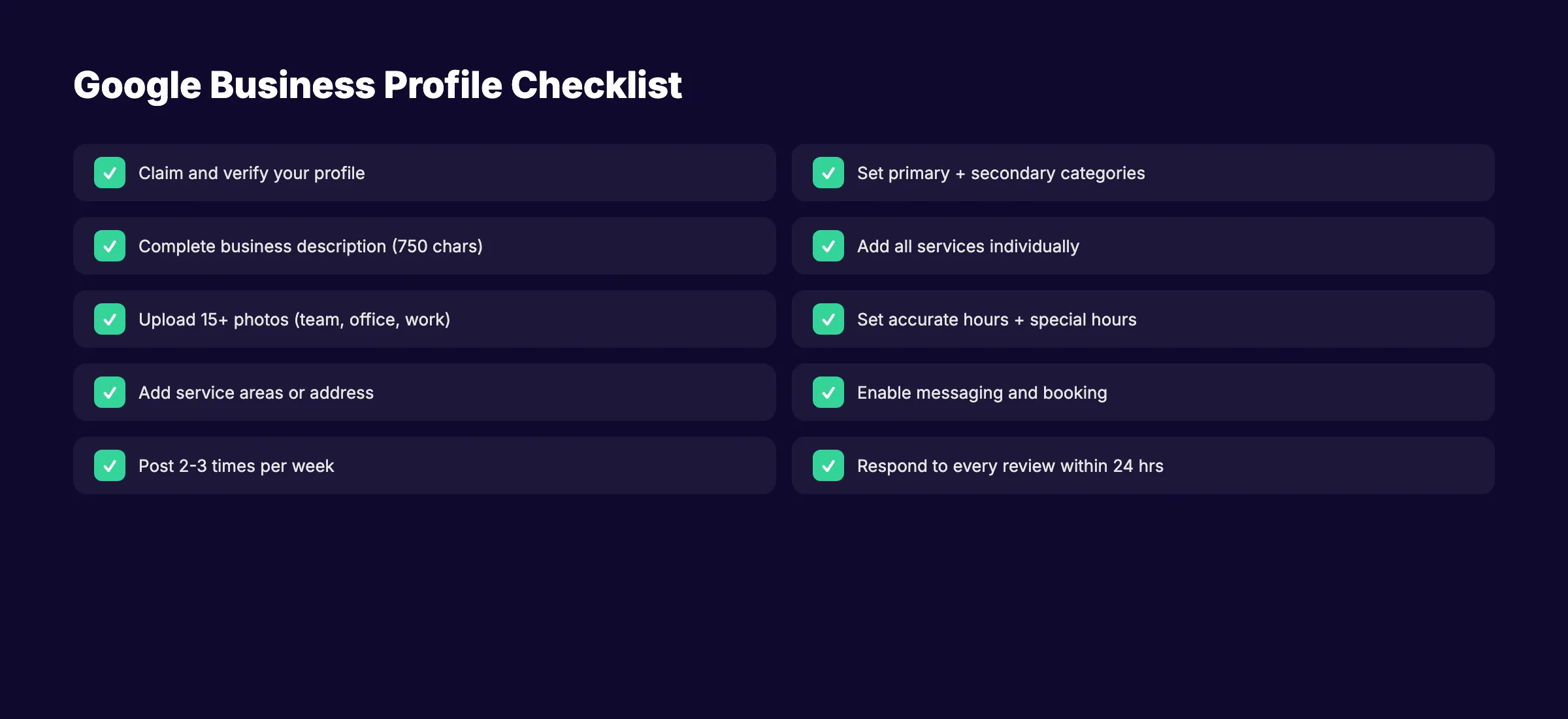
- Claim and verify your profile. Go to business.google.com. Verify by postcard, phone, email, or video. Unverified profiles do not appear in the local pack.
- Set your primary business category. Choose the most specific option. “Italian Restaurant” outperforms “Restaurant.” The primary category is the top ranking factor for the local pack.
- Add secondary categories. Add every relevant category. A plumber who also does drain cleaning and water heater installation should list all three.
- Write a complete business description. Use all 750 characters. Mention your city, services, and experience. Do not stuff keywords.
- Add every service individually. List each service with a brief description and price range. Google uses this data for search matching.
- Set accurate business hours. Include special hours for holidays. Outdated hours frustrate customers and signal neglect to Google.
- Upload 15+ photos. Team shots, office or storefront, completed work, products, and before-and-after images. Businesses with photos get 42% more direction requests.
- Enable messaging. Let customers contact you through Google directly. Response time affects your visibility.
- Post 2-3 times per week. Share tips, offers, project highlights, and announcements. See our GBP posting frequency guide for a detailed schedule.
- Respond to every review. Reply within 24 hours. Thank positive reviewers. Address negative reviews professionally. Use our review response generator.
Your SEO team. $99/month. 30 optimized articles, published automatically. GBP posts included with Local SEO. Start for $1 →
On-Page SEO Checklist
On-page signals account for 15% of local pack ranking factors and are the dominant factor for local organic results. Your website must tell Google what you do and where you do it.
Service Pages
- Create a dedicated page for each service. “Roof Repair” gets its own page. “AC Installation” gets its own page. One page per service.
- Include [city] + [service] in every title tag. Format: “[Service] in [City] | [Business Name].” Keep under 60 characters.
- Write meta descriptions for every page. 145 to 155 characters. Include your primary keyword and a benefit statement.
- Use H1, H2, H3 headers in correct hierarchy. One H1 per page. Multiple H2s for sections. H3s under H2s. Never skip levels.
- Write 300+ words of unique content per service page. Describe your process, what is included, and why customers choose you. No thin content.
- Add before-and-after photos with descriptive alt text that includes your keyword and city.
City and Location Pages
- Create a page for each city you serve. Target “service + city” combinations on each page.
- Write unique content for each city page. Mention neighborhoods, zip codes, and local details. Do not copy-paste with only the city name changed.
- Embed a Google Map showing your service area or office location.
- Add LocalBusiness schema markup on every location page with your name, address, phone, hours, and service area.
Sitewide On-Page
- Place your NAP in the footer of every page. Name, address, and phone number visible sitewide.
- Add internal links between service pages, city pages, and blog posts. 3 to 5 internal links per page minimum.
- Optimize images. Compress to under 200KB. Use WebP format. Add descriptive alt text with local keywords.
Citation and Directory Checklist
Citations are online mentions of your business name, address, and phone number. They account for 7% of local pack ranking factors, but inconsistencies can actively harm your rankings.
Core Directories
- Submit to Google Business Profile (already covered above).
- Submit to Bing Places. Second largest search engine. Free to list.
- Submit to Apple Maps. Growing mobile search share. Submit through Apple Business Connect.
- Submit to Yelp. Claim and complete your free profile.
- Submit to Facebook Business. Create a business page with accurate NAP.
- Submit to BBB (Better Business Bureau). Trust signal and E-E-A-T boost.
Industry-Specific Directories
- Submit to 10+ industry-specific directories. Restaurants: TripAdvisor, OpenTable. Home services: Angi, Thumbtack. Healthcare: Healthgrades, Zocdoc. Find your industry’s top directories.
- Submit to local directories. Chamber of commerce, local business associations, city directories, and neighborhood sites.
NAP Consistency
- Audit NAP consistency across all listings. Your business name, address, and phone number must be identical everywhere. “123 Main St” and “123 Main Street” are different to Google.
- Fix inconsistencies immediately. Use local citation tools to scan and identify mismatches. Correct every one.
- Use one phone number everywhere. Do not mix office, cell, and tracking numbers across directories.
Review Management Checklist
Reviews now account for 20% of local pack ranking factors, up from 16% in 2023. This is the fastest-growing ranking signal. 68% of consumers will not use a business rated below 4 stars.
- Set up a review generation system. Do not wait for reviews to happen. Send a text or email request within 24 hours of service completion.
- Create a direct review link. Google provides a short URL for your review page. Share it via text message for the highest conversion rate.
- Add a review QR code to printed materials. Use our review QR code generator and place it on invoices, business cards, and receipts.
- Target 2-4 new reviews per month. Review velocity (how often you get new reviews) matters as much as total count.
- Respond to every review within 24 hours. Positive and negative. Responses show potential customers you are engaged and professional.
- Never buy fake reviews. Google detects and removes them. Getting caught can result in profile suspension.
- Monitor review platforms beyond Google. Check Yelp, Facebook, and industry-specific sites monthly.
For 21 specific strategies, see our complete guide to getting more Google reviews.
How Reviews Affect Rankings in 2026
Google weighs review signals more heavily than ever. The 2026 BrightLocal study shows reviews grew from 16% to 20% of local pack ranking factors. Three specific review metrics influence rankings:
- Quantity. More reviews signal popularity. Target 50+ reviews for local pack eligibility.
- Quality. Average rating matters. The sweet spot is 4.5 stars. A perfect 5.0 looks suspicious.
- Recency. New reviews every month signal an active, trusted business. Stale review profiles (last review 6+ months ago) lose positioning.
Review content also feeds AI Overviews. Google’s AI pulls from review text to generate local business summaries. Detailed reviews that mention specific services and locations give Google more data to work with.
3,500+ blogs published. 92% average SEO score. See what Stacc can do for your local business. Start for $1 →
Local Content Strategy Checklist
Blog content builds topical authority, captures informational searches, and creates internal links to your service pages. Businesses that publish 4+ posts per month rank for 3x more keywords.
- Publish at least 4 blog posts per month. Target keywords your customers search for. Mix informational (“how much does [service] cost”) with commercial (“best [service] in [city]”).
- Create a content calendar. Plan 30 to 60 days ahead. Batch creation monthly. See our content calendar guide.
- Write location-specific content. “How [City] Weather Affects Your [Product/Service]” and “[City] Guide to [Topic]” rank well and attract local links.
- Write cost guides for your services. “How Much Does [Service] Cost in [City]?” is one of the highest-converting content types for local businesses.
- Answer questions your customers actually ask. Pull from Google’s People Also Ask, your own FAQ page, and customer service calls.
- Link every blog post to at least 2 service pages. This builds internal link authority and pushes ranking power to your money pages.
- Optimize every post for SEO content writing best practices. Primary keyword in title, first 100 words, and at least 1 H2.
- Repurpose blog content for GBP posts and social media. Every blog post should generate 2 to 3 GBP posts and at least 1 social media post. This maximizes the value of every piece of content you create.
Technical SEO Checklist
Technical issues suppress your rankings silently. A broken site prevents everything else from working.
- Install an SSL certificate (HTTPS). Every page must load securely. Unsecured sites display “Not Secure” warnings that destroy trust.
- Achieve under-3-second page load time on mobile. Compress images. Minimize JavaScript. Use a fast hosting provider.
- Pass Core Web Vitals. Check your scores in Google Search Console. Fix LCP (Largest Contentful Paint), CLS (Cumulative Layout Shift), and INP (Interaction to Next Paint) issues.
- Ensure full mobile responsiveness. Test every page on a phone. Tap-to-call buttons, readable text, and no horizontal scrolling.
- Submit an XML sitemap to Google Search Console. Point Google to every important page on your site. See our XML sitemap guide.
- Optimize your
robots.txtfile. Make sure Google can crawl your important pages. See our robots.txt guide. - Fix broken links. Run a site crawl to find 404 errors. Redirect or fix every one. See our broken link guide.
- Set up Google Analytics 4 and Google Search Console. Both are free and essential for tracking.
- Run a full SEO audit. Use our free SEO audit tool to identify technical issues, or follow our SEO audit guide.
Link Building Checklist
Backlinks account for 11% of local pack ranking factors. For local businesses, quality and relevance beat quantity every time.
- Join your local Chamber of Commerce. Most chambers link to member websites.
- Sponsor local events, teams, or charities. Sponsorship pages almost always include a backlink.
- Partner with complementary local businesses. Cross-referral and cross-link opportunities. A dentist and an orthodontist. A roofer and a general contractor.
- Get listed on supplier or manufacturer websites. If you are a certified installer or authorized dealer, ask for a link on their “find a partner” page.
- Offer expert commentary to local media. Local journalists need quotes from professionals. Be available and you earn links from news sites.
- Create link-worthy content. Cost guides, local statistics, and original research earn natural backlinks.
- Avoid paid link schemes. Do not buy links. Do not participate in link exchanges that violate Google’s guidelines. A few quality local links beat hundreds of spammy ones.
- Earn links from local content. Publish local statistics, cost guides, or neighborhood comparison content that journalists and bloggers reference naturally.
- Check competitor backlinks. Use Ahrefs or Semrush to see where your top local competitors get their links. Replicate the best ones.
Why Local Links Matter More Than Generic Ones
A link from your city’s Chamber of Commerce page carries more local ranking value than a link from a national blog with 10x the domain authority. Google weighs geographic relevance for local search. Five local links from businesses, news sites, and organizations in your service area outperform 50 generic links from unrelated websites.
For more detail, see our guide on building backlinks for blogs.
Tracking and Measurement Checklist
SEO without measurement is guesswork. Set up tracking before you start optimizing so you can see the impact of every change.
- Track local pack rankings. Monitor your position for 15 to 20 target keywords. Check weekly.
- Monitor organic traffic in Google Analytics. Set up location-based segments to isolate local traffic.
- Track phone calls from GBP. GBP Insights shows how many calls your profile generates. Compare month over month.
- Track form submissions by source. Use UTM parameters or GA4 event tracking to identify which pages and channels drive leads.
- Monitor review volume and rating. Target 2 to 4 new Google reviews per month with a 4.5+ average.
- Check Google Search Console weekly. Monitor impressions, clicks, and average position for your target keywords. See our Search Console guide.
- Audit your checklist quarterly. Re-run this entire checklist every 90 days. Local SEO is not a one-time project. It is an ongoing system.
Rank everywhere. Do nothing. Blog SEO, Local SEO, and Social on autopilot. Stacc starts at $49/mo. Start for $1 →
How to Prioritize This Checklist
40 items can feel overwhelming. Here is how to prioritize based on impact:
Week 1: Fix the Critical Items
These have the highest impact per hour of effort:
- Claim and verify your Google Business Profile
- Set the correct primary and secondary categories
- Fix NAP inconsistencies across existing listings
- Install SSL certificate if not already active
- Fix mobile usability issues
Month 1: Build the Foundation
- Complete every GBP field
- Create service pages for your top services
- Build city pages for your top 3 service areas
- Submit to the 6 core directories
- Launch your review generation system
- Start posting to GBP 2 to 3 times per week
Ongoing: Scale and Compound
- Publish 4+ blog posts per month
- Build 3 to 5 local backlinks per month
- Monitor rankings and leads weekly
- Respond to all reviews within 24 hours
- Re-audit this checklist every 90 days
The businesses that dominate local search follow this exact sequence. They fix the foundation first, then build content and links consistently. There are no shortcuts. But the compound effect is powerful. For a deeper breakdown of everything on this list, see our complete local SEO guide.
FAQ
What is a local SEO checklist?
A local SEO checklist is a step-by-step list of actions that improve your business visibility in local search results, Google Maps, and the local pack. It covers Google Business Profile optimization, on-page SEO, citations, reviews, content, technical SEO, and link building. Use it as a systematic guide to audit and improve your local presence.
How long does it take to complete a local SEO checklist?
The foundation items (GBP, NAP, technical fixes) can be completed in 1 to 2 weeks. Building service pages and city pages takes 2 to 4 weeks. Content and link building are ongoing monthly activities. Most businesses see initial ranking improvement within 60 to 90 days of completing the foundation steps. For detailed timelines, see our guide on how long SEO takes.
What is the most important item on a local SEO checklist?
Your Google Business Profile. GBP signals account for 32% of local pack ranking factors. If you only do one thing, claim, verify, and fully optimize your GBP. The primary business category alone is the single most influential ranking factor according to BrightLocal’s 2026 study.
How often should I run a local SEO audit?
Run a full audit every 90 days. Check rankings and reviews weekly. Monitor Google Search Console and Analytics monthly. Local SEO is an ongoing system. Businesses that audit and adjust quarterly outperform those that set and forget.
Do I need to hire an SEO agency for local SEO?
Not necessarily. This checklist covers everything you can do yourself. If you lack time, consider outsourcing content creation and GBP management. Stacc offers blog SEO at $99 per month and local SEO at $49 per month, handling content publishing and GBP posts automatically.
What are the top local SEO ranking factors in 2026?
According to BrightLocal’s 2026 Local Search Ranking Factors study: Google Business Profile signals (32%), reviews (20%), on-page signals (15%), links (11%), behavioral signals (8%), citations (7%), and other factors including AI visibility signals (7%). Reviews are the fastest-growing factor, up from 16% in 2023.
Local SEO is not a project with a finish line. It is a system you run consistently. Complete this checklist once to build the foundation. Re-run it quarterly to stay ahead of competitors. The businesses ranking in the top 3 of the local pack are not doing anything mysterious. They are doing these 40 things consistently, month after month.
Related Tools & Resources
Free SEO Tools:
Best Lists:

Written by
Siddharth GangalSiddharth is the founder of theStacc and Arka360, and a graduate of IIT Mandi. He spent years watching great businesses lose organic traffic to competitors who simply published more. So he built a system to fix that. He writes about SEO, content at scale, and the tactics that actually move rankings.
Automate your Google Business Profile content
30 GBP posts, local SEO articles, and review responses. Published every month automatically.
30-day trial · Cancel anytime
theStacc
Stop writing SEO content manually
30 blog articles, 30 GBP posts, and social media content. Published every month. Automatically.
Start Your $1 Trial$1 for 3 days · Cancel anytime