Define the result you need to measure
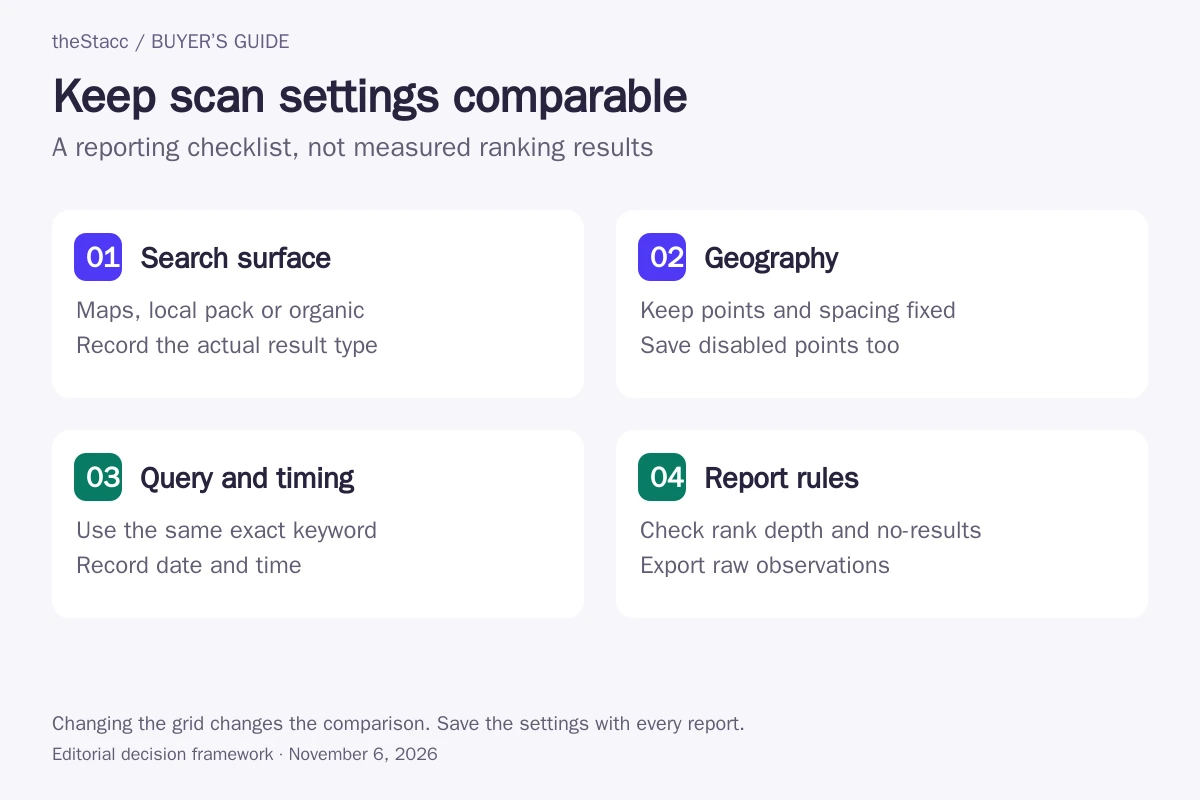
A geographic grid checks a keyword from several map coordinates. A single-location tracker follows selected queries from one configured place. Neither should be read as the position every potential customer sees. Ask which surface the tool queries: Google Maps results, the local pack in Search and organic website results are different measurements.
Quick shortlist: compare Local Falcon and Whitespark for explicit scan-credit budgets; inspect BrightLocal or SE Ranking when you already need their broader reporting; consider Localo for recurring Position Maps alongside profile work. Confirm current availability for Local Viking and Places Scout. theStacc and Google Business Profile remain in this guide as adjacent options with clear limits, not interchangeable grid trackers.
For broader platform selection, see local SEO software. For client seats, multi-location operations and delivery ownership, use local SEO tools for agencies. Directory discovery and cleanup belong in the local citation tools guide.
Compare the measurement and the billing unit
| Provider | Measurement role | Published price or access | Limit to inspect |
|---|---|---|---|
| theStacc | Coming soon | See current plans; no standalone grid rate | No geographic heatmap |
| Local Falcon | Dedicated geographic scan reports | $24.99/month; 7,500 plan credits | One credit per grid point; extras can consume credits |
| BrightLocal | Local Search Grid within a local reporting plan | $369/year for one-location Track; displayed as $31/month | Five grid keywords; distinguish legacy credit allowances |
| Localo | Position Maps with a profile subscription | $39/month equivalent billed annually, plus VAT where applicable | Routine monitoring and research scans have different limits |
| Whitespark | Separate Local Ranking Grids product | US$10/month; 2,000 credits | One credit per point; unused credits expire |
| SE Ranking | Local & Map Rank Tracker within a broader suite | Core: $129 monthly; check selected billing option | Point-keyword allocation, not a universal per-scan wallet |
| Local Viking | GeoGrid brand with a pricing destination change | Current price unverified; pricing redirects to Local Optics | Confirm current product and legacy account terms |
| GeoRanker | Local Heatmap and city/location reports | Starter: US$49/month billed monthly | 20 saved Heatmap reports at a time; API separate |
| Places Scout | Legacy provider identity; current offer needs confirmation | Standalone pricing not verified | Original domain redirects to Yext |
| Google Business Profile (Free) | First-party performance context; not a grid tracker | Free profile; verified access needed for performance | No geographic rank grid in the documented report |
How this comparison was researched
theStacc publishes this guide and sells SEO software and managed services. It is included in the comparison, so this is not an independent endorsement. The page was prepared with automated editorial assistance using official product pages and documentation. We have not run paid-account accuracy tests, benchmarked scan speed or measured ranking outcomes. The order preserves the existing provider list and is not a score or league table.
Selection advice is editorial judgement based on the documented measurement and billing model. Prices are dated observations, not quotes for your business. Confirm account entitlements, taxes and billing period before purchase. See our editorial standards.
Ten providers and their fit for Maps measurement
1. theStacc
Useful fit: For teams that need profile work now, with Maps rank tracking coming soon
theStacc documents Maps, local-pack and organic positions separately, with keyword and location limits tied to your entitlement. Its module does not provide a geographic heatmap. Do not buy it to answer a point-by-point coverage question.
Check the actual tracked query, location and update schedule in your account. Compare the documented Local SEO scope with your requirements and current plan terms. theStacc publishes this guide and is included in it.
2. Local Falcon
Useful fit: For a scan budget you can calculate from points and frequency
Local Falcon’s Starter plan lists $24.99 billed monthly and 7,500 credits. Its credit guide defines one credit as one scan point. An optional Falcon AI report uses another 25 credits; the scan allowance is not all available for grid searches if you add analysis.
Unused subscription credits expire after the billing cycle. Extra pay-as-you-go credits have different pricing and do not expire. Specify whether the proposal includes analysis, extra platforms and competitor scans. Official pricing · How credits work.
3. BrightLocal
Useful fit: For grids and conventional local rank reports in one account
BrightLocal’s current one-location Track selection shows $369 billed annually, displayed as $31 per month. It lists geographic tracking for up to five keywords, separate from the conventional tracker’s allowance. Confirm the monthly checkout amount if you do not want an annual commitment.
Its own grid guide describes preset and custom grid sizes. The help page we accessed is labelled Legacy Platform, and its credit-help link returned 404. Ask support for the credit rules, rerun charges and allowance for your actual account; do not reuse a legacy quota as a current entitlement. Current plan details · Legacy grid setup documentation.
4. Localo
Useful fit: For a business comparing neighbourhood visibility on a recurring schedule
Localo’s Single Business page displays $39 per month billed annually, plus VAT where applicable. Its Advanced Grid guide allows 3×3, 5×5 and 7×7 grids with controls for the area and centre. It says position grids update every seven days.
Keep those monitored profiles separate from Visibility Scan, the Pro/Enterprise research tool. Its grids and Leads Finder searches share a plan-specific monthly search quota. Confirm keyword and active-profile allowances for the selected plan. Plan details · Advanced Grid · Visibility Scan limits.
5. Whitespark
Useful fit: For buyers who want to budget for grid scans separately
Whitespark’s Local Ranking Grids starts at US$10 per month for 2,000 credits. Each keyword has a separate grid, and each grid point costs one credit each time it is scanned. Unused credits expire at the end of the billing period.
The product offers CSV and PDF export. Check the proposed schedule against your allowance before creating multiple keyword grids. This purchase is separate from Whitespark’s Local Rank Tracker, Local Citation Finder and listing services. Official Local Ranking Grids details.
6. SE Ranking
Useful fit: For an existing suite customer checking their included local allowance
SE Ranking’s current Core plan lists $129 with monthly billing. Its subscription comparison lists three Local Marketing locations and 1,500 local tracking keywords; the Local Rankings help explains that tracking limits use point-keyword combinations.
A point paired with several keywords uses several tracking units, and disabled grid points reduce the allocation. Do not multiply this quota by reporting runs as though it were a consumable scan-credit wallet. The help text is inconsistent about cadence, so confirm the schedule and legacy-plan limits in your account. Current subscription comparison · Local tracking rules.
7. Local Viking
Useful fit: For existing customers checking the destination product and credit rules
Local Viking’s public site still describes GeoGrid tracking. Its pricing link redirected to Local Optics during this research, and the destination did not expose readable pricing. We retain the original provider identity and do not repeat the former starter price.
Local Optics documentation describes separate keyword and geogrid wallets. Geogrid scans use one credit per active point per search term per run; its geogrid balance rolls over, unlike keyword credits. Ask which rules apply to your existing or new account before purchasing. Observed pricing destination · Destination credit documentation · Scheduled grid rules.
8. GeoRanker
Useful fit: For teams separating named-market reports from nearby grid points
GeoRanker’s current Starter SEO Suite lists US$49 per month billed monthly and up to 20 saved Local Heatmap reports at a time. That is a storage/report allowance, not a published number of point scans per month.
Its local checker guide separates city tracking from Local Heatmap. Ask for a Maps example and confirm result source, refresh frequency and retention. The Starter plan does not include SERP API access; do not assume an API allowance comes with the report subscription. Current pricing · Local reporting workflow.
9. Places Scout
Useful fit: For previous users establishing what can still be bought and exported
The Places Scout website redirected to Yext’s homepage when checked. That destination does not substantiate the old standalone starter price or the previous guide’s claim that it is a cheaper geo-grid alternative.
Before including it in a purchase shortlist, get written confirmation of the current product, grid access, billing, data retention and migration/export process. The redirect alone does not prove feature parity or account migration. Original provider destination, now redirecting to Yext.
10. Google Business Profile (Free)
Useful fit: For checking customer interactions alongside a separate rank report
Google’s performance documentation describes views, searches and interactions such as website clicks and directions. Access requires a verified profile and a signed-in associated Google account. These metrics help interpret activity, but do not give a rank at every point around the business.
The report can include organic and Google Ads activity. Do not equate its view totals with a tracker’s grid coverage, or its search terms with a paid keyword allowance. Google’s performance report documentation.
Run a comparison you can interpret later
Before a trial, write a short measurement specification. Ask each vendor to return a sample using the same requirements. Keep the raw observations as well as the summary graphic; otherwise a later settings change can look like a visibility change.
| Record | Why it matters to the comparison |
|---|---|
| Business and result surface | Match the correct profile and distinguish Maps, local pack and organic results. |
| Exact query and language | A rewritten query or different language is a different observation. |
| Coordinates, spacing and disabled points | A wider area or changed point set changes the population being measured. |
| Date, time and schedule | Keep the collection period visible rather than comparing unidentified screenshots. |
| Result depth and missing values | Ask whether absent results are excluded, assigned a fallback rank or shown separately. |
| Export and history access | Confirm what you can retain when you stop paying or move providers. |
Do not compare average-rank or share-of-voice labels without reading their definitions. Two dashboards can use different cutoffs or denominators. Record configuration changes explicitly; a denser grid can produce a different average without proving that any work improved a ranking.
Budget for the actual scans, not the word “credit”
Illustrative arithmetic: one location, 25 active points, three keywords and four scheduled runs produce 25 × 3 × 4 = 300 point-keyword observations. These are invented planning inputs, not client results. In a one-credit-per-point-per-keyword-per-run product, those base observations use 300 credits before add-ons. A monthly calendar does not always contain exactly four weekly runs.
That formula does not apply unchanged to every invoice. Local Falcon and Whitespark document point-based scan credits. SE Ranking allocates point-keyword combinations. GeoRanker publishes a cap on saved Heatmap reports. Localo separates monitored profiles from research searches. For BrightLocal, confirm the current account’s allowance and charging rules before carrying forward legacy documentation.
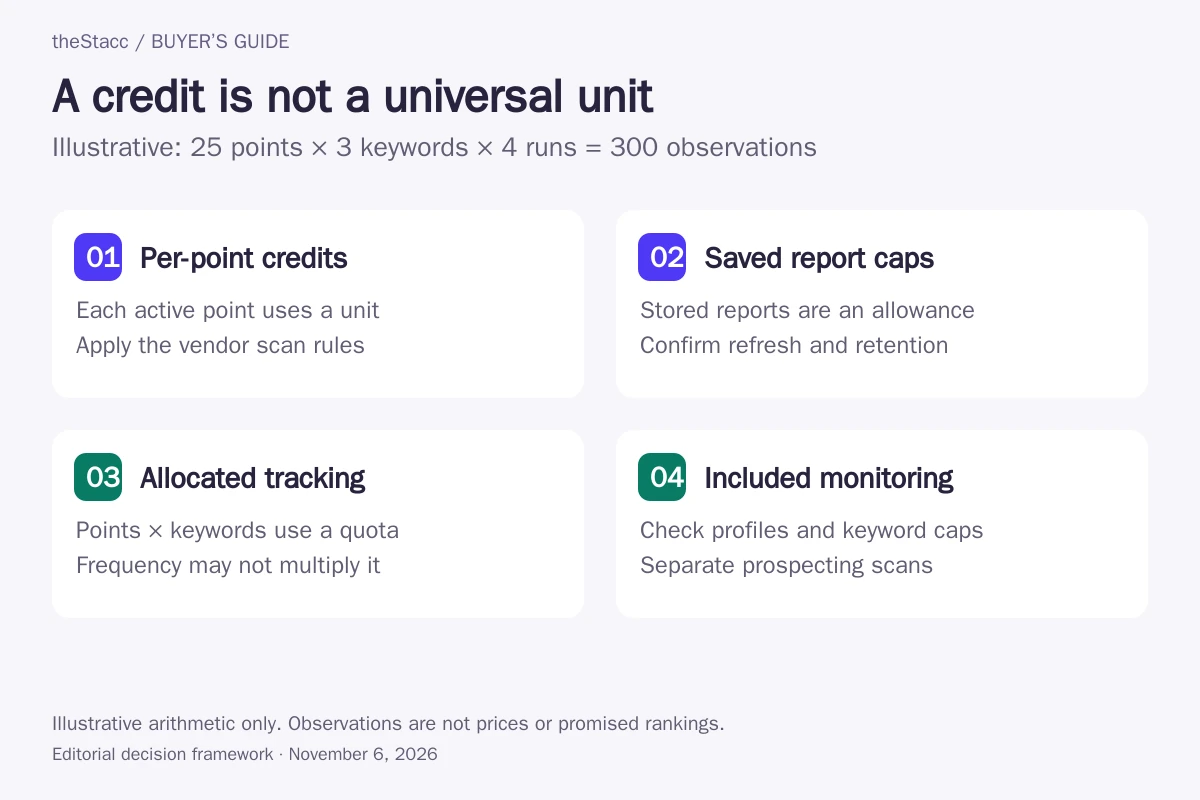
Ask for the expected charge at your actual scan schedule, what happens at the cap, whether failed or disabled points are charged, when credits expire, and what an extra location adds. Keep optional AI analysis and other search platforms separate. A cheap entry plan can still be the wrong purchase if it does not retain the history you need.
A ranking observation does not explain its cause
Google’s own guidance says local results mainly depend on relevance, distance and popularity. It also says there is no way to request or pay for a better local ranking. That is the ranking-factor basis used here; this guide does not turn a third-party factor survey into a Google statement. Read Google’s local ranking guidance.
Keep a separate record of business-profile edits and other work. A report can identify where to investigate, but a change in position alone does not establish why it happened or whether sales increased. If you need someone to perform the work, evaluate delivery scope separately from the tracking subscription; our affordable SEO services guide covers that purchasing decision.
Choose the smallest measurement scope that answers your question
Start with a written question: which neighbourhoods show the profile, whether the same queries changed over time, or whether profile interactions changed. Then inspect a sample report, its source settings and the billing rules. Avoid adding profile-management or citation features to a shortlist solely because the provider calls them “local SEO”.
For geographic coverage, compare grid products. For profile tasks, with Maps rank tracking coming soon, compare theStacc’s documented scope. For customer interactions, inspect the native Google report. These can complement each other without pretending they are the same measurement.
Check theStacc against your tracking requirement
Review the Local SEO module and account limits. It supports profile workflows; rank tracking on Google Maps is coming soon.
Start free →Google Maps rank tracking: questions answered
What is a Google Maps rank tracking tool?
It records where a business appears for a specified search and location. A geo-grid repeats that search from multiple coordinates. A conventional local tracker may use one chosen location. Confirm whether the report measures Google Maps, the Search local pack or organic results before comparing its numbers.
How many credits does a geo-grid scan use?
That depends on the product. In a one-credit-per-point model, multiply active points by keywords and scheduled runs, then by locations. Optional analysis may cost more. Other products allocate point-keyword combinations or cap saved reports instead. A credit from one vendor is not a universal unit.
Is a 5×5 grid enough?
There is no universal grid size for every business. Start with the area you actually need to examine, then choose spacing and points that cover it. A dense small grid and a widely spaced grid answer different questions. Keep the settings stable when comparing dates.
Why do two rank trackers disagree?
First compare the exact keyword, result surface, coordinates, spacing, time, ranking depth and treatment of missing results. Reports with different settings describe different observations. Ask each provider to show the underlying result and export before deciding that a difference proves an accuracy problem.
Does Google Business Profile include a free geo-grid tracker?
Google’s documented performance report covers searches, views and interactions for a verified profile. It is useful context, but it is not a geographic grid of keyword positions. Use it alongside a separately specified tracking method when you need neighbourhood-level observations.
Will buying a Maps tracker improve rankings?
A tracker records observations; a subscription is not evidence of ranking improvement. Google says local results mainly depend on relevance, distance and popularity, and that businesses cannot request or pay for a better local ranking. Use the report to investigate, and follow Google’s own profile guidance.
Does theStacc replace a geographic rank grid?
No. Rank tracking on Google Maps is coming soon in theStacc, and it does not provide a geographic heatmap today. Compare it for its Google profile workflow; use a dedicated grid tool to evaluate coverage across multiple points.
Should scans run weekly or every month?
Choose a schedule that supports a real reporting decision and fits the product’s allowed cadence. For consumable credits, count the actual scheduled runs in the billing period; some months include an extra weekly run. Repeating an unchanged scan more often creates more observations, not proof of an improvement.
Sources, access limits and maintenance
Official destinations were checked on November 6, 2026 and linked beside the relevant claims. We did not verify private account screens or purchase subscriptions. Some vendor documentation is changing: SE Ranking’s help was readable through indexed official content while direct requests returned 403, and its cadence wording is internally inconsistent. BrightLocal’s legacy credit-help link returned 404. Local Viking pricing redirected to Local Optics without readable prices, while Places Scout’s domain redirected to Yext.
Those limits remain visible instead of being filled with historic prices or inferred entitlements. Recheck the selected plan, product identity, history export and scan rules before buying. The examples and graphics are editorial guidance, not an accuracy benchmark or promised outcome.
Explore this topic: How to Rank Higher on Google Maps in 7 Proven Steps · Google Maps Ranking Factors: What Moves the 3-Pack.