
HARO Link Building: The Complete Guide (2026)
Learn how to use HARO for link building in 2026. Covers the relaunch under Featured.com, pitch templates, alternatives, and success rates. Updated guide.
Siddharth Gangal • 2026-03-29 • SEO Tips
In This Article
Over 46% of SEO professionals used HARO as their primary link building channel before it shut down in December 2024. Then it vanished. Connectively, the Cision rebrand, introduced paid tiers nobody wanted and closed 11 months later.
HARO link building is back. Featured.com acquired the brand in April 2025 and relaunched it as a free, ad-supported platform. The three daily email digests returned. But the rules have changed. AI-generated pitches flooded the old platform so badly that 85% of responses were SEO spam by the end. Journalists stopped trusting it.
This guide covers how HARO link building works in 2026. The full timeline, the new platform, the pitch strategy that actually gets placements, and the alternatives you need when HARO alone is not enough.
We publish 3,500+ blog posts across 70+ industries. Link building is a core part of the SEO strategy we run for every client. Here is what works now.
Here is what you will learn:
- The full HARO timeline from founding to shutdown to relaunch
- How to write pitches that stand out from 300+ responses per query
- The 5-15% success rate benchmark and how to beat it
- 8 HARO alternatives that work in 2026
- Common mistakes that get your pitches ignored
- How to track and measure HARO link building ROI
What HARO Is and How It Works in 2026
HARO (Help A Reporter Out) connects journalists with expert sources. A journalist needs a quote for an article about small business SEO. They post a query on HARO. You respond with a quote and your credentials. If the journalist uses your quote, you get a mention and usually a backlink from their publication.
The HARO Model
The platform sends 3 email digests per day (morning, afternoon, evening) containing journalist queries organized by category. Categories include business, technology, health, lifestyle, education, and general.
Each query includes:
- The journalist’s name and outlet
- The topic and specific question
- Deadline for responses
- Requirements (credentials, word count, format)
You reply to queries relevant to your expertise. The journalist selects the best responses, publishes the article, and links back to your site.
Why HARO Links Are Valuable
HARO links are editorial. A journalist at Forbes, Business Insider, or a major trade publication chose to cite you. Google treats these differently from guest posts or directory links.
| Link Type | Average DR | Google Trust | Effort per Link |
|---|---|---|---|
| HARO / Digital PR | 61 | High (editorial) | 5-20 pitches |
| Guest posting | 30-50 | Medium | 1-3 hours per post |
| Directory submissions | 10-30 | Low | Minutes |
| Broken link building | 40-60 | Medium | 2-5 hours |
According to BuzzStream’s link building research, 48.6% of SEO experts say digital PR (which includes HARO) is the most effective link building tactic. The average domain authority of placements through digital PR is DR 61.
Stop writing. Start ranking. Stacc publishes 30 SEO articles per month for $99. Content that earns links naturally. Start for $1 →
The Full HARO Timeline: From Launch to Shutdown to Relaunch
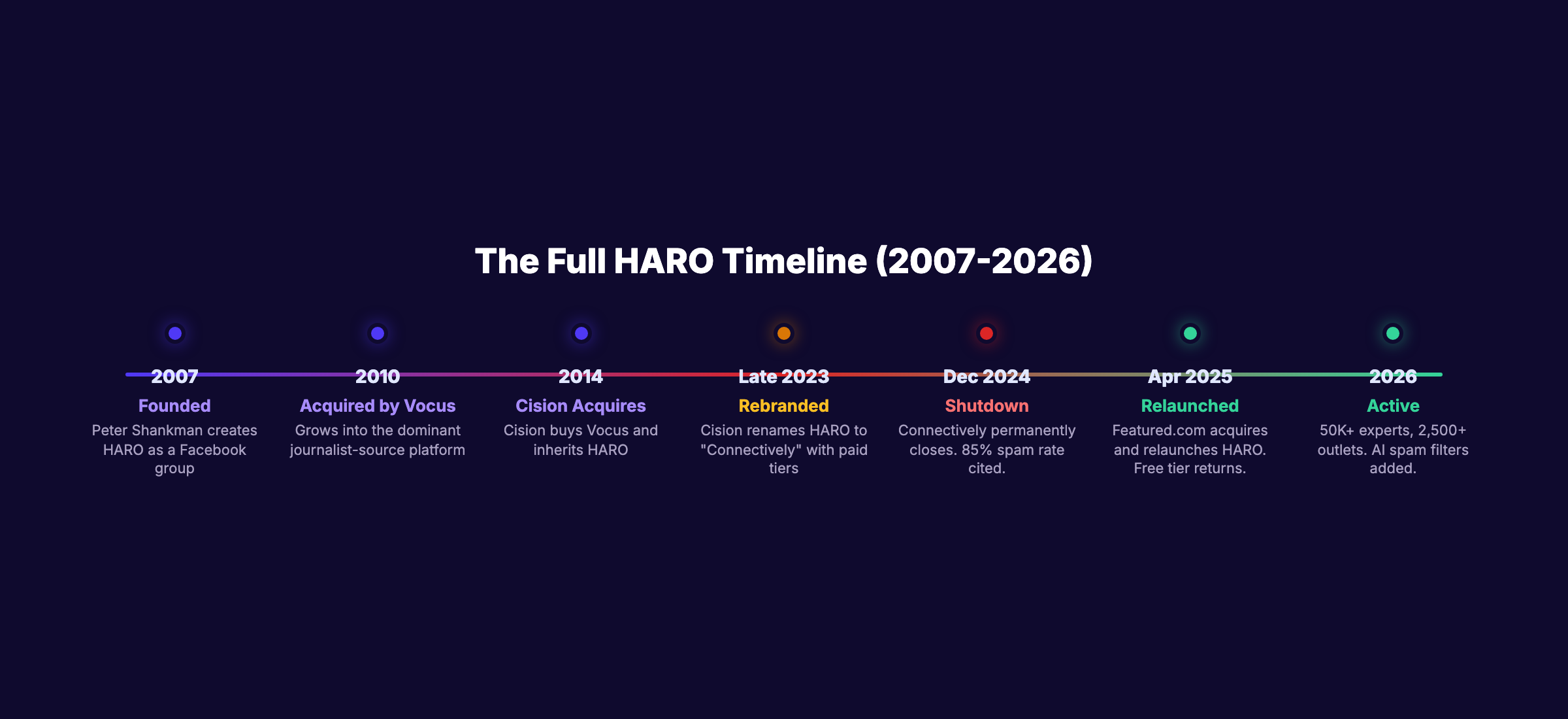
Understanding the timeline matters. Most HARO guides online are outdated. They reference a platform that no longer exists in its original form. Here is exactly what happened.
2007-2023: The Original HARO Era
Peter Shankman founded HARO in 2007 as a Facebook group connecting journalists with sources. It grew into the dominant platform for journalist-source matching. Vocus acquired HARO in 2010. Cision acquired Vocus in 2014. Through all the ownership changes, HARO stayed free and email-based. Over 46% of SEO professionals used it regularly.
Late 2023: The Connectively Rebrand
Cision rebranded HARO to “Connectively” in late 2023. The rebrand introduced a new interface, tiered subscriptions from $29 to $149 per month, and a pay-per-pitch model. The SEO community reacted poorly. Paying to pitch journalists who might not respond felt backwards.
December 9, 2024: The Shutdown
Connectively shut down permanently on December 9, 2024. Cision pivoted to its CisionOne platform and abandoned the journalist-source matching model. Thousands of SEO professionals lost their primary link building channel overnight.
April 2025: The Featured.com Relaunch
Featured.com acquired HARO from Cision on April 16, 2025, and relaunched it 6 days later. The new HARO is free with an ad-supported model. Paid tiers start at $19 per month for premium features. The 3 daily email digests returned. Featured.com serves 50,000+ experts and partners with 2,500+ media outlets.
2026: The Current State
HARO operates under Featured.com with improvements aimed at the AI spam problem that killed the original platform. LinkedIn verification and AI text detection help filter low-quality pitches. The platform works, but competition per query remains intense. Most serious link builders now use HARO alongside 2-3 other platforms.
How to Write HARO Pitches That Get Placed
The average HARO query receives 100 to 300 pitches. Popular queries from major publications get up to 2,000 responses. Your pitch needs to stand out from all of them.
Pitch Within 6 Hours
Speed is the single biggest factor in HARO success. Pitches submitted within 6 hours of a query posting see 20% higher conversion rates. Journalists often stop reading responses once they find 3-5 good ones. Late pitches rarely get read.
Set up email notifications and block time to respond immediately when relevant queries arrive.
Lead With Credentials
Journalists filter pitches by scanning the first 2 lines. Lead with who you are and why you are qualified to answer. Not your company description. Your specific expertise.
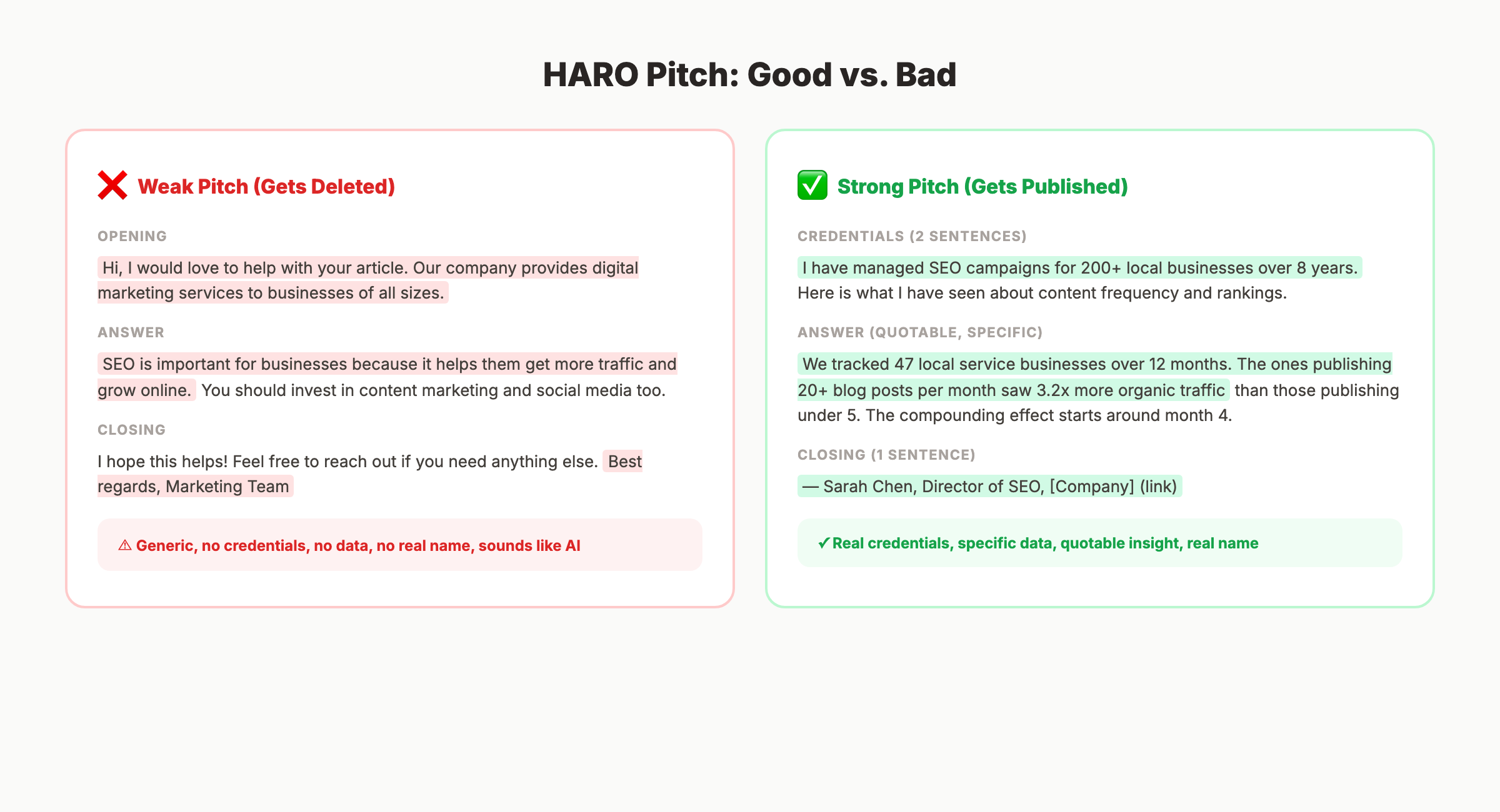
Bad opening: “Hi, I would love to help with your article. Our company provides digital marketing services…”
Good opening: “I have managed SEO campaigns for 200+ local businesses over 8 years. Here is what I have seen about [topic]…”
Give a Specific, Quotable Answer
Journalists need quotes they can copy directly into their article. Vague, general responses get deleted. Specific answers with data, examples, or contrarian takes get published.
Bad answer: “SEO is important for businesses because it helps them get more traffic.”
Good answer: “We tracked 47 local service businesses over 12 months. The ones publishing 20+ blog posts per month saw 3.2x more organic traffic than those publishing under 5. The compounding effect starts around month 4.”
The second answer gives the journalist a specific stat, a methodology, a timeline, and a quotable insight.
Keep Pitches Under 300 Words
Journalists do not read essays. The ideal pitch has 3 parts:
- Credentials (2 sentences): Who you are and your relevant experience
- Answer (3-5 sentences): Your specific, quotable response with data
- Closing (1 sentence): Your full name, title, company, and website URL
That is it. No sales pitch. No company overview. No “I hope this helps.”
Use Your Real Name and Headshot
After the AI spam problem destroyed the old HARO, journalists trust real people with verifiable identities. Use your real photo, real name, and real LinkedIn profile. The Featured.com relaunch includes LinkedIn verification for this reason.
Your SEO team. $99 per month. 30 optimized articles, published automatically. Every post designed to earn organic links. Start for $1 →
HARO Link Building: Step-by-Step Process
Here is the exact process for building links through HARO in 2026.
Step 1: Set Up Your HARO Profile
Create an account at Featured.com/HARO. Complete your profile with:
- Professional headshot
- LinkedIn profile link (enables verification)
- Bio with specific expertise areas
- Website URL (this is where your backlink points)
- Industry categories you can speak to
The more specific your expertise profile, the better journalists can evaluate your authority.
Step 2: Choose Your Categories
Select 3-5 categories that match your expertise. Do not select everything. Targeted categories mean fewer but more relevant queries. Quality responses to relevant queries beat mass-pitching irrelevant ones.
For SEO and marketing professionals, the best categories are typically Business and Finance, Technology, and General.
Step 3: Filter Queries by Opportunity
Not every query deserves a response. Filter for:
- Publication authority: Prioritize queries from sites with DR 50+. A link from a DR 70 site is worth 10 links from DR 20 sites. Use your backlink audit skills to evaluate.
- Relevance to your expertise: Only respond if you have genuine knowledge. Journalists spot fakes immediately.
- Deadline feasibility: Skip queries with deadlines under 2 hours unless you can respond immediately.
- Specificity: Queries asking for “general tips about marketing” attract 1,000+ responses. Queries asking for “B2B SaaS pricing strategies for mid-market companies” attract 50. Target specific queries.
Step 4: Draft and Send Your Pitch
Follow the pitch structure from the previous section. Write it fresh each time. Do not use templates with fill-in-the-blank slots. Journalists recognize template pitches instantly.
Do NOT use AI to write your pitch. The new HARO platform uses AI text detection. And journalists have spent 2 years filtering AI responses. An obvious AI pitch goes straight to trash.
Step 5: Track Every Pitch
Build a simple spreadsheet to track:
| Date | Query Topic | Publication | DR | Status | Link URL |
|---|---|---|---|---|---|
| 3/29/2026 | Local SEO tips | Forbes | 93 | Pitched | Pending |
| 3/28/2026 | Content marketing ROI | HubSpot Blog | 91 | Published | /blog/url |
Track your pitch-to-placement rate monthly. The benchmark is 5-15%. If you are below 5%, your pitches need work. Above 15%, you are doing well.
Step 6: Follow Up on Placements
When your pitch gets published:
- Verify the link is live and points to the right page
- Check if the link is dofollow (over 50% of HARO placements are dofollow)
- Share the article on social media and tag the journalist
- Save the placement for future credibility (“As seen in Forbes, HubSpot…”)
- Add the referring domain to your backlink monitoring dashboard
8 HARO Alternatives for Link Building in 2026
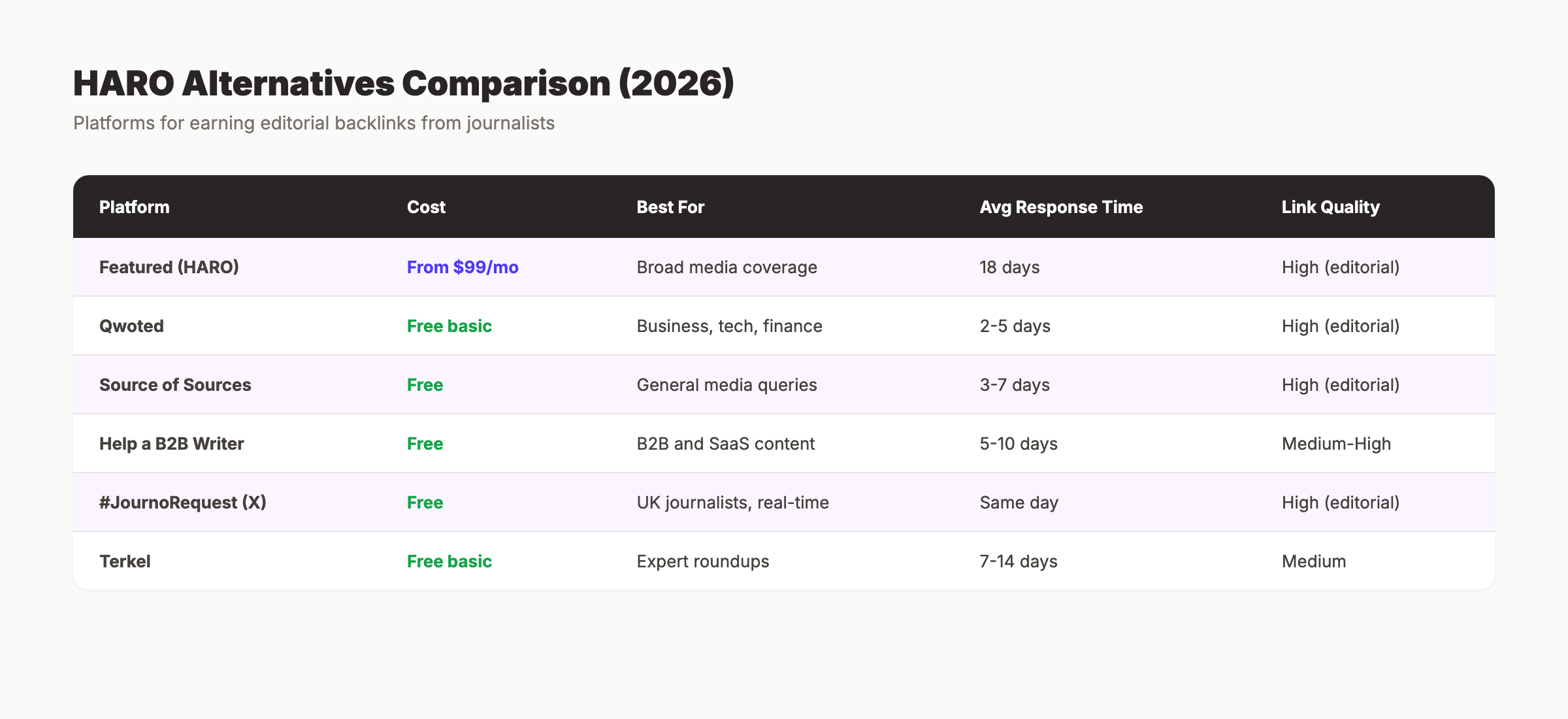
HARO alone is not enough. The best link builders use multiple platforms. Here are 8 alternatives ranked by effectiveness.
1. Qwoted
Qwoted is the closest direct competitor to HARO. It uses algorithmic matching to connect 25,000+ journalists with expert sources. The free plan allows 2 pitches per month. Paid plans start at $149 per month for unlimited pitching.
Best for: B2B companies, SaaS brands, and professionals who need curated, high-quality matches rather than mass email digests.
2. Source of Sources (SOS)
Peter Shankman, the original HARO founder, launched Source of Sources after the Connectively shutdown. It runs on an honor system with a strict one-strike spam policy. Free and email-based, just like the original HARO.
Best for: Anyone who valued the original HARO model. Smaller pool means less competition per query.
3. Featured.com (Platform)
Separate from HARO, Featured.com’s own platform creates full articles assembled from expert quotes. You contribute answers, and Featured publishes the compiled article with links to all contributors.
Best for: B2B companies that want guaranteed placements (higher acceptance rate than traditional HARO).
4. #JournoRequest on X (Twitter)
Journalists post source requests on X using #JournoRequest and #PRRequest hashtags. Completely free. Global reach. Requires active monitoring or a tool like TweetDeck.
Best for: PR professionals and brands already active on X. Fast response times possible since you see queries in real time.
5. SourceBottle
Australian-founded platform (2009) with a niche industry focus. Free tier available with paid plans from $5.95 per month. Email-based matching similar to HARO.
Best for: Companies targeting Australian, UK, or niche industry publications.
6. Help a B2B Writer
Free platform focused exclusively on B2B content. Writers and journalists post queries, and B2B experts respond with quotes and data.
Best for: B2B SaaS, consulting, and professional services companies.
7. Muck Rack
Full PR suite with a journalist database, media monitoring, and pitch tracking. Custom enterprise pricing. More than just a query platform.
Best for: Companies with dedicated PR teams and larger budgets.
8. Direct Journalist Outreach
Skip the platforms entirely. Find journalists who cover your industry on LinkedIn and X. Build relationships before you need a link. Offer expertise proactively. This is harder but produces the highest-quality results.
Best for: Long-term content marketing strategy where relationships matter more than volume.
3,500+ blogs published. 92% average SEO score. See what Stacc can do for your site. Start for $1 →
Common HARO Link Building Mistakes
These mistakes account for most failed pitches. Avoid them and your success rate jumps above the 5-15% average.
Pitching Queries Outside Your Expertise
Journalists check your background. If you pitch a healthcare query and your website is about plumbing SEO, the journalist ignores you. Worse, repeated off-topic pitches get your account flagged.
Only pitch queries where you have genuine, demonstrable expertise.
Sending Generic AI-Written Responses
85% of responses on the old HARO platform were SEO-driven spam. Journalists developed sharp filters for AI-generated content. They look for:
- Overly polished, robotic language
- Generic advice without specific examples
- Responses that perfectly match the query keywords (obvious SEO optimization)
- Missing personal anecdotes or original data
Write your own pitches. Use your own voice. Share your own experiences.
Burying Your Credentials
The journalist decides in 5 seconds whether to keep reading. If your credentials are buried in paragraph 3, they never see them. Lead with who you are.
Pitching Without a Website or Bio
Your HARO profile links to your website. That is where the backlink points. If your website is a blank landing page or a clearly thin site, journalists skip you. They do not want to link to low-quality sites.
Make sure your site has quality content, an about page with real bios, and a clear area of expertise. Following a solid on-page SEO strategy helps your site look authoritative to journalists evaluating it.
Ignoring Deadlines
Pitching after the deadline wastes everyone’s time. Set calendar reminders. If you cannot pitch within the window, skip that query.
Not Following Up After Publication
When your pitch gets published, the work is not done. Share the article. Tag the journalist. Thank them publicly. This builds a relationship that leads to future queries coming directly to you, bypassing the platform entirely.
Measuring HARO Link Building ROI
HARO link building takes time. You need a system to track whether that time produces results.
Key Metrics to Track
| Metric | Benchmark | Tool |
|---|---|---|
| Pitches sent per month | 20-40 | Spreadsheet |
| Pitch-to-placement rate | 5-15% | Spreadsheet |
| Average DR of placements | 50+ | Ahrefs, Semrush |
| Dofollow vs. nofollow ratio | 50%+ dofollow | Ahrefs |
| Referral traffic from placements | Varies | Google Analytics |
| Ranking improvement on target pages | Track monthly | Google Search Console |
Cost Analysis
The average cost per link through digital PR is $750 when using an agency. HARO is free (or $19 per month for premium features). The cost is your time.
If you spend 5 hours per week on HARO and land 3 links per month, your effective cost per link is roughly $100-200 at an average professional hourly rate. That compares favorably to the $84 average cost per link from Ahrefs’ industry data and dramatically undercuts agency rates.
Expected Timeline
Do not expect results in week 1. Realistic expectations:
- Month 1: Learning the platform, refining pitches. 0-2 placements.
- Month 2-3: Finding your rhythm. 2-5 placements per month.
- Month 4-6: Consistent results. 3-8 placements per month.
- Month 6+: Journalists start recognizing your name. Inbound requests begin.
The compounding effect mirrors what we see with blog content. Early effort compounds into long-term results.
Rank everywhere. Do nothing. Blog SEO, Local SEO, and Social on autopilot. Start for $1 →
FAQ
Is HARO still available in 2026?
Yes. Featured.com acquired HARO from Cision in April 2025 and relaunched it as a free, ad-supported platform. The 3 daily email digests returned. Paid tiers start at $19 per month for premium features like priority access and enhanced profiles. The platform serves 50,000+ experts and partners with 2,500+ media outlets.
What is the success rate for HARO link building?
The average pitch-to-placement rate is 5-15%. This means for every 20 pitches you send, 1 to 3 will result in a published mention with a backlink. Pitching within 6 hours of query posting increases your success rate by about 20%. Highly specific, data-backed responses outperform generic advice by a wide margin.
Can I use AI to write my HARO pitches?
Strongly discouraged. The new HARO platform under Featured.com uses AI text detection to flag automated responses. Journalists spent 2 years dealing with AI spam on the old platform and have sharp filters for it. Write your own pitches with your own voice, data, and experience. AI-generated responses get deleted immediately.
What are the best HARO alternatives?
The top alternatives are Qwoted (algorithmic matching with 25,000+ journalists), Source of Sources (founded by HARO creator Peter Shankman), Featured.com’s own expert platform, and #JournoRequest on X. Most serious link builders use 2-3 platforms simultaneously rather than relying on any single one.
How many links can I get from HARO per month?
A consistent effort of 20-40 pitches per month typically produces 3-5 links. Some of those will be from high-DR publications (DR 50-90+). The quality of HARO links generally outweighs the quantity. A single link from a DR 80+ publication can move rankings more than 20 links from low-authority sites.
Does HARO link building still work after the Connectively shutdown?
Yes, but the approach has evolved. The Featured.com relaunch restored the core functionality. Competition remains high, and AI spam filters are stricter. The fundamentals still work: respond fast, lead with credentials, give specific quotable answers, and only pitch queries where you have genuine expertise. Pair HARO with direct journalist outreach and other platforms for the best results.
Written and published by Stacc. We publish 3,500+ articles per month across 70+ industries. All data verified against public sources as of March 2026.
