How to pitch SEO services and win more clients: prospect research, mini audits, data-driven proposals, objection handling, and closing techniques that convert. Real examples included.
Winning an SEO pitch depends on showing the prospect a problem they did not know they had, then pricing the fix in their revenue terms. The seven steps below run from research and a short live audit through proposal structure, objection handling, and the close. Traffic graphs come last, not first.
Most SEO professionals lose pitches before they walk into the room. They open with traffic graphs, crawl error reports, and Domain Authority scores. The prospect nods. Nothing happens.
The gap is not knowledge. It is framing. A business owner does not care about technical SEO metrics. They care about how many leads SEO will bring and whether that number justifies the spend.
This is a repeatable 7-step system for pitching SEO services to clients. From the research you do before any meeting to the follow-up process that turns a "thinking about it" into a signed contract. Stacc has published over 3,500 SEO articles across 70+ industries. This process is what actually works for businesses ranging from local service providers to B2B SaaS companies.
Here is what you will learn:
- How to research a prospect before any conversation
- How to run a 15-minute audit that uncovers proof
- How to translate every technical finding into business language
- How to build a data case that justifies budget
- How to handle the 5 most common objections
- How to write a one-page proposal that gets decisions
- How to follow up without being ignored
Time required: 2–4 hours per prospect (front-loaded research and audit) Difficulty: Intermediate What you will need: Google Search Console access (if the client shares), Ahrefs or Semrush free tier, a one-page proposal template
Step 1: Research the Prospect Before Any Conversation
Before any call, spend 30 minutes learning this prospect's world. Search their primary service keyword, check their Google rankings, and identify 2-3 competitors ranking above them. The goal is one specific, relevant observation you can open with. Not a generic pitch.
Specifically:
- Search their core service keyword in Google (e.g., "IT consulting Denver") and note whether they appear in the top 10
- Run a quick competitor analysis using Ahrefs Free Webmaster Tools or Semrush's free site check. Look for the organic traffic gap between their site and their top competitor
- Check their Google Business Profile if they are a local business: missing categories, fewer than 20 reviews, or no recent posts are all signal-rich problems
- Look at the top-ranking competitor and estimate how much traffic they receive on keywords the prospect should own
The research takes 20-30 minutes. What you end up with is a briefing. Specific enough to open the first 60 seconds with a real observation instead of a sales script.
Why this step matters: Walking in blind signals that you treat every prospect the same. A targeted opener: "I noticed your competitor [name] gets an estimated 1,200 visits per month from the keyword you told me is your biggest lead driver, and you do not rank in the top 20 for it". Separates you from every other vendor they have heard from. It earns the next 30 minutes of attention.
Pro tip: Screenshot the SERP before your meeting. Showing a prospect their competitor ranking above them in real time creates more urgency than any slide deck you could build.
Step 2: Run a Mini Audit to Find Their Biggest SEO Gaps
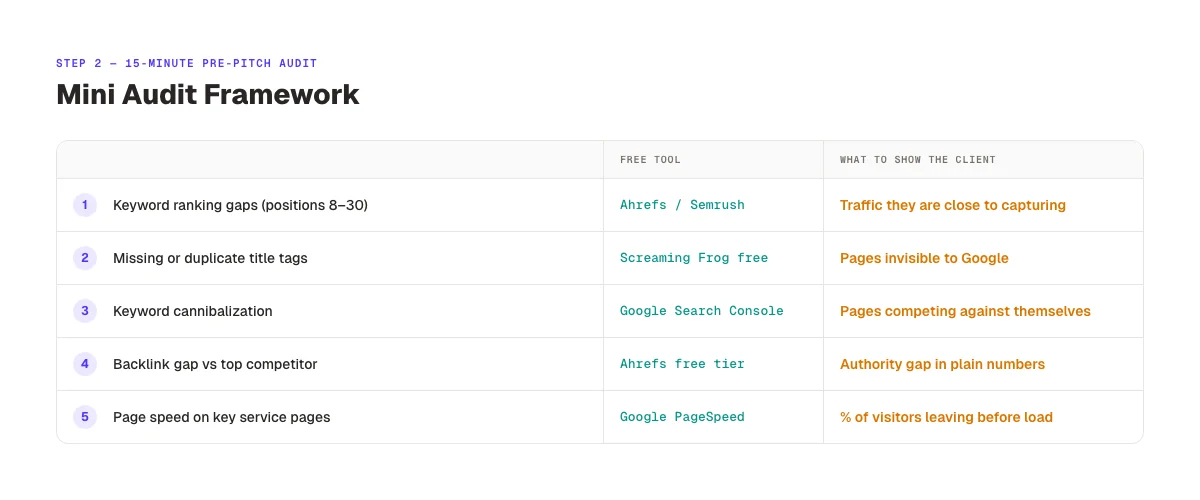
An audit gives you proof. It shifts the conversation from "I believe SEO will help you" to "here is exactly what is costing you traffic right now." The mini audit does not need to cover everything. It needs to surface 3 specific, fixable problems.
Specifically:
- Use a free SEO audit tool to pull basic site health: crawl errors, missing title tags, slow page speed
- Identify pages that rank in positions 8-30 for their primary service keywords. These are easy wins already in reach
- Check for keyword cannibalization: 3 or more pages targeting the same keyword splits ranking authority and holds all of them back
- Compare their backlink count to a top competitor using any free tool. A large gap signals a clear opportunity
- Note any page with no meta description or duplicate title tags
Pick the top 3 issues. Attach an estimated traffic impact to each. That becomes the proof section of your pitch.
For keyword gap analysis, positions 8-30 are the highest-value targets. A page ranking 11th for a keyword with 600 monthly searches is leaving 200-300 potential clicks on the table every month. With real ranking authority already in place.
Why this step matters: Clients respond to specifics, not possibilities. "Your homepage has no title tag for your main service keyword, and you have 4 pages competing for the same phrase" is a problem they can feel. "Your SEO has room to improve" is something every vendor says.
Step 3: Lead with Business Outcomes, Not SEO Jargon
The single biggest mistake in an SEO pitch is leading with metrics the client does not understand. Domain Authority, crawl budget, anchor text distribution. These mean nothing to a business owner who wants more customers. Before your meeting, translate every technical finding into a business outcome.
Use this conversion table in your preparation:
| Technical finding | Business translation |
|---|---|
| Page ranks position 11 for primary keyword | You are missing roughly 300 clicks per month from buyers already searching for you |
| 4 pages targeting the same keyword | Your site is splitting its own ranking ability. All 4 pages are weaker than they should be |
| Homepage loads in 6.2 seconds | About 50% of mobile visitors leave before the page finishes loading |
| Competitor has 3× more backlinks | Google treats them as more credible, so they rank above you for the same queries |
| No Google Business Profile posts in 90 days | GBP profiles with regular posts appear in local maps results 2× more often |
Every finding becomes a cost. A business not ranking for its core service keyword is actively losing leads to competitors every day. That is the frame for your entire pitch. Not technical debt, but daily revenue leakage.
Specifically:
- Before every meeting, rewrite each audit finding as a missed lead or lost revenue figure
- Open with the prospect's single biggest opportunity (not their biggest problem. Opportunity framing feels constructive, not critical)
- Use dollar estimates where you can: "That keyword gets 500 searches per month. If 3% of those visitors converted, that is 15 leads per month your competitor captures and you do not."
For service businesses specifically, connecting SEO to appointment bookings, consultation requests, or phone call volume makes the business case tangible. A 10% improvement in organic visibility is hard to care about. A projection of 15-25 additional leads per month is not.
Why this step matters: Budget decisions happen at the business outcome level, not the technical metric level. A business owner approves $2,000/month for "20-30 additional qualified leads per month." The same business owner pauses on "$2,000/month to improve Domain Authority from 18 to 30." Same service, different frame, completely different outcome.
Step 4: Build the Data Case for SEO
Once you have established the problem, the prospect asks why SEO over paid ads, social media, or doing nothing. Your job is to answer that question with data. Decision makers need a business case, not a trend report.
Here are the numbers that move budget conversations:
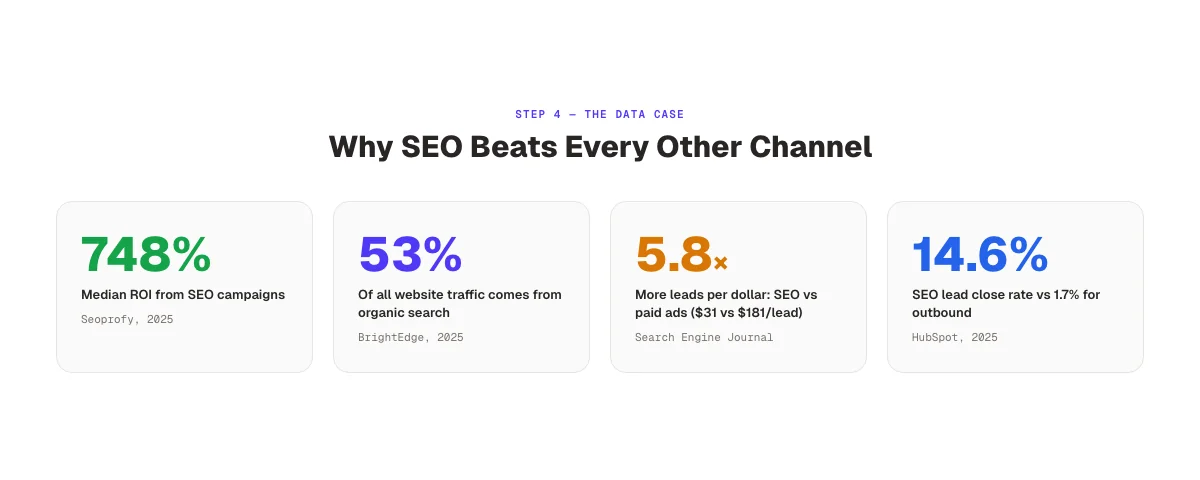
Organic search drives 53% of all website traffic. Paid search, social media, email, and display combined account for the rest. For most businesses, Google is where buyers start. And SEO is how you capture that demand consistently.
The cost per lead from SEO is roughly $31. The cost per lead from paid advertising is roughly $181. That is a 5.8× cost advantage. Unlike PPC, the traffic does not stop when you stop paying. It compounds.
SEO leads close at 14.6%, compared to 1.7% for outbound marketing. The reason is intent. Someone who searches "emergency HVAC repair Chicago" is already looking to hire. Someone who receives a cold call is not.
According to SEO ROI research from Seoprofy, the median return on SEO investment is 748%. Meaning $7.48 back for every $1 spent. Medical, legal, and B2B sectors regularly see returns above 900%.
To close the case, build a simple traffic forecast using the SEO forecasting formula:
- Pull monthly search volume for the prospect's 5 most important keywords
- Apply a 20% click-through rate for a top-3 ranking position (conservative estimate)
- Multiply by their site's average conversion rate, or use the industry average of 2.5-3%
- The result is a monthly lead estimate if they achieve those rankings
A prospect who sees that SEO could deliver 30-40 leads per month at $1,500/month. Versus 12 leads from PPC at $3,500/month. Has the financial logic to approve the investment. The SEO budget guide has more on how to frame these comparisons by business size.
Why this step matters: Without a data case, you are asking for trust. With a data case, you are presenting a business decision. Skeptical prospects are rarely convinced by enthusiasm. They are convinced by numbers they can run through their own P&L.
Stop writing. Start ranking. theStacc publishes 30 SEO-optimized articles per month for your clients. Automatically. No writers to manage, no briefs to write. 3,500+ blogs published, 92% average SEO score.
Step 5: Handle the 5 Most Common Objections
Every SEO pitch surfaces the same 5 objections. Know them before they appear. A prepared response that acknowledges the concern and redirects with data closes more deals than the best deck you can build.
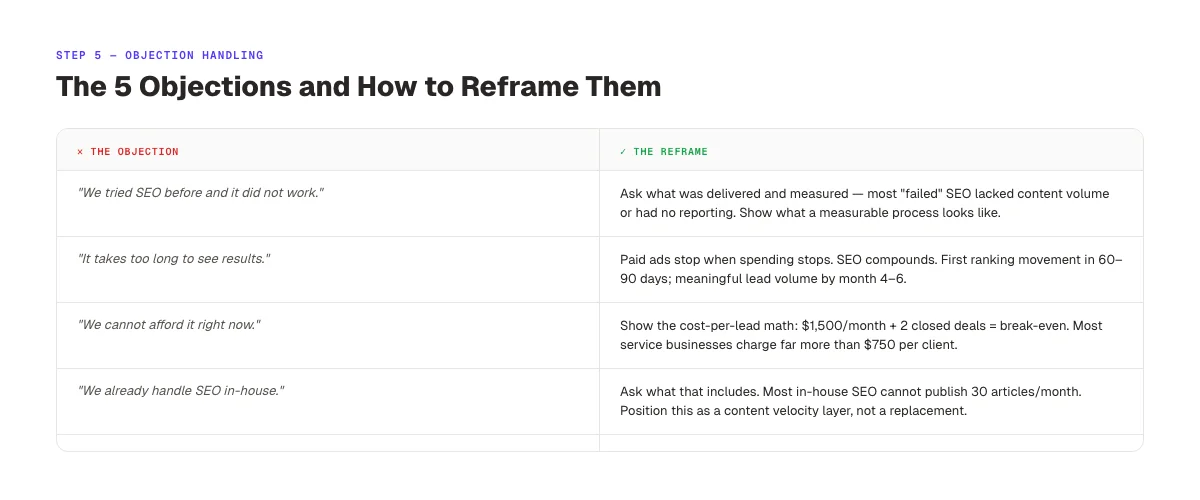
"We tried SEO before and it did not work."
This is the most frequent objection. And the easiest to handle. Ask what the agency delivered, what was measured, and what timeline they expected. Most "failed" SEO campaigns failed because of unrealistic timelines, a low volume of content, or agencies that promised rankings and disappeared. Your response: "That is worth understanding. Can you walk me through what they actually delivered?" Then show what a different, measurable process looks like.
"It takes too long to see results."
SEO does take time. Do not deny it. Reframe it instead: "Paid ads stop the moment you stop paying. SEO builds an asset that compounds. Most businesses start seeing ranking movement within 60-90 days and meaningful lead volume within 4-6 months." Then compare the 12-month cost of SEO versus the 12-month cost of running the same PPC spend.
"We cannot afford it right now."
This is usually about perceived risk, not actual budget. Break down the cost per lead. If your service costs $1,500/month and the client closes 30% of inbound leads, they need just 2 additional closed deals per month to break even. And most service businesses charge well above $750 per client. Show that math explicitly.
"We already handle SEO in-house."
Ask what that currently includes. Most "in-house SEO" is one generalist doing basic on-page work with no content strategy and no consistent publishing. Your pitch: "That is a great foundation. This would sit on top of it. We handle content velocity specifically. Most in-house teams cannot publish 30 articles per month while managing everything else."
"How do I know you will get results?"
Show proof. Case studies with specific before-and-after traffic numbers, screenshots, and a named client carry more weight than any credential. For the SEO KPIs that matter most. Organic traffic growth, keyword position movement, and lead volume from organic. Show the reporting cadence you commit to. If you are newer, show the process: "Here is the methodology, here are the tools, and here is exactly how we report progress every month."
Why this step matters: Objections are not rejections. They are requests for more information. The prospect who objects is still in the conversation. Treat every objection as a buying signal. A prepared, calm response that addresses the concern without arguing builds more trust than any pitch material.
Step 6: Present a Clear, Scoped Proposal
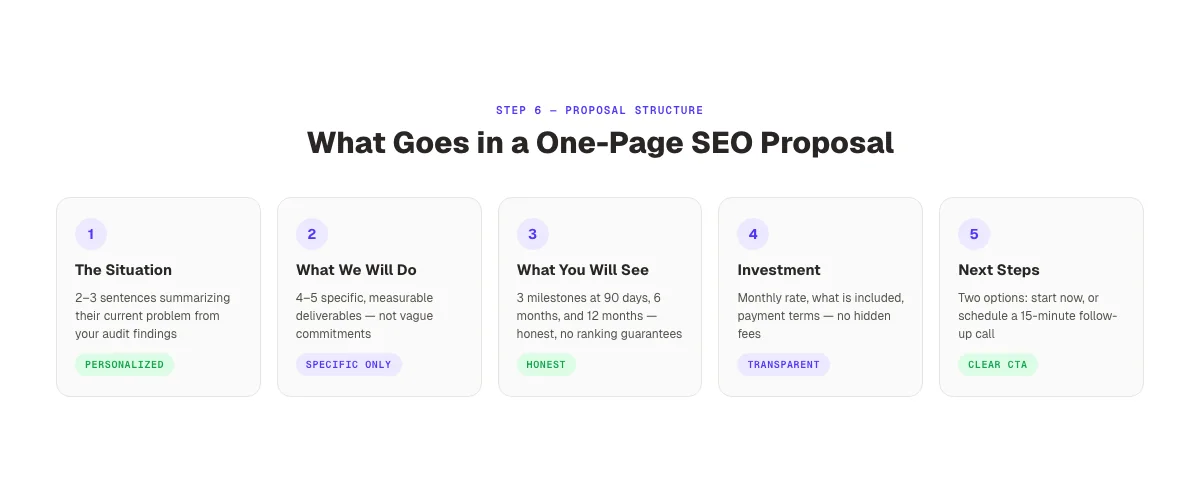
A proposal does 3 things: confirms what you agreed to discuss, specifies what you will deliver, and states what it costs. It should fit on one page or screen. The cleaner the proposal, the faster the decision.
Specifically:
- Section 1. The Situation: 2-3 sentences summarizing their current problem from your audit findings
- Section 2. What We Will Do: 4-5 specific deliverables, not vague commitments. "Publish 30 SEO-optimized blog articles per month, each targeting a specific keyword" is a deliverable. "Increase your online presence" is not.
- Section 3. What You Will See: 3 measurable milestones at 90 days, 6 months, and 12 months. Be honest. Do not promise specific rankings.
- Section 4. Investment: Monthly rate, what is included, and payment terms
- Section 5. Next Steps: Two options. Start now, or schedule a 15-minute call to answer questions
Avoid open-ended deliverables. Phrases like "ongoing SEO optimization" or "content as needed" create scope disputes within 60 days. Every line item should be specific and verifiable.
For the deliverables section, include output quantities wherever possible. "4 blog posts per month" is clearer than "content marketing." "Monthly keyword ranking report covering 20 tracked terms" is clearer than "monthly SEO reporting." Specificity removes the friction that causes stalls. For a full breakdown of what strong SEO reporting looks like, see the SEO reporting guide.
Why this step matters: Most deals stall in the proposal stage. Not because the price is too high, but because the proposal is too vague. When a client cannot tell exactly what they are buying, they delay. Clarity is the fastest path from proposal to signature.
Pro tip: Add a "What We Do Not Handle" section. Listing 3-4 explicit out-of-scope items ("We do not run paid ads, manage social media, or redesign your website") prevents scope creep disputes and signals that you have done this before.
Your SEO team. $99/month. 30 optimized articles published automatically. Clients get consistent content without managing writers, briefs, or deadlines. See what theStacc publishes →
Step 7: Follow Up Systematically
Most SEO deals do not close on the first pitch. A buyer who needs internal approval, is mid-budget-cycle, or is comparing 2-3 vendors will not decide in the first meeting. The follow-up sequence is where pitches become signed contracts.
Specifically:
- Day 1 (same day as pitch): Send a brief recap email with the proposal link and a 3-bullet summary of the key audit findings
- Day 3-4: Send one piece of relevant value. A case study from a similar industry, a specific stat about their category, or a follow-up to a question they raised in the meeting
- Day 7-10: Check in with one direct question: "Has the team had a chance to review the proposal? Any questions I can answer?"
- Day 14-21: One final follow-up with a soft urgency signal: "I have a start slot opening in the next 2 weeks. Wanted to flag it in case the timing works for you."
- Day 30+: Move to a low-pressure nurture: a monthly industry update, a relevant article, or a check-in on a business goal they mentioned. Stay visible without pressure.
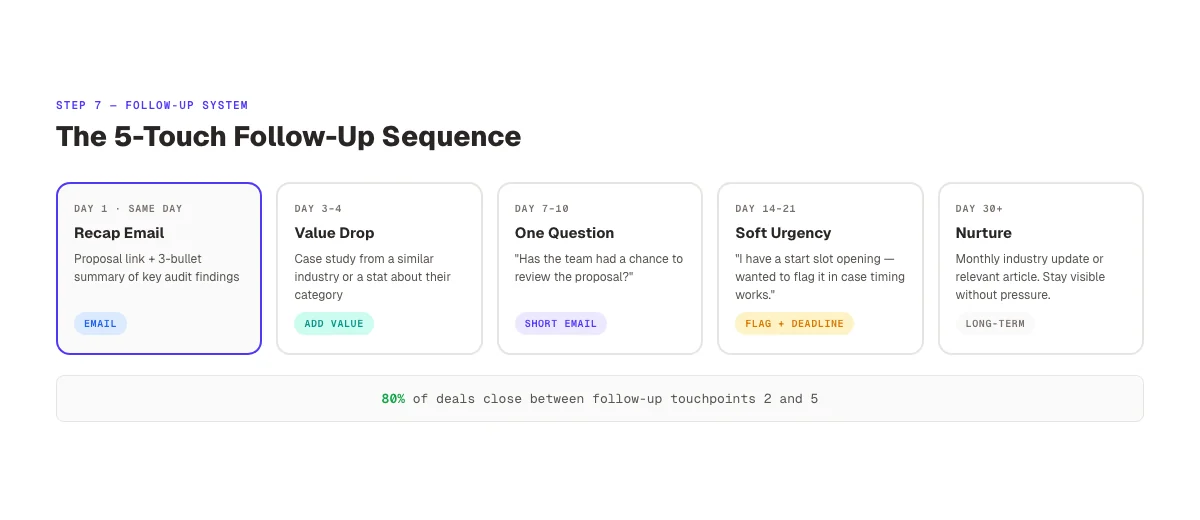
The goal of every follow-up is to add value, not to ask for a decision. A prospect who receives useful, relevant information between touchpoints builds trust. A prospect who receives "just checking in" emails does not.
Why this step matters: 80% of deals close between follow-up touchpoints 2 and 5. Most salespeople stop after 1-2 contacts and assume the deal is dead. The prospect who goes quiet is often waiting for internal approval, the right budget cycle, or the confidence that you will show up after the contract starts. Consistent follow-up signals that confidence.
Results: What to Expect
After completing this 7-step system, here is a realistic timeline:
- Week 1: Research brief and mini audit ready for each qualified prospect
- Weeks 2-4: Discovery calls completed, proposals sent, objections handled
- Month 2-3: A portion of pitched prospects make decisions. Qualified prospects close at 20-30% with a well-run pitch process
- Month 3-6 for closed clients: First ranking movements for target keywords appear
- Month 6-12: Measurable lead volume from organic search begins compounding
The pitch process becomes faster over time. Once you have a strong audit template, a proof library with case studies and before-and-after screenshots, and a one-page proposal format, each new pitch takes 1-2 hours of preparation instead of 4-6.
For businesses interested in SEO for lead generation specifically, the fastest-closing pitches combine a specific keyword opportunity (from the audit) with a revenue estimate (from Step 4) and a clear deliverable (from the proposal). That combination answers the 3 questions every buyer needs answered: What is wrong? What will you do? What will it cost?
Troubleshooting
Problem: The prospect keeps saying "we need to think about it" across multiple follow-ups. Solution: Ask one direct question: "What specific concern is holding you back?" This surfaces the real objection. Usually budget approval, a competing vendor, or an internal stakeholder who needs to sign off. Once you know the actual barrier, you can address it instead of waiting it out.
Problem: The proposal is moving forward but price is the sticking point. Solution: Break the engagement into phases. Offer a smaller first scope. A one-time audit and a 90-day content sprint. Before the full monthly retainer. This lowers the initial commitment and gives the client a proof window before the larger investment.
Problem: Prospects engage with the pitch but go quiet after the proposal. Solution: Shorten the proposal document. Anything longer than one page creates decision friction. Reduce to 3 sections: problem summary, what you deliver, and the price. Follow up within 48 hours by phone, not email. A brief call surfaces questions that would otherwise kill the deal silently.
What practitioners are saying on X
Fundamentals plus AI-search measurement remain the dual stack operators describe on X.
- @jakezward (Feb 2026): 2026 SEO predictions emphasize AI Overview share-of-SERP, schema for LLM token efficiency, brand mentions in AI answers as a KPI, proprietary data as a moat, and content refresh beating net-new AI slop. See the post on X.
- @hridoyreh (Mar 2026): Widely shared SEO skill tree: foundations, research, technical, on-page, content, links, AI SEO/GEO, analytics, UX, brand, programmatic — useful map for stats and how-to posts. See the post on X.
- @ConnorGillivan (Jul 2026): 2026 SEO stack favorite list: Semrush/Ahrefs, GSC, Surfer, KeywordInsights, ChatGPT, SEOwind, Screaming Frog, ClearScope, GA4, Notion/Airtable — tools amplify systems, they don’t replace them. See the post on X.
Grok, AI Overviews, and multi-engine visibility
For “how to pitch seo services to clients”, multi-engine visibility still starts with clear definitions, sourced numbers, and extractable section answers. Grok additionally factors live X discussion — keep public claims consistent with this page.
- Google AI Overviews: Use passage-ready answers, tables, and FAQ schema where relevant.
- ChatGPT / Perplexity: Cite named sources next to key claims.
- Grok: Maintain accurate entity facts on-site and in high-signal X posts.
Frequently Asked Questions
An initial pitch or discovery call should run 30-45 minutes. The first 10 minutes are discovery. Ask about their business goals and current marketing. The next 20 minutes cover audit findings and the data case. The final 5-10 minutes address questions and define next steps. Pitches that run longer tend to lose momentum; a focused 30 minutes with clear next steps outperforms a 90-minute deep-dive every time.
Monthly SEO retainers for local service businesses typically range from $1,000-$3,000/month. Mid-market B2B companies generally invest $3,000-$8,000/month. The average freelance SEO engagement runs around $1,348/month per client. The most important factor is scoping clearly. Undercharging for an open-ended scope creates resentment on both sides within 90 days. For detailed pricing benchmarks, see the SEO cost guide.
Do not pitch against the current agency. Ask what results they are currently seeing and what they wish were different. Position your service as a specialized layer. Content velocity, local SEO, or a specific module the existing agency does not cover. If the relationship is underperforming, the prospect will surface that themselves. Pushing against a current vendor raises defensiveness; asking good questions opens the door.
One strong case study is enough to start. It needs 3 elements: a specific before metric (organic traffic or ranking position), a specific after metric, and the timeframe. Even one real result with clear numbers beats 10 vague testimonials. As you close more clients, build a case study for each industry vertical you target. A law firm case study carries more weight with another law firm than a generic "we grew traffic by 200%" story.
Never guarantee specific rankings. Google's algorithm changes constantly, and any agency promising specific positions is either uninformed or dishonest. Instead, guarantee the work: "We commit to 30 articles published per month, all SEO-optimized, all delivered on schedule. Ranking outcomes depend on competition level, domain age, and Google's weighting. But here is what clients in your category typically see in the first 6 months." Commitment to a process earns more trust than a ranking promise that you cannot control.
The most common reason is leading with technical findings instead of business outcomes. Prospects who hear about Domain Authority, crawl budgets, and backlink gaps. Without understanding what those mean in dollars. Default to "let me think about it." The fix is to translate every audit finding into a lead count or revenue estimate before the meeting. Data in business terms closes; data in SEO terms confuses.
The 7-step system works because it reframes the pitch as a business conversation, not a technical presentation. Research before every call. Lead with business outcomes. Let data do the persuasion. Handle objections before they stall progress. Propose clearly. Follow up with value.
The SEO professionals and agencies that win clients consistently are not more technically skilled than their competitors. They are better at making the business case. And better at staying in the conversation long enough for the prospect to trust them.
For businesses that want to build a scalable SEO operation without hiring a full team, theStacc handles content velocity automatically: 30 SEO-optimized articles per month, published directly to your CMS.
3,500+ blogs published. Every article is SEO-scored before publish. See what consistent, automated SEO content does for organic rankings. Then show your clients the same proof. Try theStacc for free →
Related Tools & Resources
Free SEO Tools:
Best Lists:
Sources & references
- [1] Princeton / Georgia Tech et al. — GEO research (arXiv:2311.09735)
- [2] @hridoyreh on X — Widely shared SEO skill tree: foundations, research, technical, on-page, content, links, AI SEO/GEO, analytics, UX, bran
- [3] @jakezward on X — 2026 SEO predictions emphasize AI Overview share-of-SERP, schema for LLM token efficiency, brand mentions in AI answers
- [4] Referenced source — seoprofy.com

Researched, written, and published articles that compound organic traffic.
Weekly local SEO teardowns
One practical email a week. Map Pack, GBP, AI Overviews — no fluff. Unsubscribe anytime.