Learn how to start a digital marketing agency in 2026. An 8-step playbook covering niche, pricing, first clients, and scaling. Under 90 days to launch.
You want to start a digital marketing agency. The problem is that 68 percent of new agencies never make it past year 2, and most die from the same three mistakes: no niche, no pricing system, and no delivery process. That costs the founders years of savings, damaged reputations, and the slow realization that freelancing in a nice font is not an agency.
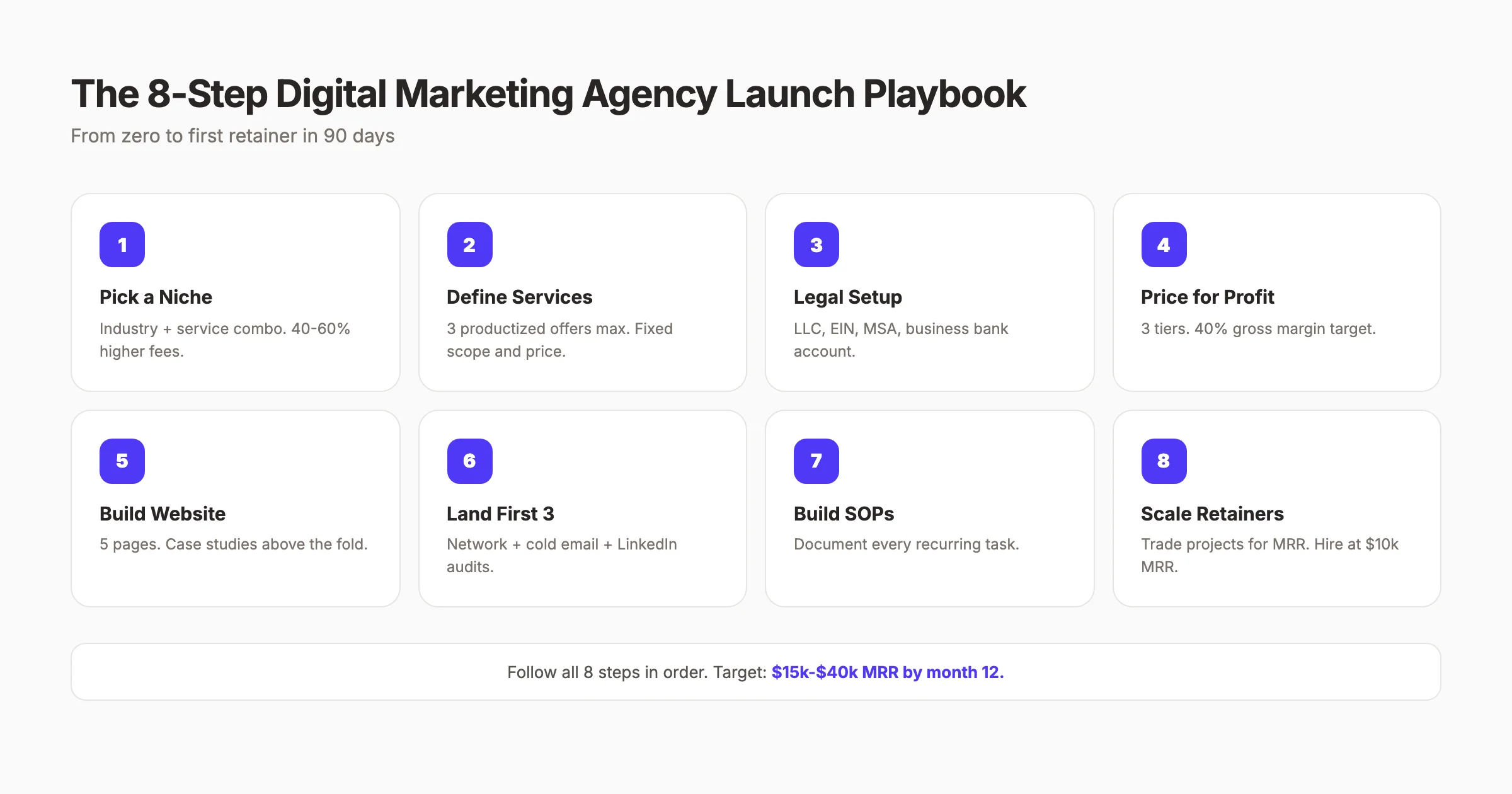
This guide fixes that. We publish 3,500+ blogs across 70+ industries for agencies and service businesses, and we watched hundreds of agency founders go from zero to first retainer using the same playbook below. The 8 steps are sequenced so each unlocks the next. Skip any and the later steps break.
Here is what you will learn:
- How to pick a niche that pays 40 to 60 percent above market rates
- How to price retainers for 40 percent profit margins
- How to land the first 3 clients in under 90 days
- How to build delivery systems that let you scale past yourself
- How to turn project work into recurring revenue
Most founders get to step 5 and stall. This guide keeps you moving.
Overview: What You Will Need
Time required: 60 to 90 days from decision to first paying client Difficulty: Intermediate. Requires marketing execution skill and sales willingness. Upfront cost: 1,500 to 3,500 dollars Recurring cost: 200 to 500 dollars per month in software Legal prerequisites: US social security number or EIN, state business registration, business bank account
You do not need a team, an office, investors, a fancy website, or 10 years of agency experience. You do need a clear offer, a pricing system, and the willingness to ask 100 strangers per week if they want help.
Step 1: Pick a Niche You Can Actually Win
The single most important decision you will make is your niche. A general digital marketing agency competes with 500,000 other agencies. A niched agency competes with 20. That is a 25,000 times easier math problem.
Niche on two axes at once. Pick an industry and pick a service. Not "digital marketing for everyone" but "local SEO for HVAC companies" or "paid social for DTC skincare brands." Agencies that double-niche command 40 to 60 percent higher retainers because prospects believe the niched agency understands their business.
Specifically, choose your niche by answering these 4 questions:
- What industry have you worked in before, even briefly?
- Who in your network already runs a business in that industry?
- Can those businesses afford a 2,000 dollar monthly retainer?
- Do they have a clear acquisition problem you can solve?
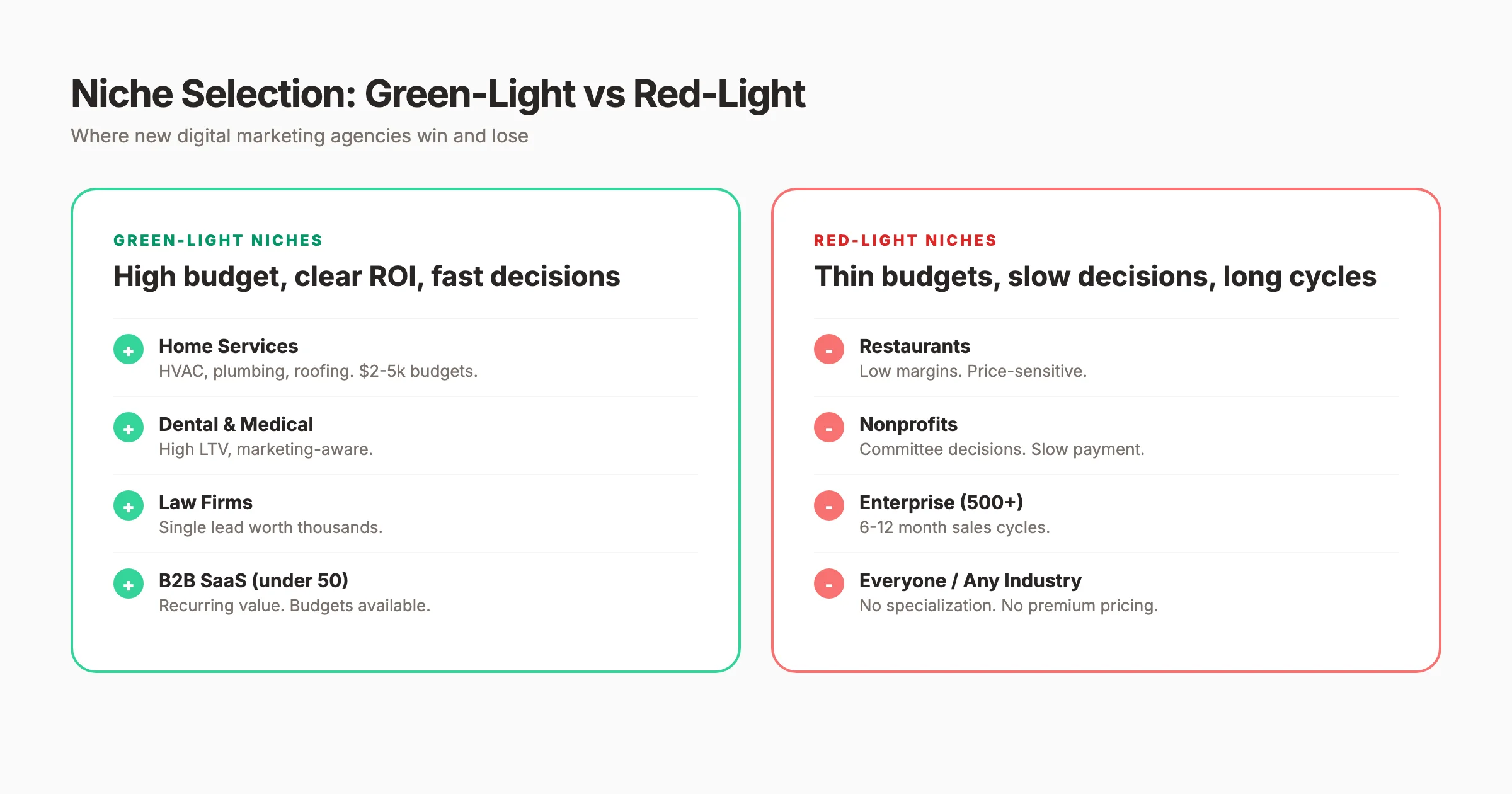
Green-light niches for new agencies include home services (HVAC, plumbing, roofing), dental and medical practices, law firms, local real estate, and B2B SaaS under 50 employees. Red-light niches include restaurants (low budgets), nonprofits (slow decisions), and enterprise (long sales cycles).
Run a quick sanity check. Search "[industry] marketing agency" on Google. If the top 10 results are national agencies, there is room for a specialist. If the top 10 are all specialists already, find a sub-niche within it.
Why this step matters: Agency pricing, positioning, website copy, and sales scripts all derive from the niche. Pick the wrong one and you will rebuild everything in year 2.
Pro tip: Interview 10 business owners in your target niche before committing. Ask about their current marketing spend, what they wish worked better, and what they pay per month. If 7 of 10 give you the same answer, you found the right niche.
Step 2: Define Your Service Menu
New agency founders try to offer everything. That is the fastest path to burnout and thin margins. Offer 3 services maximum at launch. More than 3 and you cannot standardize delivery.
Build the menu from 3 categories: one acquisition service, one retention service, one reporting service. Acquisition is what brings new customers. Retention keeps them engaged. Reporting proves the work is paying off. Every retainer should include all 3.
Proven service combinations for new agencies:
| Acquisition | Retention | Reporting |
|---|---|---|
| Local SEO and GBP | Email marketing | Monthly dashboard |
| Google Ads | SMS campaigns | Weekly call |
| Content marketing | Social posting | Monthly call |
| Paid social | Review management | Quarterly strategy |
| Cold email | Lifecycle automation | Monthly report |
Productize each service. Productized means fixed scope, fixed price, fixed timeline, no custom bids. One local SEO package. One content package. One ads package. Prospects buy faster when the offer is clear.
Think carefully about delivery. If your niche is local services, local SEO tools for agencies let you manage GBP posts and citations at scale. If content is your acquisition service, a done-for-you content partner cuts delivery time by 80 percent and protects margins. Compare your options in our breakdown of marketing agencies vs AI tools.
Avoid offering web design as a core service. Web design is project work, not retainer work, and it will pull you off the recurring revenue path. Offer it as a one-time onboarding add-on instead.
Why this step matters: Your service menu defines your margins. A broad menu forces you to hire specialists before you have the revenue. A tight menu lets you deliver most of the work yourself in year 1.
Pro tip: Some new agencies white-label SEO content from day 1 to keep delivery simple and margins predictable.
Step 3: Set Up the Legal and Financial Foundation
Most new agency owners delay legal setup because it feels boring. Skip this step and you will spend 6 months fixing tax issues, signing contracts in personal name, and losing enterprise deals that require a W-9.
Form an LLC in your home state. An LLC separates your personal assets from agency liabilities. It costs 100 to 500 dollars depending on the state. Delaware and Wyoming are overrated for small agencies. File in your home state unless your accountant tells you otherwise.
The 6 legal and financial steps every agency needs:
- ✓ File LLC with state secretary of state
- ✓ Get federal EIN from the IRS website (free, 10 minutes)
- ✓ Open a business bank account separate from personal
- ✓ Buy professional liability insurance (50 to 80 dollars per month)
- ✓ Create a client master services agreement (MSA) template
- ✓ Set up accounting software from day 1
Expect 500 to 1,500 dollars in upfront legal costs for the first year. Ongoing bookkeeping runs 150 to 400 dollars per month once you have 3 clients. For a deeper breakdown of agency cost structures, see our marketing agency cost guide.
Your master services agreement protects you from 3 things: scope creep, non-payment, and intellectual property disputes. Use a template from an attorney who works with agencies. Do not copy one from the internet. A bad MSA costs more than a good attorney.
Separate business and personal finances on day 1. Every revenue and expense flows through the business account. This makes taxes, audits, and eventual sale of the agency dramatically easier. Commingling funds is the number one rookie mistake that kills LLC liability protection.
Open a business credit card for software subscriptions. Use it to build business credit and earn travel points. Do not rely on personal credit to fund the agency long term.
Why this step matters: Enterprise clients, insurance providers, and loan officers all require proof of legal entity status. Agencies without LLCs get rejected for larger deals.
Step 4: Price Your Services for Profit
Pricing kills more agencies than bad marketing. New agency founders price by looking at competitors and cutting 20 percent. That is the fastest way to go broke.
Price on value, not hours. A monthly retainer should deliver a result worth 5 to 10 times its cost to the client. If you get a plumbing company 15 extra jobs per month at 800 dollars per job, that is 12,000 dollars in revenue. A 2,000 dollar monthly retainer is cheap at that outcome.
Set up 3 pricing tiers. Starter, Growth, and Scale. This is how 90 percent of successful agencies price. The 3-tier structure lets prospects self-select and increases average contract value because most buyers pick the middle tier.
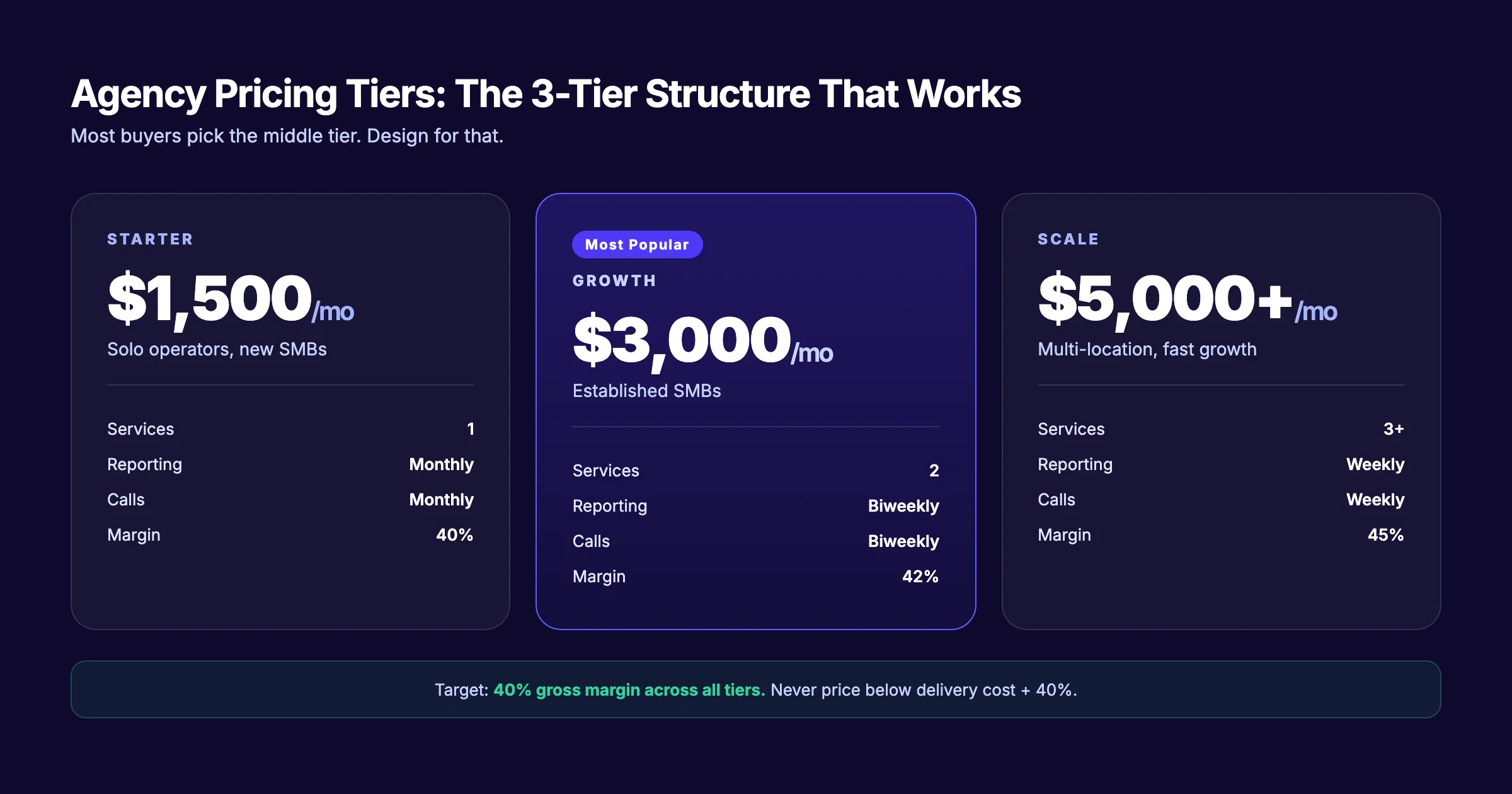
Example 3-tier structure:
| Tier | Monthly Price | Target Client | Deliverables |
|---|---|---|---|
| Starter | $1,500 | Solo operators, new businesses | 1 service, monthly report |
| Growth | $3,000 | Established SMBs | 2 services, biweekly calls |
| Scale | $5,000+ | Multi-location, fast-growth | 3 services, weekly calls |
Target a 40 percent gross profit margin on every retainer. Calculate the fully-loaded delivery cost including your time at 75 dollars per hour. If delivery eats more than 60 percent of retainer revenue, the package is mispriced.
Never charge by the hour. Hourly pricing caps your earnings and penalizes efficiency. The better you get, the less you earn. Retainers and project fees scale with value instead.
Build in an annual price increase clause. A 5 to 8 percent annual bump keeps you ahead of inflation and rewards loyal clients with grandfathered tiers. State the increase schedule in the MSA so it is never a surprise.
Ask for 50 percent upfront on any project work. Retainers bill on the 1st of each month in advance. Cash flow kills more agencies than sales. Never deliver work without a signed contract and first payment.
Why this step matters: A 40 percent margin agency at 20,000 dollars in monthly recurring revenue earns more than a 15 percent margin agency at 50,000 dollars. Margin trumps revenue in year 1.
Start publishing content for your agency before day 1. Your own SEO proves you can do the work. We publish 30 SEO-optimized blog posts per month so your agency ranks while you sell.
Step 5: Build Your Agency Website and Brand
Your agency website is the most important sales asset you own. Prospects will land on it before every discovery call. If the site looks like a template, you look like a template agency. Price is negotiated before the call even starts, based on the site alone.
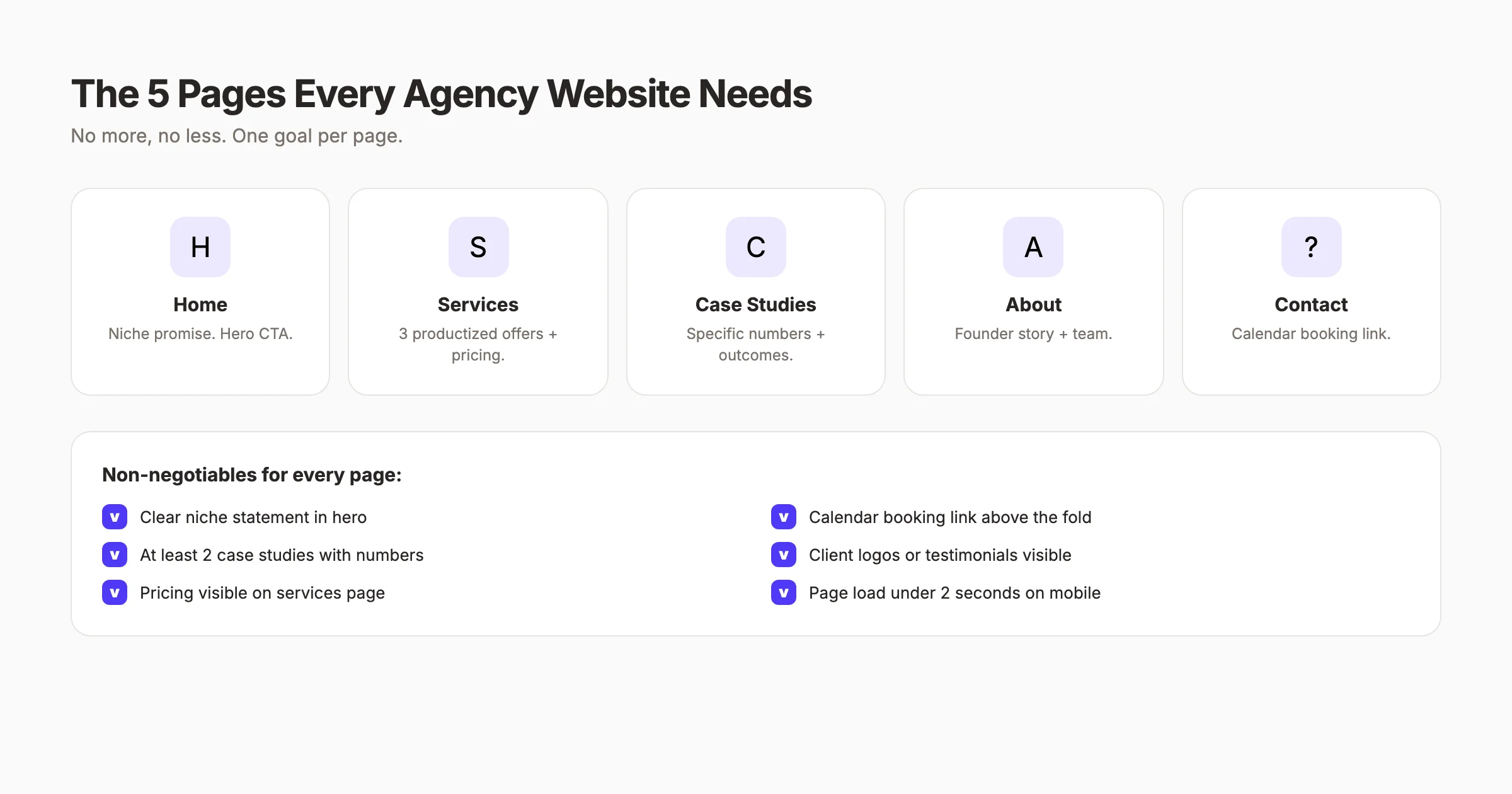
Build 5 pages, no more. Home, Services, Case Studies, About, Contact. Each page has one goal. Home sells the niche promise. Services explain the productized offer. Case studies prove it. About builds trust. Contact books the call.
The non-negotiables every agency site needs:
- Clear niche statement in the hero (who you help + what you deliver)
- At least 2 case studies with specific numbers
- Pricing visible on the services page (or "starting at" pricing)
- Calendar booking link above the fold on every page
- Social proof: logos, testimonials, review ratings
- Page load under 2 seconds on mobile
Choose a simple tech stack. WordPress, Webflow, or Framer all work. Do not build a custom site. Do not spend more than 3,000 dollars on the launch site. You will redesign it in 12 months once you have real case studies.
Your own website must rank for your niche keywords. This is the biggest trust signal prospects see. An agency that cannot rank its own site cannot rank a client site. Publish 4 to 8 blog posts per month on topics your niche searches for. See our full SEO for small business guide for the ranking playbook.
Spend more time on the brand than the logo. Pick a memorable name, a clean wordmark, and 2 brand colors. Skip expensive brand agencies. Canva or a 500-dollar Fiverr designer is enough at launch. Iterate on the brand in year 2 when revenue exceeds 20,000 dollars monthly.
Your writing voice is part of your brand. Read your site copy out loud. If it sounds like every other agency, rewrite it. Specific claims, specific outcomes, and opinionated language win deals against generic competitors.
Why this step matters: A strong site closes 35 to 50 percent of discovery calls. A weak site closes 10 percent. Same calls, 3x the close rate.
Pro tip: Publish one case study per month from day 1. Even if the client is a friend or family member, document the work as a formal case study. Case studies are the single highest-converting asset on an agency website.
Step 6: Land Your First 3 Clients
The first 3 clients are the hardest. After them, referrals compound and outreach gets easier. But the first 3 require disciplined daily outreach across 3 channels.
Channel 1 is your personal network. Make a list of 100 people you know who either run a business in your niche or know someone who does. Message each one individually. Do not mass-email. A personal LinkedIn message or text converts 15 to 25 percent to a discovery call.
Channel 2 is cold outreach. Identify 500 prospects in your niche using LinkedIn Sales Navigator or Apollo. Send 100 personalized cold emails per week. Target a 2 to 5 percent response rate and a 1 percent call-booked rate. That is 1 to 5 calls per week, every week, until you close 3 clients.
Channel 3 is free audits. Post a free audit offer on LinkedIn weekly. "I will audit the first 5 HVAC company websites that DM me this week." You will get 10 to 30 DMs. Of those, 2 to 3 turn into discovery calls. Of those, 1 turns into a client within 60 days.
First-3-clients outreach math:
| Channel | Weekly Activity | Response Rate | Calls Booked |
|---|---|---|---|
| Personal network | 20 messages | 20% | 4 |
| Cold email | 100 emails | 3% | 3 |
| LinkedIn audits | 1 post per week | 20 DMs | 3 |
| Total weekly | 120+ touches | , | 10 calls |
Discount the first 3 clients in exchange for case studies. Offer 30 to 50 percent off the first 3 months if they agree to a documented case study, a reference call, and a written testimonial. The case studies and testimonials are worth 10 times the lost revenue.
Close the first call with a simple offer. Define the outcome, the scope, the timeline, and the price. Send the contract within 24 hours. Ask for first payment within 48 hours. Speed wins early deals.
Why this step matters: Agencies that take more than 90 days to land the first client usually quit. Momentum in the first 90 days is psychological as much as financial.
Pro tip: Record your first 10 discovery calls and watch them back. You will find 5 to 7 objections that come up repeatedly. Build scripted answers to each. Your close rate will double by call 20.
Step 7: Build Delivery Systems and SOPs
An agency is a set of systems that deliver repeatable outcomes. A freelancer is one person doing the work. The line between the two is SOPs.
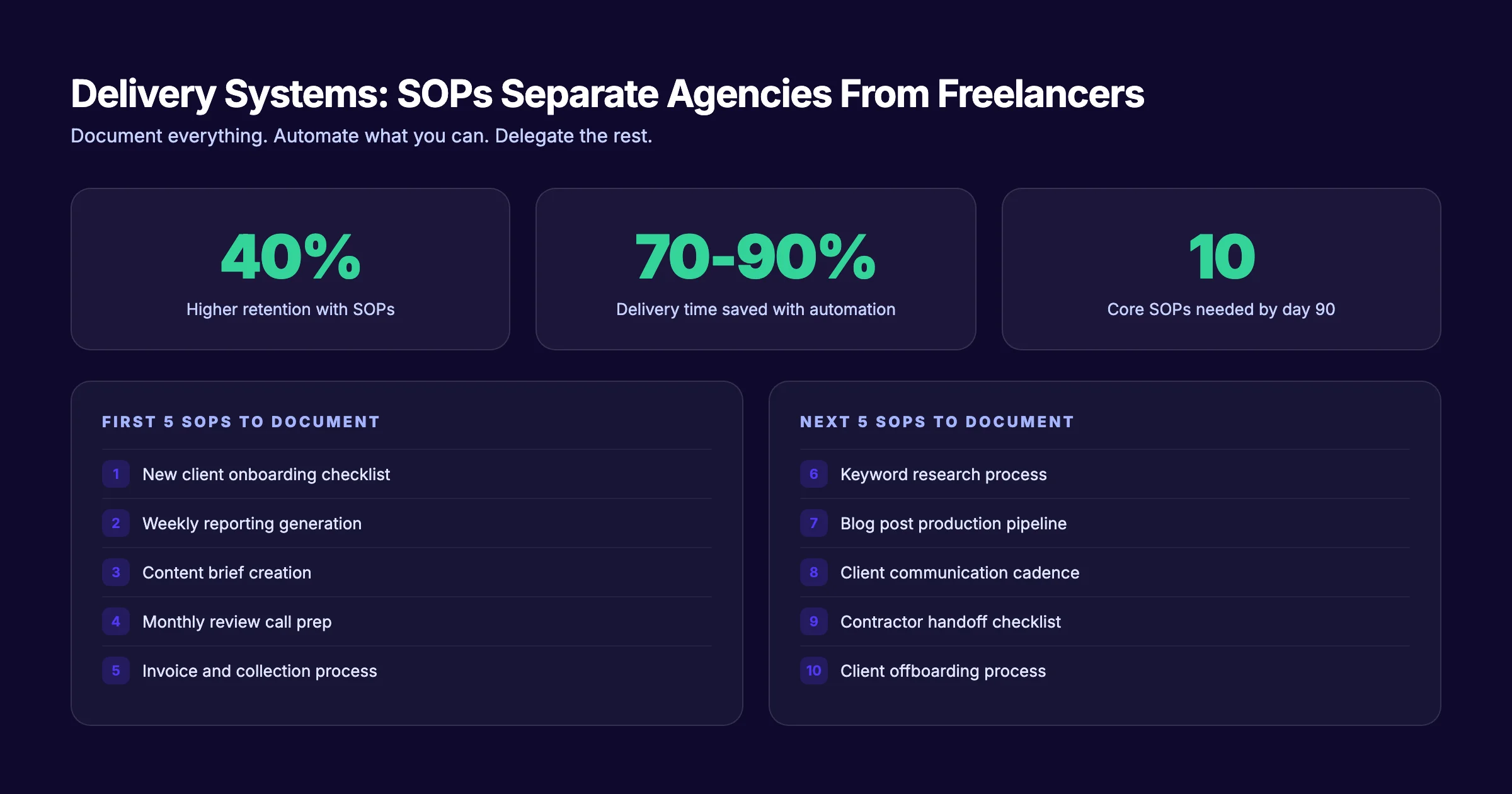
Document every recurring task as a standard operating procedure. Every SOP has 4 parts: the outcome, the trigger, the checklist, and the definition of done. Store them all in one tool. Notion, ClickUp, and Google Docs all work.
The 10 SOPs every agency needs in the first 90 days:
- ✓ New client onboarding (from signed contract to first deliverable)
- ✓ Weekly reporting generation
- ✓ Monthly client review call prep
- ✓ Content brief creation
- ✓ Keyword research process
- ✓ Blog post production pipeline
- ✓ Client communication cadence
- ✓ Invoice generation and collection
- ✓ Contractor handoff (when you hire help)
- ✓ Client offboarding (if one leaves)
Systems are what separate a scalable agency from a stressed freelancer. See our breakdown of done-for-you vs DIY vs agency SEO for how delivery models compare.
Automate everything that can be automated. Content production, reporting, citation building, GBP posting, and review requests all have tools that cut delivery time 70 to 90 percent. Keep a curated list of SEO tools for agencies to evaluate as you scale. theStacc publishes 30 blog posts per month for agency clients, which frees founder hours for sales and strategy.
Build a client portal or shared folder for every client. One folder, one dashboard, one weekly status email. Consistency in communication is what keeps retainers alive past month 6.
Track 3 metrics weekly per client: rankings, traffic, and conversions. Put them on a dashboard. Send a 5-line weekly update email. Most agencies skip this and lose clients who "do not feel the work happening."
Why this step matters: Agencies with strong SOPs have 40 percent higher client retention than those without. Retention is the single largest driver of long-term agency profit.
Step 8: Scale With Retainers, Not Project Work
Project work is a trap. It pays the bills in month 1 but forces you back into sales every 30 days. Retainers are the only way to build a valuable agency.
Trade project clients for retainer clients over the first 12 months. Every project work bid should include a retainer option as the headline offer. "I can do this as a one-time project for 4,000 dollars, or as an ongoing retainer for 2,000 per month with compounding results." Most clients pick the retainer.
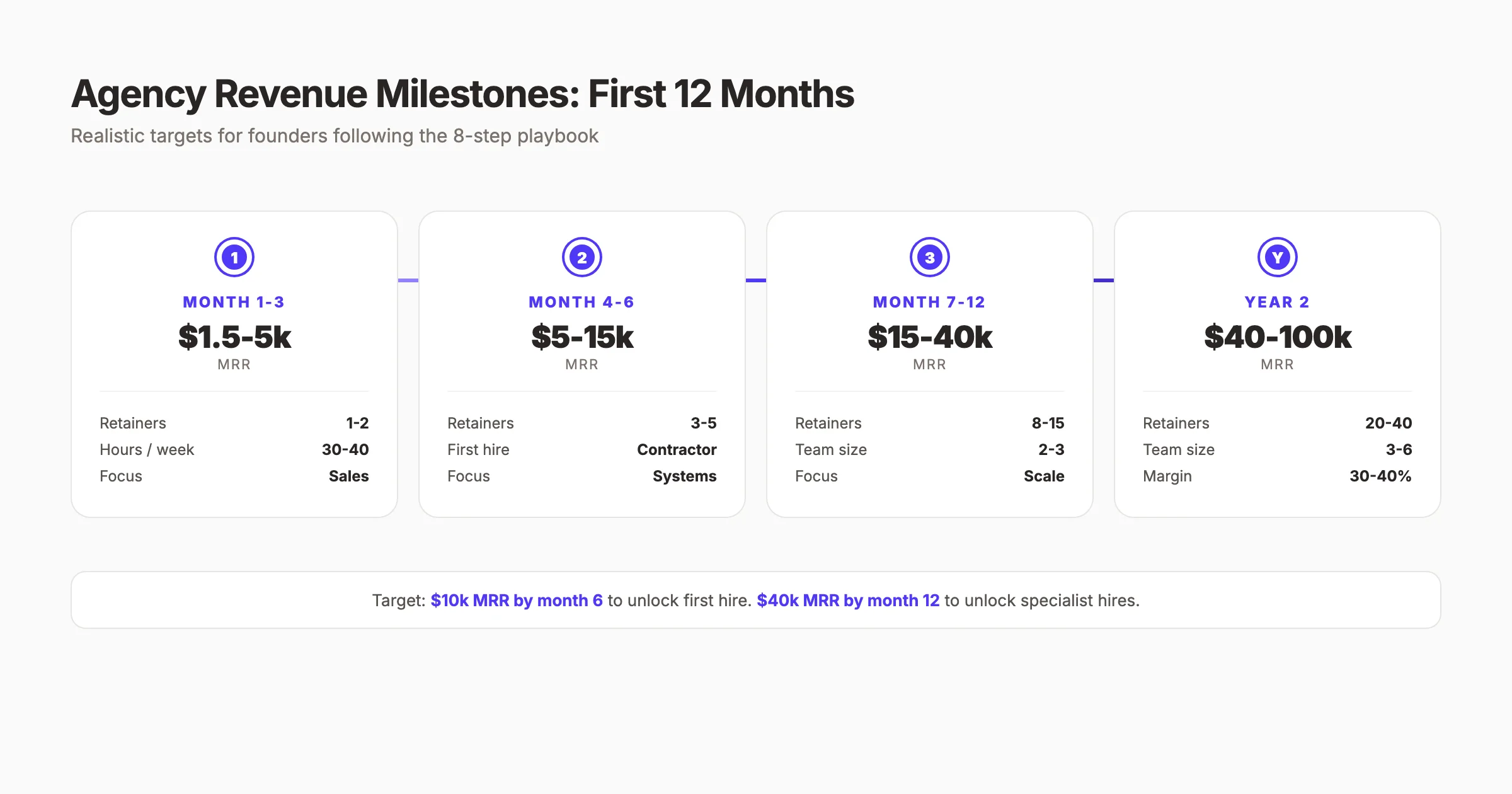
Build toward 10,000 dollars in monthly recurring revenue before hiring. That is the floor. Below 10k MRR, you are a freelancer with a company name. Above 10k MRR, you have a business that can support a first contractor.
The hiring order that works:
| Hire | Trigger MRR | Hours Per Week | Rate |
|---|---|---|---|
| First contractor (VA or writer) | $10K MRR | 10–20 | $20–50/hr |
| Specialist (ads, SEO, design) | $25K MRR | 20–40 | $50–100/hr |
| Full-time operations manager | $50K MRR | 40 | $4–6K/mo |
| Second specialist | $75K MRR | 40 | $5–8K/mo |
Hire for the role you hate doing most, not the role with the most hours. Founders who outsource sales first usually fail. Founders who outsource delivery first usually thrive. Sales is the founder's permanent job until 100K MRR.
Use a content calendar to plan 12 months of client content at once. Planning beats improvising on volume. See how to create an SEO content calendar for a template.
Ask every satisfied client for 2 things at month 3: a case study and a referral. Formalize this as a step in your SOP. Agencies with referral programs grow 3x faster than those without.
Reinvest 20 percent of profit into your own marketing. Most agencies are so busy serving clients they forget to market themselves. If you build an SEO team later, fund it with reinvested profit, not personal savings.
Why this step matters: Retainer revenue is worth 3 to 5 times project revenue when the agency is sold. Building toward MRR from day 1 changes the asset value of the business.
Results: What to Expect
An 8-step launch plan looks clean on paper. The reality is messier but the outcomes are predictable if you follow the steps in order.
After completing these 8 steps, you should expect:
- Month 1 to 3: First paying client landed. Revenue between 1,500 and 5,000 dollars monthly. Founder doing 100 percent of delivery.
- Month 4 to 6: 3 to 5 active retainers. Revenue between 5,000 and 15,000 dollars monthly. First contractor hired.
- Month 7 to 12: 8 to 15 retainers. Revenue between 15,000 and 40,000 dollars monthly. Founder spending 60 percent on sales.
- Year 2: 20 to 40 retainers. Revenue between 40,000 and 100,000 dollars monthly. Team of 3 to 6 people. Profit margin at 30 to 40 percent.
Not every agency hits these numbers. Agencies that stall usually fail at steps 4 and 6, pricing too low and under-marketing. Agencies that beat these numbers usually nail steps 1 and 7, a sharp niche and strong systems.
First-year profit will be smaller than expected. Most of the money goes back into software, contractor costs, and founder salary. Budget to pay yourself 30,000 to 60,000 dollars in year 1 unless you had savings or a co-founder.
Troubleshooting Common Problems
Problem: Cannot land the first client Based on product docs, public reviews, and hands-on product exploration. Solution: Your niche or pricing is wrong. Interview 20 more prospects, ask what they would actually pay, and tighten the offer. Usually the niche is too broad or the price is too high.
Problem: Clients churn at month 3. Solution: You have a reporting problem, not a delivery problem. Clients leave when they do not feel the work happening. Send a weekly 5-line update email. Set up a shared dashboard. Do not wait for the client to ask "what did you do this week?"
Problem: Making revenue but losing money. Solution: You are mispricing or over-delivering. Audit delivery hours per client. Any client where delivery costs exceed 60 percent of revenue needs a price increase or scope cut at the next renewal.
Problem: Cannot scale past 15k MRR because founder is a bottleneck. Solution: You have no SOPs. Stop selling for 2 weeks and document every recurring task. Then hire 1 contractor to own 1 SOP. Repeat until founder is only doing sales and strategy.
What practitioners are saying on X
Agency and white-label models evolve fast. Here is operator signal from X on tooling and service delivery.
- @syedbalkhi (Sep 2024): White-label pro services can add multi-six-figure revenue without building an in-house services org — partner delivery behind the brand. See the post on X.
- @ConnorGillivan (Jul 2026): 2026 SEO stack favorite list: Semrush/Ahrefs, GSC, Surfer, KeywordInsights, ChatGPT, SEOwind, Screaming Frog, ClearScope, GA4, Notion/Airtable — tools amplify systems, they don’t replace them. See the post on X.
- @jakezward (Feb 2026): 2026 SEO predictions emphasize AI Overview share-of-SERP, schema for LLM token efficiency, brand mentions in AI answers as a KPI, proprietary data as a moat, and content refresh beating net-new AI slop. See the post on X.
Grok, AI Overviews, and multi-engine visibility
For “how to start a digital marketing agency”, multi-engine visibility still starts with clear definitions, sourced numbers, and extractable section answers. Grok additionally factors live X discussion — keep public claims consistent with this page.
- Google AI Overviews: Use passage-ready answers, tables, and FAQ schema where relevant.
- ChatGPT / Perplexity: Cite named sources next to key claims.
- Grok: Maintain accurate entity facts on-site and in high-signal X posts.
Publish content built for Google and AI citations. theStacc’s Content SEO module ships SEO-scored articles structured for rankings and generative engines — including clearer entity pages models like Grok can quote.
FAQ
Between 1,500 and 3,500 dollars covers legal setup, a basic website, core software, and 2 months of marketing spend. The bigger reserve is living expenses. Budget 6 months of personal runway because revenue ramps slowly in months 1 to 3.
Yes, but with 2 adjustments. Pick a narrower niche where you have some knowledge. Start as a freelancer for 3 to 6 months to build 2 case studies before launching as an agency. Most successful agency founders worked inside agencies or at marketing-heavy companies before launching.
Most agencies are profitable by month 4 to 6 if pricing is correct. Profitable means the agency pays for software, contractors, and a modest founder salary. Full-market-rate founder salary usually starts around month 9 to 12. Agencies that are unprofitable past month 6 almost always have a pricing or niche problem.
Niche down. A general agency competes with 500,000 other agencies. A niched agency competes with 20. Niched agencies charge 40 to 60 percent higher retainers and close deals 2x faster. You can always expand into adjacent niches in year 2.
Not for the first 10,000 dollars of monthly recurring revenue. Most agencies operate solo or with one contractor until 10k MRR. Below that, hiring destroys margin. Above that, hiring unlocks the next growth phase. Start with contractors before full-time hires.
Local SEO, Google Ads management, content marketing, and paid social typically have the highest margins for new agencies. Web design and one-off SEO audits have low margins because they are project work. Services with recurring monthly value tend to have 40 to 60 percent gross margins while project work often runs 10 to 20 percent.
Conclusion
You now know how to start a digital marketing agency in 8 steps. Pick a niche, productize 3 services, set up the legal base, price for 40 percent margins, build a 5-page site, land 3 clients, document your SOPs, and scale with retainers.
Which step are you going to start with today, step 1, step 4, or step 6? The first 90 days set the trajectory for the next 5 years. Start with the step you have been avoiding.
Run your agency marketing while you land clients. theStacc publishes 30 SEO blog posts per month so your agency site ranks for your niche before the first cold email goes out.
Sources & references
- [1] Princeton / Georgia Tech et al. — GEO research (arXiv:2311.09735)
- [2] @hridoyreh on X — Widely shared SEO skill tree: foundations, research, technical, on-page, content, links, AI SEO/GEO, analytics, UX, bran
- [3] @jakezward on X — 2026 SEO predictions emphasize AI Overview share-of-SERP, schema for LLM token efficiency, brand mentions in AI answers

Plan topics, review article drafts, and publish to a connected CMS.
Weekly local SEO teardowns
One practical email a week. Map Pack, GBP, AI Overviews. No fluff. Unsubscribe anytime.