Property Management SEO: The Complete Guide (2026)
The complete property management SEO guide. Covers local SEO, GBP optimization, owner-focused keywords, content strategy, and reviews. Updated April 2026.
Siddharth Gangal • 2026-04-02 • SEO Tips
In This Article
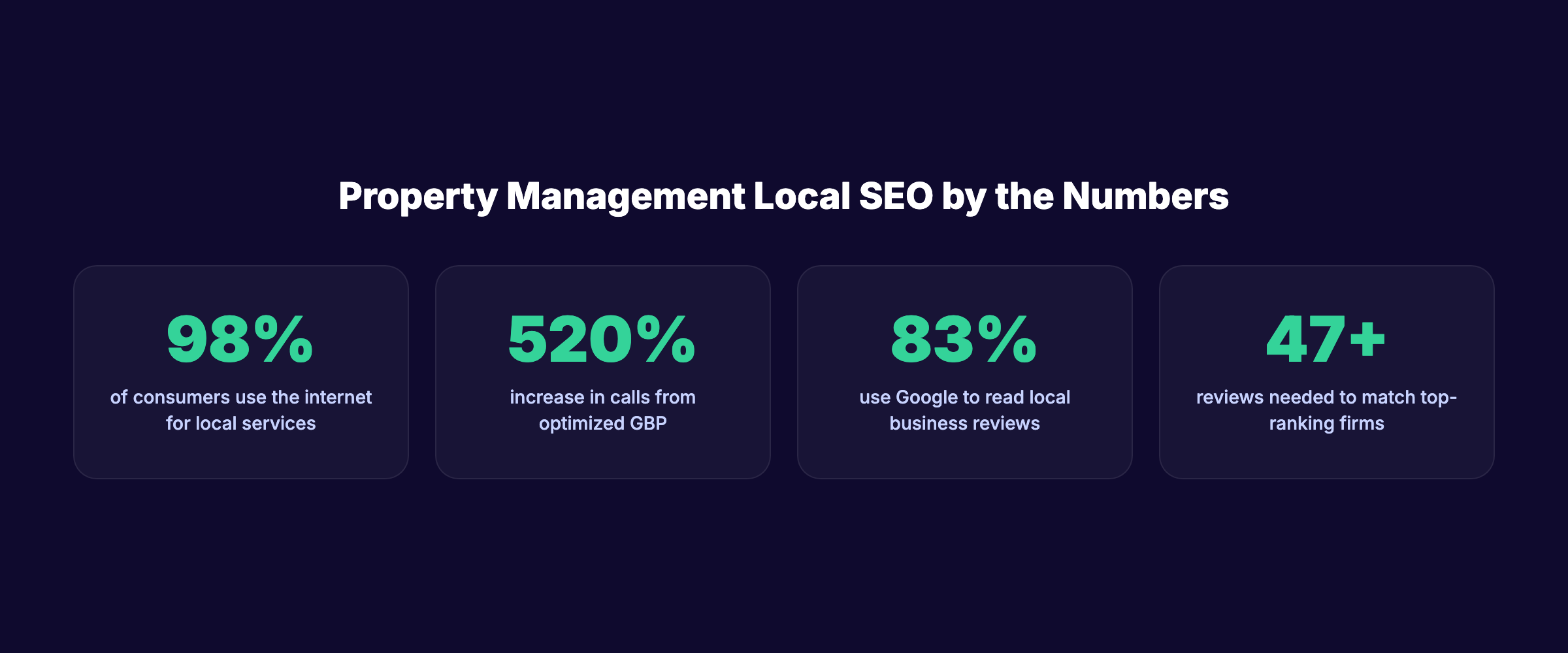
98% of consumers use the internet to find local services. Property management is no exception.
When a landlord searches “property management company near me” or “best property manager in [city],” your company either shows up or it does not. There is no middle ground in local search. The firms that appear in Google’s top 3 local results capture the majority of calls, form submissions, and signed contracts.
Most property management companies still rely on referrals and word of mouth. That works until growth stalls. A property management SEO guide is the missing piece for firms that want predictable, scalable lead generation from property owners actively searching for help.
We have published 3,500+ blog posts across 70+ industries, including property management, real estate, and home services firms. This guide covers the exact SEO playbook that drives qualified owner leads for property management companies.
Here is what you will learn:
- Why property management SEO targets owners, not tenants
- How to find high-intent keywords property owners actually search
- The local SEO playbook for dominating your service area
- How to optimize your Google Business Profile for owner leads
- A content strategy that builds authority and converts
- Technical SEO essentials for property management websites
- How to turn reviews into your strongest ranking signal
Why Property Management SEO Targets Owners, Not Tenants
The biggest mistake in property management SEO is targeting the wrong audience.
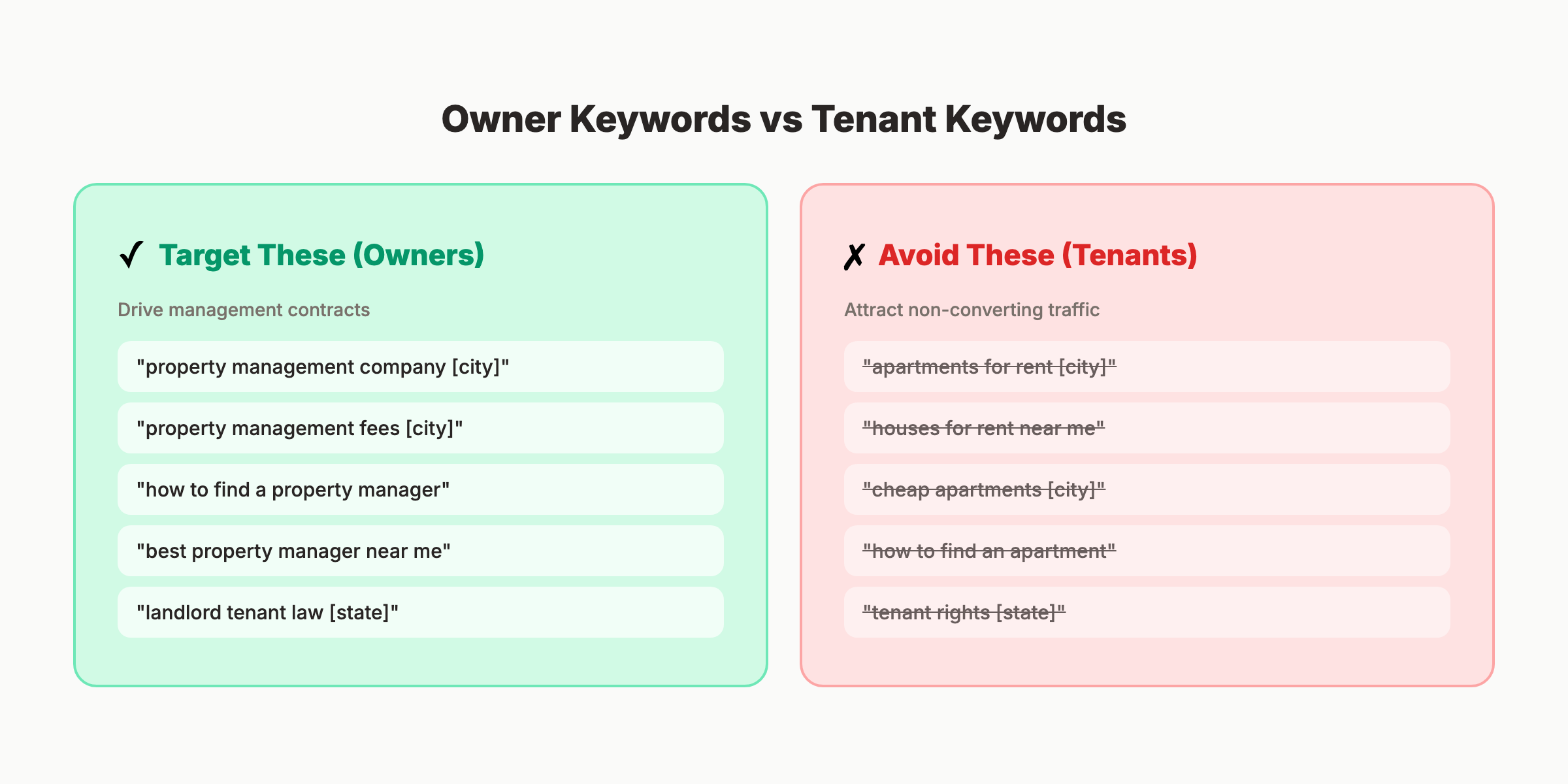
Most property management websites optimize for tenant-focused keywords like “apartments for rent in Denver” or “houses for rent near me.” Those keywords attract renters. Renters do not sign management contracts. Renters do not generate revenue for your property management business.
Your SEO strategy must target property owners and landlords. These are the people who hire property managers.
Owner Intent vs. Tenant Intent
| Owner Keywords (Target These) | Tenant Keywords (Avoid These) |
|---|---|
| “property management company [city]" | "apartments for rent [city]" |
| "best property manager near me" | "houses for rent near me" |
| "property management fees [city]" | "cheap apartments [city]" |
| "how to find a property manager" | "how to find an apartment" |
| "landlord tenant law [state]" | "tenant rights [state]" |
| "rental property ROI calculator" | "rent calculator” |
Every page on your site should answer one question: does this help me attract property owners who need management services?
The Dual-Audience Challenge
Property management companies serve two audiences. Owners hire you. Tenants live in the properties you manage.
Both audiences search online. Both need content. But your SEO budget should prioritize owner-focused content because owners drive revenue.
Create separate content tracks:
- Owner track: Management service pages, pricing, landlord education, ROI content
- Tenant track: Maintenance portals, community guides, move-in checklists
Keep tenant content useful but lean. Invest your SEO effort into owner acquisition content.
Keyword Research for Property Management Companies
Effective keyword research for property management focuses on intent, not volume. A keyword with 50 monthly searches from property owners is worth more than a keyword with 5,000 searches from tenants.
High-Value Keyword Categories
Service + Location Keywords (highest conversion rate):
- “property management [city]”
- “property management company [city] [state]”
- “residential property manager [city]”
- “rental management services [neighborhood]”
- “commercial property management [city]”
Problem-Based Keywords (attract owners researching solutions):
- “how to deal with bad tenants”
- “landlord tenant laws [state]”
- “how much does property management cost”
- “when to hire a property manager”
- “property management fees explained”
Comparison and Decision Keywords (bottom-of-funnel):
- “best property management companies [city]”
- “property management vs self-managing rental”
- “[company A] vs [company B] property management”
- “property management company reviews [city]“
Long-Tail Keywords Win
Long-tail keywords account for 70% of all search traffic. They are easier to rank for and carry higher intent.
Instead of targeting “property management” (impossibly competitive), target:
- “single family property management [city]” (specific service + location)
- “HOA management company for small associations” (niche + qualifier)
- “vacation rental management [beach town]” (property type + location)
- “property management for out-of-state landlords” (specific pain point)
Use your keyword research process to build a list of 50-100 target keywords organized by intent and priority.
Seasonal Search Patterns
Property management searches follow seasonal patterns:
| Season | Search Trend | Content Opportunity |
|---|---|---|
| Spring (Mar-May) | Peak rental season starts. Owners prep properties. | ”Spring rental preparation checklist,” “how to price your rental for summer” |
| Summer (Jun-Aug) | Highest search volume for management services. | Service pages, comparison content, pricing pages |
| Fall (Sep-Nov) | Lease renewals and maintenance planning. | ”How to handle lease renewals,” “winter property maintenance guide” |
| Winter (Dec-Feb) | Lower volume. Owners evaluate current managers. | ”Signs you need a new property manager,” “property management cost analysis” |
Publish seasonal content 6-8 weeks before peak search periods.
Stop writing. Start ranking. Stacc publishes 30 SEO articles per month for your property management company. Every post targets the keywords owners search. Start for $1 →
Local SEO: Dominating Your Service Area
Property management is a local business. Most owners want a management company in or near their property’s location. Local SEO determines whether your company appears when they search.
Google 3-Pack Ranking Factors
The Google 3-Pack (the map results at the top of local searches) captures most clicks for “property management near me” type searches.
Three factors determine your local ranking:
| Factor | What Google Measures | How to Optimize |
|---|---|---|
| Relevance | Does your listing match the query? | Accurate categories, complete profile, keyword-rich description |
| Distance | How close is your business to the searcher? | List accurate address, define service areas |
| Prominence | How well-known is your business? | Reviews, citations, backlinks, brand mentions |
Citation Building
Citations are online mentions of your business name, address, and phone number (NAP). Consistency across every listing is mandatory.
Priority citation sources for property management:
- Google Business Profile
- Yelp
- Better Business Bureau
- Zillow (property manager directory)
- Realtor.com
- All Property Management directory
- National Association of Residential Property Managers (NARPM)
- Local Chamber of Commerce
- LinkedIn company page
- Facebook business page
- Bing Places
- Apple Maps
Audit your NAP across every listing. Even small differences (“Suite 100” vs “Ste 100”) weaken your local signal.
Service Area Pages
If you manage properties across multiple cities or neighborhoods, create a dedicated page for each service area.
A generic “We serve the greater metro area” page will not rank for specific city searches. Each service area page needs:
- City or neighborhood name in the H1 and throughout the content
- Specific services offered in that area
- Local market data (average rents, vacancy rates, property values)
- Testimonials from property owners in that area
- Unique content about local landlord-tenant regulations
- Embedded Google Map
Do not duplicate content across service area pages. Google penalizes thin, templated location pages. Each page must contain genuinely useful, location-specific information.
Follow our local SEO guide for a full breakdown of local ranking strategies.
Google Business Profile Optimization
Your Google Business Profile is the most valuable local SEO asset for a property management company. Optimizing your GBP can increase calls by up to 520% and direction requests by 2,717%.
Profile Setup Checklist
- Business name (exact legal name, never keyword-stuffed)
- Primary category: “Property Management Company”
- Secondary categories: “Real Estate Agency,” “Rental Agency,” “Property Maintenance”
- Full street address (must match all citations exactly)
- Local phone number (not a tracking number as your primary)
- Website URL (link to your homepage or a dedicated landing page)
- Business hours (keep updated, including holidays)
- Service area definition (list every city and neighborhood you serve)
- Business description (750 characters max, include services and locations)
- Services list with descriptions
- 10+ photos (office, team, managed properties, before/after maintenance)
GBP Posts
Publish 2-4 Google Business Profile posts per month. Active profiles rank higher than dormant ones.
Post topics for property management companies:
- New property acquisitions (“Now managing 15 units at [address]”)
- Maintenance tips for property owners
- Local market updates (“[City] rental vacancy rate dropped to X% this month”)
- Seasonal reminders (“Spring property inspection checklist for landlords”)
- Team highlights and certifications
- Community involvement
Photos and Virtual Tours
Google rewards profiles with regular photo uploads. Properties with photos get 42% more direction requests and 35% more click-throughs.
Upload at minimum:
- Professional office exterior and interior shots
- Team photos with name captions
- Well-maintained properties you manage (with owner permission)
- Before and after maintenance photos
- Community area photos
Your SEO team. $99 per month. 30 optimized articles published automatically. Built for property management companies that want more owner leads. Start for $1 →
Content Strategy That Converts Owners
Content is what separates property management companies that get found online from those that stay invisible. Every blog post, guide, and resource page is an opportunity to rank for keywords property owners search.
Content Pillars for Property Management
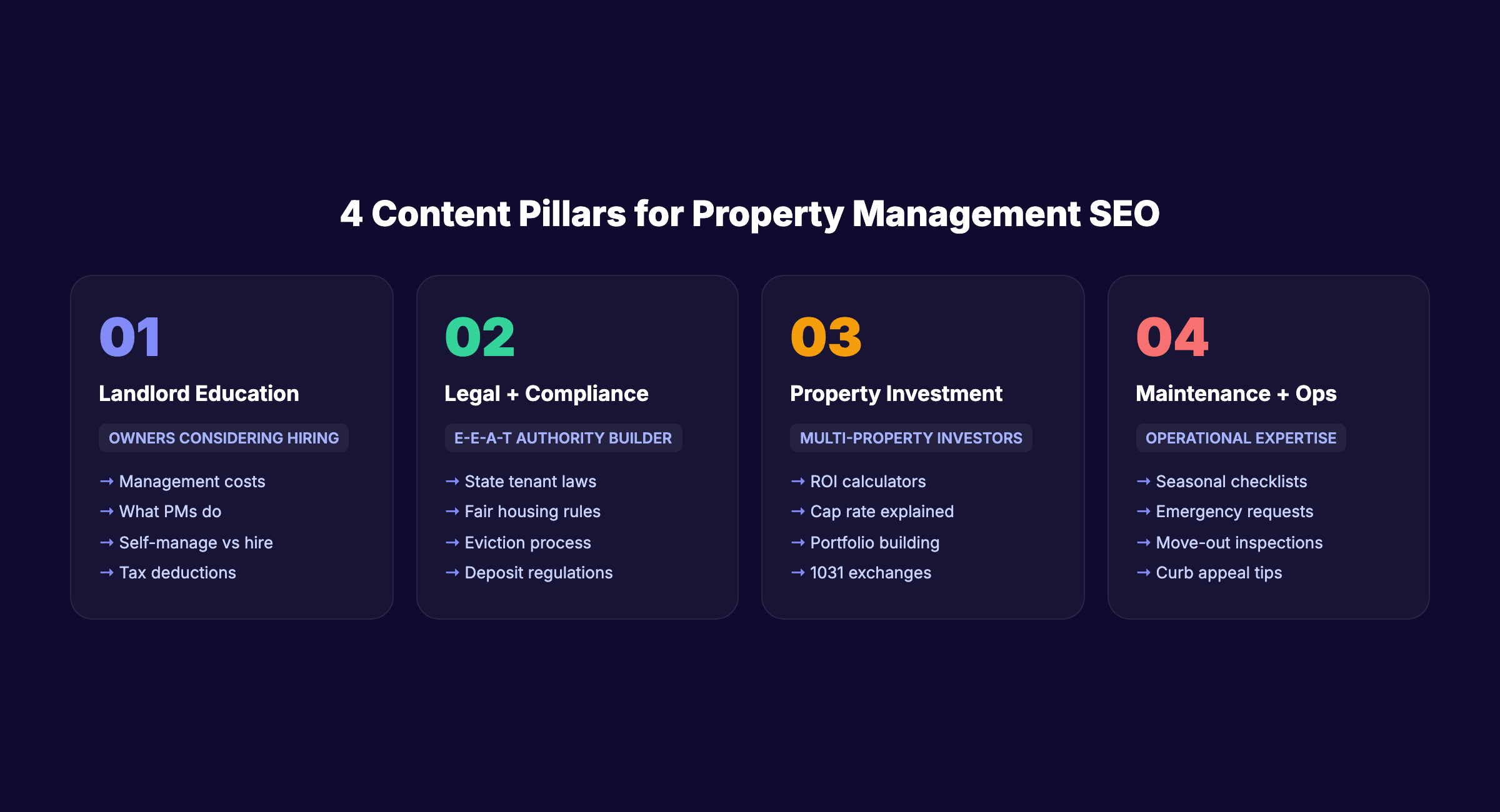
Pillar 1: Landlord Education This content targets owners considering professional management. It positions your company as a trusted expert:
- “How much does property management cost in [city]?”
- “What does a property manager actually do?”
- “Self-managing vs hiring a property manager: the real costs”
- “Landlord tax deductions every property owner should know”
- “How to evaluate property management companies”
Pillar 2: Legal and Compliance Legal content builds E-E-A-T signals and attracts owners worried about compliance:
- “[State] landlord-tenant law guide 2026”
- “Fair housing laws every landlord must follow”
- “How to legally handle tenant evictions in [state]”
- “Security deposit rules by state”
- “Rental property insurance requirements”
Pillar 3: Property Investment This content targets real estate investors who own multiple properties:
- “Best cities for rental property investment 2026”
- “How to calculate rental property ROI”
- “Cap rate vs cash-on-cash return explained”
- “Building a rental property portfolio: a step-by-step guide”
- “1031 exchange guide for rental property owners”
Pillar 4: Maintenance and Operations Practical content that demonstrates operational expertise:
- “Seasonal property maintenance checklist”
- “How to handle emergency maintenance requests”
- “Preventive maintenance schedule for rental properties”
- “Tenant move-out inspection checklist”
- “Landscaping and curb appeal tips for rental properties”
Publishing Frequency
| Publishing Pace | Timeline to Results | Growth Rate |
|---|---|---|
| 2-4 posts per month | 6-12 months | Slow but steady |
| 8-12 posts per month | 3-6 months | Meaningful growth |
| 20-30 posts per month | 60-90 days | Rapid authority building |
Companies that blog consistently generate 55% more website visitors than those that do not (HubSpot). For property management, each blog post creates a new entry point for owners researching management options.
Build topical authority by covering every angle of your core topics. A single article about tenant screening is not enough. Cover screening methods, background check services, credit score thresholds, red flags, and legal considerations. That depth tells Google your site is the authority on tenant screening.
Content That Converts
The most valuable content for property management companies answers the question: “Should I hire a property manager?”
Create a detailed comparison page: “Self-Managing Your Rental vs Hiring a Property Manager.” Include:
- Time investment comparison (hours per month)
- Cost comparison (your fees vs. DIY mistakes and vacancies)
- Legal risk comparison
- Real examples with specific numbers
- A calculator that shows breakeven point
This single page can become your highest-converting asset.
Technical SEO for Property Management Websites
Technical SEO ensures Google can crawl, index, and understand your website. Many property management sites run on outdated platforms with poor technical foundations.
Site Speed
Property management websites often load slowly due to high-resolution property photos and heavy IDX integrations. Target these Core Web Vitals thresholds:
| Metric | Target | Common Issue |
|---|---|---|
| LCP (Loading) | Under 2.5 seconds | Unoptimized property photos |
| INP (Interactivity) | Under 200ms | Heavy search/filter widgets |
| CLS (Visual Stability) | Under 0.1 | Late-loading map embeds |
Quick fixes:
- Convert all images to WebP format
- Lazy-load property gallery images
- Defer non-critical JavaScript
- Enable browser caching
- Use a CDN for static assets
Mobile Optimization
80% of local searches happen on mobile. Your site must perform flawlessly on phones:
- Click-to-call button on every page
- Property listings readable without zooming
- Forms easy to complete on mobile
- Maps and directions load properly
- Navigation menu accessible on small screens
- No horizontal scrolling on any page
Schema Markup
Schema markup helps Google understand your business and content. Implement these schema types:
- LocalBusiness (or RealEstateAgent) with NAP, hours, and service area
- Organization with sameAs links to all official profiles
- Article/BlogPosting on every blog post
- FAQPage on service pages and blog posts
- Review schema for displayed testimonials
- Service schema for each management service offered
Use our Schema Markup Generator to create valid structured data.
URL Structure
Clean URL structure helps both users and search engines:
- Good:
/property-management-austin/or/blog/landlord-tenant-law-texas/ - Bad:
/services/page-3/?id=127or/pm-services-austin-tx-rental-management-company/
Keep URLs short, descriptive, and include 1-2 target keywords. Avoid keyword stuffing in URLs.
3,500+ blogs published. 92% average SEO score. See what Stacc can do for your property management company. Start for $1 →
Reviews: Your Strongest Ranking Signal
Google reviews are the single most impactful ranking factor you can directly control for local SEO. Property management companies average 39 Google reviews. Top-ranking firms have 47 or more.
83% of consumers use Google to find local business reviews. For property management, both owners and tenants leave reviews. Owner reviews carry more weight for your target audience.
Building a Review Generation System
- Ask at the right moment. Request reviews after positive milestones: successful tenant placement, smooth lease renewal, profitable property sale.
- Make it effortless. Send a direct link to your Google review page via email or text. Use a QR code in your office.
- Follow up once. If they do not leave a review within a week, send one reminder. Never send more than one.
- Separate owner and tenant reviews. Encourage owners to mention they are property owners in their reviews. These reviews signal your core service to Google and to prospective clients.
Responding to Every Review
Respond to every single review within 48 hours. Both positive and negative.
| Review Type | Response Strategy |
|---|---|
| Positive (owner) | Thank them, mention specific results (occupancy rate, maintenance response) |
| Positive (tenant) | Thank them, highlight the property and neighborhood |
| Negative (reasonable) | Acknowledge the issue, describe what you did to fix it, invite offline conversation |
| Negative (unfair) | Stay professional, state facts briefly, do not argue publicly |
Consistent review responses signal to Google that your business is active and engaged. They also build trust with prospective owners who read reviews before calling.
Review Velocity Matters
The number of recent reviews matters more than total review count. A company with 200 reviews but none in the past 3 months sends a weaker signal than one with 50 reviews and 5 new ones this month.
Build review generation into your monthly operations. Target 4-6 new reviews per month minimum.
Link Building for Property Management Companies
Backlinks from trusted websites tell Google your property management company is credible and authoritative. For local businesses, local links carry the most weight.
High-Value Link Sources
| Source | Examples | How to Earn |
|---|---|---|
| Real estate associations | NARPM, local REIA, state apartment associations | Membership directories, guest articles |
| Local business organizations | Chamber of Commerce, Rotary, business improvement districts | Sponsorships, event participation |
| Local media | City newspapers, business journals, community blogs | Expert commentary, press releases, data studies |
| Real estate publications | BiggerPockets, Zillow blog, Realtor Magazine | Guest posts, expert roundups |
| Complementary businesses | Real estate agents, attorneys, contractors, insurance agents | Cross-referral agreements, joint content |
Content That Earns Links
Local market reports: Publish quarterly rental market data for your city. Average rents, vacancy rates, and trend analysis. Local media and real estate blogs link to original data.
Free tools and resources: Landlord checklists, ROI calculators, and maintenance schedules earn links from property investment blogs.
Legal guides: State-specific landlord-tenant law guides become reference resources that attorneys and real estate sites link to.
Community involvement: Sponsor local events, participate in housing initiatives, and partner with local nonprofits. Each creates a link opportunity.
Common Property Management SEO Mistakes
Targeting Tenants Instead of Owners
This is the most expensive mistake. Spending your SEO budget on “apartments for rent” keywords brings traffic that never converts to management contracts. Every keyword, every page, and every blog post should answer: does this attract property owners?
Duplicate Service Area Pages
Creating 20 city pages with identical content except the city name is a fast path to a Google penalty. Each service area page needs unique, substantive content about that specific market.
Ignoring Reviews
Property management companies that have strong organic rankings but few reviews lose contracts to competitors with better social proof. Review generation must be an ongoing system, not an afterthought.
Keyword Stuffing
Cramming “property management [city]” into every sentence makes your content unreadable. Write for owners first. Optimize for search engines second. Use your primary keyword naturally and include related terms.
Neglecting Mobile Experience
Over 80% of local searches happen on mobile devices. If your property listings, contact forms, and service pages do not work on phones, you lose most of your potential leads before they ever reach your site.
No Conversion Tracking
Ranking well means nothing without conversion tracking. Set up Google Analytics goals for phone calls, form submissions, and contact page visits. Know exactly which pages and keywords generate management contracts.
Measuring Property Management SEO Results
Track these metrics to measure your SEO performance:
| Metric | Tool | Target |
|---|---|---|
| Organic traffic from owners | Google Analytics | 20%+ growth quarter over quarter |
| 3-Pack rankings | Google Search Console | Top 3 for “property management + [city]“ |
| Keyword rankings | Semrush, Ahrefs, or Search Console | Page 1 for 10+ service keywords within 6 months |
| GBP profile views | GBP insights | Month-over-month increase |
| Phone calls from search | Call tracking or GBP metrics | Consistent monthly increase |
| Management contract inquiries | CRM or form tracking | Track cost per acquisition |
| Review count and rating | GBP dashboard | 47+ reviews, 4.5+ average |
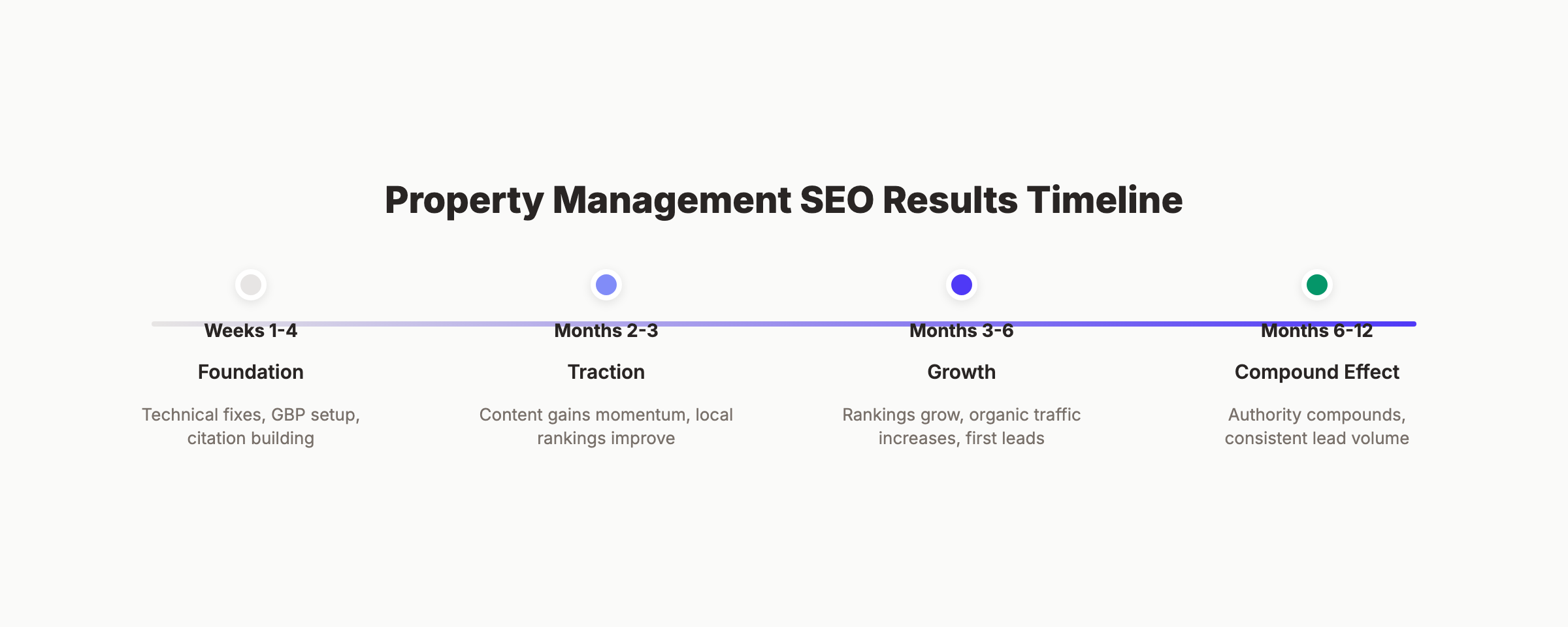
Timeline Expectations
- Weeks 1-4: Technical fixes, GBP optimization, citation building. Local ranking improvements possible.
- Months 2-3: Content gains traction. Local rankings improve. First organic leads arrive.
- Months 3-6: Rankings grow across multiple service keywords. Organic traffic increases measurably.
- Months 6-12: Authority compounds. The site ranks for hundreds of keywords. Lead volume becomes consistent.
The compound effect is real. Firms that quit at month 3 never reach the tipping point where SEO becomes their top lead source.
Rank everywhere. Do nothing. Blog SEO, Local SEO, and Social Media on autopilot for your property management company. Start for $1 →
FAQ
How long does SEO take for a property management company?
Most property management companies see initial local ranking improvements within 4-8 weeks. Meaningful results like consistent 3-Pack rankings and qualified owner leads typically take 3-6 months. Competitive metro areas may require 6-12 months of consistent effort.
What keywords should property management companies target?
Focus on owner-intent keywords: “property management company [city],” “property management fees [city],” and “how to find a property manager.” Avoid tenant-focused keywords like “apartments for rent” that attract traffic that never converts to management contracts.
How much does property management SEO cost?
SEO agencies charge $1,500-5,000+ per month for property management SEO. Automated publishing services like Stacc start at $99 per month for 30 optimized articles. In-house content production typically costs $80-250 per article from freelance writers.
Do Google reviews help property management SEO?
Yes. Reviews are the strongest local ranking signal you can directly influence. Property management companies averaging 47+ Google reviews rank significantly higher in local results. Focus on generating owner reviews that mention specific management services.
Should property management companies blog?
Absolutely. Companies that blog generate 55% more website visitors. For property management, blog content targeting landlord education, local market updates, and legal compliance attracts property owners researching management options. Publishing 8+ posts per month accelerates results.
What is the most common property management SEO mistake?
Targeting tenant keywords instead of owner keywords. Spending your SEO budget optimizing for “apartments for rent” type searches brings traffic that never converts to management contracts. Every keyword and page should target property owners who need management services.
Property management SEO comes down to one principle: be visible where property owners search.
Start with your Google Business Profile and local citations. Build content that answers the questions landlords ask before hiring a management company. Generate reviews that prove your track record. The firms that invest in this now will own the local search results in their markets for years.
Written and published by Stacc. We publish 3,500+ articles per month across 70+ industries. All data verified against public sources as of March 2026.