Learn how to respond to negative Google reviews with our 7-step framework. Includes templates, examples, and tips for fake reviews. Updated March 2026.
A single negative Google review can cost you up to 30 customers. That number comes from research compiled by Sixth City Marketing, and it gets worse. It takes roughly 40 positive reviews to undo the damage of one bad one.
Most business owners either ignore negative reviews or respond with something defensive that makes the situation worse. 75% of businesses do not respond to negative reviews at all. The ones that do respond see 45% more foot traffic, according to ReviewTrackers.
This guide walks you through exactly how to respond to negative Google reviews in 7 steps. You will learn a repeatable framework that protects your reputation, wins back unhappy customers, and signals trust to every future prospect reading your reviews.
We have published 3,500+ blogs across 70+ industries, many for local service businesses where Google reviews directly determine revenue. Here is what works.
What you will learn:
- A 7-step response framework you can use for any negative review
- Word-for-word response templates for common situations
- How to handle fake reviews and competitor attacks
- Industry-specific tips for healthcare, legal, and restaurants
- The 5 mistakes that make negative reviews worse
Why Negative Reviews Matter More Than You Think
Before diving into the steps, consider what is at stake.
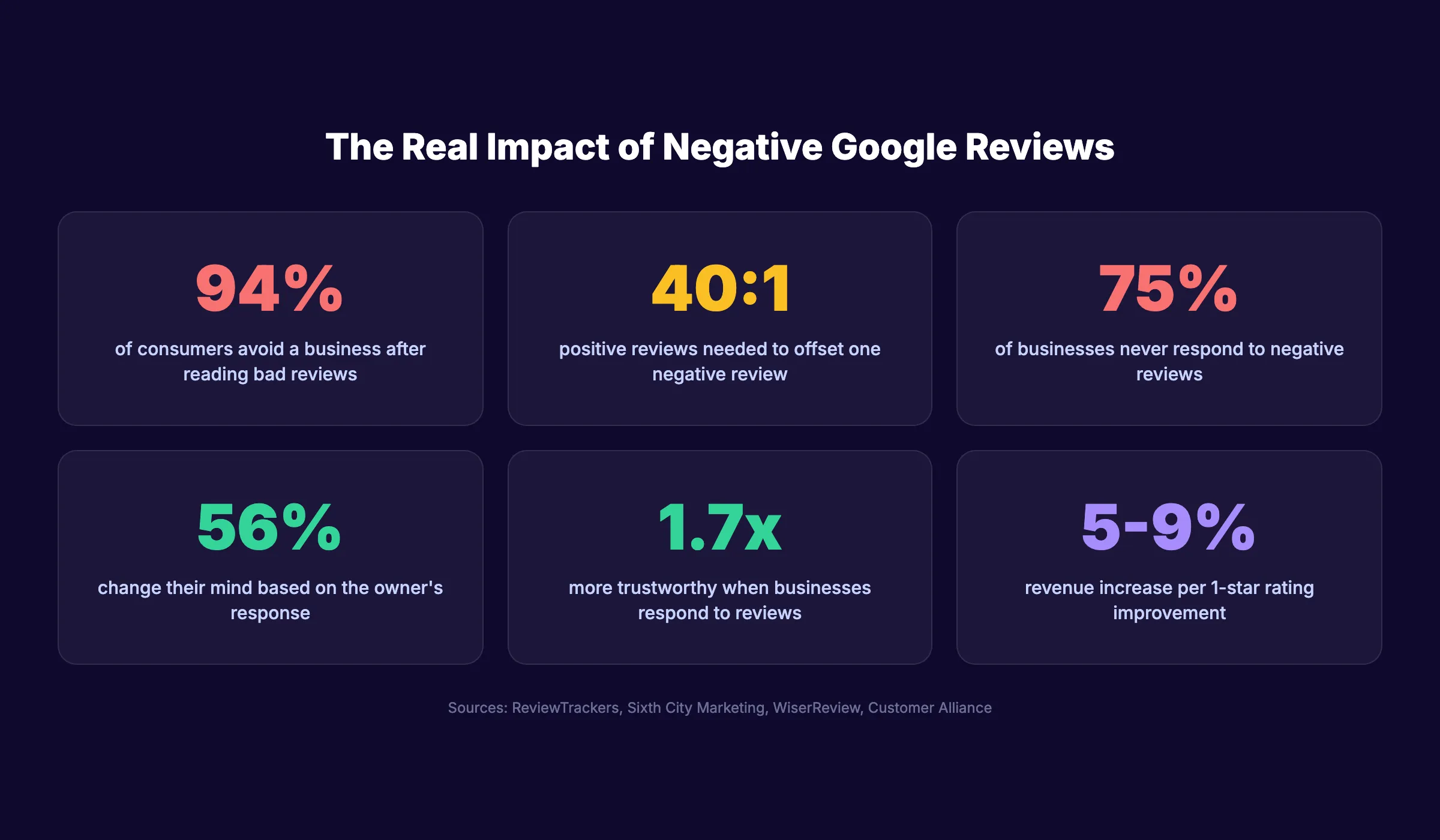
94% of consumers say a bad review convinced them to avoid a business. 56% of consumers change their perspective on a business based on how the owner responds, not the review itself. That means your response matters more than the complaint.
Google reviews also account for roughly 20% of local SEO ranking factors. When you respond to reviews, Google sees activity and engagement on your profile. That signals relevance. Businesses that respond to reviews are seen as 1.7 times more trustworthy than those that do not.
Here is the most counterintuitive stat: a perfect 5.0 rating actually hurts conversions. Research from Northwestern University found that purchase likelihood peaks between 4.0 and 4.7 stars. A few negative reviews, handled well, make your business look more credible.
The goal is not to eliminate negative reviews. It is to respond so well that the response itself becomes a trust signal.
| Metric | Impact |
|---|---|
| Consumers who avoid businesses after reading bad reviews | 94% |
| Consumers who change their mind based on the response | 56% |
| Businesses that do not respond to negative reviews | 75% |
| Positive reviews needed to offset 1 negative review | ~40 |
| Revenue increase per 1-star rating improvement | 5-9% |
| Customers who expect a response within 7 days | 53% |
Step 1: Read the Review Twice Before You Type
The first instinct after reading a negative review is to defend yourself. Resist it.
Read the review once to understand the complaint. Read it a second time to identify the specific issue, the emotion behind it, and any factual details you can verify.
Ask yourself these questions:
- Is this a real customer? Check your records for their name, date of service, or order number.
- What exactly went wrong? Identify the core complaint. Strip away the emotion.
- Is any part of this valid? Even exaggerated reviews often contain a kernel of truth.
- Is this a policy issue, a people issue, or a one-time mistake?
Why this step matters: Responding emotionally is the number one reason review responses backfire. A defensive reply gets screenshotted, shared on social media, and causes far more damage than the original review. Taking 10 minutes to process the review before typing saves you from a response you cannot delete.
Pro tip: If the review makes you angry, write your response in a notes app first. Walk away for 30 minutes. Edit it. Then post.
Step 2: Respond Within 24 Hours
Speed matters. 53% of customers expect a response to their negative review within 7 days. But 7 days is the floor, not the target.
Respond within 24 hours. Faster is better. Research from Widewail shows that 67% of unhappy reviewers who receive a fast response will return to the business.
A quick response shows three things:
- You are paying attention to customer feedback.
- You take complaints seriously.
- You value the person behind the review.
Every day you wait, more potential customers see an unanswered complaint. Each one of them forms an opinion about how you handle problems.
Why this step matters: A negative review with no response tells future customers you do not care. A negative review with a same-day response tells them you are responsive and accountable. The review stays the same. The perception changes completely.
Set up a monitoring system:
- Turn on Google Business Profile notifications (Settings > Notifications > Reviews)
- Check your GBP dashboard every morning
- Assign one team member to own review responses
- Set a target: every review gets a response within 24 hours, positive or negative
Step 3: Open With Gratitude, Not Defense
Your first sentence sets the tone for the entire response. Start with a thank you.
This feels counterintuitive when someone just left a 1-star review calling your business terrible. But opening with gratitude disarms the reader and signals maturity to everyone else watching.
Good openings:
- "Thank you for taking the time to share your experience."
- "We appreciate you bringing this to our attention."
- "Thank you for your feedback, [Name]."
Bad openings:
- "We are sorry you feel that way." (dismissive)
- "This is not accurate." (defensive)
- "We have never had this complaint before." (invalidating)
Use the reviewer's first name if it is visible. Personalization shows you are not copying and pasting a generic template.
Why this step matters: 89% of consumers read the business owner's reply before making a purchasing decision. Your response is not just for the person who complained. It is a public statement to every future customer who reads your reviews. A gracious opening signals professionalism.
Pro tip: Never start with "I" or "We are sorry you feel." Both put the focus on you instead of the customer's experience.
Step 4: Acknowledge the Specific Issue
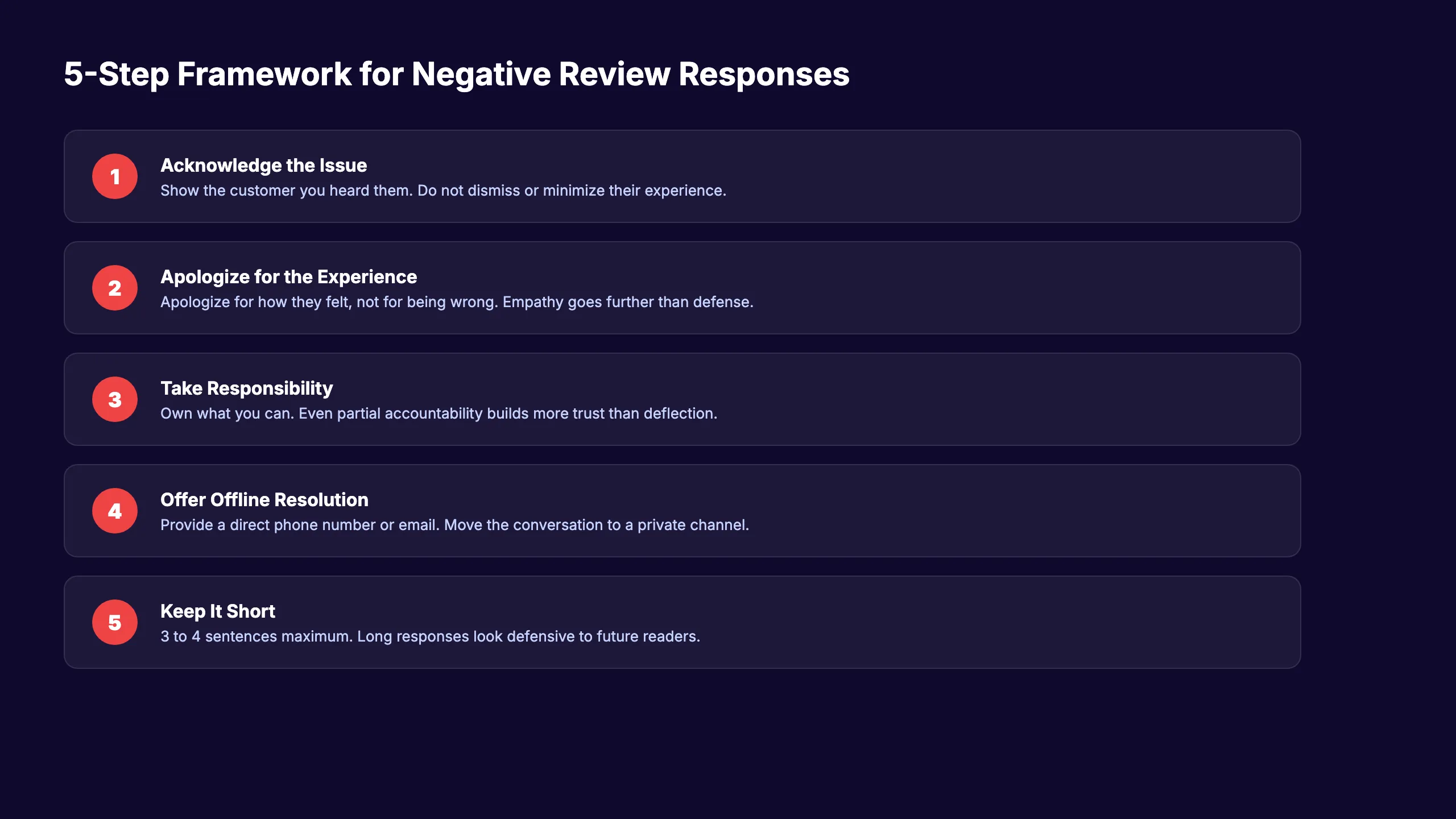
Generic responses are almost as bad as no response. "We are sorry for the inconvenience" tells the reviewer nothing.
Name the specific issue they raised. This proves you actually read the review and care enough to address it directly.
Generic (bad):
"We are sorry you had a negative experience. We strive to provide the best service."
Specific (good):
"We understand your appointment was delayed by 45 minutes on Tuesday, and that is not the experience we aim for."
When you name the problem, three things happen:
- The reviewer feels heard. This is often all they wanted.
- Other readers see that you take specific feedback seriously.
- You demonstrate accountability rather than deflection.
If the complaint is vague ("terrible service"), acknowledge the frustration without guessing at details. Say: "We want to understand what happened so we can make it right."
Why this step matters: Studies show that 56% of consumers change their opinion based on how a business responds. The difference between changing their mind and confirming their suspicion often comes down to whether you addressed the actual complaint or hid behind corporate language.
Your reputation runs on autopilot too. theStacc publishes 30 SEO articles per month to keep your business visible where it matters.
Step 5: Offer a Clear Resolution
Acknowledgment without action is just a polished apology. Every response to a legitimate complaint should include a concrete next step.
Resolution options by complaint type:
| Complaint Type | Resolution Example |
|---|---|
| Long wait time | "We have added a second technician to our morning schedule." |
| Rude staff member | "We are addressing this with our team directly." |
| Billing error | "We will issue a refund within 48 hours." |
| Quality issue | "We would like to redo the service at no charge." |
| Miscommunication | "We are updating our process to prevent this." |
The resolution does not need to be elaborate. It needs to be specific and actionable.
Avoid vague promises. "We will do better" means nothing. "We have changed our scheduling system to prevent double-bookings" means everything.
Why this step matters: A resolution turns a complaint into a recovery story. When future customers see that you fixed the problem, the negative review actually works in your favor. It shows you are a business that listens, adapts, and makes things right.
Step 6: Take the Conversation Offline
After acknowledging the issue and offering a resolution, move the detailed discussion off of Google.
Provide a direct phone number, email address, or name of a person they can contact. Do not ask them to "call the front desk" or "email info@." Give them a real human to reach.
Example:
"I would like to make this right. Please contact me directly at sarah@yourbusiness.com or call 555-123-4567. I am the owner and I will personally handle this."
Why you take it offline:
- Detailed back-and-forth in a public review thread looks messy
- Privacy concerns (you cannot share account details publicly)
- The reviewer is more likely to resolve the issue in a private conversation
- Once resolved privately, many reviewers will update or remove their review
Why this step matters: You do not want to negotiate, explain billing details, or discuss private information in a public forum. Moving offline protects both parties and dramatically increases the chance of a positive outcome.
Pro tip: Never say "please call us." Always say "please call me" and give a specific name and number. Personal contact converts at twice the rate of generic contact.
Step 7: Follow Up and Request an Update
Most businesses stop after posting their response. The best businesses follow through.
After resolving the issue offline, wait 3 to 5 days. Then reach out once more to confirm the customer is satisfied.
If they express that the issue was resolved, you can politely ask: "We are glad we could make this right. If you feel your experience has improved, we would appreciate if you considered updating your review."
Do not:
- Offer incentives for changing a review (this violates Google's review policies)
- Pressure them repeatedly
- Make them feel obligated
Do:
- Express genuine appreciation
- Ask once, politely, with no strings attached
- Accept their decision either way
Why this step matters: 67% of customers who get a fast, satisfactory response will return to the business. Many of them will update their review from 1 or 2 stars to 4 or 5 stars. The ones who do not update still remember how you handled it. They become quiet advocates.
Stop writing. Start ranking. theStacc publishes 30 SEO articles per month for your business, starting at $99.
How to Handle Fake Reviews and Competitor Attacks
Not every negative review comes from a real customer. Fake reviews from competitors, disgruntled ex-employees, or random internet users are a real problem. An estimated 10.7% of all Google reviews are fake.
How to identify a fake review:
- The reviewer has no history of visiting businesses in your area
- The complaint describes a service you do not offer
- Multiple 1-star reviews appear on the same day from new accounts
- The language is generic and does not reference specific details
How to respond to a fake review:
"Thank you for the feedback. We have searched our records and cannot find an account or visit matching your description. If you are a customer, please contact us at [email] so we can look into this. We take all feedback seriously."
This response does three things: stays professional, casts doubt on the review's authenticity for other readers, and invites the reviewer to prove they are real (they rarely do).
How to report a fake review to Google:
- Open Google Maps and find your business listing
- Click on the review
- Click the three-dot menu and select "Report review"
- Choose the reason (spam, fake, conflict of interest)
- Submit the report
Google removed over 240 million policy-violating reviews in 2024 alone, according to Search Engine Land. Be persistent. If the first report does not work, submit again through Google Business Profile support.
Legal note: The FTC banned fake reviews in 2024, with fines up to $51,744 per violation. If a competitor is posting fake reviews, document everything. You may have legal options.
Industry-Specific Response Tips
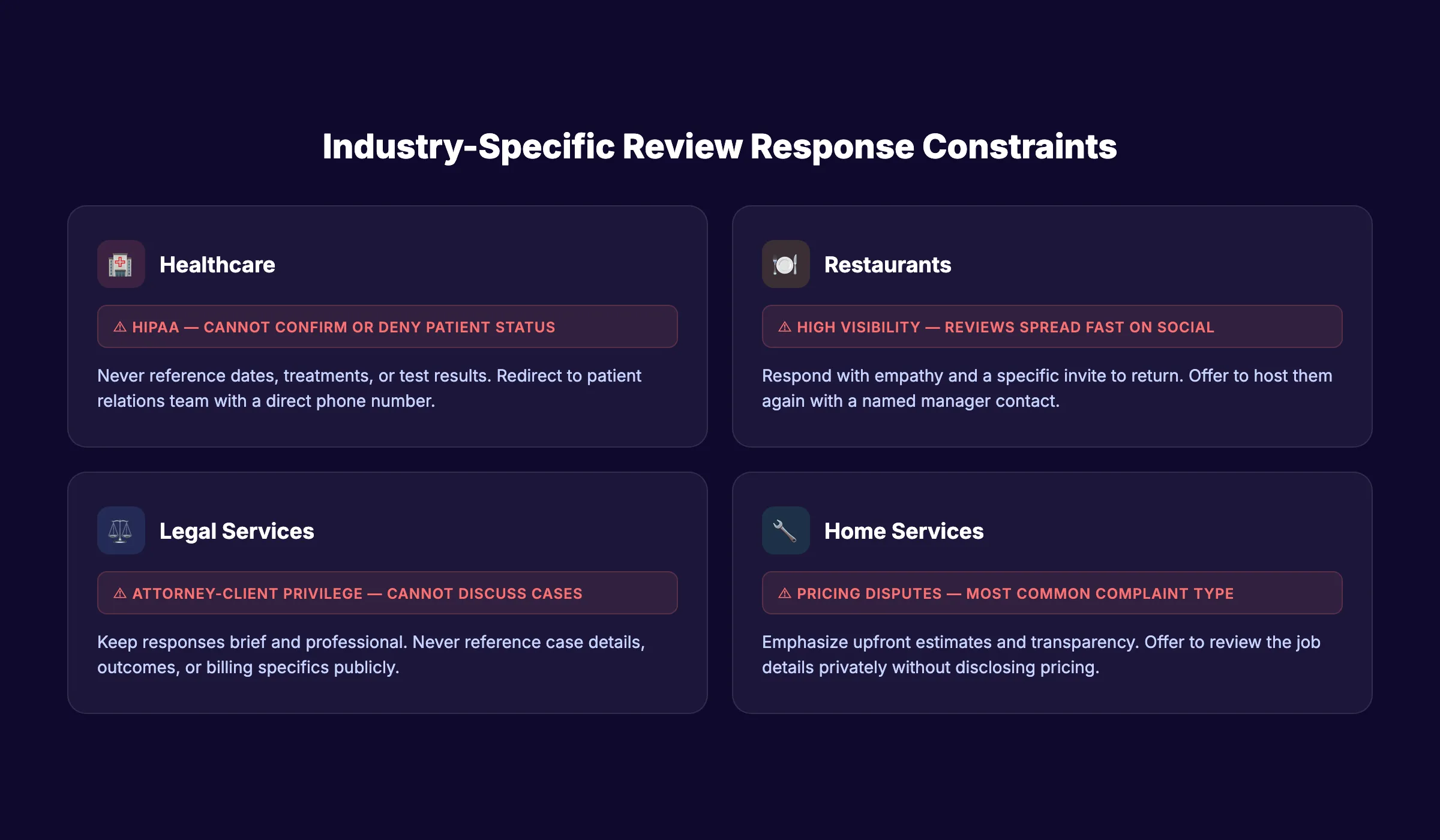
Different industries face unique constraints when responding to negative reviews. Here are the most important distinctions.
Healthcare (HIPAA Compliance)
Healthcare providers cannot confirm or deny that someone is a patient. A response that says "We treated you on March 5 and your lab results were normal" violates federal law.
Safe response template for healthcare:
"Thank you for your feedback. Due to privacy regulations, we cannot discuss specific patient details in a public forum. We take all concerns seriously and invite you to contact our patient relations team at [phone] so we can address this directly."
Restaurants and Hospitality
Food and service complaints are highly visible. Respond with empathy and a specific invite to return.
"We are sorry your meal did not meet expectations. We are sharing your feedback with our kitchen team. We would love to host you again. Please ask for [manager name] on your next visit for a complimentary appetizer."
Legal Services
Attorneys face confidentiality rules similar to HIPAA. Never reference case details.
"We appreciate your feedback and take all client concerns seriously. Attorney-client privilege prevents us from discussing specifics publicly. Please contact [name] at [phone] to discuss your concerns directly."
Home Services (Plumbers, HVAC, Electricians)
These reviews often involve pricing disputes. Address the concern without revealing exact pricing.
"We understand pricing is a concern, and we appreciate you raising it. Our estimates are provided before any work begins. We would like to review the details with you. Please reach out to [name] at [phone]."
For more on local search optimization in these industries, see our guides on home services SEO, dental SEO, restaurant SEO, and law firm SEO.
5 Mistakes That Make Negative Reviews Worse
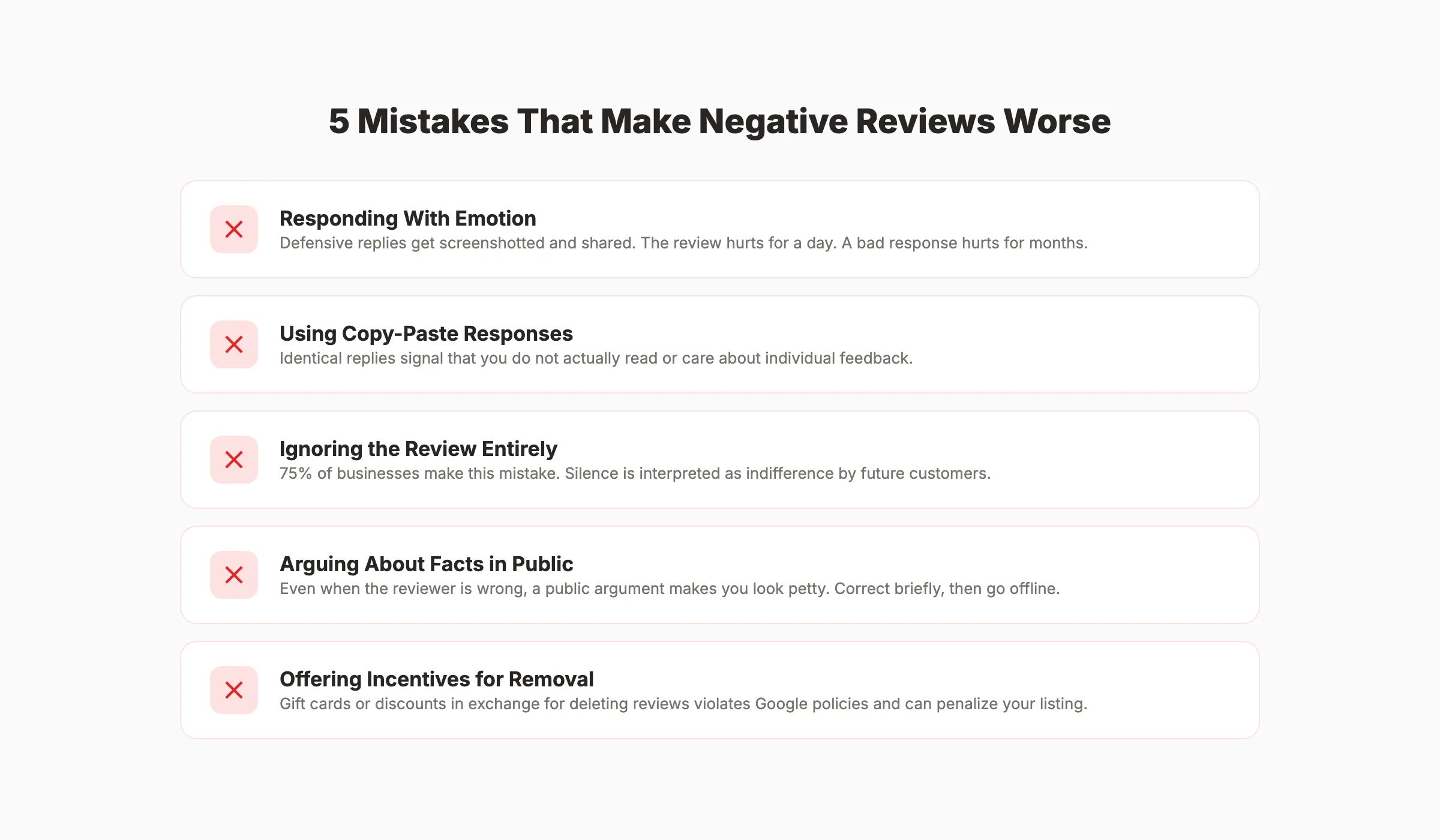
Avoid these errors. Each one can turn a manageable complaint into a reputation crisis.
1. Responding With Emotion
A defensive or angry response gets screenshotted and shared. The review damages you for a day. A bad response damages you for months.
2. Using Copy-Paste Responses
When every review gets the same "We are sorry for the inconvenience" reply, customers notice. It signals that you do not actually read or care about feedback.
3. Ignoring the Review Entirely
75% of businesses make this mistake. Silence is interpreted as indifference. A business that responds, even imperfectly, outperforms one that does not respond at all.
4. Arguing About Facts in Public
Even when the reviewer is wrong, a public argument makes you look petty. Correct factual errors briefly, then move the conversation offline.
5. Offering Incentives for Removal
Offering discounts, gift cards, or refunds in exchange for deleting a review violates Google's policies. Google can penalize your listing for this practice. Resolve the issue genuinely. If the customer is happy, they may update the review on their own.
Your SEO team. $99 per month. 30 optimized articles, published automatically. See what theStacc can do for your site.
Response Templates You Can Use Today
Here are 4 templates for the most common negative review scenarios. Customize the bracketed sections for each situation.
Template 1: Legitimate Service Complaint
"Hi [Name], thank you for sharing your experience. We are sorry that [specific issue] happened during your visit. That is not the standard we hold ourselves to. We have [specific action taken] to prevent this from happening again. I would love the chance to make this right. Please contact me at [email/phone] so I can personally address this.
[Your Name], [Title]"
Template 2: Vague or Non-Specific Complaint
"Hi [Name], thank you for your feedback. We want to understand what happened so we can improve. Could you contact us at [email/phone]? We would appreciate the chance to learn more about your experience and make things right.
[Your Name]"
Template 3: Pricing or Value Complaint
"Hi [Name], thank you for raising this. We understand that pricing is an important factor, and we work to be transparent about costs upfront. We would like to review the details of your experience. Please reach out to [name] at [phone/email] and we will look into this together."
Template 4: Suspected Fake Review
"Thank you for the feedback. We have searched our records and cannot locate an account or appointment matching your details. If we are mistaken, please contact us at [email] with your booking information so we can investigate. We take every review seriously."
Results: What to Expect
After implementing this 7-step framework consistently, here is a realistic timeline.
- Week 1-2: You have a response on every negative review within 24 hours. Immediate credibility boost.
- Month 1: Some reviewers begin updating their ratings after offline resolution. Expect 10-20% of resolved complaints to result in a review update.
- Month 2-3: Your overall star rating starts climbing. Potential customers notice the pattern of professional responses.
- Month 3-6: Local SEO rankings improve as Google sees consistent engagement on your profile. Review response is a confirmed local ranking signal.
For a full guide on optimizing your Google Business Profile beyond reviews, read our GBP optimization guide.
What practitioners are saying on X
AI search advice ages quickly. Here is high-signal public discussion from SEO and growth operators — context for your roadmap, not a substitute for primary data.
- @noelcetaSEO (Sep 2025): Local SEO playbook still centers complete GBP, NAP consistency, quality citations, local keywords, location content, review velocity, and local links. See the post on X.
- @irentdumpsters (Jan 2026): Most businesses have a GBP; few fully optimize every ranking-relevant section for Map Pack visibility. See the post on X.
- @EldarCohenSEO (Jul 2026): 2026 WhiteSpark-oriented reminder: primary Google Business category is a top Map Pack ranking factor — wrong primary category can erase visibility for money queries. See the post on X.
Grok, AI Overviews, and multi-engine visibility
Local topics like “respond to negative google reviews” get cited when GBP, NAP, reviews, and service-area steps are concrete. Grok mixes those web facts with Map Pack operator advice circulating on X.
- Google AI Overviews: Use passage-ready answers, tables, and FAQ schema where relevant.
- ChatGPT / Perplexity: Cite named sources next to key claims.
- Grok: Maintain accurate entity facts on-site and in high-signal X posts.
Rank higher in the Map Pack without a full-time local SEO hire. theStacc’s Local SEO module handles daily GBP posts, review reply workflows, and local visibility tracking — built for service businesses that need calls, not vanity rankings.
FAQ
Within 24 hours. 53% of customers expect a response within 7 days, but faster responses produce better outcomes. Same-day responses have the highest rate of reviewer follow-up and review updates.
Only if it violates Google's review policies (spam, fake, hate speech, conflicts of interest). Report the review through Google Maps or your GBP dashboard. Google removed over 240 million reviews in 2024, but legitimate negative reviews cannot be removed just because you disagree with them.
Yes. 88% of consumers prefer businesses that respond to both positive and negative reviews. Every unanswered negative review is a missed opportunity to demonstrate professionalism. Even a brief, professional response is better than silence.
Yes. Google reviews account for approximately 20% of local ranking factors. Responding to reviews signals engagement and relevance to Google. Businesses with active review management consistently outrank those that ignore their reviews.
When a reviewer leaves only a star rating and no text, respond with: "We noticed your rating and would like to understand your experience. Please contact us at [email/phone] so we can learn what happened and make it right." This shows effort to every reader and sometimes prompts the reviewer to elaborate or remove the rating.
This only happens when responses are defensive or argumentative. A response that thanks, acknowledges, resolves, and moves offline has virtually zero risk of escalation. The data is clear: businesses that respond are seen as 1.7 times more trustworthy than those that do not.
Now you have a repeatable system for responding to every negative Google review your business receives. The 7-step framework works across every industry and every type of complaint.
Start with Step 1 on your oldest unanswered review today. One professional response at a time, your review profile becomes your strongest sales asset.
Related Tools & Resources
Free SEO Tools:
Best Lists:
Sources & references
- [1] Princeton / Georgia Tech et al. — GEO research (arXiv:2311.09735)
- [2] @noelcetaSEO on X — Local SEO playbook still centers complete GBP, NAP consistency, quality citations, local keywords, location content, rev
- [3] @irentdumpsters on X — Most businesses have a GBP; few fully optimize every ranking-relevant section for Map Pack visibility.
- [4] @EldarCohenSEO on X — 2026 WhiteSpark-oriented reminder: primary Google Business category is a top Map Pack ranking factor — wrong primary cat
- [5] Referenced source — www.sixthcitymarketing.com

Manage Google Business Profile posts, review replies, and local rank tracking.
Weekly local SEO teardowns
One practical email a week. Map Pack, GBP, AI Overviews — no fluff. Unsubscribe anytime.