
Law Firm SEO (2026): Strategies, Tactics & Examples
Practical law firm seo guide strategies for 2026: step-by-step tactics, real examples, and tools to improve rankings and drive organic traffic.
Legal keywords cost between $50 and $900 per click on Google Ads (iLawyer Marketing, 2025). That is not a typo. Mesothelioma lawyer keywords alone exceed $900 per click.
Meanwhile, 96% of people seeking legal advice start with a search engine. If your firm does not rank organically, you are paying the most expensive toll on the internet every single time a potential client finds you.
The cost adds up fast. A personal injury firm spending $137 per click needs just 20 clicks per day to burn through $82,000 per month. Most of those clicks do not convert. Organic search, by contrast, delivers a 4.28% conversion rate for legal services compared to the 2.4% industry average.
This law firm SEO guide covers every channel, tactic, and strategy your firm needs to rank without writing a check to Google Ads for every visitor.
We publish 3,500+ blogs across 70+ industries. Legal SEO is one of the most competitive verticals we work in. This guide distills what actually works.
Here is what you will learn:
- Why organic search delivers 5:1 ROI for law firms (and how to get there)
- How to find practice-area keywords that drive consultations
- The on-page SEO signals Google demands from legal sites
- How to dominate the Local Map Pack for your city
- Content strategies that generate 68% more qualified leads
- Link building methods that stay within ABA compliance
- Technical SEO fixes specific to law firm websites
- How to adapt to AI Overviews and zero-click search in 2026
- Realistic pricing, ROI timelines, and build-vs-buy comparisons
Chapter 1: What Is Law Firm SEO (And Why It Costs $50 to $900 Per Click Without It)
Law firm SEO is the process of optimizing your firm’s website, content, and online presence to rank in organic search results for legal queries. The goal is simple: attract potential clients without paying per click.
The legal industry has some of the most expensive paid search costs of any sector. Here is what firms pay per click by practice area.
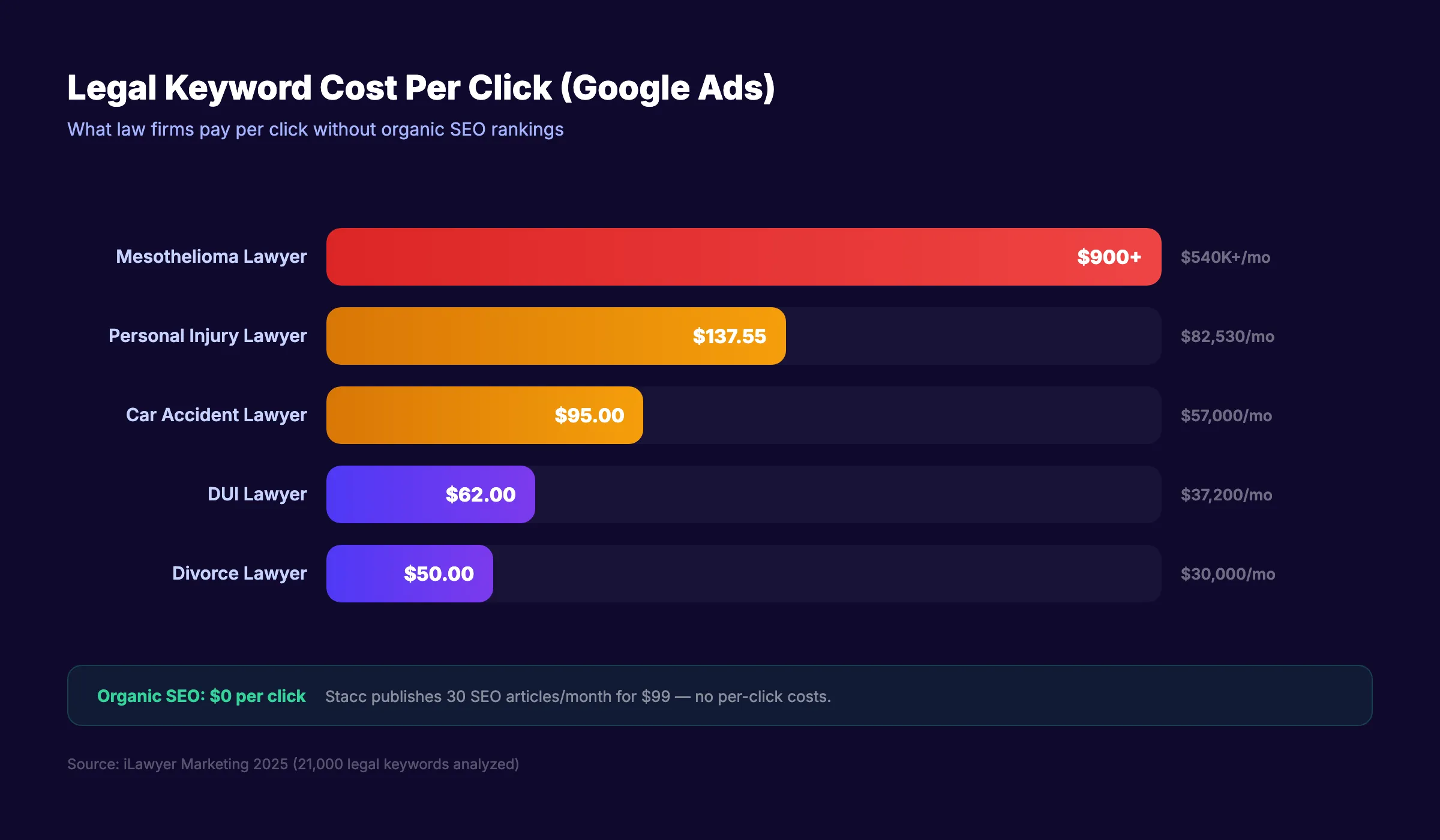
| Practice Area | Average CPC | Monthly Spend (20 clicks/day) |
|---|---|---|
| Mesothelioma Lawyer | $900+ | $540,000+ |
| Personal Injury Lawyer | $137.55 | $82,530 |
| Car Accident Lawyer | $95.00 | $57,000 |
| DUI Lawyer | $62.00 | $37,200 |
| Divorce Lawyer | $50.00 | $30,000 |
Source: iLawyer Marketing, 2025
Organic search eliminates these per-click costs entirely.
Why Organic Search Outperforms Paid Ads for Lawyers
66% of call conversions in the legal industry come from organic search (Ruler Analytics, 2024). That is more than paid search, social media, and referrals combined.
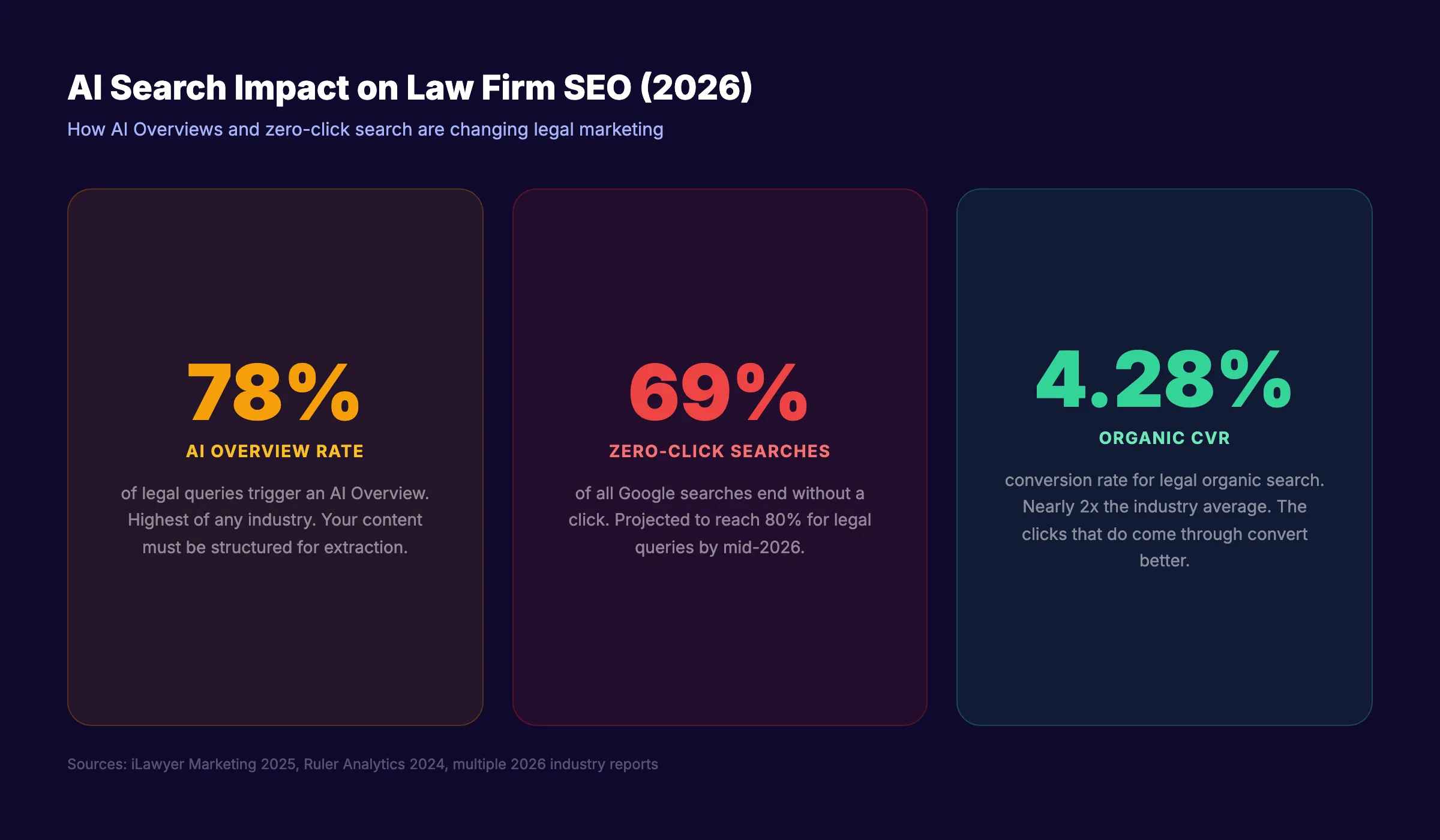
Organic clicks also convert better. The 4.28% conversion rate for legal organic search nearly doubles the 2.4% cross-industry average. Potential clients trust organic results more than ads. They click deeper, spend more time on the site, and call more often.
The math favors SEO over paid ads in every scenario beyond 6 months. A firm investing $5,000 per month in SEO that generates 50 organic leads per month is paying $100 per lead. That same firm would pay $6,875 per month for 50 clicks (not leads) on personal injury keywords.
The YMYL Factor: Why Google Holds Law Firms to a Higher Standard
Google classifies legal content as YMYL (Your Money or Your Life). This means the content can directly affect a person’s health, finances, or legal rights. Google applies stricter quality standards to YMYL pages.
For law firm websites, this means:
- Every page needs clear author attribution from a licensed attorney
- Claims must be accurate, sourced, and current
- The site must demonstrate E-E-A-T (Experience, Expertise, Authoritativeness, Trustworthiness)
- Attorney bio pages must include credentials, bar admissions, and case experience
- Reviews and testimonials must comply with ABA Model Rule 7.2
Firms that ignore YMYL standards will not rank. Period. Google’s quality raters specifically evaluate legal content for these signals.
Chapter 2: Keyword Research for Law Firms (By Practice Area)
79% of legal professionals rate SEO as the most effective marketing channel (BrandMuscle, 2020). Keyword research determines whether that investment pays off.
The right keywords connect your firm to people actively seeking legal help. The wrong keywords attract researchers, students, and competitors.
High-Intent Keywords That Drive Consultations
Legal keywords fall into 3 intent categories. Focus your budget on the first one.
| Intent Type | Example Keywords | Conversion Potential |
|---|---|---|
| Transactional (hire) | “personal injury lawyer near me”, “divorce attorney [city]“ | High |
| Investigational (evaluate) | “how much does a DUI lawyer cost”, “best family law firm in [city]“ | Medium |
| Informational (learn) | “what is premises liability”, “how to file for divorce” | Low (but builds authority) |
Transactional keywords signal someone ready to hire. These are your money keywords. “Car accident lawyer in Houston” has far more value than “what to do after a car accident.”
Build your keyword research strategy around transactional terms first. Then layer in informational content to build topical authority.
Practice-Area Keyword Examples
Every practice area has its own keyword ecosystem. Here are seed keywords for the 6 most common legal specializations.
| Practice Area | Money Keywords | Blog Keywords |
|---|---|---|
| Personal Injury | ”personal injury lawyer [city]”, “car accident attorney near me" | "what to do after a car accident”, “average settlement amounts” |
| Family Law | ”divorce lawyer [city]”, “child custody attorney near me" | "how to file for divorce in [state]”, “custody rights for fathers” |
| Criminal Defense | ”DUI lawyer [city]”, “criminal defense attorney near me" | "first offense DUI penalties [state]”, “felony vs misdemeanor” |
| Estate Planning | ”estate planning attorney [city]”, “trust lawyer near me" | "do I need a will or a trust”, “how to avoid probate” |
| Immigration | ”immigration lawyer [city]”, “visa attorney near me" | "green card application process”, “H1B visa requirements” |
| Business Law | ”business attorney [city]”, “corporate lawyer near me" | "how to form an LLC”, “partnership agreement checklist” |
Tools for Legal Keyword Research
Start with free tools before investing in paid platforms. Google Search Console shows which queries already drive impressions. Google’s “People Also Ask” boxes reveal questions your audience asks.
For deeper research, use the best keyword research tools available. Ahrefs, Semrush, and Google Keyword Planner all provide volume, difficulty, and CPC data. Filter for keywords with a difficulty score under 40 and clear commercial intent.
Build a topical map for each practice area. Group keywords into clusters around core topics. One pillar page targets the primary keyword. Supporting blog posts target long-tail variations.
Your firm needs 30+ pages of content to compete in legal SEO. Stacc publishes 30 optimized blog posts per month for $99. No writers to manage. No briefs to approve. Start for $1 →
Chapter 3: On-Page SEO for Law Firm Websites
On-page SEO covers everything on the page itself. Title tags, meta descriptions, headers, content, images, and internal links. For law firms, on-page optimization also includes E-E-A-T signals that Google requires for YMYL content.
Title Tags and Meta Descriptions for Legal Pages
Every page on your site needs a unique title tag under 60 characters. Include your primary keyword and your city.
Good title tag: “Personal Injury Lawyer in Dallas | Smith Law Firm” Bad title tag: “Home | Smith & Associates Law Firm”
Meta descriptions should be 145 to 155 characters. Include the keyword, a benefit, and a call to action. “Injured in a car accident in Dallas? Our personal injury lawyers have recovered $50M+ for clients. Free consultation.”
Attorney Bio Pages That Build E-E-A-T
Attorney bio pages are among the most important pages on a law firm website. Google’s quality raters look at these pages to assess expertise and trustworthiness.
Every attorney bio page should include:
- Full name and professional headshot
- Bar admissions and license numbers
- Education and certifications
- Practice area specializations
- Years of experience and notable case results
- Published articles, speaking engagements, or media appearances
- Schema markup for the Person entity
Link each attorney bio to the practice area pages they support. This creates a clear expertise signal for Google. Add internal links from blog posts back to the attorney who authored them.
Practice Area Pages That Rank
Each practice area deserves its own dedicated page. Do not lump all services onto a single page. Google ranks specific pages for specific queries.
A strong practice area page includes:
- A clear H1 with the practice area and city
- 1,500 to 2,500 words of original content
- An overview of the legal process
- Common questions clients ask
- Case results or settlement ranges (with disclaimers)
- A consultation CTA above the fold and after each section
- Structured blog post layout with logical header hierarchy
Follow on-page SEO best practices for every practice area page. Optimize images with descriptive alt text. Use header tags (H2, H3) to create a scannable structure.
On-page SEO done right compounds over time. Stacc handles content creation, optimization, and publishing automatically. 30 articles per month. Zero effort from your team. Start for $1 →
Chapter 4: Local SEO. How to Dominate the Map Pack
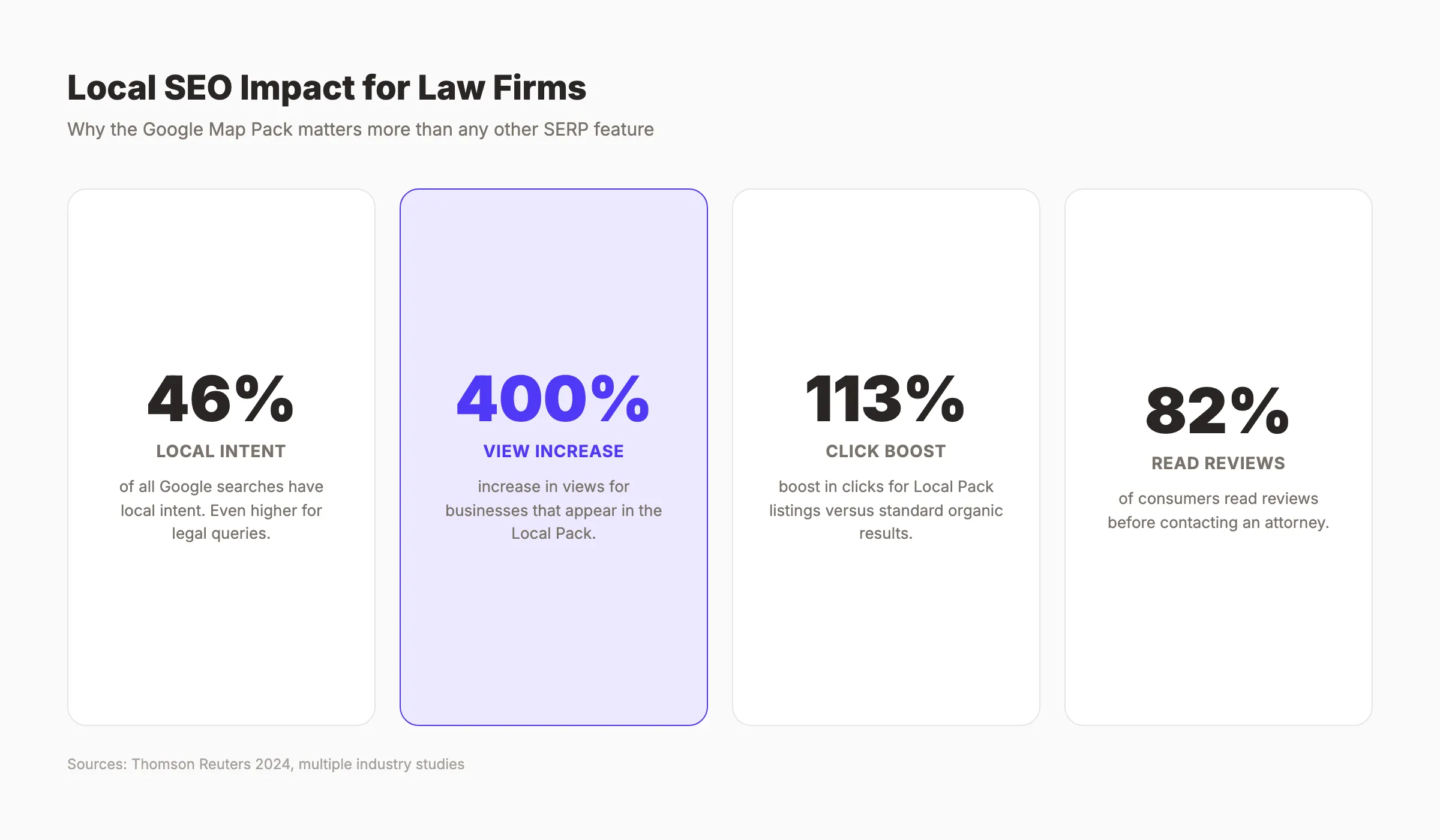
46% of all Google searches have local intent. For law firms, that number is even higher. “Lawyer near me” searches have grown 150% over the past 5 years.
The Local Pack (the 3 map listings at the top of search results) captures 44% of all clicks. Firms that appear in the Local Pack see a 400% increase in views and a 113% boost in clicks.
Google Business Profile Optimization for Law Firms
Your Google Business Profile is the foundation of local SEO for attorneys. An optimized GBP listing directly impacts your Map Pack ranking.
Complete every field in your profile:
- Business name (exact legal name, no keyword stuffing)
- Primary category: select the most specific option (e.g., “Personal Injury Attorney” not just “Lawyer”)
- Secondary categories: add all relevant practice areas
- Business description: 750 characters with your top keywords
- Service areas: list every city and county you serve
- Hours: keep updated, including holiday hours
- Photos: add 10+ high-quality images (office, team, lobby)
- Posts: publish weekly GBP posts with updates and offers
Weekly GBP posts signal to Google that your listing is active and maintained. Firms that post weekly see measurably higher visibility in local results.
Citations and NAP Consistency
Citations are online mentions of your firm’s Name, Address, and Phone number (NAP). Consistent NAP data across the web reinforces your location legitimacy.
Submit your firm to these directories first:
- Avvo
- FindLaw
- Justia
- Martindale-Hubbell
- Super Lawyers
- Lawyers.com
- Yelp
- BBB (Better Business Bureau)
- State Bar directory
- Local Chamber of Commerce
Use the best local SEO tools to audit your citations. Every listing must match your GBP exactly. One wrong phone number or outdated address can suppress your ranking.
Reviews: The 82% Factor
82% of consumers read online reviews before contacting an attorney (Thomson Reuters, 2024). Google Reviews directly influence your Local Pack ranking.
The three factors that matter most:
- Review volume. More reviews signal trust. Aim for 50+ reviews minimum.
- Review recency. A steady stream of new reviews matters more than a spike 2 years ago.
- Review response. Respond to every review within 24 hours. Thank positive reviewers. Address negative reviews professionally.
Build a review generation system. Send a follow-up email after every case resolution. Include a direct link to your Google review page. Read our guide on getting more Google reviews for 21 proven methods.
ABA compliance note: never offer incentives for reviews. Do not ask clients to mention specific outcomes or case details. Keep the process voluntary and ethical.
Chapter 5: Content Strategy. What to Publish and How Often
Law firms with active blogs generate 68% more qualified leads than those without (Semrush, 2024). Content builds the topical authority that Google rewards with higher rankings across your entire site.
Blog Topics That Generate Leads for Attorneys
Not all blog topics drive revenue. Focus on content that matches the buyer journey.
Bottom-of-funnel content (highest priority):
- “How much does a [practice area] lawyer cost in [city]”
- “[Practice area] lawyer vs. doing it yourself”
- “Questions to ask a [practice area] attorney before hiring”
Middle-of-funnel content:
- “What to expect during the [legal process]”
- “[State] [practice area] laws explained”
- “How long does a [case type] take”
Top-of-funnel content (highest volume):
- “What to do after [event]”
- “[Legal term] explained in plain English”
- “[State] [legal topic] FAQ”
Map every topic to a practice area and a target keyword. Use a content calendar to plan 3 months ahead.
Publishing Frequency for Law Firm Blogs
Most law firms publish 1 to 2 posts per month. That is not enough to build authority. The firms ranking on page 1 publish 8 to 12 posts per month.
Here is the publishing frequency breakdown:
| Monthly Posts | Authority Building | Expected Timeline to Rank |
|---|---|---|
| 1-2 | Minimal | 12-18 months |
| 4-8 | Moderate | 6-12 months |
| 12-20 | Strong | 3-6 months |
| 20-30 | Aggressive | 2-4 months |
Consistency matters more than volume. Publishing 8 posts per month for 12 months beats publishing 30 posts for 2 months and stopping.
Every post should follow SEO content writing best practices. Target one primary keyword per post. Include secondary keywords naturally. Write for the reader first.
Building Topical Authority in Your Practice Area
Google does not rank individual pages in isolation. It evaluates your entire site’s expertise on a topic. A firm with 50 pages about personal injury law outranks a firm with 5 pages on the same topic, all else being equal.
Build topical authority through content clusters:
- Create one pillar page per practice area (2,000+ words)
- Write 10 to 15 supporting posts that cover subtopics
- Link every supporting post back to the pillar page
- Link the pillar page out to every supporting post
- Update the cluster quarterly with new content
This internal linking structure tells Google exactly what your site is about. Read our guide on how to write SEO blog posts for the step-by-step process.
Building topical authority requires volume. Stacc publishes 30 SEO-optimized articles per month. Each post targets a specific keyword cluster. Your firm builds authority on autopilot. Start for $1 →
Chapter 6: Link Building for Attorneys
Links from other websites remain one of the top 3 ranking factors. For law firms, link building requires a careful approach that respects both Google’s guidelines and ABA ethical rules.
Legal Directories That Move Rankings
Legal directories provide some of the most relevant backlinks a law firm can earn. Not all directories carry equal weight.
| Directory | Domain Authority | Link Type | Priority |
|---|---|---|---|
| Avvo | 91 | DoFollow | High |
| FindLaw | 82 | DoFollow | High |
| Justia | 88 | DoFollow | High |
| Martindale-Hubbell | 73 | DoFollow | Medium |
| Super Lawyers | 76 | DoFollow | Medium |
| Lawyers.com | 68 | NoFollow | Medium |
| Nolo | 82 | DoFollow | Medium |
| State Bar Association | Varies | DoFollow | High |
DA scores are approximate and vary by source.
Claim and optimize every listing. Add your full firm description, practice areas, attorney bios, and a link to your website. Incomplete listings waste a ranking opportunity.
Local Link Building Strategies
Local links carry extra weight for firms targeting city-level keywords. These strategies work for law firms of every size.
Sponsor local events. Bar association events, legal aid fundraisers, community sports teams. Each sponsorship typically includes a backlink from the event page.
Write for local publications. Op-eds in local newspapers, guest articles on local business blogs, and legal columns in community newsletters all generate relevant links.
Partner with complementary businesses. Real estate agents, financial advisors, and insurance brokers all serve overlapping audiences. Cross-link on resource pages.
Create linkable legal resources. Free legal guides, FAQ pages for your state’s laws, and interactive tools (settlement calculators, legal fee estimators) attract links naturally.
Run a backlink audit every quarter. Remove toxic links and identify new opportunities.
What to Avoid: ABA-Compliant Link Practices
ABA Model Rule 7.2 governs communications about legal services. Several common link building tactics cross ethical lines for attorneys.
Do not:
- Buy links from private blog networks (PBNs)
- Exchange links with other law firms in a reciprocal scheme
- Use testimonials that imply guaranteed outcomes
- Publish misleading specialization claims to earn links
- Pay for editorial links disguised as organic content
Safe alternatives:
- Earn links through original research and data
- Provide expert commentary to journalists (HARO, Connectively)
- Publish genuine case studies with client consent
- Create free community resources that attract natural links
Chapter 7: Technical SEO Checklist for Law Firms
A slow, poorly structured website will not rank regardless of how good your content is. Technical SEO ensures Google can crawl, index, and understand your site.
Core Web Vitals for Law Firm Websites
Google uses Core Web Vitals as a ranking signal. These 3 metrics measure user experience.
| Metric | What It Measures | Target |
|---|---|---|
| LCP (Largest Contentful Paint) | Page load speed | Under 2.5 seconds |
| INP (Interaction to Next Paint) | Responsiveness | Under 200 milliseconds |
| CLS (Cumulative Layout Shift) | Visual stability | Under 0.1 |
Common issues on law firm websites:
- Oversized hero images that slow LCP
- Unoptimized third-party scripts (live chat widgets, analytics)
- Missing image dimensions that cause layout shifts
- Heavy custom fonts that block rendering
Run your site through Google PageSpeed Insights. Fix the top 3 issues first. Most law firm websites can reach passing scores with image compression and script deferral alone.
Schema Markup for Legal Services
Schema markup helps Google understand your content and display rich results. Law firms should implement these schema types.
| Schema Type | Use Case | Benefit |
|---|---|---|
| LocalBusiness (LegalService) | Homepage and contact page | Map Pack eligibility, rich snippets |
| Attorney | Attorney bio pages | Knowledge panel potential |
| FAQPage | FAQ sections | FAQ rich results in SERPs |
| Review | Testimonial pages | Star ratings in search results |
| Article | Blog posts | Enhanced article snippets |
| BreadcrumbList | All pages | Improved navigation in SERPs |
Use our Schema Markup Generator to create the JSON-LD code. Add it to the <head> section of each page. Test with Google’s Rich Results Test before publishing.
Mobile Optimization (62%+ of Legal Searches)
Over 62% of legal searches happen on mobile devices. Google uses mobile-first indexing, meaning it evaluates the mobile version of your site first.
- Test every page on a real mobile device
- Ensure tap targets are at least 48px by 48px
- Use responsive design (not separate mobile URLs)
- Keep forms short (name, phone, email, brief description)
- Make the phone number clickable on every page
- Compress images for mobile bandwidth
Also audit your robots.txt file and XML sitemap. Make sure Google can crawl your most important pages without hitting dead ends or broken links.
Technical SEO problems silently kill your rankings. Run a free check with our SEO Audit Tool to find issues before Google does. Start for $1 →
Chapter 8: AI Search and Law Firm SEO in 2026
AI search has fundamentally changed how people find and evaluate law firms. Google’s AI Overviews now appear at the top of search results for most legal queries.
78% of Legal Queries Trigger AI Overviews
The legal industry has the highest AI Overview trigger rate of any sector. 78% of legal search queries now display an AI-generated summary above the traditional results.
This creates 2 problems for law firms:
- Fewer clicks reach your website. 69% of Google searches already end without a click. That number is climbing toward 80% for legal queries by mid-2026.
- The AI Overview answers the question directly. Searchers get basic legal information without visiting your site.
The firms that adapt will capture a disproportionate share of the remaining clicks. The firms that ignore AI search will see traffic decline steadily.
How to Get Cited in AI-Generated Answers
AI Overviews pull content from pages that Google considers authoritative on the topic. Getting cited in these summaries requires a specific content approach.
Read our full Generative Engine Optimization guide for the complete strategy. Here are the key tactics for law firms.
Structure content for extraction. Use clear H2 and H3 headers. Write concise definitions and explanations in the first paragraph under each header. AI models pull from well-structured content.
Include specific data and statistics. AI summaries prefer content with concrete numbers. “The average car accident settlement in Texas is $15,000 to $75,000” is more citable than “settlements vary.”
Build entity authority. Consistent author bylines, schema markup, and cross-platform presence (Avvo, LinkedIn, publications) establish your attorneys as recognized entities.
Answer the exact question. Match your H2 headers to common search queries. Start the section with a direct answer, then expand.
Our guide on optimizing for AI Overviews covers the tactical details.
The Zero-Click Problem for Attorneys
Zero-click searches are queries where the user gets their answer without clicking any result. For law firms, this means potential clients may read a summary of their legal rights, average settlement amounts, or legal processes without ever reaching your website.
The counter-strategy has 3 parts:
- Target queries that require action. “Personal injury lawyer near me” cannot be fully answered by an AI Overview. The searcher still needs to call someone.
- Create content that goes deeper than a summary. AI Overviews provide surface-level answers. Your content should offer state-specific detail, case examples, and actionable next steps.
- Build brand recognition. When your firm appears in AI Overviews repeatedly, searchers remember the name. Direct searches for your firm name bypass AI Overviews entirely.
Chapter 9: How Much Does Law Firm SEO Cost in 2026
Law firm SEO pricing ranges from $2,500 to $15,000+ per month when hiring an agency (PageOne Power). The wide range reflects differences in competition, market size, and scope.
Typical Pricing Tiers
| Tier | Monthly Cost | What You Get | Best For |
|---|---|---|---|
| DIY / Tools Only | $100-$300 | SEO tools, no execution | Solo practitioners with time |
| Automated Service | $99-$199 | 30-80 published articles/mo | Firms wanting volume at low cost |
| Mid-Range Agency | $2,500-$5,000 | Strategy + 4-8 pages/mo | Small to mid-size firms |
| Premium Agency | $5,000-$10,000 | Full strategy + 8-15 pages/mo | Competitive markets |
| Elite Agency | $10,000-$15,000+ | Enterprise strategy + link building | High-value practice areas |
The gap between tiers 2 and 3 is worth examining. An automated service like Stacc produces 30 articles per month for $99. A mid-range agency produces 4 to 8 pages for $2,500. The content quality differs, but the volume difference matters for topical authority.
ROI Timeline: When to Expect Results
Legal SEO is a long-term investment. Here is a realistic timeline.
Months 1 to 3: Technical fixes, GBP optimization, initial content published. Minimal ranking movement.
Months 3 to 6: Early rankings for long-tail keywords. Organic traffic begins growing. First leads from SEO.
Months 6 to 12: Competitive keywords start moving to page 1. Content compounds. Monthly leads increase steadily.
Months 12 to 24: Full authority established. Rankings stabilize for primary keywords. 423% to 642% three-year ROI for well-executed campaigns (PageOne Power).
The 5:1 average ROI ratio for legal SEO means every $1 invested returns $5 in client value over 3 years. No other marketing channel matches this for law firms.
Agency vs. DIY vs. Automated SEO
| Factor | DIY | Automated (Stacc) | Agency |
|---|---|---|---|
| Monthly cost | $0-$300 | $99-$199 | $2,500-$15,000 |
| Content output | 1-2 posts | 30-80 posts | 4-8 posts |
| Time required | 20-40 hrs/mo | 0 hrs | 2-5 hrs/mo |
| Strategy included | No | Keyword targeting | Full strategy |
| Link building | Manual | Not included | Usually included |
| Time to results | 12-18 months | 3-6 months | 3-6 months |
Most firms benefit from a hybrid approach. Use an automated service for consistent content volume. Invest in targeted link building separately. Run a quarterly SEO audit to track progress.
30 articles per month. $99. No agency retainer. Stacc publishes SEO-optimized blog content for law firms every month. Your firm builds authority while you practice law. Start for $1 →
Chapter 10: Common Law Firm SEO Mistakes
After working across dozens of legal industry sites, these mistakes appear repeatedly. Each one quietly drains rankings.
1. Keyword stuffing practice area pages. Loading “personal injury lawyer Houston” into every paragraph triggers spam filters. Use the keyword naturally 3 to 5 times per 1,000 words. Lean on synonyms and variations.
2. Ignoring attorney bio pages. Google evaluates E-E-A-T for legal content. A thin bio page with just a name and headshot tells Google nothing about expertise. Expand every bio to 500+ words.
3. Duplicating content across location pages. Firms with multiple offices often copy the same page and swap the city name. Google deindexes duplicate content. Write unique content for each location.
4. Neglecting Google Business Profile. A claimed but unoptimized GBP listing will not rank in the Local Pack. Complete every field. Post weekly. Respond to every review.
5. Publishing 1 blog post per quarter. Sporadic publishing signals abandonment. Consistent output signals authority. Even 4 posts per month moves rankings more than 1 post per quarter.
6. Using stock photos everywhere. Custom photos of your office, team, and community outperform stock images. Google’s image recognition can identify stock photos. Authenticity matters for YMYL sites.
7. No internal linking structure. Pages that do not link to each other create orphan content. Build a clear internal linking strategy that connects every page to related content.
8. Skipping mobile optimization. Over 62% of legal searches are mobile. A site that looks broken on phones loses more than half its potential clients before they scroll.
9. Ignoring AI search changes. Firms that do not optimize for AI Overviews and zero-click search will lose visibility steadily through 2026 and beyond.
10. No tracking or measurement. Install Google Search Console and Google Analytics 4. Track keyword rankings, organic traffic, and conversions monthly. You cannot improve what you do not measure. Use the best SEO tools for lawyers to monitor progress.
Frequently Asked Questions
How long does it take for law firm SEO to work?
Most law firms see initial ranking movement within 3 to 6 months. Competitive keywords like “personal injury lawyer [city]” may take 6 to 12 months to reach page 1. Long-tail keywords and informational queries often rank within 60 to 90 days. Consistent content publishing and technical optimization accelerate the timeline.
Is SEO worth it for small law firms?
Yes. Small firms often benefit more from SEO than large firms. A solo practitioner spending $99 per month on content can outrank firms spending $10,000 per month on ads. Organic traffic compounds over time. The 5:1 ROI ratio applies regardless of firm size. Start with local SEO and practice-area content targeting your specific city.
How much should a law firm spend on SEO?
Budget depends on market competition and firm size. Solo practitioners and small firms should budget $500 to $2,000 per month (tools + content). Mid-size firms in competitive markets should allocate $2,500 to $5,000. Large firms targeting high-value keywords like personal injury or mesothelioma may invest $10,000+ per month.
Can a law firm do SEO in-house?
Yes, but it requires significant time investment. A partner or marketing coordinator would need 20 to 40 hours per month for keyword research, content writing, technical updates, and link building. Most firms find it more cost-effective to outsource content production while keeping strategy oversight in-house.
What is the best SEO strategy for a new law firm website?
Start with 3 priorities. First, optimize your Google Business Profile completely. Second, create practice area pages targeting “[practice area] lawyer in [city]” keywords. Third, begin publishing 8 to 12 blog posts per month targeting long-tail informational keywords. Build from there. Read our guide on SEO for new websites for the full breakdown.
Does AI-generated content work for law firm SEO?
AI-generated content can rank when properly edited and reviewed by a licensed attorney. Google does not penalize AI content. It penalizes low-quality content regardless of how it was created. The key is accuracy, expertise signals, and E-E-A-T compliance. Learn how to scale blog content with AI while maintaining quality standards.
SEO that runs itself. Stacc publishes 30 optimized blog posts per month for law firms. No writers to manage. No agency retainer. Just consistent, compounding organic growth. Start for $1 →
Law firm SEO is not optional in 2026. With 96% of potential clients searching online and AI Overviews changing how results appear, firms that invest now will capture the clients that competitors miss. Start with your Google Business Profile, build practice area pages, and publish content consistently. The firms that rank will be the firms that clients call.
Related Tools & Resources
Free SEO Tools:
Best Lists:

Written by
Siddharth GangalSiddharth is the founder of theStacc and Arka360, and a graduate of IIT Mandi. He spent years watching great businesses lose organic traffic to competitors who simply published more. So he built a system to fix that. He writes about SEO, content at scale, and the tactics that actually move rankings.
30 SEO blog articles published every month
Keyword-optimized, scheduled, and live on your site. Automatically.
30-day trial · Cancel anytime
theStacc
Stop writing SEO content manually
30 blog articles, 30 GBP posts, and social media content. Published every month. Automatically.
Start Your $1 Trial$1 for 3 days · Cancel anytime