Social Media for Financial Advisors: The Guide (2026)
The complete social media guide for financial advisors. LinkedIn, compliance, content ideas, and client acquisition strategies. Updated March 2026.
Siddharth Gangal • 2026-03-29 • SEO Tips
In This Article
42% of Americans under 30 get financial advice from social media. Your prospects are scrolling LinkedIn and Instagram right now. Social media for financial advisors is not optional in 2026. It is a client acquisition channel that builds trust before a prospect ever books a consultation.
Most financial advisors treat social media like a compliance headache. They post a market recap once a month, get zero engagement, and decide social does not work for wealth management. The problem is not the platform. The problem is posting generic content to people who do not know you yet.
Financial advising is a trust business. A prospect will not hand over their retirement savings to someone they found on a cold call. But they will reach out to an advisor whose LinkedIn posts they have read for 6 months. Social media extends your credibility from 30 conversations per week to 3,000 impressions per week.
4 in 10 financial advisors acquired new clients through social media last year. Advisors with a defined marketing strategy converted social leads at 57%, compared to 36% without one. The math is clear.
Here is what this guide covers:
- Which platforms generate the most leads for financial advisors
- The 80/20 content rule that keeps followers engaged
- A weekly posting schedule with specific examples
- LinkedIn strategy for high-net-worth client acquisition
- FINRA, SEC, and state compliance requirements
- How to turn social media engagement into booked consultations
- Paid advertising strategies for advisor lead generation
- Common mistakes that kill engagement
Which Platforms Matter for Financial Advisors
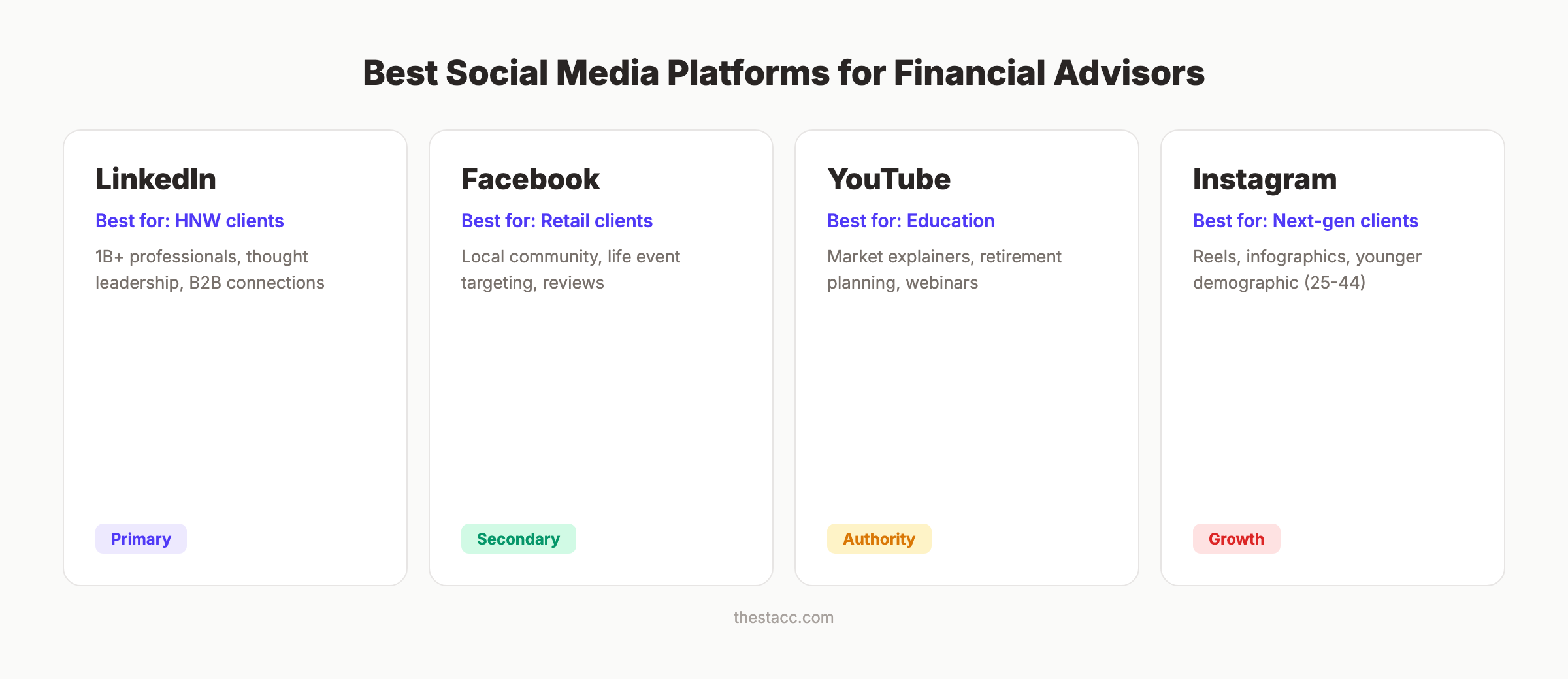
Not every platform deserves your time. Focus on the 2 to 3 platforms where your ideal clients spend time. A wealth manager targeting executives needs a different strategy than a planner targeting young families.
LinkedIn: Best for High-Net-Worth Clients
LinkedIn is the primary platform for financial advisors. Nearly 50% of high-net-worth individuals use LinkedIn, and over half log in every week. 68% of advisors now invest in LinkedIn as a marketing tool.
- 1 billion+ professionals. Your HNW prospects are already there.
- Thought leadership content builds credibility with decision-makers.
- Connection targeting lets you reach CEOs, business owners, and executives directly.
- LinkedIn articles rank in Google search results, extending your visibility.
Financial advisors who generate original content on LinkedIn are 22 percentage points more likely to succeed on the platform. This is your highest-ROI channel for client acquisition. We cover LinkedIn strategy in detail below.
Facebook: Best for Retail and Local Clients
Facebook reaches the broadest demographic for retail financial planning. It is the strongest platform for advisors serving local communities and family clients.
- 3 billion monthly active users. Your local prospects are already active.
- Life event targeting. Facebook ads let you target people who recently retired, inherited money, or changed jobs.
- Local community groups. “Recommendations” posts in neighborhood groups generate warm referrals.
- Facebook Business Page reviews build social proof that appears in Google search.
Set up a Facebook Business Page with your credentials, certifications, and a clear “Book a Consultation” CTA. Join 5 to 10 local community groups. When someone asks “Does anyone know a good financial advisor?”, respond with your credentials and a link to your reviews.
YouTube: Best for Educational Content
Financial topics are complex. YouTube lets you explain retirement planning, tax strategies, and market trends in depth. A 5-minute video on “How to maximize your 401(k) contributions in 2026” ranks in Google video results and builds trust for months.
- Long-form education positions you as an authority.
- Webinar recordings extend the value of live events.
- Market commentary videos attract prospects researching specific topics.
- YouTube Shorts (under 60 seconds) reach new audiences through the algorithm.
Instagram: Best for Next-Generation Clients
Instagram reaches younger professionals and first-time investors (ages 25 to 44). 23% of Gen Z adults will not even consider an advisor without a social media presence.
- Reels (short videos under 90 seconds) reach 3 to 5x more people than static posts.
- Infographic carousels (“5 retirement mistakes to avoid in your 30s”) get saved and shared.
- Stories keep you visible daily without polished production.
- Behind-the-scenes content humanizes your practice.
X/Twitter: Best for Market Commentary
X works for real-time market commentary and connecting with financial media. It is not a primary lead generation channel, but it builds visibility among peers and journalists.
Platform Priority
Pick 2 platforms. LinkedIn + Facebook is the best combination for most advisors. Add YouTube if you are comfortable on camera. Add Instagram if your target market skews under 45.
Your SEO team. $99/month. 30 optimized articles published automatically. Social media posts included at $49/mo. Start for $1 →
The 80/20 Content Rule for Financial Advisors
Most advisors post market recaps exclusively. “Markets were up this week” repeated 4 times gets zero engagement. The 80/20 rule works better: 80% value-driven content, 20% promotional.
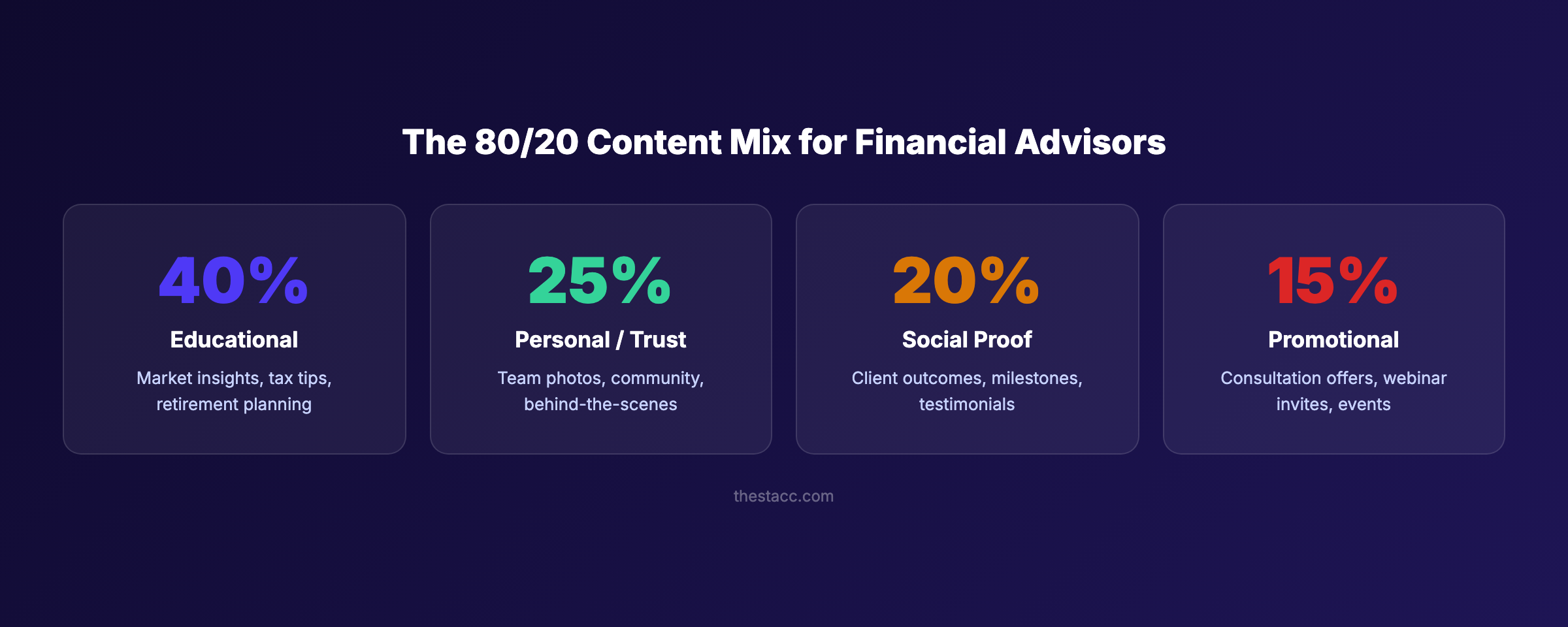
Educational Content (40% of Posts)
Answer the questions your clients ask every day:
- “How much should I save for retirement by age 40?”
- “Roth IRA vs traditional IRA: which is better for you?”
- “3 tax deductions most small business owners miss”
- “What does a financial advisor actually do?”
- “How to build an emergency fund in 6 months”
Keep posts under 150 words. Use simple language. Avoid jargon. Financial planning is confusing enough. Your job on social media is to make it clear.
Short-form video works best for educational content. A 60-second Reel explaining one concept builds more trust than a 500-word text post. Film on your phone. Speak naturally. Polished production is not required.
Personal and Trust-Building Content (25% of Posts)
People hand their life savings to people they trust. Show the human side of your practice:
- Team photos and introductions
- Local event sponsorships and community involvement
- Office celebrations and firm milestones
- Volunteer work and charity partnerships
- Personal stories about why you became an advisor
A photo of your team at a local charity event builds more connection than 10 posts about the S&P 500. Prospects want to know their advisor cares about the same community they live in.
Social Proof (20% of Posts)
Share evidence that clients trust you:
- Client outcome stories (anonymized, with permission and compliance approval)
- Google review screenshots with a “thank you” caption
- Firm milestones (“20 years serving Denver families”)
- Awards, certifications, or industry recognitions (CFP, CFA, ChFC designations)
- Media mentions or speaking engagements
Under the SEC marketing rule that took effect in November 2022, advisors can now use client testimonials with proper disclosures. Disclose whether the person is a client and whether they received compensation for their testimonial. Check with your compliance team before posting any testimonial content.
Promotional Content (15% of Posts)
Limit direct sales pitches to 15% or less. Save promotions for moments that matter:
- “Open enrollment ends December 15. Let us review your benefits elections.”
- “Tax season is here. Book a free 15-minute tax planning review.”
- “Hosting a retirement planning webinar next Thursday. Register free.”
- “New job? Your first 90 days are the best time to set up your 401(k) correctly.”
Every promotional post needs a clear CTA: booking link, phone number, or “DM us.”
Weekly Posting Schedule for Financial Advisors
Consistency matters more than frequency. 4 posts per week on a predictable schedule outperforms random daily posting.
Monday: Market Insight
Share one timely observation about the markets, economy, or financial planning. Keep it specific and actionable.
Example: “The Fed held rates steady last week. If you are sitting on a money market earning 5.2%, this is a good time to review whether a CD ladder or short-term bonds offer better returns for your situation.”
Wednesday: Educational Tip
Teach one practical concept. Make it useful for someone who is not a financial expert.
Example: “Most people do not know that HSA contributions are triple tax-advantaged: tax-deductible going in, tax-free growth, and tax-free withdrawals for medical expenses. If you have a high-deductible health plan, maxing your HSA should come before extra 401(k) contributions.”
Thursday: Client Story or Social Proof
Share a positive outcome. Anonymize details and get compliance approval.
Example: “A couple came to us 5 years ago with 6 different retirement accounts and no clear plan. We consolidated everything, set up automatic rebalancing, and built a withdrawal strategy. They retired on schedule last month. Sometimes the biggest value an advisor adds is clarity.”
Saturday: Seasonal or Life-Event Post
Tie content to relevant seasons, life events, or financial milestones.
Example: “Getting married this spring? Congratulations. Here are 3 financial conversations to have before the wedding: combining accounts vs keeping them separate, updating beneficiaries, and reviewing insurance coverage.”
Scaling to Daily Posting
Add these if you want to post more often:
- Tuesday: Industry news or regulation update
- Friday: FAQ video (“This week’s question: Should I pay off my mortgage early?”)
- Sunday: Personal reflection or book recommendation
For social media automation tools to schedule posts in advance, see our guide.
LinkedIn Strategy for Financial Advisors
LinkedIn deserves its own section. It is where 67% of advisor-to-client conversions happen. Here is how to use it effectively.
Profile Optimization
Your LinkedIn profile is your digital business card. Optimize every element:
- Headline: Do not use your job title alone. Use a value statement. “Helping tech executives build retirement income plans” beats “Vice President, Wealth Management.”
- Banner image: Custom banner with your firm name, credentials, and a booking link.
- About section: Write 3 paragraphs. Who you help. What problems you solve. How to reach you. Include your CFP, CFA, or other designations.
- Featured section: Pin your best article, a webinar recording, or a client resource.
- Experience: List specific outcomes, not job descriptions.
Content Types That Work
Not all LinkedIn content performs equally for advisors:
- Text posts with a personal story (highest engagement). “A client called me panicking about the market drop. Here is what I told them…”
- Carousel documents (how-to breakdowns). “5 Steps to Evaluate Your 401(k) Options”
- Short videos (under 2 minutes). Market commentary or concept explanations.
- LinkedIn articles (long-form, 800 to 1,500 words). Deep dives on tax planning, estate planning, or retirement strategies. These rank in Google.
- Polls (conversation starters). “What is your biggest financial concern right now?”
Connection Strategy
Do not send cold connection requests with a sales pitch. That approach destroys trust instantly.
- Identify your ideal client profile. Job title, company size, industry, location.
- Engage with their content first. Comment thoughtfully on 3 to 5 of their posts.
- Send a personalized connection request. Reference something specific. “Enjoyed your post about scaling your dental practice. I work with several practice owners on retirement planning.”
- Share value after connecting. Send a relevant article or resource. Do not pitch.
- Let the relationship develop. Most LinkedIn connections take 3 to 6 months to convert.
LinkedIn Articles vs Posts
Posts get more immediate engagement. Articles get more long-term search visibility. Use both.
Post 3 to 4 times per week. Publish 1 to 2 articles per month on deeper topics. Articles about “How business owners can reduce their tax burden” or “Estate planning mistakes to avoid” attract prospects through Google search for months.
Building E-E-A-T signals on LinkedIn strengthens your authority across all search engines. Your LinkedIn content feeds your overall content marketing strategy.
Compliance: FINRA, SEC, and State Rules
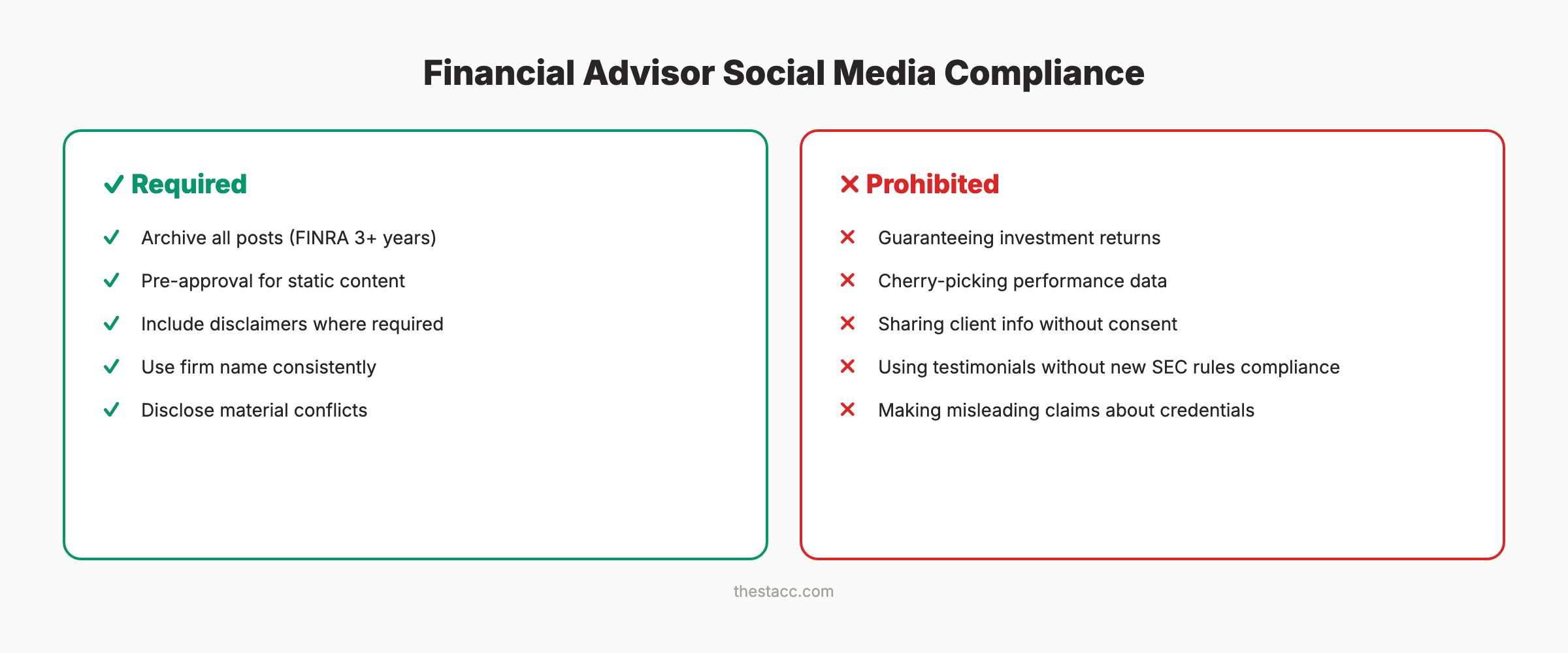
This is the section most guides skip. Financial advisor social media is regulated by FINRA, the SEC, and state regulators. Ignoring compliance can result in fines, suspension, or termination.
FINRA Rules for Broker-Dealers
FINRA Rule 2210 governs all communications with the public, including social media. Key requirements:
- Fair and balanced. Every post must present a fair picture. Do not omit material information.
- No misleading claims. Do not exaggerate results, predict performance, or make promissory statements.
- Pre-approval for static content. Blog posts, pre-written social media posts, and articles must be reviewed by a registered principal before publishing.
- Interactive content supervision. Real-time posts (comments, replies, live videos) do not require pre-approval but must be supervised by the firm.
- Recordkeeping. Archive all social media communications for at least 3 years. The requirement applies to the content, not the platform.
SEC Marketing Rule (Effective November 2022)
The SEC marketing rule changed how advisors can use testimonials and endorsements:
- Testimonials are now permitted with proper disclosures. You must disclose whether the person is a client, whether they were compensated, and any material conflicts of interest.
- Endorsements from non-clients are allowed with similar disclosures.
- Performance advertising must include specific disclosures and cannot cherry-pick favorable time periods.
- Hypothetical performance requires additional policies and disclosures.
What You Must Do
- Archive every post. FINRA requires 3+ years of records. Use a compliance archiving tool (Smarsh, Global Relay, or Hearsay).
- Get pre-approval for any static content: articles, scheduled posts, and pre-written responses.
- Include disclaimers where required. At minimum: “Investing involves risk. Past performance does not guarantee future results.”
- Use your firm name consistently across all platforms.
- Disclose material conflicts in any post that references specific products or strategies.
What You Must Not Do
- Do not guarantee returns. “We will double your money” or “Guaranteed 10% annual returns” violates FINRA and SEC rules.
- Do not cherry-pick performance. Showing only your best-performing accounts or time periods is misleading.
- Do not share client information without written consent. Even anonymized stories should be reviewed by compliance.
- Do not use testimonials without following the new SEC marketing rule requirements.
- Do not make misleading credential claims. Accurately represent your designations and licenses.
Practical Compliance Workflow
Build compliance into your content process, not around it:
- Batch-create content for the month. Write all posts in a document.
- Submit for pre-approval to your compliance officer or broker-dealer.
- Archive approved content before scheduling.
- Schedule posts using a compliance-friendly tool.
- Monitor comments daily and document any interactive communications.
- Quarterly review of all social media activity with your compliance team.
Compliance does not have to kill your social media presence. Educational content, community posts, and market commentary rarely trigger compliance issues. Performance claims and product-specific guarantees do.
Rank everywhere. Do nothing. Blog SEO, Local SEO, and Social on autopilot. Stacc starts at $49/mo. Start for $1 →
Turning Followers Into Clients
Followers do not pay advisory fees. Booked consultations do. Here is how to convert social media activity into revenue.
Optimize Every Profile for Lead Capture
Every social media profile needs:
- Phone number (tap-to-call on mobile)
- “Book a Consultation” link in your bio
- Office location and service area
- Credentials and designations (CFP, CFA, ChFC)
- Firm name and disclosure
Your Google Business Profile should match your social media information exactly. Consistency builds trust with both prospects and search engines.
Lead Magnets That Convert
Give prospects a reason to share their contact information:
- Retirement readiness calculator. Embed on your website. Promote on social media. Collect email addresses.
- Tax planning checklist (PDF download). “Download our 2026 year-end tax planning checklist.”
- Free webinar. “Retirement Planning for Business Owners: Live Q&A This Thursday.”
- Portfolio review offer. “Get a free second opinion on your current investment allocation.”
A lead magnet promoted in your social media bio generates leads 24 hours a day, 7 days a week. Update it quarterly to stay relevant.
Webinar Funnels
Webinars are the highest-converting lead generation tactic for financial advisors:
- Promote the webinar across LinkedIn, Facebook, and email for 2 weeks.
- Host a 30-minute session on a specific topic. “How to Plan for Retirement If You Started Late.”
- Include a Q&A segment. Live questions build trust and reveal prospect concerns.
- Follow up within 24 hours. Send the recording, a summary, and a consultation offer.
- Nurture non-converters with a monthly email sequence.
A single webinar with 50 attendees can generate 5 to 10 consultation requests. That is a 10 to 20% conversion rate from one event.
Response Speed
A prospect who comments “How do I roll over my 401(k)?” or DMs “Do you work with clients in my area?” is a warm lead. Respond within 1 hour. After 4 hours, the prospect contacts a competitor. Speed wins.
Set mobile notifications for all business messages. If you have staff, assign social media response to a specific team member during business hours.
Nurture With Content
Not every prospect is ready to book a consultation today. Stay visible:
- Repurpose your blog content into social media posts.
- Share client success stories monthly.
- Send a weekly email newsletter with your best social media content.
- Post consistently so your name appears in their feed every week.
The average prospect interacts with 7 to 13 pieces of content before contacting an advisor. Social media fills that pipeline.
Paid Social Advertising for Financial Advisors
Organic reach builds long-term presence. Paid ads generate immediate leads.
LinkedIn Ads for HNW Client Targeting
LinkedIn is the most effective paid channel for targeting high-net-worth prospects. The cost per click is higher ($5 to $15), but the client lifetime value justifies it.
| Ad Type | Best For | Budget | Targeting |
|---|---|---|---|
| Sponsored Content | Thought leadership reach | $20-$50/day | Job title, company size, industry |
| Lead Gen Forms | Consultation requests | $25-$60/day | C-suite, VP+, business owners |
| Message Ads | Direct outreach | $15-$30/day | Specific job titles in target geography |
| Video Ads | Brand awareness | $15-$40/day | Broad professional audience |
Target by job title (CEO, CFO, VP of Finance), company size (50+ employees), and industry. One closed HNW client from LinkedIn can justify 12 months of ad spend.
Facebook Life Event Targeting
Facebook allows you to target people based on life events. These are peak financial planning moments:
| Life Event | Financial Need | Ad Message |
|---|---|---|
| Recently retired | Retirement income plan | ”Just retired? Let us help you build a withdrawal strategy.” |
| Recently inherited | Estate and tax planning | ”Received an inheritance? A plan protects it.” |
| New job | 401(k) rollover, benefits | ”New job? Do not leave your old 401(k) behind.” |
| Recently married | Financial planning, insurance | ”Congratulations. Here are 3 money moves for newlyweds.” |
| New baby | College savings, life insurance | ”Growing family? A 529 plan starts at $25/month.” |
Life event targeting converts 3 to 5x better than interest-based targeting because you reach people at the moment they need advice.
Budget Guidelines
| Firm Size | Monthly Ad Budget | Expected Leads | Platform Split |
|---|---|---|---|
| Solo advisor | $500-$1,000 | 10-25 leads | 70% LinkedIn, 30% Facebook |
| Small RIA (2-5 advisors) | $1,000-$3,000 | 25-75 leads | 60% LinkedIn, 40% Facebook |
| Mid-size firm (6-20) | $3,000-$8,000 | 75-200 leads | 50% LinkedIn, 30% Facebook, 20% YouTube |
| Large firm (20+) | $8,000+ | 200+ leads | Split across all platforms |
Track every campaign with cost per lead, cost per consultation, and cost per new client. Target a cost per lead under $50 for retail clients and under $150 for HNW prospects.
Common Mistakes Financial Advisors Make on Social Media
Only Posting Market Recaps
“The S&P 500 was up 1.2% this week” adds zero value. Everyone already knows. Add your perspective. Explain what it means for your clients. Tie it to a specific action they should consider. Commentary is valuable. Recaps are noise.
Ignoring Compliance Archiving
Every social media post must be archived. FINRA requires 3+ years of records. Deleting a post does not erase the compliance obligation. Use an automated archiving tool. Manual tracking is unreliable and will fail an audit.
Posting Generic Content
Carrier-provided graphics and generic “Happy National Financial Planning Month” posts do not differentiate you. Create original content that reflects your expertise and personality. A 60-second phone video of you explaining a tax tip outperforms a generic graphic every time.
Not Engaging With Comments
Social media is a 2-way channel. Posting without responding to comments tells your audience you do not care about conversation. Reply to every comment. Ask follow-up questions. Start discussions. The algorithm rewards engagement.
Avoiding Video
Video builds trust faster than any other content format. Prospects see your face, hear your voice, and develop familiarity before they ever meet you. You do not need professional production. A well-lit phone video with clear audio is enough. Start with 60-second tips and scale from there.
Trying to Be on Every Platform
Posting inconsistently across 5 platforms is worse than posting consistently on 2. Pick LinkedIn and one other platform. Master those before expanding. Consistency on 2 platforms beats sporadic activity across 5.
For a broader local SEO strategy that combines social media with Google Business Profile optimization, see our dedicated guide. Strong Google reviews and an optimized Google Business Profile amplify everything you do on social media.
FAQ
What is the best social media platform for financial advisors?
LinkedIn is the best overall platform for financial advisors. 67% of advisor-to-client conversions happen on LinkedIn. Nearly 50% of high-net-worth individuals use the platform weekly. Facebook is the best secondary platform for advisors targeting local and retail clients. Most advisors should focus on LinkedIn + Facebook and add YouTube or Instagram based on their target demographic.
How often should financial advisors post on social media?
Post 3 to 4 times per week on a consistent schedule. Monday market insight, Wednesday educational tip, Thursday client story, and Saturday seasonal content is an effective pattern. Consistency matters more than frequency. 4 posts per week every week beats daily posting followed by weeks of silence.
What should financial advisors post on social media?
Follow the 80/20 rule: 80% value-driven content (educational tips, personal stories, client outcomes) and 20% promotional content (consultation offers, webinar invites). The biggest mistake advisors make is posting only market recaps or only promotional content. Mix educational, personal, social proof, and promotional posts for the best engagement.
Is social media worth it for financial advisors?
Yes. 4 in 10 advisors acquired new clients through social media last year. Advisors with a defined social media strategy converted leads at 57%, compared to 36% without one. 23% of Gen Z adults will not consider an advisor without a social media presence. The question is not whether to use social media. It is how to use it effectively.
How do financial advisors stay compliant on social media?
Archive all posts for at least 3 years (FINRA requirement). Get pre-approval for static content from your compliance officer or broker-dealer principal. Include disclaimers where required. Do not guarantee returns. Do not cherry-pick performance data. Do not share client information without consent. Educational and community content rarely triggers compliance issues. Product-specific claims and performance data require extra scrutiny.
Can financial advisors use client testimonials on social media?
Yes, with conditions. The SEC marketing rule (effective November 2022) permits testimonials and endorsements with proper disclosures. You must disclose whether the person is a client, whether they received compensation, and any material conflicts of interest. Check with your compliance team before posting any testimonial content. FINRA-registered advisors have additional requirements through their broker-dealer.
Social media for financial advisors works when you stop treating it like a compliance burden and start treating it like a trust-building tool. Show up consistently. Educate more than you sell. Respond quickly. The advisors growing their practice fastest are the ones their community sees every week in their feed, not the ones hiding behind a firm logo.
45% of consumers who already have a financial advisor still use social media to learn more about financial planning. Your existing clients are watching. Your future clients are searching. Be visible where they are.
3,500+ blogs published. 92% average SEO score. See what Stacc can do for your advisory firm. Start for $1 →
Written and published by Stacc. We publish 3,500+ articles per month across 70+ industries. All data verified against public sources as of March 2026.