Veterinary SEO: The Complete Guide (2026)
The complete veterinary SEO guide. Local SEO, GBP optimization, keyword data, content strategy, and reviews for vet clinics. With real stats. Updated 2026.
Siddharth Gangal • 2026-03-28 • Local SEO
In This Article
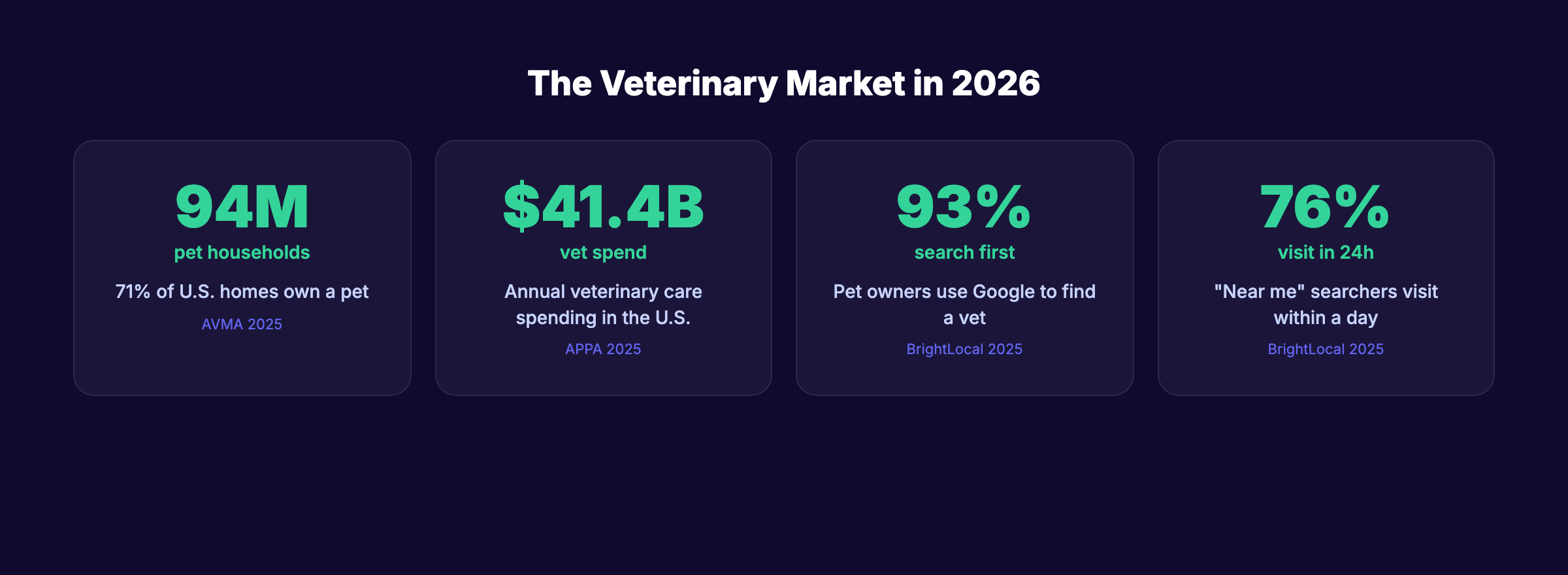
Veterinary SEO is the fastest way to fill your appointment book without spending $5 to $10 per click on Google Ads. 93% of pet owners use Google to find their nearest clinic. The practice that ranks first wins the appointment.
The U.S. veterinary services market reached $42.81 billion in 2025 and is growing at 6.11% per year. Pet ownership hit 94 million households. That is 71% of all American homes with at least one pet, according to AVMA data. Demand is enormous. But 38% of patients never return after their first appointment. Ranking on Google matters for acquisition. Staying there matters for retention.
This guide covers every aspect of veterinary SEO. Local search, Google Business Profile, keywords specific to vet clinics, content that pet owners actually search for, and review management that builds trust.
We have published 3,500+ SEO articles across 70+ industries, including veterinary clinics, animal hospitals, and specialty practices. This guide reflects what ranks right now.
Here is what you will learn:
- Why veterinary practices need SEO (with real ROI numbers)
- How to dominate the local 3-pack for “[service] vet near me” searches
- The exact keywords pet owners search when looking for a vet
- How to create content that ranks for competitive pet health terms
- Why reviews are the single most important ranking signal for vets
Why Veterinary Practices Need SEO
46% of all Google searches have local intent. For veterinary clinics, the number is higher. Nobody drives an hour for a vet visit. Pet owners search locally, pick from the top 3 results, and call.
The clinics that rank in Google’s local 3-pack capture most of those calls. 42% of local searchers click on Map Pack results. That is free traffic that paid ads cannot match at scale.
The Cost of Ignoring SEO
| Channel | Cost Per Lead | Monthly Budget | Compounding? |
|---|---|---|---|
| Google Ads | $5-$10 per click | $1,000-$3,000/mo | No (stops when you stop paying) |
| Social media ads | $3-$8 per click | $500-$2,000/mo | No |
| SEO (organic) | $0.50-$2 per lead (after 6 months) | $99-$500/mo | Yes (every post builds on the last) |
| Referral programs | Low | Staff time | Somewhat |
Paid ads stop the moment you stop paying. SEO compounds. Every blog post, every review, and every GBP update builds authority that keeps working months and years after publication.
The Veterinary Market Opportunity
The numbers tell the story:
- 94 million U.S. pet-owning households (71% of all homes)
- $41.4 billion spent on veterinary care in 2025
- 87.3 million dogs and 73.8 million cats in the U.S.
- Gen Z pet ownership surged 43.5% from 2023 to 2024
- Millennials represent 30% of all pet-owning households
Younger pet owners search online first. They do not ask their parents for a vet recommendation. They Google it. If your practice does not rank, you are invisible to the fastest-growing segment of pet owners.
Your SEO team. $99 per month. 30 optimized articles published automatically. Built for local service businesses like veterinary clinics. Start for $1 →
Local SEO for Veterinary Clinics
Local SEO determines whether your clinic appears in the Google Map Pack when someone searches “vet near me.” 76% of “near me” searchers visit a business within 24 hours. For emergency vet searches, that window shrinks to minutes.
The 3 Local Ranking Factors
Google ranks local results on 3 factors:
- Relevance — Does your listing match the search? Correct categories, complete services list, detailed description.
- Distance — How close is your clinic to the searcher? Fixed by your physical location.
- Prominence — How well-known is your business online? Reviews, citations, backlinks, and website authority.
You cannot change your location. But you control relevance and prominence entirely through SEO.
Citations and NAP Consistency
Every online listing of your clinic must show the exact same Name, Address, and Phone number. “Happy Paws Veterinary Clinic” on Google and “Happy Paws Vet” on Yelp creates a mismatch that confuses Google’s algorithm.
Build citations on these platforms:
- Google Business Profile
- Bing Places for Business
- Yelp (critical for vet discovery)
- AVMA Find a Vet directory
- VetFinder / PetMD Find a Vet
- Better Business Bureau
- Facebook business page
- Apple Maps
- Nextdoor (high-intent local platform)
- Local Chamber of Commerce
Audit your current citations with our SEO audit tool to find and fix inconsistencies.
Multi-Location Vet SEO
Corporate groups now employ about 40% of practicing veterinarians. If your practice has multiple locations, each one needs its own Google Business Profile, its own location page on your website, and its own citation strategy. Do not point all locations to the same homepage.
For our complete guide to ranking locally, see our local SEO guide.
Google Business Profile for Veterinarians
Your Google Business Profile is the single most important digital asset for a veterinary clinic. Optimized profiles get 2.7x more engagement than incomplete ones.
Complete Every Field
| Field | What to Enter | Why It Matters |
|---|---|---|
| Business name | Exact legal name (no keyword stuffing) | Google penalizes modified names |
| Primary category | ”Veterinarian” or “Animal Hospital” | Determines which searches trigger your listing |
| Secondary categories | Emergency Veterinarian, Pet Boarding, Pet Groomer (if applicable) | Captures additional search types |
| Services | Every service with a description: wellness exams, vaccinations, dental, surgery, boarding | Services appear in search results |
| Service area | Every city and zip code you serve | Expands geographic reach |
| Business hours | Include holiday and emergency hours | Prevents frustrated callers |
| Description | 750 characters. Lead with services + location. | Helps Google match your listing to searches |
| Attributes | Wheelchair accessible, appointment required, online scheduling | Displays in listing and filters |
GBP Posts for Vet Clinics
Post 2 to 3 times per week. GBP posting signals activity and relevance to Google.
Post ideas veterinary clinics should rotate:
| Post Type | Example | Frequency |
|---|---|---|
| Pet health tips | ”3 signs your dog needs a dental cleaning” | 2x/week |
| Seasonal alerts | ”Tick season peaks in April. Here is how to protect your pet.” | Monthly |
| Team spotlights | ”Meet Dr. Sarah, our new feline specialist” | Monthly |
| Promotions | ”Free wellness exam for new clients this month” | Bi-weekly |
| Community | ”We donated 50 spay/neuter procedures to [Local Shelter]“ | Monthly |
Photos That Drive Engagement
Upload photos of your facility, team, and happy patients (with owner permission). Clinics with 100+ photos see dramatically more calls and direction requests. Add new photos every month. Include exam rooms, waiting areas, the surgical suite, and outdoor spaces.
3,500+ blogs published. 92% average SEO score. Every article passes a 40-point quality audit before it goes live. Start for $1 →
Keyword Strategy for Veterinary SEO
Most vet clinics target generic terms like “veterinarian” or “vet near me.” Those terms have value. But the real wins come from long-tail keywords that match specific services and conditions pet owners search for.
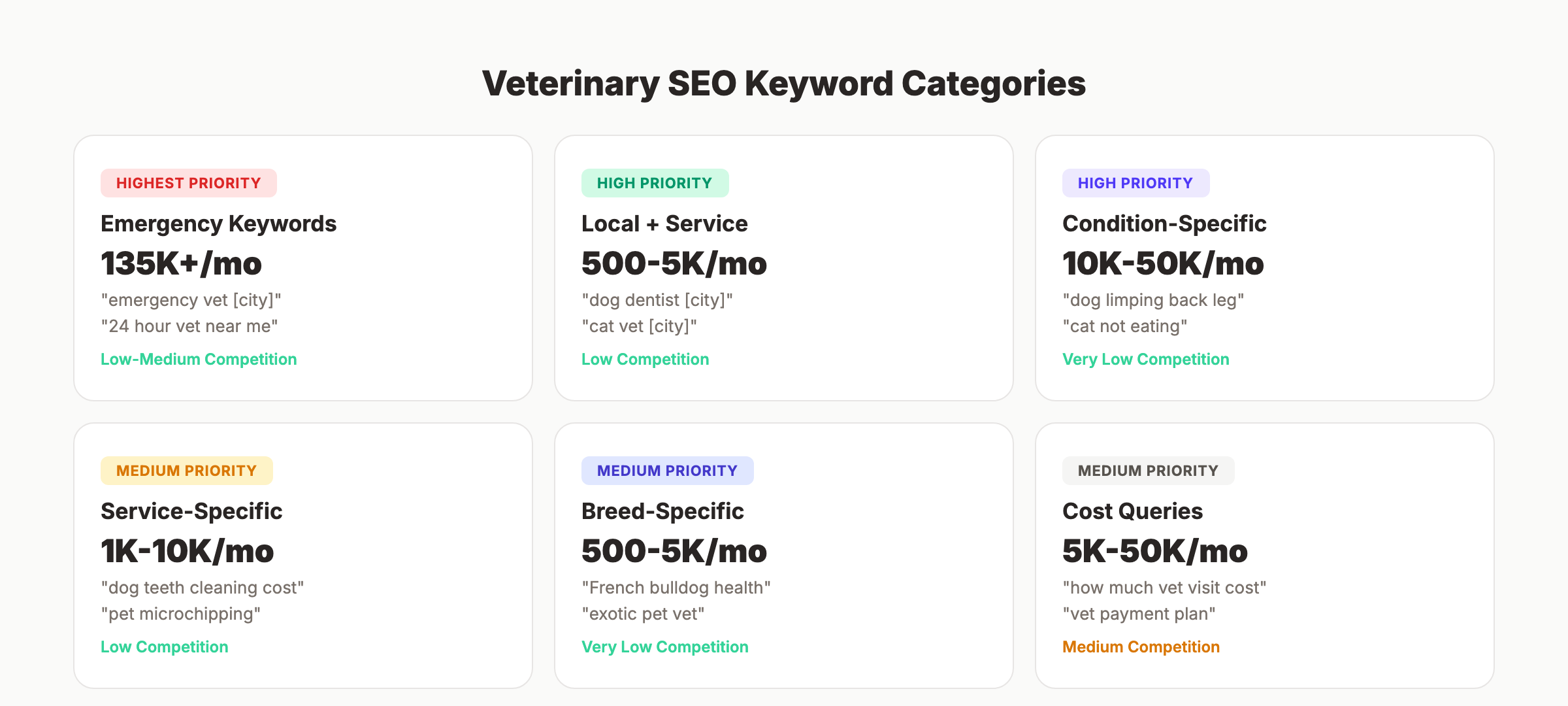
The Veterinary Keyword Map
| Keyword Category | Examples | Volume | Competition | Priority |
|---|---|---|---|---|
| Emergency | ”emergency vet [city],” “24 hour vet near me” | 135K+/mo | Low-Medium | Highest |
| Local + service | ”dog dentist [city],” “cat vet [city]“ | 500-5K/mo | Low | High |
| Condition-specific | ”dog limping back leg,” “cat not eating” | 10K-50K/mo | Very low | High |
| Service-specific | ”dog teeth cleaning cost,” “pet microchipping near me” | 1K-10K/mo | Low | Medium |
| Breed-specific | ”best vet for French bulldogs,” “exotic pet vet near me” | 500-5K/mo | Very low | Medium |
| Cost queries | ”how much does a vet visit cost,” “vet payment plan” | 5K-50K/mo | Medium | Medium |
High-Intent Keywords to Target First
Focus your keyword research on terms where the searcher needs a vet now:
- “emergency vet [city]” (135,000 monthly searches nationally)
- “vet near me open now”
- “[service] for dogs near me” (dental, spay, neuter, vaccinations)
- “veterinary clinic [city]” (246,000 monthly searches for “near me” variants)
- “exotic pet vet [city]” (60,500 monthly searches)
These searches have immediate intent. The person searching “emergency vet near me” at 11 PM is calling the first result they see.
Content Keywords That Build Authority
For blog content, target questions pet owners search before and after vet visits:
- “how often should I take my dog to the vet”
- “what vaccines does my puppy need”
- “is [food/plant] toxic to dogs”
- “why is my cat throwing up”
- “how much does [procedure] cost for a dog”
Each of these becomes a blog post that builds topical authority around veterinary care topics. Google starts treating your site as a trusted source on pet health, which lifts rankings across all your pages.
Content That Ranks for Veterinary Topics
Pet health content is categorized as YMYL (Your Money or Your Life) by Google. Bad veterinary advice can harm animals. Google holds YMYL content to higher quality standards, which means your content needs strong expertise signals.
E-E-A-T for Veterinary Content
| Signal | What It Means for Vet Clinics |
|---|---|
| Experience | Show you treat real animals. Use case examples, post-treatment photos, patient stories. |
| Expertise | Display DVM credentials, board certifications, specialty training. Author bios on every blog post. |
| Authoritativeness | Get listed on AVMA directories. Earn links from pet health publications. |
| Trustworthiness | Show reviews, transparent pricing, contact info on every page. HTTPS required. |
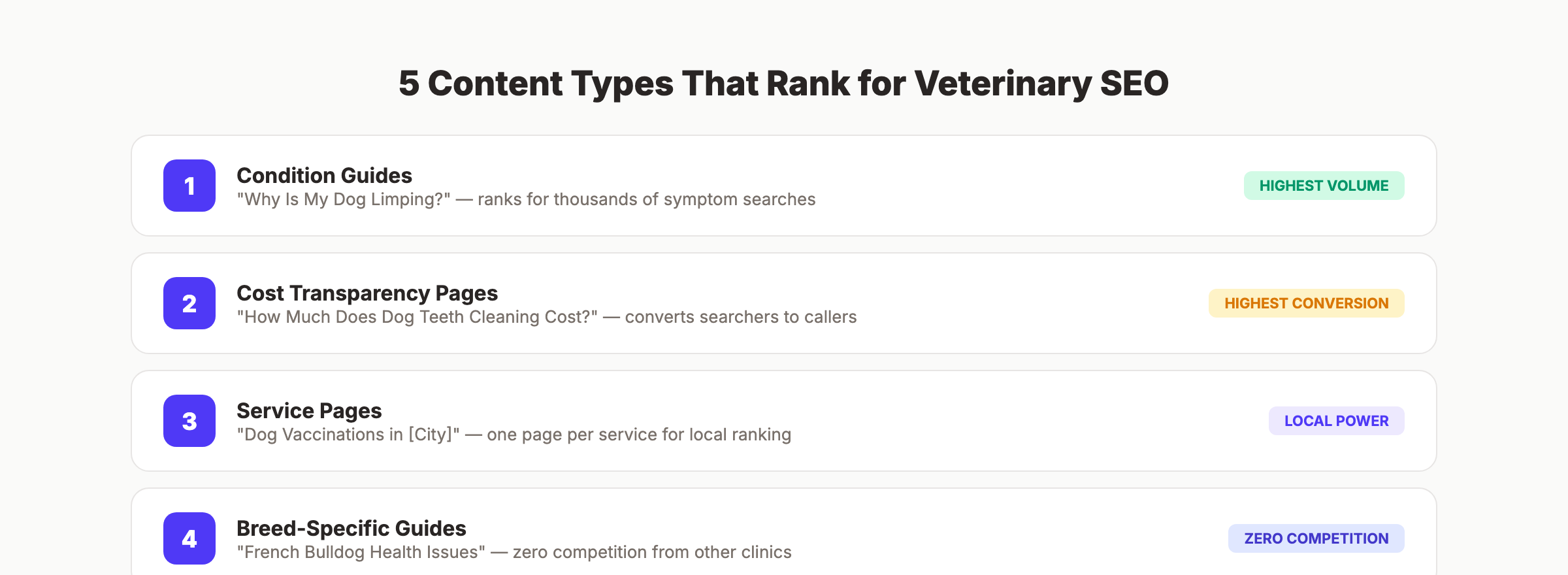
5 Content Types That Work for Vet SEO
1. Condition guides (highest volume) “Why Is My Dog Limping? 7 Causes and What to Do” — These rank for thousands of symptom-related searches. Write one per common condition.
2. Cost transparency pages (highest conversion) “How Much Does Dog Teeth Cleaning Cost in [City]?” — Pet owners search costs before calling. Be the practice that answers honestly.
3. Service pages (local ranking power) One dedicated page per service. “Dog Vaccinations in [City]” ranks better than a generic “Services” page that lists everything.
4. Breed-specific care guides (zero competition) “French Bulldog Health Issues: What Every Owner Should Know” — Breed-specific content attracts dedicated pet owners with zero competition from other vet clinics.
5. Seasonal pet safety content (timely traffic spikes) “4th of July Fireworks: How to Keep Your Dog Calm” — Seasonal content captures massive search spikes at predictable times each year.
Publishing Frequency
Consistency beats intensity. Clinics that publish 4 or more blog posts per month build topical authority faster than those publishing once per month. A regular content calendar ensures steady output without last-minute scrambling.
Rank everywhere. Do nothing. Blog SEO, Local SEO, and Social on autopilot. Stacc starts at $99 per month with a $1 trial. Start for $1 →
On-Page SEO for Veterinary Websites
Most veterinary websites fail basic on-page SEO checks. Common problems include missing title tags, no H1 structure, images without alt text, and page load times over 5 seconds.
The Veterinary On-Page Checklist
- Title tag includes service + location (under 60 characters): “Dog Vaccinations in Austin TX | Happy Paws Vet”
- Meta description is 145 to 155 characters with a clear benefit
- H1 tag matches the page’s primary topic (one per page)
- H2 tags break content into scannable sections
- Primary keyword appears in the first 100 words
- Images have descriptive alt text (“veterinarian examining golden retriever” not “IMG_4872”)
- Page loads in under 3 seconds on mobile
- URL is short and descriptive (“/dog-vaccinations-austin” not “/services?id=12”)
- Internal links connect related service and blog pages
Use our free on-page SEO checker to audit any page in seconds.
Schema Markup for Vet Clinics
Add VeterinaryCare schema to your homepage and service pages. This structured data helps Google understand your business and display rich results in search.
Key schema properties for vet clinics:
@type: VeterinaryCarename: Your clinic nameaddress: Full street addresstelephone: Main phone numberopeningHours: Business hours (include emergency hours)areaServed: Cities and zip codes you servemedicalSpecialty: Specialties (dentistry, surgery, oncology)aggregateRating: Your average review rating
Schema does not directly boost rankings. But a listing with star ratings, hours, and a phone number visible in search results gets more clicks than a plain listing. More clicks signal relevance to Google, which improves rankings indirectly.
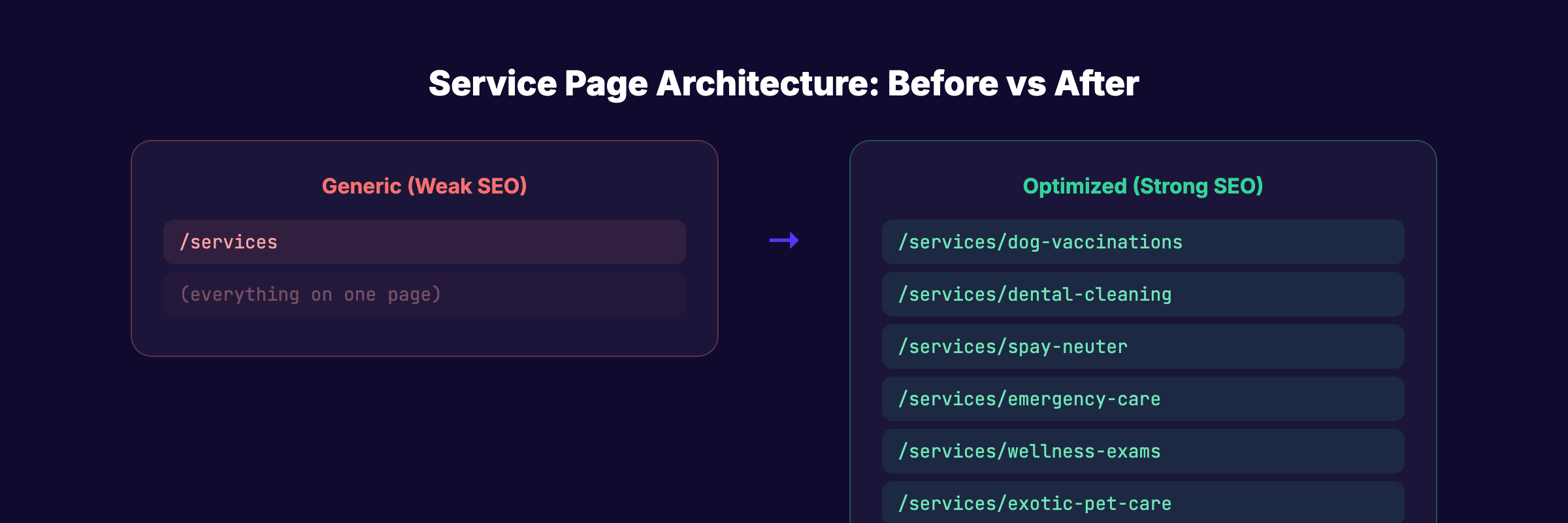
Service Page Architecture
Create one page per major service rather than listing everything on a single “Services” page:
| Instead of | Create |
|---|---|
| Generic “Services” page | /services/dog-vaccinations |
| /services/dental-cleaning | |
| /services/spay-neuter | |
| /services/emergency-care | |
| /services/wellness-exams | |
| /services/exotic-pet-care |
Each page targets a specific keyword, includes local modifiers, and links to related blog content. This architecture gives Google clear signals about what each page covers.
Reviews and Reputation for Vet Clinics
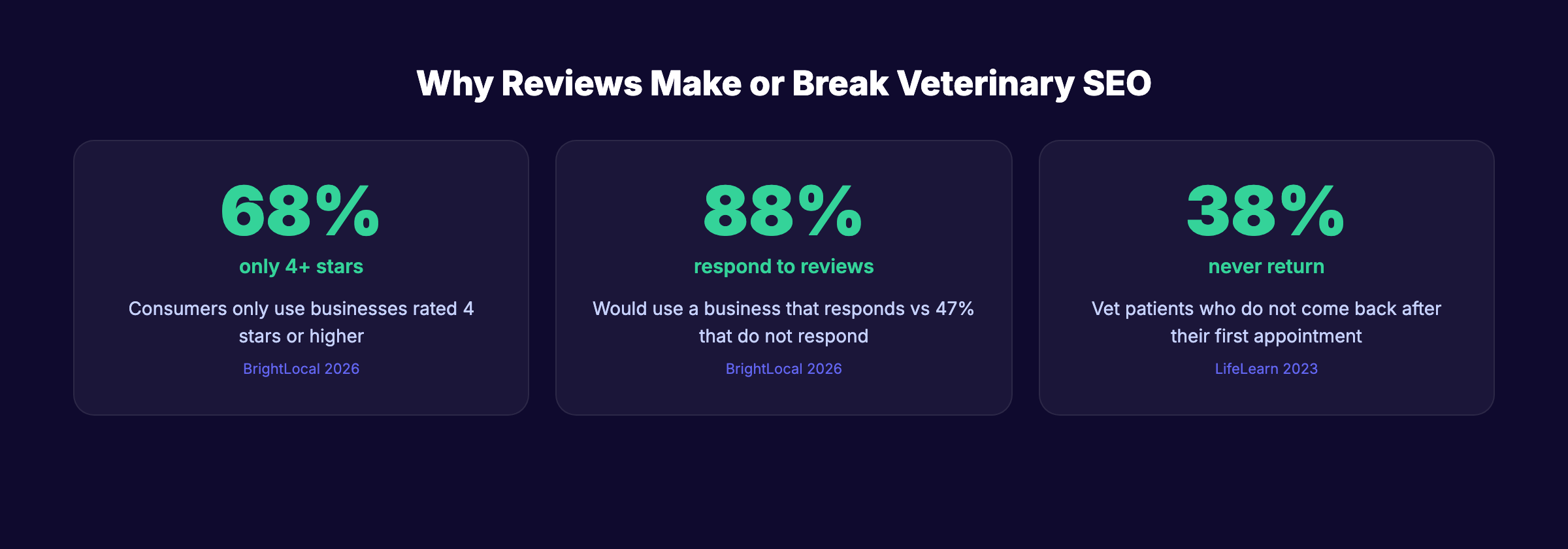
Reviews are the most influential ranking factor for veterinary local SEO. 68% of consumers only use businesses rated 4 stars or higher. For a vet clinic where pet owners trust you with their family member, that threshold matters even more.
Here is a stat that should concern every practice owner: 80% of practices rate their own service as excellent, but only 8% of clients agree. That perception gap means your reviews tell a different story than you think.
How Reviews Impact Veterinary SEO
| Review Factor | Impact |
|---|---|
| Quantity | More reviews = higher local rankings. Aim for 50+ minimum. |
| Velocity | 2 to 3 new reviews per week signals an active, healthy business |
| Rating | 4.5+ stars is the target. Below 4.0 and you lose visibility in some local features |
| Recency | Reviews from the last 90 days carry more weight than older ones |
| Response rate | 88% of consumers use businesses that respond to reviews. Only 47% use businesses that do not respond. |
The Veterinary Review System
38% of veterinary patients never return after their first appointment. A review request system helps with both SEO and retention.
Build reviews at these touchpoints:
- After every wellness visit — Send a text or email within 2 hours with a direct Google review link
- After successful treatments — When a pet recovers from surgery or illness, the owner’s gratitude is highest
- At annual checkups — Remind long-term clients to update their review
- After positive phone interactions — Front desk staff can mention reviews when a caller thanks them
For the complete playbook on generating reviews, see our guide on getting more Google reviews.
Responding to Every Review
Respond to every review within 24 to 48 hours. Thank positive reviewers by name and mention their pet. For negative reviews, acknowledge the concern, avoid discussing medical details publicly, and take the conversation offline. Our guide on responding to negative reviews covers the exact framework.
Skip the agency. Keep the results. Stacc starts at $99 per month with a $1 trial. 30 articles. Published automatically. Start for $1 →
Measuring Veterinary SEO Results
Veterinary SEO takes 3 to 6 months for measurable traction. Set expectations with your team early and track the metrics that actually matter.
The Vet Clinic SEO Dashboard
| Metric | Tool | What It Shows | Check |
|---|---|---|---|
| Organic impressions | Google Search Console | Whether Google shows your pages | Weekly |
| GBP views + actions | GBP Insights | How many people see and click your listing | Weekly |
| Keyword rankings | Ahrefs, Semrush, or GSC | Whether you rank for target vet terms | Bi-weekly |
| Website traffic | Google Analytics | Whether search visitors reach your site | Weekly |
| Phone calls | Call tracking | Whether organic traffic converts to calls | Weekly |
| New client bookings | Practice management software | Whether calls convert to appointments | Monthly |
ROI Math for Veterinary SEO
Here is the calculation for a typical small animal practice:
- Average first-visit revenue: $250 to $400
- Annual client value (2 to 3 visits plus products): $600 to $1,200
- Client lifetime value (5-year average): $3,000 to $6,000
- SEO investment: $99 to $500 per month
- New clients from organic per month (after 6 months): 5 to 15
- Average client acquisition cost through SEO: $29.18
At $3,000 lifetime value per client and 10 new clients per month from organic search, SEO generates $30,000 per month in lifetime client value. Against a $99 to $500 monthly investment, the ROI exceeds 5,000%.
Established practices should allocate 2% to 5% of gross revenue to marketing. For a practice generating $1 million per year, that is $20,000 to $50,000 annually. SEO at $99 to $500 per month uses a fraction of that budget while delivering the highest long-term return.
FAQ
Does SEO work for veterinary clinics?
Yes. 93% of pet owners use Google to find a vet. 76% of “near me” searchers visit a business within 24 hours. Veterinary SEO puts your clinic in front of pet owners at the exact moment they need you. The practices ranking in the local 3-pack capture most new client calls in their area.
How much does veterinary SEO cost?
SEO for vet clinics ranges from $99 per month for automated content services to $3,000+ per month for full-service agencies. Most independent practices see strong results between $99 and $500 per month. The key is consistent blog publishing and active Google Business Profile management. See our full SEO cost breakdown for details.
How long does veterinary SEO take to show results?
Expect initial ranking improvements within 3 to 6 months for long-tail and local keywords. Competitive terms like “vet near me” in a large city take 6 to 12 months. Google Business Profile optimization often shows results within 30 to 60 days because local rankings update faster than organic rankings.
What keywords should a veterinarian target?
Start with emergency and local keywords (“emergency vet [city],” “veterinary clinic near me”). Then target service-specific terms (“dog dental cleaning [city]”). Build authority with condition-based content (“why is my dog limping”). Avoid generic national terms where corporate chains dominate.
How do I get my vet clinic to rank on Google Maps?
Complete every field in your Google Business Profile. Choose “Veterinarian” as your primary category. Add all services with descriptions. Post 2 to 3 times per week. Collect reviews consistently (aim for 2 to 3 per week). Ensure your NAP (Name, Address, Phone) is identical across all online directories. See our GBP optimization guide for the full walkthrough.
How important are online reviews for vet clinics?
Reviews are the single most important local ranking signal for veterinary practices. 68% of consumers only use businesses rated 4+ stars. Clinics with consistent review generation (2 to 3 per week) rank higher, get more clicks, and convert more callers to appointments. Responding to every review within 48 hours doubles the impact.
The veterinary practices winning new clients in 2026 are the ones that rank where pet owners search. Every blog post, every GBP update, and every review stacks on the last. Start now and own the local search results in your market 6 to 12 months from today.
Stop writing. Start ranking. Stacc publishes 30 SEO articles per month for $99. Built for local service businesses like veterinary clinics. Start for $1 →
Written and published by Stacc. We publish 3,500+ articles per month across 70+ industries. All data verified against public sources as of March 2026.