
AI Share of Voice: The Complete Measurement Guide
Learn how to measure AI share of voice across ChatGPT, Perplexity, and Gemini. Includes a DIY audit framework, tools, and improvement strategies. Updated.
Your brand either shows up in AI-generated answers or it does not. There is no page 2.
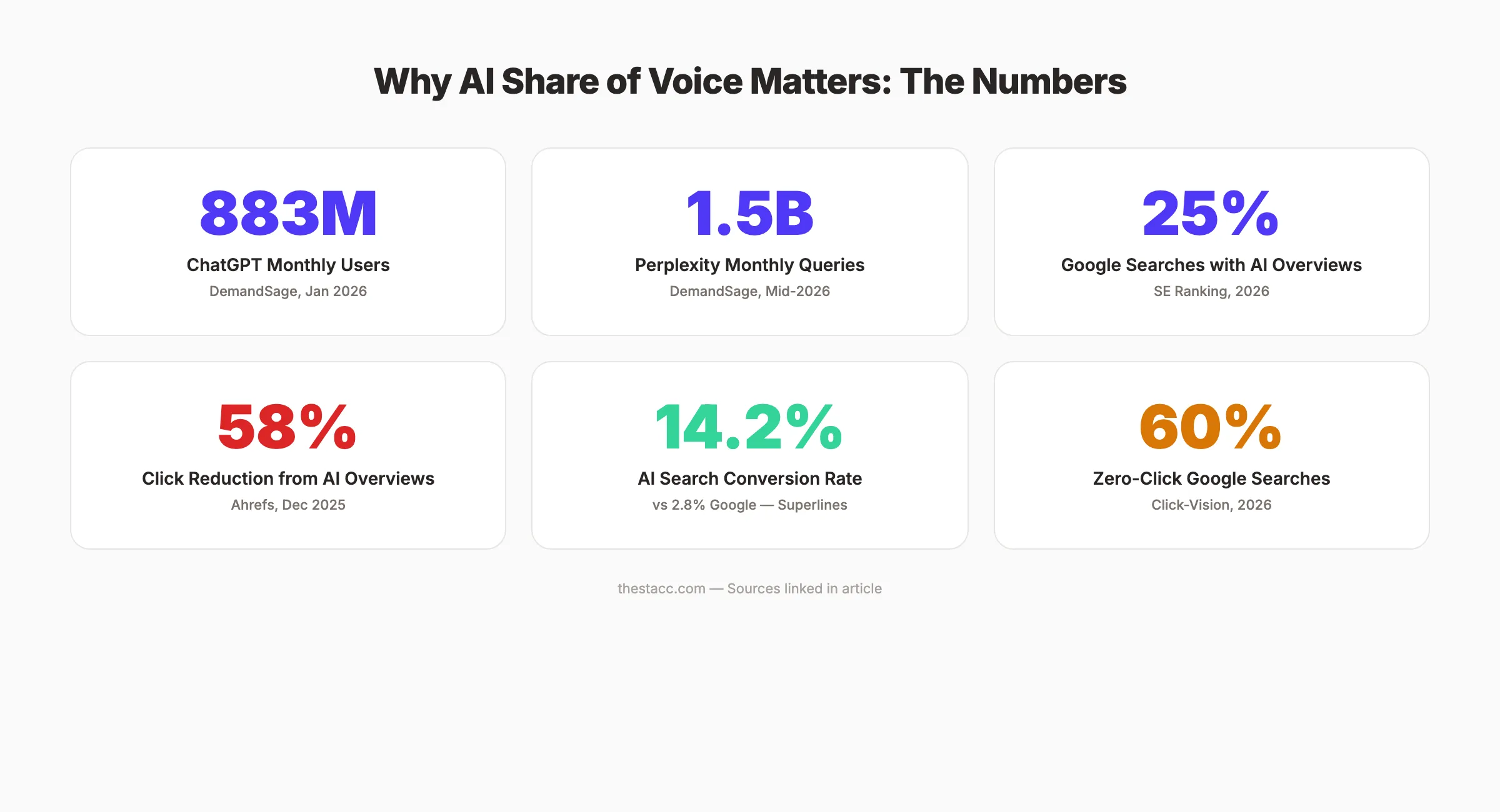
That is the reality of search in 2026. ChatGPT processes 5.4 billion visits per month. Perplexity handles 1.5 billion queries. Google AI Overviews appear in 25% of all searches. And 60% of Google searches now end with zero clicks.
Traditional share of voice measured how often your brand appeared in organic search results. AI share of voice measures something different: how often AI models mention, recommend, or cite your brand when users ask questions in your category.
We have published 3,500+ blog posts across 70+ industries. This guide covers everything we know about measuring and improving AI share of voice. From manual audits to automated tracking tools to the strategies that actually move the needle.
Here is what you will learn:
- What AI share of voice is and how it differs from traditional SOV
- The 3 distinct types of AI SOV (and why most tools only track one)
- A step-by-step manual audit framework you can run today
- How ChatGPT, Perplexity, Gemini, and Claude differ in citation behavior
- 12 tools that track AI share of voice (free and paid)
- 7 strategies to increase your AI visibility
- How to connect AI SOV to actual revenue
What Is AI Share of Voice?
AI share of voice measures how frequently your brand appears in AI-generated responses relative to competitors. It answers one question: when someone asks an AI about your category, does your brand come up?
The formula is straightforward:
AI SOV = (Your brand mentions in AI responses / Total AI responses for your prompt set) x 100
If you track 100 prompts related to your industry and your brand appears in 23 responses, your AI share of voice is 23%.
This differs from traditional SEO share of voice in 3 ways:
- No fixed rankings. Google shows 10 blue links in a predictable order. AI responses change between sessions, users, and even identical prompts run minutes apart.
- Mentions replace positions. In traditional SOV, ranking #1 means more than ranking #5. In AI responses, being mentioned at all matters more than placement within the answer.
- Citations carry weight. Some AI models link to sources. Being cited (with a URL) carries more authority than being named without attribution.
According to LLM Pulse, a 15-30% AI share of voice is strong in competitive B2B categories. Most brands sit below 5%.
The metric matters because AI search traffic converts at 14.2% compared to Google’s 2.8%. Roughly 5x more valuable per session. Being visible in AI answers is not just a vanity metric. It drives revenue.
Why AI Share of Voice Matters in 2026
The shift from traditional search to AI-assisted search is not theoretical. It is happening right now, and the numbers are hard to ignore.
The Scale of AI Search
ChatGPT has 883 million monthly active users as of January 2026. It holds between 60-80% of the AI chatbot market depending on the measurement methodology.
Perplexity processes 1.2-1.5 billion queries per month. Google AI Overviews reach 2 billion monthly users across 200 countries. Three in four Americans now search with AI on a weekly basis.
Combined, AI-driven search captured 12-15% of global search volume by end of 2025. That number is higher today.
The Click Impact
This is where it gets urgent for anyone who relies on organic traffic:
- AI Overviews reduce clicks to the top-ranking page by 58% (Ahrefs, December 2025)
- Organic CTR fell 61% and paid CTR fell 68% on queries with AI Overviews (Seer Interactive)
- 93% of Google AI Mode searches end without a single click (SafariDigital)
But here is the flip side: brands cited in AI Overviews earned 35% more organic clicks and 91% more paid clicks than those not cited. Visibility in AI answers does not just replace clicks. It amplifies them.
The B2B Buyer Shift
73% of B2B buyers now use AI tools like ChatGPT and Perplexity during their research process. Your potential customers are asking AI “What is the best [your category] tool?” before they ever open Google.
If your brand does not appear in those answers, you are invisible during the consideration phase. That is why tracking AI search visibility is no longer optional.
Your SEO team. $99 per month. 30 optimized articles, published automatically. Start for $1 →
The 3 Types of AI Share of Voice
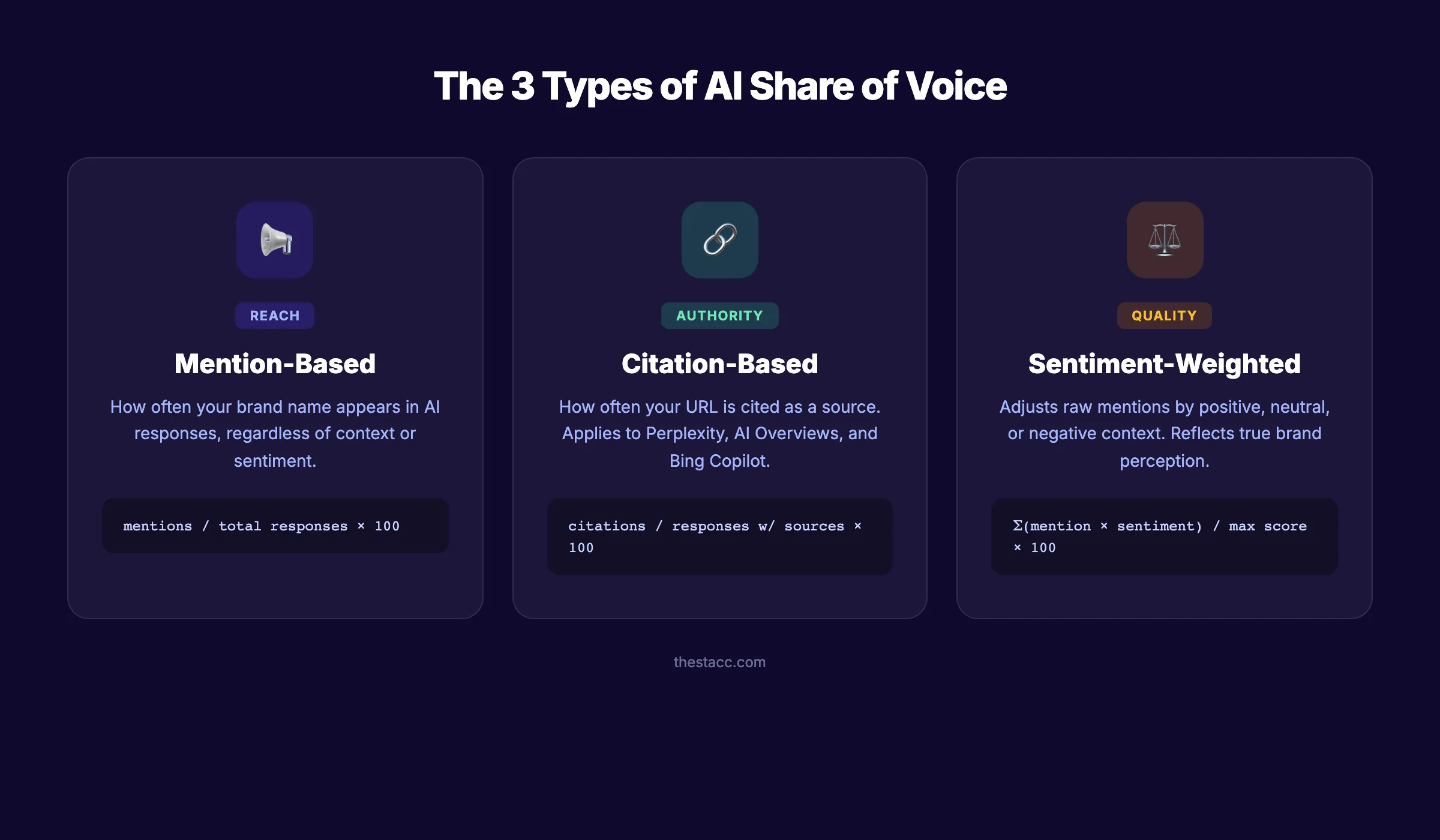
Most articles and tools treat AI share of voice as a single metric. It is not. There are 3 distinct measurement types, and confusing them leads to bad decisions.
1. Mention-Based SOV
Counts how often your brand name appears in AI responses. Regardless of context.
Formula: (Responses mentioning your brand / Total responses) x 100
Strength: Easy to track. Captures both positive and negative visibility. Weakness: A brand mentioned as “avoid this product” still counts as a mention. Sentiment is invisible.
2. Citation-Based SOV
Counts how often your URL appears as a source in AI responses. This applies to models that cite sources, like Perplexity, Google AI Overviews, and Bing Copilot.
Formula: (Responses citing your URL / Total responses with citations) x 100
Strength: Indicates that the AI considers your content authoritative enough to reference. Drives actual traffic. Weakness: ChatGPT rarely cites sources. Claude almost never does. This metric misses visibility on those platforms entirely.
3. Sentiment-Weighted SOV
Adjusts the raw mention count by the sentiment of each mention. A positive recommendation (“Brand X is the best option for…”) scores higher than a neutral mention (“Brand X is one of several options”) or a negative one (“Brand X has been criticized for…”).
Formula: Sum of (mention x sentiment score) / Total possible score x 100
Strength: Reflects the actual quality of your AI visibility, not just the quantity. Weakness: Harder to track manually. Requires NLP-based analysis or manual classification of each mention.
Most tracking tools only measure mention-based SOV. That is a problem. If your brand appears in 30% of responses but half of those mentions are negative comparisons, your effective AI share of voice is far lower than 30%.
The most accurate picture combines all three. Track mentions for reach, citations for authority, and sentiment for quality.
How to Measure AI Share of Voice (DIY Framework)
You do not need an expensive tool to start measuring. Here is a manual framework you can run today with nothing but a browser and a spreadsheet.
Step 1: Build Your Prompt Bank
Create 50-100 prompts that mirror how real buyers search for your product category. Organize them by funnel stage:
| Funnel Stage | Example Prompts | Count |
|---|---|---|
| Awareness | ”What is [category]?”, “How does [category] work?“ | 10-15 |
| Consideration | ”Best [category] tools”, “Top [category] for [use case]“ | 20-30 |
| Decision | ”[Brand A] vs [Brand B]”, “Is [brand] worth it?”, “[brand] alternatives” | 15-20 |
| Problem-specific | ”How to solve [pain point]”, “[industry] + [problem]“ | 10-15 |
Do not use prompts that include your brand name. You want to see if the AI brings you up organically.
Step 2: Run Prompts Across 4 Platforms
Test each prompt on:
- ChatGPT (GPT-4o or later)
- Perplexity (default mode)
- Google Gemini
- Claude
Use fresh sessions (not logged-in accounts with conversation history) to avoid personalization bias.
For each response, record in your spreadsheet:
| Column | What to Record |
|---|---|
| Prompt | The exact question asked |
| Platform | Which AI model |
| Your Brand Mentioned | Yes/No |
| Position | 1st, 2nd, 3rd, or later in the response |
| Sentiment | Positive / Neutral / Negative |
| Competitors Mentioned | List all brand names |
| Source Cited | Was your URL cited? (Yes/No) |
| Date | When the test was run |
Step 3: Calculate Your Scores
From your spreadsheet, calculate 3 numbers:
Overall AI SOV: Total responses mentioning your brand / Total responses x 100
Platform-specific SOV: Same formula, filtered by each AI platform.
Sentiment-adjusted SOV: Assign scores: Positive = 1.0, Neutral = 0.5, Negative = -0.5. Sum the scores for your mentions. Divide by total prompts. Multiply by 100.
Step 4: Map Your Competitors
For every prompt, you also captured which competitors appear. Rank all brands by mention frequency. This gives you a competitive AI share of voice leaderboard.
Example output:
| Brand | Mentions | AI SOV | Avg Sentiment |
|---|---|---|---|
| Competitor A | 34/50 | 68% | Positive |
| Competitor B | 28/50 | 56% | Neutral |
| Your Brand | 12/50 | 24% | Positive |
| Competitor C | 8/50 | 16% | Negative |
Step 5: Repeat Monthly
AI responses are non-deterministic. They change as models update their training data and as your content mix shifts. Run this audit monthly to track trends, not just snapshots.
Track each month’s numbers on a line chart. The trend matters more than any single score.
This manual process takes 4-6 hours per month. For teams that want automation, the next section covers tools that handle this at scale.
How Each AI Platform Handles Citations
Not all AI models treat brand mentions the same way. Understanding the differences helps you prioritize where to focus your generative engine optimization efforts.
ChatGPT
- Mentions brands frequently in recommendations
- Rarely cites source URLs in standard chat mode
- Pulls from training data, not live web (except in Browse mode)
- Favors brands with strong presence across multiple authoritative sources
- Response variability is high. The same prompt produces different brand recommendations across sessions
Perplexity
- Always cites sources with numbered references
- Pulls from live web results in real time
- Heavily favors content that appears in top Google results
- Reddit is the most frequently cited domain, referenced in approximately 40% of analyzed cases
- Most citation-friendly platform for tracking citation-based SOV
Google Gemini and AI Overviews
- AI Overviews cite sources directly with clickable links
- Sources tend to match or overlap with top organic results
- Structured data and schema markup increase citation likelihood
- Gemini in standalone mode cites less frequently than AI Overviews
- Brands with strong E-E-A-T signals get cited more often
Claude
- Almost never cites URLs
- Mentions brands based on training data prevalence
- Conservative in recommendations. Tends to list options rather than pick winners
- Lower commercial intent in responses compared to ChatGPT or Perplexity
- Useful for measuring pure brand awareness SOV, not citation SOV
Platform Priority Matrix
| Goal | Primary Platform | Secondary |
|---|---|---|
| Drive referral traffic | Perplexity | Google AI Overviews |
| Build brand awareness | ChatGPT | Gemini |
| Earn source citations | Perplexity | Google AI Overviews |
| Track competitive positioning | ChatGPT | Perplexity |
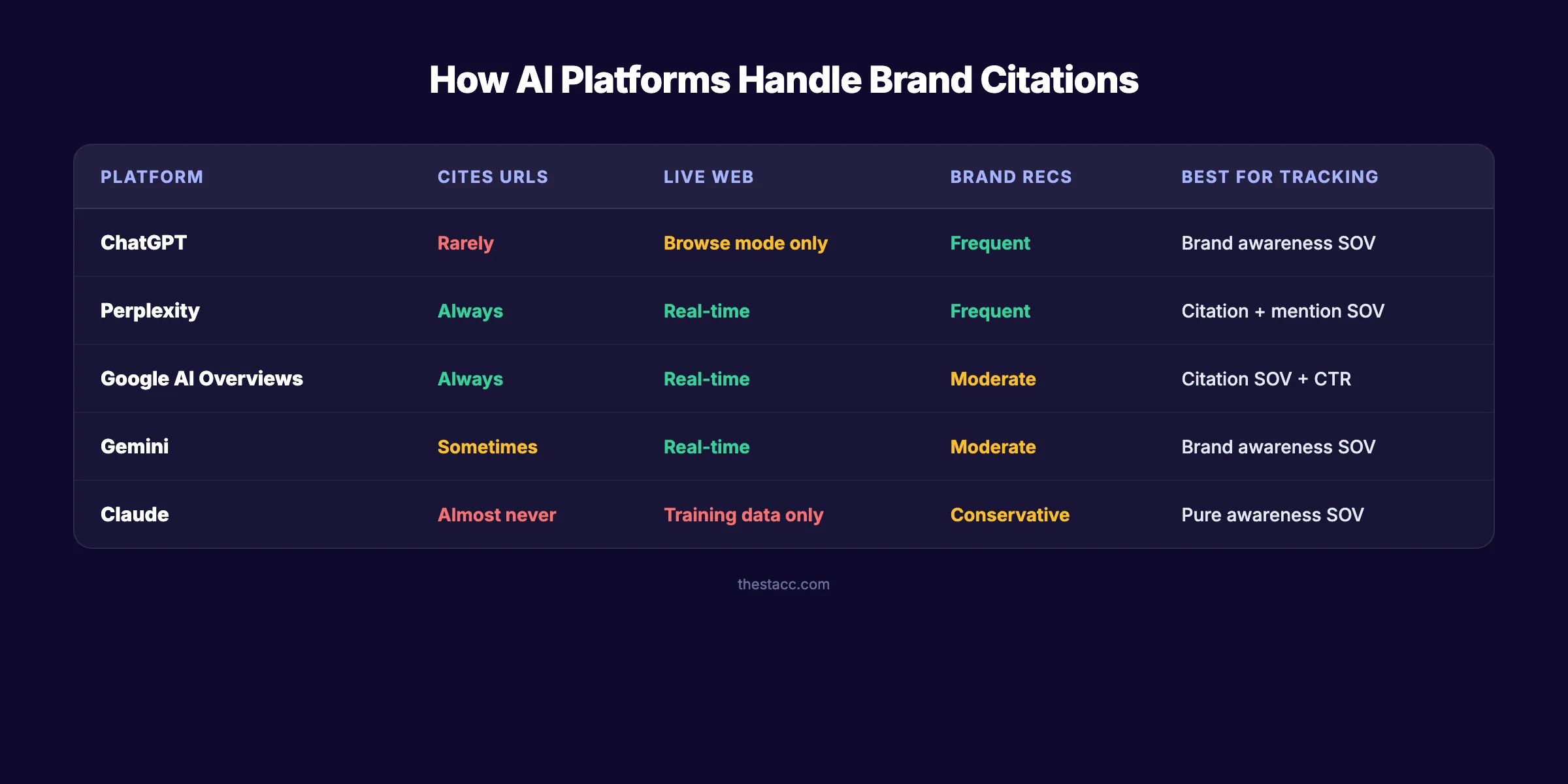
If you can only track one platform, start with Perplexity. It cites sources, pulls live data, and gives you the clearest picture of citation-based SOV. For a deeper comparison, see our guide on Gemini vs ChatGPT for search.
3,500+ blogs published. 92% average SEO score. See what Stacc can do for your site. Start for $1 →
12 Tools That Track AI Share of Voice
The tool market for AI SOV tracking has exploded in the past year. Here are the options worth considering, organized by budget.
Free Tools
| Tool | Platforms Tracked | Best For |
|---|---|---|
| HubSpot AEO Grader | ChatGPT, Perplexity, Gemini | Quick brand audit with 5-dimension scorecard |
| Neil Patel AI Brand Visibility | Multiple LLMs | Fast brand presence check |
| Semrush AI Search Visibility Checker | Multiple | Quick check (limited vs. paid) |
| SEO Review Tools (v3.1) | Multiple LLMs | Free AI brand visibility report |
| LLMClicks | ChatGPT, Gemini | Quick visibility check |
Paid Tools ($49-$200/month)
| Tool | Platforms Tracked | Starting Price | Key Feature |
|---|---|---|---|
| Otterly.AI | ChatGPT, Perplexity, Google AIO | ~$49/mo | Auto-calculates SOV in about 1 minute |
| Semrush AI Visibility Toolkit | ChatGPT, Google AI Mode, Perplexity | $139+/mo | SOV integrated with broader SEO suite |
| SE Ranking (SE Visible) | Multiple LLMs | Part of plans | Weighted rank scoring system |
| Advanced Web Ranking | Multiple LLMs | Part of plans | Credibility and sentiment scores |
| Peec AI | Multiple | Varies | Citation tracking for marketing teams |
| LLM Pulse | Multiple LLMs | Varies | SOV with industry benchmarks |
Enterprise Tools
| Tool | Best For | Key Feature |
|---|---|---|
| Conductor | Large brands | Mention-based + citation-based SOV split |
| Talkwalker | Brand monitoring | AI + social mention tracking combined |
Which Tool Should You Pick?
- Just starting out? Use HubSpot AEO Grader (free) for a baseline score, then run the manual DIY audit from Chapter 4 for deeper insight.
- Ready to invest? Otterly.AI offers the best value for small-to-mid teams. It tracks across platforms and calculates SOV automatically.
- Already using Semrush? Their AI Visibility Toolkit adds SOV tracking to your existing workflow. See our Semrush review for the full breakdown.
- Enterprise brand? Conductor gives the most granular competitive intelligence with separate mention and citation tracking.
For the broader set of AI-focused SEO tools, check our list of the best AI SEO tools in 2026.
7 Strategies to Improve Your AI Share of Voice
Measuring AI SOV is useful only if you act on the data. Here are 7 strategies ranked by impact.
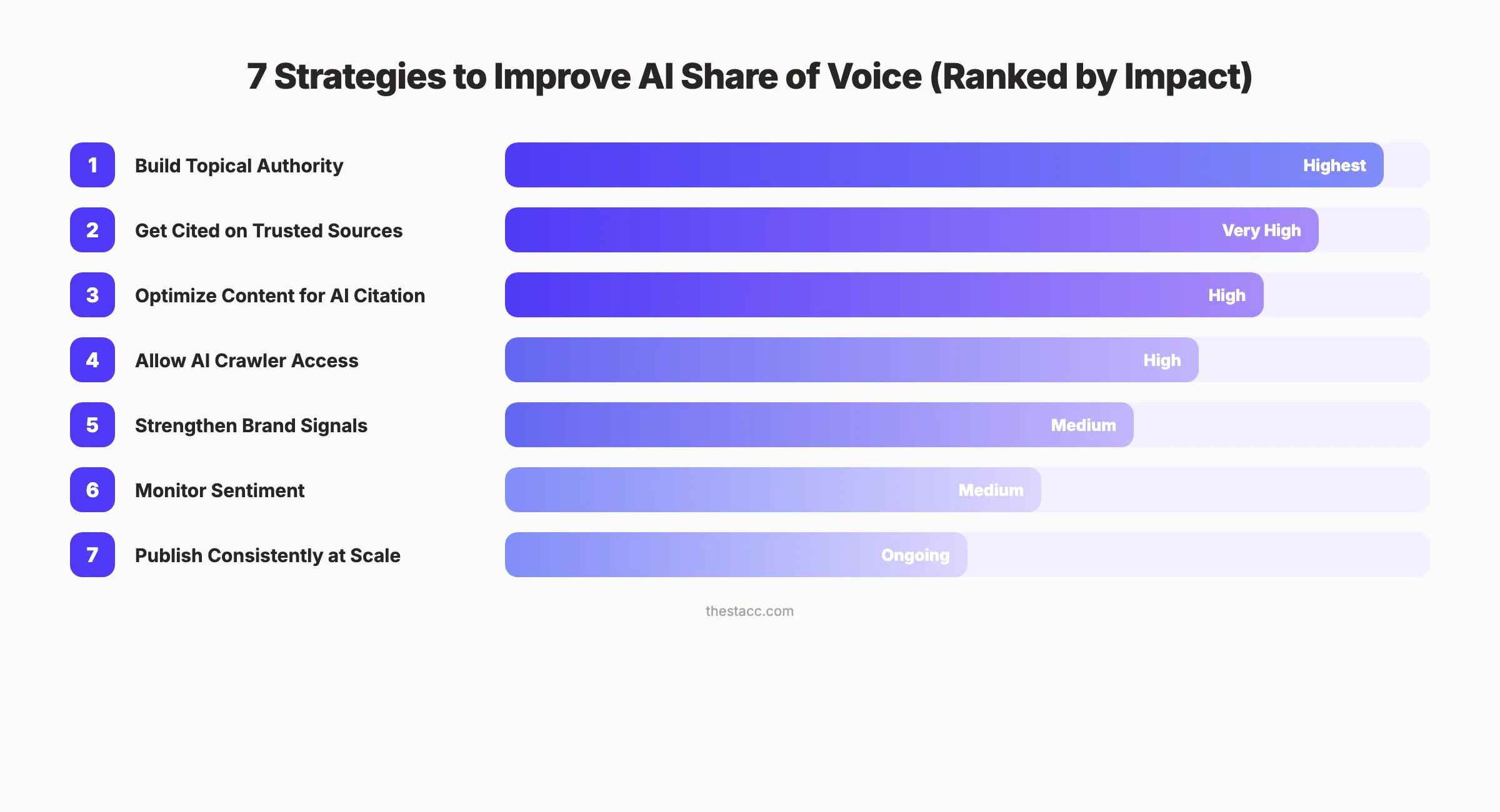
1. Build Topical Authority Across Your Category
AI models recommend brands they encounter repeatedly across authoritative sources. Publishing one article about your topic is not enough. You need depth.
Create a content cluster around your core topics: pillar pages, supporting articles, glossary entries, comparison pages, and data studies. When an AI model sees your brand associated with a topic across 20+ high-quality pages, it starts including you in answers. Read our guide on building topical authority for the full framework.
2. Get Cited on Sources That AI Models Trust
AI models pull from the web. Some sources carry more weight than others.
High-priority citation sources:
- Reddit (cited in 40% of LLM responses, per Semrush)
- Wikipedia and Wikidata
- Industry publications and trade media
- G2, Capterra, and TrustRadius reviews
- GitHub (for developer-facing products)
- Stack Overflow and Quora
Contribute authentic, helpful content on these platforms. AI models treat third-party mentions as stronger signals than your own website claims. This is the modern version of link building. Except you are building LLM training signals, not just backlinks.
3. Optimize Your Content for AI Citation
Structure your content so AI models can extract clean answers. This is the core of generative engine optimization:
- Use clear H2/H3 headings that match common questions
- Lead paragraphs with direct answers (not buildup)
- Include structured data and schema markup
- Add concise definitions, statistics with sources, and comparison tables
- Keep sentences short and claims specific
Research from the original GEO paper (KDD 2024) showed that these optimization techniques can boost visibility in AI responses by up to 40%.
4. Ensure AI Crawlers Can Access Your Site
If AI crawlers cannot reach your content, your brand will never appear in AI responses. Check your robots.txt for these user agents:
GPTBot(OpenAI/ChatGPT)PerplexityBot(Perplexity)ClaudeBot(Anthropic/Claude)Google-Extended(Gemini)
Many sites block these crawlers by default. If you want AI visibility, you need to allow them access. Our guide on AI crawlers covers the full setup. You should also consider adding an llms.txt file to help AI systems understand your site structure.
5. Strengthen Your Brand Signals Everywhere
AI models build brand associations from training data. The more consistent your brand appears across the web with specific attributes, the stronger those associations become.
Focus on:
- Consistent NAP (name, address, phone) across directories
- Updated profiles on G2, Capterra, Clutch, and industry directories
- Active social media with brand-consistent messaging
- Guest posts and expert quotes in industry publications
- A strong Google Business Profile (for local brands)
This is E-E-A-T applied to AI. Experience, expertise, authority, and trust signals determine whether an AI model considers your brand worth mentioning.
6. Monitor and Respond to Sentiment
Being mentioned is only valuable if the mention is positive. Track sentiment alongside frequency.
If an AI model consistently describes your brand in neutral or negative terms, investigate why. Common causes:
- Negative reviews on high-authority platforms
- Outdated information in training data
- Competitor comparison content that positions you unfavorably
- Lack of positive third-party validation
Address the root cause. Earn more positive reviews. Publish case studies with real results. Update your messaging on platforms that AI models reference frequently.
7. Publish Consistently at Scale
AI models favor brands that produce fresh, frequent, high-quality content. A blog that publishes 30 articles per month builds more topical authority than one that publishes 2.
This is the compounding effect in action. Every article is another data point that tells AI models: this brand knows this topic. Over 60-90 days, that signal compounds into consistent AI visibility.
Stop writing. Start ranking. Stacc publishes 30 SEO articles per month for $99. Start for $1 →
How to Connect AI SOV to Revenue
AI share of voice is a leading indicator. But the executive team wants to see revenue impact. Here is how to connect the two.
The Attribution Framework
Track these metrics alongside your AI SOV score each month:
| Metric | Source | What It Shows |
|---|---|---|
| AI SOV % | Your monthly audit | Brand visibility in AI answers |
| AI referral traffic | Google Analytics 4 (filter by source) | Visits from AI platforms |
| Branded search volume | Google Search Console | People searching your brand name |
| Conversion rate from AI traffic | GA4 goal tracking | Revenue per AI-referred visitor |
| Share of branded queries | Search Console | Brand awareness growth |
The Correlation Pattern
In practice, the relationship works like this:
- AI SOV increases → more people see your brand in AI answers
- Branded search volume rises → those people Google your brand to learn more
- Direct and organic traffic grows → they visit your site
- Pipeline and revenue follow → some percentage converts
You will not see a direct “AI click → purchase” path in most cases. AI influence is more like a billboard than a Google Ad. It builds awareness that converts through other channels.
Benchmark Your Progress
Track AI SOV monthly alongside organic traffic and branded search volume. If AI SOV rises by 10 percentage points over 3 months, you should see a corresponding lift in branded searches within 30-60 days.
If AI SOV rises but branded search does not, the mentions may be neutral or negative. Check your sentiment-weighted SOV.
If branded search rises but conversions do not, the problem is on your website, not your AI visibility. Run a content audit to identify conversion bottlenecks.
Common Mistakes That Tank Your AI SOV
Avoid these 5 errors that we see brands make repeatedly.
1. Tracking too few prompts. Running 10 prompts and calling it a day gives you noise, not signal. You need 50+ prompts to get a stable measurement. AI responses vary between runs, so small sample sizes produce unreliable scores.
2. Using branded prompts in your audit. If you include “Is [your brand] good?” in your prompt set, you are inflating your SOV. Only use unbranded category-level queries that a real buyer would ask.
3. Blocking AI crawlers. Many sites block GPTBot, ClaudeBot, and PerplexityBot in robots.txt without realizing it. If AI crawlers cannot read your content, your brand cannot appear in their responses. Check your robots.txt setup today.
4. Ignoring third-party platforms. Your website alone does not determine AI SOV. AI models heavily weight Reddit, Wikipedia, review sites, and industry publications. If you only optimize your own site, you are missing the biggest lever.
5. Measuring once and forgetting. AI responses change as models update. A single measurement is a snapshot, not a strategy. Track monthly to identify trends and measure the impact of your optimization efforts.
FAQ
What is AI share of voice?
AI share of voice measures how often your brand appears in AI-generated responses when users ask questions related to your industry or product category. It is calculated by dividing your brand mentions by total AI responses for a set of relevant prompts.
How is AI share of voice different from traditional SEO share of voice?
Traditional SOV measures your visibility in organic search rankings. AI SOV measures brand mentions in AI-generated answers from ChatGPT, Perplexity, Gemini, and similar models. There are no fixed positions in AI responses. Mentions and citations replace rankings. For a deeper comparison, read our breakdown of GEO vs SEO.
What is a good AI share of voice percentage?
In competitive B2B categories, 15-30% is considered strong. Most brands fall below 5%. The benchmark depends heavily on your industry and the number of competitors. Track your score relative to competitors rather than aiming for an absolute number.
Can you improve AI share of voice without paid tools?
Yes. The DIY manual audit framework in this guide requires only a browser and a spreadsheet. For optimization, focus on building topical authority, earning citations on third-party platforms, and ensuring AI crawlers can access your site.
Which AI platform should I track first?
Start with Perplexity. It cites sources with URLs, pulls from live web data, and gives you the clearest picture of both mention-based and citation-based SOV. Add ChatGPT next for brand awareness tracking. For a full optimization guide, see how to optimize for Perplexity.
How often should I measure AI share of voice?
Monthly is the minimum cadence. AI models update their behavior and training data regularly. Monthly tracking lets you spot trends, measure the impact of your GEO efforts, and respond to competitive shifts before they become problems.
AI share of voice is the new scoreboard for brand visibility. The brands measuring it today will own the AI-generated recommendations that drive buyer decisions tomorrow. Start with the manual audit, pick a tracking tool that fits your budget, and focus your optimization on the strategies that move the metric.
Rank everywhere. Do nothing. Blog SEO, Local SEO, and Social on autopilot. Start for $1 →
Related Tools & Resources
Free SEO Tools:
Best Lists:

Written by
Siddharth GangalSiddharth is the founder of theStacc and Arka360, and a graduate of IIT Mandi. He spent years watching great businesses lose organic traffic to competitors who simply published more. So he built a system to fix that. He writes about SEO, content at scale, and the tactics that actually move rankings.
30 SEO blog articles published every month
Keyword-optimized, scheduled, and live on your site. Automatically.
30-day trial · Cancel anytime
theStacc
Stop writing SEO content manually
30 blog articles, 30 GBP posts, and social media content. Published every month. Automatically.
Try for free$1 for 3 days · Cancel anytime