
Gemini Search vs ChatGPT Search (2026): Accuracy, Citations & SEO
Gemini Search vs ChatGPT Search compared on accuracy, citation quality, real-time data, SEO impact, and which AI search engine is better for marketers.
Two AI search engines now control how millions of people find information online. Gemini Search vs ChatGPT Search is the comparison every marketer and business owner needs to understand in 2026.
ChatGPT reaches 900 million weekly active users. Google Gemini captures 25.2% of the AI chatbot app market, up from 14.7% one year ago. Both platforms now function as search engines. They retrieve real-time web data, cite sources, and deliver answers that replace traditional search results.
The question is not which one is better overall. Each platform handles search differently. Gemini pulls from Google’s index natively. ChatGPT browses the web through its own retrieval system. The differences in how they find, process, and cite information affect your content visibility directly.
We have published 3,500+ articles across 70+ industries with a 92% average SEO score. We optimize every piece for both traditional search and AI search engines. This comparison covers what matters for search specifically, not general chatbot features.
Here is what you will learn:
- How Gemini Search and ChatGPT Search retrieve and present information
- A side-by-side comparison across 10 search-specific factors
- Where each platform wins (and where each falls short)
- How citations and source attribution differ between platforms
- What these differences mean for your SEO and content strategy
- Which platform to prioritize based on your goals
What Gemini Search and ChatGPT Search Actually Do
Both platforms retrieve live web data and generate answers. The mechanics behind each are fundamentally different.
Gemini Search
Gemini is built on Google’s infrastructure. It has native access to Google Search, Google Maps, Gmail, YouTube, and the full Google ecosystem. When you ask Gemini a question, it queries Google’s search index directly. The result feels like a Google search that writes its own summary.
Gemini processes multimodal inputs. It handles text, images, video (up to 1 hour), and audio (up to 8 hours) natively. For search-specific tasks, its connection to Google’s real-time index means it accesses the freshest data available.
Google powers AI Overviews on approximately 25% of all Google searches. Gemini’s technology underpins these AI Overviews. Understanding how Gemini Search works is understanding how AI Overviews select and present sources.
ChatGPT Search
ChatGPT uses its own web browsing capability to retrieve real-time information. When you ask a search question, ChatGPT sends queries to the web, retrieves relevant pages, and synthesizes an answer from multiple sources.
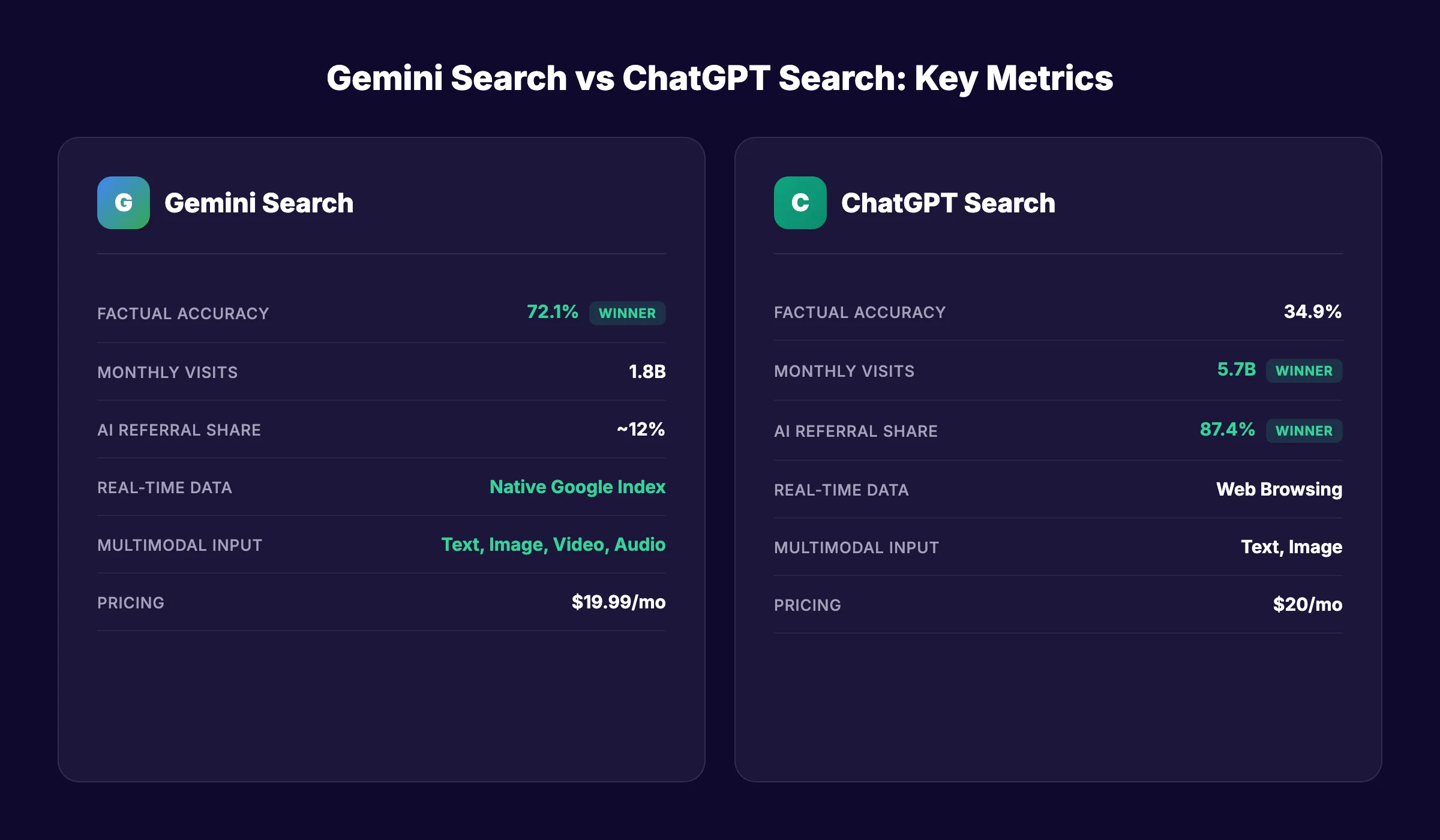
ChatGPT generates 87.4% of all AI referral traffic to websites. Its search function produces inline citations with clickable links. Users can follow those links to the original source.
The key difference: ChatGPT retrieves and summarizes. Gemini searches and integrates. ChatGPT pulls from the open web. Gemini pulls from Google’s proprietary index and ecosystem.
Head-to-Head Comparison: 10 Search-Specific Factors
| Factor | Gemini Search | ChatGPT Search |
|---|---|---|
| Data source | Google Search index (native) | Web browsing (retrieval-based) |
| Real-time accuracy | High (direct Google index access) | Good (web browse with slight delay) |
| Citation style | Inline links, sometimes grouped at end | Inline numbered citations with links |
| Source diversity | Pulls from Google’s ranked results | Pulls from broader web crawl |
| Factual accuracy (SimpleQA) | 72.1% verified accuracy | 34.9% verified accuracy |
| Response structure | Information-dense, sometimes overwhelming | Organized, clean outlines and summaries |
| Multimodal search | Text, image, video, audio input | Text and image input |
| Ecosystem integration | Gmail, Maps, Drive, YouTube, Workspace | Third-party connectors (Drive, GitHub, Dropbox) |
| Monthly visits | ~1.8 billion | ~5.7 billion |
| Pricing | Free tier + $19.99/mo (Advanced) | Free tier + $20/mo (Plus) |
The Key Takeaway
Gemini wins on factual accuracy and real-time data. ChatGPT wins on response structure and user experience. Both serve different search needs well.
Stop writing. Start ranking. Stacc publishes 30 SEO-optimized articles per month. Every article is built for Google and AI search engines. Start for $1 →
Where Gemini Search Wins
Real-Time Information Accuracy
Gemini’s direct connection to Google’s search index gives it a significant edge for time-sensitive queries. Flight prices, stock data, breaking news, weather forecasts, and live event information come back faster and more accurately.
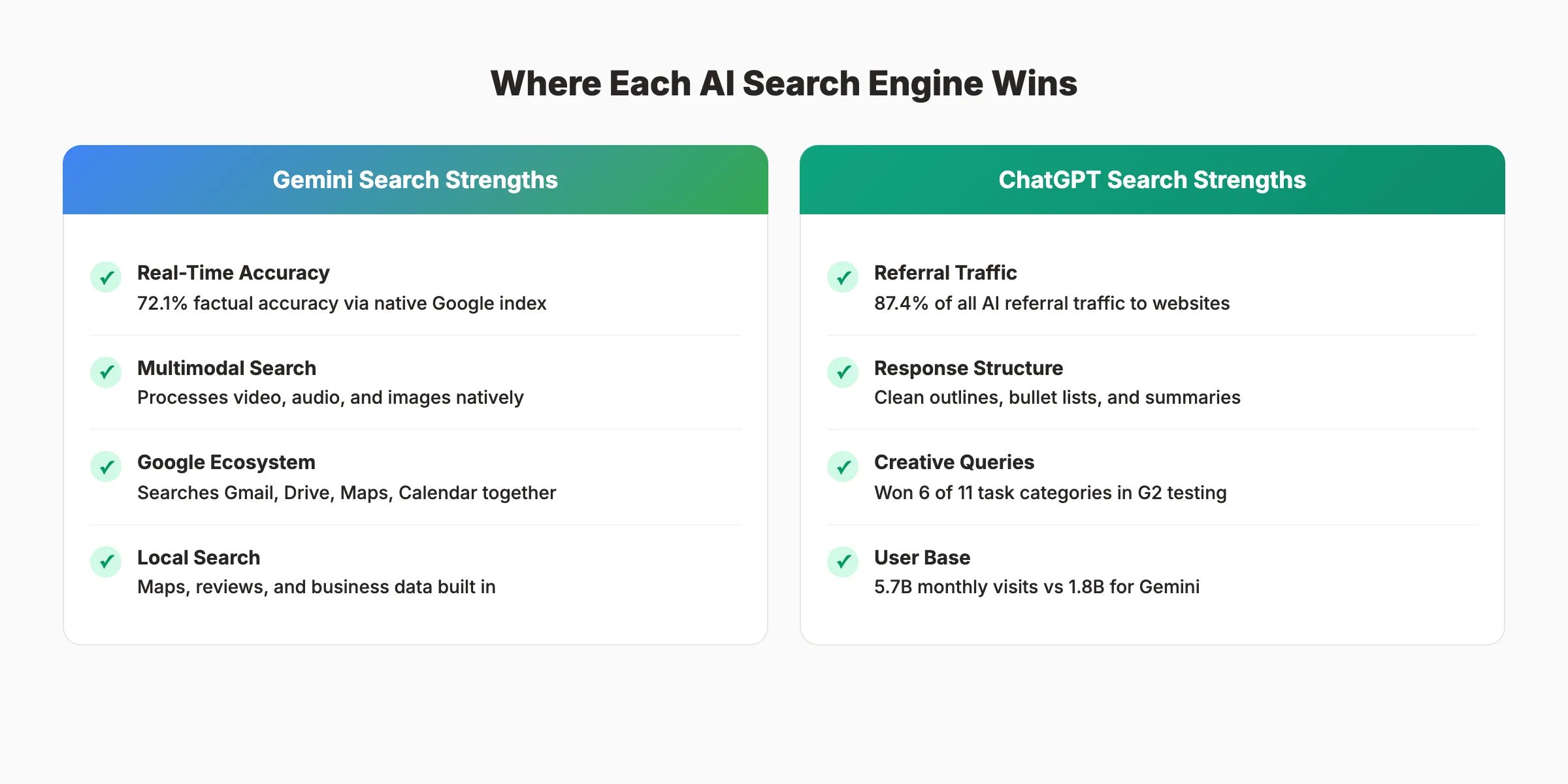
The SimpleQA benchmark tested factual accuracy across verified questions. Gemini scored 72.1%. ChatGPT variants scored 34.9%. That gap matters for any search where factual precision is critical.
Multimodal Search Capability
Gemini processes video and audio natively. You can upload a video clip and ask “What product is shown at the 3-minute mark?” ChatGPT cannot process video or audio files. For visual and multimedia search tasks, Gemini has no competition.
Google Ecosystem Integration
If your workflow runs on Google Workspace, Gemini searches across your Gmail, Drive, Calendar, and Docs simultaneously. It can pull a specific attachment from an email thread or find a document you edited last month. ChatGPT requires separate connectors and cannot match this depth of integration.
Local and Map-Based Searches
Gemini taps into Google Maps data. Restaurant recommendations, directions, business hours, and local service queries return richer results with maps, photos, and reviews embedded in the response.
Where ChatGPT Search Wins
Response Quality and Structure
ChatGPT organizes search results into clean, scannable formats. Bullet lists, numbered steps, comparison tables, and highlighted takeaways make long answers easier to read. Gemini often returns dense paragraphs that require more effort to parse.
For research tasks where you need a structured summary rather than raw facts, ChatGPT produces more usable output.
Referral Traffic to Websites
ChatGPT drives 87.4% of all AI referral traffic. Users who click ChatGPT’s inline citations convert at twice the rate of traditional search visitors. They also convert in one-third the sessions.
For businesses that depend on website traffic, ChatGPT Search is the more important platform. Its citation model sends more visitors to source websites than Gemini does.
Creative and Analytical Queries
ChatGPT outperforms Gemini on creative writing, brainstorming, coding, and analytical reasoning. In G2 testing, ChatGPT won 6 out of 11 task categories while Gemini won 3.
For queries that require synthesis, comparison, or original analysis, ChatGPT produces more thoughtful responses.
User Base and Market Reach
ChatGPT records 5.7 billion monthly visits compared to Gemini’s 1.8 billion. More users means more potential exposure for cited content. If your content appears in ChatGPT search results, it reaches a larger audience.
How Each Platform Handles Citations and Sources
This is where the comparison matters most for SEO professionals and content creators.
Gemini’s Citation Model
Gemini cites sources inline or groups them at the bottom of responses. It pulls primarily from pages that rank well in Google’s index. Optimizing for Google AI Overviews directly improves your chances of being cited by Gemini.
Gemini tends to cite:
- Pages ranking in Google’s top 20 for related queries
- Content with clear structure and authoritative signals
- Pages with schema markup and strong E-E-A-T signals
- Recent content (freshness weighted heavily)
ChatGPT’s Citation Model
ChatGPT generates numbered inline citations with clickable source links. It browses the web independently of Google’s index. This means pages that do not rank in Google can still get cited by ChatGPT.
ChatGPT tends to cite:
- Content with specific statistics and data points
- Pages with clear, extractable answers
- Sources mentioned across multiple web properties
- Content from domains with cross-platform authority
The SEO Implication
Gemini rewards Google SEO performance. If your pages rank well in traditional search, Gemini is more likely to cite them. ChatGPT rewards content quality and authority signals independent of Google rankings. Fewer than 10% of sources cited by ChatGPT rank in Google’s top 10 for the same query.
This means optimizing for both platforms requires both traditional SEO and generative engine optimization tactics.
Your SEO team. $99 per month. 30 optimized articles, published automatically. Built for Google, Gemini, and ChatGPT. Start for $1 →
What This Means for Your SEO and Content Strategy
The split between Gemini Search and ChatGPT Search creates two optimization paths. Smart strategy covers both.
Optimize for Gemini (and Google AI Overviews)
Since Gemini pulls from Google’s index, traditional SEO is your entry point.
- Rank in Google’s top 20 for your target queries
- Implement FAQ and Article schema markup
- Write clear, structured answers in your content headers
- Keep content fresh (update within 6 months)
- Read our full guide on optimizing for Google AI Overviews
Optimize for ChatGPT Search
ChatGPT’s retrieval is independent of Google rankings. Focus on these signals:
- Include specific statistics with source citations
- Build brand authority across multiple platforms
- Allow AI crawlers (GPTBot) in your
robots.txt - Create an llms.txt file for AI-readable site structure
- Publish original data and research that AI cannot find elsewhere
- Follow the GEO optimization checklist
Cover Both With One Content Strategy
The overlap between Gemini and ChatGPT optimization is significant. Content that is well-structured, data-rich, authoritative, and regularly updated performs well on both platforms. Our guide on getting cited in AI search covers the unified approach.
| Action | Gemini Benefit | ChatGPT Benefit |
|---|---|---|
| Strong Google rankings | Direct citation source | Indirect authority signal |
| Statistics with source links | AI Overview inclusion | Inline citation selection |
| Schema markup | Rich result eligibility | Structured data parsing |
| Fresh content (updated within 6 months) | Freshness ranking boost | Higher retrieval priority |
| Cross-platform brand mentions | Entity recognition | Authority assessment |
| Topical authority clusters | Topic relevance scoring | Full-coverage source selection |
Pricing and Access Compared
Both platforms offer free and paid tiers. The paid tiers unlock the full search capabilities.
| Plan | Gemini | ChatGPT |
|---|---|---|
| Free tier | Gemini with standard model, web search | GPT-4o mini, limited search |
| Paid tier | $19.99/mo (Google One AI Premium) | $20/mo (ChatGPT Plus) |
| Paid includes | Gemini Advanced, 2TB storage, Workspace integration | GPT-4o, DALL-E, advanced search, voice |
| Enterprise | Google Workspace AI add-on ($30/user/mo) | ChatGPT Enterprise (custom pricing) |
| API access | Gemini API (usage-based) | OpenAI API (usage-based) |
Consumer pricing is nearly identical. The real cost difference appears at enterprise scale. Google bundles Gemini into Workspace. OpenAI prices ChatGPT Enterprise separately.
For marketers evaluating where to spend time optimizing, the platform choice matters more than the subscription cost. Focus optimization efforts where your audience searches.
Which One Should You Use?
The answer depends on what you need from AI search.
Choose Gemini Search if you:
- Need the most accurate real-time information
- Work within the Google ecosystem (Workspace, Gmail, Drive)
- Run local business queries or map-based searches
- Want multimodal search (video, audio, image inputs)
- Prioritize factual precision over response formatting
Choose ChatGPT Search if you:
- Need well-structured research summaries
- Want creative or analytical responses
- Prioritize reading experience and output organization
- Run coding, brainstorming, or comparative analysis queries
- Want the largest user base exposure for cited content
Use both if you:
- Run a business that depends on online visibility
- Create content optimized for AI search engines
- Want to maximize brand exposure across AI platforms
- Track AI search visibility as a marketing metric
Most businesses should optimize for both. Gemini covers Google’s ecosystem (including AI Overviews on 25% of searches). ChatGPT drives the majority of AI referral traffic. Missing either one means leaving visibility on the table.
3,500+ blogs published. 92% average SEO score. See what Stacc can do for your site. Start for $1 →
FAQ
Is Gemini Search more accurate than ChatGPT Search?
For factual, time-sensitive queries, yes. Gemini scored 72.1% on the SimpleQA verified accuracy benchmark compared to 34.9% for ChatGPT. Gemini’s direct access to Google’s search index gives it fresher and more accurate real-time data. For creative or analytical queries, ChatGPT produces more structured and useful responses.
Does ChatGPT Search send more traffic to websites than Gemini?
Yes. ChatGPT generates 87.4% of all AI referral traffic to websites. It produces inline citations that users click. Visitors from ChatGPT convert at twice the rate of traditional search visitors. Gemini drives less referral traffic because its answers are more self-contained within the Google ecosystem.
Can I optimize my content for both Gemini and ChatGPT Search?
Yes. The core optimization strategies overlap. Write well-structured content with specific statistics, implement schema markup, maintain freshness, and build authority across multiple platforms. Our generative engine optimization guide covers the unified approach in detail.
Which AI search engine is growing faster?
Gemini is growing faster from a smaller base. Its AI chatbot app market share jumped from 14.7% to 25.2% in one year. ChatGPT’s share declined from 69.1% to 45.3% in the app market during the same period. Both platforms are growing in total users. The market is expanding overall.
How does Gemini Search relate to Google AI Overviews?
Gemini’s technology powers Google AI Overviews. AI Overviews appear on roughly 25% of Google searches. Optimizing for Gemini Search and optimizing for AI Overviews are effectively the same task. Content that Gemini cites in its search responses is the same content Google surfaces in AI Overviews.
Should I block or allow AI crawlers from these platforms?
Allow them. Blocking GPTBot (ChatGPT) or Google-Extended (Gemini) prevents your content from appearing in AI search results. Unless you have a specific licensing reason to block AI access, keeping crawlers enabled maximizes your visibility. Read our AI crawlers guide for specific configuration steps.
AI search is not one platform. It is two major platforms with different retrieval methods, different citation models, and different user bases. The businesses that win in 2026 are the ones visible on both Gemini Search and ChatGPT Search, not just one.

Written by
Siddharth GangalSiddharth is the founder of theStacc and Arka360, and a graduate of IIT Mandi. He spent years watching great businesses lose organic traffic to competitors who simply published more. So he built a system to fix that. He writes about SEO, content at scale, and the tactics that actually move rankings.
30 SEO blog articles published every month
Keyword-optimized, scheduled, and live on your site. Automatically.
30-day trial · Cancel anytime
theStacc
Stop writing SEO content manually
30 blog articles, 30 GBP posts, and social media content. Published every month. Automatically.
Start Your $1 Trial$1 for 3 days · Cancel anytime