
The Blog GEO Checklist: 15 Steps for AI Visibility
Use this blog GEO checklist to optimize every post for AI search. 15 steps covering structure, citations, schema, and tracking. Updated 2026.
Traditional search volume will drop 25% by the end of 2026, according to Gartner. The traffic is not disappearing. It is moving to AI search engines. ChatGPT, Perplexity, Google AI Overviews, and Gemini now answer billions of queries per month. Your blog posts either get cited in those answers or they get skipped.
Most blog GEO checklist guides focus on site-wide optimization. They cover robots.txt, schema markup, and brand entity strategy. That is useful but incomplete. What most writers need is a per-post checklist they can run before hitting publish.
This is that checklist. 15 actionable items to apply to every blog post so AI search engines find, extract, and cite your content.
We have published 3,500+ blogs across 70+ industries. We optimize every article for both traditional SEO and generative engine optimization. This checklist covers exactly what we check before publishing.
Here is what you will learn:
- The exact content structure AI search engines prefer to cite
- How to format passages so they get extracted as AI answers
- Technical requirements for AI crawler access
- Authority signals that increase citation rates
- How to measure whether your GEO optimization is working
What Is GEO and Why Your Blog Posts Need It
Generative Engine Optimization (GEO) is the practice of optimizing content so AI search engines cite it in their answers. Unlike traditional SEO, where the goal is a top-10 ranking, GEO aims for your content to be one of 2 to 7 sources an AI model references.
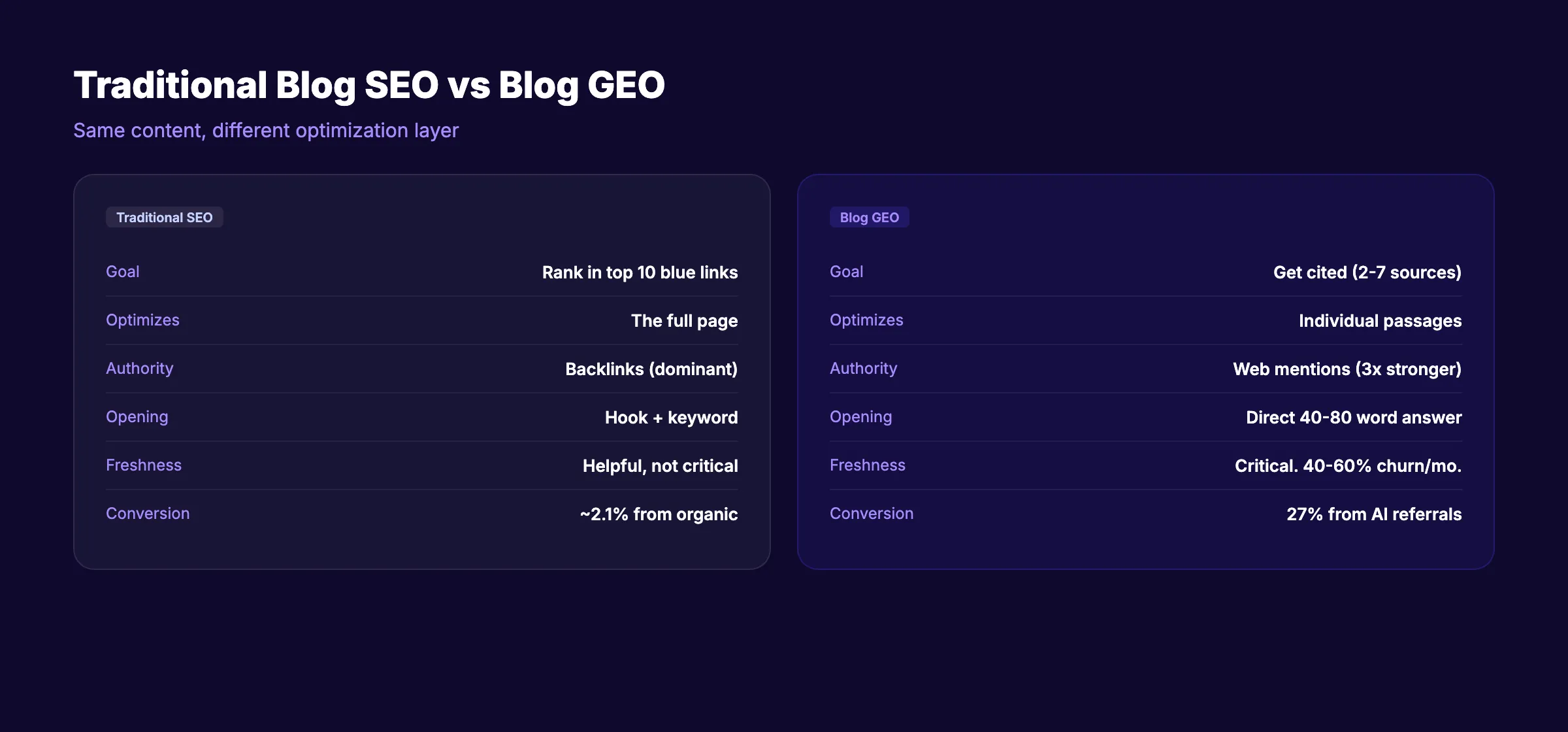
The difference matters because AI search works differently:
| Factor | Traditional SEO | Blog GEO |
|---|---|---|
| Goal | Rank on page 1 (10 blue links) | Get cited (2-7 sources per answer) |
| Unit of optimization | The full page | Individual passages and sections |
| Key authority signal | Backlinks (dominant) | Web mentions (3x stronger at 0.664 vs 0.218 correlation) |
| Opening format | Hook + keyword | Direct 40-80 word answer to the query |
| Content freshness | Helpful | Critical. 40-60% of cited domains change monthly. |
| Conversion rate | ~2.1% from organic | 27% from AI-referred visitors |
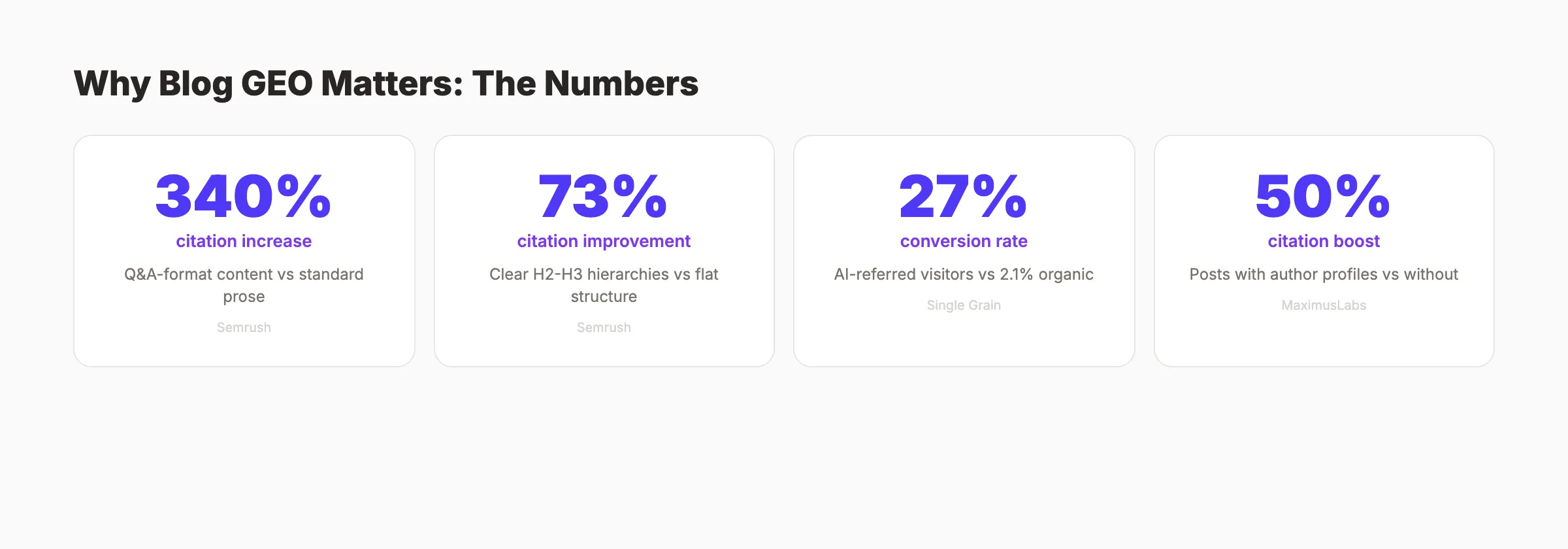
That last stat is the reason GEO matters for revenue, not just visibility. AI-referred visitors convert at 27% compared to 2.1% for traditional organic. They arrive with higher intent because the AI already pre-qualified the match.
The 15-Point Blog GEO Checklist
Use this checklist for every blog post before publishing. The items are ordered by impact, highest first.
1. Answer the Core Query in the First 80 Words
- The first paragraph directly answers the question the target keyword implies
- The answer is 40 to 80 words, self-contained, and makes sense without any surrounding context
- No filler introduction before the answer
AI models extract passages. The first passage on a page gets the highest retrieval score. If your opening is a generic introduction instead of a direct answer, the AI finds a competitor’s direct answer first.
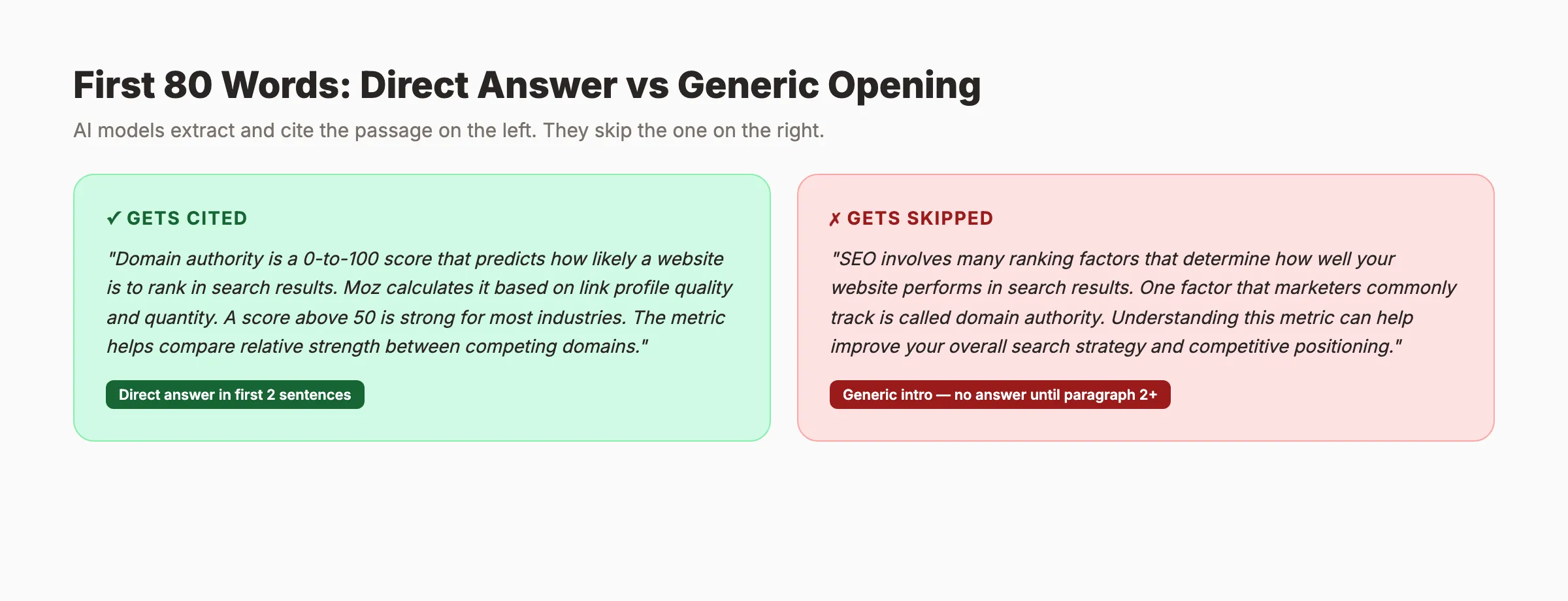
Example for “what is domain authority”:
Bad: “SEO involves many ranking factors. One factor that marketers track is called domain authority. Understanding this metric can help your strategy.”
Good: “Domain authority is a 0-to-100 score that predicts how likely a website is to rank in search results. Moz calculates it based on link profile quality and quantity. A score above 50 is strong for most industries.”
2. Use Question-Phrased H2 Headings
- At least 3 H2 headings are phrased as questions users ask
- Questions match the conversational prompts people type into AI search
- Each question heading is followed immediately by a direct answer
Q&A-format content increases AI citation rates by 340%, according to Semrush research. AI models match user queries to headings. A heading phrased as “How Long Does SEO Take?” matches the exact query structure better than “SEO Timeline Expectations.”
3. Keep Paragraphs to 2-3 Sentences Maximum
- No paragraph exceeds 3 sentences
- Each paragraph covers one single point
- Each paragraph makes sense if extracted on its own
AI models extract individual chunks, not full pages. A 5-sentence paragraph that mixes 3 different points is harder for retrieval systems to match to a specific query. Short, focused paragraphs produce cleaner extractions.
Your SEO team. $99 per month. 30 optimized articles, published automatically. Start for $1 →
4. Include Statistics with Source Attribution
- At least 3 statistics with named sources per post
- Each stat includes the specific number (not “many” or “most”)
- Each stat links to the original source
Adding statistics boosts AI visibility by 22%. Adding expert quotations boosts it by 37%, per research from Position Digital. AI models prioritize verifiable claims over opinions. A page that states “96% of web pages get zero traffic” with a source link outranks a page that states “most pages get no traffic.”
5. Add Comparison Tables for Any Multi-Item Data
- At least 1 HTML/markdown table per post when comparing items
- Tables have clear header rows and consistent formatting
- Tables present data AI can extract without interpreting images
Tables have 35% higher extractability than prose for comparison data. AI models parse table structures natively. A comparison table of “Tool A vs Tool B vs Tool C” gets cited directly. The same information in paragraph form gets skipped because it requires interpretation.
6. Write a Self-Contained FAQ Section
- 4 to 6 FAQ questions at the end of the post
- Each answer is 2 to 4 sentences, direct and complete
- Questions mirror People Also Ask phrasing
- FAQ schema markup is implemented
FAQ sections are citation magnets. Each question-answer pair is a standalone passage that matches specific AI queries perfectly. Posts with FAQ schema get disproportionately more AI citations because the structured data tells models exactly where the answers are.
7. Implement Article and FAQ Schema Markup
-
BlogPostingorArticleschema with title, author, datePublished, dateModified -
FAQPageschema for the FAQ section - Author entity linked to an author profile page
-
Organizationschema on the homepage
75% of high-performing GEO pages use schema markup, according to research compiled by Onely. Schema does not guarantee citations, but it makes your content machine-readable. AI models that parse structured data can extract answers more accurately.
8. Allow AI Crawlers in Robots.txt
-
PerplexityBotis allowed -
GPTBotis allowed -
ClaudeBotis allowed -
Googlebotis allowed (for AI Overviews) - No blanket disallow rules blocking AI crawlers
If AI crawlers cannot access your content, AI search engines cannot cite it. Check your robots.txt and verify that no rules block the major AI user agents. This is the most common technical barrier to AI visibility.
9. Add an llms.txt File
- An llms.txt file exists at your domain root
- It describes your site structure, key pages, and content categories
- It is formatted according to the emerging llms.txt standard
An llms.txt file helps AI systems understand what your site covers and where to find specific content types. It takes 10 minutes to create and has no downside.
3,500+ blogs published. 92% average SEO score. See what Stacc can do for your site. Start for $1 →
10. Include Author Credentials on Every Post
- Author name is visible on the page
- Author links to a profile page with bio, credentials, and social links
- Author profile includes relevant expertise for the topic
Author profiles boost citation rates by 50%, per MaximusLabs data cited by Onely. AI models use E-E-A-T signals to evaluate source trustworthiness. A named expert with credentials signals higher reliability than “Admin” or no author attribution.
11. Use Bold Text for Key Takeaways
- At least 1 bold sentence per H2 section highlighting the key insight
- Bold text summarizes the actionable takeaway, not just important keywords
AI extraction systems weight visually emphasized text. A bold sentence within a section serves as a summary the model can extract quickly. Think of bold text as a passage-level meta description.
12. Link to Authoritative External Sources
- At least 3 external links to authoritative sources (.edu, .gov, research organizations, major industry publications)
- Links go to specific pages with the claim, not homepages
- Each external link supports a factual claim in your content
AI models that cross-reference your claims against other sources give higher trust scores to content that explicitly cites its evidence. Linking to Google Search Central, Ahrefs studies, or academic research adds verifiable authority.
13. Build Internal Links to Related Content
- 3 to 5 internal links per 1,000 words
- Links use descriptive anchor text (not “click here”)
- Links connect to topically related posts in the same content cluster
Internal linking signals topical depth. AI models that detect a cluster of 5 to 10 interlinked articles on the same subject assign higher topical authority scores than they assign to isolated standalone posts.
14. Update the Published Date and Content Regularly
- The post includes a visible “Last updated” date
- The
dateModifiedfield in schema markup reflects the actual last edit - Content is refreshed with current-year data at least quarterly
- Stale statistics are replaced with newer sources
Content freshness is a stronger signal for AI search than for Google. 40 to 60% of domains cited by AI models change monthly, according to University of Digital data cited by Onely. A post with 2024 data loses citation potential against a competitor with 2026 data on the same topic. Updating old blog posts resets the freshness clock.
15. Track AI Referral Traffic and Citation Frequency
- GA4 is configured to track referrals from
perplexity.ai,chatgpt.com, andgemini.google.com - A monthly review cadence checks which pages receive AI referral traffic
- Citation frequency is monitored (manually or with a tool)
- Pages losing citations are flagged for content refresh
You cannot optimize what you do not measure. Set up AI search visibility tracking to identify which posts earn citations and which need improvement. The posts receiving AI referral traffic are your GEO success stories. Study their structure and replicate it.
Stop writing. Start ranking. Stacc publishes 30 SEO articles per month for $99. Start for $1 →
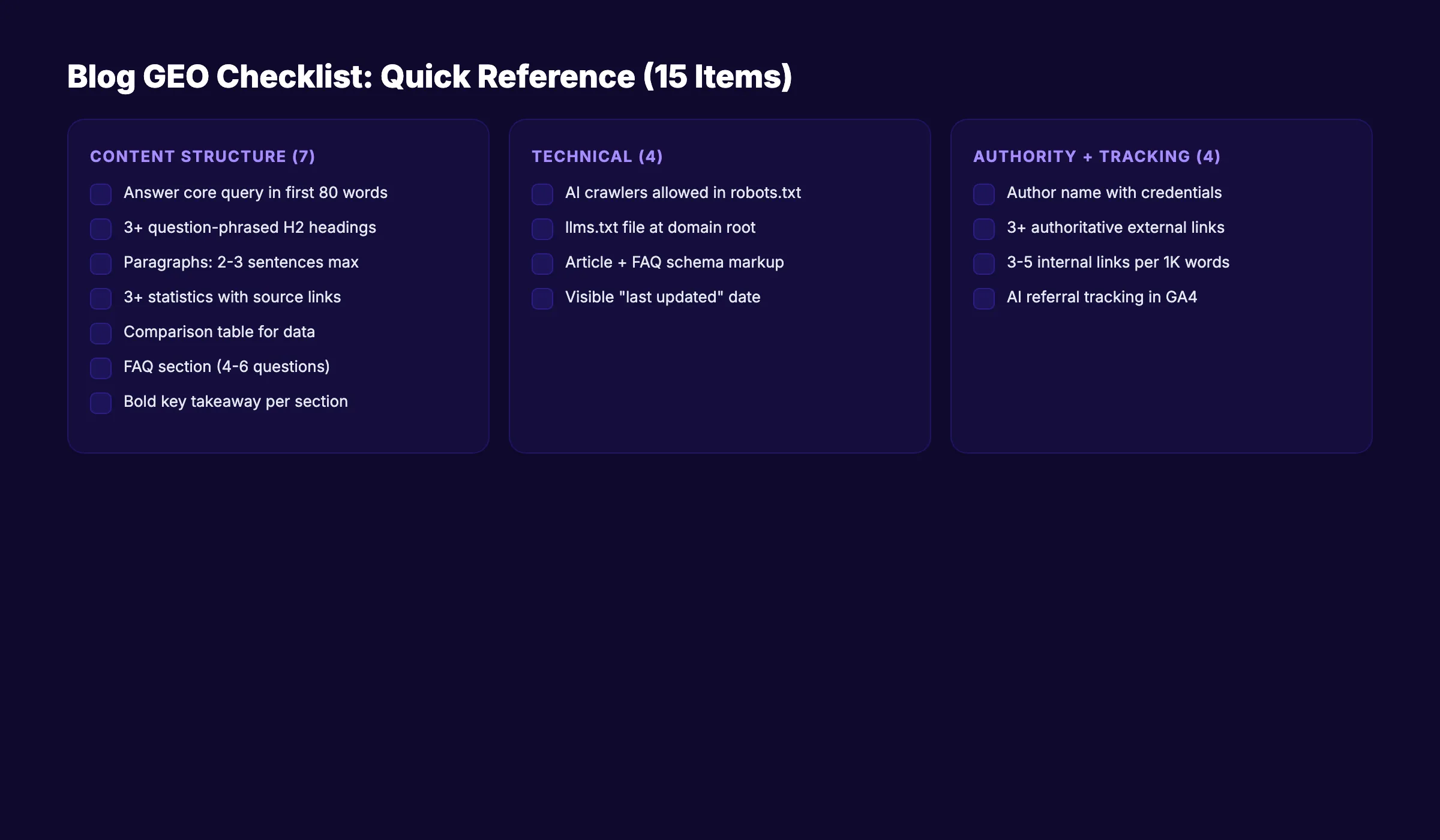
The Blog GEO Checklist (Quick Reference)
Copy this checklist and use it for every post:
Content Structure
- Direct answer in first 80 words
- Question-phrased H2 headings (3+ per post)
- Paragraphs of 2-3 sentences maximum
- At least 3 statistics with source links
- Comparison table for multi-item data
- Self-contained FAQ section (4-6 questions)
- Bold key takeaway per section
Technical
- AI crawlers allowed in robots.txt
- llms.txt file at domain root
- Article + FAQ schema markup implemented
- Visible “last updated” date
Authority
- Author name with linked credentials
- 3+ external links to authoritative sources
- 3-5 internal links per 1,000 words
Measurement
- AI referral tracking in GA4
- Monthly citation review
How to Apply This Checklist to Existing Blog Posts
New posts should follow the checklist from the start. But most sites have dozens or hundreds of existing posts that need GEO optimization. Here is how to prioritize.
Identify Your Highest-Value Posts
Start with the posts that already rank on page 1 or 2 in Google. These have proven topical relevance. Adding GEO optimization makes them eligible for AI citations without rebuilding from scratch.
Pull your top 20 pages by organic traffic from Google Search Console. These are your priority targets.
Run a GEO Audit on Each Post
For each priority post, check against the 15-point checklist above. Score each post on how many items it passes. Posts scoring below 8 out of 15 need a full rewrite of their opening and structure. Posts scoring 8 to 12 need targeted fixes. Posts scoring 13 or above need minor tweaks only.
Focus on the Opening First
The single highest-impact change for existing posts is rewriting the opening. Most older blog posts start with a generic introduction. Replace it with a direct 40-80 word answer to the query the keyword implies. This one change alone can earn AI citations.
Add FAQ Sections to Posts That Lack Them
If a post has no FAQ section, add one. Write 4 to 6 questions based on People Also Ask data for that keyword. Each answer should be 2 to 4 sentences. Add FAQ schema markup. This is the second-highest impact change after the opening rewrite.
Update Statistics and Dates
Replace any statistics from 2023 or earlier with current-year data. Update the visible “last updated” date and the dateModified schema field. AI models deprioritize content with stale data.
Schedule Quarterly Reviews
Create a calendar reminder to review your top 20 GEO-priority posts every quarter. Check for stale data, broken external links, and new content gaps that competitors have filled. Consistent maintenance keeps your citation rates stable.
Common GEO Mistakes to Avoid
Mistake 1: Treating GEO as a replacement for SEO.
GEO builds on top of traditional SEO. You still need keyword research, on-page optimization, and quality content. GEO adds an optimization layer for AI search visibility. It does not replace the foundation.
Mistake 2: Stuffing content with statistics to game AI models.
Including 20 statistics in a 1,000-word post makes it unreadable. Use 3 to 5 relevant statistics per post. Quality and relevance matter more than quantity.
Mistake 3: Ignoring content freshness after publishing.
Publishing a GEO-optimized post and never updating it defeats the purpose. AI models heavily weight freshness. Schedule quarterly reviews for every high-priority post.
Mistake 4: Blocking AI crawlers in robots.txt.
26% of brands have zero AI mentions, according to Ahrefs research. In many cases the cause is a robots.txt file blocking GPTBot, ClaudeBot, or PerplexityBot. Check your file today.
Mistake 5: Writing for AI models instead of humans.
GEO optimization makes content more structured and clearer. If your content reads like it was written for a machine, you have gone too far. AI models prioritize content that serves human readers well. The same qualities that help humans understand your content help AI extract it.
Mistake 6: Ignoring web mentions and brand presence.
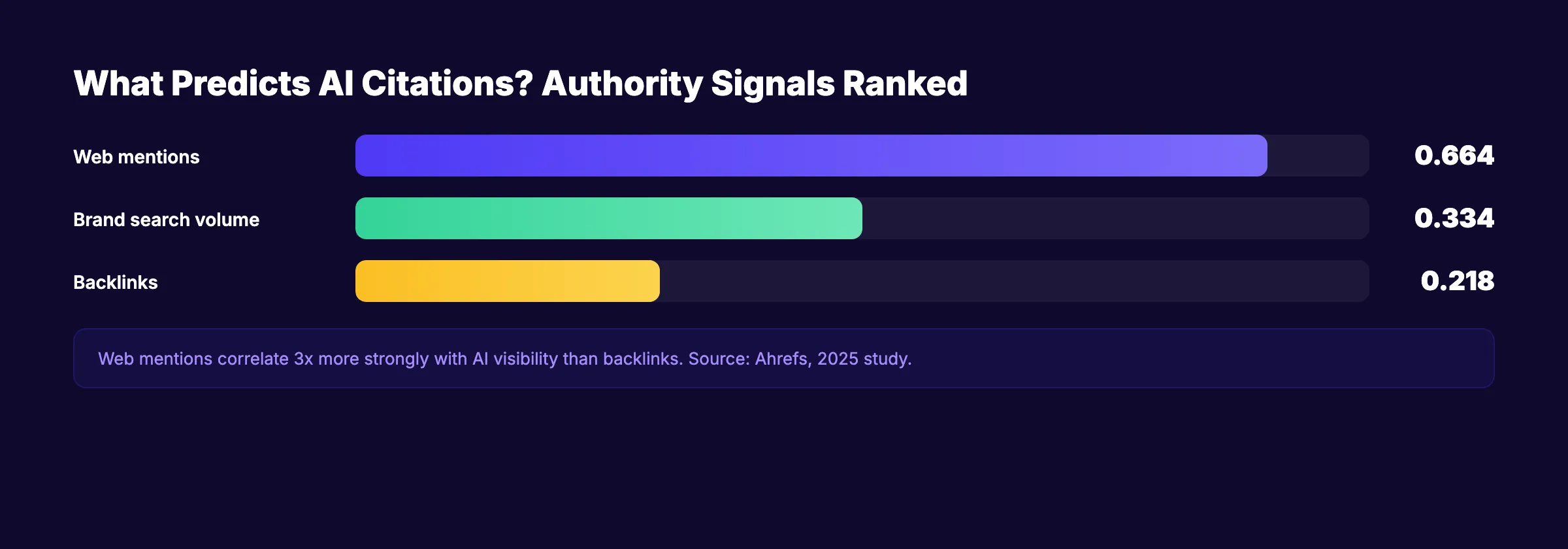
Web mentions have a 0.664 correlation with AI visibility. Backlinks have only a 0.218 correlation, per Ahrefs data. AI engines cite earned media 5 times more often than brand-owned content. If your brand is never mentioned on third-party sites, Reddit discussions, or industry publications, AI models have fewer trust signals to work with. Building brand authority through earned mentions matters more for GEO than link building.
Mistake 7: Publishing without schema markup.
75% of high-performing GEO pages use structured data. Skipping schema means AI models must infer your content structure instead of reading it directly. Article schema, FAQ schema, and author schema take 10 to 15 minutes to implement per post. The ROI compounds across every query that references your page.
FAQ
What is the difference between GEO and SEO?
SEO optimizes content to rank in traditional search engine results pages. GEO optimizes content so AI search engines (ChatGPT, Perplexity, Google AI Overviews, Gemini) cite it in their generated answers. GEO builds on SEO fundamentals but adds specific requirements for content structure, passage extractability, and authority signals. Both work together.
How long does it take to see results from GEO optimization?
Faster than traditional SEO. New or freshly updated content can earn AI citations within hours to days. Perplexity crawls in real-time. Google AI Overviews pull from its existing index and updates relatively quickly. Building consistent citation rates takes 1 to 3 months of regular publishing and optimization.
Do I need to optimize separately for each AI platform?
The core checklist applies to all platforms. ChatGPT, Perplexity, Gemini, and AI Overviews all prefer structured, well-sourced, clearly written content with direct answers. Minor differences exist. Perplexity weights content freshness more aggressively. AI Overviews favor pages already ranking in Google. But the 15-point checklist in this guide covers the shared requirements.
Does GEO work for local businesses?
Yes. Local SEO content benefits from GEO when you include location-specific data, cite local sources, and structure content for AI extraction. A local plumber publishing a well-structured guide on “how to fix a running toilet” can earn Perplexity citations just as effectively as a national brand.
How do I know if AI search engines are citing my content?
Set up GA4 to track referrals from perplexity.ai, chatgpt.com, and gemini.google.com. Pages receiving referral traffic from these domains are being cited. For manual checks, search your target queries on each platform and look for your URL in the citation list.
Can GEO increase conversions, not just visibility?
Yes. AI-sourced visitors convert at 27% compared to 2.1% for traditional organic traffic. They arrive with higher intent because the AI already matched their query to your content. Optimizing for GEO improves both visibility and revenue.
Rank everywhere. Do nothing. Blog SEO, Local SEO, and Social on autopilot. Start for $1 →

Written by
Siddharth GangalSiddharth is the founder of theStacc and Arka360, and a graduate of IIT Mandi. He spent years watching great businesses lose organic traffic to competitors who simply published more. So he built a system to fix that. He writes about SEO, content at scale, and the tactics that actually move rankings.
30 SEO blog articles published every month
Keyword-optimized, scheduled, and live on your site. Automatically.
30-day trial · Cancel anytime
theStacc
Stop writing SEO content manually
30 blog articles, 30 GBP posts, and social media content. Published every month. Automatically.
Start Your $1 Trial$1 for 3 days · Cancel anytime