Eight real US music school websites, reviewed first-hand against an enrollment-conversion rubric: trial paths, teacher trust, tuition clarity.
A parent searching "music school website design examples" is not window-shopping for inspiration. They are deciding whether to trust a stranger with their child's Tuesday afternoons for a year, on a page that has to answer that question before the first phone call ever happens.
Most of what already ranks for this search is a template gallery, a mood board, or a builder's own marketing blog — Colorlib's "30 Best Music School Website Examples," Webflow's template list, a Dribbble tag, a Pinterest board. None of them reviews a real school against what actually gets a parent to book a trial lesson.
This page reviews eight real, live, currently operating US music schools instead, scored first-hand against one fixed enrollment-conversion rubric. There is no ranked "best" pick, no promise that copying a pattern raises your own bookings or enrollments, and none of these schools is a theStacc client. For keyword strategy, Google Business Profile setup, and technical SEO, see theStacc's music school SEO guide; this page owns only the website design and conversion-path review.
Review rule: every featured site below is a real, live business, opened and screenshotted first-hand on July 12, 2026 — not an image borrowed from someone else's gallery, and not ranked against each other.
What a music-school website has to do that a generic site doesn't
A music-school website has to do something a plumber's or a dentist's site never does: sell a parent on trusting a stranger with their child's Tuesday afternoons, while the child and the parent judge the same page for completely different reasons, on a calendar the school does not control.
A plumber's site sells to the person who will actually use the service. A music school sells to a parent who pays and decides, while a child who never reads a website is the one sitting at the piano bench. Adult learners are the exception: for them, payer and user are the same person, and the design job simplifies to one buyer instead of two.
That split changes what "trust" means on the page. A parent isn't judging tone or color choices; they're judging whether this specific adult, teaching their specific child one-on-one or in a small group, deserves a recurring monthly commitment. Teacher credentials and, for youth programs, a visible safety signal do more work here than they would on a gym membership page, where the buyer and the user are usually the same adult.
Enrollment also runs on a calendar the school doesn't set. Fall brings a back-to-school push as families settle into a new school-year routine; January brings a "new year, new instrument" restart after the holidays; summer carries camps and short intensives instead of term-length lessons; and recital season, usually clustered around December and again in May or June, is when a school's actual proof — real students, on a real stage — becomes public. A homepage that never changes with that calendar is telling a parent the school isn't paying attention to it either.
| Season | What a parent is deciding | What the homepage should show |
|---|---|---|
| Fall (Aug–Sep) | Starting a new instrument for the school year | Open enrollment windows, age-band navigation front and center |
| January | Restarting a lapsed hobby or resolution | A visible, no-pressure single trial-lesson path, not a full-term ask |
| Summer | Camps or short intensives instead of year-long lessons | Camp dates and a separate short-format offer |
| Recital season (winter/spring) | Evaluating real proof before enrolling | Recent recital dates, photos, and named student outcomes |
How we chose these examples
These eight examples were chosen by applying one fixed rubric first-hand to real, live US music schools, not by aesthetics or a gallery's own "best" list, and every featured site had to clearly win on at least two of six enrollment-conversion criteria to make the cut.
The rubric has six parts:
- Trust and credential surfacing: teacher bios, real qualifications, and, for youth programs, a visible safety or background-check signal, without digging past the first click.
- Program and instrument navigation: a parent can find piano, guitar, voice, drums, strings, early-childhood, or adult programs and age bands in one or two clicks.
- Primary conversion path: a visible, low-friction trial-lesson or enrollment action above the fold, repeated in context, not buried inside a generic "Contact" form.
- Tuition and logistics clarity: a pricing model, schedule or term structure, and location, parking, or online option, findable before a parent has to call.
- Proof: recitals, real student outcomes, and genuine reviews or testimonials, presented honestly, never guaranteeing a result.
- Fundamentals: mobile layout, basic accessibility such as contrast and keyboard access (the baseline W3C WCAG expectations for any public site), and a stable load, judged qualitatively against Google's own Core Web Vitals categories rather than a manufactured Lighthouse score.
Every entry below records a screenshot captured for this piece, the date accessed, the live URL, the platform observed where identifiable, and the one enrollment-conversion element it earns its place for, checked on both a desktop and a real 390-pixel phone viewport. Template demos, builder showcase pages, agency portfolio mockups, and dead links were excluded outright, whatever their visual polish.
The live US search results for this exact phrase on July 11–12, 2026 were a uniform gallery field, not a review field. None of the nine sources below was reused as a featured example:
| Discovery source | What it is | Why it wasn't reused |
|---|---|---|
| Colorlib | "30 Best Music School Website Examples 2026" listicle | No stated selection method |
| Webflow | "4 best music school website templates and designs" | Template marketplace, not a live school |
| Dribbble (tag) | Portfolio mockups tagged "music school website" | Concept work, not a live business |
| Dribbble (search) | Broader search results on the same tag | Same portfolio-mockup issue |
| "9 Music School Website ideas" board | A mood board, not a reviewed school | |
| Bandzoogle | "Best music teacher websites" blog post | Builder's own marketing blog |
| ThemeForest | "Music School Website Templates" search results | Template marketplace |
| Weblium | "Music School Website Design" free template page | A builder's own template demo |
| Reddit r/webdev | A single "showoff Saturday" thread from 2021 | One anecdotal post, unverified as current |
Akshay VR (theStacc Marketing Head) owns this list and will recheck every entry by July 2027, sooner if any featured site redesigns, changes its trial offer, or goes offline.
The examples
Eight real, currently operating US music schools were opened and screenshotted on July 12, 2026: three independent studios, one in-home multi-city network, two multi-location academies, one nonprofit multi-campus school, and one national franchise location, scored against the same six criteria before any design decision was called worth stealing.
The scorecard below is a quick-glance summary; the write-up under each site names the specific first-hand detail behind each mark.
| Site | Trust / credential | Program nav | Trial CTA | Tuition / logistics | Proof | Fundamentals |
|---|---|---|---|---|---|---|
| Eastside Music School | Partial | Pass | Pass | Fail | Partial | Partial |
| Milwaukee Music Lessons | Partial | Pass | Pass | Pass | Pass | Pass |
| Henderson Academy of Music | Fail | Partial | Pass | Partial | Partial | Pass |
| EKS Music School | Partial | Pass | Partial | Pass | Pass | Pass |
| California Conservatory of Music | Pass | Pass | Pass | Fail | Pass | Pass |
| Dublin Music Academy | Pass | Pass | Partial | Partial | Pass | Pass |
| Community School of Music and Arts | Fail | Partial | Fail | Partial | Partial | Pass |
| School of Rock (Austin) | Fail | Pass | Partial | Fail | Partial | Pass |
Eastside Music School — independent studio, Austin, TX
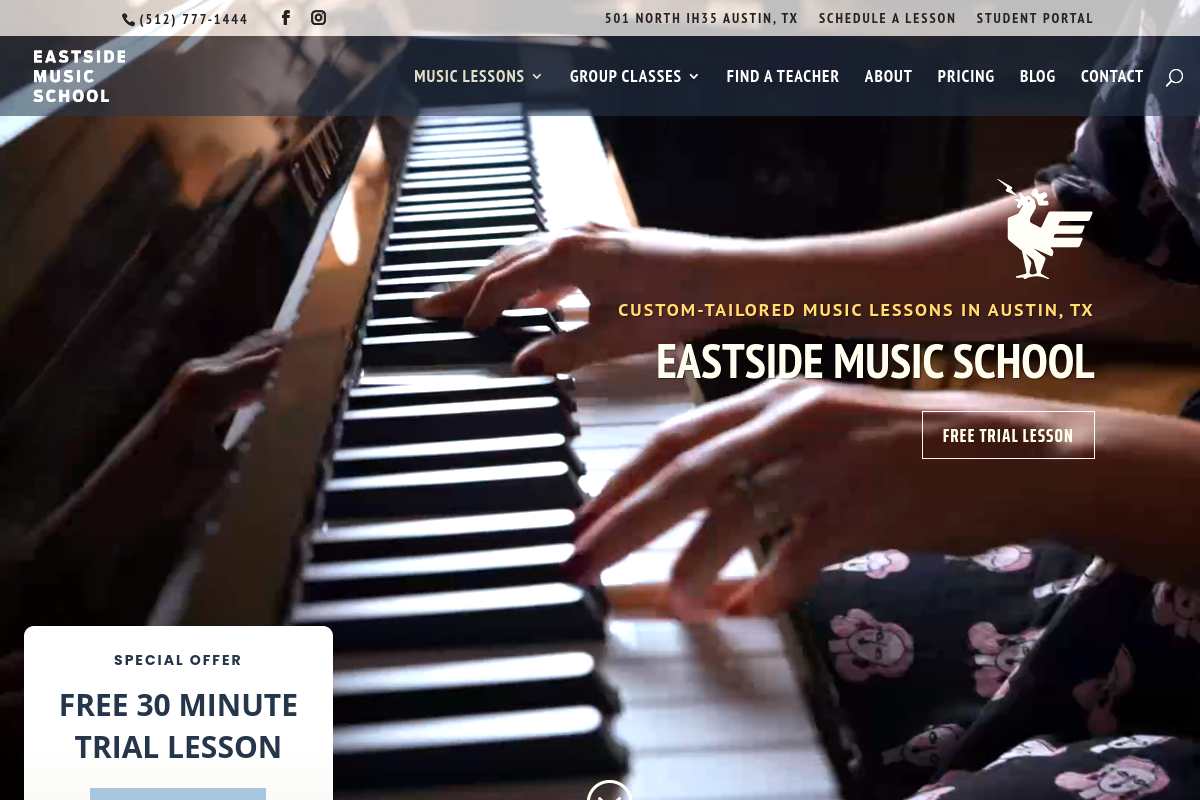
Public URL: eastsidemusic.com (501 North IH-35, Austin, TX). Captured July 12, 2026. Platform: WordPress, Divi theme (Elegant Themes).
The homepage repeats one offer — a free 30-minute trial lesson — in the top utility bar, the hero button, and a corner card that stays in view while scrolling. Piano, voice, guitar, drums, ukulele, and songwriting each get a named nav item, and three attributed adult-student testimonials sit above the contact form. No tuition figure appears anywhere on the homepage, and no teacher name or credential shows before a click into "Find a Teacher." Worth stealing: repeating one trial offer in three visual positions instead of one deep link, so a parent scanning on a phone still lands on it.
Milwaukee Music Lessons — independent studio, Milwaukee, WI
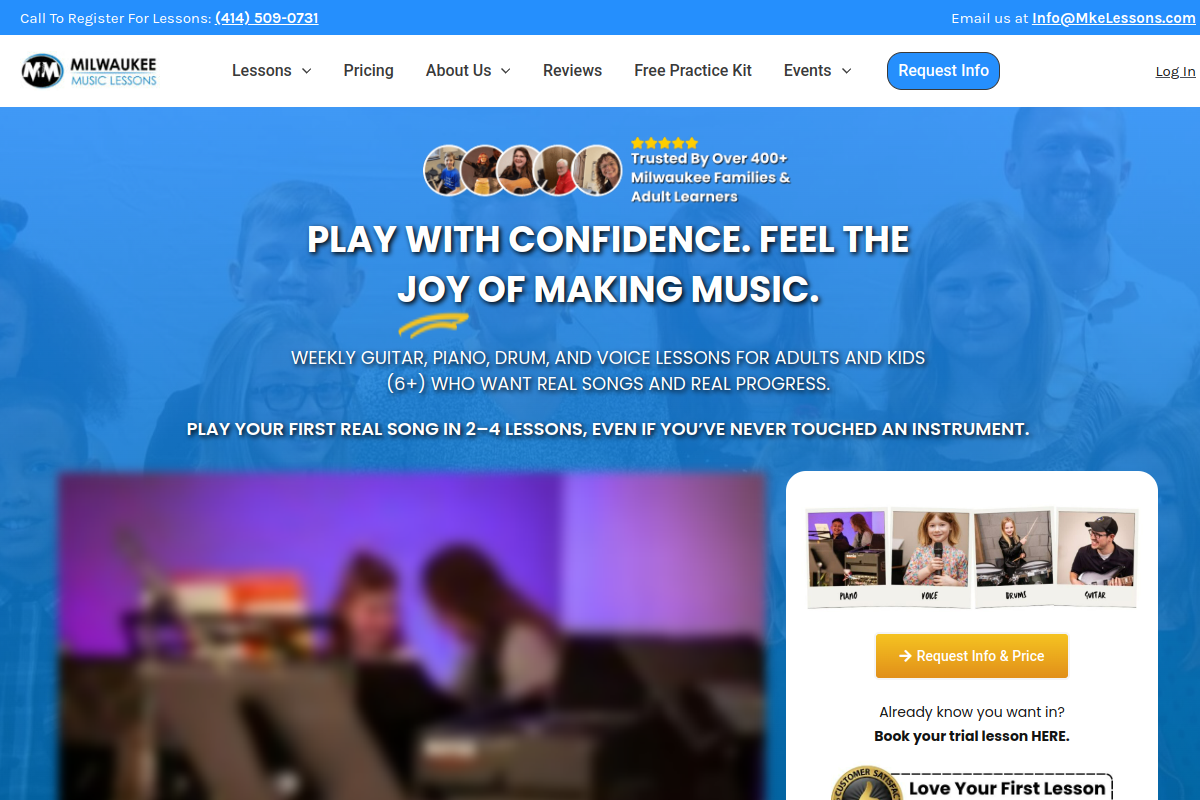
Public URL: mkelessons.com (3951 S 71st Street, Milwaukee, WI). Captured July 12, 2026. Platform: WordPress, Astra theme with Elementor.
The hero states the monthly tuition — $160 for a weekly 30-minute lesson — and a "love your first lesson or it's free" guarantee before the first scroll, alongside a sticky call-and-text bar and named teacher photos for piano, voice, drums, and guitar. The FAQ states minimum ages (six for instruments, eight for voice) and a month-to-month cancellation policy instead of a contract. A "trusted by 400+ Milwaukee families" line is a self-reported claim, not an audited figure. Worth stealing: leading with a real number instead of "contact us for pricing," removing the biggest unstated barrier for a parent budgeting a recurring cost.
Henderson Academy of Music — independent, in-home lessons across six metro areas
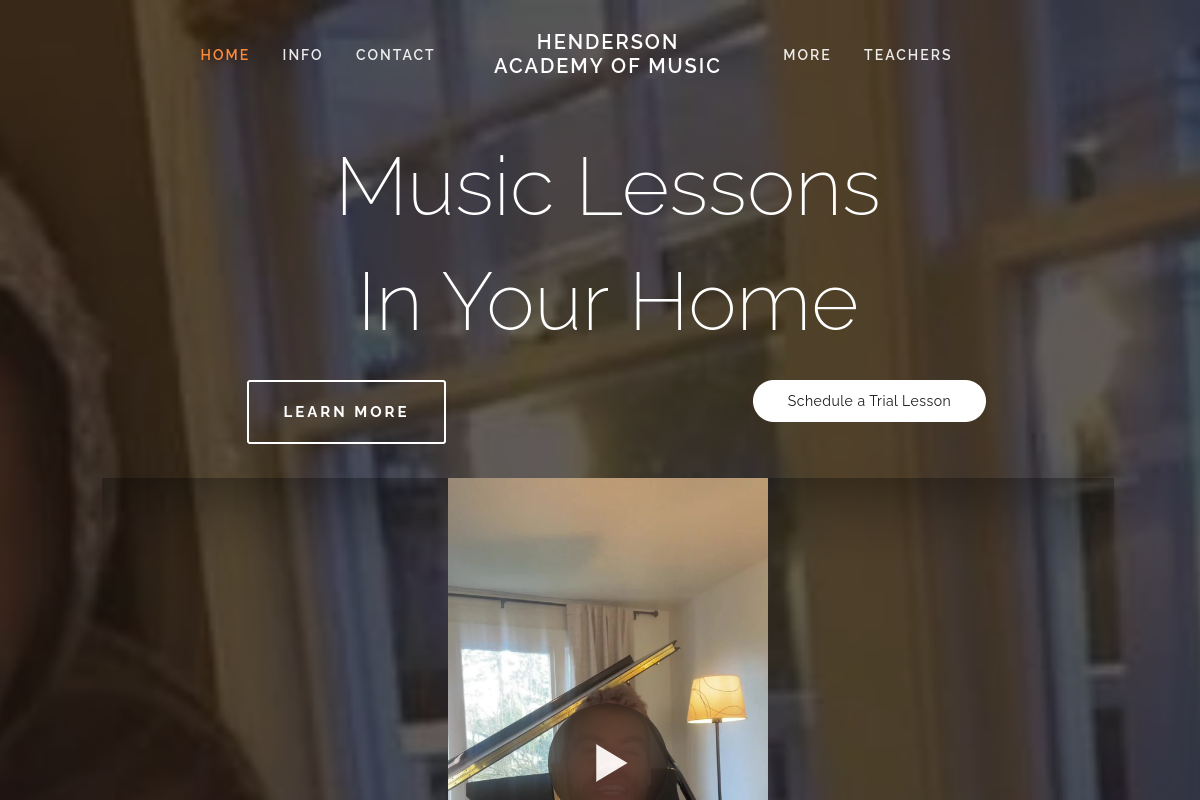
Public URL: hendersonacademyofmusic.com (Shoreline, WA; serves Seattle, Portland, the Bay Area, Los Angeles, San Diego, and New York City). Captured July 12, 2026. Platform: Squarespace.
This school has no single teaching address — lessons happen in a family's own home or over video call, across six metro areas and, by its own claim, more than 70 teachers. The hero pairs a real, unposed video of a lesson in progress with a "Schedule a Trial Lesson" button visible on both desktop and mobile without scrolling. Teacher bios sit behind a city-select menu two clicks deep, and no background-check statement appears anywhere on the public site, despite sending an instructor into a family's home. The in-home model also forgoes the location-based trust signals a studio can lean on, since an eligible Google Business Profile requires in-person customer contact at a stated location. Worth stealing: an unposed video of an actual lesson as hero content, doing double duty as trust proof for a school with no storefront to walk past.
EKS Music School — independent studio, Quincy, MA
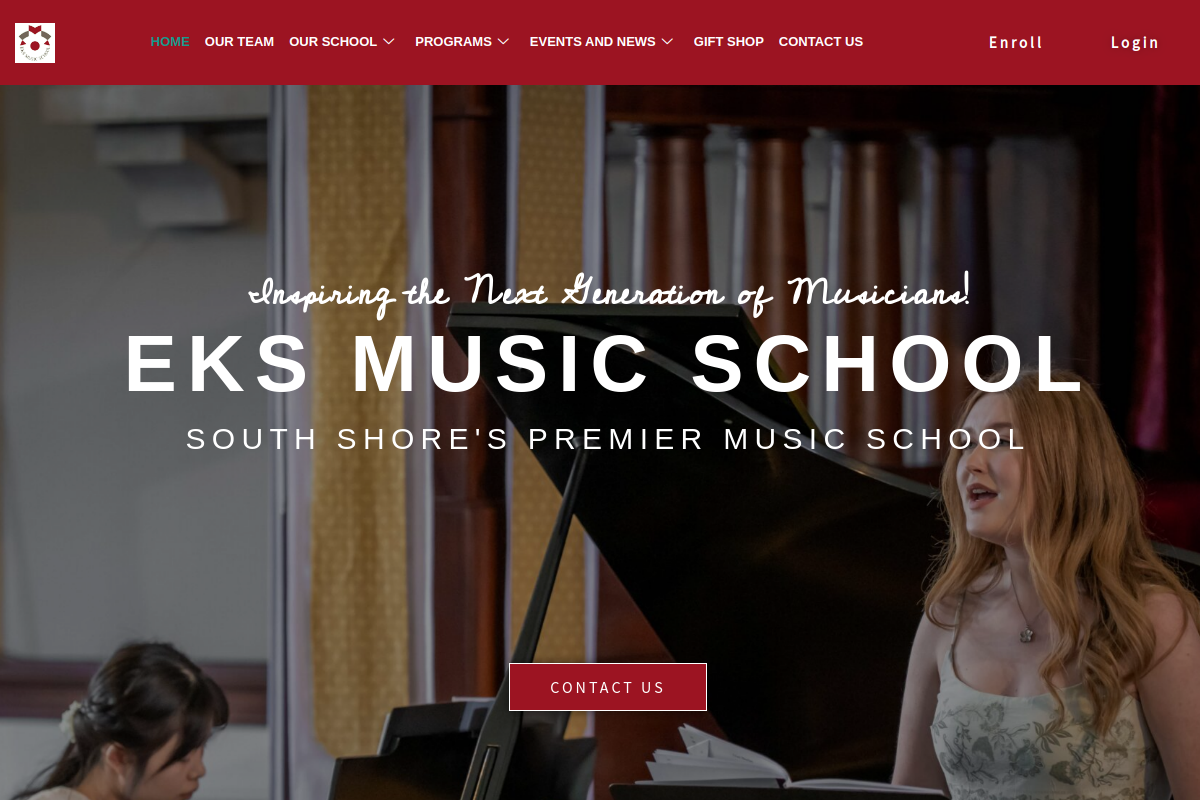
Public URL: eksmusicschool.com (101 Adams Street, Suite 20, Quincy, MA). Captured July 12, 2026. Platform: WordPress, Astra theme with Elementor and ElementsKit.
Four pricing tiers sit directly on the homepage — private lessons from $25, semi-private from $40, a $95-a-month group class, and a flexible package from $660 — next to a dozen attributed parent and student testimonials naming real teachers. Membership badges for the National Music Teachers Association, the Massachusetts Music Teachers Association, and the Royal Conservatory appear in the footer. The hero's own button reads "Contact Us," not "Book a Trial Lesson," even though a dedicated trial-lesson program exists one click deeper in the Programs menu. Worth stealing: a genuine multi-tier price list with real names on reviews, rather than a single "starting at" figure — though the trial offer deserves the same billing the pricing gets.
California Conservatory of Music — multi-location academy, Bay Area, CA
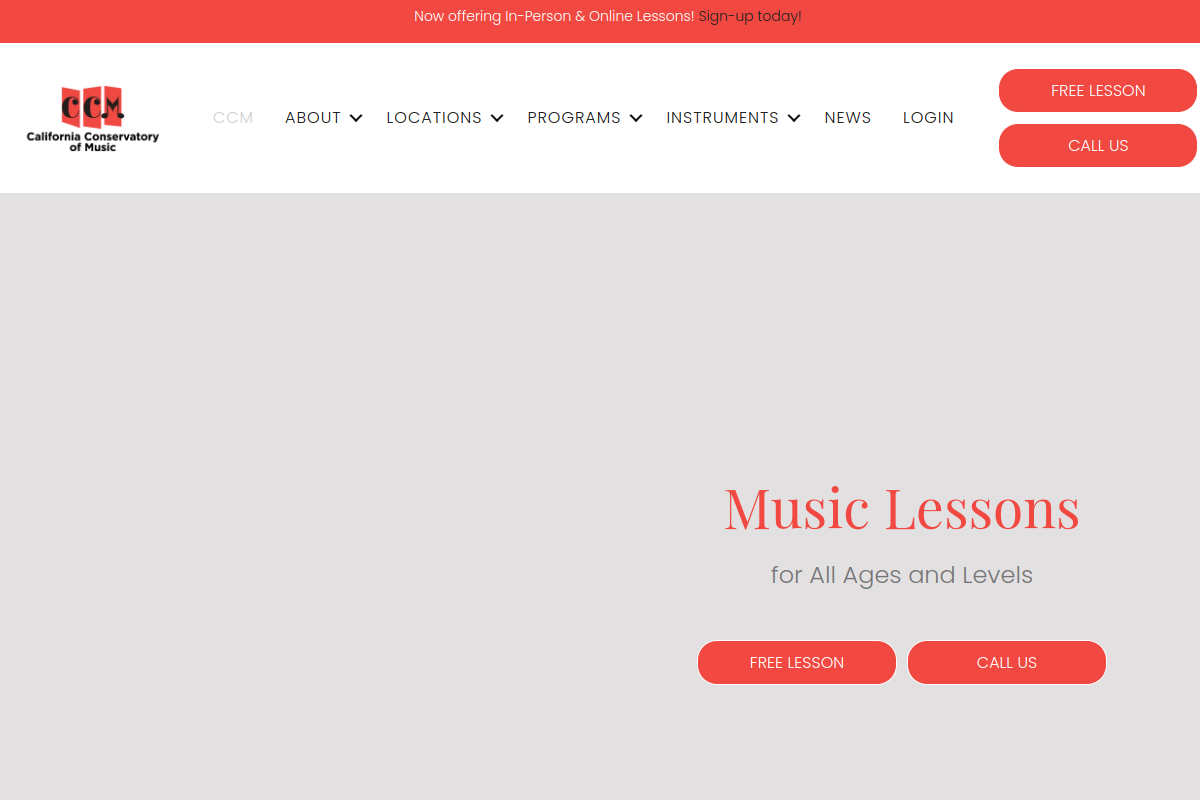
Public URL: thecaliforniaconservatory.com (Sunnyvale, Redwood City, and Fremont, CA). Captured July 12, 2026. Platform: WordPress with Elementor.
Owners Robert Miller and Christopher Mallett are named directly on the homepage alongside a "since 2011" tenure claim and a named Suzuki-method program, one of the few sites here to put an owner's name ahead of a generic "our story" line. A "Free Lesson" button repeats four times, and the mobile header adds a one-tap phone icon separate from the hamburger menu, so a parent can call without opening navigation at all. No tuition figure appears anywhere on the homepage across any of the three locations. Worth stealing: the dedicated mobile call icon, removing a full tap-sequence for a parent calling from a phone.
Dublin Music Academy — multi-location academy, Dublin, Lewis Center, Powell & Hilliard, OH
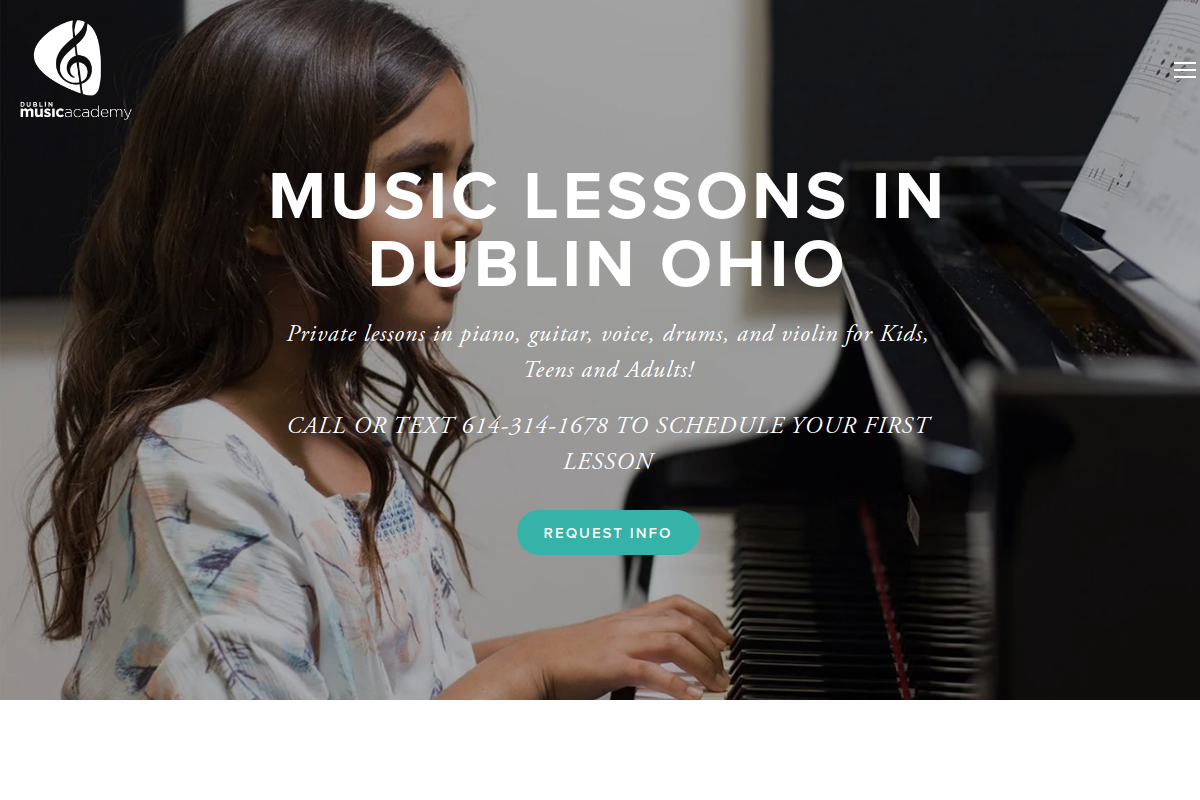
Public URL: dublinmusicacademy.org (5930 Venture Drive, Dublin, OH, plus three more Ohio locations). Captured July 12, 2026. Platform: Squarespace.
The homepage states outright that "all of our instructors are background-checked," names a specific refund policy — a full first-month refund if a family leaves before week five, branded the "Right Decision Guarantee" — and claims 1,100 students a week across four locations. Nine instruments get their own nav item, from piano through cello. The hero's primary button reads "Request Info," one step removed from the "Book a Trial Lesson" buttons further down the page. Worth stealing: naming the safety and refund policies specifically, in the school's own words, rather than a generic "we care" line.
Community School of Music and Arts — nonprofit multi-campus school, Mountain View & Belmont, CA
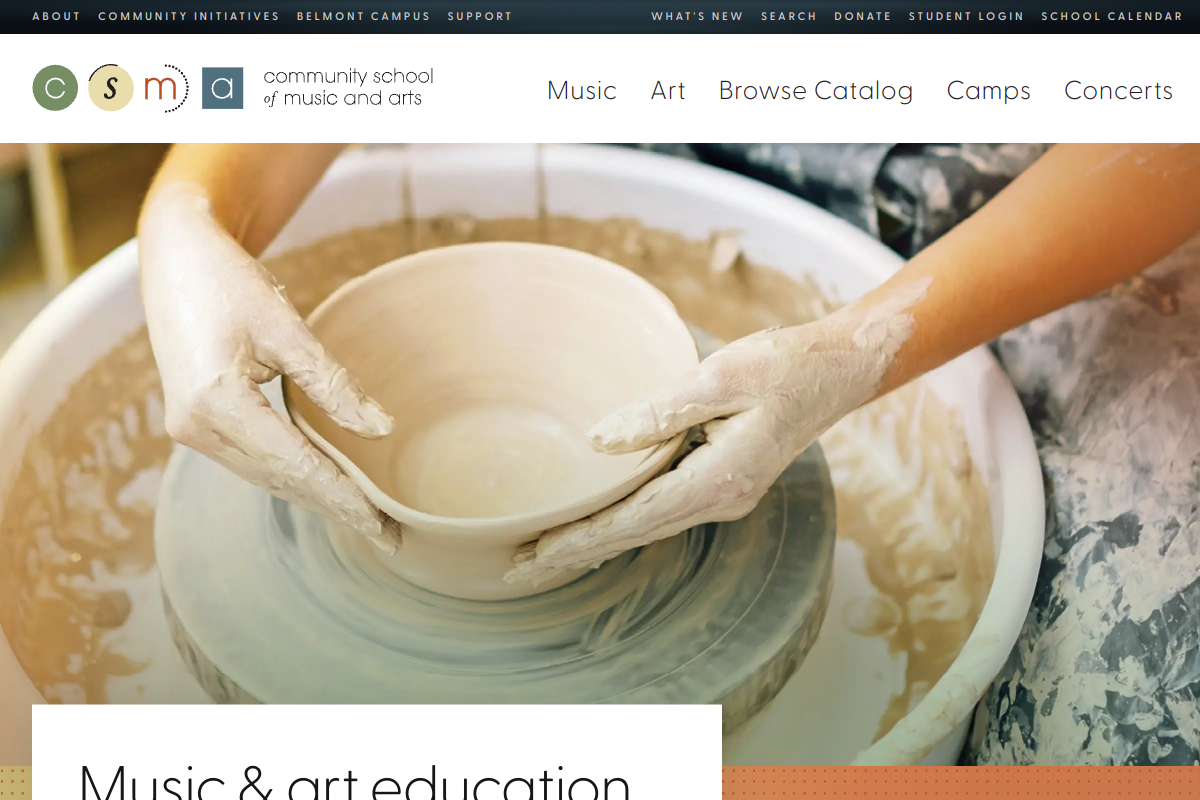
Public URL: arts4all.org (Finn Center, Mountain View, CA, plus a Belmont campus). Captured July 12, 2026. Platform: WordPress with Elementor Pro and JetEngine.
As Northern California's largest nonprofit arts-education provider, CSMA leads with financial aid and access rather than a sales pitch — "financial aid and program subsidies ensure access to the arts for all" appears in the mission statement itself, ahead of any pricing detail. Music and art share top-level navigation, so a parent opens Music, then Private Music Lessons, before reaching lesson-specific information; no trial-lesson entry point appears on the homepage, only "registration for fall classes is now open." Worth stealing: naming affordability support in the hero copy itself, before a family has to ask privately.
School of Rock — Austin, TX (national multi-branch franchise)
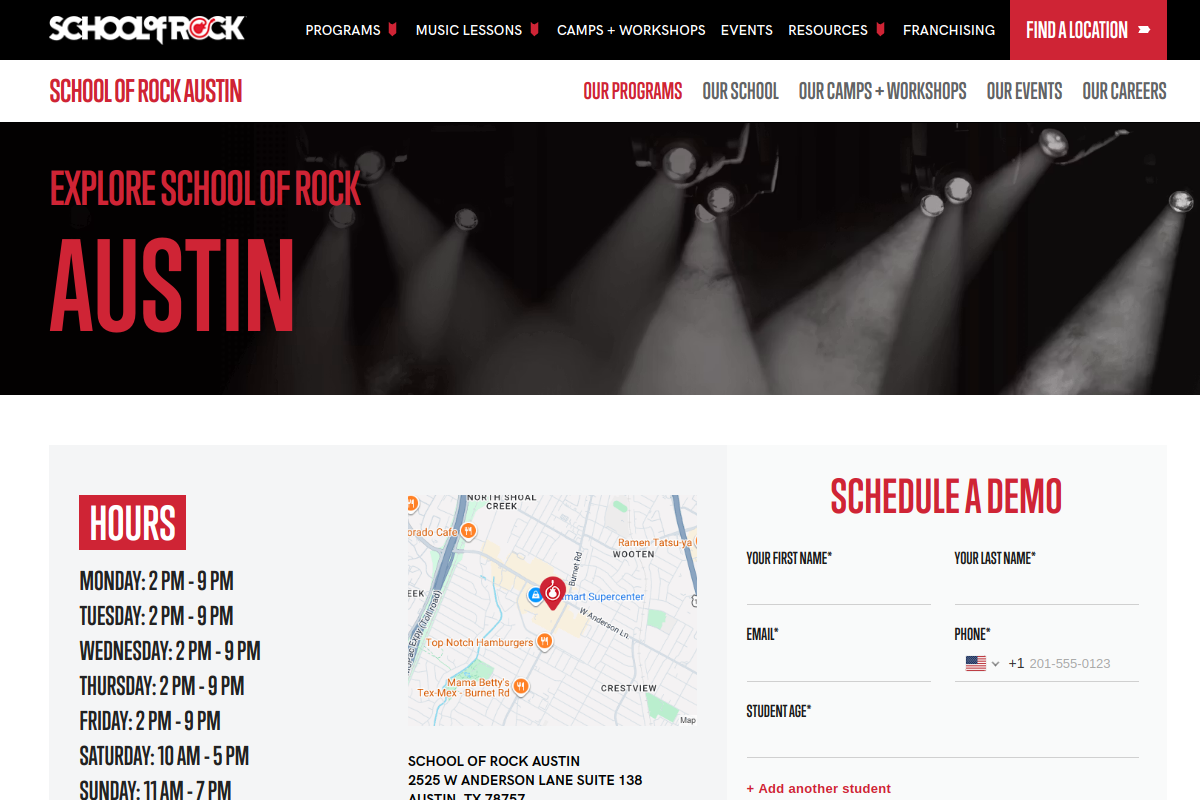
Public URL: schoolofrock.com/locations/austin (2525 W Anderson Lane, Austin, TX; one of 450-plus franchised locations worldwide). Captured July 12, 2026. Platform: custom-built corporate site with no public CMS signature detected, plus a third-party accessibility overlay icon on every page.
The location page embeds a "Schedule a Demo" lead form directly beside the address, hours, and an embedded map, so a parent doesn't have to leave the page to start. Programs are named by age band — Rookies for ages 6-7, Rock 101 for 8-13, Performance for 8-18, an Adult Program for 18-plus — with a distinct guitar, drum, vocal, bass, and keyboard lesson page for each. No tuition figure appears on the page, and no individual teacher name or credential is listed for this location. On a phone, the booking form drops below the map and hours instead of sitting beside them. Worth stealing: co-locating the lead form with proof of a physical address and posted hours, rather than a separate contact page — though "Demo" is a franchise term a first-time parent may not read as "trial lesson."
The enrollment-conversion checklist distilled from the examples
Strip away branding and eight schools converge on the same seven-part pattern: a credential-forward hero, program and age navigation, a persistent trial CTA, tuition and term transparency, recital or review proof, clear location and schedule details, and, where the budget allows, a student or parent portal.
- Credential-forward hero: name a real teacher, owner, or association membership on the first screen, not on a separate "About" page.
- Program and instrument navigation: list instruments and age bands in the main menu itself, not folded inside a single "Programs" page.
- Persistent trial CTA: repeat the same trial-lesson wording in the header, the hero, and again after the first scroll, instead of switching between "Contact Us," "Request Info," and "Schedule a Demo" for the same action.
- Tuition and term transparency: publish at least a starting price or a monthly range, plus whether lessons run month-to-month or by fixed term.
- Recital and review proof: a dated recital photo and real, attributed reviews outweigh a star badge with no stated source.
- Location and schedule clarity: state every address, hours, and whether an online option exists, especially for a multi-location or in-home school.
- Student or parent portal, or booking integration: where budget allows, a simple login or scheduling tool signals the operation runs on more than phone calls and a shared calendar.
| Element | Funnel stage it serves | Buyer it serves |
|---|---|---|
| Credential-forward hero | Impression → click | Parent (primary), adult learner |
| Program / instrument navigation | Click → qualified enquiry | Parent and adult learner |
| Persistent trial CTA | Qualified enquiry → booked trial | Parent for youth, learner for adult programs |
| Tuition and term transparency | Qualified enquiry → booked trial | Parent (payer) |
| Teacher bios and credentials | Qualified enquiry | Parent (payer) |
| Recital or outcome proof | Qualified enquiry → booked trial | Parent (payer) |
| Genuine reviews | Qualified enquiry | Parent (payer) |
| Location and schedule | Qualified enquiry → booked trial | Parent and adult learner |
| Student / parent portal or booking tool | Booked trial → retained student | Parent and adult learner |
| Youth safety signals | Qualified enquiry | Parent (payer), youth programs only |
Before a school rebuilds anything, inventory what already exists so the new site reflects real programs and real proof, not a designer's placeholder text:
- Current program and instrument list, with age bands
- Teacher roster with real credentials and, for youth programs, background-check status
- The exact trial offer: free or paid, its length, and what happens right after it
- Tuition model: per-lesson, monthly, or package, plus any multi-instrument or sibling terms
- Brand assets: real photos and video of your own students and space, not stock imagery
- Where your genuine reviews already live — Google, Facebook, or testimonials on file
- The booking or CRM tool a lead should land in, and who owns the follow-up
- The analytics events you'll fire for a trial-request submit, before the new site launches
A school that wants search engines to understand its organization, address, and hours directly can add its own structured data using the MusicSchool or LocalBusiness vocabulary schema.org defines; that markup describes your business, not this review, so it isn't part of this page's own schema.
Bring this checklist to your own redesign. theStacc's Content SEO module can research, draft, and queue the program and instrument pages a redesign needs; your team stays the final word on tuition, credentials, and safety claims.
Common mistakes on music-school sites
Three of the eight sites reviewed here hide their tuition entirely, one buries its trial-lesson offer behind a "Contact Us" button, and one nonprofit's homepage never asks a parent to book anything at all — these are the specific, repeatable mistakes a redesign should fix first.
- Hidden pricing: School of Rock's Austin location page and California Conservatory both give a phone number and a form but no figure at all; a parent has to call just to learn the cost of a recurring monthly commitment.
- No visible trial path above the fold: CSMA's homepage opens on class registration and a mission statement, with no trial-lesson or single-lesson entry point anywhere on the front page.
- Stock-photo-only trust: a generic photo of hands on a keyboard, with no named teacher, no real space, and no dated proof that lessons happen where the site claims.
- Buried teacher credentials: Henderson Academy's 70-plus teacher bios sit behind a city-select flow, and EKS's association memberships appear only in the footer, not next to the trial CTA where a nervous parent is deciding.
- No mobile enrollment path: School of Rock's booking form sits below the map and hours on a phone screen, adding a scroll a desktop visitor never has to make.
- Unlabeled program pages: a "Programs" or "Lessons" menu that lists age-tier names without saying which instruments or ages they actually cover, forcing a parent to open each one to find out.
- Missing safety signals for youth programs: an at-home or one-on-one instructor model that never states a background-check policy anywhere on the public site, even though several sites in this review do exactly that.
Fixing stock-only trust proof usually means collecting and displaying real reviews the right way — see theStacc's review management guide for how to request and respond to them without incentivizing or faking anything. Fixing a hidden multi-location structure is closer to a local SEO problem than a design one, once every location has its own address and hours published.
Not sure which mistake is costing you enquiries? We can review your current site against this same six-part rubric and tell you plainly what's missing, with no pressure to rebuild anything that already works.
Measuring whether a redesign actually helped
A redesign is only proven to help once a school defines a trial-request submit rate and a trial-to-enrollment rate in advance, names the source system and owner for each funnel stage, and compares one declared before/after window against a matched season, not fall against summer.
Keep every stage of the funnel on its own line, from a search impression through a retained student, because collapsing a form submit into an "enrollment" makes any redesign look like it worked when it only moved one stage:
| Stage | Definition | Source system | Owner |
|---|---|---|---|
| Search impression | Page or listing rendered to a searcher | Search Console / analytics | Marketing owner |
| Result click | Visitor lands on the site from that impression | Analytics | Marketing owner |
| Call click / trial-request form submit | Tap on a tracked phone number, or a submitted trial or enrollment form | Call tracking or form log | Intake owner |
| Qualified enquiry | Matches the school's written age, instrument, location/online, and budget rule | CRM | Intake owner |
| Booked trial lesson | Confirmed trial on the schedule | Scheduling / CRM | Scheduling owner |
| Attended trial | Trial actually took place | Scheduling / attendance record | Front-desk owner |
| Enrolled (recurring) student | Active, recurring enrollment under the school's own written rule | Enrollment / billing record | Enrollment owner |
| Retained through term | Still enrolled at the end of the stated term or session | Enrollment / billing record | Operations owner |
A form submit is never an enrollment, and a booked trial is never a retained student. Defining a single custom GA4 event, such as a trial-request submit, lets the rate below be computed from one authoritative event rather than reverse-engineered from generic pageview data.
| Formula | Numerator | Denominator | Evidence window | Source system | Owner | Exclusions |
|---|---|---|---|---|---|---|
| Trial-request submit rate | Unique visitors who submit the trial-lesson/enrollment request form | Unique visitors who reached the page/site in the same window | One declared window spanning comparable enrollment seasonality (e.g., matched 4-week periods, not fall vs. summer) | Web analytics (GA4 event) with form/CRM confirmation | Website/marketing owner | Bots, internal traffic, duplicate submits, spam, staff/applicant traffic |
| Trial-to-enrollment rate | Unique attended trials that convert to a paid recurring enrollment under the school's written rule | Unique attended trials in the same cohort | Trial cohort plus the school's declared decision lag (e.g., 14–30 days) | Scheduling/CRM + billing record | Enrollment/front-desk owner | No-show trials, siblings enrolled under one trial counted once, re-enrolling former students, comped lessons |
Present these as how to measure a redesign, never as evidence that any featured site above achieves a particular rate; none of these eight schools' own conversion numbers was available to this review from outside their own systems. Reviews and testimonials only count as proof when they're genuine — the FTC's Consumer Reviews and Testimonials Rule prohibits fake or materially misleading ones, which matters directly for the attributed parent quotes several of these schools publish.
Frequently asked questions
These six questions extend the review instead of repeating it: what a music-school homepage needs, which pages to build first, how to word a trial-lesson button, whether to publish tuition, which platform these eight schools actually run on, and how often to recheck the page.
What makes a good music school website?
A good music school website separates the parent decision-maker from the student user, states the trial-lesson step above the fold, names real teacher credentials, and keeps tuition and schedule details reachable without a phone call. None of the eight sites in this review passed all four checks at once; most trade one for another.
What pages should a music school website have?
At minimum: a homepage naming instruments and age bands, a trial-lesson or enrollment page, a tuition or pricing page, teacher bios with credentials, a recital or events page, and a contact page with a real address or service area. A single-teacher studio can fold most of this onto one page; a four-location academy needs a page per campus.
How do I get parents to book a trial lesson from my website?
Put the trial-lesson offer in the button text a parent taps first, not in a paragraph below it, and say plainly whether the trial is free or a small paid hold — both models appear in this review, and each sets a different expectation. A parent scanning on a phone decides in seconds whether the offer is meant for them.
Should tuition prices be shown on a music school website?
Showing at least a starting price or a monthly range removes a real barrier for a parent budgeting a recurring cost; two of the eight schools reviewed here publish exact figures and three publish none at all. If you offer both private and group formats, label which one is the typical entry point so a first-time parent doesn't assume the most expensive tier is the only option.
What website builder or platform do music schools use?
The eight schools reviewed here run on WordPress (five sites, using Elementor, Divi, or Astra themes), Squarespace (two sites), and one custom-built franchise platform — no single builder dominated this sample, and none is named here as the best choice. Pick based on who on your team will actually maintain the site, not which platform a competitor uses.
How often should a music school update its website?
Recheck the trial-lesson steps, tuition figures, and location or schedule details at least once a term, and treat any dated claim, like a specific price or a named guarantee, as due for a recheck the moment your own policy changes. This review's own title carries the year 2026 and its own annual-refresh commitment, not a one-time publish date.
Turn this rubric into your next design decision
The smallest verified change usually beats a full rebuild: name the trial-lesson step in the actual button text, publish a real starting price, or add one teacher-credential line above the fold — each is a testable change to one funnel stage, not a promise of more enrollments.
None of the eight schools reviewed here is a client, a benchmark to beat, or proof that any single pattern raises bookings or enrollments. Each is a dated, first-hand reference point: what a real school publishes, what it leaves out, and what still needs a phone call or a tour to resolve. A parent's actual decision gets made across several of these signals at once, not from any one screenshot.
Content can name your programs, your teachers, and your recital calendar clearly. It can't replace the enrollment and operations staff who confirm this term's schedule, this month's tuition, or whether a specific trial slot is actually open.
Bring your own site to this rubric. theStacc's Local SEO module and Social Media module can help keep your Google Business Profile, reviews, and recital-season posts current once the design work is settled.
Sources & references
- W3C — WCAG contrast, text alternatives, keyboard access, and clear labels as baseline web accessibility expectations
- Google Business Profile Help — eligibility requires in-person contact with customers at a stated location
- Schema.org — MusicSchool / LocalBusiness structured data vocabulary
- web.dev — Core Web Vitals (LCP, INP, CLS) as Google's field metrics for loading, interactivity, and visual stability
- Google Analytics Help — GA4 custom events for defining a school's own conversion events
- FTC — Consumer Reviews and Testimonials Rule Q&A

Explore the tools for blog content, Google Business Profile, and social publishing.
Weekly local SEO teardowns
One practical email a week. Map Pack, GBP, AI Overviews. No fluff. Unsubscribe anytime.