SEO client onboarding runs in nine steps across the first 30 days: signed scope, kickoff call, access collection, baseline audit, goal and KPI agreement, keyword and content plan, reporting setup, communication cadence, and a 90-day roadmap. Most early churn happens because expectations were never written down at the start.
Today I am going to show you how to onboard SEO clients without losing them in the first 90 days.
Most SEO clients leave in the first 6 months. Not because results failed. Because the onboarding failed. No clear timeline. No documented plan. No way for the client to track what is happening or why it matters.
The average SEO agency carries a 38% annual churn rate. The first 90 days is the peak risk window. Agencies that solve the onboarding problem dramatically change that number. Proper onboarding reduces churn by 22%.
This guide walks through 9 steps to onboard SEO clients in a way that builds trust from day 1, sets realistic expectations before they become problems, and gives clients a reason to stay long after rankings start moving.
We have published 3,500+ SEO blogs across 70+ industries. We know what keeps clients. And what loses them.
Here is what you will learn:
- How to set expectations before doubt sets in
- The full access checklist to collect in week 1
- How to run a kickoff call that aligns the entire engagement
- What to audit before publishing a single article
- How to define goals that protect the relationship when growth is slow
- How to find quick wins in days 1-30
Time required: 2-3 weeks for full onboarding Difficulty: Intermediate What you will need: Google Search Console access, Google Analytics 4, a project management tool (Notion, Asana, or ClickUp), and a reporting dashboard
Step 1: Send a Welcome Package Before Day 1
The first impression happens before the first call.
Most agencies send a contract and then wait for the kickoff meeting. The client has just made a financial decision. They are anxious, hopeful, and looking for any signal that validates the spend.
A welcome package sent within 24 hours of signing answers the 3 questions every new client has: "Did I make the right decision?", "What happens now?", and "What do you need from me?" These are the questions clients ask themselves when you do not answer them for them.
What to include in your welcome package:
- A personal welcome message specific to their business (not a template)
- A 30-60-90 day timeline showing what happens and when
- A list of everything you need from them. Credentials, brand assets, past SEO reports
- A link to an onboarding questionnaire or access form
- Your communication channels and expected response times
- A note on what NOT to expect in the first 30 days
That last item is the most important. Tell clients before they ask: "SEO takes 60-90 days to show first ranking movement." Clients who understand the timeline upfront do not panic at day 45 when rankings have not changed.
Why this step matters: Agencies that set expectations before the kickoff call eliminate the most common source of early churn. The expectation gap between what clients imagined and what SEO actually delivers.
Pro tip: Build a client portal in Notion or ClickUp that doubles as the welcome package AND the ongoing project dashboard. Clients who can see work happening in real time trust the process more during the slow early weeks.
Step 2: Collect All Credentials and Access
Access delays are the most common reason onboarding stalls. One agency cut onboarding from 28 days to 3 days by solving this single problem. Sending the access checklist with the welcome package instead of waiting for the kickoff call.
Do not wait to ask for credentials. The moment the contract is signed, send the full access request list. Tie it to a deadline. "Onboarding begins on [date]. We need this completed by [date minus 3 days] to stay on schedule."
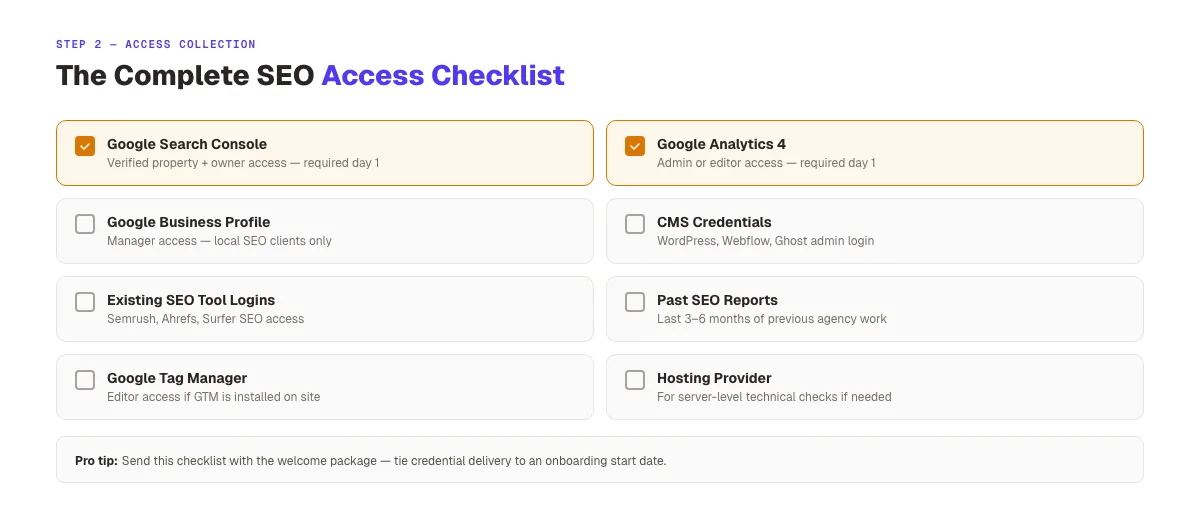
The complete SEO access checklist:
- ✓ Google Search Console. Verified property with owner access
- ✓ Google Analytics 4. Admin or editor access
- ✓ Google Business Profile. Manager access (if local SEO is in scope)
- ✓ CMS credentials. WordPress, Webflow, Ghost, or other admin login
- ✓ Existing SEO tool logins. Semrush, Ahrefs, Surfer SEO
- ✓ Past SEO reports. Minimum 3-6 months of previous work
- ✓ Google Tag Manager. Editor access if installed
- ✓ Social media accounts. If social is in scope
- ✓ Hosting provider login. For server-level technical checks
How to collect credentials securely:
Never ask for passwords over email. Use a dedicated credential manager like LastPass, 1Password, or a secure onboarding form. This protects both parties and signals professionalism from the first interaction.
Why this step matters: Missing access means your team sits idle and the client sees zero progress. Every day of delay before work starts erodes trust before the relationship has a chance to build.
Step 3: Run the Kickoff Call
The kickoff call is where onboarding locks in. Or falls apart.
Most agencies treat it as a formality. Smart agencies treat it as the most important meeting in the engagement. This is where you understand what success means to this specific client. It is also where you correct any expectations sales set incorrectly before the contract was signed.
Kickoff call agenda (60 minutes):
- Introductions (5 min). Who is on your team, who is the primary contact on theirs
- Business overview (15 min). What they sell, who buys it, current state of organic traffic
- Goals and success definition (20 min). What does success look like at 6 months? At 12?
- Timeline walk-through (10 min). Walk through your 90-day plan step by step
- Communication and reporting setup (10 min). Channel, frequency, format of monthly reports
4 questions that reveal everything you need to know:
- "What is the single keyword gap hurting your business most right now?"
- "Which competitor do you most want to outrank. And why?"
- "What did your previous SEO agency do that frustrated you?"
- "What result would make you renew at month 6 without hesitation?"
The fourth question is the most valuable. It tells you exactly what the client measures success by. In their own words. Document the answer and report against it every month.
For a full picture of what building an SEO client relationship looks like, read our guide on how to start a digital marketing agency.
Why this step matters: Goals defined in this call become the benchmark you report against every single month. Undefined goals create undefined accountability. And that ambiguity is what drives churn at month 3.
Step 4: Complete the Technical SEO Audit
Do not start publishing content on a broken site.
The technical SEO audit is the foundation every other phase builds on. If Google cannot crawl and index the site properly, content and link acquisition produce limited results. Fix the structure before adding to it.
What to audit in week 1:
| Area | What to Check | Tool |
|---|---|---|
| Crawlability | Robots.txt, XML sitemap, crawl errors | Screaming Frog, Google Search Console |
| Indexation | Pages indexed vs. expected, noindex tags, duplicate content | Google Search Console |
| Page speed | Core Web Vitals: LCP, CLS, INP | PageSpeed Insights |
| On-page basics | Title tags, meta descriptions, H1s, canonical tags | Screaming Frog |
| Broken links | Internal 404s, redirect chains | Screaming Frog |
| Mobile experience | Usability, viewport, tap target sizing | Google Search Console |
| Schema markup | Existing structured data, validation errors | Schema Markup Validator |
How to deliver the audit:
Package findings into a client-facing report within the first 2 weeks. Segment issues by priority tier:
- Critical. Blocking indexation or actively hurting rankings. Fix these first.
- High. Impacting rankings but not blocking crawl. Fix in month 1.
- Low. Incremental improvements. Add to the roadmap.
30% of mid-market sites have unindexed pages at the start of an engagement. Identifying and fixing them alone can produce a 22% organic session lift. And that is a quick win you deliver before a single article is published.
For local SEO clients, run the local SEO audit in parallel. Local ranking factors differ significantly from organic ranking factors.
Use the free SEO audit tool to surface common technical issues across any site in minutes.
Why this step matters: Publishing content on a site with crawl errors or indexation blocks is like building on a broken foundation. Every article you add amplifies the underlying problem instead of solving it.
Stop writing. Start ranking. theStacc writes, optimizes, and publishes SEO articles to your blog for $99 a month. Zero writing, zero briefing, zero management.
Step 5: Conduct Keyword and Competitor Research
Strategy without research is guesswork.
The keyword research phase should run in parallel with the technical audit. By the time you present both, you have a complete picture: site health and content opportunity. Not one or the other.
Keyword research framework for new clients:
- Seed keywords. Start with what the client said in the kickoff call. What do they most want to rank for?
- Competitor keywords. Pull what their top 3 organic competitors rank for that they do not. These are the priority content gaps.
- Page 2 targets. Filter for keywords with positions 11-20 and 50+ monthly impressions. These are already close to page 1. A targeted content push can move them within 30-60 days.
- Intent mapping. Separate commercial-intent keywords (drive leads) from informational-intent keywords (build authority). Both matter. The ratio depends on the client's current position.
Competitor analysis checklist:
- ✓ Identify 3-5 main organic competitors (may differ from direct business competitors)
- ✓ Pull their top 10 organic traffic pages by estimated monthly visits
- ✓ Find keywords they rank for in positions 4-20. These are vulnerable
- ✓ Note their content format and publishing cadence
- ✓ Check their backlink profile for link acquisition patterns
Build a keyword map that assigns each target keyword to either an existing page or a new content piece. This becomes the editorial roadmap in Step 7.
Why this step matters: Agencies that skip this step publish content for keywords that are either too competitive or too irrelevant to the client's business. Both outcomes waste budget and erode trust.
Step 6: Set Goals and Define KPIs
80% of company executives say onboarding processes need to be clearer and more defined. The biggest clarity failure is goal-setting.
Vague goals such as "improve our SEO" create vague accountability. When results are slow (and they are always slow in the first 60 days), vague goals leave clients with nothing to hold onto except frustration.
SMART goal framework for SEO engagements:
| Goal Type | Weak Version | Strong Version |
|---|---|---|
| Traffic | "Grow organic traffic" | 20% increase in organic sessions by month 6 |
| Rankings | "Improve keyword rankings" | Top 5 for [keyword] by month 4 |
| Conversions | "Get more leads" | 10 new organic leads per month by month 6 |
| Local visibility | "Show up locally" | Local pack appearance for [city + service] terms |
Set 2-3 primary KPIs and 2-3 secondary KPIs. Primary KPIs are what the client measures success by. Secondary KPIs explain WHY primary KPIs are or are not moving.
Primary KPIs:
- Organic sessions (month-over-month)
- Target keyword ranking positions
- Organic conversions. Calls, form fills, purchases
Secondary KPIs:
- Pages indexed
- Domain Authority / Domain Rating trend
- Backlinks acquired
- Articles published per month
Document these in a shared location both sides can access. A Notion doc, a Google Sheet, or a reporting dashboard. Both parties review and sign off before month 1 work begins.
Why this step matters: Clients without defined KPIs cancel at month 3. Clients with documented, agreed-upon KPIs stay for 12+ months because they can see measurable progress even when rankings are still building.
Step 7: Build the SEO Roadmap
The roadmap turns research and goals into a 6-month execution plan. It is the client's map of what you are building. And when.
Without a roadmap, clients interpret slow early months as inaction. With a roadmap, they can point to exactly where they are in the process. That one shift eliminates the most common cancellation trigger: "I do not feel like you are doing anything."
6-month SEO roadmap structure:
Month 1. Foundation
- Complete all critical and high-priority technical fixes from the audit
- Publish 4-8 foundational content pieces targeting commercial keywords
- Set up reporting dashboard and Search Console alerts
- Build citation consistency for local SEO clients
Months 2-3. Content and Authority
- Scale publishing to 15-30 articles per month
- Build internal link structure between new and existing content
- Begin targeted link outreach: broken link building, digital PR, niche directories
- Complete all high-priority technical fixes
Months 4-6. Compound Growth
- Content volume reaches full cadence
- Optimize underperforming pages with updated copy and internal links
- Target competitor keywords now visible in rankings
- Report on ROI and lead attribution
See how done-for-you SEO compares to in-house and agency alternatives on this timeline.
For clients who need white-labeled delivery, read our guide on white label SEO content for the full approach.
Why this step matters: A roadmap converts "I do not see results yet" into "I can see exactly where we are in the six-month plan." That context is the difference between a confident client and a cancellation email.
Step 8: Establish Reporting and Communication
The SEO reporting cadence is what keeps clients enrolled past month 3.
Clients do not lose confidence in SEO. They lose confidence in silence. When they do not hear from you, they assume nothing is happening. That assumption leads to cancellation. Almost always right before results start arriving.
Communication framework:
| Type | Frequency | Format |
|---|---|---|
| Monthly report | Monthly | PDF + walkthrough call (30 min) |
| Ranking updates | Weekly | Automated dashboard or email |
| Urgent issues | As needed | Direct message or call |
| Quarterly review | Quarterly | Strategy call (60 min) |
What goes in every monthly report:
- Executive summary: 3 bullet points: what happened, what it means, what comes next
- Organic traffic trend. Month-over-month and year-over-year
- Top 10 keyword ranking movements (show wins AND declines)
- Content output. Pages published, pages updated
- Backlinks acquired
- Technical issues resolved
- Next month plan
Communication channel rules:
Agree on ONE primary channel at the kickoff call. Slack for fast-moving clients. Email for traditional businesses. Never use both. Split channels mean split accountability and missed decisions.
Set response time expectations upfront. You respond within 24 business hours. The client responds within 48. This prevents the silence that clients interpret as abandonment.
Why this step matters: Agencies with standardized monthly reporting see 34% better client retention than those with ad hoc updates. Clients who feel informed stay. Clients who feel ignored cancel.
Your SEO team. $99/month. SEO-scored articles, published automatically. No writing, no briefing, no management overhead.
Step 9: Execute Quick Wins in Days 1-30
The first 30 days feel slow. Rankings have not moved. Traffic looks flat. Clients start wondering if the spend was the right call.
Quick wins interrupt that doubt before it becomes a conversation.
A quick win is any action that produces a visible, measurable result within 30 days. It does not have to be a ranking jump. A fixed crawl error, a resolved duplicate content issue, a page speed improvement. Any of these count. The goal is to show that work is producing results before the long-game rankings arrive.
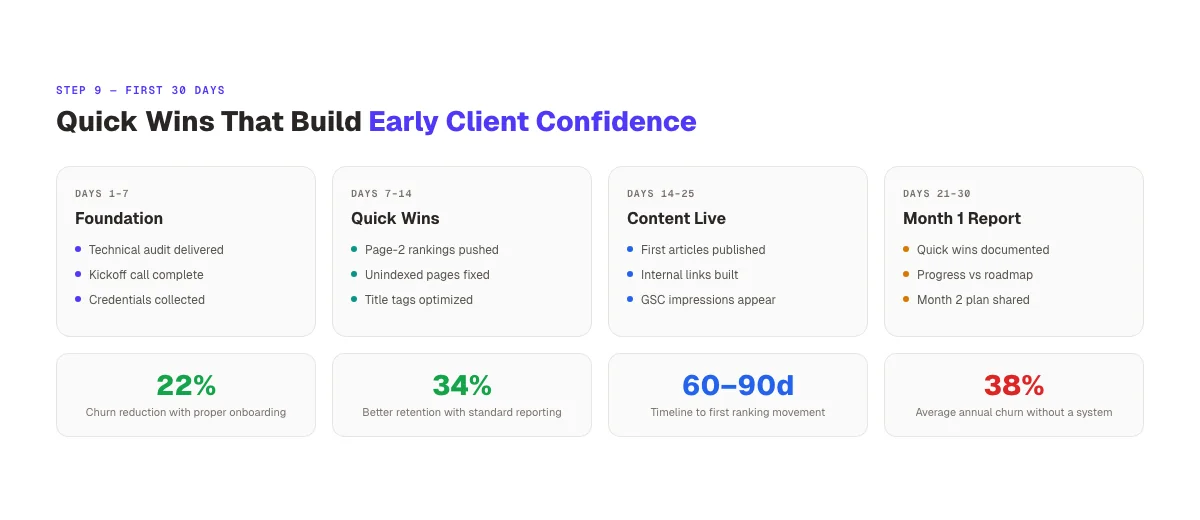
Where to find quick wins:
1. Page-2 rankings (positions 11-20)
Filter Google Search Console for pages ranking between positions 11-20 with 50+ monthly impressions. These pages already have Google's attention. A content refresh, a title tag rewrite, or 2-3 targeted internal links can push them to page 1 in 30-60 days.
2. Unindexed pages
Check for pages that exist but are not indexed. Fix the crawl block, remove the noindex tag, and submit the URL in Google Search Console. These can appear in search results within days.
3. Title tag CTR optimization
Pull pages with high impressions but low click-through rate from Search Console. Rewrite 5-10 titles with stronger power words and clearer keyword placement. CTR improvements are visible in Search Console within 2-3 weeks. A quantifiable win you can show in the month 1 report.
4. Local citation cleanup
For local SEO clients, incorrect NAP data (name, address, phone number) across directories actively suppresses local rankings. Correcting these is a quick win that shows professional diligence and produces local ranking movement faster than content. Start with the local SEO checklist in week 1 for any client with a physical location.
Document every quick win. Add it to the month 1 report. Frame it as: "Action we took → Result it produced → What it means for your rankings." Clients who see cause-and-effect in your work trust the longer-term process during the quiet months.
Why this step matters: Quick wins are proof of work. They show the client that actions are producing results. Even before the main keyword rankings arrive. That proof is what keeps clients enrolled through the slow-growth early phase.
Results: What to Expect After Onboarding
After completing all 9 steps, here is the realistic progression:
- Days 1-14: Welcome package sent, access collected, kickoff call complete, roadmap shared
- Days 15-30: First quick wins identified and executed, foundational content published, technical fixes deployed
- Days 30-60: Initial indexation of new content, technical fixes confirmed in Google Search Console, first Search Console impressions for new keywords
- Days 60-90: First keyword ranking movements, organic traffic beginning to trend upward
- Days 90-180: Compound growth phase. Content authority builds, rankings consolidate, organic conversions increase
Be honest about this timeline. Agencies that communicate "expect 60-90 days for first movement" avoid the panicked cancellation calls at day 45. Agencies that overpromise "you will see results in 2 weeks" face a trust collapse the moment week 3 arrives with nothing to show.
The agencies with the highest retention rates treat the SEO timeline as a feature, not an apology. "It takes 90 days because that is how long it takes for content to build authority". Said clearly, with context. Keeps clients enrolled.
Common Onboarding Mistakes to Avoid
Even well-intentioned agencies make these mistakes. Each one is fixable. But only if you know to look for it.
Mistake 1: Starting content before finishing the technical audit
Publishing articles on a site with crawl errors compounds the problem. Google finds broken content faster than it finds new content. Fix the foundation first. Every article added to a site with indexation blocks is an article Google cannot reliably find.
Mistake 2: Not documenting the onboarding process
If your onboarding lives in someone's head, it breaks when that person leaves or when you try to scale. Document every step in a shared playbook. Documentation also protects you legally. It shows the client exactly what was promised and when delivery occurred.
Mistake 3: Setting timelines based on best-case scenarios
"We have seen clients rank in 30 days" is dangerous to say. It sets an expectation that 95% of clients will not meet. Give conservative timelines. When you beat them, the client is delighted. When you miss them, they are prepared and understand why.
Mistake 4: Chasing access without a deadline
"Just send it when you can" means it never arrives. Tie credentials to a specific date: "Onboarding begins on [date]. We need the access form completed by [date minus 3 days] to stay on schedule." Urgency drives action. Vague requests create indefinite delays.
Mistake 5: Using unmeasurable goals
"We will improve your rankings" is not a goal. "We will move you from position 22 to position 8 for [keyword] by month 4" is. Unmeasurable goals create unmeasurable accountability. And when the client cannot measure progress, they default to "I do not think this is working."
If you are building an SEO team internally or managing a book of clients across multiple accounts, consider automating your SEO workflow to keep quality consistent at scale.
What practitioners are saying on X
AI search advice ages quickly. Here is high-signal public discussion from SEO and growth operators — context for your roadmap, not a substitute for primary data.
- @hridoyreh (Mar 2026): Widely shared SEO skill tree: foundations, research, technical, on-page, content, links, AI SEO/GEO, analytics, UX, brand, programmatic — useful map for stats and how-to posts. See the post on X.
- @jakezward (Feb 2026): 2026 SEO predictions emphasize AI Overview share-of-SERP, schema for LLM token efficiency, brand mentions in AI answers as a KPI, proprietary data as a moat, and content refresh beating net-new AI slop. See the post on X.
Grok, AI Overviews, and multi-engine visibility
For “how to onboard seo clients”, multi-engine visibility still starts with clear definitions, sourced numbers, and extractable section answers. Grok additionally factors live X discussion — keep public claims consistent with this page.
- Google AI Overviews: Use passage-ready answers, tables, and FAQ schema where relevant.
- ChatGPT / Perplexity: Cite named sources next to key claims.
- Grok: Maintain accurate entity facts on-site and in high-signal X posts.
FAQ
A full SEO onboarding takes 2-3 weeks from contract signing to first content published. The timeline: welcome package on day 1, access collected by day 7, kickoff call on day 7, technical audit complete by day 14, keyword research and roadmap delivered by day 21. Agencies that rush onboarding under a week typically skip the audit and goal-setting. Both of which surface as relationship problems at month 3.
Cover 5 areas: business overview (products, revenue model, target customer), current SEO state (what has been tried, what failed, what tools are in use), competitive landscape (3-5 competitors they want to beat), goals (traffic, rankings, leads), and constraints (budget, timeline, internal stakeholders who must approve content). This data drives every strategic decision for the first 90 days.
Address them directly, with data, before they become a conflict. Show the client what Google's algorithm update cycles look like. Show them the 60-90 day indexation timeline with real benchmarks from similar sites. Explain the compound content model. The 10th article performs better than the 1st because the domain has more authority by then. Clients who understand the mechanism trust the process.
Focus on activity and early signals, not outcomes. Report: pages published, technical issues resolved, keywords being tracked, initial impressions in Google Search Console, and any quick wins (CTR improvements, indexed pages recovered, citation fixes). This shows progress without overpromising on rankings that have not moved yet.
Three things: communicate proactively (do not wait for clients to ask what is happening), document everything (clients who see the roadmap and the checklist trust the process), and deliver at least 1-2 quick wins in the first 30 days (early proof builds confidence through the slow-growth period). Agencies with formal onboarding processes retain clients at 90%+ versus the industry average of 62%.
You now have a complete 9-step system for onboarding SEO clients without losing them in the first quarter. The process works because it treats onboarding as a product. Something designed, documented, and repeatable. Not as something you figure out client by client.
Welcome the client before they doubt the decision. Collect what you need before work stalls. Audit before you build. Set goals before you execute. Report before they wonder what you are doing.
If publishing SEO content is part of your client promise, theStacc handles your SEO articles from $99 per month. So you can make that promise without hiring a content team to keep it.
Related Tools & Resources
Free SEO Tools:
Best Lists:
Sources & references
- [1] Princeton / Georgia Tech et al. — GEO research (arXiv:2311.09735)
- [2] @hridoyreh on X — Widely shared SEO skill tree: foundations, research, technical, on-page, content, links, AI SEO/GEO, analytics, UX, bran
- [3] @jakezward on X — 2026 SEO predictions emphasize AI Overview share-of-SERP, schema for LLM token efficiency, brand mentions in AI answers

Plan topics, review article drafts, and publish to a connected CMS.
Weekly local SEO teardowns
One practical email a week. Map Pack, GBP, AI Overviews. No fluff. Unsubscribe anytime.