Local Content Marketing: The Complete Guide
Learn how to use local content marketing to rank in your city. Covers content types, local keywords, GBP posts, and publishing cadence for local businesses.
Siddharth Gangal • 2026-03-30 • Local SEO
In This Article
46% of all Google searches have local intent. Someone in your city is searching for what you sell right now. The question is whether they find your business or a competitor.
Local content marketing is how you show up for those searches without paying for ads. It costs 62% less than traditional outbound marketing and generates 3 times more leads per dollar spent. Yet most local businesses publish nothing. No blog. No local guides. No community content. They rely on Google Business Profile alone and wonder why their competitors rank higher.
The businesses that dominate local search in 2026 are the ones that publish consistently. Companies that blog generate 55% more website traffic and 67% more leads than those that do not. Local content gives Google a reason to rank your site for dozens of local keywords instead of just your business name.
We have published 3,500+ articles across 70+ industries and studied what separates local businesses that rank from those that stay invisible. This guide covers the full local content marketing system.
Here is what you will learn:
- Why local content is the highest-ROI strategy for local businesses
- The 8 content types that drive local search traffic
- How to find and target local keywords your competitors miss
- A publishing cadence that builds authority without burning out
- How to connect blog content to your Google Business Profile
- Measuring local content performance and proving ROI
Why Local Content Marketing Outperforms Paid Ads
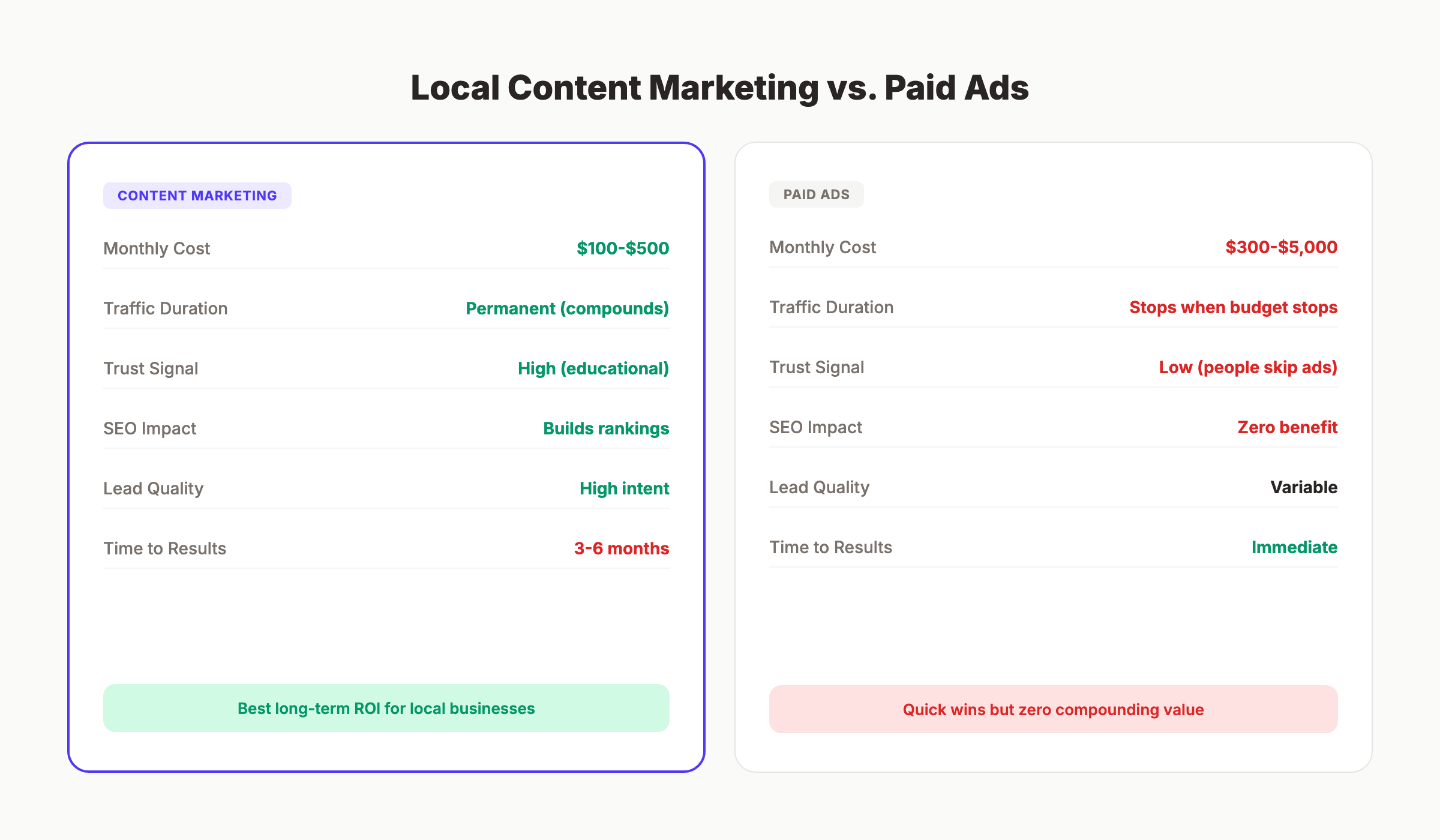
Local businesses spend $300 to $5,000 per month on Google Ads and Facebook Ads. The traffic stops the moment the budget runs out. Local content marketing builds an asset that compounds. Every blog post, guide, and location page you publish is a permanent entry point for organic traffic.
The Compounding Effect
A single blog post targeting “best plumber in Austin” can rank for months or years. It generates leads while you sleep. The 10th post compounds on the authority built by the first 9. By post 30, your site dominates dozens of local searches.
Brands publishing content weekly see a 3.5 times increase in conversions compared to those publishing monthly. That gap widens over time.
Local Content vs. Paid Ads
| Factor | Local Content Marketing | Google/Facebook Ads |
|---|---|---|
| Cost | $100 to $500/mo (or DIY) | $300 to $5,000/mo |
| Traffic duration | Permanent (compounds) | Stops when budget stops |
| Trust signal | High (educational content) | Low (people skip ads) |
| Local SEO impact | Builds rankings across keywords | Zero SEO benefit |
| Lead quality | High intent (searching for info) | Variable (interruptive) |
| Time to results | 3 to 6 months | Immediate |
The one advantage paid ads have is speed. Content takes time. But after 6 months, the content asset generates leads for free while ads keep costing the same every month.
Geotargeted content for mobile users improved foot traffic by 22% among local businesses in a 2025 study. That is real-world impact from writing about your city.
The 8 Local Content Types That Drive Traffic
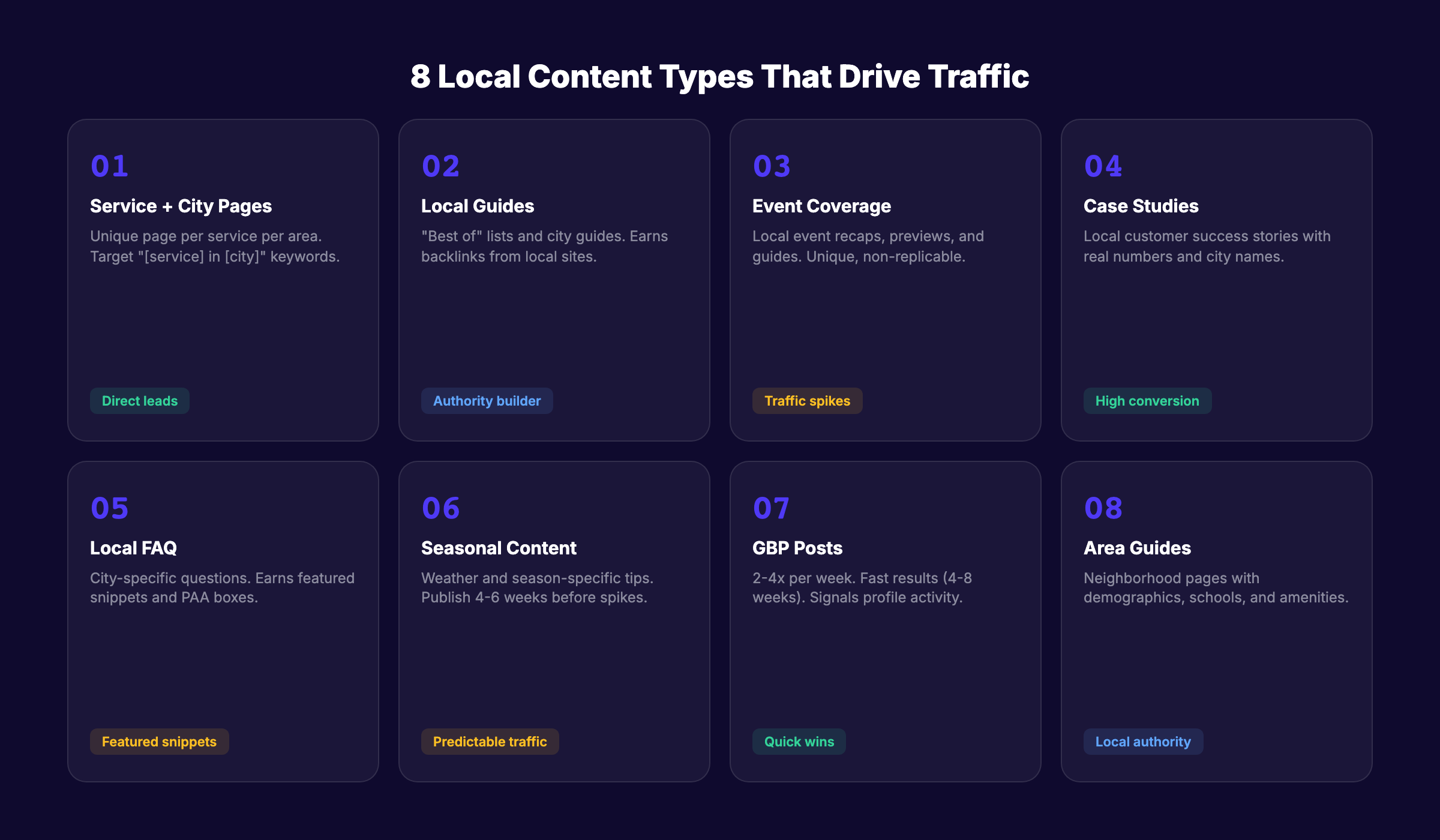
Not all content works for local businesses. Generic blog posts about industry topics compete with national brands. Local content targets searches that only your city’s residents make. That is where local businesses have an unfair advantage.
1. Location-Specific Service Pages
Every service you offer in every area you serve deserves its own page. “Plumbing Services in Austin, TX” is a different page from “Plumbing Services in Round Rock, TX.” Each page targets different local keywords and ranks in different local search results.
Do not copy-paste the same content with different city names. Write unique descriptions that mention neighborhoods, landmarks, and local context. Google filters out thin duplicate content.
2. Local Guides and “Best Of” Lists
“Best Coffee Shops in [City]” and “Complete Guide to [City] Farmers Markets” target high-volume local searches. They also earn backlinks from local blogs, media outlets, and community websites.
These guides position your business as a local authority even when the content is not directly about your services. A real estate agent who publishes “Best Neighborhoods in Austin for Families” builds trust before anyone asks them to sell a house.
3. Community Event Coverage
Local events generate search spikes. A post about “Austin Food and Wine Festival 2026” ranks during the event and earns traffic from people planning their trip. This content is unique to your market and impossible for national competitors to replicate.
Cover events you sponsor, attend, or organize. Include photos, recaps, and practical information (parking, schedules, tips).
4. Customer Case Studies and Success Stories
Case studies from local customers build trust in a way no other content can. “How We Helped a Scottsdale Restaurant Cut Energy Costs 40%” targets local search queries and provides social proof simultaneously.
Name the city. Name the business (with permission). Include specific numbers. Localized case studies rank for “[service] in [city]” queries and convert at a higher rate than generic service pages.
5. Local FAQ Content
Every local business gets the same questions. “Do you serve [neighborhood]?” “What are your hours during [local holiday]?” “How much does [service] cost in [city]?”
Turn these into FAQ pages and blog posts. Each question is a search query someone types into Google. FAQ content also earns featured snippets, which appear above standard search results.
6. Seasonal and Weather-Related Content
Seasons create predictable search patterns. “Winter Plumbing Tips for Minneapolis” spikes every November. “Hurricane Prep Checklist for Miami” spikes every June. “Spring Landscaping Ideas for Denver” spikes every March.
Publish seasonal content 4 to 6 weeks before the season begins. This gives Google time to index and rank the page before the search spike arrives. Refresh the content annually with updated information.
7. Google Business Profile Posts
GBP posts appear directly in your business listing. They signal activity to Google’s local algorithm and increase engagement with searchers who see your profile.
Post 2 to 4 times per week. Mix offers, updates, events, and tips. Each post should include a call to action (book now, call today, learn more). GBP posts generate results in 4 to 8 weeks, much faster than blog content.
For a deeper guide on optimizing your Google Business Profile, see our dedicated post.
8. Neighborhood and Area Guides
These are detailed pages about specific neighborhoods, suburbs, or districts in your service area. They work especially well for real estate agents, home services companies, and any business that serves multiple areas within a metro.
Include demographic information, school ratings, local amenities, transportation details, and photos. These pages rank for “[neighborhood] guide” searches and link naturally to your location and service pages.
Your SEO team. $99 per month. Stacc publishes 30 optimized local articles per month on autopilot. Start for $1 →
Finding Local Keywords Your Competitors Miss
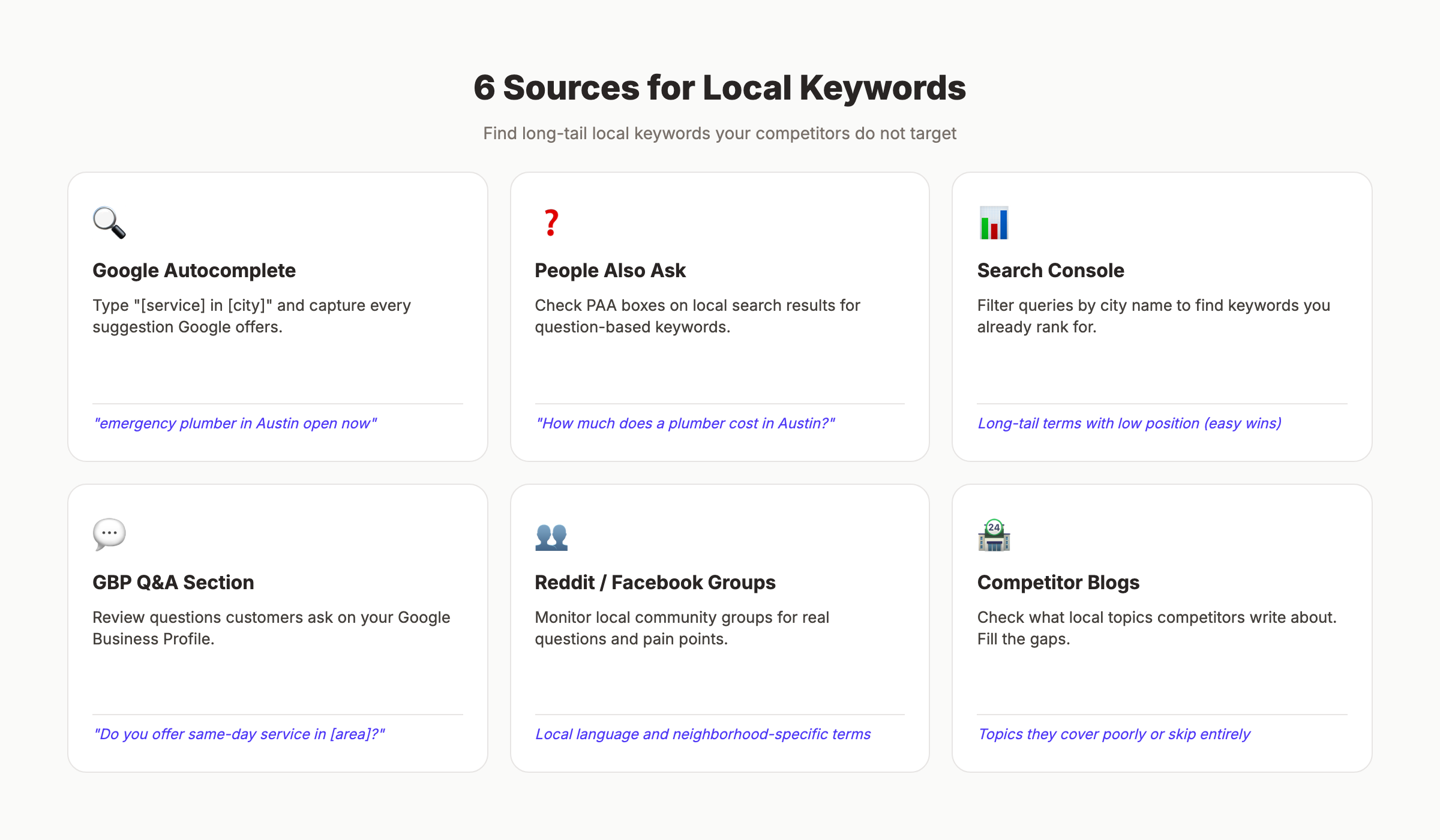
Most local businesses target obvious keywords like “[service] in [city].” Those are important but competitive. The real opportunity is in long-tail local keywords that competitors do not target because they do not know they exist.
Where to Find Local Keywords
| Source | How to Use It | Example Keywords Found |
|---|---|---|
| Google Autocomplete | Type “[service] in [city]” and note suggestions | ”emergency plumber in Austin open now” |
| Google “People Also Ask” | Check PAA boxes for local queries | ”How much does a plumber cost in Austin?” |
| Google Business Profile Q&A | Review questions customers ask on your GBP | ”Do you offer same-day service in [area]?” |
| Google Search Console | Filter by queries containing city names | Long-tail terms you already rank for |
| Competitor blog posts | Check what local topics competitors write about | Content gaps you can fill |
| Local Reddit/Facebook groups | Monitor questions local residents ask | Pain points in local language |
Local Keyword Categories
| Keyword Type | Example | Search Volume | Competition |
|---|---|---|---|
| Service + City | ”plumber in Austin” | 500 to 5,000/mo | High |
| Service + Neighborhood | ”plumber in South Lamar Austin” | 50 to 300/mo | Low |
| ”Near me" | "plumber near me” | 10,000+/mo | High (but intent matches) |
| How much / Cost | ”how much does plumbing cost in Austin” | 100 to 500/mo | Low |
| Best + City | ”best plumber in Austin” | 200 to 1,000/mo | Medium |
| Emergency + City | ”emergency plumber Austin” | 200 to 800/mo | Medium |
| Review-based | ”[business name] reviews” | 50 to 500/mo | Low |
Focus on Tier 2 and Tier 3 keywords first. These are neighborhood-level and question-based searches with lower competition and faster ranking times. Aggregate traffic from 20 to 30 long-tail keywords often exceeds traffic from 1 competitive head term.
For a deeper guide on keyword research for blog posts, see our dedicated guide.
Building a Local Publishing Cadence
Consistency beats volume. Publishing 1 well-optimized local post per week is better than publishing 10 posts in January and nothing for the next 3 months.
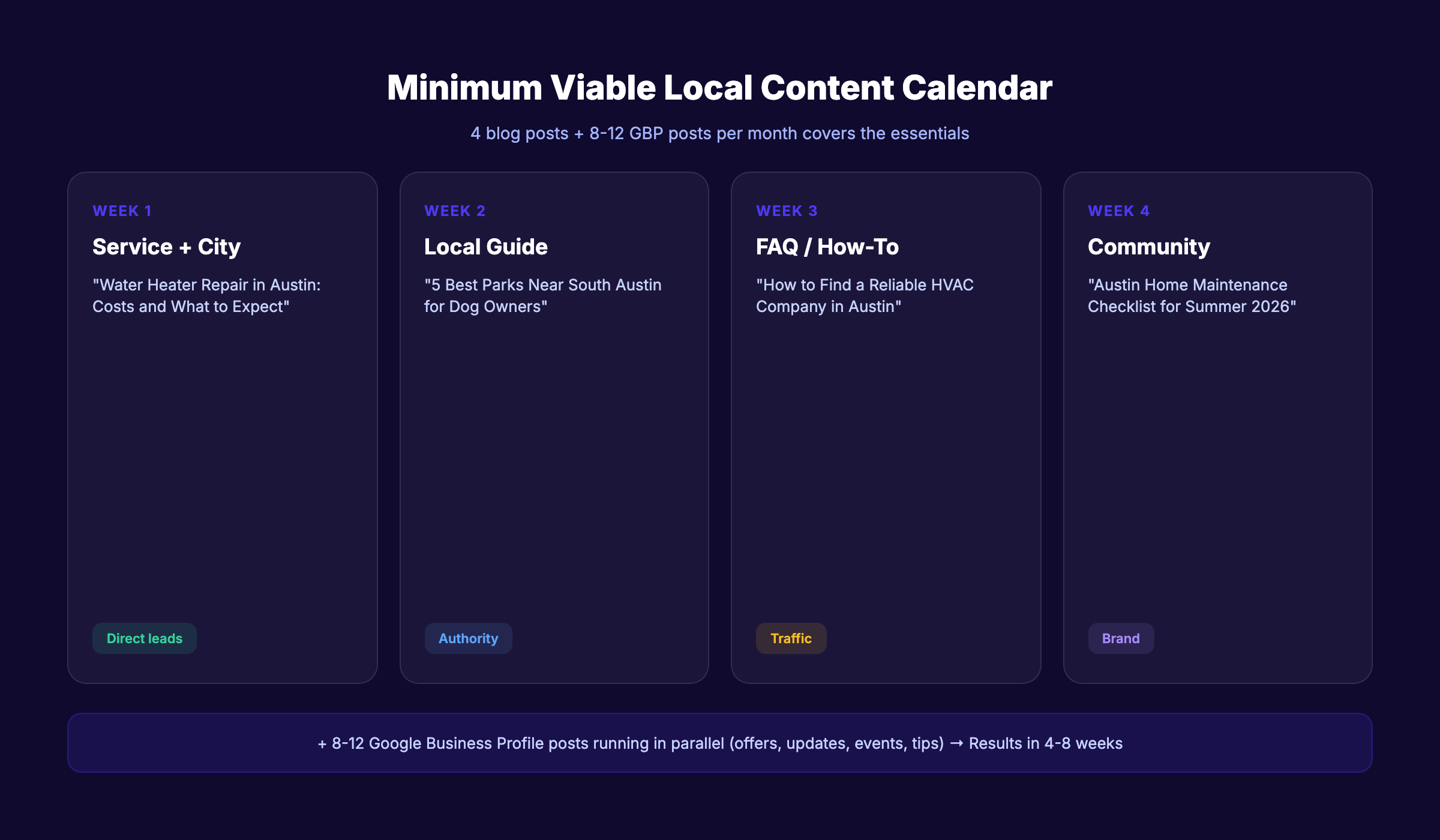
The Minimum Viable Local Content Calendar
| Week | Content Type | Example Topic |
|---|---|---|
| Week 1 | Service + City blog post | ”Water Heater Repair in Austin: Costs and What to Expect” |
| Week 2 | Local guide or list | ”5 Best Parks Near South Austin for Dog Owners” |
| Week 3 | FAQ or how-to post | ”How to Find a Reliable HVAC Company in Austin” |
| Week 4 | Community or seasonal content | ”Austin Home Maintenance Checklist for Summer 2026” |
4 posts per month covers the essentials. Each post targets a different keyword cluster and content type. Over 12 months, that is 48 pieces of local content building a web of local authority.
GBP Posts Run in Parallel
While blog posts take 3 to 6 months to rank, GBP posts show results in weeks. Run both simultaneously:
- Blog: 4 posts per month (long-term organic growth)
- GBP: 8 to 12 posts per month (short-term visibility boost)
This is what we call The Stacc Stack Method. Blog content builds organic authority. GBP posts build local visibility. Together they compound faster than either one alone.
For businesses without a content team, Stacc handles both. 30 blog articles per month for $99 and 30 GBP posts per month for $49. The system runs on autopilot.
Creating a Content Calendar for Local Content
Plan content around 3 pillars:
- Service content — Posts targeting “[service] in [city]” keywords. These drive direct leads.
- Community content — Posts about local events, news, and guides. These build local authority and earn backlinks.
- Educational content — Posts answering common questions. These drive traffic from informational searches and establish expertise.
Mix all 3 types each month. Service content converts. Community content builds brand. Educational content builds traffic. All 3 together build a local content moat competitors cannot easily replicate.
Stop writing. Start ranking. Stacc publishes 30 SEO articles per month for your local business. No writers needed. Start for $1 →
Connecting Content to Your Local SEO Stack
Local content does not exist in isolation. It connects to your Google Business Profile, your citations, your reviews, and your overall local SEO strategy. Each piece reinforces the others.
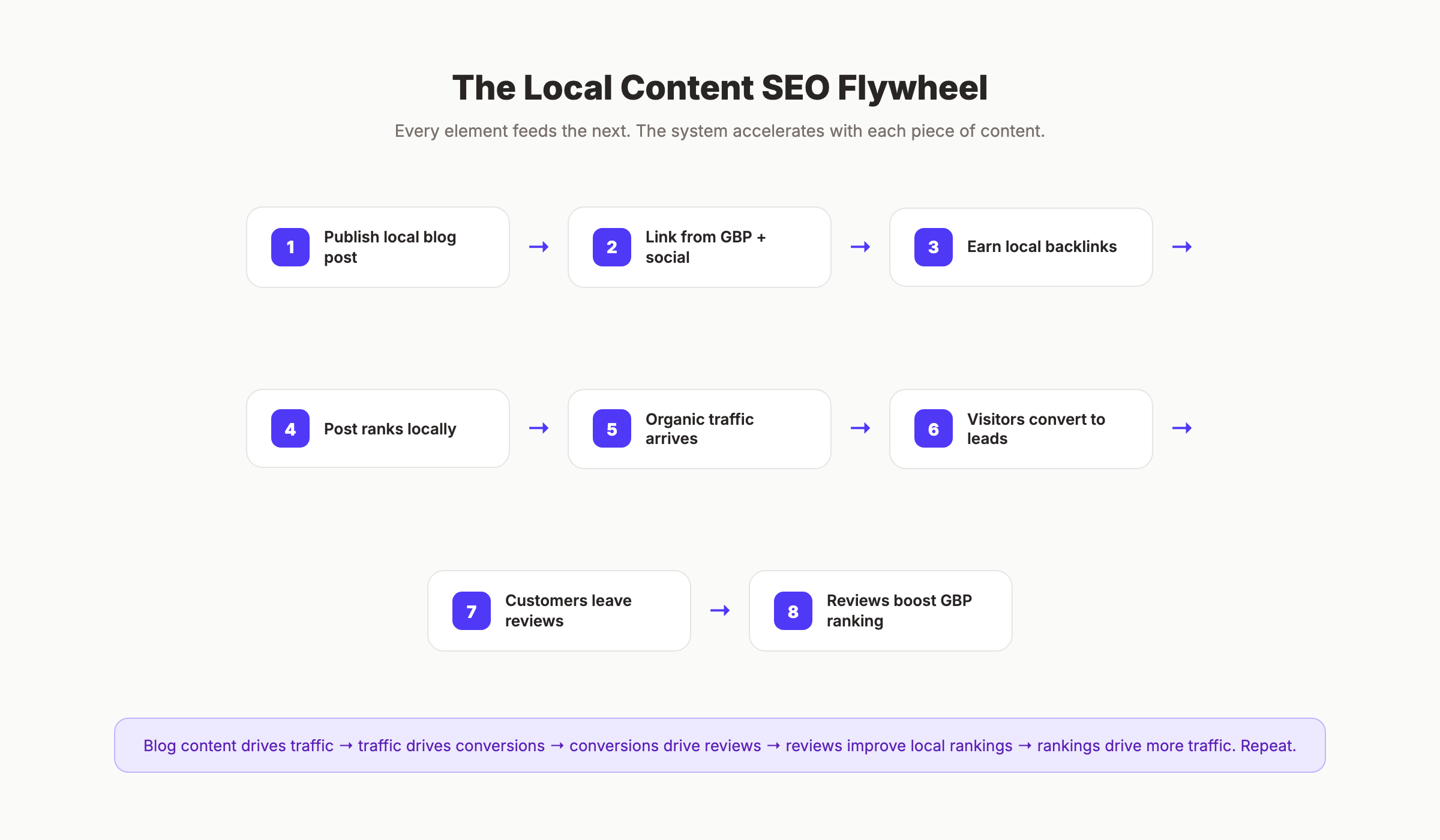
The Local SEO Content Flywheel
- Publish a local blog post targeting a specific keyword
- Link the blog post from your GBP listing (via the website link or GBP posts)
- Share the post on social media with local hashtags and geotags
- Earn local backlinks from community organizations, local media, and partners
- The post ranks and drives organic traffic to your site
- Visitors convert into calls, bookings, or form submissions
- Ask new customers for reviews on your Google Business Profile
- Reviews improve your GBP ranking, which drives more visibility
- Repeat with the next post
Every element feeds the next. Blog content drives traffic. Traffic drives conversions. Conversions drive reviews. Reviews improve local rankings. Better rankings drive more traffic. This flywheel accelerates with each piece of content you publish.
Internal Linking for Local Content
Connect your content to your money pages:
- Every local blog post should link to the relevant service page
- Every service page should link to related blog posts
- Location pages should link to area-specific blog content
- Blog posts should link to your Google Business Profile optimization efforts
Build topical authority by clustering related content together. A plumber in Austin publishing 10 posts about plumbing topics in Austin builds stronger local authority than publishing 10 posts about random plumbing topics.
Repurposing Local Content
One blog post can become 5 to 8 pieces of additional content:
- 1 GBP post highlighting the key insight
- 2 to 3 social media posts with different angles
- 1 email newsletter feature
- 1 short video summarizing the main points
- 1 infographic pulling out data or steps
Repurposing blog content for social media multiplies the value of every article without creating from scratch.
Measuring Local Content Marketing ROI
Local content marketing works. But you need to prove it with numbers. Track these metrics monthly.
Key Metrics for Local Content
| Metric | What It Measures | Tool |
|---|---|---|
| Organic traffic by city | Local visitors from search | Google Analytics (geo filter) |
| Local keyword rankings | Position for city-specific terms | Semrush, Ahrefs, or BrightLocal |
| GBP impressions and actions | Profile visibility and engagement | Google Business Profile Insights |
| Phone calls and form fills | Direct lead generation | Call tracking + form analytics |
| Backlinks from local sites | Community authority signals | Ahrefs or Moz |
| Content-driven revenue | Revenue attributed to blog traffic | CRM + UTM tracking |
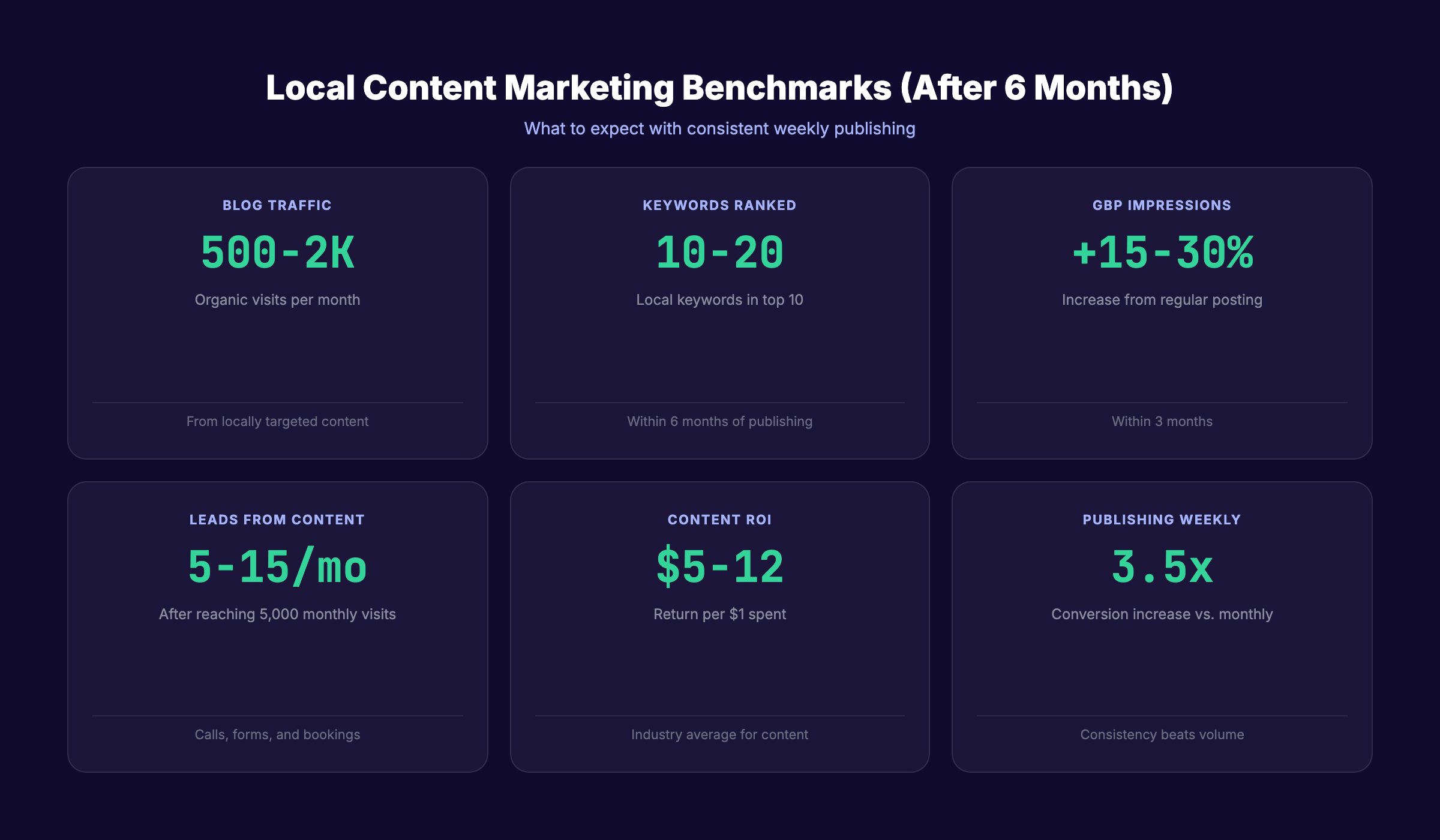
Benchmarks for Local Businesses
- Blog traffic: Expect 500 to 2,000 organic visits per month after 6 months of consistent publishing
- Keyword rankings: 10 to 20 local keywords in the top 10 within 6 months
- GBP impact: 15 to 30% increase in GBP impressions within 3 months of regular posting
- Lead generation: 5 to 15 leads per month from blog content after reaching 5,000 monthly visits
- Content ROI: $5 to $12 returned per $1 spent on content (industry average)
Track content marketing ROI alongside your other marketing channels. Content often looks slow in month 1 but outperforms paid ads by month 6 because the cost stays flat while the traffic compounds.
3,500+ blogs published. 92% average SEO score. See what Stacc can do for your local business. Start for $1 →
FAQ
How often should a local business publish content?
At minimum 4 posts per month. Brands publishing weekly see 3.5 times more conversions than those publishing monthly. If 4 posts per month is too much to produce in-house, start with 2 and scale up. Consistency matters more than volume. Pair blog posts with 8 to 12 GBP posts per month for maximum local visibility.
What is the best type of content for local SEO?
Location-specific service pages and local guides generate the most direct leads. FAQ content and “how much does X cost in [city]” posts capture high-intent informational searches. Community event coverage and neighborhood guides build local authority and earn backlinks. A mix of all 3 types performs best.
How long does local content marketing take to show results?
GBP posts can show results in 4 to 8 weeks. Blog content typically ranks within 3 to 6 months. After 6 months of consistent publishing, most local businesses see measurable increases in organic traffic, local keyword rankings, and lead generation. The compounding effect accelerates in year 2.
Should I write about my city even if the topic is not related to my business?
Yes, selectively. Community content (local event coverage, city guides, neighborhood spotlights) builds local authority signals that benefit all your pages. Google sees your site as a relevant local entity. Keep community content to 20 to 30% of your total output. The rest should directly support your services and keywords.
Can I automate local content marketing?
Yes. Services like Stacc publish 30 SEO-optimized blog articles per month and 30 GBP posts per month for local businesses. The content is localized with city-specific keywords, topics, and context. Automation removes the biggest barrier (time and writing capacity) while maintaining the consistency that drives results.
How do I know which local keywords to target first?
Start with your primary service plus your city name. Then expand to neighborhoods, “near me” variations, cost-related queries, and seasonal topics. Use Google Autocomplete, Search Console data, and competitor analysis to find gaps. Target low-competition long-tail keywords first for faster wins, then build toward competitive head terms.
Local content marketing is the most undervalued growth channel for local businesses. The businesses ranking on page 1 for dozens of local keywords are not spending more on ads. They are publishing more content. Start with 4 posts per month. Target 1 local keyword per post. Build the flywheel. Every piece of content you publish today is a lead source that works for years.
Written and published by Stacc. We publish 3,500+ articles per month across 70+ industries. All data verified against public sources as of March 2026.