
Local SEO for Franchises: The Complete Guide
Master local SEO for franchises with GBP management, location pages, NAP consistency, and review strategies. Covers franchisor and franchisee roles.
Siddharth Gangal • 2026-03-30 • Local SEO
In This Article
A franchise with 100 locations should dominate local search in 100 cities. Most do not. The typical franchise has a handful of locations ranking in the Google Map Pack while the rest sit invisible behind independent competitors.
Local SEO for franchises is the primary customer acquisition channel for physical locations in 2026. 46% of all Google searches have local intent. 68% of users click on Local Pack results over standard organic listings. Every franchise location that misses the Pack loses customers to a competitor who shows up instead.
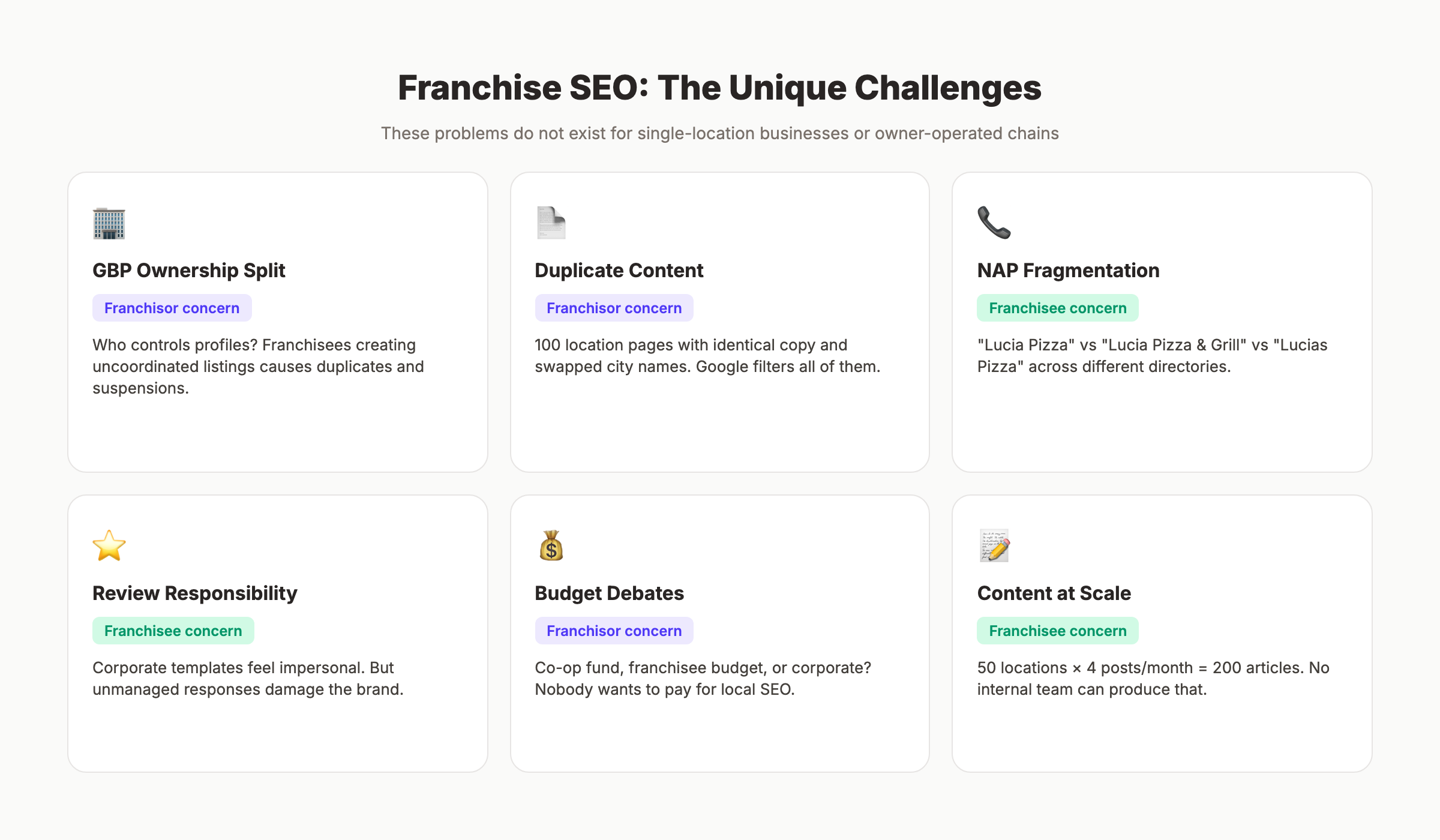
The challenge is unique to franchises. You are managing dozens or hundreds of Google Business Profiles simultaneously. Franchisees create listings without coordinating with corporate. NAP data drifts out of sync across directories. Location pages use identical copy with city names swapped. The brand’s online presence fragments across independent ecosystems.
We have published 3,500+ articles across 70+ industries and studied how the highest-performing franchise brands build local search visibility at scale. This guide covers the system.
Here is what you will learn:
- Why franchise SEO differs from standard multi-location SEO
- How to structure GBP ownership between franchisor and franchisee
- The location page template that avoids duplicate content penalties
- NAP consistency strategies for 50 to 500+ locations
- Review management at franchise scale
- How to measure local SEO performance across the entire network
Why Franchise SEO Is Different From Standard Local SEO
A multi-location business with 10 offices operates under one ownership structure. A franchise operates under a split model. Corporate sets the brand. Franchisees run the locations. That split creates SEO problems that standard local businesses never face.
The Franchisor-Franchisee Tension
| Challenge | Franchisor View | Franchisee View |
|---|---|---|
| Brand consistency | ”Every location must look identical online" | "I need content that reflects my local market” |
| GBP ownership | ”Corporate should control all profiles" | "I want access to my own listing” |
| Content creation | ”Use approved templates only" | "I want to post about my community” |
| Review management | ”Follow the brand response guidelines" | "I know my customers personally” |
| Budget allocation | ”SEO investment protects the brand" | "I need leads for my specific location” |
This tension kills franchise SEO when left unresolved. The franchisor locks everything down. Franchisees lose the ability to create locally relevant content. Or franchisees operate independently and the brand fragments across inconsistent listings, duplicate websites, and mismatched information.
The answer is a governed model. Corporate builds the framework, templates, and guardrails. Franchisees customize within those boundaries. Neither side operates alone.
What Makes Franchise SEO Harder
- Scale: 50 to 500+ locations mean 50 to 500+ GBP listings, citation profiles, and review streams
- Ownership complexity: GBP profiles need clear corporate/franchisee role assignments
- Duplicate content risk: Franchise websites default to templated pages with identical copy
- NAP fragmentation: Each franchisee may list different business name variations
- Review responsibility: Who responds to reviews? Corporate or the local owner?
- Budget debates: Who pays for local SEO? The co-op fund, the franchisee, or corporate?
For a broader look at multi-location local SEO, see our dedicated guide. This article focuses on the franchise-specific challenges that guide does not cover.
Google Business Profile Ownership and Management
Every franchise location needs its own verified Google Business Profile. Google treats each address as a separate business entity. One profile for the entire franchise network will get suspended.
The GBP Role Hierarchy for Franchises
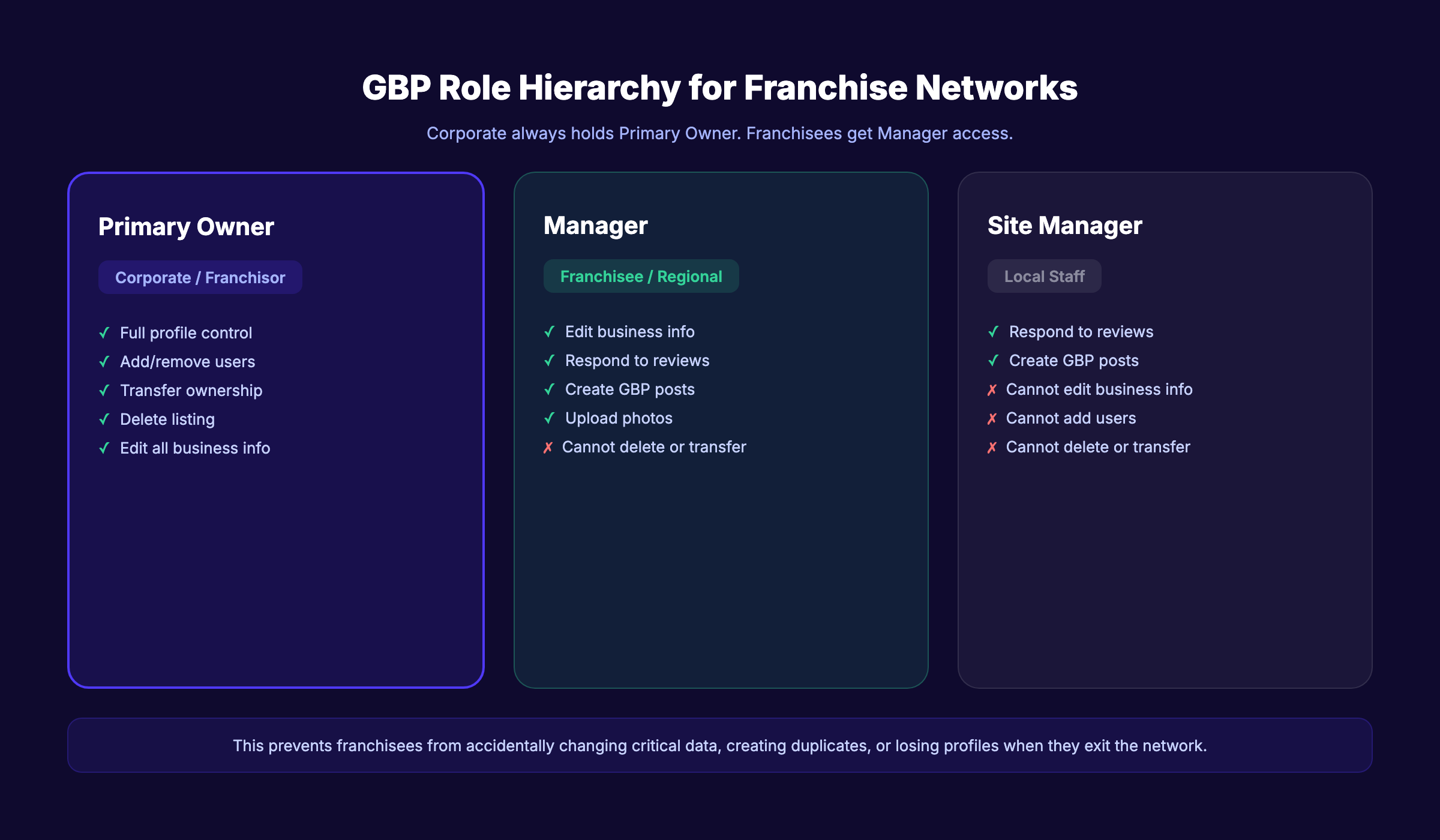
Google Business Profile supports 3 management roles. Franchises should use all 3 strategically:
| Role | Access Level | Who Should Hold It |
|---|---|---|
| Primary Owner | Full control. Can add/remove owners and managers. Transfer ownership. Delete listing. | Corporate / Franchisor |
| Manager | Can edit info, respond to reviews, create posts. Cannot delete or transfer. | Franchisee / Regional Manager |
| Site Manager | Can respond to reviews and create posts. Cannot edit business info. | Local staff / Marketing assistant |
The rule: Corporate always holds Primary Owner status. This prevents franchisees from accidentally (or intentionally) changing critical business information, creating duplicate listings, or losing access to profiles.
Franchisees get Manager access so they can respond to reviews, create GBP posts, and upload local photos. This gives them enough control to stay engaged without risking brand consistency.
Bulk Verification for Franchise Networks
Franchises with 10 or more locations can use Google’s bulk verification process:
- Create a Business Group in Google Business Profile Manager
- Add all locations via spreadsheet upload (business name, address, phone, hours, category)
- Submit for bulk verification through the manager dashboard
- Google verifies all locations within 1 to 2 weeks
For new franchise locations, add them to the existing Business Group immediately during onboarding. Delayed GBP setup is one of the most common franchise SEO mistakes. A new location without a verified profile is invisible in local search from day one.
GBP Optimization Checklist (Per Location)
- Primary category matches the franchise’s main service
- Business name matches the exact franchise name format (no keyword stuffing)
- Address, phone, and hours match the website and all directories
- 10+ photos uploaded (exterior, interior, team, products)
- Business description includes city name and primary services
- Services and products listed with descriptions
- Weekly Google Posts (2 to 4 per week)
- Q&A section seeded with common questions
- Booking or appointment link active
For a deeper guide on optimizing your Google Business Profile, see our dedicated post.
Rank everywhere. Do nothing. Stacc publishes 30 GBP posts per month per location for $49/mo. Blog SEO, Local SEO, and Social on autopilot. Start for $1 →
Building Franchise Location Pages That Rank
Location pages are the single most important on-site asset in franchise SEO. They are also where most franchises fail. Copying the same page across 100 locations with different city names triggers Google’s thin content filter.
The Franchise Location Page Template
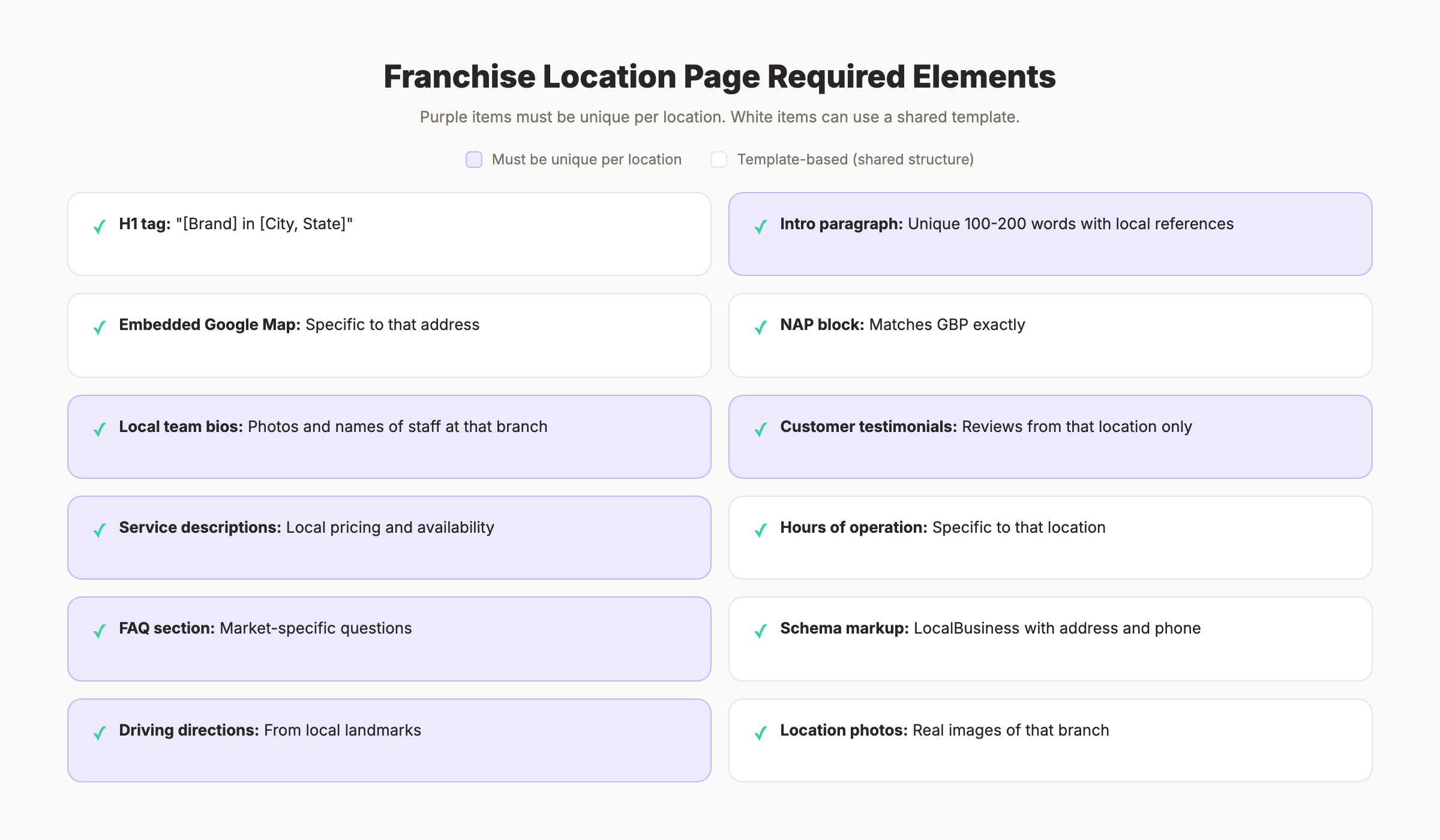
Every location page needs these elements with genuinely unique content:
| Element | What to Include | Why It Matters |
|---|---|---|
| H1 tag | ”[Brand Name] in [City, State]“ | Primary local keyword targeting |
| Unique intro (100-200 words) | Location-specific description with neighborhood references | Avoids duplicate content |
| Embedded Google Map | Map for that specific address | Geographic signal for Google |
| NAP block | Name, address, phone matching GBP exactly | Trust signal consistency |
| Hours of operation | Specific to that location (including holidays) | User experience + GBP match |
| Local team bios | Photos and names of staff at that location | Unique, non-duplicable content |
| Customer testimonials | Reviews from customers of that specific location | Social proof + local content |
| Location-specific services | Services offered at that branch (may vary by location) | Keyword targeting + user relevance |
| Driving directions | From nearby landmarks and highways | Local context + helpful content |
| Schema markup | LocalBusiness or relevant subtype with address, phone, hours | Rich results eligibility |
Avoiding Duplicate Content at Scale
The biggest risk is boilerplate. When corporate provides a template, franchisees fill in the city name and leave the rest identical. Google sees 100 pages with 95% identical content and suppresses all of them.
What to make unique per location:
- The opening paragraph (mention the neighborhood, local landmarks, community)
- Service descriptions (localize pricing, availability, and seasonal details)
- Team section (different staff at every location)
- Testimonials (different customers at every location)
- FAQ section (different questions relevant to each market)
A franchise can standardize the page layout (template) while making the content unique. The structure stays the same. The words change.
URL Structure
Use subfolders under the main domain:
franchise.com/locations/austin-tx/
franchise.com/locations/dallas-tx/
franchise.com/locations/houston-tx/
Never create separate domains or subdomains for franchise locations. Separate domains (austinfranchise.com) split authority entirely. Subdomains (austin.franchise.com) split it partially. Subfolders consolidate everything under one domain and pass authority to every location.
NAP Consistency Across the Franchise Network
NAP (Name, Address, Phone Number) consistency is the foundation of franchise local SEO. Google cross-references your business information across hundreds of sources. Mismatches erode trust and suppress rankings.
Why Franchises Struggle With NAP
Franchises face unique NAP challenges:
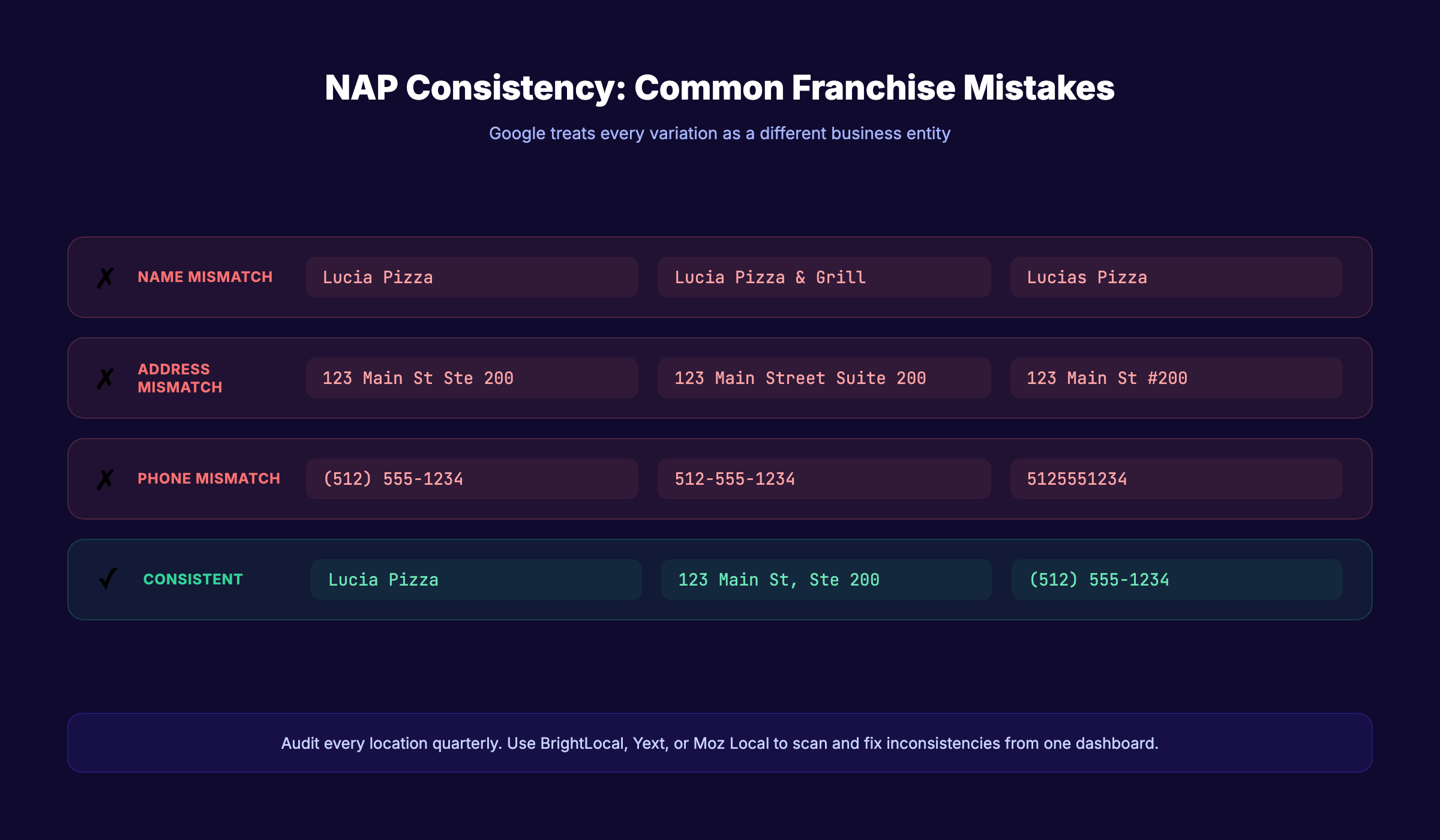
- Name variations: “Lucia Pizza,” “Lucia Pizza & Grill,” and “Lucia’s Pizza” all appear across different directories. Google treats these as separate businesses.
- Phone number fragmentation: Some locations use a corporate tracking number. Others use a local number. Some use both.
- Address formatting: “Suite 200” vs. “Ste 200” vs. “#200” creates mismatches across directories.
- Franchisee-created listings: When franchisees set up their own Yelp, Facebook, and directory profiles without corporate coordination, inconsistencies multiply.
The NAP Audit Process
For every franchise location:
- Business name matches the exact format across GBP, website, and all directories
- Address uses identical formatting everywhere (abbreviations, suite numbers, unit numbers)
- Phone number is the same on GBP, website, and all citations
- No duplicate listings exist on Google, Yelp, Facebook, or other directories
- Closed or relocated locations are properly marked or redirected
Citation Building at Franchise Scale
Follow the 3-phase approach:
Phase 1 (Week 1-2): Submit all locations to the 4 major data aggregators (Data Axle, Neustar Localeze, Foursquare, Apple Maps). One submission per location generates 50 to 150 downstream citations within 60 to 90 days.
Phase 2 (Week 2-4): Manually claim and optimize primary directories (Yelp, BBB, Facebook, Bing Places, Yellow Pages) for each location.
Phase 3 (Month 2-3): Submit to industry-specific and regional directories relevant to the franchise vertical.
Use a centralized platform (BrightLocal, Yext, or Moz Local) to monitor and sync citations across all locations from one dashboard. Manual management breaks down after 20 locations.
For a deeper look at our local SEO checklist, see our step-by-step guide.
Your SEO team. $99 per month. Stacc publishes 30 optimized articles per month for franchise brands on autopilot. Start for $1 →
Review Management for Franchise Brands
Review signals account for 15.44% of local ranking factors. For franchises, reviews carry a double burden. They affect individual location rankings and the overall brand perception.
91% of consumers say that local branch reviews influence their perception of the entire brand. One franchise location with a 2.8-star rating drags down every other location’s brand trust.
Who Responds to Reviews?
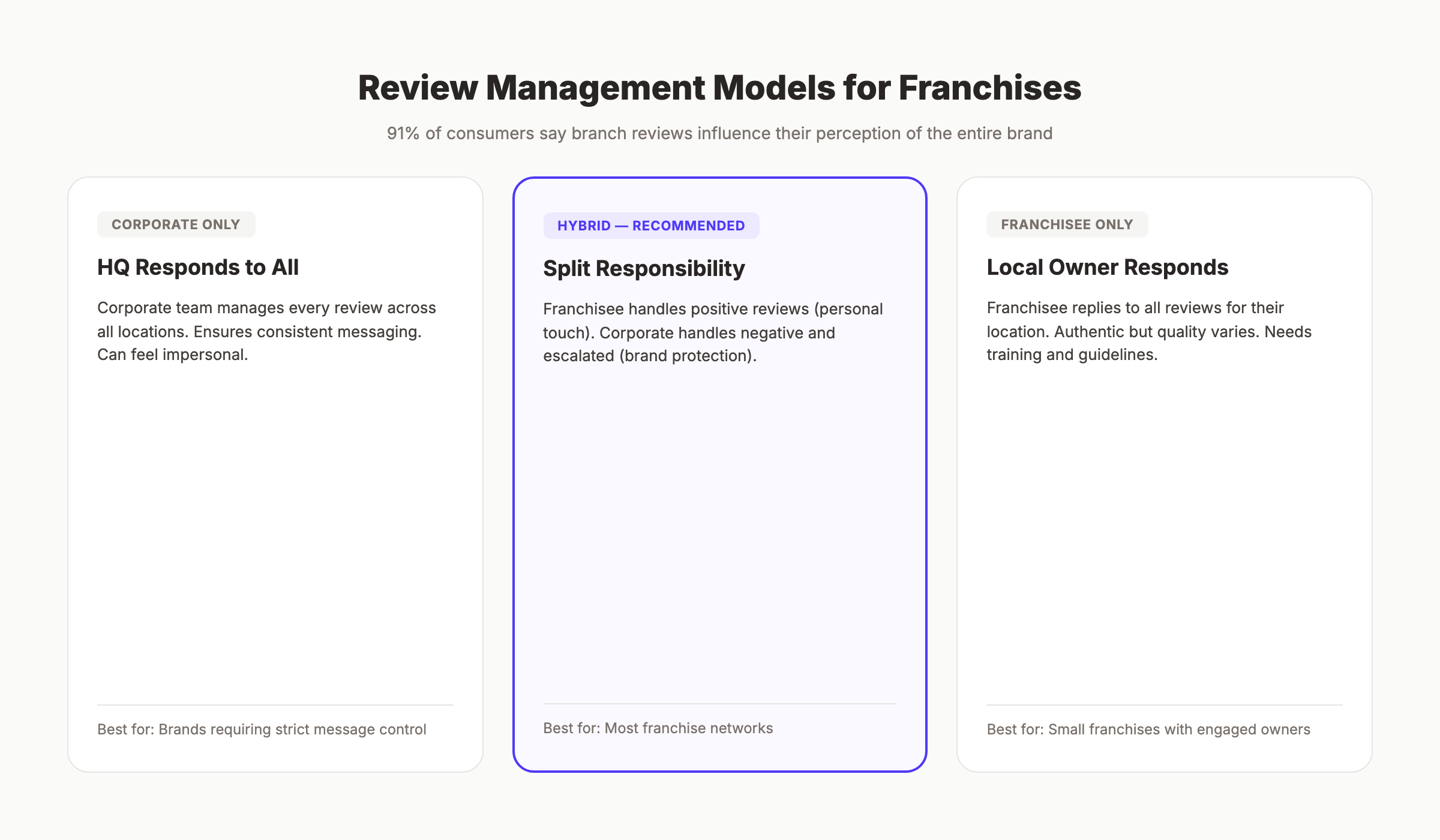
This is the most debated question in franchise SEO. There are 3 models:
| Model | How It Works | Best For |
|---|---|---|
| Corporate responds to all | HQ team manages every review across all locations | Brands requiring strict message control |
| Franchisee responds | Local owner replies to their own reviews | Small franchises with engaged owners |
| Hybrid (recommended) | Corporate handles negative and escalated reviews. Franchisee handles positive and routine. | Most franchise networks |
The hybrid model works best. Franchisees know their customers and can personalize positive review responses. Corporate handles negative reviews to ensure consistent, legally sound responses that protect the brand.
Review Generation at Scale
Every franchise location should generate 4 to 8 new reviews per month. Recency matters more than total count. A location with 120 recent reviews outranks one with 400 stale reviews from 2019.
Build a system:
- Train franchisees and their staff to ask for reviews after every service
- Provide SMS/email templates with direct links to the Google review form
- Send automated review requests within 2 hours of service completion
- Track review velocity per location on a weekly dashboard
- Celebrate top-performing locations to motivate the network
For more strategies on generating Google reviews for local businesses, see our guide.
Handling Negative Reviews Across the Network
Negative reviews at one location affect the entire brand. Corporate should:
- Monitor all locations for negative reviews daily (use tools like BrightLocal or ReviewTrackers)
- Respond within 24 hours with a professional, empathetic message
- Move the conversation offline (“Please contact us at [phone/email] so we can resolve this”)
- Never argue, blame the customer, or reveal private details
- Track complaint patterns across locations to identify operational issues
Local Content Strategy for Franchise Brands
Most franchise websites are content deserts. The homepage looks polished. The location pages are thin. There is no blog, no local content marketing, and no reason for Google to consider the site authoritative in any local market.
Content at Two Levels
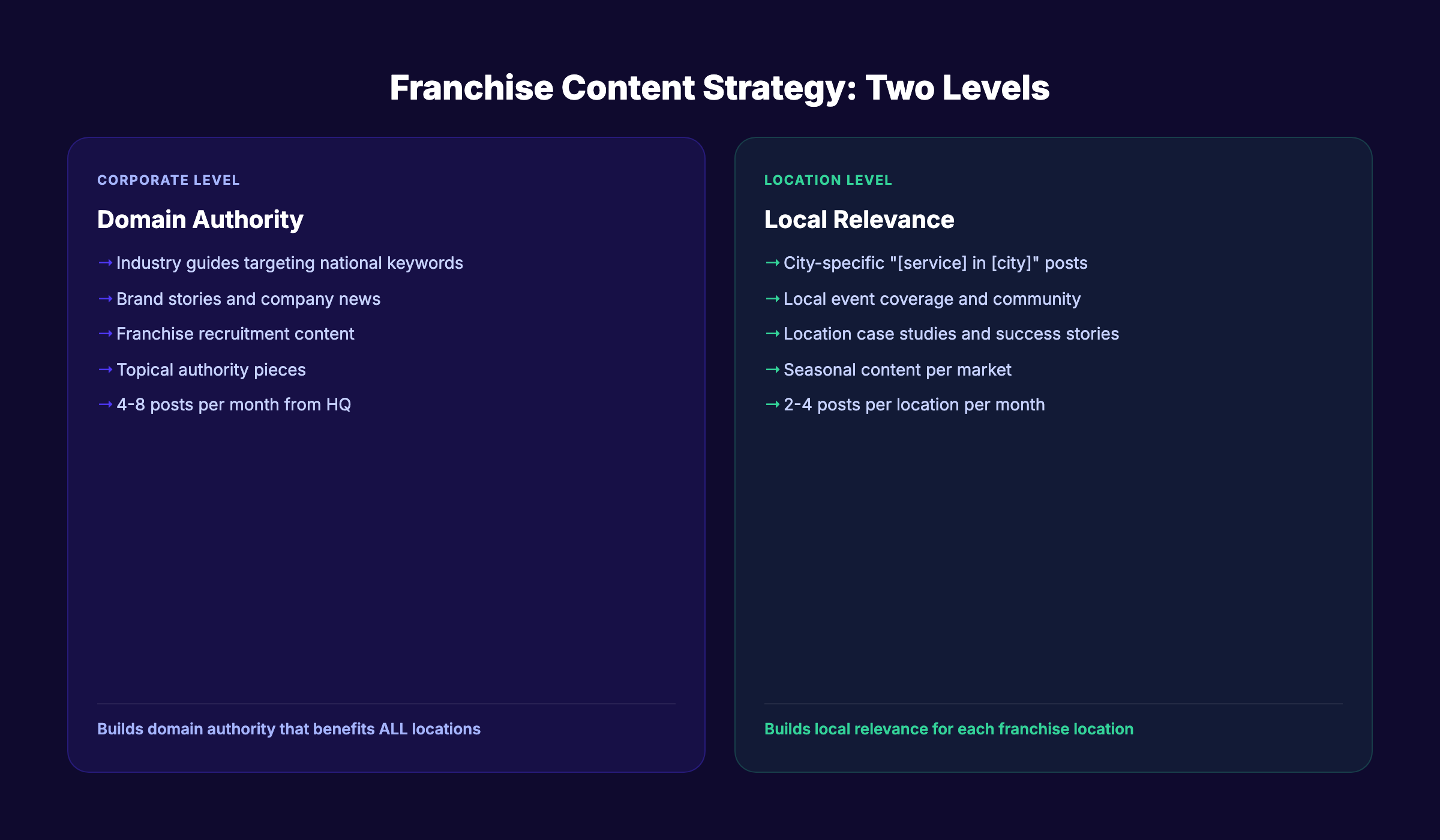
Franchise content works on 2 levels:
Corporate content (franchisor’s blog):
- Industry guides and how-to content targeting national keywords
- Brand stories and company news
- Franchise opportunity content (for recruitment)
- Topical authority pieces that benefit all locations
Local content (per location or region):
- City-specific blog posts targeting “[service] in [city]” keywords
- Local event coverage and community involvement
- Location-specific case studies and customer stories
- Seasonal content relevant to that market
Corporate content builds domain authority. Local content builds local relevance. Both feed the same domain, which means every piece of content benefits every location.
Publishing Cadence for Franchises
| Content Type | Frequency | Owner |
|---|---|---|
| Corporate blog posts | 4 to 8 per month | HQ marketing team |
| Location-specific posts | 2 to 4 per location per month | Local team or Stacc |
| GBP posts | 8 to 12 per location per month | Automated or local team |
| Social media | 3 to 5 per location per week | Local team or automated |
At 50 locations publishing 2 posts per month each, the franchise needs 100 blog articles per month. That volume is impossible for most internal teams. Automation through a service like Stacc ($99/month for 30 articles per location) makes the math work.
The alternative is letting location pages stagnate. Stale content signals to Google that the location is not active. Active competitors with fresh content overtake dormant franchise locations every time.
Measuring Franchise Local SEO Performance
You cannot manage what you do not measure. Franchise networks need location-level reporting that rolls up into a network-wide dashboard.
Per-Location Metrics
| Metric | Target | Tool |
|---|---|---|
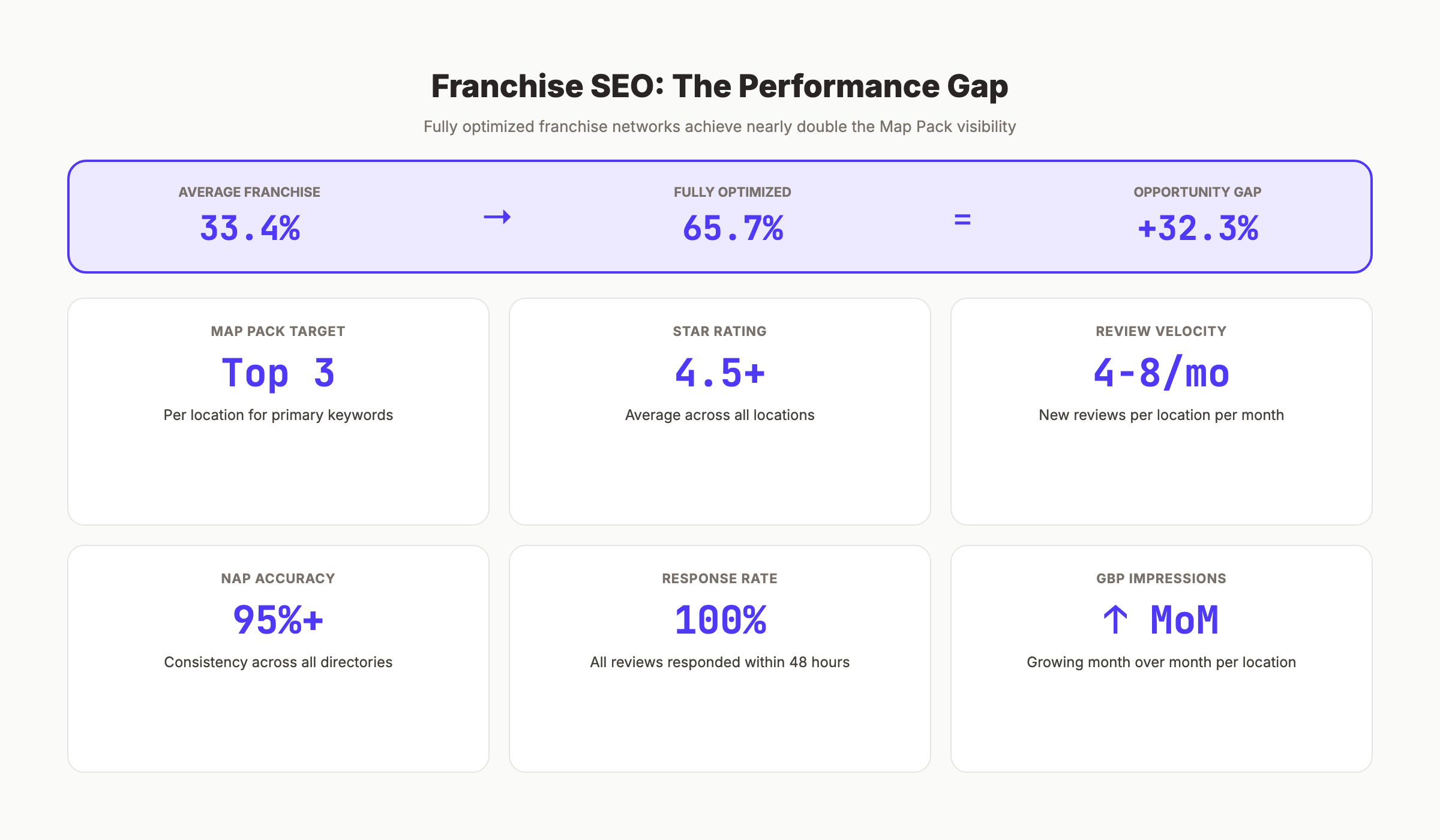
| Google Map Pack position | Top 3 for primary keywords | BrightLocal or Local Falcon |
| GBP impressions | Growing month over month | GBP Insights |
| GBP actions (calls, directions, clicks) | 5 to 15% action rate | GBP Insights |
| Review count and rating | 4.5+ stars, 4 to 8 new reviews/month | ReviewTrackers or BrightLocal |
| Citation accuracy | 95%+ NAP consistency | Moz Local or Yext |
| Location page organic traffic | Growing month over month | Google Analytics |
Network-Wide Dashboard
Roll up individual metrics into a franchise-wide view:
- Percentage of locations in the Map Pack (target: 50%+ of locations in top 3)
- Average star rating across all locations (target: 4.5+)
- Network-wide GBP impression growth (month over month trend)
- Locations with citation accuracy above 95% (target: 100% of locations)
- Review response rate (target: 100% of reviews responded to within 48 hours)
Track local SEO statistics benchmarks to know where the network stands relative to industry averages. Multi-location brands that fully optimize local SEO achieve 65.7% Map Pack visibility for competitive keywords. The average franchise sits at 33.4%.
The gap between 33.4% and 65.7% is the opportunity. Closing it means more calls, more foot traffic, and more revenue at every location.
3,500+ blogs published. 92% average SEO score. See what Stacc can do for your franchise network. Start for $1 →
FAQ
Should each franchise location have its own website or use one corporate site?
One corporate site with subfolder location pages (franchise.com/locations/city/) is the recommended approach. Separate websites split domain authority and create management overhead. A single domain consolidates SEO value so that every piece of content, every backlink, and every review benefits the entire network.
Who should own the Google Business Profile for each franchise location?
The franchisor should always hold Primary Owner status. Franchisees get Manager access to respond to reviews, create posts, and upload photos. This prevents accidental data changes, duplicate listings, and profile loss when a franchisee exits the network.
How do I prevent duplicate content across franchise location pages?
Use a standardized page template but require unique content in 5 areas: opening paragraph, service descriptions, team bios, customer testimonials, and FAQ section. Each page shares the same structure but different words. Staff photos and local reviews provide content that is inherently unique to each location.
How much should a franchise spend on local SEO per location?
Franchises typically spend $200 to $1,000 per location per month on local SEO (including content, citations, and GBP management). At scale, the per-location cost drops. A 100-location franchise spending $300 per location invests $30,000 per month total but generates significantly more local search traffic than the same spend on PPC, where clicks cost $20 to $40 each.
How long does it take for franchise local SEO to show results?
New location GBP profiles appear in Maps within 1 to 3 weeks after verification. Ranking in the Local Pack takes 60 to 90 days with consistent optimization. Full competitive positioning (top 3 for primary keywords) takes 4 to 8 months. Review velocity, content publishing, and citation accuracy are the biggest accelerators.
Can Stacc help franchise brands with local SEO?
Yes. Stacc publishes 30 blog articles per month ($99/mo) and 30 GBP posts per month ($49/mo) per location. For franchise networks, this means each location gets its own content pipeline with localized keywords and geo-specific topics. The content runs on autopilot, which removes the bottleneck of producing hundreds of articles per month across the network.
Franchise local SEO is a governance problem as much as a marketing problem. The brands that win are not spending more per location. They are operating a system where corporate builds the framework, franchisees execute within guardrails, and every location plugs into a repeatable process for GBP optimization, content publishing, review generation, and citation management. Build the system once. Scale it to every location. Measure at the network level and fix at the location level.
Written and published by Stacc. We publish 3,500+ articles per month across 70+ industries. All data verified against public sources as of March 2026.
