
Local SEO for Multi-Location Businesses (2026)
The complete guide to local SEO for multi-location businesses. Covers GBP management, location pages, citations, reviews, and scaling strategies.
A single-location business has one Google Business Profile to manage. One set of reviews. One location page. A multi-location business has 10, 50, or 500 of everything. The complexity multiplies with every new branch, franchise, or office you open.
Most multi-location businesses fail at local SEO for multi-location scaling because they treat every location the same. They copy-paste location pages, ignore individual Google Business Profiles, and let citations fall out of sync. The result: inconsistent rankings where some locations dominate the Map Pack and others are invisible.
That inconsistency costs real money. Businesses in the Google Local Pack receive 126% more traffic and 93% more actions (calls, directions, website clicks) than those ranked 4 through 10. Every location that misses the Pack is leaving customers to competitors.
We have published 3,500+ articles across 70+ industries and studied how the best multi-location brands scale local search visibility. This guide covers the system.
Here is what you will learn:
- How to structure your website for multiple locations without duplicate content
- The right way to manage Google Business Profiles at scale
- How to build location pages that rank in each local market
- Citation and NAP consistency strategies that prevent ranking damage
- Review management systems for 10 to 500+ locations
- How to measure local SEO performance across all branches
Why Multi-Location Local SEO Is Different
Single-location local SEO is straightforward. Optimize one Google Business Profile, build citations, get reviews, publish content. Multi-location SEO multiplies every task and introduces new challenges that single-location businesses never face.
The Scale Problem
Every new location adds:
- 1 Google Business Profile to verify, optimize, and maintain
- 1 location page on your website to create and keep updated
- 50 to 150 citations across directories to build and monitor
- An ongoing stream of reviews to manage and respond to
- Location-specific content to produce regularly
At 20 locations, that is 20 GBP listings, 20 location pages, and 1,000 to 3,000 citations. Manual management breaks down fast.
The Duplicate Content Trap
The single biggest mistake in multi-location SEO is duplicating content. Swapping the city name on identical pages does not work. Google recognizes thin, duplicated content and suppresses those pages in search results.
A BrightLocal study found a 107% ranking lift when businesses used genuinely hyperlocal content on each location page instead of templated copy with city name swaps.
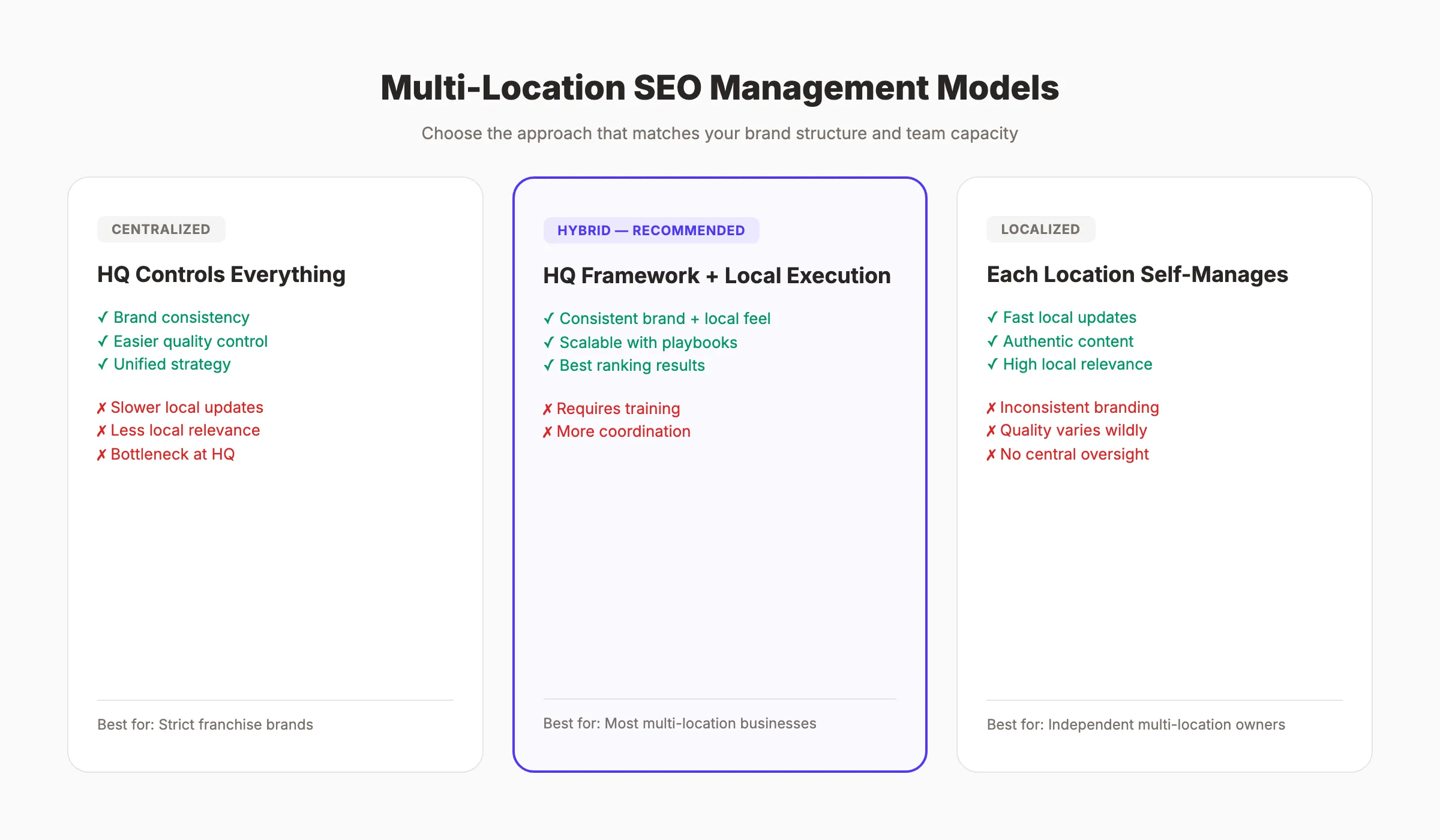
Centralized vs. Localized Management
| Approach | Pros | Cons | Best For |
|---|---|---|---|
| Centralized (HQ controls everything) | Brand consistency, easier QA | Slower updates, less local relevance | Franchises with strict brand guidelines |
| Localized (each location manages itself) | Fast local updates, authentic content | Inconsistent branding, quality varies | Independent multi-location owners |
| Hybrid (HQ sets framework, locations customize) | Balance of consistency and local relevance | Requires clear playbooks and training | Most multi-location businesses |
The hybrid model works best for most businesses. HQ creates templates, guidelines, and automation. Local teams customize content, respond to reviews, and add location-specific details.
Structuring Your Website for Multiple Locations
Your website architecture determines how Google discovers and ranks each location. Get it wrong and locations compete against each other instead of against competitors.
The Ideal URL Structure
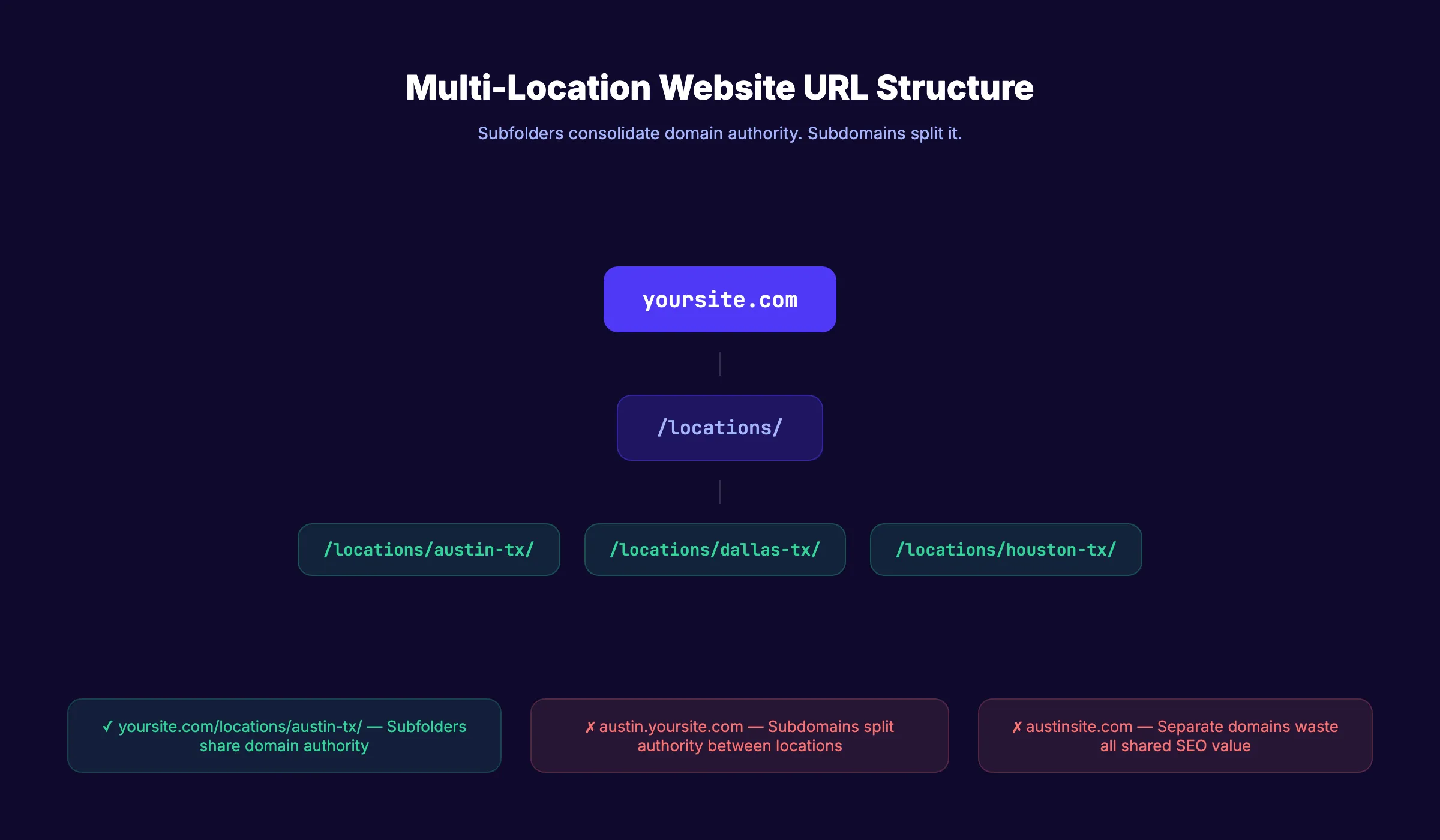
Use a consistent subfolder pattern:
yoursite.com/locations/
yoursite.com/locations/austin-tx/
yoursite.com/locations/dallas-tx/
yoursite.com/locations/houston-tx/
Do not use subdomains (austin.yoursite.com). Subdomains split domain authority. Subfolders keep all authority consolidated under one domain, which benefits every location.
What Every Location Page Needs
Each location page must include genuinely unique content. At minimum:
- Unique H1 with city and service (e.g., “Plumbing Services in Austin, TX”)
- Full NAP (Name, Address, Phone) matching the GBP listing exactly
- Embedded Google Map for that specific location
- Location-specific hours of operation
- 3 to 5 unique paragraphs about that location (not copied from other pages)
- Staff profiles or team members specific to that branch
- Location-specific schema markup (LocalBusiness or relevant subtype)
- Customer reviews or testimonials from that location
- Driving directions from nearby landmarks
- Photos of the actual location (interior and exterior)
The Wiideman study found that custom location images alone produce an 84% ranking improvement over stock photos.
Avoiding Keyword Cannibalization
When multiple location pages target similar keywords, they compete against each other. Prevent this by:
- Targeting geo-specific keywords per page (“plumber in Austin” vs. “plumber in Dallas”)
- Avoiding broad, non-geographic terms on location pages
- Using canonical tags when service descriptions overlap
- Creating a clear internal linking structure from the locations hub to each location page
If your locations share a metro area (e.g., 3 locations in Houston), differentiate with neighborhood-level targeting. “Plumber in The Heights, Houston” is different from “Plumber in Katy, Houston.”
For more on on-page SEO best practices, see our dedicated guide.
Your SEO team. $99 per month. Stacc publishes 30 optimized articles per month for each of your locations on autopilot. Start for $1 →
Google Business Profile Management at Scale
Each physical location needs its own verified Google Business Profile. Google treats every location as a separate entity. One GBP for a 20-location business will get suspended.
Setting Up Multiple GBP Listings
For businesses with 10 or more locations, use Google’s bulk verification process:
- Create a Business Group in Google Business Profile Manager
- Upload a spreadsheet with all location data (name, address, phone, hours, categories)
- Request bulk verification through the manager dashboard
- Google reviews and verifies locations within 1 to 2 weeks
For fewer than 10 locations, verify each individually via postcard, phone, or email.
GBP Optimization Checklist (Per Location)
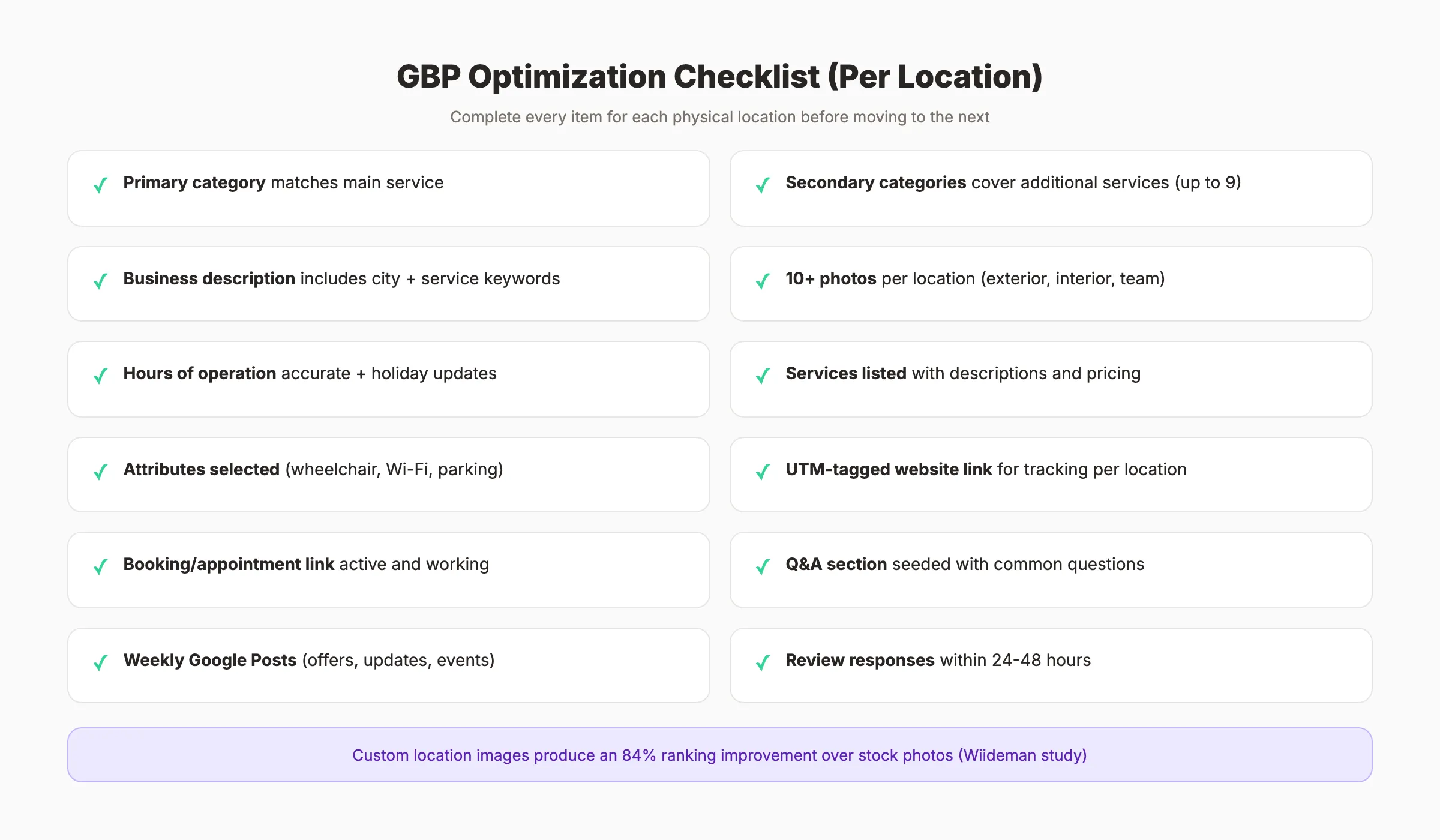
- Primary category matches the main service (e.g., “Plumber” not “Plumbing Service”)
- Secondary categories cover additional services (up to 9 additional categories)
- Business description includes city name and primary service keywords
- Photos uploaded: minimum 10 per location (exterior, interior, team, products)
- Hours of operation accurate and updated for holidays
- Services and products listed with descriptions
- Attributes selected (wheelchair accessible, Wi-Fi, parking, etc.)
- UTM-tagged website link for tracking
- Appointment or booking link active
- Q&A section seeded with common questions and answers
Google Posts for Multi-Location
Google Posts appear directly in your GBP listing and signal activity to the algorithm. Active profiles with weekly posts rank higher than dormant ones.
At scale, create a post template system:
| Post Type | Frequency | Template |
|---|---|---|
| Offers and promotions | 2 per month | [Offer] at [Location]. [Details]. Valid through [Date]. |
| Updates and news | 2 per month | New at [Location]: [Update]. [Details]. |
| Events | As needed | Join us at [Location] for [Event]. [Date/Time]. |
| Product highlights | 1 per month | Now available at [Location]: [Product/Service]. |
Posting consistently across all locations is one of the strongest signals for local SEO. Stacc automates 30 GBP posts per month per location for $49/month, which removes the manual posting burden entirely.
Citation Building and NAP Consistency
NAP stands for Name, Address, Phone Number. Google cross-references your NAP across hundreds of directories to verify your business exists and is trustworthy. Inconsistencies confuse the algorithm and suppress rankings.
Why NAP Consistency Matters More at Scale
A single-location business might have 50 citations. A 20-location business has 1,000+. Every citation must match exactly. “123 Main St” and “123 Main Street” are different in Google’s eyes. “Company Name LLC” and “Company Name” are different too.
At scale, even small variations multiply into hundreds of mismatches. Google’s confidence in your entity drops and rankings follow.
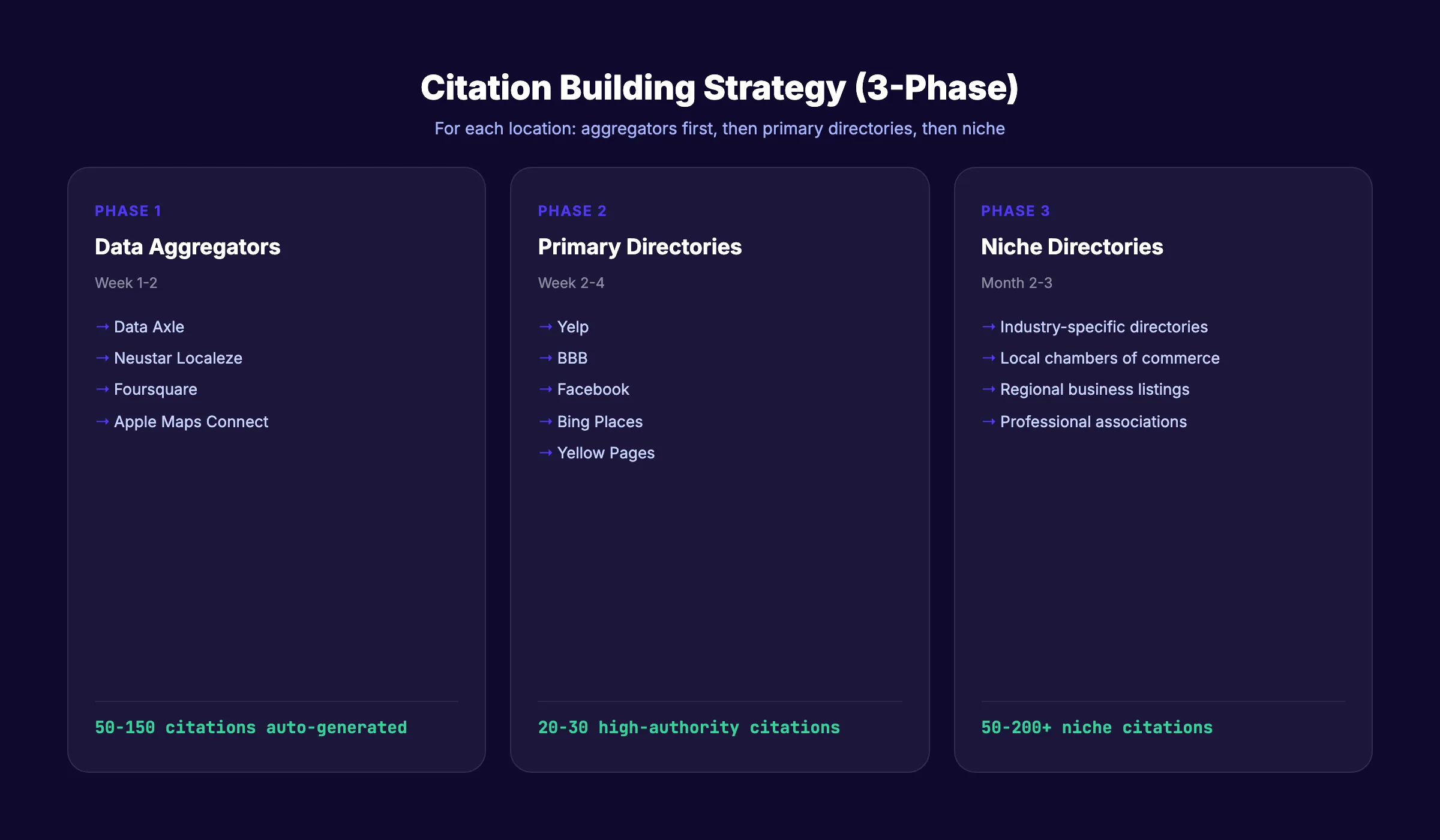
Citation Building Strategy
Phase 1: Data Aggregators (Week 1 to 2)
Submit to the 4 major data aggregators first:
- Data Axle (formerly Infogroup)
- Neustar Localeze
- Foursquare
- Apple Maps Connect
These aggregators distribute your NAP to hundreds of downstream directories automatically. One submission generates 50 to 150 consistent citations within 60 to 90 days.
Phase 2: Primary Directories (Week 2 to 4)
Manually claim and optimize listings on:
- Yelp
- Better Business Bureau
- Bing Places
- Yellow Pages
- Industry-specific directories
Phase 3: Niche Directories (Month 2 to 3)
Research industry and location-specific directories. A BrightLocal analysis of 1,700 restaurant locations found 200+ previously overlooked directories. Every industry has niche directories that general guides miss.
Citation Monitoring Tools
| Tool | Locations Supported | Starting Price | Key Feature |
|---|---|---|---|
| BrightLocal | Unlimited | $39/mo | Citation tracking + building |
| Moz Local | Per location | $14/location/mo | Data aggregator distribution |
| Yext | Enterprise | Custom pricing | Real-time sync across 200+ directories |
| Whitespark | Unlimited | $33/mo | Citation finder + builder |
Audit citations quarterly. Use your chosen tool to scan for inconsistencies and fix them immediately. A single wrong phone number on 30 directories is 30 trust signals telling Google your information is unreliable.
Stop writing. Start ranking. Stacc publishes 30 SEO articles per month for your site. Every article builds authority across all locations. Start for $1 →
Review Management Across Locations
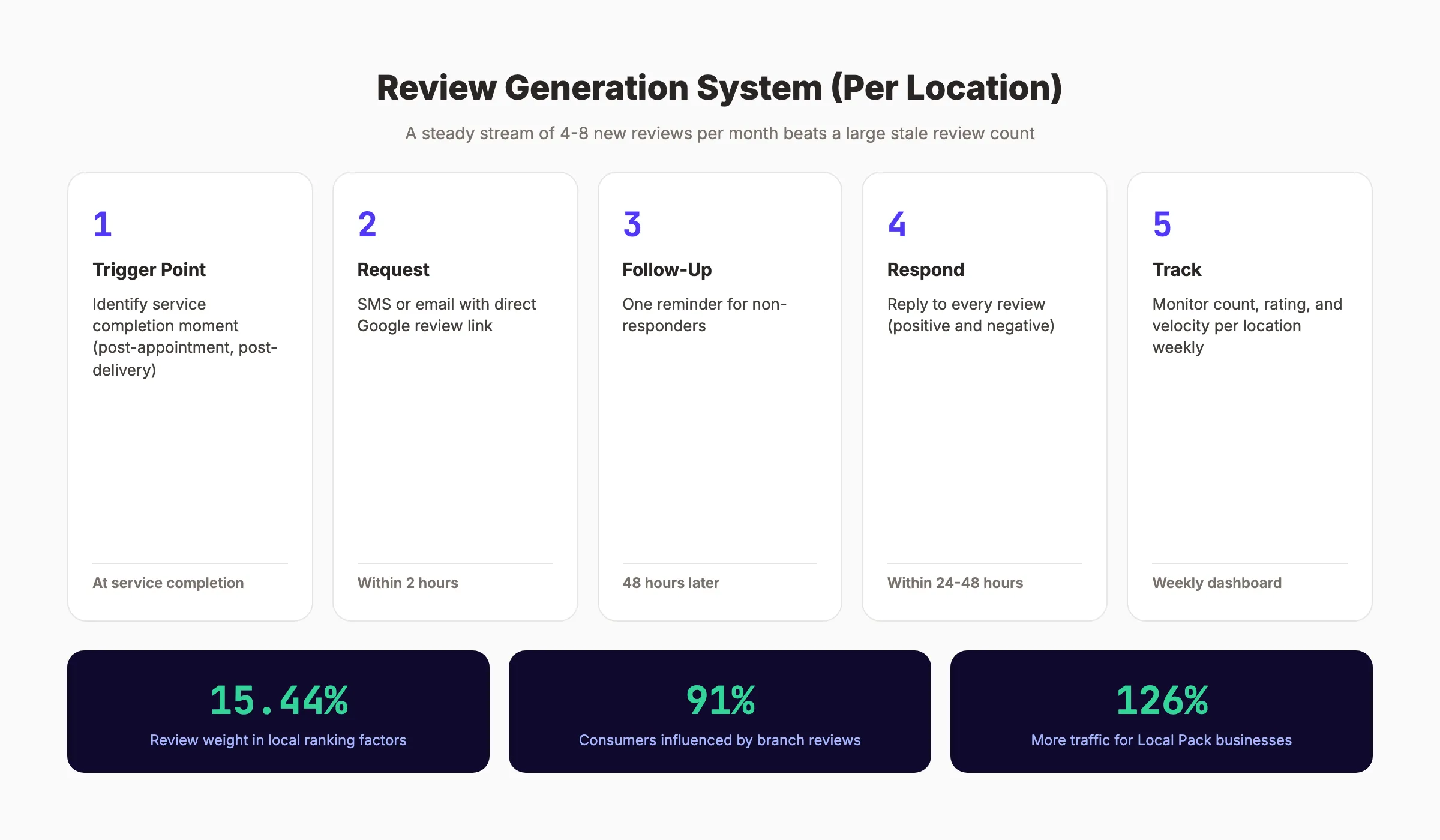
Reviews account for roughly 15.44% of local ranking factors. That is up from 10.8% in 2015, and the weight keeps growing. For multi-location businesses, reviews are both a ranking factor and a trust signal that directly affects which location a customer chooses.
The Recency Problem
A location with 400 reviews from 2019 can get outranked by a competitor with 120 reviews but consistent new reviews every week. Google weights review recency heavily. A steady stream of 4 to 8 new reviews per month per location is more valuable than a large but stale review count.
Review Generation at Scale
Systematic review generation across locations requires a process:
- Trigger point: Identify the service completion moment (post-appointment, post-delivery, post-checkout)
- Request method: SMS or email with a direct link to the Google review form
- Timing: Send within 2 hours of service completion (highest response rate)
- Follow-up: One reminder 48 hours later for non-responders
- Tracking: Monitor review count and rating per location weekly
Train each location’s front desk or service team to ask for reviews in person. “Would you mind leaving us a Google review? It helps other people find us.” Simple and effective.
For a deeper guide on generating more Google reviews, see our dedicated post.
Responding to Reviews
Google confirms that responding to reviews improves local rankings. For multi-location businesses:
- Respond to every review within 24 to 48 hours
- Personalize responses with the reviewer’s name and specific details
- For negative reviews: acknowledge, apologize, offer to resolve offline
- Use templates as starting points but customize each response
- Track response rate per location (target 100%)
91% of consumers say that local branch reviews influence their overall perception of the brand. One unmanaged location with a 3.2-star rating drags down the brand’s entire reputation.
Local Content Strategy for Multiple Locations
Content is how you differentiate location pages and build topical authority in each market. Generic content does not rank. Location-specific content does.
Hyperlocal Content Ideas
| Content Type | Example | Why It Works |
|---|---|---|
| Local guides | ”Best Neighborhoods in Austin for First-Time Buyers” | Targets local search queries and builds trust |
| Community involvement | ”Our Dallas Team Sponsors Little League Tournament” | Creates unique, non-duplicable content |
| Location-specific FAQ | ”Do You Offer Emergency Service in Houston?” | Targets long-tail local queries |
| Local case studies | ”How We Helped a Scottsdale Restaurant Cut Energy Costs 40%“ | Provides social proof for that market |
| Seasonal content | ”Winter Plumbing Tips for Minneapolis Homeowners” | Targets seasonal search spikes |
Blog Content at Scale
Publishing blog content per location is the most effective way to build local organic visibility. Each location should have its own content cadence.
The challenge is volume. 10 locations publishing 4 posts per month is 40 articles. 50 locations is 200 articles. That is where automation matters.
Stacc publishes 30 SEO-optimized articles per month starting at $99. For multi-location businesses, each location can have its own content pipeline with localized keywords and geo-specific topics.
Internal Linking Between Locations
Build a hub-and-spoke model:
- Hub:
/locations/(main locations index page) - Spokes:
/locations/austin-tx/,/locations/dallas-tx/, etc. - Blog to location: Every blog post links to the most relevant location page
- Location to blog: Each location page links to related blog posts
- Cross-location: Only link between locations when contextually relevant (e.g., “We also serve Houston” from a Katy location page)
This model passes authority from the domain to each location while keeping the site structure clean.
Measuring Multi-Location Local SEO Performance
You cannot improve what you do not measure. Multi-location SEO requires location-level metrics, not just aggregate numbers.
Key Metrics Per Location
| Metric | What It Tells You | Target |
|---|---|---|
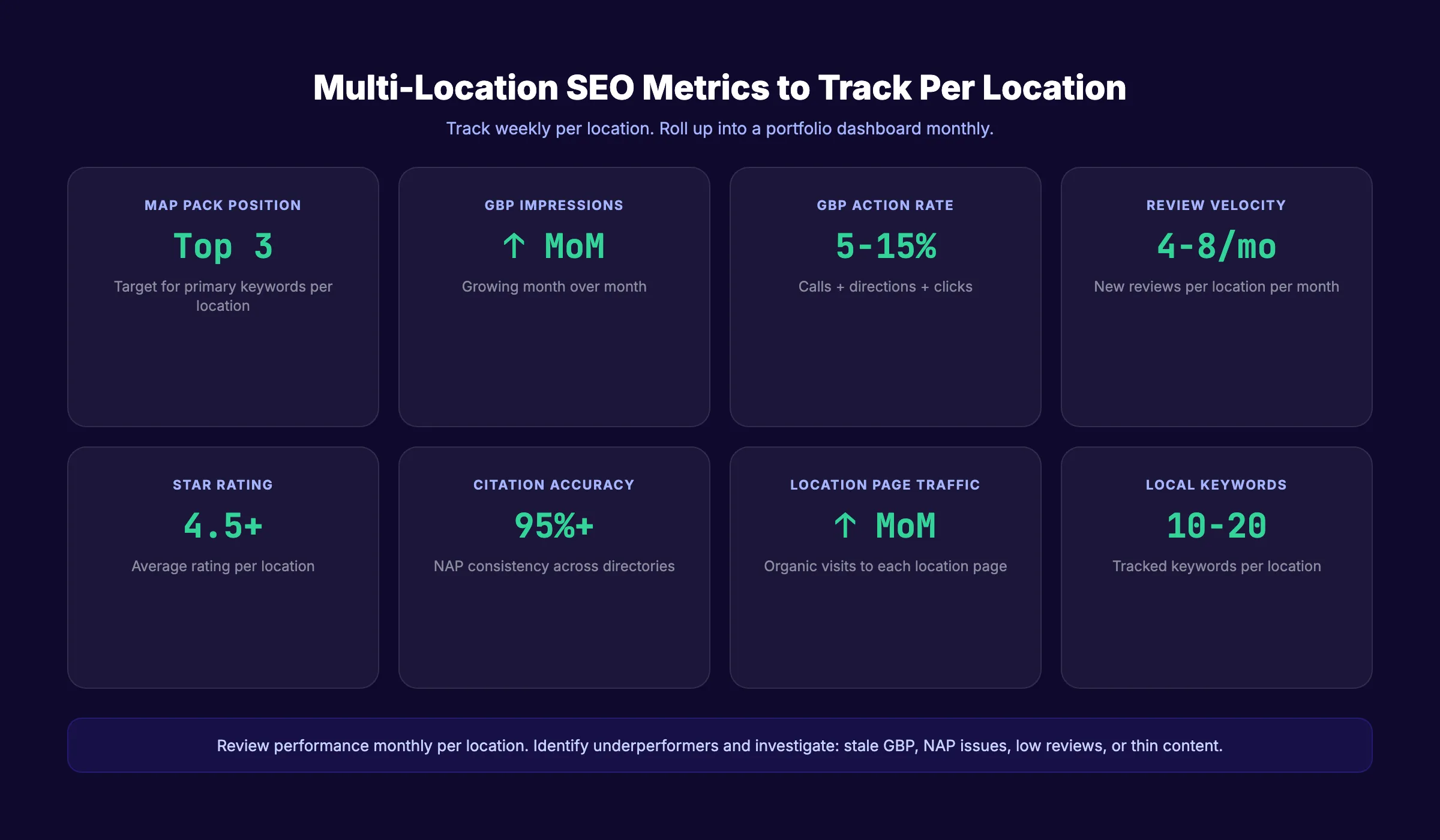
| Google Map Pack position | Local search visibility | Top 3 for primary keywords |
| GBP impressions | How often the listing appears | Growing month over month |
| GBP actions (calls, directions, clicks) | Engagement and intent | 5 to 15% action rate |
| Organic traffic to location page | Website visibility | Growing month over month |
| Review count and rating | Trust and social proof | 4.5+ stars, 4 to 8 new reviews/month |
| Citation accuracy score | NAP consistency | 95%+ accuracy |
| Local keyword rankings | Search position by geo | Tracking 10 to 20 keywords per location |
Tools for Multi-Location Tracking
- BrightLocal. Local rank tracking, citation monitoring, review management per location
- Local Falcon. Map Pack tracking with heat maps showing visibility radius
- Google Search Console. Organic performance per location page URL
- Google Business Profile Insights. Impressions, actions, and queries per listing
- Whitespark. Local rank tracking and citation building
Track local SEO statistics and benchmarks to know where you stand relative to your industry. Review performance monthly per location and quarterly at the portfolio level.
Reporting Structure
Create a monthly scorecard for each location:
- Map Pack position for top 5 keywords
- GBP impressions and actions (month over month change)
- New reviews received and average rating
- Citation accuracy score
- Organic traffic to the location page
- Top performing content for that market
Roll up individual scorecards into a portfolio dashboard. Identify which locations underperform and investigate why. Common causes: stale GBP profile, NAP inconsistencies, low review velocity, or thin location page content.
3,500+ blogs published. 92% average SEO score. See what Stacc can do for your multi-location business. Start for $1 →
FAQ
How many Google Business Profiles can I manage from one account?
Google allows you to manage up to 100 GBP listings from a single Business Profile Manager account. For businesses with more than 100 locations, you can request access to manage additional listings or use the GBP API for bulk management. Each location still needs its own separate, verified profile.
Should I create separate websites for each location or use one domain?
One domain with location subfolders (yoursite.com/locations/city/) is the recommended approach. Separate domains split your SEO authority and make management more difficult. Subdomains are slightly better than separate domains but still dilute authority. Subfolders consolidate everything under one domain and pass authority to every location page.
How do I handle duplicate services across location pages?
Describe services differently for each location by including local context. Instead of copying “We offer emergency plumbing,” write “Our Austin team responds to emergency plumbing calls across Travis County within 45 minutes.” Add local pricing, service area details, and location-specific case studies to make each page genuinely unique.
How often should I post on Google Business Profile for each location?
At minimum once per week per location. Google rewards active profiles with higher visibility. Posting 2 to 3 times per week is ideal. Use a mix of offers, updates, and event posts. Automate posting with tools like Stacc ($49/month for 30 GBP posts per location) to maintain consistency without manual effort.
What is the most common mistake in multi-location SEO?
Duplicate location pages. Copying the same page and swapping the city name triggers Google’s thin content filter. Each location page needs 300 to 500 words of unique, locally relevant content. Include local staff, local photos, local testimonials, and neighborhood-specific information that cannot exist on any other page.
How long does it take to see results from multi-location local SEO?
New location listings typically appear in Google Maps within 1 to 3 weeks after verification. Ranking in the Local Pack takes 60 to 90 days with consistent optimization. Full competitive positioning (top 3 for primary keywords) takes 4 to 8 months depending on market competition and the strength of existing competitors. Review velocity and content consistency are the biggest accelerators.
Multi-location local SEO is a systems problem, not a one-time project. The businesses that win build repeatable processes for GBP management, citation monitoring, review generation, and content publishing. Every location plugged into that system ranks. Every location outside it struggles. Start with the local SEO checklist, scale the process to each branch, and measure location by location. The compound effect across 10, 50, or 500 locations is what separates local market leaders from invisible brands.
Related Tools & Resources
Free SEO Tools:
Best Lists:

Written by
Siddharth GangalSiddharth is the founder of theStacc and Arka360, and a graduate of IIT Mandi. He spent years watching great businesses lose organic traffic to competitors who simply published more. So he built a system to fix that. He writes about SEO, content at scale, and the tactics that actually move rankings.
Automate your Google Business Profile content
30 GBP posts, local SEO articles, and review responses. Published every month automatically.
30-day trial · Cancel anytime
theStacc
Stop writing SEO content manually
30 blog articles, 30 GBP posts, and social media content. Published every month. Automatically.
Start Your $1 Trial$1 for 3 days · Cancel anytime