Pool Service SEO: The Complete Guide (2026)
The complete pool service SEO guide. Google Business Profile, service pages, reviews, seasonal keywords, and content strategy to book more jobs. Updated April 2026.
Siddharth Gangal • 2026-04-02 • Local SEO
In This Article
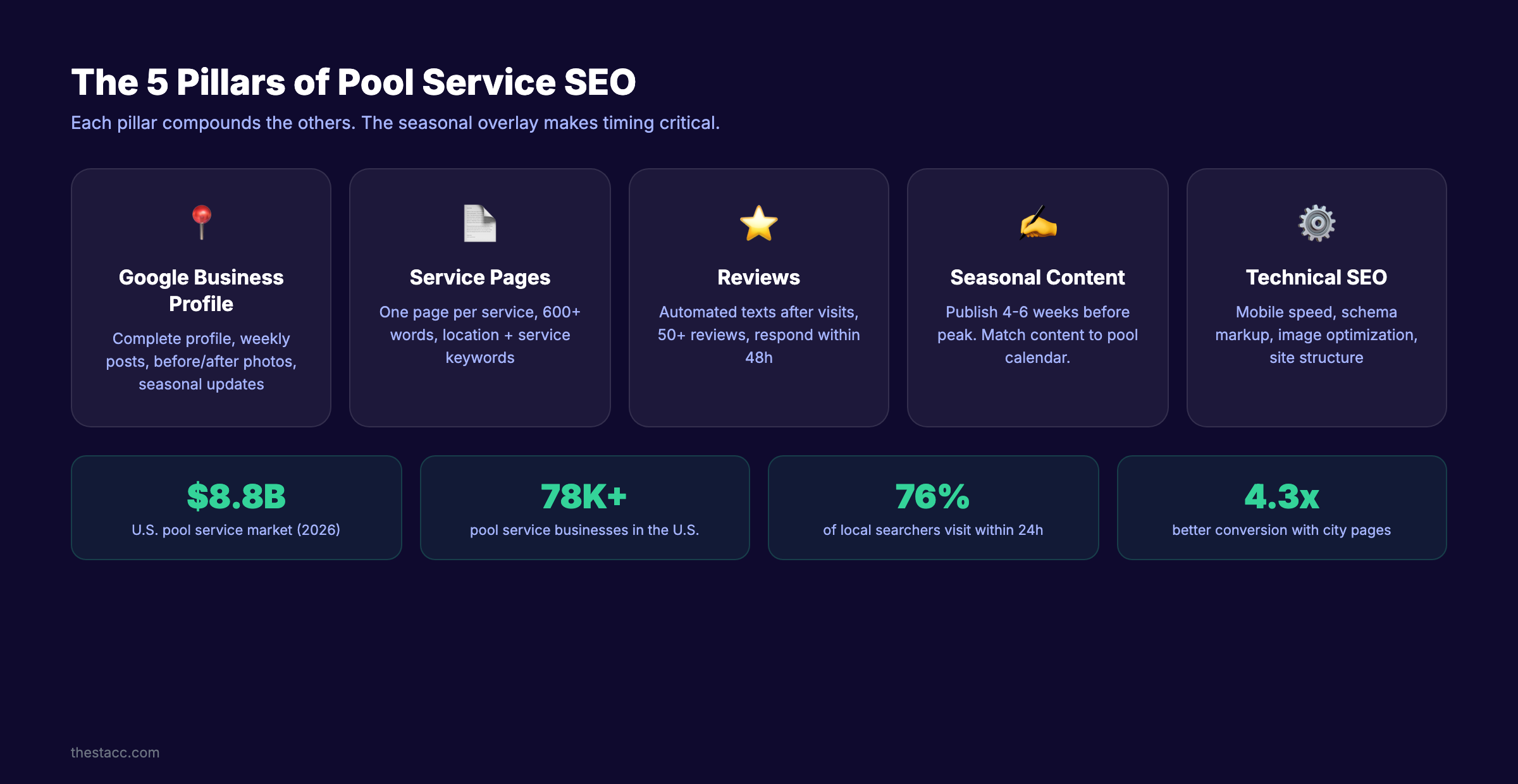
The U.S. pool service industry generates $8.8 billion in annual revenue across 78,000+ businesses. The pandemic-era construction boom created over 120,000 new pools per year. Every one of those pools needs regular maintenance.
Most pool service companies rely on yard signs, referrals, and Nextdoor posts. Those channels work. But they do not scale. Pool service SEO builds a lead pipeline that grows every month without increasing your marketing spend.
76% of people who search for a local service on their phone visit a business within 24 hours. When a homeowner searches “pool cleaning near me” or “pool repair in [city],” the companies ranking in the top 3 Map Pack results get the majority of calls. If your pool business does not appear there, you lose that customer to the competitor who does.
This guide covers every element of pool service SEO. From Google Business Profile to service page structure, seasonal keyword strategy, review tactics, and the content that ranks.
We have published 3,500+ blogs across 70+ industries. Our average SEO score is 92%. We work with home services businesses every day.
Here is what you will learn:
- How to optimize your Google Business Profile for the Map Pack
- The exact service page structure that ranks for pool keywords
- A seasonal keyword strategy matched to the pool service calendar
- How to turn Google reviews into a ranking and conversion tool
- Content ideas that attract homeowners year-round
- Technical SEO basics every pool company website needs
- How to track results and measure SEO ROI
Why Pool Service SEO Beats Paid Ads
Pool service keywords cost $3 to $30 per click on Google Ads. A company spending $1,500 per month on ads generates 50 to 150 clicks. At a 5% conversion rate, that is 3 to 8 new customers per month.
SEO produces the same type of leads. But the cost per lead drops over time instead of staying flat.
The Compounding Advantage
A service page ranking for “pool cleaning in [city]” generates free clicks every month. After 6 months, you have multiple pages ranking for different services and locations. After 12 months, organic traffic can replace most of your paid spend.
Paid ads stop the moment the budget stops. A ranked page keeps generating leads for years. That is the core difference.
The Local Search Opportunity
Pool service is hyperlocal. Homeowners need a company that serves their neighborhood. Google understands this. Local SEO signals determine which pool companies appear in the Map Pack for “near me” and city-based searches.
The pool service industry is highly fragmented. No single company holds more than 5% market share. That fragmentation means local competition is manageable. A pool company with 10 optimized service pages and 50+ Google reviews can dominate search results in most mid-size markets.
What Competitors Miss
Most pool service SEO advice is generic: “optimize your website” and “get more reviews.” This guide gives you the exact structure, keywords, and process for each element. Including the seasonal strategy that most guides completely ignore.
Google Business Profile: Your Most Valuable Asset
Your Google Business Profile (GBP) drives Map Pack visibility. For pool companies, the Map Pack is where homeowners find and compare local options before calling.
Category Selection
Choose the right primary category. This determines which searches trigger your listing.
| Business Type | Primary GBP Category | Secondary Categories |
|---|---|---|
| Pool cleaning/maintenance | Swimming Pool Cleaning Service | Pool Cleaning Service |
| Pool repair | Swimming Pool Repair Service | Swimming Pool Contractor |
| Pool building | Swimming Pool Contractor | Swimming Pool Builder |
| Full-service | Swimming Pool Contractor | Swimming Pool Cleaning Service, Pool Repair |
If you offer multiple services, choose the category that represents your highest-revenue service as your primary.
Complete Every Field
Incomplete profiles rank lower. Fill out everything Google offers.
- Business name: Exact legal name. Do not stuff keywords like “Best Pool Service Dallas.”
- Description: 750 characters. Cover services, service area, years in business, and what sets you apart.
- Services: List every service with a description. Pool cleaning, chemical balancing, equipment repair, pump replacement, leak detection, pool opening, pool closing.
- Appointment URL: Link to your scheduling page or contact form.
- Hours: Accurate hours. Update for seasonal changes.
- Photos: Pools you have serviced, before-and-after shots, team photos, branded trucks. Upload 5 to 10 new photos per month.
Post Weekly
GBP posts signal an active business. Post at least once per week.
Post ideas for pool companies:
- Seasonal tips (pool opening checklist, winterization reminders)
- Before-and-after photos of cleanings or repairs
- Special offers (first cleaning discount, seasonal packages)
- Educational content (water chemistry basics, filter maintenance)
- Weather-related alerts (freeze warnings, algae season prep)
Each post should include a call to action: “Book Now,” “Get a Free Quote,” or “Call Today.”
Stop writing. Start ranking. Stacc publishes 30 SEO articles per month for $99. Plus Google Business Profile posts on autopilot. Start for $1 →
Pool Service Keywords: What Homeowners Search
Keyword research for pool companies follows a predictable seasonal pattern. Understanding what homeowners search and when they search it shapes your entire content strategy.
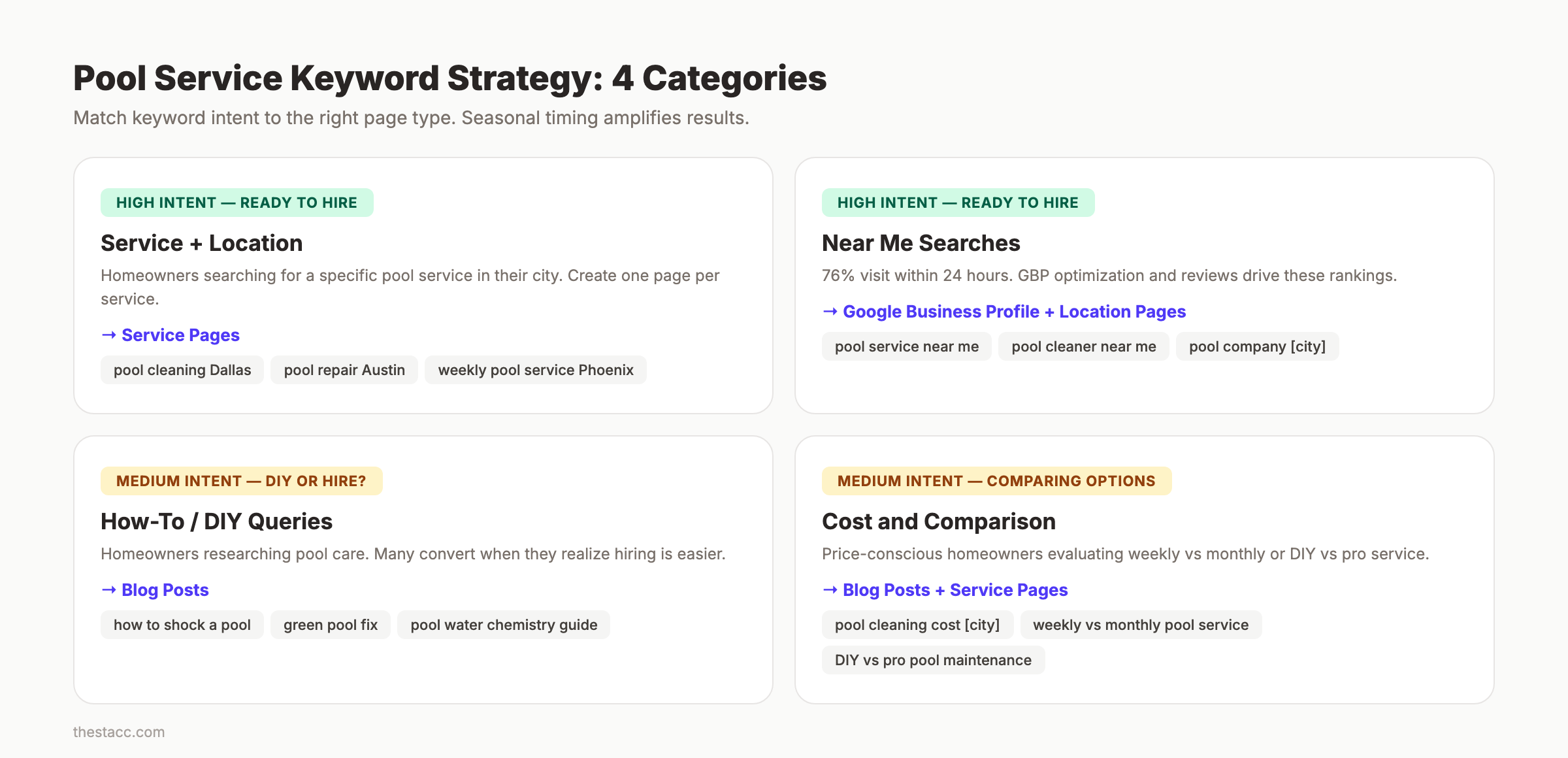
The 4 Keyword Categories
| Category | Example Keywords | Intent | Content Type |
|---|---|---|---|
| Service + Location | ”pool cleaning Dallas,” “pool repair Austin” | High (ready to hire) | Service pages |
| Near Me | ”pool service near me,” “pool cleaner near me” | High (ready to hire) | GBP + local pages |
| How-To / DIY | ”how to shock a pool,” “green pool fix” | Medium (researching) | Blog posts |
| Cost / Comparison | ”pool cleaning cost,” “weekly pool service price” | Medium (evaluating) | Blog + service pages |
High-Value Service Keywords
Each of these deserves a dedicated service page.
Maintenance services:
- Pool cleaning + [city]
- Weekly pool service + [city]
- Pool maintenance + [city]
- Chemical balancing + [city]
- Pool vacuuming + [city]
Repair services:
- Pool pump repair + [city]
- Pool leak detection + [city]
- Pool filter repair + [city]
- Pool heater repair + [city]
- Pool resurfacing + [city]
Seasonal services:
- Pool opening + [city]
- Pool closing/winterization + [city]
- Green pool cleanup + [city]
- Algae removal + [city]
Equipment:
- Pool pump replacement + [city]
- Pool filter replacement + [city]
- Pool light installation + [city]
- Salt system installation + [city]
Seasonal Keyword Trends
Pool service searches are highly seasonal. Your content and ad strategy should match.
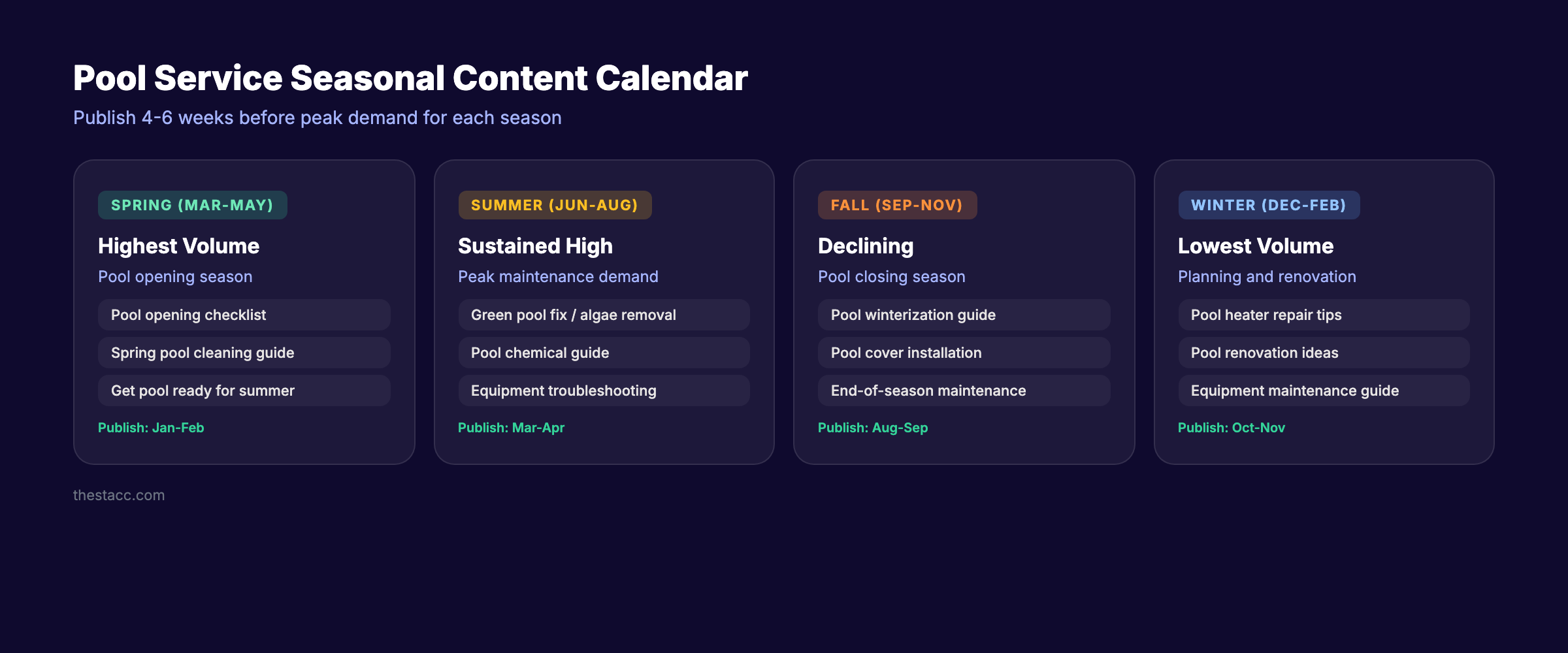
| Season | Search Volume Peak | Top Keywords |
|---|---|---|
| Spring (Mar-May) | Highest of the year | ”pool opening,” “pool cleaning service,” “get pool ready for summer” |
| Summer (Jun-Aug) | Sustained high | ”pool maintenance,” “green pool fix,” “pool chemical service” |
| Fall (Sep-Nov) | Declining | ”pool closing,” “winterize pool,” “pool cover installation” |
| Winter (Dec-Feb) | Lowest | ”pool heater repair,” “pool equipment maintenance,” “pool renovation” |
Publish seasonal content 4 to 6 weeks before the peak. A blog post about “pool opening checklist” published in February ranks in time for the March/April search surge.
Service Pages: One Page Per Service
A single “Services” page listing pool cleaning, repair, and maintenance together will not rank for any of those keywords individually. Each service needs its own dedicated page.
Why Individual Pages Win
Google ranks pages, not websites. A page titled “Pool Cleaning in Phoenix” targets that exact keyword. A page titled “Our Services” targets nothing specific.
Individual service pages give you:
- A unique URL ranking for each service keyword
- Space for service-specific content (600+ words minimum)
- A dedicated landing page for Google Ads campaigns
- Schema markup opportunities for each service
- Internal linking between related services
The Ideal Service Page Structure
1. H1 with service + location Example: “Pool Cleaning Service in Phoenix, AZ”
2. Opening paragraph (60 to 80 words) What the service includes, who it is for, and why homeowners choose you. Include the primary keyword in the first sentence.
3. What is included (H2) List specific tasks. For pool cleaning: skimming, brushing, vacuuming, filter cleaning, chemical testing, chemical adjustment, pump basket cleaning, tile cleaning. Homeowners want to know exactly what they are paying for.
4. Service frequency options (H2) Weekly, bi-weekly, monthly, one-time. Include pricing ranges where possible. “Weekly pool cleaning starts at $120 per month” is more useful than “Contact us for pricing.”
5. Why choose us (H2) Licensed, insured, years of experience, warranties on equipment work. Include trust signals.
6. Service area (H2) List specific cities, neighborhoods, and ZIP codes you serve. This helps Google match your page to location-based searches.
7. FAQ section (H2) Answer 4 to 6 common questions. “How often should I have my pool cleaned?” “What does pool chemical balancing include?” Add FAQ schema for rich results.
8. Call to action “Get a Free Quote” with phone number and form. Make the phone number clickable for mobile users.
Reviews: The Ranking Factor That Closes Deals
Google reviews influence both your Map Pack ranking and your conversion rate. Homeowners compare 3 to 5 pool companies before calling. The one with more reviews and a higher rating wins.
How Many Reviews You Need
Pool companies with 50+ Google reviews dominate the Map Pack in most local markets. Aim for a consistent flow of new reviews every month. Review velocity (the rate of new reviews) matters more than total count.
A pool company that gets 6 new reviews per month outranks one with 150 total reviews but none in the last 3 months.
How to Get Reviews Consistently
Pool service has a natural advantage: recurring visits. Your technician sees the customer’s property regularly. Use that relationship.
Review generation checklist:
- Send an automated text after each service visit (not every visit, weekly or monthly)
- Place a review link in your email invoices
- Train technicians to mention reviews after a positive interaction
- Add a QR code to leave-behind cards or door hangers
- Respond to every review within 48 hours
The automated text after a service visit is the highest-converting method. Time it right after the technician leaves, when the pool looks clean and the homeowner is satisfied.
Review Response Best Practices
Respond to every review. Positive and negative.
Positive: Thank the customer. Mention the service or neighborhood. “Thanks for the great review. We love keeping pools in the Scottsdale Ranch area crystal clear.”
Negative: Acknowledge the issue. Apologize. Offer to resolve it offline. Never argue publicly. A professional response to a negative review often impresses prospective customers more than the review itself.
For detailed strategies, see our guide on getting more Google reviews for local businesses.
Your SEO team. $99 per month. 30 optimized articles published automatically. Built for home services businesses like pool companies. Start for $1 →
Content Strategy: Blog Posts That Book Jobs
Pool service content serves 2 purposes: ranking for informational keywords and building the topical authority that strengthens your service pages.
Content Topics That Work
Seasonal maintenance content (highest search volume):
- “Pool Opening Checklist: 10 Steps to Get Your Pool Ready for Summer”
- “How to Winterize Your Pool in [City]”
- “Green Pool? How to Fix Algae in 48 Hours”
- “When to Start Heating Your Pool in [City]”
Cost and comparison content (high conversion):
- “How Much Does Pool Cleaning Cost in [City]?”
- “Weekly vs. Monthly Pool Service: Which Is Worth It?”
- “DIY Pool Maintenance vs. Hiring a Pro: The Real Cost”
- “Salt Water Pool vs. Chlorine: Maintenance Comparison”
Educational content (builds authority):
- “Pool Water Chemistry 101: A Homeowner’s Guide”
- “5 Signs Your Pool Pump Needs Replacement”
- “How Often Should You Run Your Pool Filter?”
- “Pool Stain Identification: What Causes Them and How to Remove Them”
Local content:
- “Best Pool Season Tips for [City] Homeowners”
- “Pool Regulations in [County]: What Homeowners Need to Know”
Publishing Frequency
The pool companies ranking highest publish 8 to 16 blog posts per month. Most pool companies publish zero. That gap is your competitive advantage.
Consistent publishing builds topical authority. A site with 40 pool-related articles earns more authority than one with 4. You do not need to write every post yourself. A content automation approach lets you publish at volume without hiring a content team.
Seasonal Content Calendar
Plan content around the pool service calendar. Publish 4 to 6 weeks before peak demand.
| Publish Month | Content Focus | Peak Search Month |
|---|---|---|
| January-February | Pool opening guides, spring prep | March-April |
| March-April | Summer maintenance, chemical guides | May-June |
| May-June | Troubleshooting (green pool, equipment) | June-August |
| August-September | Pool closing, winterization | October-November |
| October-November | Off-season equipment maintenance | December-January |
| December | ”New year” planning, renovation ideas | January-February |
Technical SEO for Pool Company Websites
Technical SEO ensures Google can find, crawl, and rank your pages. Most pool company websites have fixable issues holding them back.
Mobile Optimization
Over 70% of “near me” searches happen on mobile. A homeowner standing next to a green pool is searching on their phone. Your site must work perfectly on mobile.
Mobile checklist:
- Pages load in under 3 seconds
- Phone numbers are tap-to-call
- Contact forms work on mobile
- Text is readable without zooming
- Images resize correctly
- “Get a Quote” button is visible without scrolling
Test with Google PageSpeed Insights. Fix anything below 80. Core Web Vitals are a confirmed ranking factor.
Schema Markup
Schema markup helps Google understand your business. For pool companies, 3 types matter:
LocalBusiness schema: Name, address, phone, hours, service area. Required for local SEO.
Service schema: Identifies each service you offer. Helps Google match your pages to service-specific queries.
FAQPage schema: Turns FAQ sections into rich results in Google search. More SERP visibility means more clicks.
Site Structure
A clean site structure helps Google crawl efficiently and helps homeowners find what they need.
Recommended pool company site structure:
Homepage
├── Services (hub page)
│   ├── Pool Cleaning
│   ├── Pool Maintenance
│   ├── Pool Repair
│   ├── Pool Opening
│   ├── Pool Closing
│   ├── Equipment Installation
│   └── [Each service type]
├── Service Areas
│   ├── [City 1]
│   ├── [City 2]
│   └── [Each location]
├── About
├── Blog
│   ├── Seasonal guides
│   ├── How-to articles
│   └── Cost comparison posts
├── Gallery (before/after)
└── Contact / Get a Quote
Link service pages to related blog posts. Link blog posts back to relevant service pages. This internal linking structure distributes authority and helps every page rank stronger.
Image Optimization
Pool companies have a visual advantage: before-and-after photos sell the service. Use them strategically.
- Compress images for fast loading (under 200KB per image)
- Add descriptive alt text: “Green pool before and after cleaning service in Scottsdale AZ”
- Use geo-tagged file names:
pool-cleaning-scottsdale-before-after.jpg - Upload the same photos to your GBP with location details
Optimized images appear in Google Image search and drive extra traffic.
Local Citations and Directories
Citations are mentions of your pool company on other websites. Consistent citations strengthen your local ranking signals.
Priority Directories for Pool Companies
Home services platforms:
- Angi (formerly Angie’s List)
- HomeAdvisor
- Thumbtack
- Nextdoor
- Houzz
General local:
- Google Business Profile
- Yelp
- Apple Maps
- Bing Places
- YellowPages
- BBB (Better Business Bureau)
Industry-specific:
- Pool and Hot Tub Alliance (PHTA) member directory
- Local Chamber of Commerce
- State contractor licensing board
NAP Consistency
Your Name, Address, and Phone Number must match exactly across every listing. If your GBP says “123 Main St, Suite 4,” every other listing must say the same. Not “123 Main Street #4.”
Inconsistent NAP confuses Google and hurts local rankings. Audit all listings quarterly.
3,500+ blogs published. 92% average SEO score. See what Stacc can do for your pool service business. Start for $1 →
Tracking Pool Service SEO Results
SEO without measurement is guesswork. Track these metrics monthly.
Key Metrics
| Metric | Tool | What It Tells You |
|---|---|---|
| Organic traffic | Google Analytics 4 | Visitors from search |
| Keyword rankings | Google Search Console | Which queries you rank for |
| Map Pack impressions | GBP Insights | How often you appear locally |
| Phone calls from GBP | GBP Insights + call tracking | Leads from local search |
| Quote requests | GA4 + CRM | Form submissions from organic |
| Review count and rating | Google Business Profile | Trust signals and ranking factor |
| Seasonal traffic trends | GA4 year-over-year | How seasonal patterns affect your traffic |
Realistic Timeline
Month 1 to 2: Technical fixes, GBP optimization, service page creation. Minimal ranking changes.
Month 3 to 4: New pages index. Long-tail keywords start ranking. GBP visibility improves.
Month 5 to 6: Service pages gain traction. Blog content ranks for how-to and cost queries. Organic traffic increases 20 to 40%.
Month 7 to 12: Compounding effect across services and locations. Map Pack dominance builds. Organic traffic grows 50 to 100%+ from baseline.
Pool service SEO has a seasonal overlay. Expect the biggest jumps in spring and early summer when search volume peaks. Winter months show slower growth in traffic but are the perfect time to build content that ranks before the next season.
The timeline for SEO results depends on market competition. A pool company in a mid-size city sees faster results than one in Phoenix, Miami, or Dallas.
Common Pool Service SEO Mistakes
Avoid these mistakes. Each one costs rankings and leads.
1. One page for all services. Pool cleaning, repair, and maintenance need separate pages. A single “Services” page cannot rank for all 3.
2. No seasonal content. Pool search demand is seasonal. Companies that publish pool opening guides in January rank in time for the March surge. Companies that wait until April miss the window.
3. Ignoring Google Business Profile. Your GBP is the single most important local SEO asset. An incomplete profile with no photos and no posts is invisible in the Map Pack.
4. No review system. Hoping customers leave reviews does not work. You need automated texts, email reminders, and trained technicians asking at the right moment.
5. Generic location pages. Copying the same text across 8 city pages and swapping the city name fails. Each location page needs unique content specific to that area.
6. No blog content. A website with 5 static pages and no blog cannot build topical authority. The pool companies dominating search publish consistently.
7. Slow mobile site. Over 70% of searches happen on mobile. A site that takes 5 seconds to load loses visitors before they see your phone number.
8. Missing schema markup. LocalBusiness and FAQPage schema are easy to add. They directly impact your eligibility for rich results and Map Pack features.
FAQ
How long does pool service SEO take to work?
Most pool companies see initial ranking improvements in 3 to 4 months. Competitive keywords take 6 to 12 months. Long-tail seasonal keywords often rank within 60 to 90 days if published before peak season.
How much does SEO cost for a pool company?
SEO agencies charge $750 to $3,000 per month for pool service businesses. Automated content services like Stacc publish 30 optimized articles per month starting at $99. The right investment depends on your market size and competition level.
What are the best keywords for a pool service company?
Service + location keywords drive the most leads: “pool cleaning [city],” “pool repair near me,” “weekly pool service [city].” Seasonal keywords like “pool opening” and “green pool cleanup” generate high-intent traffic during peak months.
Do Google reviews help pool company SEO?
Yes. Review quantity, quality, and recency are confirmed local ranking factors. Pool companies with 50+ reviews dominate the Map Pack in most markets. Review velocity (new reviews per month) matters more than total count.
Should I create separate pages for each city I serve?
Yes. Each city needs its own page with unique content. City-specific pages convert 4.3x better than generic pages and rank for 3x more relevant keywords. Do not duplicate text across locations.
Is blogging worth it for a pool company?
Yes. Blog content targets informational and cost-related keywords that service pages cannot. Posts like “How Much Does Pool Cleaning Cost” and “DIY vs. Pro Pool Maintenance” attract homeowners in the research phase. Those readers convert to customers when they realize hiring a pro is easier.
Pool service SEO is a system that compounds over time. Every service page, blog post, review, and GBP update adds to your local authority. The pool companies booking the most jobs from Google in 2026 are the ones that started building this system 6 to 12 months ago.
Start with your Google Business Profile. Build individual service pages. Launch a review system. Publish seasonal content before peak demand. The leads will follow.
Rank everywhere. Do nothing. Blog SEO, Local SEO, and Social on autopilot. Built for home services businesses. Start for $1 →
Written and published by Stacc. We publish 3,500+ articles per month across 70+ industries. All data verified against public sources as of March 2026.