Programmatic ABM: The Complete Guide (2026)
Programmatic ABM uses AI to deliver personalized B2B marketing at scale. Learn the 3 ABM tiers, key strategies, and ROI data. Updated April 2026.
Siddharth Gangal • 2026-04-02 • SEO Tips
In This Article
97% of marketers report that account-based marketing delivers higher ROI than any other strategy. Yet most B2B companies still target 10 to 50 accounts manually. Programmatic ABM changes that equation entirely.
Programmatic ABM is the practice of scaling account-based marketing to hundreds or thousands of target accounts using AI, automation, and intent data. It combines the precision of traditional ABM with the reach of programmatic advertising. You get personalized messaging for each account without the manual work that limits traditional ABM to a handful of targets.
The global ABM market reached $1.15 billion in 2026, growing at 11.94% CAGR. And 86.2% of marketers expect AI to boost their ABM ROI over the next year. The shift from manual ABM to programmatic ABM is accelerating.
We have published 3,500+ SEO articles across 70+ industries and work with B2B companies that use content as a core ABM channel. This guide explains what programmatic ABM is, how the 3 tiers of ABM work, where AI fits, and how content strategy powers the whole system.
Here is what you will learn:
- What programmatic ABM means and how it differs from strategic ABM
- The 3 tiers of ABM and when to use each
- How AI automates targeting, personalization, and campaign execution
- The role of content and SEO in programmatic ABM
- Key metrics and ROI data from 2026 ABM programs
- How to get started with programmatic ABM
What Is Programmatic ABM?
Programmatic ABM is a 1-to-many account-based marketing strategy that uses technology to deliver personalized campaigns to hundreds or thousands of target accounts simultaneously. It automates the parts of ABM that traditionally required manual effort: account research, audience segmentation, content personalization, ad placement, and performance tracking.
Traditional ABM targets 5 to 50 accounts with highly customized campaigns. Each account gets its own landing page, custom content, and dedicated sales outreach. The results are strong, but the approach does not scale. Most marketing teams cannot produce custom campaigns for 500 accounts.
Programmatic ABM solves the scale problem. Instead of building 500 custom campaigns, you build campaign templates that adapt automatically based on account attributes. Firmographic data (industry, company size, revenue), technographic data (tools they use), and intent data (topics they research) determine what each account sees.
The human sets the strategy. The technology executes at scale.
How Programmatic ABM Works
The process follows 5 stages:
- Account selection — AI scores and ranks target accounts based on fit and intent signals
- Audience mapping — Technology identifies the buying committee members at each account
- Content personalization — AI adapts messaging based on industry, role, and buying stage
- Multi-channel delivery — Programmatic ads, email, social, and content serve the right message
- Measurement and optimization — AI tracks engagement per account and adjusts campaigns
The difference from traditional demand generation is targeting. Demand gen casts a wide net. Programmatic ABM targets specific companies. Every impression, click, and content view maps to a named account.
The 3 Tiers of Account-Based Marketing
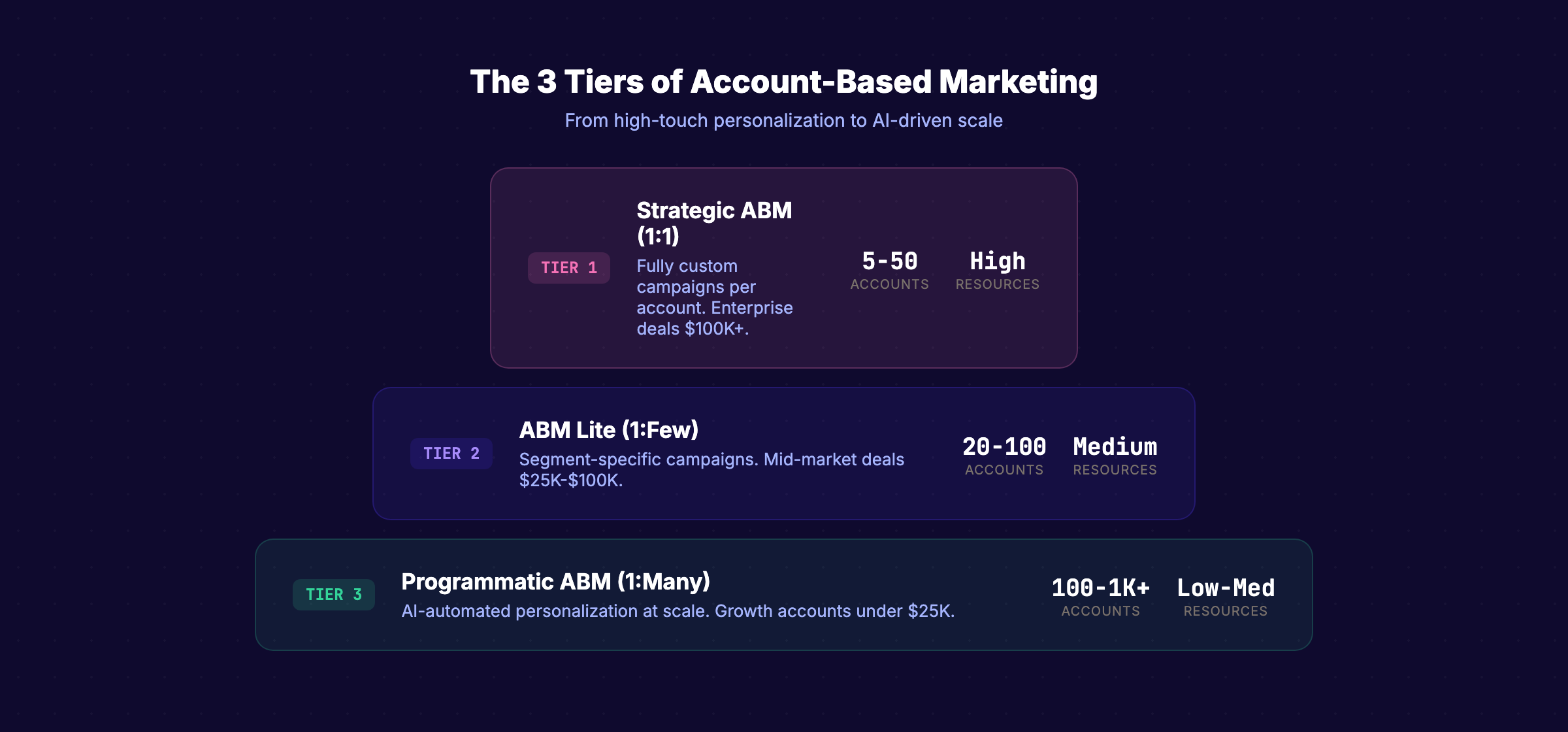
ABM operates on 3 tiers. Each serves a different purpose and requires different resources. Understanding all 3 is essential for choosing the right approach.
| Tier | Name | Account Volume | Personalization | Resources Required |
|---|---|---|---|---|
| Tier 1 | Strategic ABM (1:1) | 5-50 accounts | Fully custom per account | High (dedicated team) |
| Tier 2 | ABM Lite (1:Few) | 20-100 accounts | Customized per segment | Medium (shared team) |
| Tier 3 | Programmatic ABM (1:Many) | 100-1,000+ accounts | Automated per attribute | Low-medium (tech-driven) |
Tier 1: Strategic ABM (1:1)
Strategic ABM targets your highest-value accounts with fully personalized campaigns. Each account gets custom content, dedicated sales support, and tailored outreach. This tier works for enterprise deals worth $100K+ where the investment in personalization pays for itself.
The ROI is the highest of all 3 tiers. But it requires the most resources per account.
Tier 2: ABM Lite (1:Few)
ABM Lite groups 20 to 100 accounts that share common characteristics (same industry, same size, same pain point) and delivers segment-specific campaigns. You create 5 to 10 campaign variations instead of 100 custom versions.
This tier balances personalization with efficiency. It works well for mid-market accounts worth $25K to $100K.
Tier 3: Programmatic ABM (1:Many)
Programmatic ABM targets 100 to 1,000+ accounts using technology to automate personalization. Dynamic content adapts based on account attributes. Programmatic ads serve tailored messaging across display, social, and video channels.
This tier works for building awareness and generating demand across a large addressable market. It is the most scalable approach and the fastest growing tier in 2026.
Most B2B companies use all 3 tiers simultaneously. The top 10 accounts get Tier 1 treatment. The next 50 get Tier 2. The remaining 500+ get Tier 3. This pyramid model maximizes both personalization and reach.
How to Choose the Right Tier
The tier selection depends on 3 factors: deal size, buying committee complexity, and your available resources.
| Factor | Tier 1 (Strategic) | Tier 2 (Lite) | Tier 3 (Programmatic) |
|---|---|---|---|
| Average deal size | $100K+ | $25K-$100K | Under $25K |
| Buying committee | 10+ stakeholders | 5-10 stakeholders | 3-5 stakeholders |
| Sales cycle length | 6-12+ months | 3-6 months | 1-3 months |
| Content per account | Custom per account | Custom per segment | Template-based, automated |
| Marketing headcount needed | 2-3 dedicated | 1-2 shared | 0.5 FTE + technology |
| Typical company using this | Enterprise SaaS, consulting firms | Mid-market B2B, professional services | Growth-stage SaaS, services companies |
If you sell $10K annual contracts to 1,000 potential customers, Tier 3 programmatic ABM is the clear choice. If you sell $500K enterprise deals to 20 prospects, Tier 1 strategic ABM makes sense. Most companies need a mix.
Your SEO team. $99 per month. 30 optimized articles per month build the content library that powers ABM campaigns at every tier. Start for $1 →
How AI Powers Programmatic ABM
AI transforms programmatic ABM from a manual-heavy process into an automated system. Here are the 5 areas where AI has the biggest impact.
AI for Account Scoring and Selection
AI analyzes firmographic data, technographic signals, and intent data to score and rank target accounts. Instead of marketing and sales manually building account lists from CRM data, AI identifies which companies match your ideal customer profile and shows buying intent right now.
84% of marketers now use AI and intent data for account selection. Predictive models lift conversion rates by 22% compared to manual selection methods.
AI for Content Personalization
AI generates content variations tailored to each account segment. A single blog post about “SEO for healthcare” can be adapted into 5 versions targeting hospitals, dental practices, physical therapy clinics, dermatology groups, and mental health providers. Each version uses industry-specific language, examples, and data points.
This is where content marketing strategy and ABM intersect directly. The content you publish on your blog serves double duty: it ranks organically for search traffic AND it gets distributed to target accounts as part of ABM campaigns.
AI for Multi-Channel Orchestration
AI coordinates ad delivery across display, social, CTV, email, and content channels. It determines which channel works best for each account based on engagement patterns. An account that engages with LinkedIn ads but ignores display ads automatically gets more LinkedIn budget.
AI for Intent Signal Monitoring
AI tracks what target accounts are researching in real time. When a target account starts searching for topics related to your product, AI triggers campaign acceleration. The account moves from awareness content to consideration content automatically.
AI for Performance Optimization
AI monitors campaign performance per account and adjusts budgets, messaging, and channel mix in real time. Underperforming accounts get different creative. High-engagement accounts get escalated to sales.
Content and SEO as ABM Infrastructure
Most ABM guides focus on ads and outreach. They miss the biggest opportunity: content.
Every ABM campaign needs content to work. Landing pages, blog posts, case studies, whitepapers, and email sequences all require written content tailored to target accounts. Without a content library, ABM campaigns have nothing to deliver.
How SEO Content Powers ABM
Here is the connection most B2B marketers miss. The blog content you create for organic search traffic also serves as ABM content.
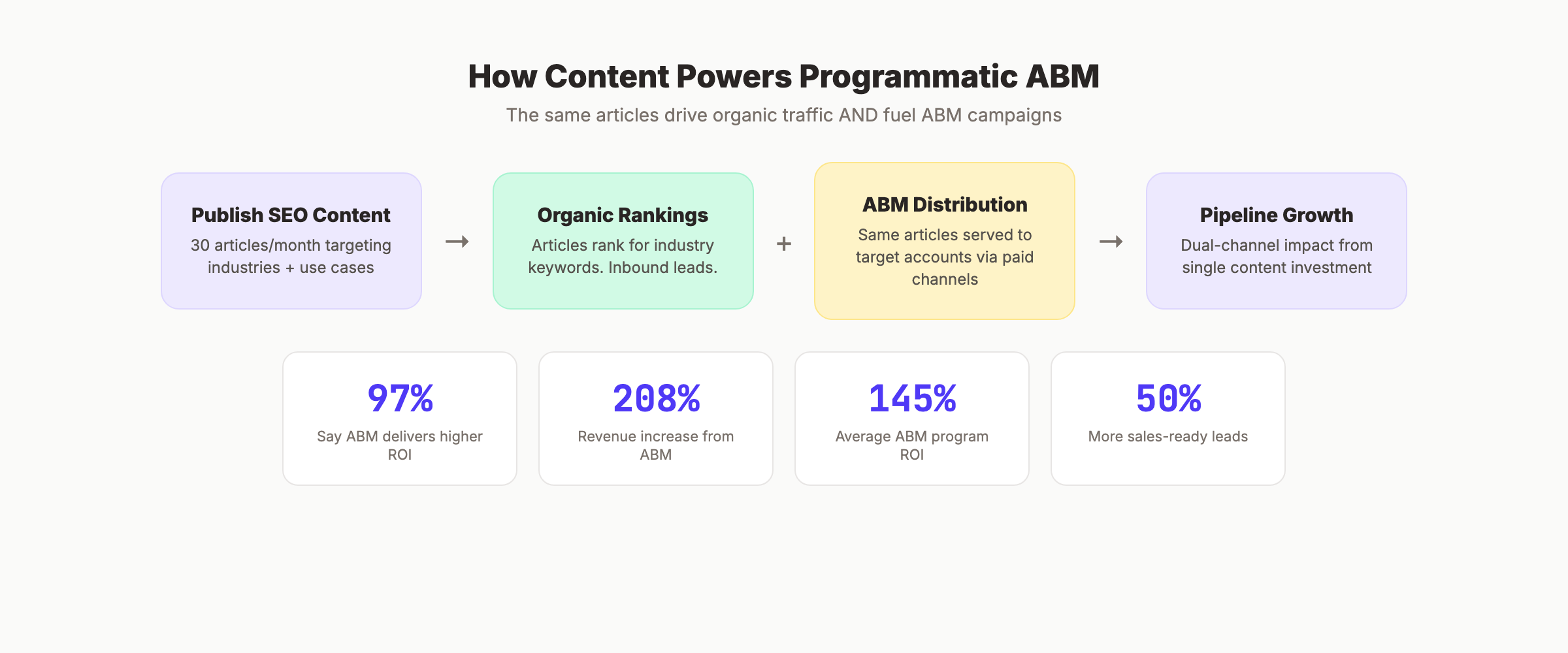
A blog post titled “SEO for Law Firms” ranks organically AND gets distributed to law firm accounts in your ABM target list. The same article serves 2 channels. The organic traffic generates inbound leads. The ABM distribution generates account engagement from specific target companies.
This is the Content Compound Effect applied to ABM. Every article you publish adds to your content library. That library powers both organic discovery and targeted account campaigns.
Building an ABM Content Library
The minimum content library for effective programmatic ABM includes:
| Content Type | Purpose in ABM | Quantity Needed |
|---|---|---|
| Industry-specific blog posts | Awareness stage, organic + ABM distribution | 3-5 per target industry |
| Case studies | Consideration stage, proof of results | 1-2 per industry vertical |
| Comparison pages | Decision stage, competitive positioning | 1 per main competitor |
| Landing pages | Conversion, account-specific messaging | 1 per account segment |
| Email sequences | Nurture, multi-touch engagement | 3-5 emails per segment |
At 30 blog posts per month, you can build a complete ABM content library for 5 to 6 industries within 90 days. That library then serves both organic SEO and programmatic ABM distribution indefinitely.
Content Personalization at Scale
Programmatic ABM does not require unique content for every account. It requires content that adapts based on attributes. A single article framework can be personalized through:
- Industry-specific examples and case studies
- Company-size-relevant pricing and metrics
- Role-specific value propositions (CTO versus CMO versus CEO)
- Buying-stage-appropriate depth (awareness versus consideration)
The key insight: you do not need separate content for SEO and ABM. The same articles serve both channels. This is why content velocity matters so much for B2B companies running ABM. More content means more segments covered, more keywords ranked, and more ABM campaigns fueled.
For guidance on creating content that ranks and converts, read our SEO content writing guide.
3,500+ blogs published. 92% average SEO score. Every article builds the content library that powers your ABM campaigns. Start for $1 →
Programmatic ABM Metrics That Matter
Programmatic ABM requires different metrics than traditional demand gen. Measuring leads alone misses the point. ABM measures account-level engagement and pipeline progression.
Key Metrics
| Metric | What It Measures | Benchmark |
|---|---|---|
| Account engagement score | Multi-channel interaction per account | Increasing over time |
| Account penetration | % of buying committee reached per account | 40%+ of identified contacts |
| Pipeline velocity | Speed from first touch to opportunity creation | 20-30% faster than non-ABM |
| Account-influenced revenue | Revenue from accounts touched by ABM | 208% increase reported |
| Marketing-qualified accounts (MQAs) | Accounts meeting engagement threshold | Replacing MQLs as primary metric |
| Content engagement by account | Which content each account consumes | Informs sales conversations |
| Return on investment | Revenue generated versus ABM spend | 137-145% average ROI |
The ABM Measurement Shift
Traditional marketing measures leads. ABM measures accounts. The difference matters because B2B purchases involve buying committees of 6 to 10 people. A single lead from a target account does not represent the buying decision. Account-level engagement across the entire committee does.
Track engagement per account across all channels: ad impressions, website visits, content downloads, email opens, and sales interactions. The aggregate score tells you whether an account is progressing through the buying journey.
For deeper insight into how to measure content marketing ROI, read our dedicated guide.
ABM ROI by the Numbers
The data on ABM effectiveness is clear:
- 97% of marketers say ABM delivers higher ROI than other strategies
- 208% increase in marketing-generated revenue for ABM adopters
- 145% average ROI for well-executed ABM programs
- 50% more sales-ready leads generated by ABM versus non-ABM
- 65% of companies report increased pipeline opportunities from ABM
- 71.2% of B2B organizations now actively use ABM strategies
- 86.2% expect AI to boost their ABM ROI in the coming year
These numbers explain why 49.7% of organizations plan to increase ABM budgets in 2026. The ROI case is settled. The question is no longer “should we do ABM?” It is “how do we scale it?”
Programmatic ABM is the answer to the scaling question. It delivers ABM results at 5 to 10x the account volume with lower per-account costs than manual approaches.
How to Get Started with Programmatic ABM
Getting started does not require a 6-figure platform investment. Here is a practical launch plan.
Phase 1: Define Your Target Account List (Week 1-2)
Build a list of 200 to 500 target accounts based on your ideal customer profile. Use firmographic filters (industry, size, revenue, location) and layer in intent data if available.
Checklist:
- Define your ideal customer profile with specific firmographic criteria
- Pull initial list from your CRM, LinkedIn Sales Navigator, or ZoomInfo
- Score accounts by fit (how well they match your ICP) and intent (buying signals)
- Segment accounts into 3 to 5 groups by industry or use case
Phase 2: Build Your Content Library (Week 2-6)
Create the minimum content needed to run campaigns for each segment.
Checklist:
- Publish 3 to 5 blog posts per target industry (for organic ranking + ABM distribution)
- Create 1 case study per industry vertical
- Write 1 landing page per account segment
- Build a 3-email nurture sequence per segment
- Ensure all content follows on-page SEO best practices
Phase 3: Launch Programmatic Campaigns (Week 4-8)
Activate multi-channel campaigns targeting your account list.
Checklist:
- Set up programmatic display ads targeting accounts by IP or cookie-based matching
- Launch LinkedIn Matched Audiences campaigns for buying committee members
- Activate email sequences for known contacts at target accounts
- Distribute blog content through paid social targeting account company pages
- Enable retargeting for accounts that visit your website
Phase 4: Measure and Optimize (Ongoing)
Track account-level engagement and adjust campaigns based on performance.
Checklist:
- Monitor account engagement scores weekly
- Identify accounts showing acceleration signals (multiple touches across channels)
- Escalate high-engagement accounts to sales for direct outreach
- Refresh ad creative every 4 to 6 weeks to prevent fatigue
- Add new content monthly to expand your ABM distribution library
Rank everywhere. Do nothing. Blog SEO, Local SEO, and Social on autopilot. Build your ABM content library while you focus on accounts. Start for $1 →
FAQ
What is the difference between ABM and programmatic ABM?
ABM is the strategy of targeting specific accounts with personalized marketing. Programmatic ABM is the execution method that uses technology to scale ABM to 100 to 1,000+ accounts. Traditional ABM is manual. Programmatic ABM is automated. Both target specific accounts, but programmatic ABM does it at scale.
How much does programmatic ABM cost?
Entry-level programmatic ABM platforms start at $1,000 to $3,000 per month. Enterprise platforms like Demandbase and 6sense run $5,000 to $25,000+ per month. The bigger cost is content production. You need 3 to 5 articles per target industry plus landing pages and email sequences for each segment.
Can small B2B companies use programmatic ABM?
Yes. Programmatic ABM is not limited to enterprise budgets. A B2B company with 200 target accounts can run effective campaigns using LinkedIn Matched Audiences, Google Display targeting, and email automation. The content requirement is the main investment. Publishing 30 articles per month at $99 through Stacc builds a complete ABM content library in 60 to 90 days.
How does content marketing support ABM?
Every blog post you publish for organic SEO also serves as ABM content. Industry-specific articles rank in Google AND get distributed to target accounts through programmatic campaigns. The content serves dual channels. This is why content velocity matters for ABM. The faster you build your library, the more segments you can target.
What metrics should I track for programmatic ABM?
Track account engagement score, account penetration rate, pipeline velocity, and marketing-qualified accounts (MQAs). Avoid measuring individual leads. ABM measures accounts, not people. An account with 5 contacts engaging across 3 channels is more valuable than 50 random leads from non-target companies.
How long before programmatic ABM shows results?
Initial engagement data appears within 2 to 4 weeks of campaign launch. Pipeline impact typically shows at 60 to 90 days. Revenue attribution requires 2 to 4 quarters depending on your sales cycle length. ABM is a long-term strategy. The companies that commit for 12+ months see the strongest ROI.
Programmatic ABM is the bridge between personalization and scale that B2B marketing has needed. The combination of AI automation, intent data, and content infrastructure makes it possible to target thousands of accounts with relevant messaging. Start with 200 accounts, build your content library, and scale from there. The businesses that build this infrastructure now will own the pipeline advantage for years.
Written and published by Stacc. We publish 3,500+ articles per month across 70+ industries. All data verified against public sources as of March 2026.