Yoga Studio SEO: Get More Students from Google (2026)
SEO for yoga studios explained step by step. Covers local keywords, GBP optimization, class pages, blog strategy, and review tactics. Updated 2026.
Siddharth Gangal • 2026-03-29 • Local SEO
In This Article
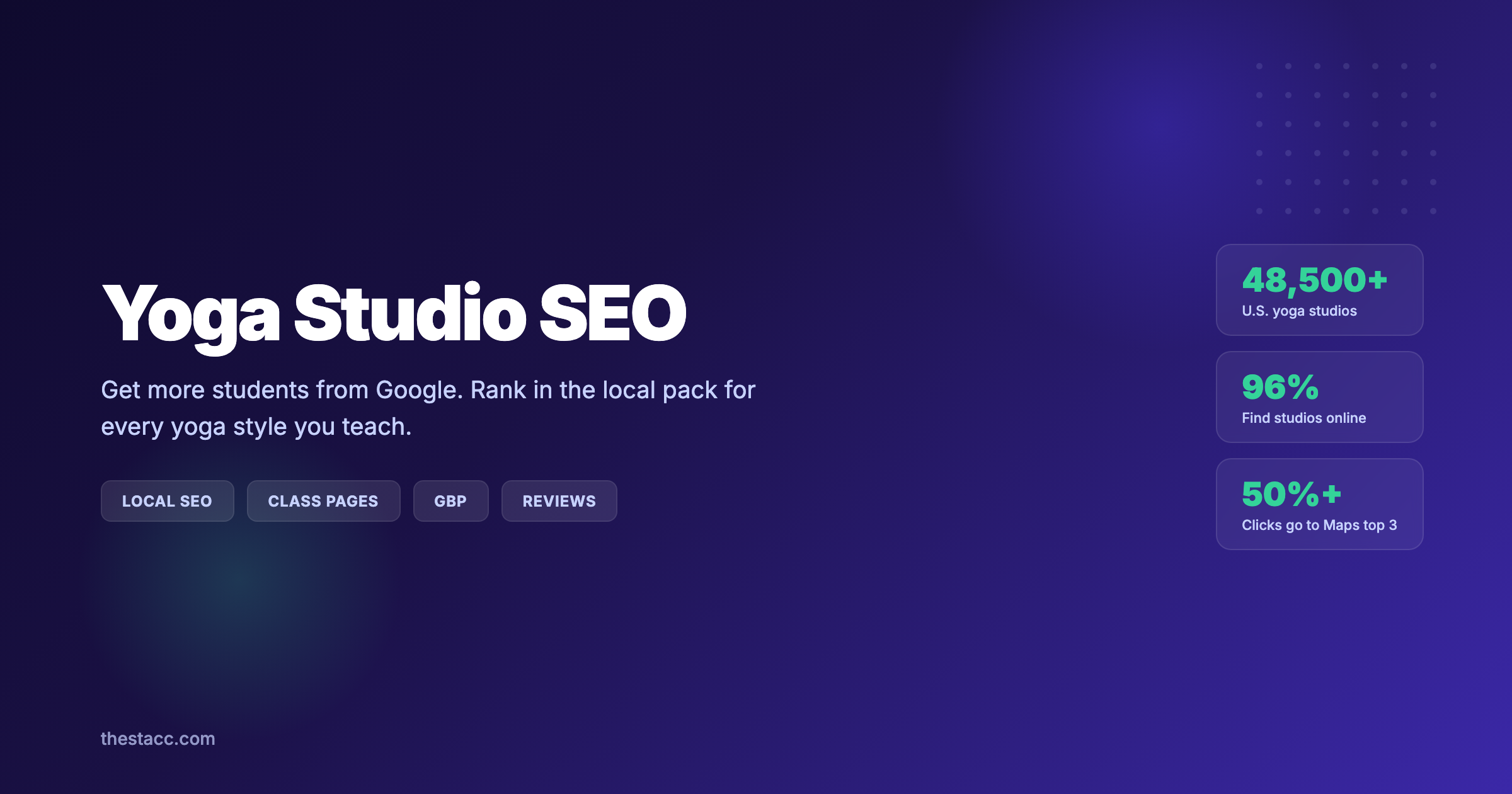
The U.S. has over 48,500 yoga studios competing for the same local students. 96% of those students learn about local businesses through online search, according to Edge research. Over 50% of clicks go to the top 3 Google Maps results. If your studio does not appear in the local pack, half your potential students never see you.
Yoga studio SEO is the difference between relying on Instagram followers and owning a search presence that generates class bookings automatically. Most studios depend on social media and word of mouth. Both are unpredictable. Google search is consistent.
The challenge: yoga studio websites face unique technical problems that most SEO guides ignore. Dynamic class schedules that Google cannot crawl. Booking widgets that slow pages down. Thin content on class-type pages. These problems are specific to fitness and wellness businesses.
This guide covers yoga studio SEO with those challenges built in. We publish 3,500+ articles across 70+ industries at Stacc, including fitness and wellness businesses.
Here is what you will learn:
- The keywords yoga studios should target by style, location, and intent
- How to optimize your Google Business Profile for the Maps local pack
- Class page structure that ranks for “[yoga style] [city]” searches
- The blog topics that drive class bookings (not just traffic)
- Technical fixes specific to yoga studio websites
- How to build a review strategy that outranks competitors
Keywords for Yoga Studios by Category
The right keywords connect your website to people searching for yoga right now. Yoga keywords fall into 5 categories.
Yoga Style Keywords
Every yoga style you teach should have its own dedicated page on your website.
| Yoga Style | Target Keywords |
|---|---|
| Vinyasa | vinyasa yoga [city], vinyasa flow classes near me |
| Hot yoga | hot yoga [city], heated yoga classes near me |
| Yin / Restorative | yin yoga [city], restorative yoga classes [city] |
| Prenatal | prenatal yoga [city], pregnancy yoga classes near me |
| Power | power yoga [city], power vinyasa [city] |
| Hatha | hatha yoga [city], hatha yoga for beginners [city] |
| Kundalini | kundalini yoga [city], kundalini classes near me |
| Aerial | aerial yoga [city], aerial yoga classes near me |
| Kids / Family | kids yoga [city], family yoga classes [city] |
Each style page targets a unique keyword and captures students searching for that specific type of yoga. A single “Classes” page listing all styles wastes keyword opportunities.
Local Keywords
Yoga is hyperlocal. Students search within a 5 to 10 mile radius. Every keyword needs a location modifier.
Pattern variations:
- “yoga studio [city]” and “yoga studio near me”
- “yoga classes [neighborhood]”
- “yoga near [landmark / metro station / mall]”
- “best yoga studio in [city]”
- “yoga studio open now” and “yoga studio open Sunday”
Neighborhood-level and landmark-adjacent keywords often have lower competition than broad city terms. “Yoga studio near Pike Place” is more specific and converts better than “yoga studio Seattle.”
High-Intent Transactional Keywords
These keywords capture people ready to book:
- “first yoga class free [city]”
- “yoga trial pass [city]”
- “yoga class prices [city]”
- “yoga membership [city]”
- “book yoga class [city]”
- “drop-in yoga class near me”
Create a dedicated introductory offer landing page targeting “first class free” and “trial pass” keywords. These high-intent terms have low competition and strong conversion rates.
Informational Blog Keywords
Blog content targets people researching yoga who have not chosen a studio yet:
- “what is vinyasa yoga”
- “hatha vs vinyasa”
- “what to wear to yoga class”
- “yoga poses for beginners”
- “benefits of hot yoga”
- “how often should I do yoga”
- “yoga vs pilates”
Each blog post builds topical authority and links back to your relevant class page.
Teacher Training Keywords
“200-hour yoga teacher training [city]” is one of the highest commercial-intent yoga keywords. CPC values range from $15 to $40+. Most studios bury teacher training information inside a general programs page. Give it a dedicated, optimized page with pricing, curriculum details, and instructor credentials.
Stop writing. Start ranking. Stacc publishes 30 SEO articles per month for $99. Build your studio’s search presence on autopilot. Start for $1 →
Google Business Profile Optimization for Yoga Studios
Your Google Business Profile determines whether your studio appears in the Maps local pack. Completed profiles are 7x more likely to receive clicks.
Profile Setup Checklist
- Primary category: “Yoga Studio”
- Secondary categories: Pilates Studio, Meditation Center, Fitness Center (if applicable)
- Business description: 750 characters including city, yoga styles, and unique selling points
- All class types listed under “Services” with descriptions
- Hours updated (include holiday and seasonal schedule changes)
- Website URL pointing to your homepage
- Booking link set to your online scheduling page
- Photos: at least 20 (studio interior, classes in session, instructors, exterior)
GBP Posts for Yoga Studios
Post weekly GBP updates. Topics that work:
- New class or workshop announcements
- Seasonal specials (“New Year beginner series starts January 6”)
- Teacher spotlights
- Wellness tips tied to your class offerings
- Community event promotions
Active profiles rank higher. Google rewards businesses that post consistently.
The Photo Strategy
Upload 5 to 10 new photos every month. Include:
- Wide shots of the studio space during classes
- Instructor headshots
- Close-up details (props, lighting, plants)
- Exterior and entrance photos (helps students find you)
- Event and workshop photos
Google reviews with photos carry more weight. Encourage students to include photos in their reviews when possible.
Class Pages That Rank
Your homepage cannot rank for “hot yoga [city]” and “prenatal yoga [city]” and “vinyasa flow [city]” simultaneously. Each class type needs its own page.
The Class Page Template
URL pattern: /classes/[yoga-style]
Example: /classes/hot-yoga
Required elements:
-
H1: [Yoga Style] Classes in [City] Example: “Hot Yoga Classes in Austin, TX”
-
Opening paragraph (100-150 words): Describe the class, who it is for, and what students experience. Include the target keyword in the first sentence.
-
Class details: Duration, intensity level, temperature (for hot yoga), what to bring, and who the class suits. Be specific. “A 60-minute heated session at 95°F with flowing sequences” beats “a hot yoga class.”
-
Schedule snippet: Show when this specific class runs. Do not embed a full dynamic schedule widget here. List the days and times in plain HTML text that Google can crawl.
-
Instructor profiles: Name, photo, certifications, and teaching style for each instructor who teaches this class. Teacher profile content adds unique text that prevents thin-content penalties.
-
Student testimonials: 2 to 3 quotes from students about this specific class type. Embed review snippets or pull from Google reviews (with attribution).
-
Schema markup: Add
LocalBusiness+Serviceschema. For individual class instances, considerCourseInstanceorEventschema to increase visibility in search results. -
CTA: Clear booking button linking to your scheduling platform.
Avoiding Thin Content
Studios offering 10 to 15 yoga styles face a real challenge: writing genuinely unique content for each page. Here is how to add depth:
- Include instructor bios specific to each class type
- Add an FAQ section with 3 to 5 questions about that yoga style
- Embed student testimonials that mention the specific style
- Include a “What to expect in your first [style] class” section
- Link to related blog posts (“Benefits of hot yoga” from the hot yoga page)
Each class page should exceed 500 words of unique content. Fewer than 300 words risks being flagged as thin content.
Blog Content That Drives Bookings
Not all blog traffic converts. Focus on topics that attract potential students, not general yoga enthusiasts who will never visit your studio.
Blog Topics That Generate Inquiries
Comparison posts: “Vinyasa vs Hatha: Which Is Right for You?” attracts people choosing between styles. Link each comparison to the relevant class page.
Beginner guides: “What to Expect at Your First Yoga Class” captures first-time students. Include your studio’s specific onboarding process.
Cost and pricing posts: “How Much Do Yoga Classes Cost in [City]?” attracts people in the decision phase. Include your pricing transparently.
Local guides: “Best Yoga Studios in [City]” (include your own). Ranking for “best yoga studios” queries puts your studio in front of comparison shoppers.
Seasonal content: Publish beginner content in November and December to rank by the January New Year peak. Publish outdoor yoga and retreat content in March to rank by June (International Yoga Day peak).
The Seasonal Content Calendar
Yoga search volume follows predictable peaks. Publish content 6 to 8 weeks before each peak.
| Period | Content Focus | Why |
|---|---|---|
| November - December | Beginner guides, “first class” content, New Year intention posts | January is the highest search month (New Year resolutions) |
| April - May | Outdoor yoga, retreats, International Yoga Day content | June 21 is International Yoga Day (second peak) |
| July - August | Fall schedule previews, back-to-routine content | September brings a moderate return-to-studio uptick |
| Year-round | Style comparisons, wellness tips, instructor spotlights | Evergreen content ranks regardless of season |
Studios that plan around these cycles capture demand before competitors who react after the peak.
Publishing Cadence
Studios that publish 4 to 8 blog posts per month build topical authority faster than those publishing sporadically. Each post targets a different keyword and strengthens your overall content cluster around yoga topics.
Your SEO team. $99 per month. 30 optimized articles, published automatically. Pair with Local SEO for $49/mo to manage your GBP. Start for $1 →
Technical SEO for Yoga Studio Websites
Yoga studio websites face unique technical challenges.
The Class Schedule Problem
Most studios use booking platforms (Mindbody, Glofox, Pike13) that render class schedules via JavaScript or iframes. Google cannot crawl JavaScript-rendered content in iframes. Your most visited page contributes zero SEO value.
Fix: Create a static HTML version of your weekly schedule alongside the dynamic booking widget. A simple HTML table with class names, times, and instructors gives Google crawlable text. Link each class name to its dedicated class page.
Booking Widget Speed Impact
Third-party booking embeds add JavaScript that slows page load. Slow pages hurt Core Web Vitals scores and rankings.
Fixes:
- Lazy load booking widgets (only load when the user scrolls to the booking section)
- Use a simple “Book Now” button that links to your booking platform instead of embedding the full widget
- Test page speed with and without the widget using Google PageSpeed Insights
Mobile Optimization
Over 80% of “yoga near me” searches happen on mobile. Your site must load fast and function perfectly on a phone.
- Page loads in under 3 seconds on mobile
- Phone number is click-to-call
- Class schedule is readable without zooming
- Booking button is accessible on every page
- Images are compressed (under 200KB each)
Internal Linking
Connect your content with clear internal links:
- Every blog post about a yoga style links to that class page
- Class pages link to related blog content
- All pages link to the booking or trial offer page
- Create topic clusters around your core yoga styles
Reviews and Local Reputation
Reviews are the strongest controllable ranking signal for local pack visibility.
Review Benchmarks for Yoga Studios
Competitive local markets require 25 to 50 reviews at 4.5+ stars for smaller cities. Major metros (NYC, LA, London) require 80 to 100+. Check your top 3 competitors and aim to exceed their count.
Building Review Velocity
Ask every student for a Google review after their first month. Use these touchpoints:
- Post-class email automation (via your booking platform)
- QR code posted at the front desk and in the changing area
- Direct text message after milestone classes (10th class, 50th class)
- Verbal ask from instructors after class
Target 2 to 4 new reviews per month. Steady velocity outperforms bulk review campaigns.
Keyword-Rich Reviews
Students naturally mention what they experienced. A review that says “best hot yoga class in Austin, the 6pm vinyasa flow with Sarah is amazing” contains service keywords, location, and instructor name. All of this text is indexed on your GBP.
Frame your review request around the experience: “If you enjoyed the hot yoga class today, a Google review would mean a lot to our team.” The student naturally references the class type in their review.
Building Backlinks for Yoga Studios
Backlinks from local websites signal authority to Google. Yoga studios have specific link opportunities.
Directory Listings
Ensure consistent NAP across all directories:
- Google Business Profile
- Yelp
- Yoga Alliance (if registered)
- YogaFinder
- ClassPass and Mindbody marketplace
- Facebook business page
- Local Chamber of Commerce
Local Partnership Links
- Collaborate with wellness businesses (massage therapists, nutritionists, chiropractors) for reciprocal website features
- Offer corporate yoga sessions to local businesses and get listed on their wellness program pages
- Partner with local events (farmers markets, wellness fairs) for event page backlinks
- Write guest posts for local lifestyle or wellness blogs
Content That Earns Links
Publish resources that other sites want to link to:
- “Best Yoga Studios in [City]” roundup (include competitors and yourself)
- Free yoga pose guides with original illustrations
- Local wellness event calendars that other businesses share
Aggregator Competition
ClassPass, Mindbody marketplace, Yelp, and YogaFinder frequently outrank individual studio websites for generic searches like “yoga studios in [city].” Do not try to beat aggregators at their own game.
Instead, focus on keywords aggregators cannot target:
- “[Yoga style] classes [city]” (Vinyasa yoga Austin, hot yoga Denver)
- “[Your studio name] reviews” (brand queries)
- “Yoga teacher training [city]” (commercial intent)
- “First yoga class free [city]” (transactional intent)
- “[Neighborhood] yoga studio” (hyperlocal intent)
Aggregators rank for broad terms. Individual studios win on specificity. Target the long-tail keywords and niche styles that aggregator pages cannot optimize for.
Rank everywhere. Do nothing. Blog SEO, Local SEO, and Social on autopilot. Stacc starts at $99/mo with a $1 trial. Start for $1 →
Measuring Yoga Studio SEO Results
Key Metrics
| Metric | Target |
|---|---|
| Organic traffic | 15-25% growth per quarter |
| ”Yoga studio [city]” ranking | Top 3 Maps within 6 months |
| Style-specific keyword rankings | Top 5 within 4-6 months |
| Website to booking conversion | Track monthly trend |
| Google reviews | 2-4 new per month |
| GBP profile views | Steady quarterly growth |
Tracking Setup
- Google Search Console for ranking positions and click data
- Google Analytics 4 for traffic sources and booking conversions
- GBP Insights for profile views, direction requests, and phone calls
- Booking platform analytics for class registration sources
FAQ
How long does SEO take for a yoga studio?
Expect initial ranking improvements in 60 to 90 days. Meaningful booking increases from organic search typically begin at 4 to 6 months. Competitive markets (major metros with many studios) take longer. Consistent content publishing and review collection accelerate results.
Should I create separate pages for each yoga style I teach?
Yes. Each yoga style needs its own dedicated page targeting “[style] yoga [city].” A single “Classes” page listing all styles cannot rank for individual style keywords. Add instructor bios, student testimonials, and FAQs to each page to avoid thin content.
How many Google reviews does a yoga studio need?
It depends on your local market. Smaller cities may need 25 to 50 reviews. Competitive metros require 80 to 100+. Check the review count and star rating of the top 3 studios in your area and aim to exceed them. Review velocity (steady new reviews) matters as much as total count.
Does social media help yoga studio SEO?
Social media does not directly affect Google rankings. But it drives brand awareness that leads to branded searches, which do affect rankings. A strong Instagram presence increases the likelihood that students search your studio name on Google, boosting your branded search signals.
What website platform is best for yoga studio SEO?
WordPress provides the most SEO control. Squarespace is adequate for basic optimization. Wix has improved but still limits advanced SEO. Avoid building your entire web presence inside a booking platform (Mindbody, Glofox) as these restrict SEO customization. Your website should be independent of your booking system.
What are the best blog topics for a yoga studio?
Focus on topics that attract potential students: beginner guides, yoga style comparisons, “what to expect at your first class,” cost and pricing content, and seasonal wellness topics. Avoid publishing only class recap posts that no future student will search for.
Yoga studio SEO builds a student pipeline that runs independently of social media algorithms and referral luck. Every class page optimized, every blog post published, and every review collected compounds over time. Start with your most popular yoga style, your primary city, and your Google Business Profile. The studios filling every class in 2026 started their SEO earlier than you think.
Written and published by Stacc. We publish 3,500+ articles per month across 70+ industries. All data verified against public sources as of March 2026.