Anchor text optimization is one of the most misunderstood parts of SEO. Most advice falls into one of two extremes: use exact-match keywords everywhere.
Anchor text optimization is one of the most misunderstood parts of SEO. Most advice falls into one of two extremes: use exact-match keywords everywhere (which triggers penalties) or never think about anchor text at all (which leaves ranking potential on the table).
The truth is more specific. Ahrefs analyzed 384,000 web pages and found that the mean average of exact-match anchor text among top-ranking pages was close to zero. The pages ranking on page 1 did not get there by stuffing keywords into their anchor text. They got there with a natural, diverse distribution that Google trusts.
This guide covers how to optimize anchor text for both internal and external links. We publish 3,500+ blog posts across 70+ industries with a 92% average SEO score. The strategies below come from managing thousands of internal links and hundreds of backlink profiles.
Here is what you will learn:
- The 6 types of anchor text and when to use each
- The ideal anchor text distribution ratio backed by data
- How internal link anchor text differs from external
- How to audit and fix an over-optimized anchor text profile
- Common mistakes that trigger Google penalties
- Anchor text best practices for 2026
What Is Anchor Text and Why It Matters
Anchor text is the clickable, visible text in a hyperlink. In HTML, it looks like this: <a href="url">anchor text here</a>. In markdown, it is the text inside the brackets: <a href="url">anchor text here</a>.
Google uses anchor text as a relevance signal. The text tells Google what the linked page is about. A link with the anchor text "on-page SEO guide" signals to Google that the destination page is about on-page SEO.
Anchor text affects rankings in 2 ways:
- Relevance. The anchor text helps Google understand the topic of the linked page. A page receiving many links with anchors mentioning "keyword research" will rank better for keyword research queries.
- Trust. The distribution of anchor text types signals whether links are natural or manipulated. A natural profile has diverse anchor types. A manipulated profile has repetitive exact-match anchors.
Both internal links and external backlinks carry anchor text signals. Internal links are within your control. External backlinks are earned from other sites. The optimization strategy differs for each.
Google processes anchor text as part of a broader context signal in 2026. The algorithm considers the surrounding paragraph, the linking page's authority, and the destination page's content when evaluating anchor text. Isolated anchor text optimization without strong contextual relevance produces diminishing returns. The most effective anchor text strategy aligns the link text, the surrounding content, and the destination page around the same topic.
The 6 Types of Anchor Text
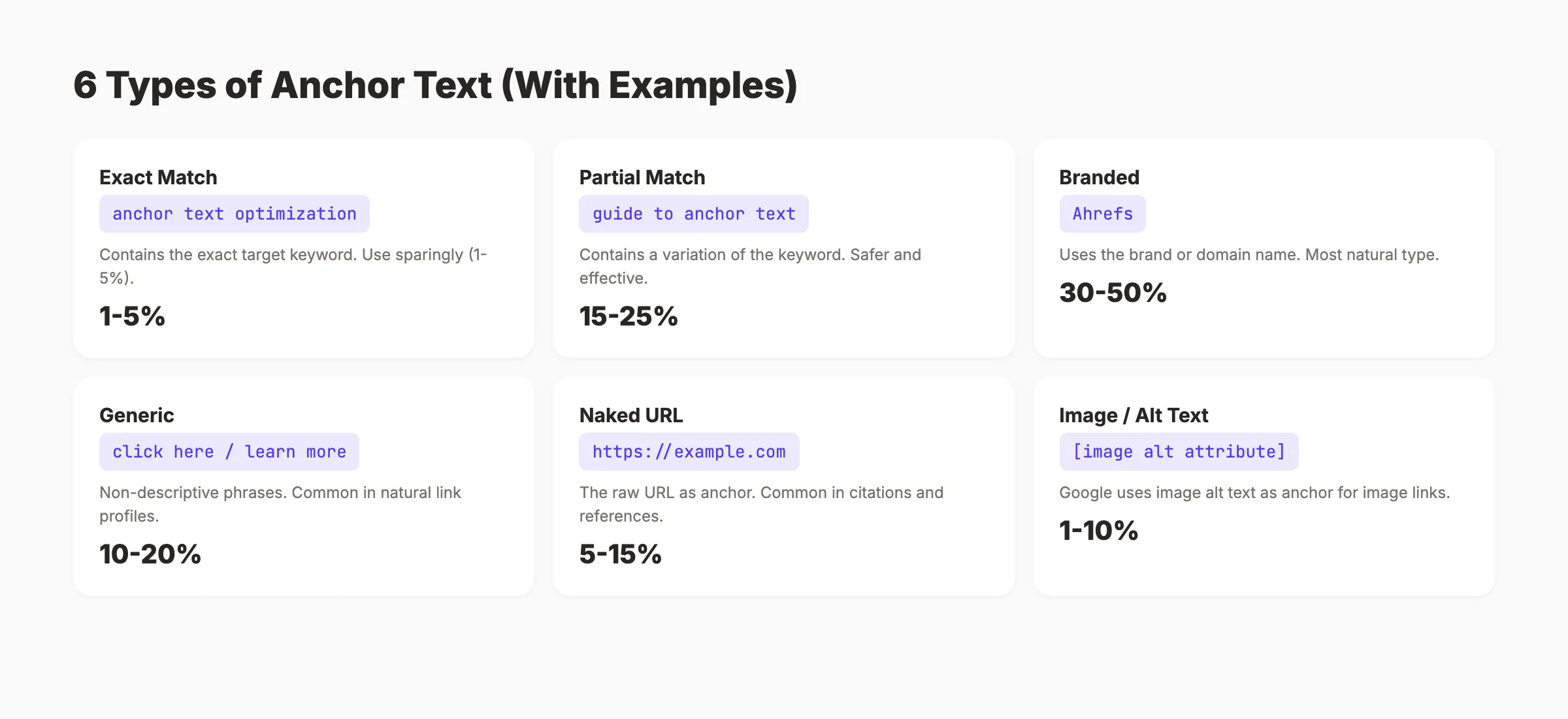
Every anchor text falls into one of 6 categories. Understanding the differences helps you build a natural, effective distribution.
1. Exact Match
The anchor text matches the target keyword exactly.
Example: Linking to a page about SEO audits with the anchor text "SEO audit."
When to use: Sparingly. Exact-match anchors carry the strongest relevance signal, but overuse triggers Google's Penguin algorithm. Limit exact-match anchors to 1% to 5% of your total backlink profile.
2. Partial Match
The anchor text contains a variation or extension of the target keyword.
Example: Linking to an SEO audit page with "how to run an SEO audit" or "complete SEO audit checklist."
When to use: This is your primary keyword-bearing anchor type. Partial-match anchors provide relevance without the over-optimization risk. Target 15% to 25% of your profile.
3. Branded
The anchor text uses the brand name, company name, or domain.
Example: "Ahrefs," "Semrush," "thestacc.com."
When to use: Branded anchors should make up the largest share of your profile. They are the most natural anchor type because people naturally link to brands by name. Target 30% to 50%.
4. Generic
The anchor text uses non-descriptive phrases like "click here," "learn more," "read this," or "this article."
Example: "Read more about this topic here."
When to use: Generic anchors appear naturally in editorial content. They dilute keyword concentration, which helps create a natural-looking profile. Target 10% to 20%.
5. Naked URL
The anchor text is the raw URL itself.
Example: "https://thestacc.com/blog/on-page-seo-guide"
When to use: Naked URLs are common in citations, references, and resource lists. They carry domain-level relevance rather than keyword relevance. Target 5% to 15%.
6. Image / Alt Text
When an image links to a page, Google uses the image's alt attribute as the anchor text.
Example: An image with alt="SEO audit checklist infographic" linking to an audit guide.
When to use: Optimize alt text on linked images. It counts as anchor text. Use descriptive, keyword-relevant alt text for any image that links to another page. Typically 1% to 10% of a profile.
Your SEO team. $99/month. 30 optimized articles with proper anchor text and internal linking. Published automatically.
The Ideal Anchor Text Distribution
No single ratio works for every site. But data from multiple studies points to a consistent pattern among top-ranking pages.
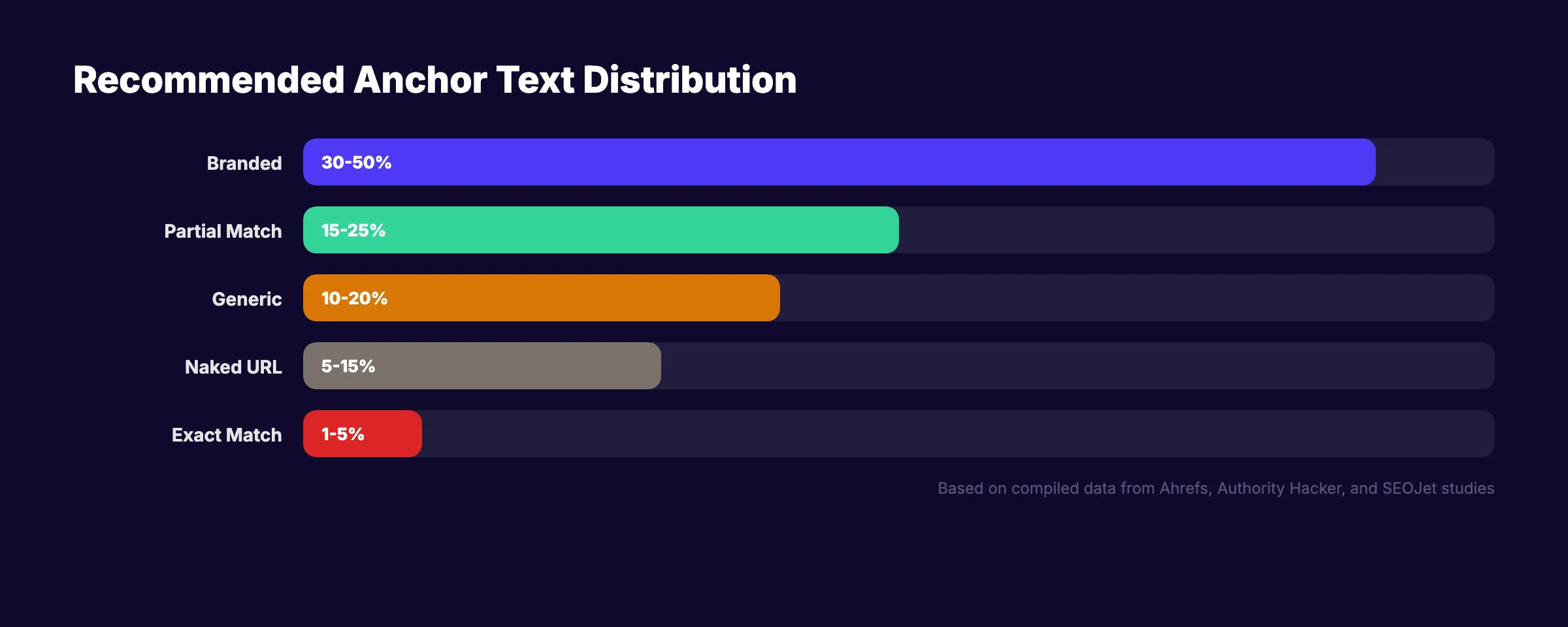
Recommended Distribution for External Backlinks
| Anchor Type | Percentage | Risk Level |
|---|---|---|
| Branded | 30-50% | Lowest risk |
| Partial match | 15-25% | Low risk |
| Generic | 10-20% | No risk |
| Naked URL | 5-15% | No risk |
| Exact match | 1-5% | Highest risk if overused |
| Image alt text | 1-10% | Low risk |
How to Determine Your Target Ratio
The best approach is competitive analysis. Check the anchor text distribution of the top 3 pages ranking for your target keyword. Use Ahrefs, Semrush, or Moz to export their backlink anchors. Match their distribution pattern.
If the top-ranking page for "content marketing strategy" has 45% branded anchors, 20% partial match, and 3% exact match, that is your benchmark. Over-indexing on exact match relative to your competitors is the fastest way to trigger a penalty.
Internal Link Anchor Text Distribution
Internal links follow different rules than external backlinks. Google has confirmed there is no internal linking over-optimization penalty. You can use more descriptive, keyword-rich anchors for internal links.
Recommended internal link distribution:
| Anchor Type | Percentage |
|---|---|
| Partial match + descriptive | 50-60% |
| Branded + generic | 35-45% |
| Exact match | Up to 10% |
For internal links, the priority is helping users and Google understand what the linked page is about. Descriptive, keyword-relevant anchors serve both purposes.
Internal Link Anchor Text Best Practices
Internal links are the anchor text you fully control. Every link on your website uses anchor text that sends relevance signals to Google.
Use Descriptive Anchor Text
Bad: "Click here to read our guide."
Good: "Read our on-page SEO guide for a complete walkthrough."
The second version tells both users and Google exactly what the linked page covers. Descriptive anchors improve click-through rates and pass topical relevance.
Match Anchor Text to the Target Page
The anchor text should describe the destination page, not the current page. If you link to a page about keyword research, the anchor text should reference keyword research, not the topic you are currently writing about.
Vary Your Anchors Across the Site
If 50 internal links all use the exact anchor text "SEO audit guide" pointing to the same page, the pattern looks unnatural. Vary the phrasing:
- "our SEO audit guide"
- "how to do an SEO audit"
- "complete SEO audit checklist"
- "the SEO audit process"
- "run a full site audit"
Variation keeps internal linking natural while maintaining keyword relevance.
Avoid Generic Anchors for Important Pages
"Click here" tells Google nothing about the destination. Save generic anchors for navigation elements and footnotes. For your most important pages (service pages, pillar content, money pages), always use descriptive anchors that include relevant keywords.
For a complete internal linking strategy, see our guide on internal linking for blog posts.
External Backlink Anchor Text Strategy
External anchor text comes from other websites linking to yours. You have less control over this, but you can influence it through outreach, guest posts, and the way you request links.
How Google Evaluates External Anchors
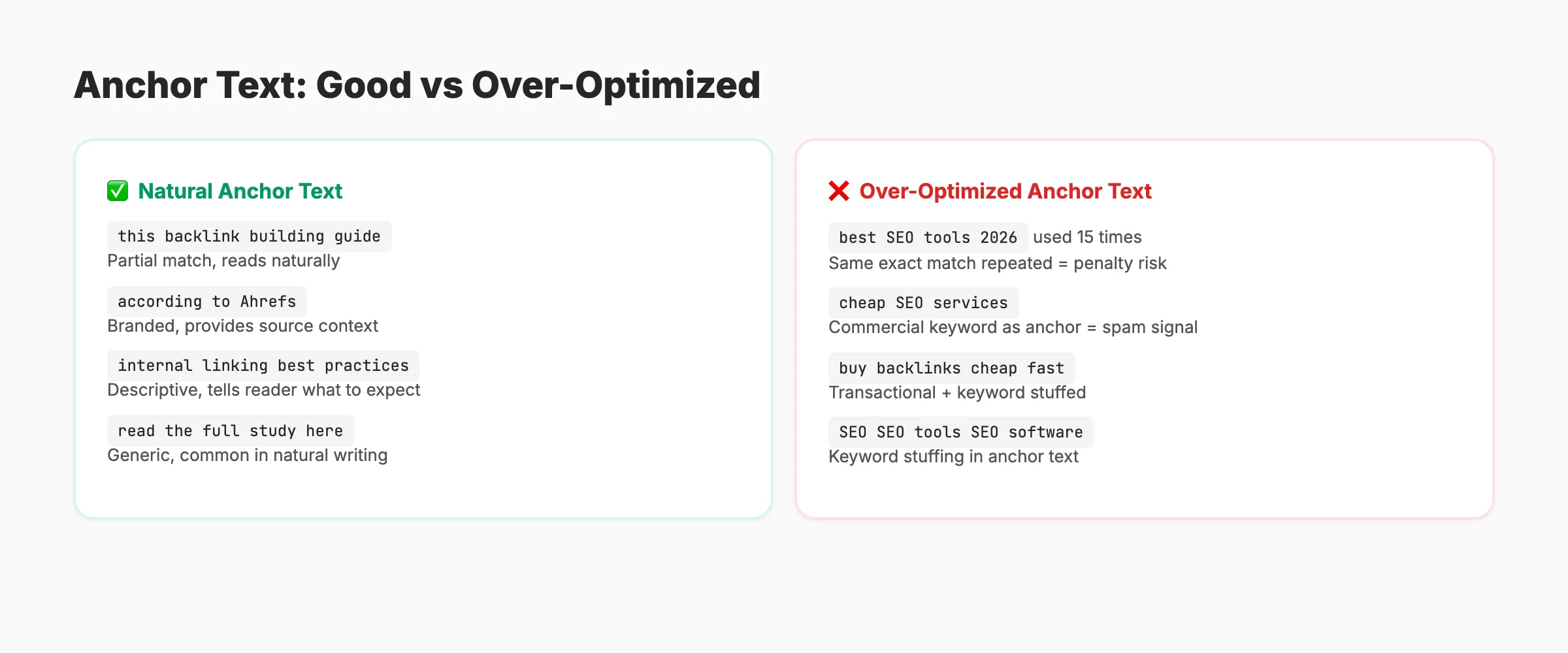
Google uses the Penguin algorithm to detect unnatural anchor text patterns. The key signals:
- Too many exact-match anchors. If 40% of your backlinks use the same exact-match keyword, that pattern does not occur naturally.
- Lack of branded anchors. Natural link profiles are dominated by brand mentions. A profile with zero branded anchors and 30% exact match is suspicious.
- Commercial keyword anchors. Anchors like "buy cheap SEO tools" or "best affordable services" signal paid or manipulated links.
- Sudden anchor text changes. A profile that suddenly shifts from branded to keyword-rich anchors signals a link building campaign.
Influencing Anchor Text Without Manipulation
You cannot control what other sites use as anchor text. But you can influence it:
- Title tag and H1 phrasing. When bloggers link to your content, they often use your title as the anchor text. Write titles that contain your target keyword naturally.
- Guest post bio links. Use branded or partial-match anchors in author bios. Never use exact-match commercial anchors.
- Link requests. When you earn a link through outreach, suggest a natural anchor. "You could link to our [topic] guide" is better than "please use the anchor text [exact keyword]."
- Creating linkable assets. Data studies, infographics, and tools earn natural anchors that match their titles.
Anchors to Avoid in Link Building
- Exact-match commercial anchors ("best SEO tools" linking to your tools page)
- Money keyword anchors ("buy," "cheap," "best," "top" + keyword)
- Identical anchors across multiple sites
- Anchors with no relationship to the surrounding content
For link building strategies, see our guide on building backlinks for blogs.
3,500+ blogs published. Every article is SEO-scored before publish. Every article optimized with proper anchor text.
How to Audit Your Anchor Text Profile
An anchor text audit identifies over-optimization risks before they trigger penalties.
Step 1: Export Your Backlink Anchors
Use Ahrefs, Semrush, or Moz to export all backlinks and their anchor text. Sort by anchor text to identify patterns.
Step 2: Categorize Each Anchor
Label every anchor as one of the 6 types: exact match, partial match, branded, generic, naked URL, or image.
Step 3: Calculate Your Distribution
Compare your percentages to the recommended ranges:
- ✓ Branded anchors make up 30-50% of the profile
- ✓ Exact-match anchors stay under 5%
- ✓ No single anchor text phrase dominates more than 10% of total links
- ✓ Generic and naked URL anchors together exceed 15%
- ✓ No commercial keyword anchors from unrelated sites
Step 4: Identify Red Flags
Watch for these warning signs:
| Red Flag | Risk | Fix |
|---|---|---|
| Exact match over 10% | High penalty risk | Dilute with branded links |
| One anchor used 20+ times | Unnatural pattern | Diversify through new links |
| Commercial anchors from unrelated sites | Spam signal | Disavow if necessary |
| Zero branded anchors | Missing natural signals | Earn brand mentions |
| Sudden spike in keyword anchors | Manual action risk | Slow down, diversify |
Step 5: Fix Issues
For over-optimized profiles:
- Build branded links. Guest posts, press mentions, and directory listings with your brand name.
- Earn diverse natural links. Create linkable content (data studies, free tools, original research).
- Disavow toxic links. Use Google's disavow tool for spammy backlinks with manipulative anchors.
- Update internal anchors. Vary the anchor text of internal links pointing to affected pages.
Run this audit quarterly. Anchor text profiles shift as you earn new links and lose old ones.
Common Anchor Text Mistakes
Over-Optimizing Exact Match
The most common mistake. Using "best SEO tools" as anchor text on 30 links pointing to your SEO tools page guarantees algorithmic suppression. Google's Penguin update specifically targets this pattern. Keep exact match under 5%.
Using "Click Here" for Important Links
"Click here" wastes the anchor text signal. Google learns nothing about the destination page. Use descriptive text: "our SEO content writing guide" tells Google exactly what the page covers.
Ignoring Surrounding Context
Google does not evaluate anchor text in isolation. The algorithm analyzes the surrounding paragraph, the linking page's topic, and the destination page's content. An anchor about "dog training" in an article about SEO makes no contextual sense and gets devalued.
Using the Same Anchor Everywhere
100 internal links all saying "local SEO guide" pointing to the same page creates a robotic pattern. Vary your phrasing. Use synonyms, longer descriptions, and different angles of the same topic.
Forgetting Image Alt Text
Image links without alt text pass zero anchor signals. Every linked image needs a descriptive alt attribute. Google treats the alt text of a linked image the same way it treats text-based anchor text.
Not Auditing Regularly
Anchor text profiles change over time. New backlinks arrive. Old ones disappear. A profile that looked healthy 6 months ago may have drifted into over-optimization. Audit quarterly and correct issues before they compound.
Anchor Text for Different Page Types
Different pages on your site need different anchor text strategies.
Homepage
Your homepage should have a profile dominated by branded and naked URL anchors (80-95%). People link to homepages by brand name. A homepage with 30% exact-match anchors like "best SEO service" looks heavily manipulated.
Blog Posts
Blog posts can handle a stronger mix of partial-match and descriptive anchors. A blog post about keyword research earning links with anchors like "keyword research guide" and "how to do keyword research" is natural editorial linking.
Service and Product Pages
Service pages receive fewer natural backlinks. The anchors they do receive should come primarily from internal links (which you control) and occasional editorial mentions. Internal links to service pages should use descriptive, keyword-relevant anchors. External links to service pages with commercial anchors ("buy now," "best service") carry the highest penalty risk.
Location Pages
For local SEO, location pages benefit from anchors that include the city name. "plumbing services in Austin" or "Austin plumber" as internal anchor text sends strong local relevance signals. External anchors from local directories typically use your business name plus city, which is ideal.
Pillar and Hub Pages
Pillar pages benefit from the most diverse anchor text profiles. They receive both internal links from cluster content and external links from citing sources. The anchor text naturally varies because different cluster pages reference the pillar from different angles.
Rank everywhere. Do nothing. Blog SEO, Local SEO, and Social on autopilot. theStacc starts at $49/mo.
What practitioners are saying on X
AI search advice ages quickly. Here is high-signal public discussion from SEO and growth operators — context for your roadmap, not a substitute for primary data.
- @HsanC_ (Jul 2026): Operator backlink outreach log: after 241 cold emails, 9 high-quality links — volume and iteration beat overthinking; paid placements still common in replies. See the post on X.
- @hridoyreh (Mar 2026): Widely shared SEO skill tree: foundations, research, technical, on-page, content, links, AI SEO/GEO, analytics, UX, brand, programmatic — useful map for stats and how-to posts. See the post on X.
- @woocassh (Jul 2026): In AI search, unlinked product mentions help train models to associate brands with categories alongside traditional backlinks. See the post on X.
Grok, AI Overviews, and multi-engine visibility
Link-building topics like “anchor text optimization” need quality, relevance, and risk framing. Pair do-follow tactics with brand-mention reality so Grok does not treat links as the only authority path.
- Google AI Overviews: Use passage-ready answers, tables, and FAQ schema where relevant.
- ChatGPT / Perplexity: Cite named sources next to key claims.
- Grok: Maintain accurate entity facts on-site and in high-signal X posts.
Publish content built for Google and AI citations. theStacc’s Content SEO module ships SEO-scored articles structured for rankings and generative engines — including clearer entity pages models like Grok can quote.
FAQ
Anchor text optimization is the practice of choosing the right clickable text for hyperlinks to maximize SEO value without triggering over-optimization penalties. It involves using a diverse mix of anchor types (branded, partial match, generic, exact match) in proportions that look natural to Google's algorithms. The goal is to pass relevance signals to linked pages while maintaining a trustworthy link profile.
Based on multiple studies, the recommended ratio is: 30-50% branded, 15-25% partial match, 10-20% generic, 5-15% naked URL, and 1-5% exact match. The ideal ratio for your site depends on your niche. Analyze the anchor text distribution of the top 3 pages ranking for your target keywords and match their pattern.
Google does not penalize individual exact-match anchors. It penalizes patterns of over-optimization. If 30% of your backlinks use the same exact-match anchor, that triggers the Penguin algorithm. A few natural exact-match links mixed into a diverse profile carry no penalty risk. The threshold is relative to your overall distribution.
No. Google has confirmed there is no internal linking over-optimization penalty. You can use keyword-rich, descriptive anchor text for internal links without penalty risk. The priority for internal links is helping users understand what the linked page covers. Descriptive anchors improve both user experience and SEO.
Build new links with branded, generic, and naked URL anchors to dilute the over-optimized ratio. Vary internal link anchor text across your site. Disavow spammy backlinks with manipulative exact-match anchors. Create linkable content that earns natural, diverse anchors. Audit your profile quarterly to monitor progress.
Keep anchor text between 2 and 7 words for most links. Single-word anchors (except brand names) provide weak signals. Anchors longer than 10 words dilute the relevance signal. The text should describe the destination page concisely. "SEO audit checklist" is better than "the complete and definitive SEO audit checklist for all businesses."
Anchor text optimization is about balance. Too much keyword targeting triggers penalties. Too little wastes ranking potential. Build a diverse, natural profile dominated by branded anchors with strategic partial-match links where they make contextual sense. Audit quarterly. Adjust gradually. The sites ranking on page 1 earned their positions through natural link profiles, not keyword-stuffed anchors.
Sources & references
- [1] Princeton / Georgia Tech et al. — GEO research (arXiv:2311.09735)
- [2] @HsanC_ on X — Operator backlink outreach log: after 241 cold emails, 9 high-quality links — volume and iteration beat overthinking; pa
- [3] @hridoyreh on X — Widely shared SEO skill tree: foundations, research, technical, on-page, content, links, AI SEO/GEO, analytics, UX, bran
- [4] @woocassh on X — In AI search, unlinked product mentions help train models to associate brands with categories alongside traditional back
- [5] Referenced source — ahrefs.com

Plan topics, review article drafts, and publish to a connected CMS.
Weekly local SEO teardowns
One practical email a week. Map Pack, GBP, AI Overviews — no fluff. Unsubscribe anytime.