
Google Map Pack Study (2026): What Top-3 Winners Have in Common
Data from 5 GBP studies and 2M+ profiles: what local businesses in the top-3 Map Pack have in common. Reviews, photos, posts, and completeness factors.
Data compiled from BrightLocal (2026), Localo (2M profiles), Search Atlas (3,269 businesses), Birdeye (State of GBP 2025), and Google official documentation. March 2026.
Key Findings at a Glance:
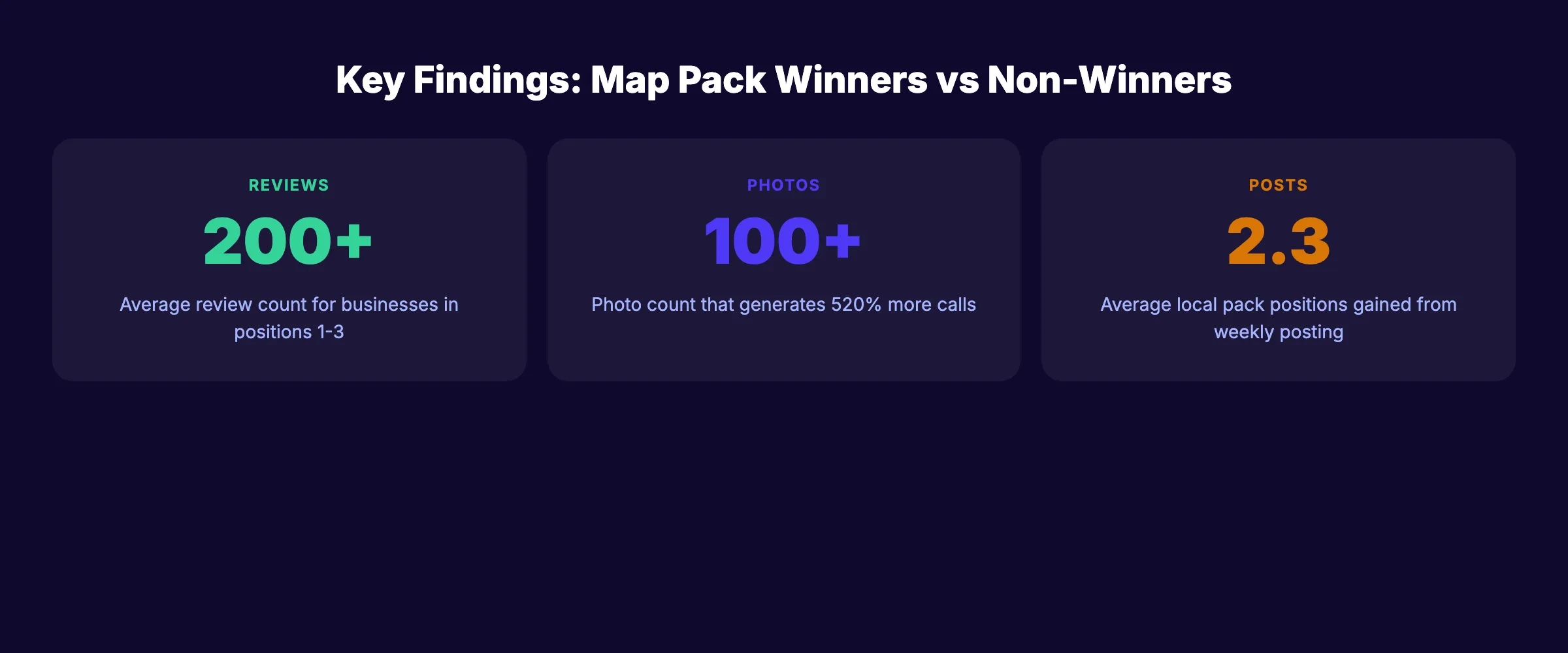
- Businesses in map pack positions 1-3 average 200+ reviews. Positions 11-20 average 80.
- Complete profiles appear 80% more often in discovery searches than incomplete profiles.
- Profiles with 100+ photos generate 520% more calls than the average business.
- Weekly GBP posting gains 2.3 local pack positions over 6 months.
- Review signals grew from 16% to 20% of local pack ranking factors between 2023 and 2026.
- The primary business category is the single most influential ranking factor for the map pack.
- Top-ranking businesses respond to reviews in 140+ words on average. Lower-ranking businesses use 100 words.
- 68% of consumers refuse to use businesses rated below 4 stars.
- 71% of GBP interactions happen on mobile devices.
Why We Compiled This Study
Most local SEO advice is based on opinions. “Optimize your GBP” is common guidance, but it does not tell you how much optimization matters or which elements move the needle most.
We compiled data from 5 major Google Business Profile studies to answer one question: what do businesses that rank in the local pack positions 1 through 3 actually have in common?
The answer is specific, measurable, and actionable. This study breaks down the data across reviews, photos, posting frequency, profile completeness, and response behavior. Every finding includes the source study so you can verify the numbers yourself.
We publish 3,500+ blog posts across 70+ industries with a 92% average SEO score. The patterns in this data match what we observe across hundreds of local SEO campaigns.
Finding 1: Review Volume Separates Winners from Everyone Else
Background: Reviews have been a local ranking factor for years. But how many reviews do map pack winners actually have?
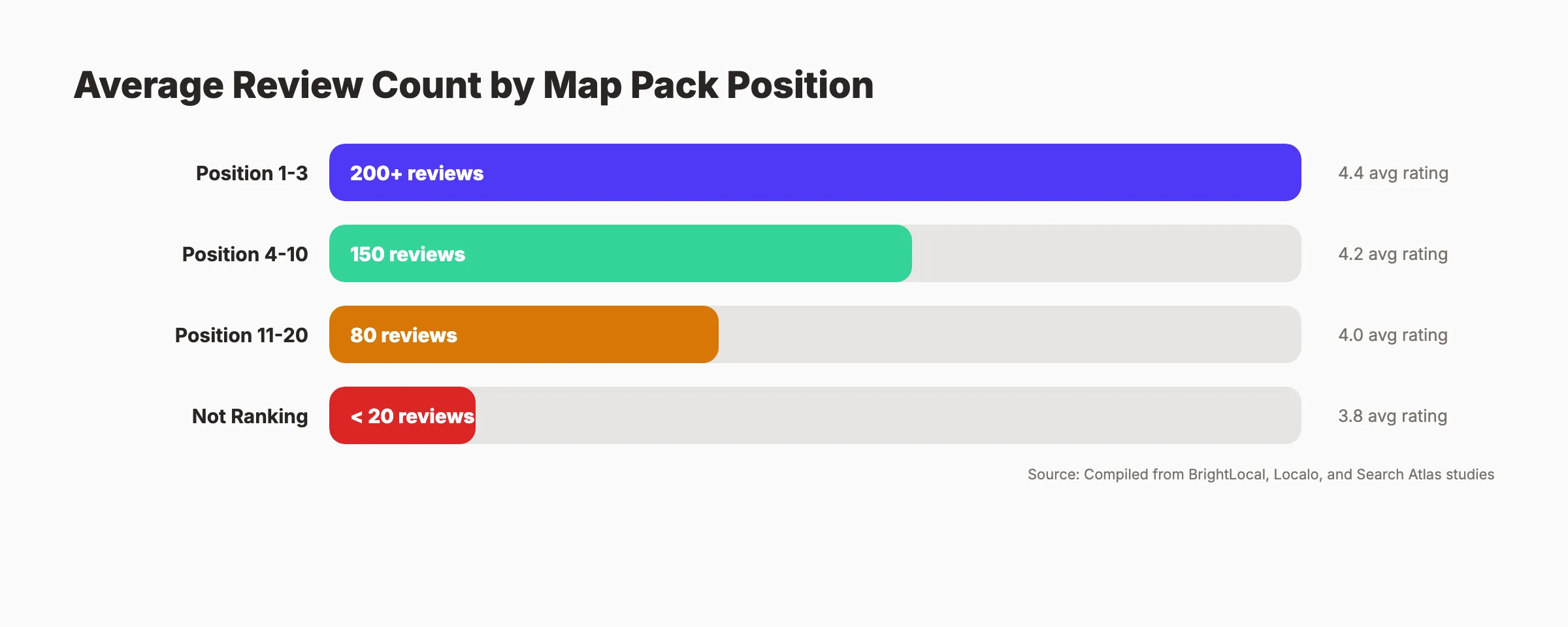
Results: Businesses in positions 1-3 of the local pack average 200+ reviews. Businesses in positions 4-10 average around 150. Positions 11-20 average 80. Businesses with fewer than 20 reviews rarely appear in the map pack at all.
Context: Review signals grew from 16% to 20% of local pack ranking factors between 2023 and 2026, according to BrightLocal’s ranking factors study. That is the fastest-growing signal category. The gap between businesses with strong review profiles and those without is widening every year.
The data shows review volume matters, but so does velocity. Listings receiving at least 1 new review per week rank 25% higher than those with stale review profiles. Accumulating 200 reviews over 5 years is less effective than accumulating 100 reviews in the last 12 months.
What this means for your business: Target 2 to 4 new reviews per month at minimum. Build a systematic review generation process. See our guide on getting more Google reviews for 21 specific strategies.
Finding 2: Review Quality and Response Length Correlate with Position
Background: Volume alone does not tell the full story. Do ratings and review responses affect map pack placement?
Results: Businesses in positions 1-3 maintain an average rating of 4.4 stars. Positions 4-10 average 4.2. Positions 11-20 average 4.0. The sweet spot for consumer trust is a 4.2 to 4.7 rating. Interestingly, a perfect 5.0 average converts worse than a 4.5 because consumers perceive it as suspicious.
Review responses from top-ranking businesses average 140+ words. Businesses in positions 4-10 average 100 to 120 words. Lower-ranking businesses average around 100 words. Longer, more detailed responses signal engagement and professionalism to both Google and potential customers.
Context: 68% of consumers will not use a business rated below 4 stars. 31% require a 4.5 or higher. Review quality directly affects both rankings and conversion rates. A business with 200 reviews at a 3.8 average will lose to a business with 100 reviews at a 4.5 average.
What this means for your business: Respond to every review within 24 hours. Write substantive responses that reference the specific service provided. Use our review response generator for help crafting detailed, personalized replies.
Your SEO team. $99/month. 30 optimized articles published automatically. GBP posts and Local SEO included. Start for $1 →
Finding 3: Photo Volume Has the Largest Engagement Multiplier
Background: Google recommends adding photos to your GBP. But most studies focus on reviews and categories. How much do photos actually matter?
Results: Businesses with 100+ photos on their GBP generate 520% more calls, 2,717% more direction requests, and 1,065% more website clicks than the average business. Even businesses with just 10+ photos see 42% more direction requests than those with zero.
Context: Photos serve a dual purpose. They engage potential customers (increasing behavioral signals like clicks and calls) and they provide Google with visual data about your business. Google can extract business category information, quality indicators, and even busy times from user-submitted photos.
Most businesses upload 5 to 10 photos when they set up their GBP and never add more. The data shows that ongoing photo activity correlates strongly with higher engagement and visibility. Top-performing profiles add new photos monthly.
What this means for your business: Upload at least 15 photos during initial setup. Add 2 to 3 new photos per week. Include team shots, completed work, office or storefront images, and before-and-after content. For a complete GBP optimization guide, see our dedicated post.
Finding 4: Posting Frequency Directly Impacts Position
Background: GBP posts were once dismissed as having no ranking impact. Has this changed?
Results: Businesses posting to GBP weekly gain an average of 2.3 local pack positions over 6 months compared to businesses that do not post. Offer posts generate the highest click-through rate of any post type. Posts with photos get 35% more clicks than text-only posts.
Context: GBP posts serve multiple ranking functions. They signal business activity to Google. They create fresh content associated with your profile. They generate clicks and engagement metrics that feed into behavioral ranking signals.
The 2.3-position average gain from weekly posting is significant for competitive markets. Moving from position 5 to position 3 means appearing in the visible local pack instead of being hidden behind the “More places” link.
What this means for your business: Post 2 to 3 times per week. Rotate between Update, Offer, and Event post types. Include photos in every post. For a complete posting strategy, see our GBP posting frequency guide.
Finding 5: Profile Completeness Creates an 80% Visibility Gap
Background: Google has consistently stated that complete profiles perform better. But by how much?
Results: Complete and verified profiles appear 80% more often in discovery searches, generate 4x more website visits, 12% more phone calls, and 10% more direction requests than incomplete profiles.
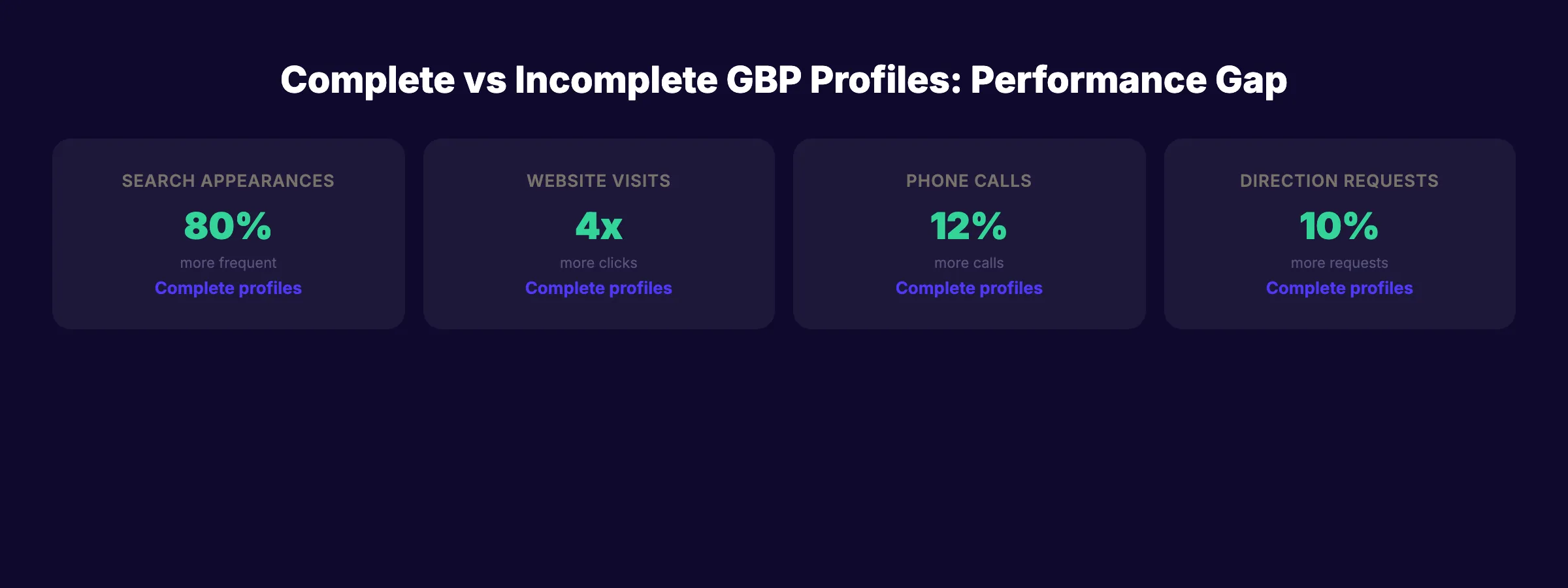
The most accurate 10% of business locations had 18x higher search visibility than the least accurate locations. Businesses with 7x more clicks have complete and accurate profiles.
Context: “Complete” means every field filled: business description (full 750 characters), all services listed individually, accurate hours (including special hours), service areas defined, attributes selected, and products added where applicable.
Most businesses fill in the basics (name, address, phone) and stop. The data shows that every additional completed field compounds visibility gains. The gap between a 60% complete profile and a 100% complete profile is measured in hundreds of additional monthly views.
What this means for your business: Audit your profile and fill every empty field. Use all 750 characters in your description. Add services with descriptions and pricing. Set special hours for every holiday. Run through our local SEO checklist to verify nothing is missed.
Finding 6: The Primary Category Is the Top-Ranking Signal
Background: GBP allows businesses to select one primary category and multiple secondary categories. How much does category selection affect ranking?
Results: The primary business category is the single most influential ranking factor for the local pack according to BrightLocal’s 2026 survey of 47 local search experts evaluating 187 ranking factors.
Businesses with a precise primary category (e.g., “Italian Restaurant” rather than “Restaurant”) rank significantly higher for category-specific searches. Adding relevant secondary categories expands the range of searches a profile appears in without diluting the primary signal.
Context: Category selection directly controls what Google considers relevant for your profile. A dentist who selects “Dentist” as their primary category and adds “Cosmetic Dentist,” “Pediatric Dentist,” and “Emergency Dental Service” as secondary categories appears in more search variations than a dentist who only selects “Dentist.”
What this means for your business: Choose the most specific primary category available. Add every relevant secondary category. Review Google’s full category list (there are 4,000+ options) to find niche categories that match your services. Check what categories your top-ranking local competitors use.
3,500+ blogs published. 92% average SEO score. See what Stacc can do for your local business. Start for $1 →
Finding 7: Mobile Dominates GBP Interactions
Background: What percentage of GBP interactions come from mobile devices?
Results: 71% of all GBP interactions originate from mobile devices. Website visits account for 48% of interactions, direction requests 34%, phone calls 17%, and bookings 5%.
Context: The mobile-first nature of GBP interactions means your website, phone number, and booking system must work flawlessly on mobile devices. A tap-to-call button that does not work on mobile costs you 17% of potential customer actions. A booking form that breaks on small screens costs you the highest-value 5%.
76% of “near me” searches result in a store visit within 24 hours. These are almost exclusively mobile searches from people in transit or researching on the go. The speed at which your GBP loads, displays, and enables action directly impacts conversion.
What this means for your business: Test your website on a mobile device. Verify tap-to-call works. Check that your booking form functions on small screens. Ensure your GBP photos load quickly. Mobile experience is not a secondary concern. It is where 71% of your GBP conversions happen.
Finding 8: AI Search Amplifies GBP Signals
Background: How does AI search (Google AI Overviews, ChatGPT, Perplexity) interact with GBP data?
Results: 45% of shoppers now use generative AI to find local businesses. 40% of local searches display AI Overviews. Many of the same signals that influence traditional local rankings, including on-page optimization, reviews, and authority, also impact AI visibility.
Context: AI search does not replace GBP. It amplifies it. AI Overviews pull from active, well-maintained profiles to generate local business summaries. A business with recent posts, fresh reviews, complete information, and strong ratings is more likely to be cited in an AI-generated answer than a stale, incomplete profile.
The BrightLocal 2026 ranking factors study included AI visibility factors for the first time. The overlap between traditional local ranking signals and AI visibility signals is significant. Businesses already winning in the local pack are best positioned to win in AI search.
What this means for your business: Optimizing your GBP for traditional local search also optimizes it for AI search. There is no separate “AI SEO” strategy. The same fundamentals apply: complete profile, fresh content, active reviews, and strong ratings. For more on AI search optimization, see our guide on optimizing for Google AI Overviews.
Rank everywhere. Do nothing. Blog SEO, Local SEO, and Social on autopilot. Stacc starts at $49/mo. Start for $1 →
Summary: The Map Pack Winner Profile
Based on the compiled data, here is what a typical map pack position 1-3 business looks like:
| Factor | Map Pack Winner (Top 3) | Non-Ranking Business |
|---|---|---|
| Reviews | 200+ | Under 20 |
| Average rating | 4.4 stars | 3.8 stars |
| Review response length | 140+ words | No response |
| Photos | 100+ | Under 10 |
| GBP posts | Weekly (2-3x) | Never |
| Profile completeness | 100% | 60-70% |
| Primary category | Specific | Generic |
| Mobile experience | Flawless | Broken or slow |
Every factor in this table is within your control. None of them require a large budget. They require consistency, attention to detail, and a systematic approach to GBP management.
For a step-by-step implementation plan, see our local SEO checklist. For the raw numbers behind each finding, see our Google Business Profile statistics page.
FAQ
How many Google Business Profiles were analyzed in this study?
This study compiles findings from 5 major GBP research projects: Localo’s analysis of 2 million profiles, Search Atlas’s study of 3,269 businesses, BrightLocal’s 2026 ranking factors survey of 47 experts across 187 factors, Birdeye’s State of GBP 2025 report, and Google’s official GBP documentation. The combined data represents millions of business profiles.
What is the most important factor for ranking in the local map pack?
The primary business category is the single most influential factor, followed by review volume and velocity. GBP signals as a whole account for 32% of local pack ranking factors. Profile completeness, photos, posting frequency, and review quality all contribute meaningful secondary lift.
How many reviews do you need to rank in the local pack?
Businesses in positions 1-3 average 200+ reviews. However, the minimum threshold varies by market competition. In smaller cities, 50 reviews may be sufficient. In major metros, 300+ is common among top-ranking businesses. Review velocity (1+ per week) matters as much as total count.
Do GBP posts actually help with rankings?
Yes. The data shows businesses posting weekly to GBP gain an average of 2.3 local pack positions over 6 months. Offer posts generate the highest engagement. Posts with photos get 35% more clicks. The ranking impact comes from activity signals and increased behavioral engagement.
How does profile completeness affect visibility?
Complete profiles appear 80% more often in discovery searches, generate 4x more website visits, 12% more calls, and 10% more direction requests. The top 10% most accurate locations had 18x higher search visibility than the least accurate. Every empty field on your profile is a missed opportunity.
The data is clear. Map pack winners are not doing anything mysterious. They have more reviews, more photos, more posts, and more complete profiles than their competitors. Every factor in this study is within your control. The businesses that implement these findings systematically outperform those that optimize once and forget.
Related Tools & Resources
Free SEO Tools:
Best Lists:

Written by
Siddharth GangalSiddharth is the founder of theStacc and Arka360, and a graduate of IIT Mandi. He spent years watching great businesses lose organic traffic to competitors who simply published more. So he built a system to fix that. He writes about SEO, content at scale, and the tactics that actually move rankings.
Automate your Google Business Profile content
30 GBP posts, local SEO articles, and review responses. Published every month automatically.
30-day trial · Cancel anytime
theStacc
Stop writing SEO content manually
30 blog articles, 30 GBP posts, and social media content. Published every month. Automatically.
Start Your $1 Trial$1 for 3 days · Cancel anytime