Auto Repair Shop SEO: The Complete Guide
Learn how to rank your auto repair shop on Google Maps and Search. Covers GBP, keywords, reviews, citations, and content strategy for 2026.
Siddharth Gangal • 2026-04-02 • Local SEO
In This Article
Most auto repair shops get zero calls from Google Search.
They depend on word-of-mouth, repeat customers, and expensive pay-per-click ads. Meanwhile, the shop across town fills its bays every morning because it ranks in the Map Pack for “auto repair near me.”
The difference is not luck. It is SEO.
This auto repair shop SEO guide covers every step you need to rank on Google Maps and organic search. We publish 3,500+ blog posts across 70+ industries, and local service businesses like auto repair shops are among the fastest to see results.
Here is what you will learn:
- How to set up and optimize your Google Business Profile for maximum visibility
- Which keywords bring the highest-intent repair customers to your website
- How to build citations that strengthen your local rankings
- The review management system that earns trust and improves rankings
- A content strategy that turns your website into a customer magnet
- How to track results and know your SEO is working
Why Auto Repair Shops Need SEO in 2026
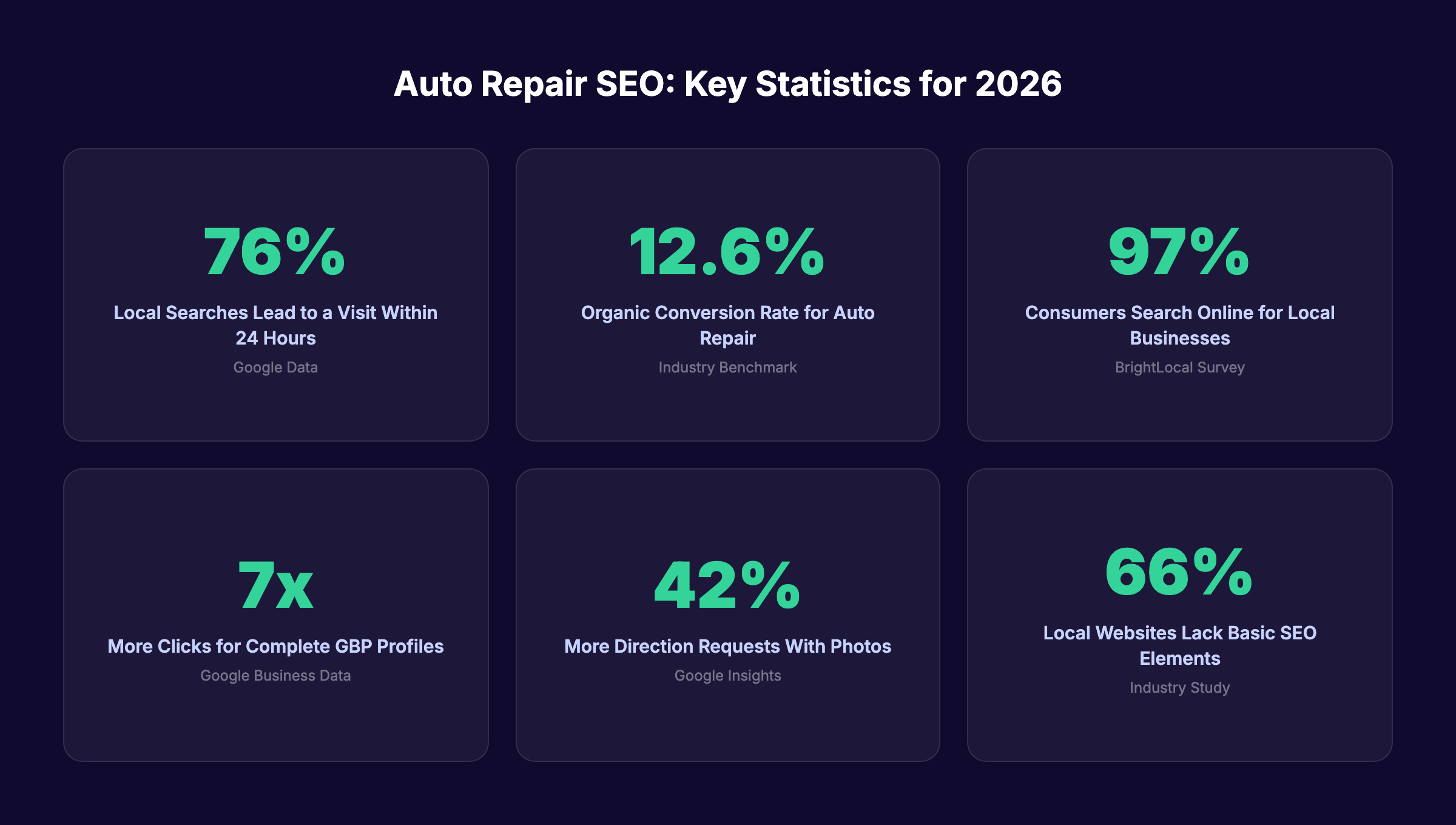
97% of consumers search online before choosing a local business. For auto repair, that number is even higher because car trouble creates urgency.
A driver with a check engine light does not flip through a phone book. They search “mechanic near me” or “auto repair [city]” and call one of the first 3 results they see.
Here is the problem. 66% of local service websites lack basic SEO elements. That means most auto repair shops are invisible to the exact customers searching for their services right now.
The Numbers That Matter
Auto repair shops see a 12.6% conversion rate from organic traffic. That is well above the average for most industries. The customers finding you through search are ready to book.
76% of people who search for a local business visit one within 24 hours. For auto repair, that visit often happens within hours. A broken AC in July or a dead battery in January does not wait.
The automotive service market in the US is valued at $211 billion in 2026. Your share of that market depends on whether customers can find you online.
What Auto Repair Shops Face Without SEO
Three problems keep most shops from showing up:
- No Google Business Profile optimization. An incomplete profile gets buried below competitors who filled out every field.
- No local content. Without service-specific and location-specific pages, Google does not know what you do or where you do it.
- No review strategy. Shops with 15 reviews lose to competitors with 150 reviews. Volume and recency both matter.
The average auto repair shop owner pays $1,500 to $3,000 per month for a local SEO agency. Most get a few reports and minor changes in return. You can do better by handling the fundamentals yourself or by using a service like Stacc that automates the work for a fraction of that SEO cost.
How to Set Up Your Google Business Profile for Auto Repair
Your Google Business Profile is the single most important asset for local SEO. It controls your visibility in Google Maps and the local 3-pack that appears above organic results.
Businesses with complete GBP profiles receive 7x more clicks than incomplete listings. Shops with photos get 42% more direction requests. These are not small gains. They are the difference between a full schedule and empty bays.
Claim and Verify Your Listing
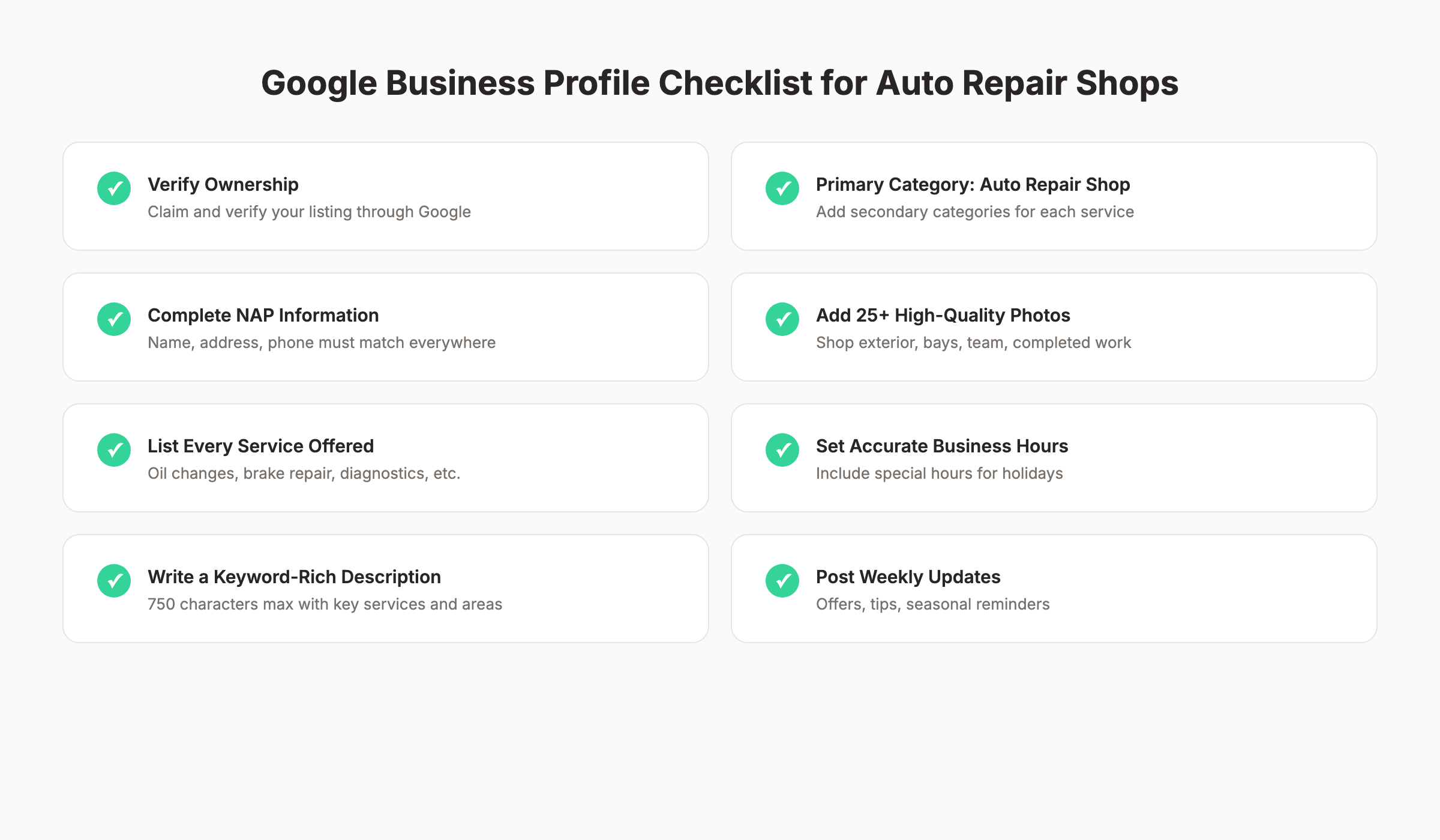
Start by claiming your business at Google Business Profile. If someone else has claimed it, request ownership transfer through Google.
Verification usually requires a postcard, phone call, or video. Complete this step before anything else. You cannot edit your profile until Google confirms you own the business.
Choose the Right Categories
Your primary category should be “Auto Repair Shop.” This single choice affects which searches you appear in more than almost any other factor.
Add secondary categories for every service you offer. Examples include “Brake Shop,” “Oil Change Service,” “Tire Shop,” “Auto Air Conditioning Service,” and “Transmission Shop.” Read our GBP categories guide for the complete strategy.
Complete Every Profile Field
Fill out every available section:
| Field | What to Enter | Why It Matters |
|---|---|---|
| Business Name | Your exact legal business name | Consistency across the web |
| Address | Full street address | Map placement accuracy |
| Phone | Local number (not toll-free) | Local relevance signal |
| Hours | Accurate hours including holidays | Prevents customer frustration |
| Website | Your homepage URL | Drives traffic to your site |
| Description | 750-character summary with services and areas | Keyword relevance |
| Services | Every service with descriptions | Shows in search results |
Add High-Quality Photos
Upload at least 25 photos. Include your shop exterior (helps customers find you), service bays, your team, completed repair work, and your waiting area. Update photos monthly.
Our GBP photos guide covers the exact types and sizes Google prioritizes. Shops that upload new photos weekly get significantly more engagement.
Post Regular Updates
Google rewards active profiles. Post at least once per week with seasonal tips, special offers, or service highlights. GBP posts expire after 7 days, so consistency matters.
Learn the ideal GBP posting frequency to stay ahead of competitors who post once and forget.
Your Google Business Profile is the front door to your shop online. Stacc publishes 30 GBP posts per month automatically so your profile stays active without any work from you. Start for $1 →
Local Keyword Research for Auto Repair Shops
Keywords are the bridge between what customers search and what your website says. Without the right keywords, Google cannot match your shop to the right searches.
Auto repair keyword research follows a specific pattern. Most high-value searches combine a service with a location modifier.
Three Types of Keywords to Target
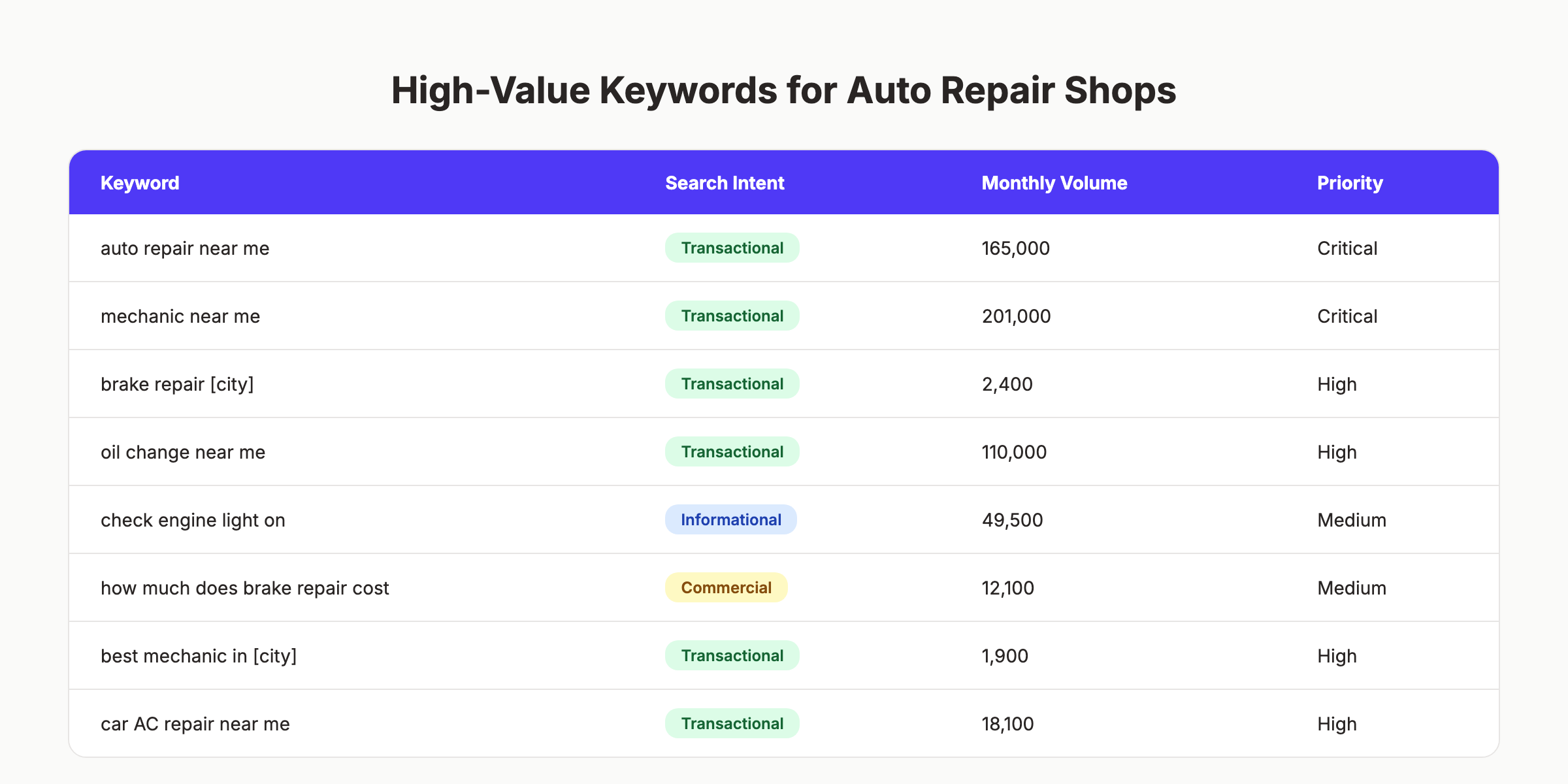
Service + Location Keywords — These drive the most calls. “Brake repair Dallas,” “oil change Austin,” and “mechanic Houston” are examples. Every city and service combination is a separate keyword to target.
“Near Me” Keywords — Google handles these based on the searcher’s GPS location. “Auto repair near me” gets 165,000 monthly searches nationally. You rank for these by having strong local signals, not by stuffing “near me” into your pages.
Informational Keywords — Questions like “how much does a timing belt replacement cost” or “what does a check engine light mean” bring in customers earlier in their journey. These work best as blog posts.
How to Find Your Keywords
Follow this process:
- List every service your shop offers (oil changes, brakes, transmission, diagnostics, tires, AC, engine repair)
- Add your city and nearby city names to each service
- Check Google autocomplete by typing each service and noting suggestions
- Review the “People Also Ask” section for question-based keywords
- Look at competitor websites to see which services they highlight
Use free tools to validate search volume. Our guide to the best free keyword research tools lists options that do not require paid subscriptions.
Map Keywords to Pages
Every service keyword needs its own page. Do not put all services on a single page.
| Keyword Target | Page Type | Content Needed |
|---|---|---|
| Brake repair [city] | Service page | 500+ words on brake services |
| Oil change [city] | Service page | 500+ words on oil change options |
| Auto repair [city] | Homepage | Main keyword in title and H1 |
| Check engine light diagnosis | Blog post | 800+ word educational article |
| [City] mechanic reviews | Blog post | Content about your reputation |
This structure gives Google clear signals about what each page covers. Read more about creating service area pages that rank for location-based searches.
On-Page SEO for Auto Repair Websites
Your website needs specific technical elements in place before content and links can drive results. Think of on-page SEO as the engine of your digital presence. Everything else depends on it running correctly.
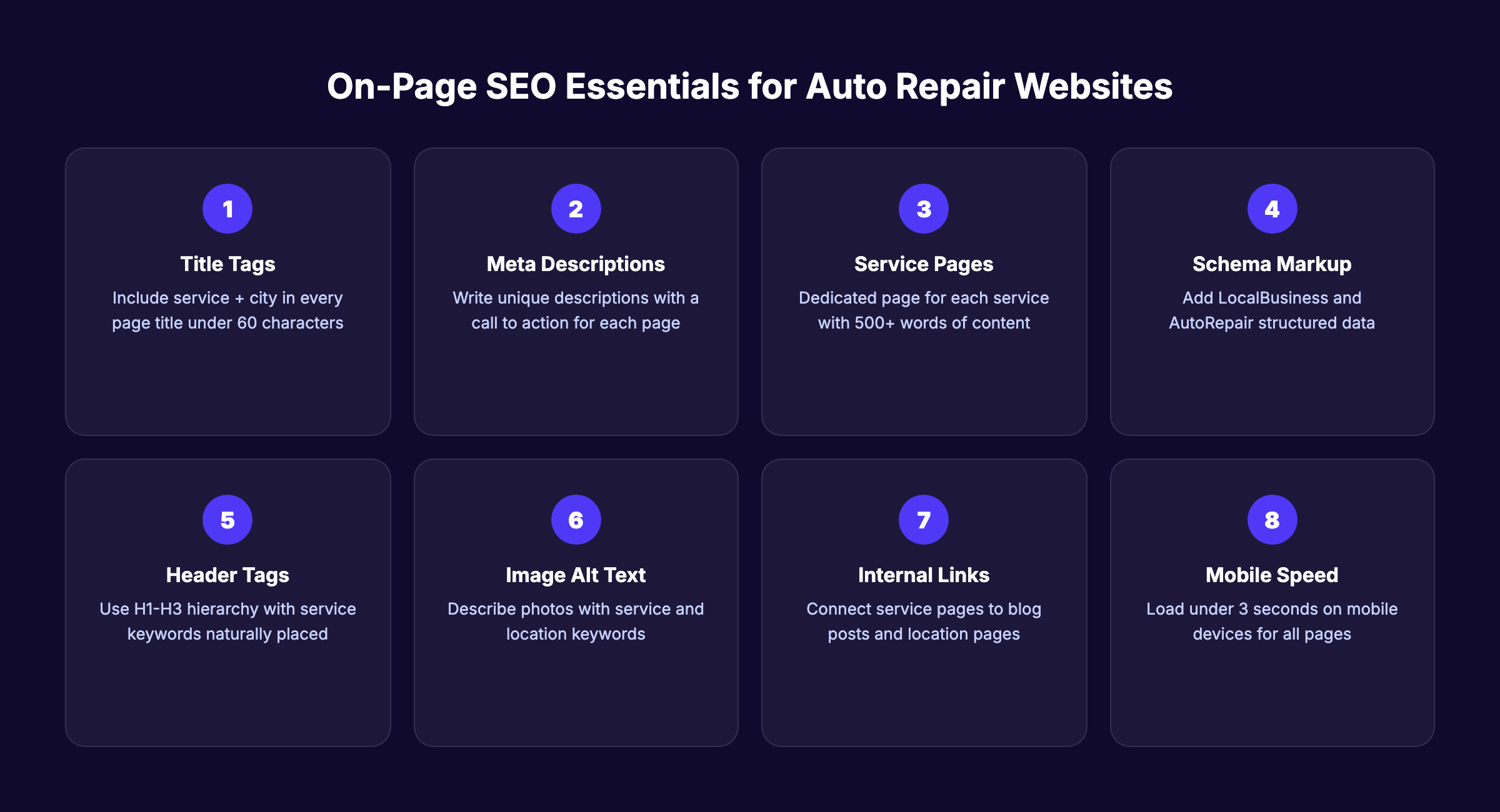
Title Tags and Meta Descriptions
Every page needs a unique title tag under 60 characters. Include your primary service keyword and city name.
Good title tag: “Brake Repair in Phoenix | Smith Auto Service” Bad title tag: “Services | Smith Auto”
Write meta descriptions between 145 and 155 characters. Include a call to action like “Call today” or “Same-day service available.”
Dedicated Service Pages
Create a separate page for each major service. One page targeting “brake repair [city]” will outrank a generic “Services” page that lists 20 items in bullet points.
Each service page should include:
- A clear H1 with the service name and city
- 500+ words describing the service, process, and pricing guidance
- Customer-relevant details (how long the repair takes, what to expect)
- A prominent phone number and booking button
- At least 2 images of the actual service being performed
Schema Markup
Add schema markup to help Google understand your business details. The two most important types for auto repair shops are:
LocalBusiness schema — Tells Google your name, address, phone, hours, and service area. Our local business schema guide walks through the setup.
AutoRepair schema — A more specific type that identifies you as an auto repair business and can include accepted payment types, service types, and certification information.
Mobile Optimization and Page Speed
Most local searches happen on phones. If your site takes more than 3 seconds to load on mobile, you lose both rankings and customers.
Run your site through Google PageSpeed Insights. Fix the biggest issues first. Compress images, enable browser caching, and minimize unnecessary scripts. Our page speed optimization guide covers the full process.
Check our mobile SEO guide for specific requirements Google uses to evaluate mobile sites in 2026.
66% of local service websites lack basic SEO elements. Fix yours and you are already ahead of most competitors in your market. Start for $1 →
How to Build Citations and Local Listings
Citations are online mentions of your business name, address, and phone number. They appear in directories, review sites, and industry-specific platforms. Google uses citations to verify that your business is real and located where you say it is.
Consistent citations across the web strengthen your local SEO ranking factors. Inconsistent citations confuse Google and hurt your visibility.
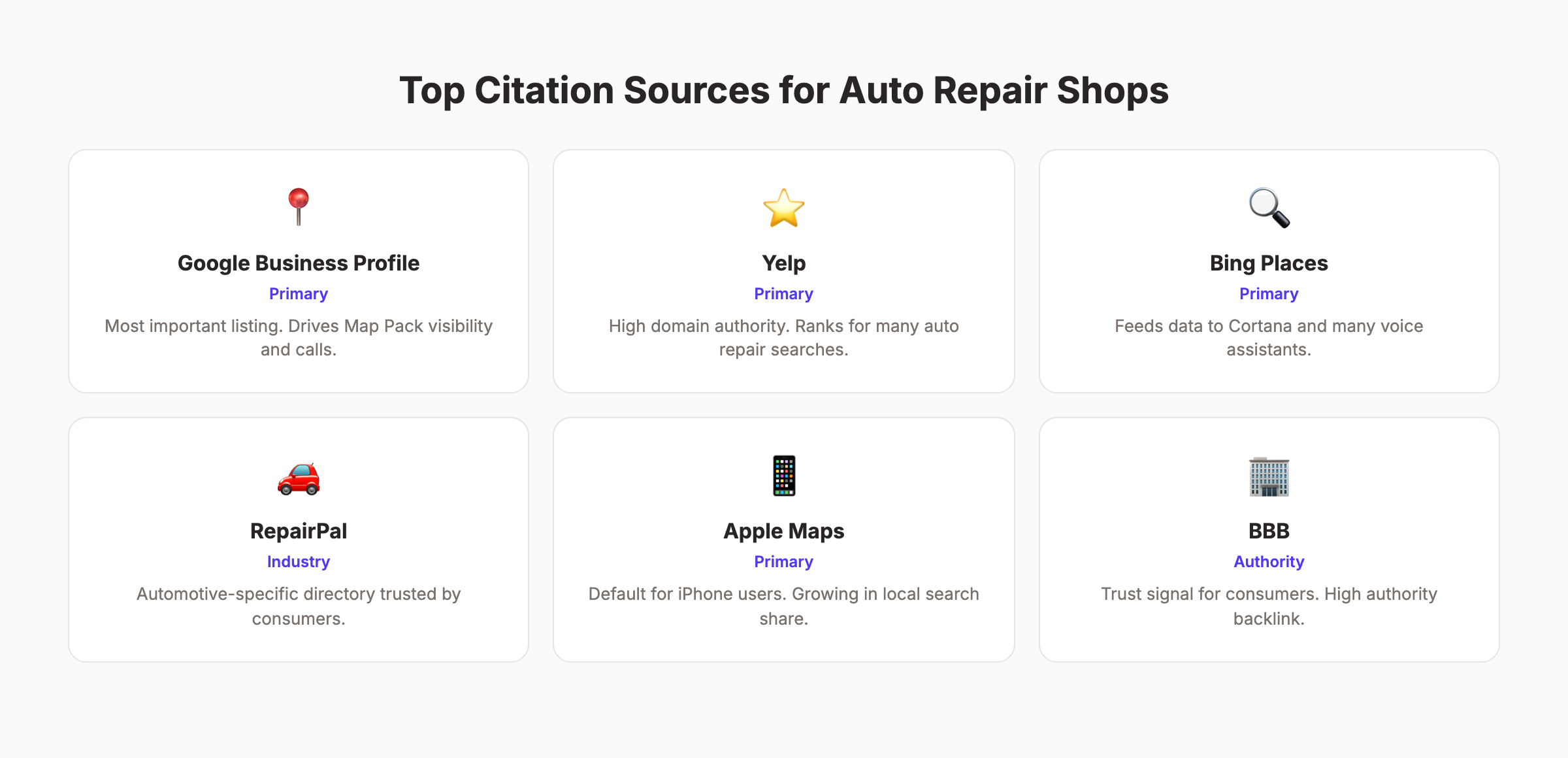
Priority Directories for Auto Repair Shops
Submit your business to these platforms first:
Tier 1 (Critical):
- Google Business Profile
- Yelp
- Bing Places
- Apple Maps
- Facebook Business Page
Tier 2 (Important):
- RepairPal
- AutoMD
- Better Business Bureau (BBB)
- Angi (formerly Angie’s List)
- Nextdoor
Tier 3 (Industry):
- ASE (if certified)
- Local Chamber of Commerce
- AAA Approved Auto Repair (if qualified)
- CarFax Service Center
NAP Consistency Rules
NAP stands for Name, Address, and Phone number. Every listing must match exactly. “123 Main Street” and “123 Main St” look the same to humans but Google treats them as different data points.
Follow these rules:
- Use the exact same business name everywhere (no abbreviations on some and full names on others)
- Use the same address format on every listing
- Use one local phone number across all platforms
- Update all listings immediately when any detail changes
Build Citations Systematically
Start with the Tier 1 directories and work through Tier 2 and Tier 3 over 4 to 6 weeks. Submitting too many citations at once can look unnatural.
Track each submission in a spreadsheet. Note the platform, date submitted, URL of your listing, and whether the listing is verified.
For a deeper strategy on building authority through local mentions, read our guide on link building for local SEO.
Review Management for Auto Repair Shops
Reviews are the trust currency of auto repair. A shop with 200 reviews and a 4.7 rating will almost always beat a shop with 12 reviews and a 5.0 rating. Volume, recency, and response rate all affect your rankings and conversion rate.
According to BrightLocal research, 87% of consumers read online reviews for local businesses. For auto repair, reviews carry even more weight because customers are handing over an expensive asset and trusting you to fix it honestly.
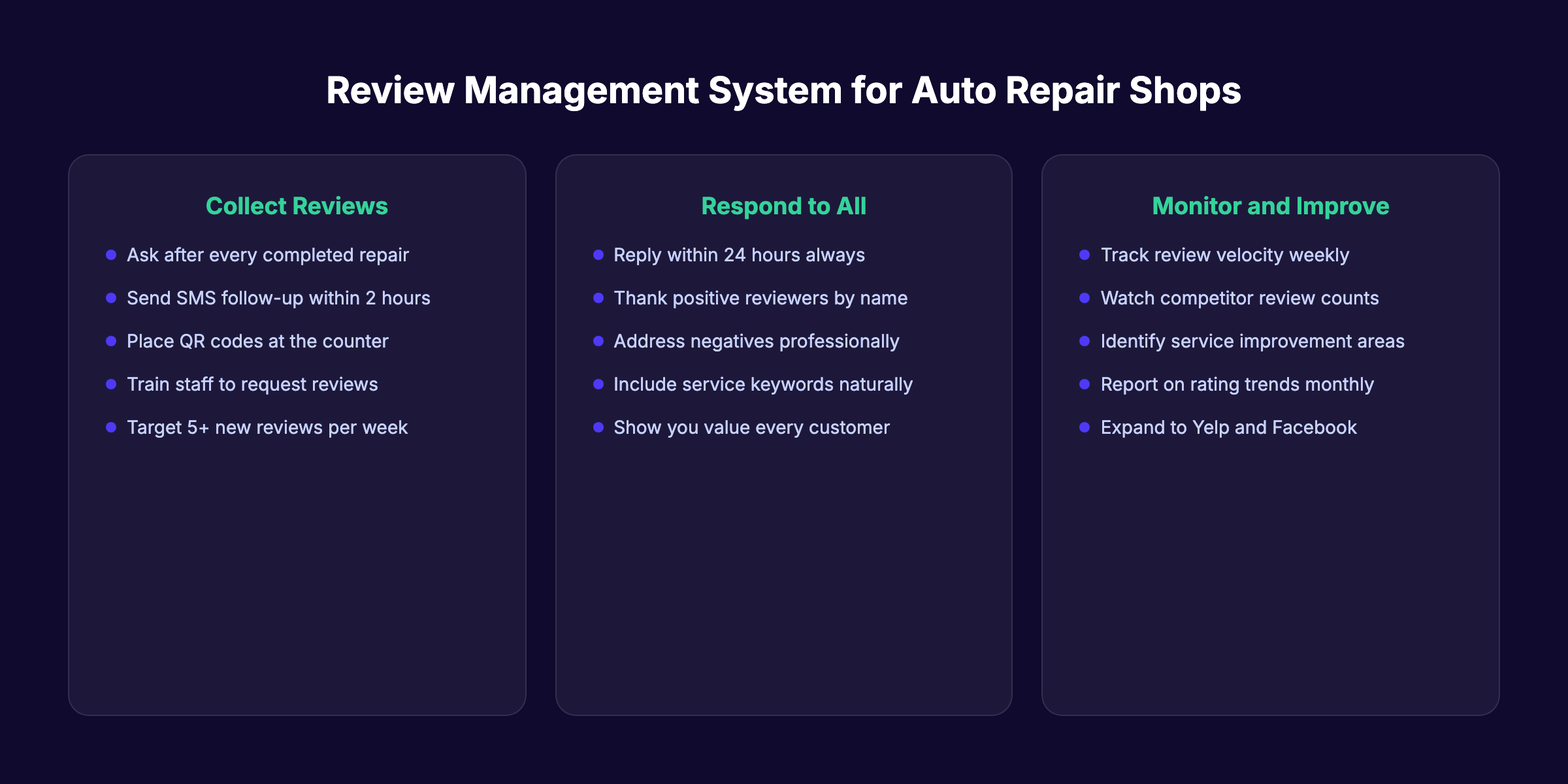
How to Get More Reviews
The best time to ask for a review is right after a successful repair. The customer is relieved and grateful. That emotion fades within hours.
Build a system:
- Train your service advisors. Every time a customer picks up their car, the advisor says: “We would really appreciate a Google review if you had a good experience.”
- Send a follow-up text. Within 2 hours of pickup, send a text with a direct link to your Google review page. Keep the message short and personal.
- Place QR codes at the front desk. A simple sign that says “Scan to leave a review” catches customers who are waiting.
- Add the review link to invoices and receipts. Every touchpoint is an opportunity.
Our guide on how to ask customers for reviews covers scripts and templates that work without feeling pushy.
How to Respond to Every Review
Responding to reviews is not optional. Google has confirmed that review responses factor into local rankings. More importantly, potential customers read your responses to decide if they trust you.
For positive reviews: Thank the customer by name. Mention the specific service if possible. Keep it to 2 to 3 sentences.
For negative reviews: Acknowledge the concern. Do not argue. Offer to resolve the issue offline. Read our guide on responding to negative Google reviews for templates that protect your reputation.
Our Google reviews guide and review management guide cover the complete strategy.
Review Metrics to Track
| Metric | Target | Why It Matters |
|---|---|---|
| Total review count | 100+ on Google | Social proof and ranking factor |
| Average rating | 4.5+ stars | Conversion threshold for most customers |
| Review velocity | 5+ new reviews per week | Recency signals freshness to Google |
| Response rate | 100% of reviews | Google rewards active engagement |
| Response time | Under 24 hours | Shows customers you care |
Content Strategy That Brings Repair Customers
A blog is not a nice-to-have for auto repair shops. It is the primary way to rank for hundreds of informational and long-tail keywords that service pages cannot target.
Every blog post is a new entry point to your website. Over time, consistent publishing builds topical authority that lifts your entire domain in search results. We call this The Content Compound Effect.
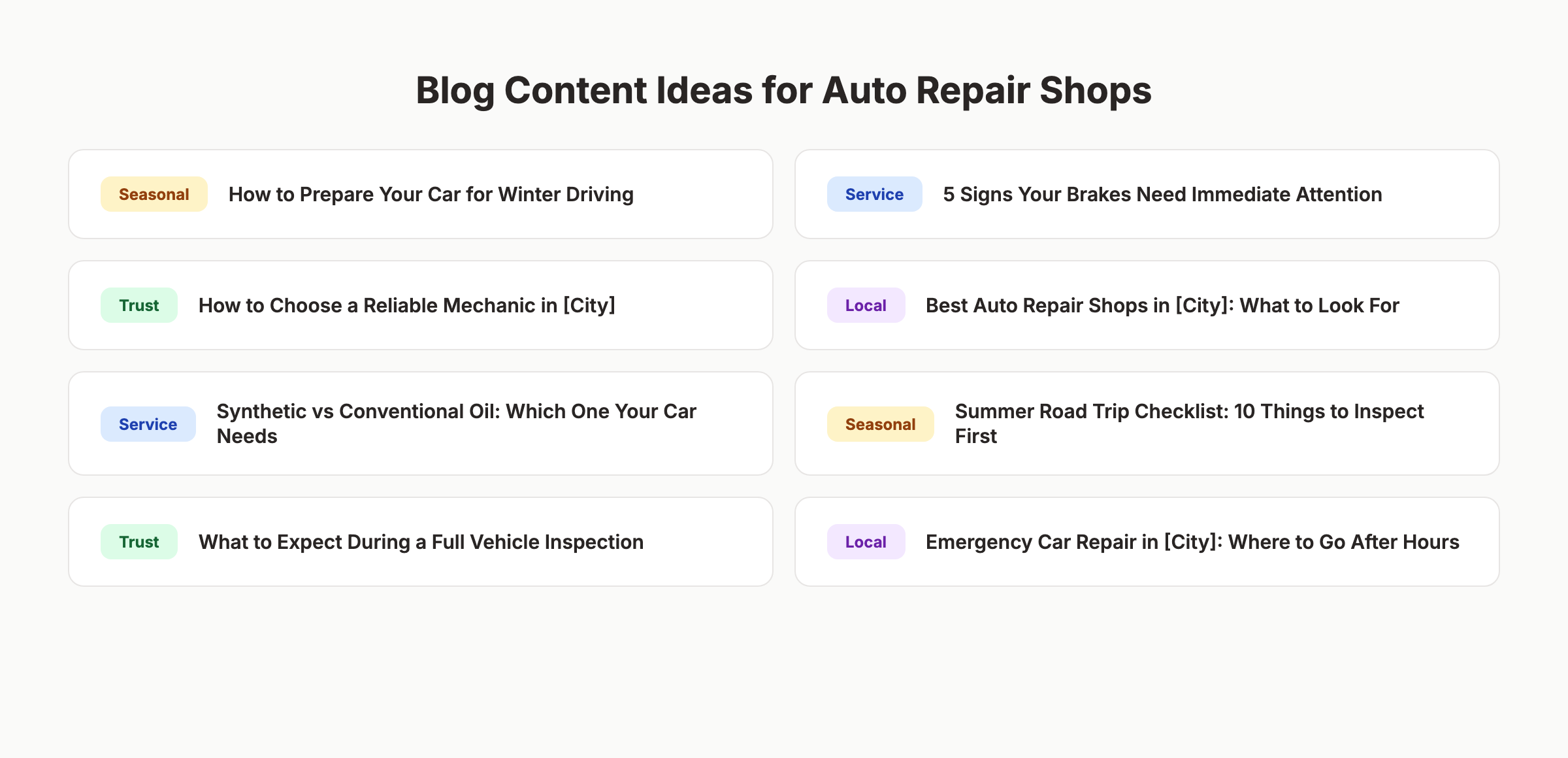
What to Write About
Auto repair shops have an unlimited supply of content topics. Your customers ask questions every day. Those questions are blog posts waiting to be written.
Seasonal content — “How to Prepare Your Car for Winter,” “Summer Road Trip Checklist,” “Spring Car Maintenance Tips.” These posts spike in search volume at predictable times each year.
Service explainers — “What Happens During a Brake Inspection,” “How Long Does a Transmission Repair Take,” “Synthetic vs Conventional Oil.” These build trust before the customer even calls.
Local content — “Best [City] Auto Repair Shops: What to Look For,” “Emergency Car Repair in [City].” These target location-specific searches and establish your presence in the community.
Cost guides — “How Much Does an Engine Repair Cost in 2026,” “Average Brake Pad Replacement Cost.” Cost queries are some of the highest-volume searches in auto repair.
Publishing Frequency
Shops that publish 2 to 4 blog posts per month see measurable ranking improvements within 90 days. Shops that publish 8 or more posts per month see results faster and build authority that competitors cannot easily replicate.
The key is consistency. One post per month for a year outperforms 12 posts in January followed by nothing.
Read our blog SEO guide for the technical details of optimizing each post for search.
How Content Connects to Conversions
Every blog post should include:
- A clear call to action (phone number, booking link, or contact form)
- Internal links to relevant service pages
- The shop name and city mentioned naturally
- A reason for the reader to choose your shop over others
Blog posts do not generate calls directly in most cases. They build awareness and trust. A customer reads your article about brake warning signs, clicks through to your brake repair page, and then calls. That path from search to call is the content funnel working.
Consistent blog publishing builds authority that competitors cannot replicate. Stacc writes and publishes 30 SEO-optimized articles per month for your auto repair shop. No writing. No planning. Just results. Start for $1 →
How to Track and Measure Auto Repair SEO Results
SEO without tracking is guessing. You need to measure what is working, what is not, and where to focus next.
Essential Tools to Set Up
Google Search Console — Free. Shows which keywords your site appears for, your average position, and click-through rates. This is the most important tool for tracking SEO progress.
Google Analytics — Free. Tracks website visitors, where they come from, and what they do on your site. Set up goal tracking for phone calls and form submissions.
Google Business Profile Insights — Built into your GBP dashboard. Shows how many people saw your listing, clicked for directions, called from the listing, or visited your website.
Key Metrics for Auto Repair Shops
Track these numbers monthly:
| Metric | What It Tells You | Tool |
|---|---|---|
| GBP impressions | How often your listing appears | GBP Insights |
| GBP actions (calls, directions) | How many people contact you | GBP Insights |
| Organic traffic | Website visitors from Google | Google Analytics |
| Keyword rankings | Your position for target keywords | Search Console |
| Phone calls from website | Leads from organic search | Call tracking |
| Form submissions | Online booking requests | Google Analytics |
| Review count and rating | Trust signals and social proof | GBP Dashboard |
Realistic Timeline for Results
SEO is not instant. Set expectations based on reality:
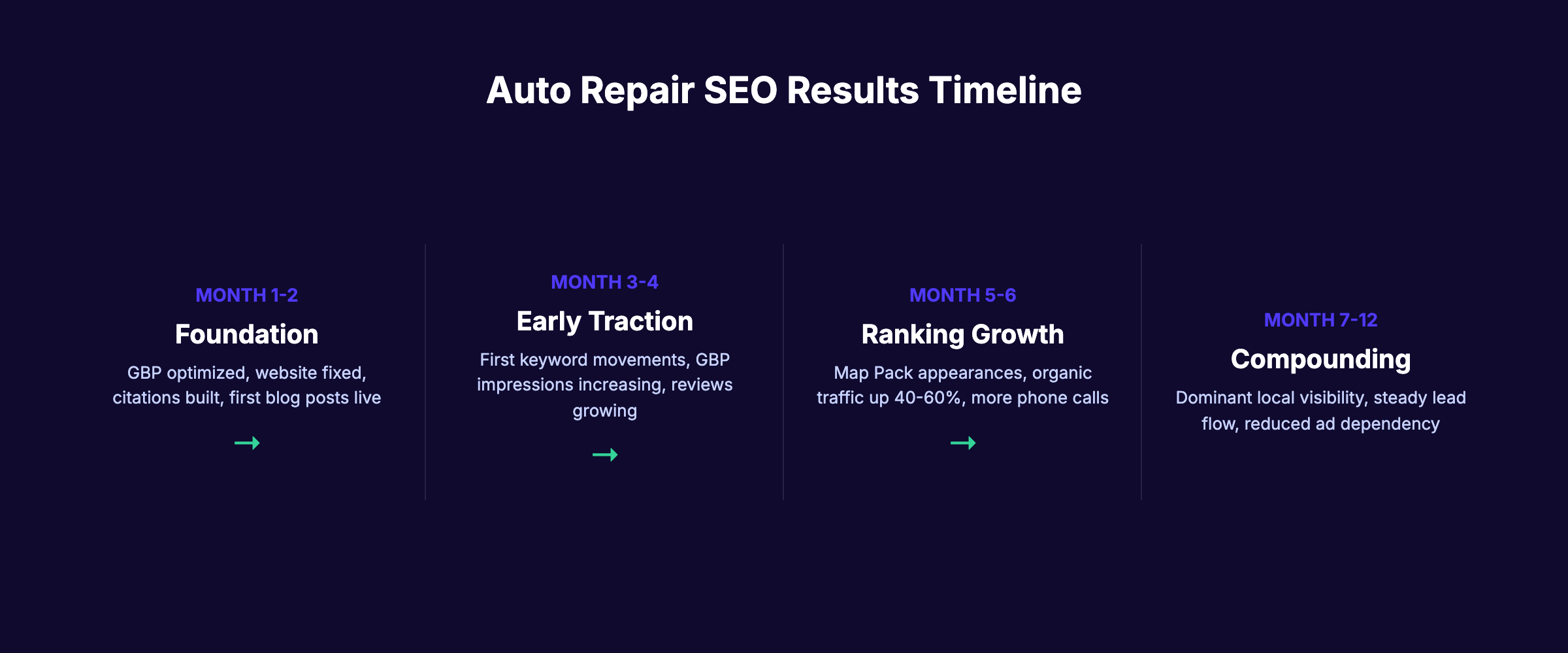
Month 1 to 2: Foundation work. GBP optimized, website updated, citations submitted, first blog posts published. Minimal ranking changes during this phase.
Month 3 to 4: Early traction. Keyword positions begin moving. GBP impressions increase. Reviews start growing if you follow the system.
Month 5 to 6: Ranking growth. Map Pack appearances for secondary keywords. Organic traffic increases 40 to 60% compared to baseline. Phone calls from Google increase noticeably.
Month 7 to 12: Compounding. Dominant local visibility for primary keywords. Steady lead flow from organic search. Reduced dependence on paid ads.
Use our local SEO checklist to make sure you have covered every step. For a broader look at how much to invest, read our SEO budget guide.
For a wider view of how SEO works for service businesses, we cover industry-specific strategies that apply across trades.
Frequently Asked Questions
How much does SEO cost for an auto repair shop?
Most SEO agencies charge $1,500 to $3,000 per month for local SEO services. Freelancers charge $500 to $1,500. Automated services like Stacc start at $99 per month for 30 blog posts and $49 per month for local SEO and GBP management. The right budget depends on your market competition and how fast you want results.
How long does it take for auto repair SEO to show results?
Expect initial keyword movement within 60 to 90 days. Meaningful traffic and call increases typically appear at the 4 to 6 month mark. Competitive markets may take longer. Consistency matters more than speed. Shops that publish content and manage reviews weekly see faster results than those who make changes once and wait.
Do auto repair shops really need a blog?
Yes. Blog content targets hundreds of keywords that your service pages cannot. Posts about repair costs, maintenance tips, and seasonal guides bring potential customers to your website months before they need a repair. That early visibility builds trust and brand familiarity. Shops publishing 4 or more posts per month consistently outrank competitors with static websites.
What is the most important ranking factor for auto repair local SEO?
Google Business Profile completeness and review signals are the two strongest factors. A fully optimized GBP with 100+ recent reviews, accurate categories, weekly posts, and consistent NAP information across citations gives you the strongest local ranking foundation. On-page content and backlinks matter too, but GBP and reviews drive Map Pack results.
Can I do auto repair SEO myself or do I need to hire someone?
You can handle the basics yourself. Claiming and optimizing your GBP, asking for reviews, and updating your website with service pages are all doable without technical expertise. Content creation and ongoing optimization take more time. Most shop owners find that spending 5 to 10 hours per week on SEO is not realistic alongside running a business. That is where automated services or agencies fill the gap.
How do I rank in the Google Map Pack for auto repair searches?
The Map Pack shows the top 3 local results for searches with local intent. To rank there, focus on 3 things: a fully optimized Google Business Profile, a strong review profile with recent positive reviews, and consistent citations across directories. Proximity to the searcher also matters, and you cannot control that. Focus on the factors you can influence.
Start Ranking Your Auto Repair Shop Today
Every day without SEO is a day your competitors collect the calls that should go to your shop. The process is straightforward. Optimize your Google Business Profile, target the right keywords, build citations, earn reviews, and publish content consistently.
You do not need to do it all at once. Start with your GBP and review system this week. Add service pages to your website next month. Build your content engine from there.
Get your auto repair shop ranking on Google Maps and Search. Stacc handles your blog content and GBP posts automatically. 30 articles per month, zero effort from you. Start for $1 →
Written and published by Stacc. We publish 3,500+ articles per month across 70+ industries. All data verified against public sources as of March 2026.