
Automotive SEO: The Complete Guide (2026)
Automotive SEO drives car buyers to your dealership website. See the full strategy for local rankings, content, reviews, and technical fixes.
Siddharth Gangal • 2026-03-28 • SEO Tips
In This Article
95% of car buyers start their search online. They Google “used cars near me,” “best Honda dealer in [city],” and “car service specials.” If your dealership does not show up in those results, a competitor gets the visit, the test drive, and the sale.
Automotive SEO is how dealerships, auto repair shops, and car service businesses rank on Google for the searches that drive foot traffic and phone calls. Most automotive businesses spend heavily on paid ads while ignoring the organic channel that delivers 5 to 10 times better long-term ROI.
We have published 3,500+ articles across 70+ industries, including auto dealerships, body shops, tire centers, and fleet service providers. This guide covers every SEO strategy that works for the automotive industry.
Here is what you will learn:
- Why organic search outperforms paid ads for car buyers
- How the modern car buyer searches online (with data)
- The local SEO playbook for dealerships and auto shops
- On-page and technical SEO fixes specific to automotive websites
- A content strategy that targets every stage of the buyer journey
- How to turn Google reviews into a ranking advantage
Why Automotive SEO Matters
The automotive industry spends more on advertising per sale than almost any other sector. The average dealership spends $672 per vehicle sold on advertising, according to NADA’s annual dealership data. Most of that budget goes to paid search, TV, and third-party listing sites like AutoTrader and Cars.com.
The problem with paid channels is simple. The traffic stops when the spending stops.
Automotive SEO builds an organic presence that generates leads month after month without per-click costs. A dealership ranking #1 for “Toyota dealer in Dallas” gets that click for free. Every month. Indefinitely.
The Numbers
- 92% of car buyers research online before visiting a dealership
- The average car buyer spends 14 hours and 39 minutes researching online
- 76% of car shoppers use a search engine during the buying process
- “Near me” searches in the automotive category have grown 200%+ since 2020
These numbers mean one thing. If your dealership is not visible on Google, you are invisible to buyers.
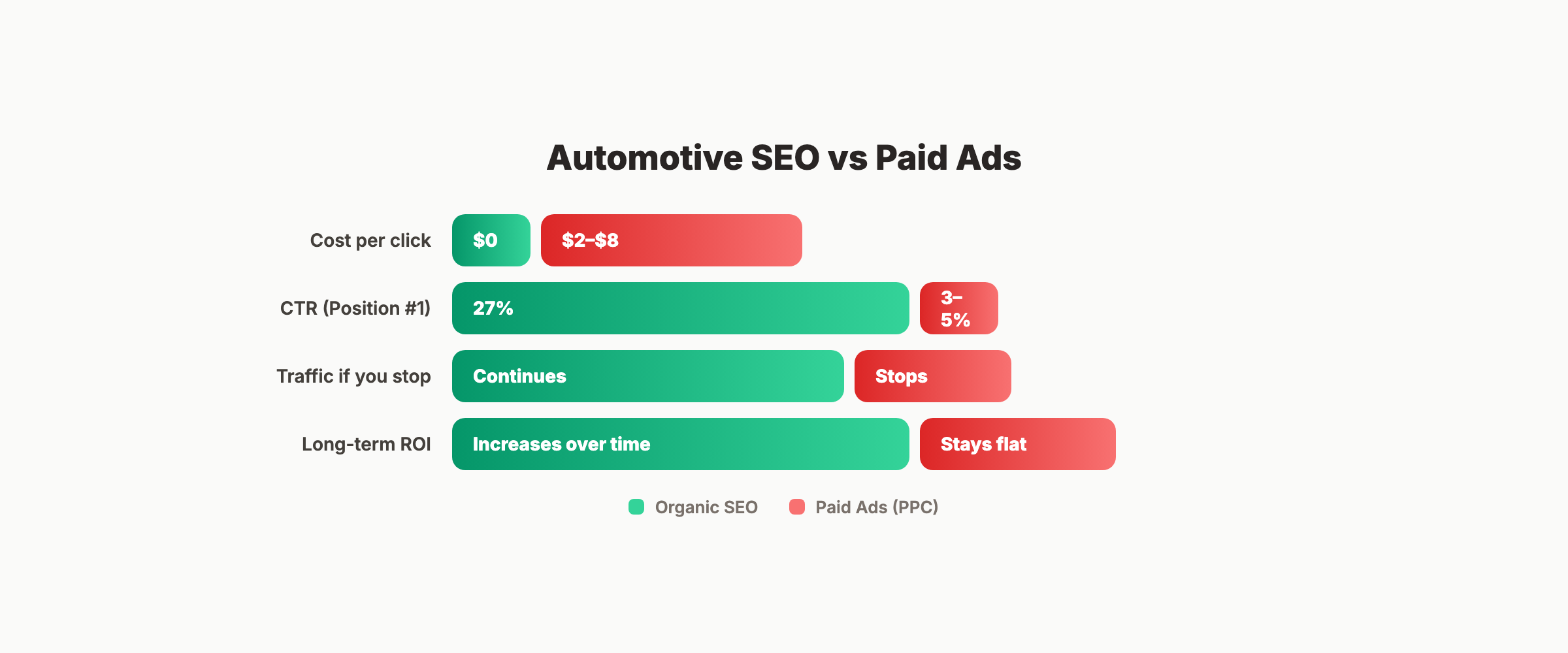
Automotive SEO vs Paid Ads
| Factor | Organic SEO | Paid Ads (PPC) |
|---|---|---|
| Cost per click | $0 | $2-$8 for auto keywords |
| Traffic when you stop paying | Continues | Stops immediately |
| Trust level | High (organic results) | Lower (marked as “Ad”) |
| Long-term ROI | Increases over time | Stays flat |
| Click-through rate | 27% for position #1 | 3-5% for search ads |
Paid ads have a role. They fill gaps while organic rankings build. But every dollar shifted from PPC to SEO produces compounding returns over 6 to 12 months. The best automotive marketing strategies use both channels, with SEO as the foundation.
How Car Buyers Search Online
Understanding how car buyers search is the foundation of any automotive SEO strategy. The buyer journey has 5 distinct phases, each with different search patterns.
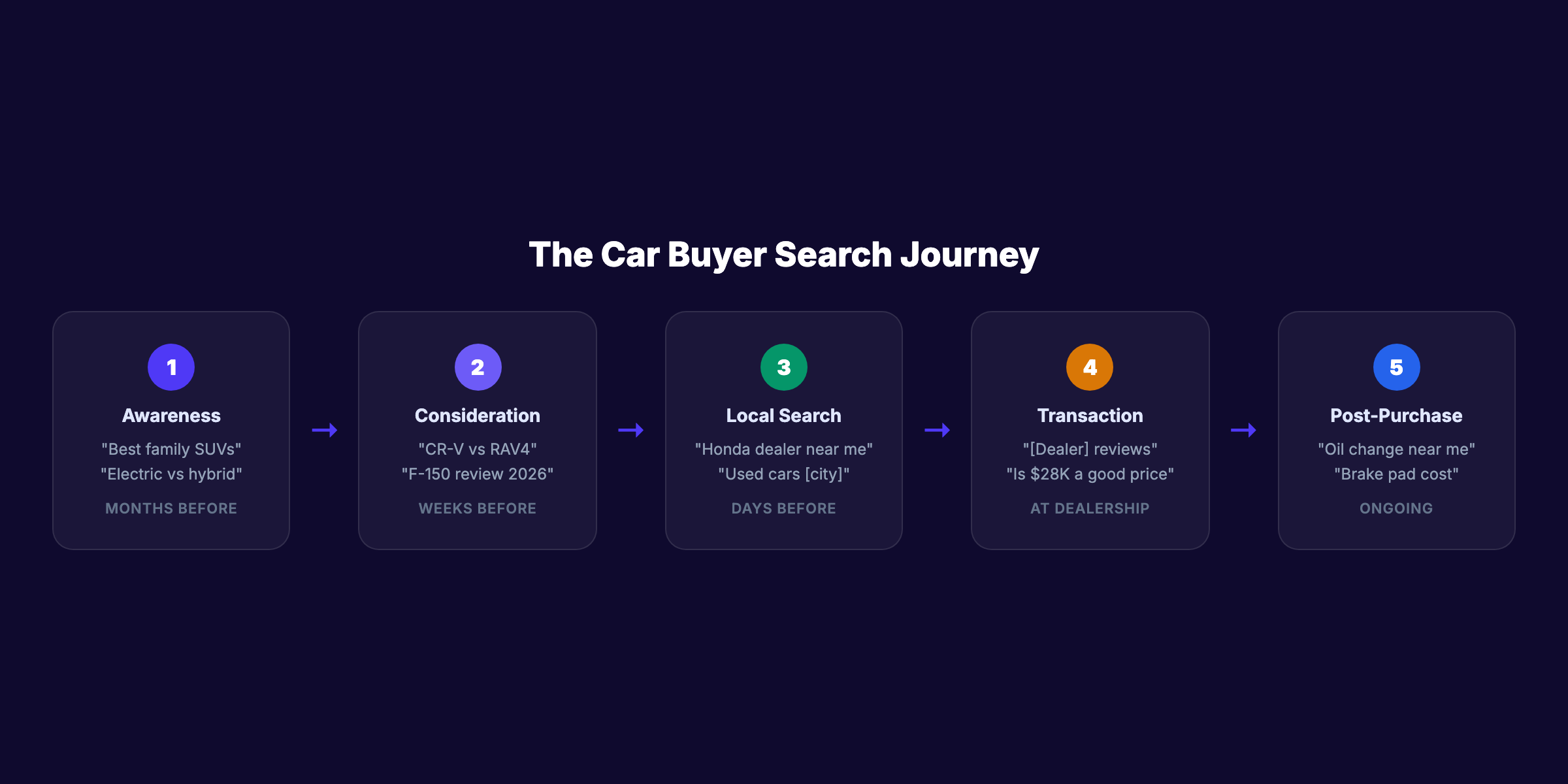
Phase 1: Awareness (Months Before Purchase)
Buyers do not start by searching for a specific car. They search for information.
- “Best family SUVs 2026”
- “Electric vs hybrid cars”
- “How much car can I afford”
- “Best cars under $30,000”
These are informational queries. They represent the top of the funnel. Dealerships that publish blog content answering these questions capture buyers 3 to 6 months before they walk onto a lot.
Phase 2: Consideration (Weeks Before Purchase)
Buyers narrow their options. Searches become model-specific.
- “Honda CR-V vs Toyota RAV4”
- “2026 Ford F-150 review”
- “Hyundai Tucson reliability”
This phase favors dealerships with detailed model comparison pages, vehicle review content, and spec-focused landing pages.
Phase 3: Local Search (Days Before Purchase)
Buyers search for dealerships. This is where local SEO dominates.
- “Honda dealer near me”
- “Used car dealership [city]”
- “Car dealership open Sunday”
- “[Brand] dealer with best reviews”
76% of people who search for a nearby business on their phone visit within 24 hours. For dealerships, ranking in the local pack (the map results) is the single highest-value SEO position.
Phase 4: Transaction (At the Dealership)
Even at the dealership, buyers search. They compare prices, check reviews, and verify inventory on their phones.
- “[Dealership name] reviews”
- “[Specific VIN] price history”
- “Is $28,000 a good price for a 2026 Camry”
Your online reputation determines whether a buyer already on your lot follows through or drives to a competitor.
Phase 5: Post-Purchase (Service and Loyalty)
The relationship does not end at the sale. Service searches drive repeat revenue.
- “Oil change near me”
- “[Brand] dealer service specials”
- “Brake replacement cost [city]”
Auto service queries are high-frequency, high-intent, and highly local. Ranking for service-related keywords builds lifetime customer value.
Your SEO team. $99 per month. Stacc publishes 30 optimized articles per month for your dealership. No agency fees. No writer management. Start for $1 →
Local SEO for Dealerships and Auto Shops
Local SEO is the highest-ROI channel for most automotive businesses. A single position in the Google Map Pack for “car dealership [city]” can generate dozens of leads per month.
Google Business Profile Optimization
Your Google Business Profile is the foundation of local automotive SEO. An optimized GBP drives map pack visibility, displays reviews, and shows inventory information.
Critical GBP optimizations for automotive businesses:
- Verify and claim your listing for every location
- Choose the correct primary category (“Car Dealer,” “Auto Repair Shop,” “Tire Shop”)
- Add all secondary categories (up to 9)
- Upload 50+ high-quality photos (lot, showroom, service bays, staff)
- Write a 750-word business description with target keywords
- Add all services with descriptions
- Post weekly updates (new inventory, service specials, community events)
- Enable messaging and Q&A
- Keep hours updated (including holiday hours)
Local Keyword Strategy
Automotive local keywords follow predictable patterns. Target these clusters:
| Keyword Pattern | Examples | Search Intent |
|---|---|---|
| [Brand] dealer [city] | “Honda dealer Dallas” | High purchase intent |
| Used cars [city] | “Used cars Austin” | Inventory browsing |
| Auto repair [city] | “Auto repair Phoenix” | Service need |
| Car service specials [city] | “Oil change specials Denver” | Price comparison |
| [Service] near me | ”Brake repair near me” | Immediate need |
Build a location page for each service area within your market. A dealership in Dallas should have pages targeting “car dealer Dallas,” “car dealer Plano,” “car dealer Fort Worth,” and every suburb within their delivery radius.
Citation Building
Citations are mentions of your business name, address, and phone number on other websites. For automotive businesses, the critical citation sources include:
- Cars.com
- AutoTrader
- CarGurus
- DealerRater
- Edmunds
- KBB (Kelley Blue Book)
- Yelp
- BBB (Better Business Bureau)
- Yellow Pages
- Industry-specific directories
Consistent NAP information across all citations directly impacts local ranking strength. One wrong phone number on AutoTrader can suppress your map pack visibility.
GBP Posting for Dealerships
Regular GBP posts signal activity to Google. For dealerships, the most effective post types are:
- New inventory arrivals (weekly)
- Service specials and coupons (bi-weekly)
- Community involvement (monthly)
- Customer delivery photos (weekly)
- Seasonal promotions (monthly)
Posting 4 to 8 times per month keeps your profile fresh and visible. Daily posting delivers even stronger local ranking signals.
On-Page SEO for Automotive Websites
Most dealership websites run on third-party platforms (DealerSocket, Dealer.com, CDK Global). These platforms create SEO challenges. They generate thousands of thin inventory pages with duplicate content and poor URL structures.
Fix Common Dealership Website Issues
Duplicate inventory pages. Every VIN creates a unique URL. When inventory rotates, old URLs return 404 errors. Implement canonical tags on inventory pages and set up proper 301 redirects for sold vehicles.
Thin content. A vehicle listing page with only specs and a price is thin content. Add 200 to 300 words of unique description per model. Highlight features, financing options, and why buyers should choose your dealership.
Slow page speed. Automotive sites are image-heavy. Compress all vehicle photos to WebP format. Lazy load images below the fold. Target Core Web Vitals scores above 90 on mobile.
Missing schema markup. Implement AutoDealer schema and Vehicle schema on your site. Schema markup helps Google understand your inventory, hours, reviews, and service offerings.
Title Tag Formulas for Automotive Pages
| Page Type | Title Formula | Example |
|---|---|---|
| Homepage | [Brand] Dealer in [City] - New & Used Cars | ”Honda Dealer in Dallas - New & Used Cars” |
| Inventory | [Year] [Make] [Model] for Sale in [City] | “2026 Honda CR-V for Sale in Dallas” |
| Model Page | New [Year] [Make] [Model] - [City] Dealer | ”New 2026 Honda CR-V - Dallas Honda” |
| Service | [Service] in [City] - [Dealer Name] | “Oil Change in Dallas - Dallas Honda” |
| Blog | [Topic] - [Dealer Name] Blog | ”Best Family SUVs 2026 - Dallas Honda” |
Every title tag should be under 60 characters and include the primary keyword.
URL Structure
Clean URLs matter. Automotive sites often generate URLs like /inventory/detail/123456789/2026-honda-cr-v. Simplify where possible.
- Good:
/new-cars/2026-honda-cr-v - Bad:
/inventory/detail/VIN_1HGCV1F36RA000001 - Good:
/service/oil-change-dallas - Bad:
/service?type=oil&location=dallas
3,500+ blogs published. 92% average SEO score. See what Stacc can do for your automotive business. Start for $1 →
Content Strategy for Automotive Businesses
Automotive content marketing targets buyers at every stage of the purchase journey. The goal is to capture organic traffic for informational, commercial, and local queries.
Content Types That Work for Automotive SEO
| Content Type | Target Audience | Examples |
|---|---|---|
| Model comparisons | Consideration phase | ”CR-V vs RAV4 2026” |
| Buyer guides | Awareness phase | ”Best SUVs for families” |
| Service guides | Post-purchase | ”When to replace brake pads” |
| Local content | Local searchers | ”Best driving roads in [state]“ |
| Financing guides | Decision phase | ”How to finance a car with bad credit” |
| Seasonal content | All stages | ”Winter car maintenance checklist” |
Blog Topics for Dealerships
A dealership publishing 20 to 30 blog posts per month targets a wide range of keywords. Here are topic clusters to build:
Vehicle research cluster:
- [Make] [Model] review 2026
- [Make] [Model] vs [Competitor]
- Best [vehicle type] under $[price]
- [Make] [Model] pros and cons
Service and maintenance cluster:
- How often to change oil for [make]
- [Make] recommended maintenance schedule
- Signs your [part] needs replacement
- Cost of [service] in [city]
Buying process cluster:
- How to negotiate car prices
- Leasing vs buying a car
- What to look for in a used car
- How to check a vehicle history report
Local community cluster:
- Best scenic drives near [city]
- [City] car show events 2026
- [Holiday] road trip checklist
Each cluster builds topical authority in a specific area. Publishing 10 to 15 articles per cluster creates enough depth for Google to recognize your site as an authority on that topic.
Content for Auto Repair Shops
Independent repair shops and service centers need different content:
- “How much does [repair] cost in [city]”
- “[Make] common problems by year”
- “DIY vs professional [service]”
- “How to find a trustworthy mechanic in [city]”
- “Signs your car needs [service]”
These queries have high local intent and low competition. A repair shop publishing 12 to 15 articles per month on these topics can dominate local search within 4 to 6 months.
Technical SEO for Dealer Websites
Automotive websites have unique technical challenges. Large inventory databases, frequent page changes, and third-party platforms create issues that most business websites never face.
Crawl Management
A dealership with 500 vehicles in inventory generates 500+ unique pages. When vehicles sell, those pages go away. This constant churn creates crawl budget waste and broken links.
Best practices:
- Use XML sitemaps that update automatically as inventory changes
- Implement 301 redirects from sold vehicle pages to the relevant model category page
- Set up a
noindextag on internal search result pages and filter pages - Optimize your robots.txt to block crawler access to duplicate or low-value pages
Mobile Optimization
78% of automotive searches happen on mobile devices. Your site must load fast and display properly on phones.
- Target under 3 seconds for mobile page load time
- Use responsive design for all pages
- Make phone numbers tap-to-call
- Ensure inventory filters work on touchscreens
- Test Core Web Vitals monthly
HTTPS and Security
Every automotive website must use HTTPS. Google has used HTTPS as a ranking signal since 2014. Dealership sites that process financing applications or collect personal information without HTTPS face both ranking penalties and legal liability.
Structured Data for Automotive
Implement these schema types on your automotive website:
| Schema Type | Where to Use | What It Shows |
|---|---|---|
| AutoDealer | Site-wide | Business info, location |
| Vehicle | Inventory pages | Make, model, year, price, mileage |
| LocalBusiness | All pages | NAP, hours, area served |
| Review | Reviews page | Star ratings, review count |
| FAQPage | FAQ sections | Questions and answers |
| Service | Service pages | Service types, pricing |
Structured data helps Google display rich results for your listings. Vehicle schema can show price, mileage, and availability directly in search results.
Review Management and Online Reputation
Reviews are a top-3 ranking factor for local SEO. For automotive businesses, reviews also directly influence purchase decisions. 88% of car buyers read online reviews before visiting a dealership.
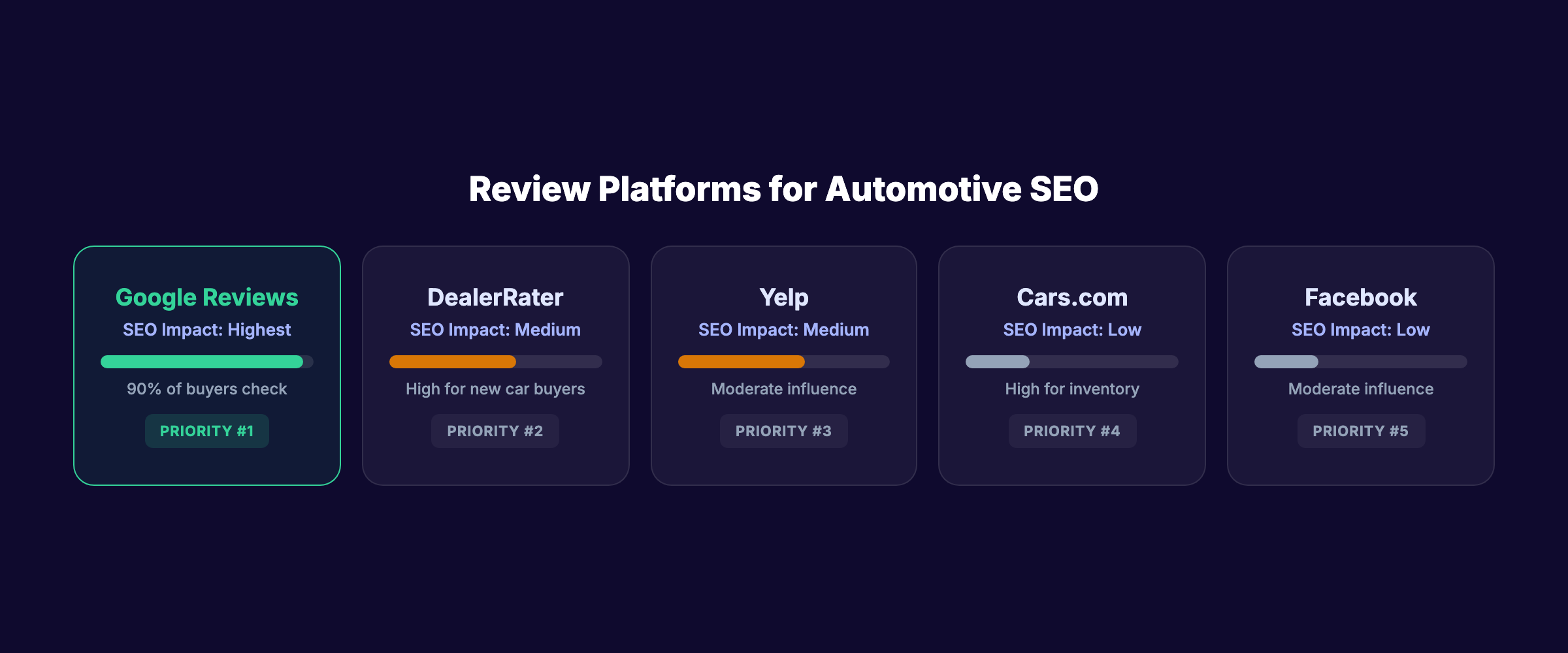
Where Reviews Matter Most
| Platform | SEO Impact | Buyer Influence |
|---|---|---|
| Google Reviews | Highest (direct ranking factor) | 90% of buyers check |
| DealerRater | Medium (industry authority) | High for new car buyers |
| Yelp | Medium (citation + trust signal) | Moderate |
| Cars.com | Low (indirect SEO) | High for inventory browsers |
| Low (social signal) | Moderate |
Focus on Google reviews first. They directly impact your local pack ranking and appear in search results.
How to Get More Reviews
Most satisfied customers never leave reviews unless asked. Build a systematic review collection process.
- Ask every customer at delivery or service completion
- Send a follow-up text or email within 24 hours
- Use a review request generator to create templates
- Place QR codes in the service waiting area and at the cashier
- Train sales and service staff to request reviews personally
Target 10+ new Google reviews per month. Dealerships with 100+ reviews and a 4.5+ star rating dominate local rankings in most markets.
Responding to Reviews
Respond to every review. Positive and negative. Response rate signals engagement to Google and builds trust with future buyers.
For negative reviews, follow this framework:
- Acknowledge the concern within 24 hours
- Apologize for the experience (not for being wrong)
- Take the conversation offline (provide a direct contact)
- Follow up and update the response when resolved
Never argue with a reviewer publicly. One bad response damages trust more than the negative review itself.
Rank everywhere. Do nothing. Blog SEO, Local SEO, and Social on autopilot for your dealership. Start for $1 →
Measuring Automotive SEO Results
Automotive SEO takes 3 to 6 months to show meaningful results. Track these metrics to measure progress.
Key Metrics
| Metric | What It Tells You | Tool |
|---|---|---|
| Local pack ranking | Map visibility | Google Search Console |
| Organic traffic | Search visibility growth | Google Analytics |
| Keywords ranking top 10 | Competitive positions | Ahrefs or Semrush |
| Phone calls from organic | Lead generation | Call tracking |
| Form submissions | Lead volume | Google Analytics goals |
| Review count + rating | Reputation strength | GBP dashboard |
| Pages indexed | Content coverage | Google Search Console |
Attribution for Automotive
Car sales have a long attribution window. A buyer who reads your blog post in January may visit in March and purchase in April. Set up multi-touch attribution to track the full journey.
Use UTM parameters on all trackable links. Set up Google Analytics 4 conversion events for:
- Vehicle detail page views
- Contact form submissions
- Click-to-call actions
- Directions requests (from GBP)
- Chat initiations
- Finance application starts
Monthly SEO Reporting
Review these metrics monthly:
- Organic traffic trend (compare month-over-month and year-over-year)
- New keywords ranking in top 100
- Local pack position for top 10 keywords
- Number of new Google reviews received
- Blog content published vs target
- Phone calls and form leads from organic
- Top-performing pages by traffic and conversions
A dealership investing in SEO should expect 60 to 90 days for initial ranking movement and 6 to 12 months for significant traffic growth.
FAQ
How much does automotive SEO cost?
Automotive SEO typically costs $1,500 to $5,000 per month from an agency. Dealership groups with multiple locations spend $5,000 to $15,000. The cost depends on market competition, number of locations, and scope of work. Automated SEO services like Stacc start at $99 per month for 30 optimized articles.
How long does automotive SEO take to work?
Most dealerships see initial ranking improvements in 60 to 90 days. Meaningful traffic growth appears at 4 to 6 months. Full local dominance in a mid-sized market typically takes 9 to 12 months of consistent effort. Learn more about SEO timelines.
Is SEO worth it for car dealerships?
Yes. Organic search generates leads at a fraction of the cost of paid ads. A dealership spending $3,000 per month on SEO that generates 50 organic leads pays $60 per lead. The same $3,000 on PPC generates 15 to 20 leads at $150 to $200 each. SEO ROI improves every month as rankings compound.
What is the most important SEO factor for dealerships?
Google Business Profile optimization is the single highest-impact factor for most dealerships. Map pack visibility drives more phone calls and visits than organic blue link rankings. Reviews, posting frequency, and category accuracy all feed into GBP performance.
Should dealerships blog for SEO?
Absolutely. Dealerships that publish 15 to 30 blog posts per month build topical authority faster and rank for hundreds of long-tail keywords. Blog content about model comparisons, maintenance guides, and buying tips captures buyers at every stage of the purchase journey.
How do I compete with AutoTrader and Cars.com in search results?
You do not need to outrank third-party listing sites for broad terms. Focus on local keywords where you have a geographic advantage. “Honda dealer in [city]” and “[city] used cars” favor local businesses over national aggregators. Build your local SEO presence and Google will prioritize your listing for nearby searchers.
The automotive industry has one of the highest customer lifetime values in any sector. A single car sale is worth $3,000 to $5,000 in profit. A loyal service customer adds another $2,000 to $4,000 per year. Automotive SEO puts your dealership in front of buyers at the exact moment they are ready to act.
Start with local SEO and GBP optimization. Build a content strategy around the buyer journey. Collect reviews consistently. And if producing 30 articles per month sounds impossible for your team, it costs $99 per month when it happens automatically.
Written and published by Stacc. We publish 3,500+ articles per month across 70+ industries. All data verified against public sources as of March 2026.
