Review bakery website examples with a practical rubric for retail, preorder, pickup, custom cakes, wholesale, and multi-location buyer paths.
Most bakery website galleries stop at photography, color, and type. An operator has harder questions. Can a walk-in customer find today's hours? Can a preorder buyer see the cutoff and correct pickup window? Does a wedding enquiry reach the person who knows the production calendar?
These bakery website examples are reviewed as working buyer paths, not as a beauty contest. We inspected four US bakery-owned sites across different models, captured their public desktop and mobile pages, and recorded only what was visible on July 13, 2026. We did not access analytics, ordering records, calls, forms, production systems, or revenue.
What a bakery website must help each buyer decide
A bakery website should answer a different decision for each buyer: “Can I visit now?”, “Can I preorder for this date?”, “Can you assess my event?”, or “Can you support a recurring account?” The required facts, urgency, commitment, and operational owner change with each path, so one generic “Order” button cannot serve them all.
| Bakery model | Seasonality, urgency, commitment | Buyer job and required path | Volatile facts, source, owner | Density check and failure state |
|---|---|---|---|---|
| Retail storefront | Daily and holiday peaks; immediate; low commitment | Find location, hours, current counter range; location page | Hours and availability; location/menu record; manager | Nearby open alternatives; stale hour or sold-out item |
| Home/cottage preorder | Drop or pickup dates; cutoff-led; planned | Confirm service date and pickup; preorder page | Drop, cutoff, pickup; order sheet; baker | Competing local pickup windows; expired drop |
| Custom cake/wedding | Event calendar; date-sensitive; high commitment | Check fit before requesting; qualification form | Date, servings band, geography; intake system; cake lead | Specialist availability; form omits event date |
| Catering/dessert table | Holiday and event peaks; planned; medium/high | Define occasion and service scope; catering route | Date, guest band, fulfillment area; event record; catering owner | Local event suppliers; retail form receives catering job |
| Wholesale account | Recurring cadence; operational; high commitment | State business type, volume band, cadence, geography; wholesale intake | Range and capacity; account system; wholesale owner | Regional suppliers; one-off contact treated as account |
| Shipped ecommerce | Gift seasons and carrier windows; planned | Choose shippable product and service date; product/order path | Stock, ship area, delivery option; commerce system; fulfilment owner | National alternatives; item shown after unavailable |
| Multi-location | Location-specific; immediate or planned | Select bakery before hours, menu, or order; location-first route | Address, hours, local range; location records; each manager | Branch-level results; wrong pickup site |
Keep vendor and employment contacts out of customer forms and enquiry counts. Licenses, permits, cottage-food rules, inspections, tax, insurance, and bonding questions depend on model and jurisdiction; assign them to a qualified local owner.
How the examples were selected and captured
We included four resolvable, US bakery-owned websites that exposed materially different buyer jobs on public pages. We reviewed nine candidates and excluded five because they duplicated a selected model, blocked a repeatable capture, or were a gallery, builder showcase, directory, restaurant-led site, or ordering-platform destination rather than the bakery's own public path.
Discovery used the brief's dated search set and public bakery-example lists. Inclusion required an operating bakery identity, first-party domain, and inspectable buyer path. Social profiles, themes, demos, portfolios, recipe-only blogs, marketplaces, and parked domains did not qualify.
| Selection log | Model included | Capture record | Usage note |
|---|---|---|---|
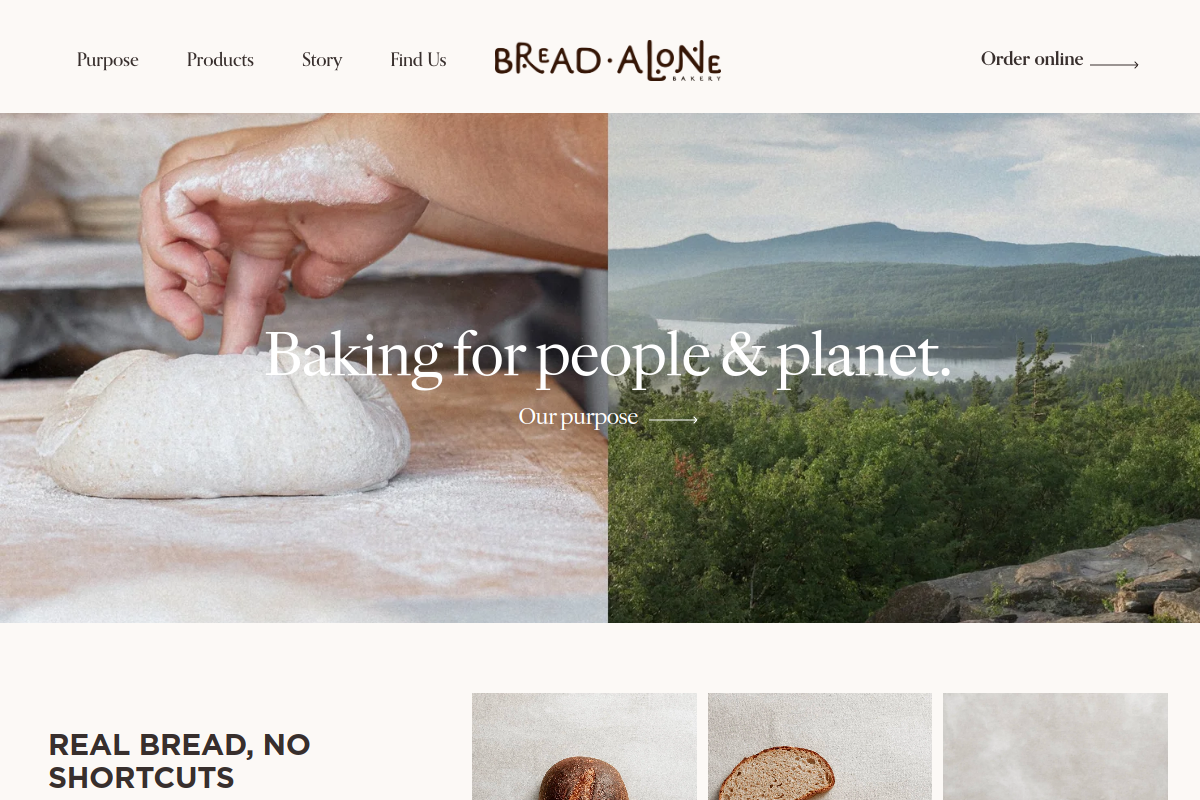
| Bread Alone | Regional retail plus wholesale | July 13, 2026; 1440×1200 and 390×844 | First-party public page; observation and linked visual reference only |
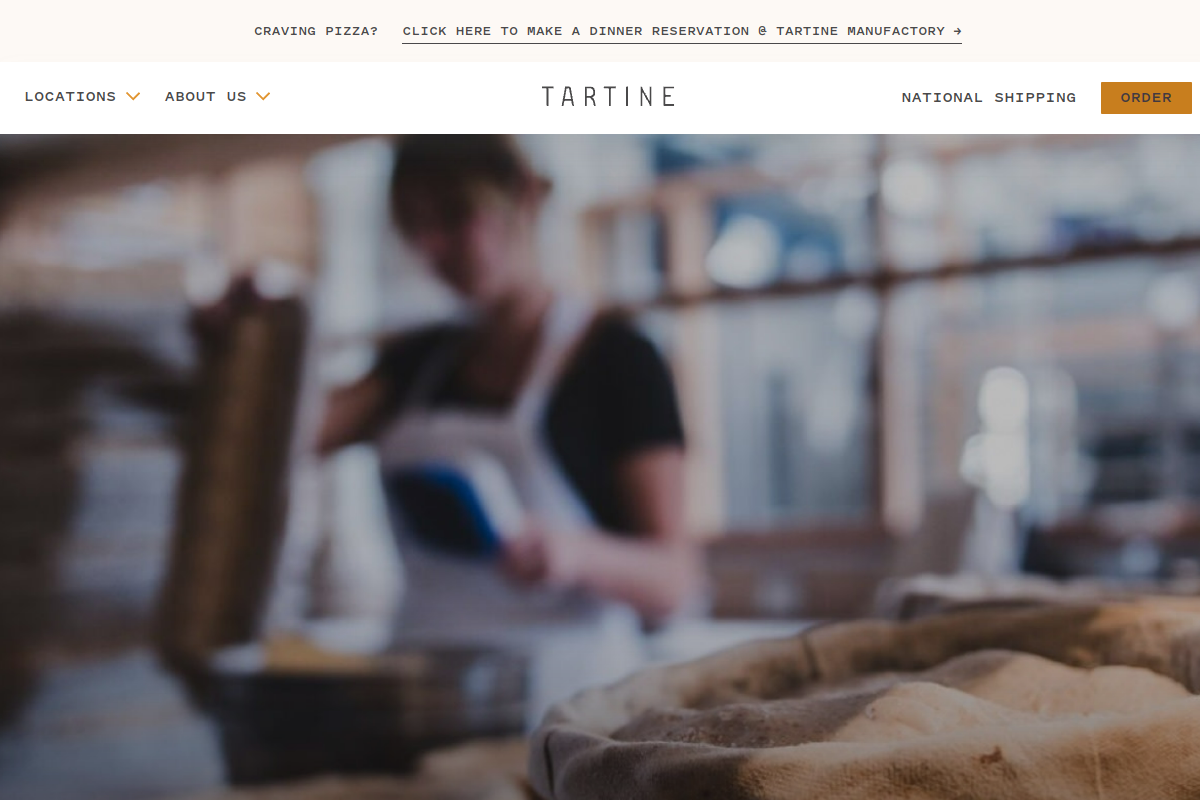
| Tartine Bakery | Multi-location, preorder, catering | July 13, 2026; 1440×1200 and 390×844 | First-party public page; observation and linked visual reference only |
| MoMa Cakes | Home-based custom and wedding | July 13, 2026; 1440×1200 and 390×844 | First-party public page; observation and linked visual reference only |
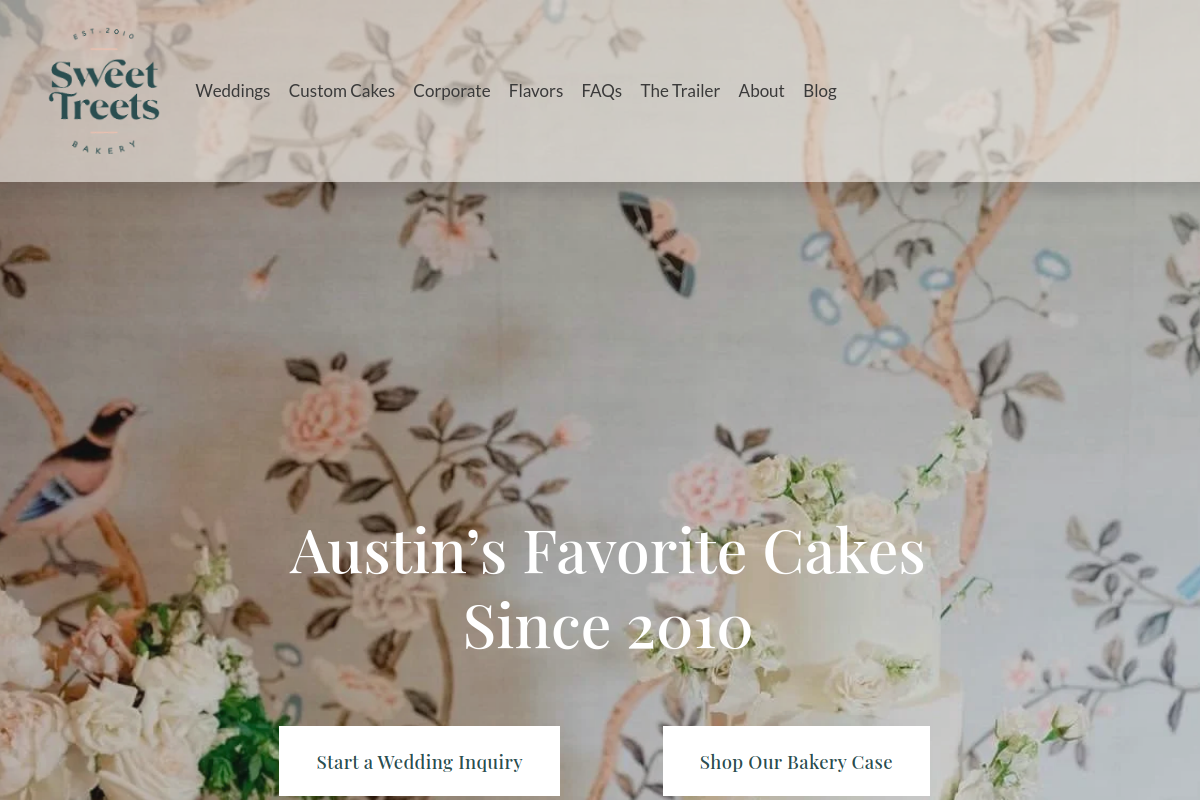
| Sweet Treets Bakery | Storefront case, custom, wedding, corporate | July 13, 2026; 1440×1200 and 390×844 | First-party public page; observation and linked visual reference only |
Desktop and mobile files were original writer captures; the cards link a dated rendering of each public URL. Dynamic pages can change, so every observation carries a date and explicit unknowns.
The bakery website review rubric
Use a fixed, non-numeric rubric before looking at visual polish. Mark each criterion present, partial, missing, or not applicable, attach the exact screenshot and URL, name the funnel stage and owner, then set an expiry trigger. The result is an evidence record for redesign decisions, not a score or ranking.
| Criterion and bakery reason | Status definition | Evidence and stage | Owner and expiry | Explicitly unknown |
|---|---|---|---|---|
| Model identity; sets the buyer's expected path | Present: explicit; partial: inferred; missing: unclear; N/A: never | Homepage copy; impression/click | Brand owner; model change | Buyer understanding |
| Location and current hours; supports an urgent visit | Present: current location block; partial: one fact absent; missing: neither; N/A: shipped-only | Location URL/capture; call click or visit path | Location manager; holiday or closure | Open status after capture |
| Menu, price, availability, sell-out; prevents false orderability | Present: dated source-linked state; partial: menu without availability; missing: none; N/A: enquiry-only | Product capture; product view/order start | Menu owner; batch, price, or sell-out | Stock and order completion |
| Preorder cutoff and pickup truth; protects production handoff | Present: date, cutoff, site, window; partial: any absent; missing: no rule; N/A: no preorder | Order path; order start | Operations; cutoff or location change | Fulfillment |
| Custom, event, catering, wholesale separation; preserves qualification | Present: distinct routes; partial: shared but classified; missing: generic contact; N/A: service not offered | Forms; form/qualified enquiry | Intake owner; capacity or scope change | Booking and completion |
| Ingredient/allergen contact route; sends questions to an owner | Present: named contact path; partial: statement only; missing: no path; N/A: qualified review | Visible page; pre-order question | Qualified operations owner; recipe/process change | Safety or suitability |
| Proof, accessibility, page experience, local context | Present: provenance and observable checks; partial: some; missing: unsupported; N/A: context-specific | Source, keyboard/mobile checks; impression/click | Reviewer; site or claim change | Compliance, ranking, causation |
| Measurement readiness; prevents stage inflation | Present: separate event rules; partial: some joins; missing: no record; N/A: never | Event specification; each named stage | Analytics owner; implementation change | Any outcome without joined data |
Google's review guidance calls for methods, evidence, benefits, and drawbacks. WCAG 2.2 informs observable keyboard, label, focus, and contrast checks; Google identifies mobile display, HTTPS, Core Web Vitals, and intrusive interstitials as page-experience considerations. Neither source certifies compliance, rankings, or impact here.
Apply the rubric to your own bakery paths. Bring the screenshots, owners, and unknowns to a focused review of content, local-search, and publishing work.
Worked reviews of selected bakery websites
These four reviews use the same evidence fields and cover distinct bakery jobs. Each observation is limited to the named public page at the stated viewport and date. “Missing” means absent from the inspected evidence, not absent from the business, while popularity, capacity, licensing, traffic, orders, booked jobs, and revenue remain unknown.

No site is a winner. Each pattern needs retesting against the adopting bakery's production, locations, and buyer facts.
Turn observations into owned publishing decisions. theStacc's Content SEO, Local SEO, and Social Media modules cover research, drafting and CMS publishing; Google Business Profile work; and scheduled social publishing. Your bakery remains the owner of operational facts.
Patterns for daily product, preorder, pickup, and sell-out truth
Treat every product action as a dated promise assembled from operating records: product version, service date, price or availability source, cutoff, pickup place and window, and sold-out behavior. The bakery needs one human owner who can approve a change and one safe expiry state that removes orderability when the facts become uncertain.
| Truth-register field | Required record | What happens when stale |
|---|---|---|
| Product/menu version and price | Version ID, source system, menu owner, approval time | Hide price/action or show an accurately labeled fallback |
| Availability and service date | Eligible date, batch or inventory source, operations owner | Mark unavailable; never leave the old batch orderable |
| Preorder cutoff | Cutoff timestamp and time zone, production owner | Close that date and reveal the next valid option |
| Pickup location/window | Location ID, address, window, location owner | Stop handoff until a valid site and window are selected |
| Sold-out behavior | Unavailable state, substitute rule if approved, next date | Disable purchase and preserve an honest explanation |
| Cancellation/refund handoff | Approved policy owner and customer-service route | Refer to the current approved route; do not improvise policy |
A common failure is split truth: the site has last week's holiday box, the order system has today's list, and confirmation names another pickup site. Test after sell-out and cutoff, not only during availability. See the bakery and coffee-shop SEO guide for broader search context.
Patterns for custom, event, catering, and wholesale jobs
Custom, event, catering, and wholesale requests need separate qualification cards because they consume different production capacity and end in different commitments. Ask only for the facts the named owner uses to assess fit, label the submission as an enquiry, and preserve qualification, booking, and completion as distinct statuses with their own timestamps.
| Buyer type | Requested facts | Owner and next status | Disqualification and qualified-review handoff |
|---|---|---|---|
| Custom cake/wedding | Date, product type, servings/guest band, design reference, pickup/delivery geography, dietary-information contact | Custom lead; submitted → qualified enquiry → booked job → completed job | Unsupported date, product, geography, or incomplete record; capacity and jurisdiction-sensitive responsibilities go to qualified owners |
| Catering/dessert table | Date, occasion, guest band, service type, fulfillment geography, menu-information handoff | Catering owner; submitted → qualified enquiry → booked job → completed job | Outside written service rule, geography, or capacity; do not promise timing or minimums without approved records |
| Wholesale/recurring | Business type, product need, volume band, cadence, delivery/pickup geography | Wholesale owner; submitted → qualified request → account approval/booking → completed fulfillment | Unsupported cadence, range, geography, or record quality; permit, license, insurance, or bonding responsibility goes to qualified review |
Do not ask a wholesale buyer for wedding servings or a wedding client for recurring volume. Generic forms force both into a message box, leaving intake to reconstruct facts while reporting counts the form as qualified.
Failure states bakery galleries tend to miss
A gallery capture rarely shows what happens after a cutoff, sell-out, location change, seasonal close, failed handoff, or unsupported request. Review those states deliberately on phone and desktop. Record the evidence, route the issue to its factual owner, and keep operational failure from being misreported as a design success or customer outcome.
| Failure-state checklist | Inspect | Route or exclusion |
|---|---|---|
| Stale hours, price, menu, seasonal page, or pickup site/window | Dated source, page version, expiry | Correct, retire, or suppress until owner approval |
| Sold-out item or missed cutoff remains orderable | Unavailable state and destination | Close the action; exclude failed/abandoned orders |
| Custom form lacks date, servings, product, or geography | Fields and qualification rule | Repair intake; do not count as qualified automatically |
| Retail, wholesale, vendor, and employment contacts mix | Form labels and routing | Classify separately; exclude non-customer contacts |
| Third-party handoff breaks or loses location context | Destination, parameters, return path | Restore context; a click remains only a click |
| Unowned allergen or jurisdiction-sensitive wording | Named approved owner and review date | Remove or refer for qualified review |
| Keyboard, focus, label, contrast, or mobile interaction issue | Observable WCAG-informed check | Repair and retest; do not certify compliance |
| Review or award cannot be verified | Original source, wording, permission, date | Remove or correct; FTC rules prohibit specified deceptive review practices |
| Bot, staff/test, duplicate, unreachable, declined, canceled, refunded, no-show, incomplete, unattributable | Stage record and exclusion reason | Keep the record in its true state; never promote it downstream |
Use the SEO audit checklist for technical mechanics and the restaurant website examples review for a substantial dine-in model. Neither replaces bakery cutoff, pickup, sell-out, custom, or wholesale checks.
Run the same review before redesigning
Before approving a redesign, choose one bakery model and one buyer job, capture the current path, repair its operational truth, then measure each stage across a declared evidence window. A new color system can wait; a wrong pickup site, expired preorder date, or custom form that bypasses capacity review cannot.
- Choose one path. Start with “preorder a Saturday box at Location A” or “request a wedding cake for a known date.”
- Capture both viewports. Save page, destination, date, viewport, reviewer, and each volatile fact.
- Assign owners and expiry. Name operational owners and triggers for sell-out, cutoff, holiday change, or retirement.
- Instrument stages separately. Define rule, timestamp, source, owner, and exclusions for a 28-day window.
| Stage | Business rule and evidence | Source system / owner | Expiry or exclusion |
|---|---|---|---|
| Impression | Eligible search appearance; dated record | Search reporting / search owner | Bot or ineligible appearance |
| Click | Eligible search-result visit; timestamp | Search reporting / search owner | Bot, staff/test, duplicate rule |
| Product view | Eligible view of declared product/version | Consented analytics / web owner | Wrong date/location or unavailable version |
| Call click | Tap on declared telephone action | Consented analytics / web owner | Not a connected call |
| Order start | Attributable entry into order flow | Analytics + ordering / digital-order owner | Bot, test, duplicate; not a placed order |
| Placed order | Ordering system reaches written placed state | Ordering/POS / digital-order owner | Failed, abandoned; not fulfilled |
| Fulfilled order | Placed order reaches written fulfilled state | POS/fulfillment / operations | Canceled, refunded, incomplete, unattributable |
| Form | Valid submitted record | Form log / intake owner | Spam, vendor, employment, duplicate |
| Qualified enquiry | Meets written date, product, band, geography, capacity rule | CRM/order system / custom owner | Unsupported or incomplete request |
| Booked job | Mutually confirmed under written rule | CRM/job system / event operations | Tentative hold; reschedule counted once |
| Completed job | Booked job reaches written completion state | Job/POS record / operations | Canceled, refunded, no-show, partial, test |
For a current-product action rate, divide unique eligible sessions with the declared menu, product, or availability action by unique eligible page sessions exposed to it in one declared 28-day window. Use the consented event log plus page/product version, owned by the website/menu owner; exclude bots, staff/tests, duplicate taps, wrong date/location sessions, and pages without the action.
For preorder completion, divide unique attributable starts reaching fulfilled/completed by all unique attributable starts in the same 28-day start cohort plus a stated fulfillment/refund lag. Use consented analytics plus ordering/POS records, owned by digital ordering/operations; exclude staff/tests, duplicates, abandoned/failed, canceled/refunded, custom/event/wholesale, and unattributable orders.
For custom work, use three separate formulas. Qualified-enquiry rate is qualified forms over valid custom/event forms in one 28-day submission cohort plus qualification lag, from form and CRM records, owned by intake, excluding spam, duplicates, vendors, employment, unsupported, and incomplete records. Booked-job rate is confirmed jobs over qualified enquiries in one 28-day enquiry cohort plus booking lag, from the CRM/job system, owned by event operations, excluding tentative holds. Completed-job rate is completed jobs over booked jobs in one 28-day booked cohort plus production/reconciliation lag, from job/POS records, owned by operations, excluding canceled, refunded, no-show, partial, test, duplicate, retail/preorder, and unattributable jobs.
Google Analytics documents separate recommended lead events, but your bakery defines the actual rules. If consented systems cannot join impression, click, call click, form, order, qualification, booking, and completion reliably, label downstream attribution unavailable. A content calendar can schedule approved seasonal pages, but it must carry the source owner and expiry date.
Frequently asked questions
These answers cover decisions that remain after the examples and rubric: what belongs on the site, how volatile product facts should behave, where buyer paths should split, and what a redesign can actually demonstrate. They do not provide food, allergen, labeling, permit, licensing, insurance, accessibility-compliance, or legal advice.
What should a bakery website include?
A bakery website should identify the bakery model, location and current hours, then give each buyer a clear route to current products, preorder, pickup, custom or event work, catering, or wholesale where offered. It also needs an unavailable-item state and separate vendor and employment contacts so those messages do not enter customer-intake reporting.
How should a bakery website show daily availability and sold-out products?
Show daily availability from the bakery's current product source, with a service date, location, last-updated cue, and an explicit sold-out or unavailable state. Remove or disable the order action when the source changes, then offer the next valid date or product route. An evergreen gallery should never imply that a photographed pastry is available today.
Should a bakery put its menu and prices on its website?
Publish a menu and prices when the bakery has an owner and source system that can keep them current. Label sample or starting information accurately if that is all the operation approves. The important decision is governance: one version, an approval date, an expiry trigger, and a safe fallback when price or product truth becomes unavailable.
How should preorder cutoff and pickup information be displayed?
Place the service date, cutoff, pickup location, and pickup window beside the preorder action, then repeat them in the order handoff and confirmation. When the cutoff passes, the page should prevent that date from appearing orderable and identify the next available option. Multi-location bakeries should require location selection before showing location-bound pickup facts.
Should retail orders, custom cakes, catering, and wholesale use separate paths?
Yes, separate these paths because they involve different information, capacity checks, owners, and evidence stages. A same-day retail order can move toward a placed order, while a wedding cake, dessert table, or recurring wholesale request first needs qualification. Shared navigation is fine; shared forms and combined reporting hide where each buyer actually stopped.
What should a custom cake or event enquiry form ask?
Ask for the requested date, product or event type, servings or guest band, design references, pickup or delivery geography, and a route for dietary-information questions. State that submission is a request, then send it to the capacity owner for qualification. Keep vendors, employment messages, unsupported requests, duplicates, and incomplete records out of the qualified-enquiry stage.
Can a bakery copy a design pattern from another bakery website?
A bakery can adapt the operational idea behind a pattern, such as choosing a location before pickup, without copying protected creative work or another bakery's claims. Test the pattern against your own shelf life, production calendar, order cutoff, capacity, and buyer paths. Obtain qualified review if permissions, intellectual property, or required disclosures are uncertain.
Will redesigning a bakery website increase orders or booked jobs?
A redesign changes observable paths but does not prove more orders or booked jobs. Measure product views, order starts, placed orders, fulfilled orders, forms, qualified enquiries, booked jobs, and completed jobs separately. Join them only through reliable, consented source records and written rules; when that join is unavailable, downstream attribution is unavailable too.
Make the next bakery website decision operational
The next bakery website decision should repair one real buyer path and its source of truth: today’s retail availability, a preorder cutoff, the correct pickup location, a custom-event qualification route, or a wholesale handoff. Capture the before state, name the owner, define expiry, and keep every measurement stage separate after release.
Visual identity still matters. It helps buyers recognize the bakery and understand its character. But the operating layer earns trust when a seasonal product sells out, a holiday cutoff passes, or one branch changes hours. That is where a beautiful static comp stops helping and an owned content system starts doing useful work.
Bring one bakery buyer path to a working session. We can map the content, local-search, and publishing decisions while your team keeps control of availability, ordering, qualification, and fulfillment facts.
Sources & references
- Google Search Central — high-quality review guidance
- Google Search Central — people-first content guidance
- Google Search Central — page experience guidance
- W3C — WCAG 2.2 quick reference
- SBA — licenses and permits depend on activity and location
- FTC — Consumer Reviews and Testimonials Rule Q&A
- Google Analytics Help — recommended lead events
- Bread Alone — public bakery website captured July 13, 2026
- Tartine Bakery — public bakery website captured July 13, 2026
- MoMa Cakes — public bakery website captured July 13, 2026
- Sweet Treets Bakery — public bakery website captured July 13, 2026

Explore the tools for blog content, Google Business Profile, and social publishing.
Weekly local SEO teardowns
One practical email a week. Map Pack, GBP, AI Overviews. No fluff. Unsubscribe anytime.