
What Is Brand Entity SEO? Complete Guide
Brand entity SEO makes your business a recognized entity in Google's Knowledge Graph and AI search. Learn how it works and why it matters. Updated April 2026.
Google does not just index your web pages anymore. It builds a database of entities: people, places, organizations, products, and concepts. Brand entity SEO is the practice of making your business a clearly recognized, accurately described entity in that database.
This matters more in 2026 than any previous year. AI engines like ChatGPT, Gemini, and Perplexity rely on entity recognition to decide which brands to mention. Content recognized as entities in knowledge graphs is 50% more likely to appear in featured snippets, knowledge panels, and rich results.
If search engines and AI systems do not recognize your brand as an entity, you are competing on keywords alone. That is an increasingly losing strategy.
What Is Brand Entity SEO?
Brand entity SEO is the practice of establishing your business as a verified entity in the knowledge databases that power modern search engines and AI systems.
An entity is any distinct “thing” that search engines can identify and understand. A person. A company. A product. A concept. Google’s Knowledge Graph contains billions of these entities and maps how they relate to each other.
Traditional SEO treats your website as a collection of documents optimized for keywords. Brand entity SEO treats your business as a verified entity in a global database. The goal is not just ranking for keywords. It is making your brand a recognized node in the knowledge systems that Google, ChatGPT, Gemini, and Perplexity all use.
Think of it this way: keyword SEO tells Google what your page says. Brand entity SEO proves to Google, and every AI engine, who you are.
Key point: Brand entity SEO is the bridge between traditional search visibility and AI search visibility.
Why Brand Entity SEO Matters
Without entity recognition, your brand is just text on a page. With it, your brand is a verified fact in a knowledge system.
AI engines require entity recognition. ChatGPT, Gemini, and Perplexity do not recommend random website pages. They recommend recognized entities. If your brand is not an entity these systems understand, your share of model visibility drops to zero.
Knowledge panels drive trust. Brands recognized as entities can trigger Google Knowledge Panels. These panels display your logo, description, social links, and key facts directly on the search results page. They signal authority to both users and algorithms.
Entity signals compound. Every consistent mention of your brand across the web strengthens your entity recognition. LinkedIn, Crunchbase, Wikipedia, industry directories, and your own website all contribute. The more sources that agree on who you are, the stronger your entity becomes in every knowledge system.
The bottom line: In 2026, brands without strong entity signals are invisible to AI search and losing ground in traditional search.
Your SEO team. $99 per month. 30 optimized articles, published automatically. Every piece reinforces your brand entity across Google and AI engines. Start for $1 →
How Brand Entity SEO Works
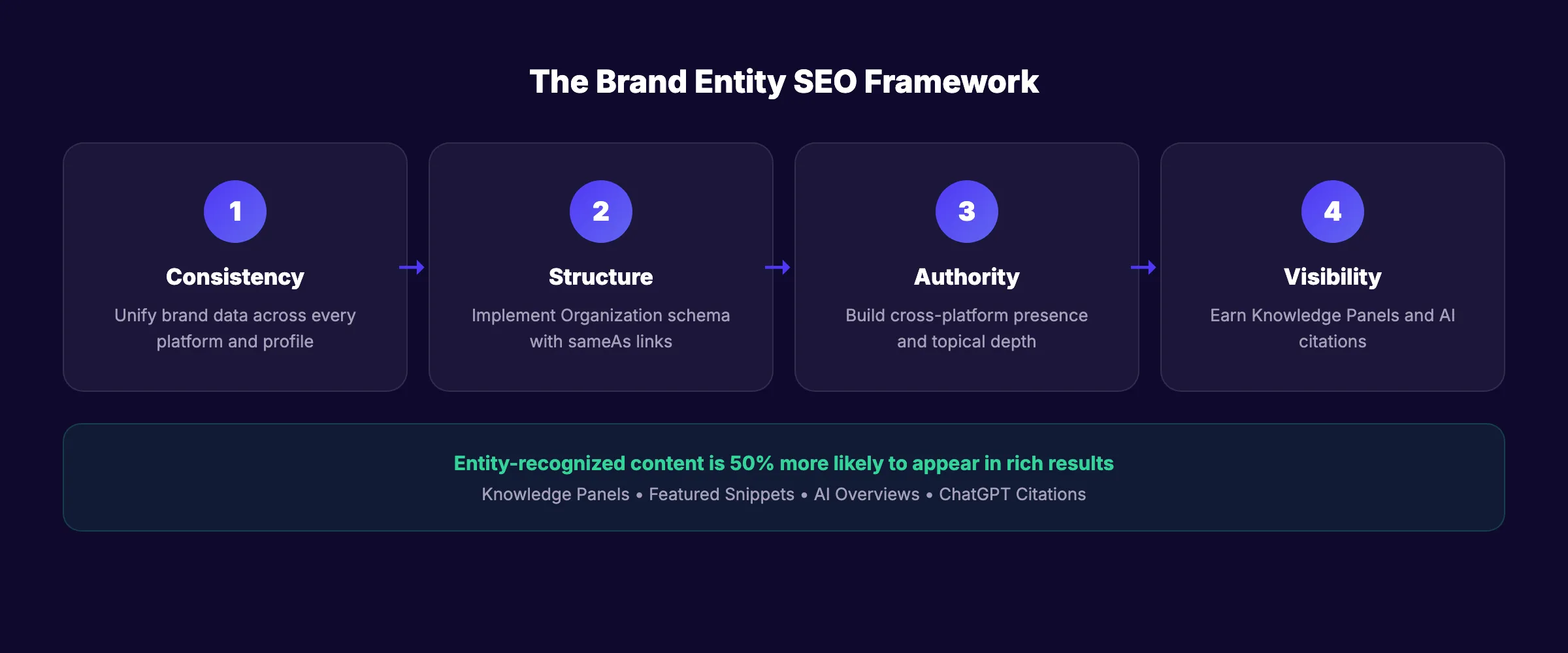
Brand entity SEO operates on a 4-part framework: Consistency → Structure → Authority → Visibility.
1. Consistency: Unify Your Brand Data
Every platform where your brand appears must say the same thing. Name, description, address, founding year, services, and leadership details must match exactly. If your website says “Founded in 2022” but LinkedIn says “Founded in 2021,” you weaken your entity signal. Read our guide on fixing wrong AI business info for the full correction process.
2. Structure: Implement Schema Markup
Schema markup translates your brand information into machine-readable format. Organization schema is the foundation. It tells search engines your official name, URL, logo, founding date, and social profiles.
The sameAs property is the most critical element. It acts as a digital equals sign. It tells Google: “The business on this website is the same business on LinkedIn, Crunchbase, and Wikipedia.” Without sameAs, search engines may treat each profile as a separate entity.
Key schema types for brand entity SEO:
| Schema Type | Purpose |
|---|---|
| Organization | Official name, logo, URL, founding date, contact, sameAs links |
| LocalBusiness | Physical address, hours, geo coordinates, service area |
| Product / Service | What you sell, pricing, availability |
| Person | Key leadership with credentials and affiliations |
| FAQ | Question-answer pairs AI engines extract directly |
3. Authority: Build Cross-Platform Presence
Entity recognition strengthens when authoritative sources validate your brand.
- Maintain accurate profiles on LinkedIn, Crunchbase, and industry directories
- Publish on authoritative third-party platforms (guest posts, industry publications)
- Earn brand mentions in news, research, and media coverage
- Build topical authority through deep content coverage of your subject area
- Ensure E-E-A-T signals (Experience, Expertise, Authoritativeness, Trustworthiness) are visible across your content
4. Visibility: Earn Knowledge Panels and AI Citations
Strong entity signals produce visible results.
- Knowledge Panels appear when Google confidently recognizes your entity
- AI Overviews cite entities with consistent, structured web presence
- ChatGPT and Perplexity mention brands that exist as clear entities across multiple authoritative sources
- Featured snippets favor content from recognized entities
The timeline: it typically takes 4-8 weeks for Google’s Knowledge Graph to process and verify new entity data.
Best Practices for Brand Entity SEO
Start with Organization schema on your homepage. This is the single highest-impact action. Include your official name, URL, logo, description, founding date, contact information, and sameAs links to all official profiles. This tells every search engine and AI crawler who you are in structured, machine-readable format.
Audit every third-party profile for consistency. Check Google Business Profile, LinkedIn, Crunchbase, Wikipedia (if applicable), industry directories, and data aggregators. Every inconsistency weakens your entity. Aim for 100% accuracy across all platforms.
Build topical authority through content clusters. AI engines recognize entities that demonstrate deep expertise. Publish content clusters of 10+ articles around your core topics. Each article strengthens the topical signal that defines your entity. Read our guide on what is topical authority for the strategy.
Allow AI crawlers to access your site. If GPTBot, ClaudeBot, and PerplexityBot cannot read your content, they cannot build an entity profile from it. Check your robots.txt configuration. Read our AI crawlers guide for technical setup.
Use consistent naming everywhere. If your brand is “Acme Solutions Inc.” do not reference yourself as “Acme,” “Acme Solutions,” and “Acme Inc.” on different pages. Pick one official name and use it everywhere.
Common Mistakes to Avoid
-
Relying on schema markup alone. Schema helps search engines parse your data, but it does not create authority. You need consistent information across third-party sources, earned mentions, and quality content. Schema without external validation produces weak entity signals.
-
Ignoring entity disambiguation. If another company shares your name or a similar name, you must be explicit about which entity you are. Use
sameAslinks, unique descriptions, and specific attributes (founding date, location, industry) to differentiate. -
Treating entity SEO as a one-time project. Entity signals need ongoing maintenance. Business details change. Profiles go stale. AI models retrain on new data. Review and update your entity information quarterly.
Brand Entity SEO and Stacc
Every article Stacc publishes reinforces your brand’s entity signals. We structure content with Organization schema, consistent brand references, E-E-A-T signals, and semantic search optimization. Consistent publishing builds the topical authority that strengthens your entity recognition in Google’s Knowledge Graph and across AI engines.
3,500+ blogs published. 92% average SEO score. See what Stacc can do for your site. Start for $1 →
Learn More
Related topics:
- What Is GEO? Generative Engine Optimization Explained
- Share of Model Visibility: The AI Search Metric
- How to Get Cited in AI Search
- Schema Markup SEO Guide
- How to Fix Wrong AI Business Info
FAQ
What is the difference between brand entity SEO and regular SEO?
Regular SEO optimizes individual pages for specific keywords. Brand entity SEO optimizes your entire brand presence to be recognized as a verified entity in knowledge databases. Regular SEO helps pages rank. Entity SEO helps your brand exist as a known fact in search engines and AI systems. Both work together.
How do I know if Google recognizes my brand as an entity?
Search for your brand name on Google. If a Knowledge Panel appears on the right side of the results page, Google recognizes you as an entity. If no panel appears, your entity signals are not strong enough yet. Check that your Organization schema is properly implemented and your sameAs links point to verified profiles.
Does brand entity SEO affect AI search visibility?
Yes. AI engines like ChatGPT, Gemini, and Perplexity use entity recognition to decide which brands to mention in responses. Brands with strong entity signals (consistent data, structured markup, cross-platform presence) are mentioned more often. Our share of model visibility guide covers how to measure this.
How long does brand entity SEO take to work?
Initial schema markup changes take 4-8 weeks for Google’s Knowledge Graph to process. Building cross-platform consistency can take 2-3 months. Earning a Knowledge Panel may take 3-6 months depending on your brand’s existing web presence and authority. Entity signals compound over time.
Brand entity SEO is how businesses transition from competing on keywords to owning their identity in every search and AI system. The brands that build strong entity signals now will be the brands AI engines recommend tomorrow.
Related Tools & Resources
Free SEO Tools:
Best Lists:

Written by
Siddharth GangalSiddharth is the founder of theStacc and Arka360, and a graduate of IIT Mandi. He spent years watching great businesses lose organic traffic to competitors who simply published more. So he built a system to fix that. He writes about SEO, content at scale, and the tactics that actually move rankings.
30 SEO blog articles published every month
Keyword-optimized, scheduled, and live on your site. Automatically.
30-day trial · Cancel anytime
theStacc
Stop writing SEO content manually
30 blog articles, 30 GBP posts, and social media content. Published every month. Automatically.
Start Your $1 Trial$1 for 3 days · Cancel anytime