Clearscope Review 2026: Honest In-Depth Verdict (Real Results)
Clearscope review covering features, pricing ($129–$399/mo), unlimited users, pros & cons, and who it's actually worth it for in 2026.
Siddharth Gangal • March 16, 2026
In This Review
Looking for Clearscope alternatives?
See top Clearscope alternatives →Editorial disclosure: This review was written and published by Stacc, a competing product to Clearscope. We have a commercial interest as an alternative. We’ve worked to present Clearscope’s features fairly and accurately, but you should weigh that context. All pricing and feature data was verified against Clearscope’s public pricing page as of March 2026.
By Stacc Editorial Team · SEO practitioners. We publish 30+ articles/month for businesses using our own platform — including this one. · Last updated: March 16, 2026
📌 Quick Verdict: This Clearscope review covers the full picture. Clearscope is the most trusted content grading tool for enterprise teams and large agencies — beloved for its clean interface, IBM Watson NLP accuracy, and unlimited-user pricing that doesn’t charge per seat. The A–F grade system is simple, clear, and predictive. But Clearscope doesn’t write, publish, or handle Local SEO. For a 5-person team, Clearscope works out to $25.80/user/month — cheaper than Surfer’s per-seat model. For a solo business owner publishing 30 articles/month, the real cost is $129 (Clearscope) + $2,400–$7,500 (writers) = $2,529–$7,629/month total. G2: 4.9/5 (91 reviews). Starting price: $129/month.
theStacc vs. Clearscope: Where We’re Better
We wrote this review. We’re a competitor. Here’s exactly where theStacc is better — so you can weigh what follows.
| Feature | Clearscope | theStacc |
|---|---|---|
| Starting price | $129/month | $99/month |
| Writing included | ✗ No — grading and suggestions only | ✓ 30 articles written for you |
| Auto-publishes to your CMS | ✗ No — you write and publish manually | ✓ Yes (WordPress, Webflow, Ghost) |
| Local SEO / Google Business Profile posts | ✗ Not included | ✓ 30 GBP posts/month |
| Social media posts | ✗ Not included | ✓ 30 posts/month (Instagram, LinkedIn, X, Facebook) |
| Done-for-you (no workflow to manage) | ✗ DIY tool — you run everything | ✓ Fully managed, hands-off |
| Real monthly cost at 30 published articles | $2,529–$7,629+/month (tool + writers + labor) | $99/month flat |
See how theStacc works → Start for $1
This Clearscope review is for anyone weighing whether $129/month is worth it — or whether the tool is even the right category of product for what they’re trying to do.
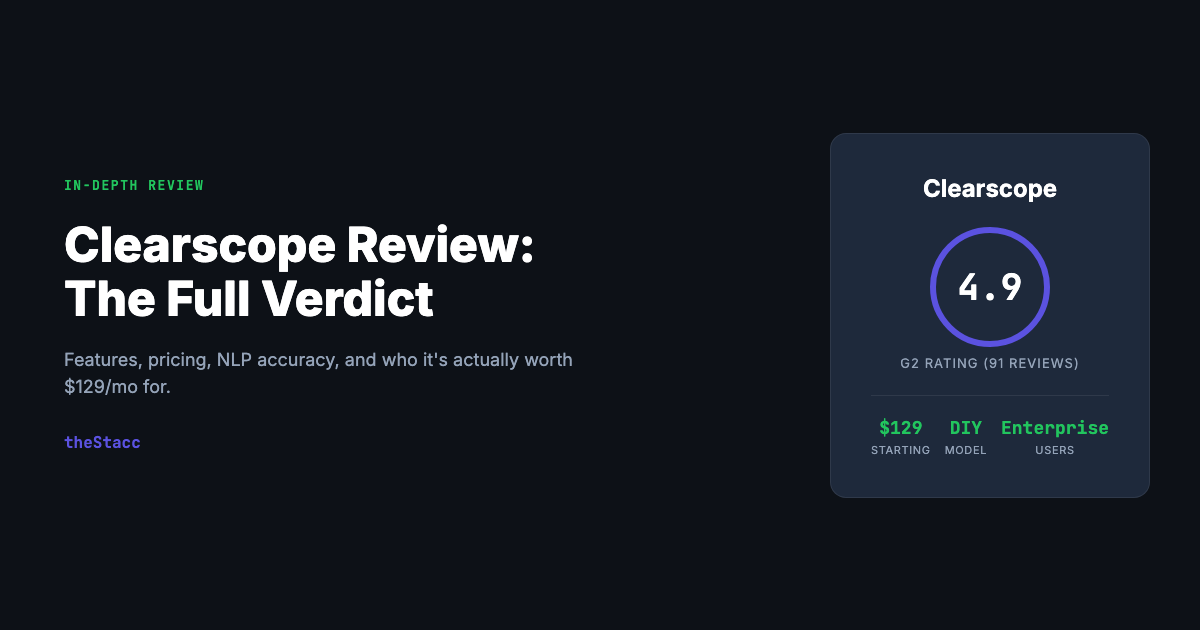
Clearscope has a 4.9/5 rating on G2 across 91 reviews, 4.9/5 on Capterra across 60 reviews, and has been on the market since 2016. It’s one of the most consistently praised tools in SEO. Most reviews are written by content managers and agency leads who use it daily with teams. For them, the answer is almost always yes.
This review takes a different angle. Most articles cover what Clearscope does. This one covers what it doesn’t — specifically the math behind the “real total cost,” the per-user pricing breakdown no other review publishes, and an honest answer to when a content grading tool is the right call versus when you actually need something else.
What Is Clearscope?
Clearscope is a content optimization platform with one core job: tell you what a piece of content needs to include to compete with the pages currently ranking for your target keyword, then grade it.
The mechanism is technically specific and worth understanding. Clearscope uses IBM Watson Natural Language Processing to analyze the top-ranking pages for any keyword. It extracts the semantically relevant terms, entities, and concepts across those pages — not just the target keyword, but the full topic map of language that appears in competing content. It then scores your content A+ through F based on how well you cover that topic map.
The grade updates in real time as you write. An A is content that comprehensively covers the topic landscape. An F means significant topic gaps exist. Users report that targeting B or above correlates with ranking improvements. The sweet spot most experienced teams aim for is A or B — not A+ — because chasing A+ often pushes writers to insert terms awkwardly rather than substantively.
What Clearscope is not: a keyword research tool (it has limited research capability), a publishing platform (no auto-publish or CMS connection beyond Google Docs and WordPress for editing), an AI writer (there are AI draft features, but the output requires editing), and definitely not a Local SEO tool. Clearscope is pure optimization.
Clearscope was founded in 2016 by Bernard Huang and Kevin Su in Austin, Texas. It has never raised outside funding — bootstrapped, profitable, and small (~15 people). That’s unusual for a tool used by enterprise-scale companies, and it’s part of why the product has a different feel: no feature bloat, no upsell ladders, no pricing pressure to hit a VC milestone.
Bernard Huang is active in the SEO community and has built Clearscope’s reputation partly through his own thought leadership on topical authority. That distribution approach — build trust through education rather than ads — is reflected in the product itself. Clearscope’s positioning is “the tool serious content teams trust,” not “the most features at the lowest price.”
Clearscope Features (2026)
Content Reports
The Content Report is Clearscope’s core product. You enter a keyword, Clearscope analyzes the top-ranking pages using IBM Watson NLP, and generates a list of recommended terms organized by importance. You write your content — inside Clearscope’s editor, inside Google Docs via the native sidebar, or inside WordPress via the plugin — and receive a live A–F grade that updates as you cover recommended terms.
Each content report includes:
- Recommended word count (derived from SERP analysis, not arbitrary)
- Recommended reading level (grade level)
- A list of high-priority and secondary terms to include
- The grade updated live as you write
The A–F grading is Clearscope’s most recognizable differentiator. Where Surfer SEO uses a 0–100 numeric score, Clearscope uses a letter grade — a design choice that has meaningful workflow implications. Letter grades are easier to communicate across teams. An editor telling a writer “this needs to be a B or above before we publish” is clearer than “get it to 72.” For agencies managing 10 writers, this standardization is genuinely valuable.
Insight — The Grade Isn’t the Goal: Clearscope’s content grade is a quality signal, not a publishing threshold. Teams that treat A+ as the target often produce over-optimized content that covers every flagged term but reads mechanically. The teams getting best results use the grade as a floor (B minimum) and treat the term list as a topic checklist rather than a mandate. The difference shows in both content quality and ranking outcomes.
The IBM Watson NLP backing is worth noting separately. Watson’s natural language processing is widely considered more accurate than the TF-IDF-based approaches used by some competitors — particularly for understanding semantic relationships rather than just frequency patterns. This is why Clearscope’s term recommendations feel less like a keyword list and more like a content brief.
Content Inventory
Content Inventory is Clearscope’s audit feature and one of its strongest capabilities for teams managing large content libraries. Connect your domain, and Clearscope tracks the optimization grade of every page, surfacing content that has decayed below ranking threshold.
At the Essentials plan level, you get 50 inventory pages tracked monthly. Business gives you 300. Add-on packages go up to 5,000 pages.
For enterprise teams with hundreds of published articles, the Inventory is often where Clearscope delivers fastest ROI. Refreshing an indexed article from a C grade to an A grade is faster and more predictable than building new content. Clearscope’s Inventory makes it possible to prioritize that work systematically rather than guessing which pages need attention.
Google Docs Integration
Clearscope’s Google Docs sidebar is considered one of the cleanest workflow integrations in the content optimization category. Writers working in Google Docs see the Clearscope grading panel appear alongside their document — recommended terms, grade, word count target — without switching tabs or copying text.
This matters operationally. The biggest friction in any content tool is the context switch: writers who have to stop, open another tool, paste content, check a score, and return. The Google Docs sidebar eliminates that friction entirely. Content teams can standardize quality across every writer without changing how writers work.
WordPress Plugin
The WordPress plugin brings the same real-time grading into the WordPress block editor. As writers work inside WordPress, the Clearscope term recommendations and grade appear in a sidebar panel.
This is distinct from most competitors, which either require copy-paste workflows or provide WordPress integrations that only import optimized drafts rather than providing live in-editor scoring.
AI Visibility Tracking
Added in 2024–2025, Clearscope now tracks whether your content appears in AI-generated responses — Google AI Overviews, ChatGPT, Perplexity, and Gemini. This “AI Visibility” tracking gives content teams a signal beyond traditional rankings: are they showing up in the AI-mediated discovery layer?
On Essentials, you get 20 AI Tracked Topics. Business gives you 50. Enterprise is custom.
This is a meaningful addition. As AI Overviews eat top-of-SERP real estate, tracking whether your content appears in those responses is a new and important signal. Clearscope’s positioning as a “discoverability platform” rather than just a content optimizer reflects this expansion.
AI Drafts
Clearscope added an AI Drafts feature: 20 per month on both Essentials and Business plans. You generate a draft from a content report, and the output is pre-populated with recommended terms — a stronger starting point than generic AI content because the brief is SERP-anchored.
The practical output quality: comparable to other NLP-anchored AI draft tools. You’ll need editing before publishing. Clearscope’s AI drafts are a convenience feature for teams that want a structured starting point, not a replacement for editorial work.
Team Collaboration and Unlimited Users
This is where Clearscope creates a genuinely significant structural advantage over its main competitor. Clearscope includes unlimited users on every plan. No per-seat pricing. No workspace limits. A 30-person agency pays the same $129/month as a solo consultant.
Contrast this with Surfer SEO, which charges per seat or per workspace on most plans. For a 5-person content team, the math shifts substantially (we cover this in detail in the pricing section below).
Clearscope Pricing (2026)
| Plan | Monthly | Annual/mo | Key Limits |
|---|---|---|---|
| Essentials | $129/mo | ~$107/mo | 20 AI Tracked Topics · 20 Topic Explorations/mo · 20 AI Drafts/mo · 50 Content Inventory Pages · Unlimited users |
| Business | $399/mo | ~$331/mo | 50 AI Tracked Topics · 50 Topic Explorations/mo · 20 AI Drafts/mo · 300 Inventory Pages · Dedicated Account Manager · Unlimited users |
| Enterprise | Custom | Custom | Custom credits · Crawler whitelisting · SSO · Custom contracts · Unlimited users |
Add-ons:
- Additional Inventory Pages: $25/mo (Essentials) / $15/mo (Business) — available in increments of 100, 200, 500, 1,000, 2,000, or 5,000
- Additional AI Drafts: $50 per batch (Essentials) / $20 per batch (Business)
Annual discount: ~17%. Free trial: None. Clearscope offers a 7-day refund window but no true trial period — a meaningful friction point for teams making their first investment.
No contracts, no hidden costs. Monthly plans can be cancelled or modified at any time.
The Real Cost of Clearscope — and “The Team Math”
Most reviews treat $129/month as the full cost of Clearscope. It isn’t.
Clearscope is an optimization tool. It grades content. It does not write content, publish content, or generate organic traffic on its own. To get 30 published articles per month — the volume needed to build meaningful SEO momentum — you need Clearscope plus writers.
$2,529–$7,629/month — the real monthly cost to publish 30 articles using Clearscope ($129) + professional writers at $80–$250/article × 30.
That math isn’t a knock on Clearscope. It’s the reality of what content production costs at volume, and it’s almost never stated clearly on pricing pages or in tool reviews.
But Clearscope has a distinct pricing angle worth understanding: the per-user cost at team scale.
The Team Math — the number no other Clearscope review publishes:
Most other Clearscope reviews focus on the $129/month headline and call it the most expensive optimizer in the category. That framing misses something important: Clearscope charges a flat fee for unlimited users. Most competitors charge per seat.
Run the per-user math at a 5-person agency team:
| Team size | Clearscope (Essentials) | Surfer SEO (Pro, per-seat est.) | Cost per user |
|---|---|---|---|
| 1 user | $129/user | $119/user | Clearscope costs more |
| 3 users | $43/user | $73/user (est.) | Clearscope costs 41% less |
| 5 users | $25.80/user | $60/user (est.) | Clearscope costs 57% less |
| 10 users | $12.90/user | $50+/user (est.) | Clearscope costs 74% less |
Stat Callout: $25.80/user/month — what Clearscope costs a 5-person agency team. That’s cheaper per user than almost every per-seat SEO tool in the category. The $129/month headline price is misleading for teams.
For agencies: the unlimited-user model makes Clearscope substantially cheaper at scale than any per-seat alternative. The $129 sticker price is the whole team’s cost, not one person’s cost.
For a solo business owner or team of one: $129/month is the full cost, and Clearscope is the most expensive content optimizer at that tier. Frase starts at $45/month. Surfer starts at $119/month. And none of those tools write or publish anything for you either — meaning the real cost still involves adding writers on top.
How to Use Clearscope: The Right 6-Step Workflow
Most new Clearscope users make the same mistake: they open the Content Report, see a list of recommended terms, and try to write their article around checking items off the list. The result is technically optimized content that reads mechanically.
The right workflow is sequential. Research and strategy first. Writing second. Optimization as a final pass.
Step 1: Run the Content Report Before You Outline
Enter your target keyword and let Clearscope generate the content report. Before you write a single word, read through every recommended term. Your goal isn’t to memorize the list — it’s to understand what subtopics keep appearing. If the term “local citations” appears 8 times across competing pages for “local SEO for plumbers,” that’s a subtopic worth its own section, not a phrase to force into a sentence.
Step 2: Build Your Outline From the Term List
Map the highest-priority terms to H2 and H3 headings. Terms that cluster together around a single concept become sections. This turns Clearscope’s list from a keyword checklist into a structural brief. Your outline reflects what the SERP considers the full topic map — not what you already knew to write about.
Step 3: Write Your First Draft Without Checking the Grade
Open the Google Docs sidebar. Write your full draft naturally, without stopping to check the grade or insert terms. Your goal in this pass is clear, useful content on the subtopics you identified in Step 2. If you’ve followed the outline correctly, you’ll cover most recommended terms organically.
Step 4: Review the Grade and Address Genuine Gaps
Check your current grade. If you’re at a C or below, look at the unchecked terms. Ask: do these represent real subtopics I should have covered? If yes, add a paragraph. If a term would require awkward insertion without adding substance, skip it. The grade is a signal, not an instruction.
Step 5: Target B, Not A+
Publish when you hit B or above. Teams chasing A+ often rewrite readable sections to insert low-value terms. B-grade content that reads well outperforms A+ content that reads like it was assembled from a keyword list. Reserve the A+ push for highly competitive keywords where exhaustive topic coverage is genuinely the ranking factor.
Step 6: Set Quarterly Content Inventory Reviews
Use the Content Inventory to track grade trends on published articles. A page that ranked at A and has drifted to C often explains a ranking drop. Refresh it before you build new content — updating indexed content is almost always faster than ranking a new page from scratch.
Does Clearscope Actually Work? What the Data Says
Clearscope’s users report an average 83.7% increase in click traffic on English content after using the platform’s recommendations. That figure comes from Clearscope’s own case study data and should be read with the understanding that it reflects motivated users with editorial processes already in place.
83.7% — average increase in click traffic reported by Clearscope users on English-language content optimized with the platform.
Enterprise clients who publicly use Clearscope include Condé Nast, Canva, Adobe, Forbes, HubSpot, and Deloitte. These companies have access to every content tool on the market and have chosen Clearscope specifically for large-team operations. Their use is meaningful validation — particularly the unlimited-user model, which only matters if you have large teams in the first place.
One G2 reviewer running a 25-person content team described switching from a per-seat tool: “The cost comparison wasn’t close once we counted all our editors, writers, and reviewers. Clearscope at $129 flat was less than half what we were paying for a tool with weaker data.”
The honest counterpoint: the 83.7% click traffic figure is correlation, not causation. Teams publishing better-optimized content are also typically teams with better editorial processes, more publishing volume, and more consistent content strategy. Clearscope is one variable, not the only one.
For teams using Clearscope in isolation — grading individual articles without a broader content strategy — results are more mixed. Optimization is a multiplier on strategy, not a substitute for it.
Clearscope Pros & Cons
Pros
- Unlimited users on all plans — no per-seat pricing, unlike Surfer; scales to 100-person agencies without cost penalties
- IBM Watson NLP accuracy — term recommendations widely considered best-in-class for semantic relevance
- A–F grading system — simple, clear, easy to standardize across a team (“publish at B or above”)
- Google Docs sidebar — live grading inside the writer’s existing workflow, no context-switching
- WordPress plugin — real-time grading directly inside the block editor
- Content Inventory — systematic audit of all existing pages; fastest ROI for teams with large content libraries
- AI Visibility Tracking — monitors content appearances in Google AI Overviews, ChatGPT, Perplexity, Gemini
- G2: 4.9/5 (91 reviews) · Capterra: 4.9/5 (60 reviews) — among the highest user satisfaction scores in SEO tools
- No contracts — cancel anytime on monthly plans
- Bootstrapped and stable — 10 years in market, profitable, no VC pressure to pivot or raise prices aggressively
Cons
- Most expensive entry point in the category — $129/month vs. Frase at $45/month, MarketMuse at $149/month; high barrier for solo users
- No free trial — 7-day refund window only; teams committing $129–$399/month without any test period is real friction
- 20 topic explorations/month on Essentials — restrictive for teams publishing 20+ articles/month
- No AI writing at publication quality — AI drafts require editing; Clearscope is not a done-for-you content solution
- No keyword research depth — limited compared to Ahrefs or Semrush; most teams need a separate tool
- No publishing integration — cannot auto-publish or connect to a CMS for distribution
- No Local SEO — no Google Business Profile, no Google Maps, no local citation tools
- English-language strength only — multilingual teams report weaker recommendations in non-English
- Small team — ~15 people; development pace slower than well-funded competitors
- Adds work per article — optimization steps increase time per article by an estimated 50%; Clearscope doesn’t reduce writing load, it increases rigor
Done-for-you alternative
Skip the tool. Get the traffic.
Stacc writes, optimizes, and publishes 30 SEO articles to your WordPress or Webflow site every month — automatically. No writers. No workflow. No logging in.
See how theStacc works → Start for $1
Who Is Clearscope Best For?
Strong fit:
- Content agencies with 5+ active users (the unlimited-user model makes economics work at team scale)
- Enterprise in-house content teams at B2B companies, media brands, or large retailers
- SEO consultants managing high-value client accounts where content quality standards must be enforced
- Teams with large existing content libraries (50+ published articles) that need systematic refresh prioritization
- Editors grading AI-written content before publishing — the A–F system works well for quality control workflows
- Organizations where multiple departments (marketing, editorial, product) contribute to content
Probably not the right call:
- Solo business owners or founders without a writing team or editorial process
- Small businesses spending <$500/month total on marketing — the content volume limitations at $129 don’t justify the cost
- Teams looking for keyword research as part of their tool stack — you’ll still need Ahrefs or Semrush
- Anyone who needs content written and published for them — Clearscope grades what you create, it doesn’t create it
- Local service businesses that need Google Maps ranking alongside website SEO — Clearscope has zero Local SEO capability
The people who are disappointed by Clearscope aren’t usually using the wrong tool. They’re using a professional content grading tool for a large team when what they needed was a done-for-you publishing service.
Clearscope vs. Alternatives
Same-category DIY content optimization tools:
| Tool | Starting price | Free trial | Key differentiator | Best for |
|---|---|---|---|---|
| Clearscope | $129/mo | No (7-day refund) | Unlimited users, IBM Watson NLP | Enterprise teams, agencies |
| Surfer SEO | $119/mo | No | 0.28 ranking correlation, Topical Map | Content teams, agencies with writers |
| Frase.io | $45/mo | Yes (7 days) | Brief building, cheapest entry point | Freelancers, small teams |
| MarketMuse | $149/mo | Limited | Topical authority scoring, content planning | Enterprise topical strategy |
| Dashword | $39/mo | Yes | Lowest cost, basic optimization | Budget-conscious solo users |
Done-for-you alternatives:
| Service | Price | Articles/mo | Auto-publishes | Local SEO |
|---|---|---|---|---|
| Stacc | $99/mo | 30 | ✓ WordPress + Webflow + Ghost | ✓ GBP included |
| Outrank.so | $99/mo | Varies | ✓ WordPress | ✗ |
| SEO.AI | $149/mo | Unstated | ✓ WordPress + others | ✗ |
Clearscope wins the enterprise DIY optimization category. The unlimited-user model, NLP accuracy, and clean interface earn their premium. For teams with writers, Clearscope is a genuine first-choice option.
The different buyer is someone who doesn’t have writers. That buyer doesn’t need a better grading tool — they need someone to write and publish the content for them. Those are different categories solving different problems.
What Real Users Say
Review Ratings (March 2026):
What users consistently praise:
- “The A–F content grade is simple, clear, and actually predictive of rankings. Our editors can standardize quality across 20 writers without any training.”
- “Unlimited users is a huge deal for our agency. We were paying 3× as much per month with a per-seat tool that had worse data.”
- “The Google Docs integration is frictionless. My writers don’t change their workflow at all.”
- “Our organic traffic increased measurably within 3 months after standardizing on Clearscope grades.”
- “Best NLP term recommendations in the category. The IBM Watson data is noticeably more semantically accurate than alternatives.”
What users consistently criticize:
- “Very expensive for what you get if you’re a small team or solo. $129/month for 20 reports is hard to justify.”
- “No free trial. It’s a lot to commit to without testing first — and the 7-day refund window isn’t the same as a real trial.”
- “Adds editing time, not saves it. My writers need to go back and insert more terms after the first draft. It’s an extra step, not an automation.”
- “Doesn’t do keyword research, backlinks, or publishing. I still need three other tools.”
- “Limited language support outside English. Our Spanish and French content gets weaker recommendations.”
Insight — The G2 vs. Small Team Gap: Clearscope’s G2 and Capterra ratings are dominated by agency and enterprise users who are using the unlimited-user model at scale. Solo users and small teams tend to rate the tool lower — the $129/month entry point without a free trial is a specific friction that doesn’t affect large teams but is a real barrier for smaller operators. If you’re evaluating Clearscope as a solo user, weight reviews from large agencies less heavily when forming your judgment.
Is Clearscope Worth It? The Verdict
For content agencies and enterprise teams: yes. Unlimited users, IBM Watson accuracy, and the clean A–F grading system justify $129/month when spread across a team of 5+. Per-user, it’s often cheaper than alternatives. The Google Docs integration disappears into existing workflows. Enterprise clients like Condé Nast and HubSpot use it at scale because the data quality and team UX are genuinely best-in-class.
For freelance SEO writers and consultants: yes, with caveats. If you’re charging premium rates and managing multiple clients, Clearscope’s term accuracy adds measurable quality. The constraint is the 20 topic explorations/month on Essentials — if you’re writing more than 20 articles/month across clients, you’ll hit the limit. Business at $399/month makes the math less obvious.
For small business owners and local service businesses: usually no. The real cost of publishing 30 articles per month with Clearscope is $129 + $2,400–$7,500 in writer fees. That’s $2,529–$7,629/month. If you need content written and published for you at a manageable price, Clearscope is the wrong category of product.
Overall Rating: 4.3/5
| Category | Rating |
|---|---|
| Content grading accuracy | ⭐⭐⭐⭐⭐ |
| IBM Watson NLP quality | ⭐⭐⭐⭐⭐ |
| Team / multi-user value | ⭐⭐⭐⭐⭐ |
| Workflow integrations | ⭐⭐⭐⭐⭐ |
| Content Inventory | ⭐⭐⭐⭐ |
| AI Visibility Tracking | ⭐⭐⭐⭐ |
| Pricing value (teams) | ⭐⭐⭐⭐ |
| Pricing value (solos/SMBs) | ⭐⭐ |
| Keyword research | ⭐⭐ |
| Done-for-you capability | ⭐ |
Clearscope FAQ
What is Clearscope? Clearscope is a content optimization and grading platform that analyzes top-ranking pages for any keyword using IBM Watson NLP, then grades your content A+ through F based on how thoroughly you cover the relevant topic map. It updates in real time as you write inside Clearscope’s editor, Google Docs, or WordPress. It was founded in 2016 by Bernard Huang and Kevin Su in Austin, Texas.
How much does Clearscope cost? Clearscope costs $129/month (Essentials) or $399/month (Business) on monthly billing. Annual billing saves approximately 17%, bringing Essentials to roughly $107/month. There is no free trial — only a 7-day refund window if you’re unsatisfied after purchase. All plans include unlimited users. See current pricing here.
Is there a free version of Clearscope? No. Clearscope has no free plan and no free trial. It offers a 7-day refund policy for new subscribers, but you must pay upfront before you can evaluate the product. This is one of the most consistently cited friction points in user reviews — particularly compared to Frase, which offers a 7-day free trial before any payment.
Does Clearscope write content for you? Clearscope has an AI Drafts feature (20 per month on all paid plans) that generates a starting draft pre-populated with recommended terms. The output needs editing before it’s publish-ready — it’s a starting point for writers, not a finished article. Clearscope does not auto-publish content to your website or manage any part of the publishing workflow.
What is a good Clearscope grade? A grade of B or above is the standard most experienced teams use as a publishing threshold. An A+ grade is achievable but often means inserting terms in ways that reduce readability rather than add substance. Most content teams that use Clearscope at scale set a minimum of B as their quality standard and push for A on competitive keywords where exhaustive topic coverage is a measurable ranking factor.
How does Clearscope’s content grade correlate with rankings? Clearscope reports that users see an average 83.7% increase in click traffic on English-language content after optimization. The company doesn’t publish an independent ranking correlation coefficient, unlike Surfer SEO which has published a 0.28 figure. The 83.7% figure reflects case study data from active users rather than a controlled study — treat it as directional rather than predictive for any individual piece.
Who owns Clearscope? Clearscope is owned by its founders, Bernard Huang and Kevin Su. The company is bootstrapped — no external venture funding has been raised since its 2016 founding in Austin, Texas. It remains independently operated with approximately 15 employees. Bernard Huang serves as CEO and is active in the SEO community through publications and conference appearances.
Does Clearscope do local SEO? No. Clearscope is focused entirely on website content optimization. It has no Google Business Profile management tools, no local citation features, and no Google Maps ranking capability. For businesses that need both website SEO and Google Maps/GBP optimization, Clearscope covers only one half of the search visibility picture.
Is Clearscope worth it for small businesses? Generally no, unless the business has an active content team. The entry plan is $129/month for 20 topic explorations — which limits you to 20 optimized articles per month. Add professional writers at $80–$250/article and you’re spending $1,729–$5,129/month for 20 articles. A done-for-you alternative like Stacc publishes 30 articles per month for $99 — written, optimized, and published automatically.
What makes Clearscope different from Surfer SEO? The biggest structural difference is user pricing. Clearscope charges a flat monthly fee regardless of team size. Surfer SEO charges per seat or limits users by plan tier. For a 5-person team, Clearscope’s $129/month works out to $25.80/user — compared to Surfer’s per-seat model that can push per-user costs to $60+/month. Clearscope also uses IBM Watson NLP rather than TF-IDF, which produces different (and many teams report more accurate) term recommendations.
What are the best Clearscope alternatives? For content optimization: Surfer SEO ($119/month, higher ranking correlation data), Frase.io ($45/month, cheapest entry point), MarketMuse ($149+/month, enterprise topical strategy). For done-for-you content publishing where content is written, optimized, and published automatically: Stacc ($99/month, 30 articles auto-published to WordPress, Webflow, or Ghost, including Local SEO). View Clearscope on G2 for user reviews.
What is the Clearscope Content Inventory? Content Inventory is Clearscope’s audit feature. Connect your domain and Clearscope tracks the optimization grade of every indexed page, surfacing which articles have drifted below ranking threshold (content decay). It’s included in all plans: 50 pages on Essentials, 300 on Business, with add-on packages up to 5,000. For teams with large published content libraries, this is often the feature with the fastest ROI — refreshing a decayed page is significantly faster than ranking a new one.
Bottom Line
Clearscope earned its 4.9/5 rating. The IBM Watson NLP data quality is best-in-class. The A–F grading system is the cleanest quality standard in the optimization category. The unlimited-user pricing model is a genuine structural advantage for agencies and enterprise teams — and no other review does the math on how much it saves compared to per-seat alternatives.
For teams with writers, Clearscope at $129/month flat is one of the most rational investments in content quality available. The tool does exactly what it promises: it tells writers what to cover to rank, grades their work, and tracks performance over time.
For business owners without writing capacity, the math is different. The real cost is $2,529–$7,629/month to publish 30 articles. That’s the honest number, and it makes Clearscope the wrong category of product for that buyer — not a bad product, just a tool built for teams that already have writers.
If you want 30 SEO articles written, optimized, and published to your site every month without hiring a team.
See how theStacc works → Start for $1
This article was researched, written, and published by Stacc. Pricing and feature data was verified against Clearscope’s public website as of March 2026. See our editorial guidelines for how we review tools.
More Reviews
- Surfer SEO Review
- Semrush Review
- Ahrefs Review
- Frase.io Review
- Jasper AI Review
- Writesonic Review
- Scalenut Review
- SEO.AI Review
- Outrank Review
- Koala AI Review
- Junia AI Review
- MarketMuse Review
- Copy.ai Review
- Grammarly Review
- QuillBot Review
- GPTZero Review
- NeuronWriter Review
- BrandWell Review
- Outranking Review
- AISEO Review
- AIOSEO Review
This review was written and published by Stacc, a competing product. We have a commercial interest as an alternative. All pricing and feature data verified against public sources as of March 2026.