Content marketing budgets run $500 to $50,000/month. Allocations by business size, the 70-20-10 rule, and cost-per-article math. Updated May 2026.
Most companies have no idea what their content marketing budget should be. They either underspend and wonder why nothing ranks, or they hand $8,000 a month to an agency that delivers four blog posts and a quarterly report. Both outcomes waste money.
A typical content marketing budget runs between 25% and 30% of your total marketing spend, which itself sits around 7% to 12% of annual revenue. That math sounds simple until you try to apply it to a real business. The real question is not "how much" but "how much for what."
We have published 3,500+ articles across 70+ industries. We have seen what businesses spend, where the money disappears, and which line items actually drive rankings. This guide breaks down every dollar.
Here is what you will learn:
- The exact content marketing budget ranges by business size and stage
- The 4 budget allocation models used by top marketing teams (70-20-10, 3-3-3, percent-of-revenue, objective-based)
- A full line-item breakdown of where the money goes
- Cost-per-article math across 6 production models
- How much of your budget should go to creation vs. distribution vs. tools
- Industry benchmarks for B2B, B2C, ecommerce, and local service businesses
- The hidden costs that destroy content ROI
- A decision framework for choosing between in-house, agency, freelance, and automation
How Much Does Content Marketing Cost in 2026?
Content marketing costs between $2,000 and $60,000 per month depending on company size, output volume, and how you produce content. The averages hide enormous variation.
According to Siege Media's 2026 cost data, the average campaign costs $6,000 to $60,000 per month. Spendesk recommends allocating 2% to 10% of annual revenue to content marketing, with growth-stage companies pushing the higher end. The HubSpot 2026 budget benchmark puts overall marketing spend at 9.4% of revenue across B2B companies.
These numbers are starting points, not answers. A solo founder spending $500 a month on a freelance writer can outrank a $20,000-a-month agency campaign if the strategy is right. A $50,000 budget can disappear into agency fees with nothing to show for it.
The honest answer depends on 5 variables: your revenue, your stage, your industry, your in-house resources, and what you measure as success. We will walk through each one.
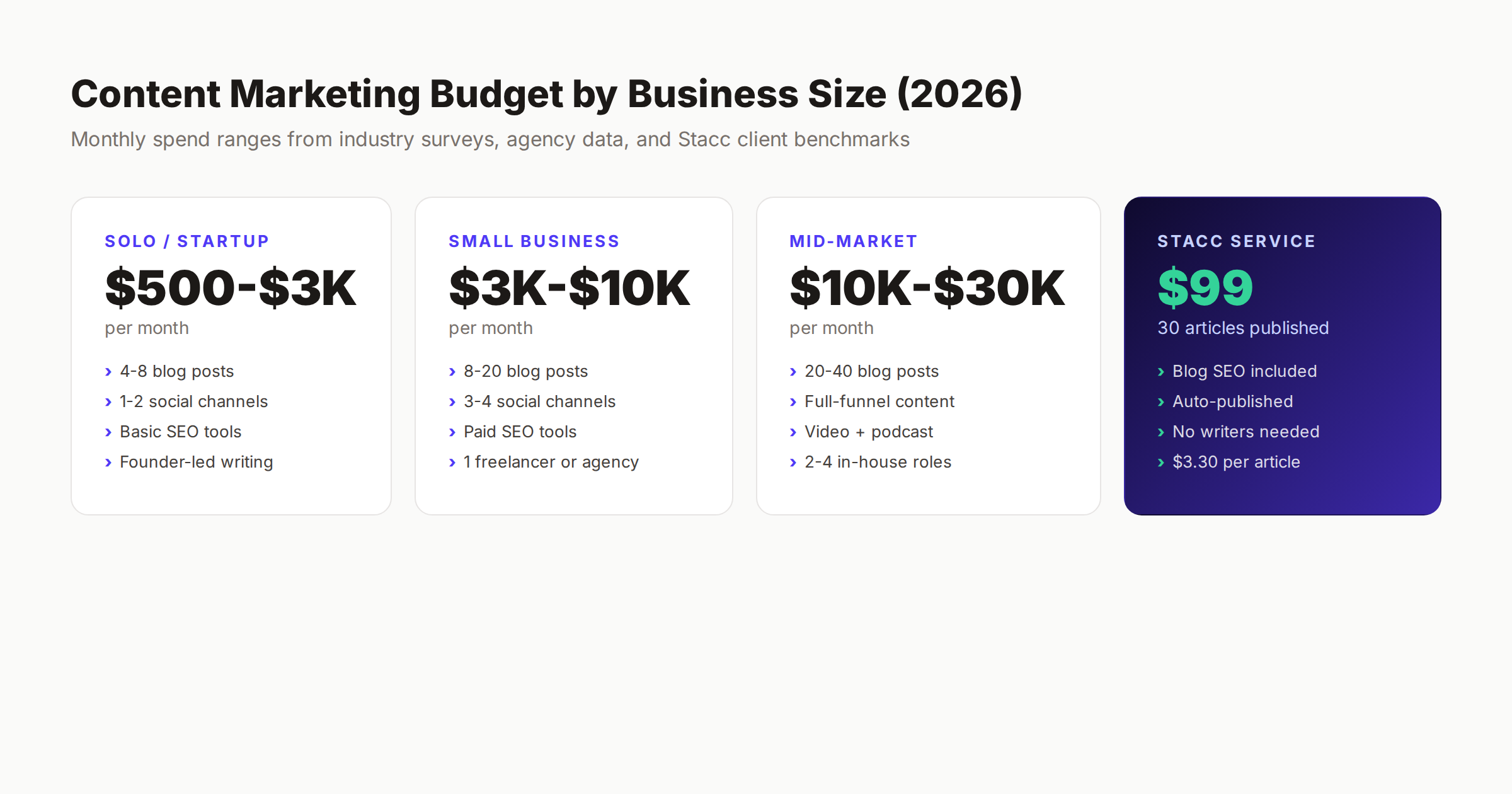
The most common budget brackets reported across the industry:
| Business Stage | Monthly Spend | Annual Spend | Typical Output |
|---|---|---|---|
| Pre-revenue startup | $0-$500 | $0-$6,000 | Founder writes, 2-4 posts/mo |
| Solo / very small | $500-$3,000 | $6,000-$36,000 | 4-8 posts, 1-2 social channels |
| Small business | $3,000-$10,000 | $36,000-$120,000 | 8-20 posts, full social, basic SEO |
| Mid-market | $10,000-$30,000 | $120,000-$360,000 | 20-40 posts, video, podcasts, paid promotion |
| Enterprise | $30,000-$60,000+ | $360,000-$720,000+ | 40+ posts, full-funnel, multi-channel, paid amplification |
These ranges align with survey data from The Digital Elevator, which found that 48% of companies spend under $5,000 a month, 24% spend $5,000 to $15,000, and 12% spend $15,000 to $25,000.
Where do these numbers come from? Three sources of cost drive every content budget: people (writers, editors, strategists), tools (SEO software, CMS, analytics), and distribution (paid social, sponsored content, email infrastructure). The mix changes as you scale.
The 4 Budget Allocation Models
There is no universal formula, but 4 frameworks dominate. Each one answers a different question about how you decide what to spend.
Model 1: Percent-of-Revenue
The most common framework. You allocate a fixed percentage of revenue to marketing, then split that across channels.
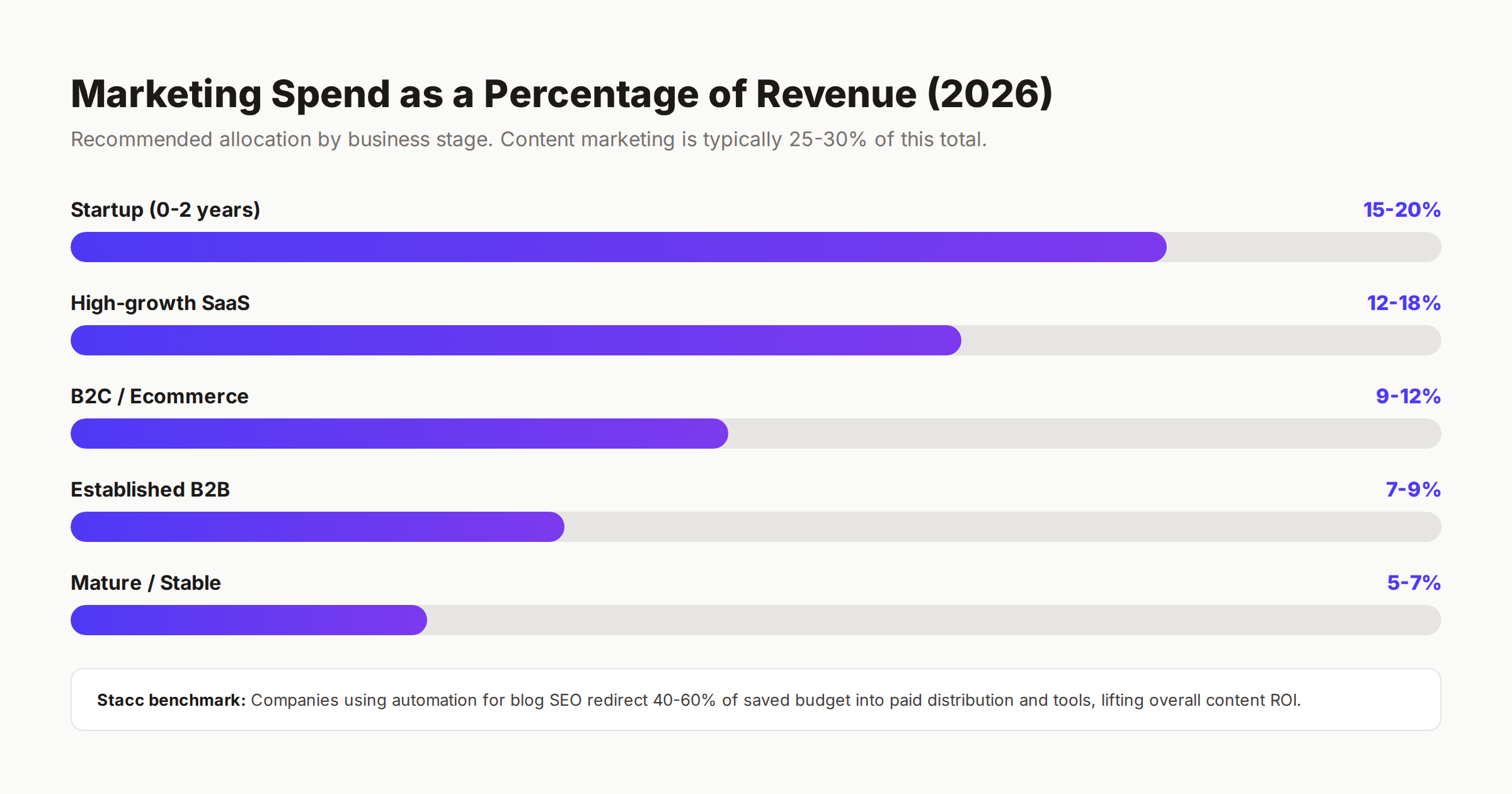
Standard guidance from the U.S. Small Business Administration and Gartner CMO Spend Survey data:
- Startups (0-2 years): 15% to 20% of revenue
- High-growth SaaS: 12% to 18% of revenue
- B2C / Ecommerce: 9% to 12% of revenue
- Established B2B: 7% to 9% of revenue
- Mature / stable: 5% to 7% of revenue
Within that marketing budget, content typically commands 25% to 30%. So a B2B SaaS company doing $5M in revenue spending 12% on marketing has a $600,000 marketing budget, with $150,000 to $180,000 dedicated to content marketing annually.
This model is easy to defend to a CFO. It is also easy to game. Companies cut marketing first when revenue dips, which is exactly when content compounding matters most.
Model 2: The 70-20-10 Rule
Made famous by Coca-Cola, Google, and IBM. You split your content spend across three risk buckets.
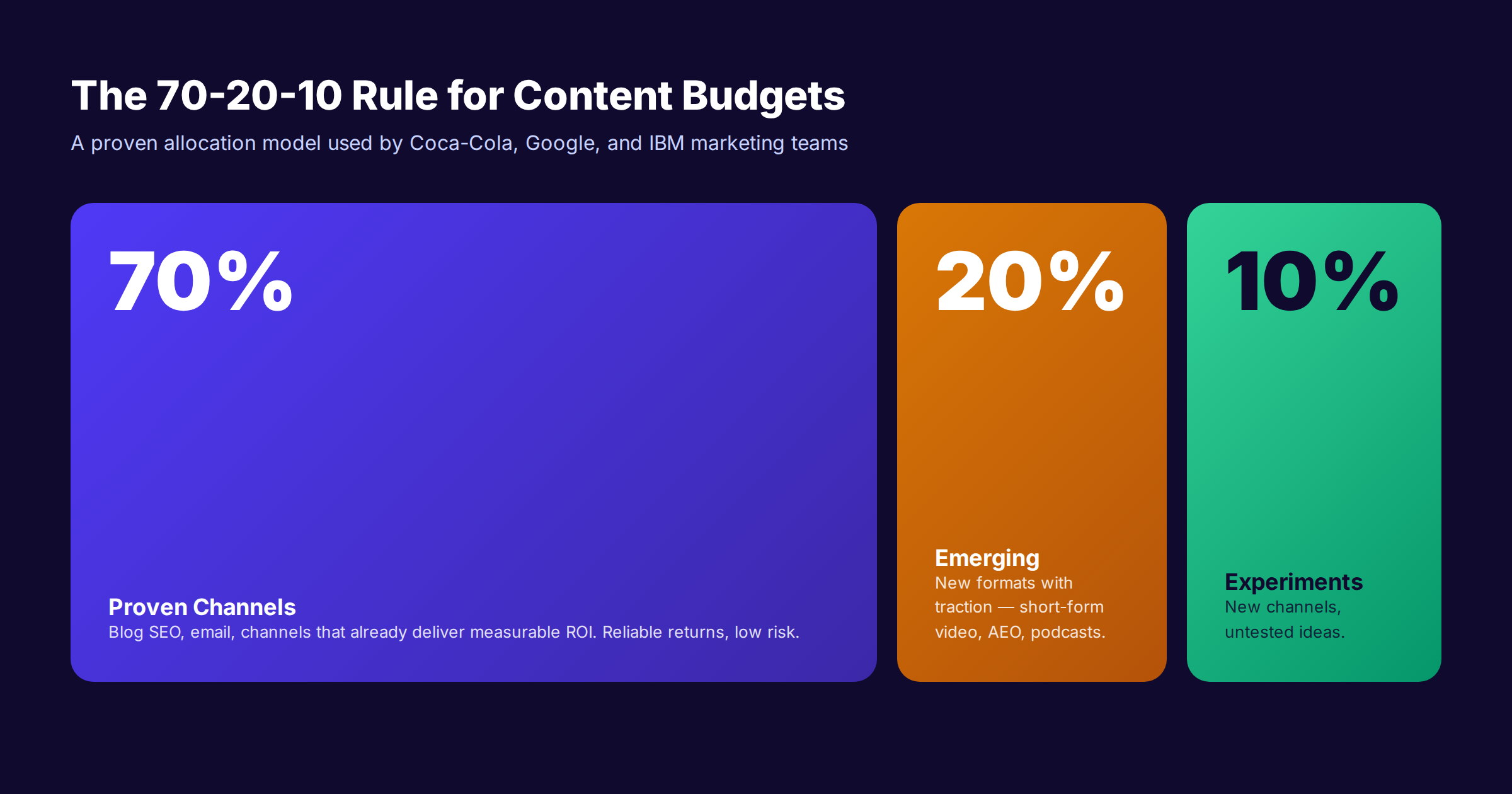
- 70% on proven channels. Blog SEO, email, formats and channels with measurable ROI history. Low risk, predictable returns.
- 20% on emerging formats. Short-form video, podcasts, AEO content, channels with traction but less data.
- 10% on experiments. New platforms, untested ideas, things that might fail or might compound.
The brilliance of this model is the discipline it forces. Without it, marketing teams either over-experiment (spreading thin across 8 channels) or under-experiment (riding one channel until it stops working).
A small business with a $5,000 monthly content budget would split it: $3,500 to blog and email (proven), $1,000 to video or podcast (emerging), $500 to one new experiment per quarter.
Model 3: The 3-3-3 Rule
A simpler framework for early-stage businesses. Spend equal thirds on creation, distribution, and analysis.
- 33% creating content. Writing, designing, producing, editing.
- 33% distributing content. Paid promotion, partnerships, email lists, social amplification.
- 33% analyzing and optimizing. Tracking what works, killing what does not, doubling down on winners.
Most companies spend 80% on creation and 10% on distribution. Then they wonder why their content never gets read. The 3-3-3 rule corrects this imbalance.
Model 4: Objective-Based Budgeting
You start with the outcome and work backwards. If you need to generate 200 organic leads per month at a $50 cost-per-lead, your content budget is $10,000.
This is the model used by data-driven marketing teams. It forces you to know your conversion rates, your cost-per-lead targets, and your channel ROI before you spend a dollar.
The challenge is that content marketing has a 6 to 12 month lag between investment and results. New companies do not have the data to model objective-based budgets. They have to fall back on percent-of-revenue or the 70-20-10 rule until enough data accumulates.
Where Your Content Budget Actually Goes
Every content marketing budget breaks down into 4 spending categories. The percentages vary by company stage, but the categories do not.
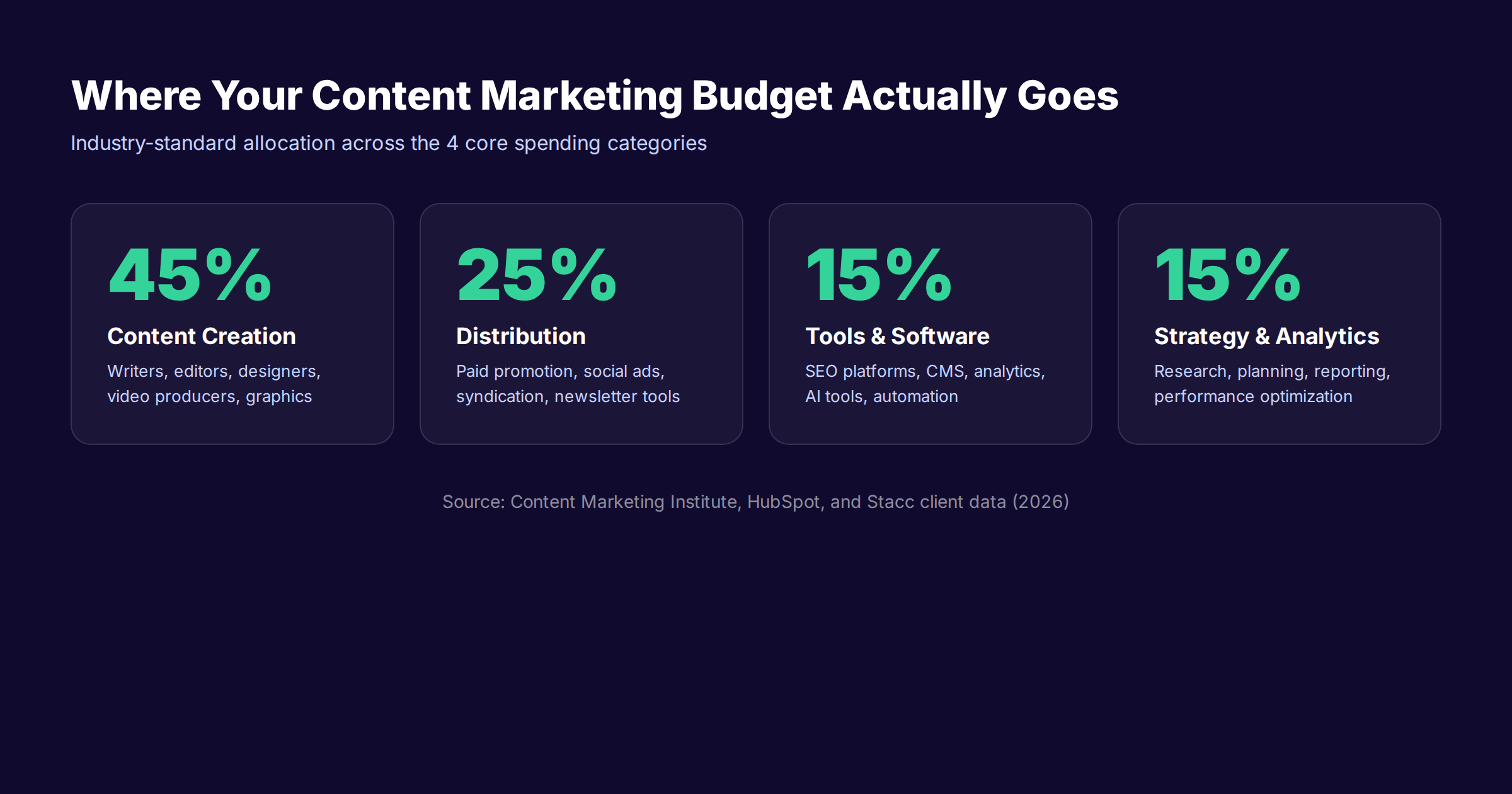
Content Creation (40-50% of budget)
The biggest line item. This covers everyone and everything involved in producing the content itself.
- Writers. In-house ($55K-$95K salary), freelancers ($150-$500/article), or agencies ($800-$2,500/article).
- Editors. Senior editors charge $75-$150/hour or $4,000-$8,000/month full-time.
- Designers. Graphics, infographics, social images. $50-$150/hour for freelancers.
- Video production. Equipment, editors, scripts. $500-$3,000 per finished video for SMBs.
- Photography. Stock subscriptions ($30-$80/mo) or custom shoots ($1,500-$5,000 per shoot).
A common mistake is to assume "content creation" means writing. It does not. The cost of writing is usually 40% of total content creation cost. Editing, design, and asset production account for the rest.
Distribution (20-30% of budget)
This is the line item most companies underfund. They produce 30 articles a month and then wonder why nobody reads them.
- Paid social amplification. $500-$5,000/month boosting top content.
- Sponsored content and syndication. $1,000-$10,000 per placement on industry sites.
- Newsletter sponsorships. $200-$2,000 per send depending on list size.
- Influencer partnerships. Highly variable. Micro-influencers $100-$1,000 per post.
- PR and outreach. $1,000-$5,000/month for ongoing campaigns.
Marketing Insider Group found that companies with the highest content marketing ROI spend 25% or more on distribution. The companies with the lowest ROI spend 5% or less.
Tools and Software (10-20% of budget)
Every content team needs a stack. The size of the stack depends on team size.
- SEO tools. Ahrefs ($129-$1,499/mo), Semrush ($139-$499/mo), or budget alternatives like our free keyword research tools roundup.
- CMS. WordPress ($0-$500/mo for hosting + plugins), Webflow ($23-$235/mo), HubSpot CMS ($25-$1,200/mo).
- Analytics. GA4 (free), Mixpanel ($25-$2,000/mo), attribution tools ($500-$5,000/mo).
- AI writing tools. Jasper, Copy.ai, Surfer ($29-$199/mo each).
- Project management. Notion, Asana, ClickUp ($10-$25/user/mo).
- Email service provider. Mailchimp, ConvertKit, Beehiiv ($30-$500/mo).
For more on building the right stack, see our breakdown of SEO tools for small business.
Strategy and Analytics (10-15% of budget)
The least visible spend but often the highest-impact. This is the work that determines whether the other 85% gets wasted.
- Strategy retainers. Fractional content strategists charge $3,000-$8,000/month.
- Audits. Content audits, technical SEO audits, competitor research. $2,000-$15,000 each.
- Training. Conferences, courses, certifications. $500-$5,000/year per team member.
- Research. Keyword research subscriptions, market research, customer interviews.
Companies that skip this category produce content nobody asked for. Companies that overinvest produce 90-page strategy decks and zero articles.
Content Marketing Budget by Business Type
Generic ranges only get you so far. Your real budget depends on your business type. Here are the benchmarks by category.
B2B SaaS
Highest content investment of any sector. Long sales cycles, technical buyers, and competitive keywords require depth.
| Stage | Monthly Budget | Output |
|---|---|---|
| Seed / Pre-Series A | $2,000-$8,000 | 4-8 posts, founder-led |
| Series A / B | $8,000-$25,000 | 12-25 posts, 1-2 in-house, paid amplification |
| Series C+ | $25,000-$80,000 | 30-60 posts, full team, video, paid distribution |
B2B SaaS companies often pay $1,500-$3,000 per article because the content requires technical accuracy. Pricing pages, integration guides, and comparison content all need product expertise.
Ecommerce / DTC
Higher volume, lower per-piece cost. Product pages, buying guides, and SEO landing pages are the workhorses.
| Stage | Monthly Budget | Output |
|---|---|---|
| <$1M revenue | $500-$3,000 | Product descriptions + 4-8 blog posts |
| $1M-$10M revenue | $3,000-$15,000 | Full catalog optimization + 15-30 blog posts |
| $10M+ revenue | $15,000-$50,000 | Video, lookbooks, editorial content, paid amplification |
The ecommerce difference is sheer volume. A 500-product store needs 500 optimized product pages plus category pages plus a content hub.
Local Service Businesses
The smallest budgets but often the highest ROI. Local intent is strong and competition is geographically limited.
| Business Type | Monthly Budget | Focus |
|---|---|---|
| Solo practitioner | $200-$1,000 | GBP, local landing pages, 4 posts/mo |
| Multi-location | $1,000-$5,000 | Each location's GBP, citations, 8-15 posts |
| Franchise / regional | $5,000-$20,000 | Multi-market SEO, paid local, 20+ posts |
Local SEO costs less because the keyword universe is smaller. A plumber in Tulsa does not compete with a plumber in Tampa. See our local SEO module for the full breakdown.
B2C / Consumer Brands
Distribution-heavy. The product is often simple; the differentiation is brand, story, and reach.
| Stage | Monthly Budget | Focus |
|---|---|---|
| Emerging brand | $1,000-$5,000 | Founder storytelling, social-first content |
| Established DTC | $5,000-$25,000 | Video, influencers, blog SEO, email |
| National brand | $25,000-$100,000 | Multi-platform content, paid promotion at scale |
B2C content is often visual-first, which means designer and video production costs run higher than B2B.
Spending $4,000+/month on a content agency for 8 blog posts? theStacc publishes 30 SEO articles every month for $99. No writers, no editors, no agency overhead. We are a service, not a tool.
The True Cost Per Published Article
Cost-per-article is the metric that exposes which production models actually work. Two companies can have identical $5,000 budgets and wildly different output.
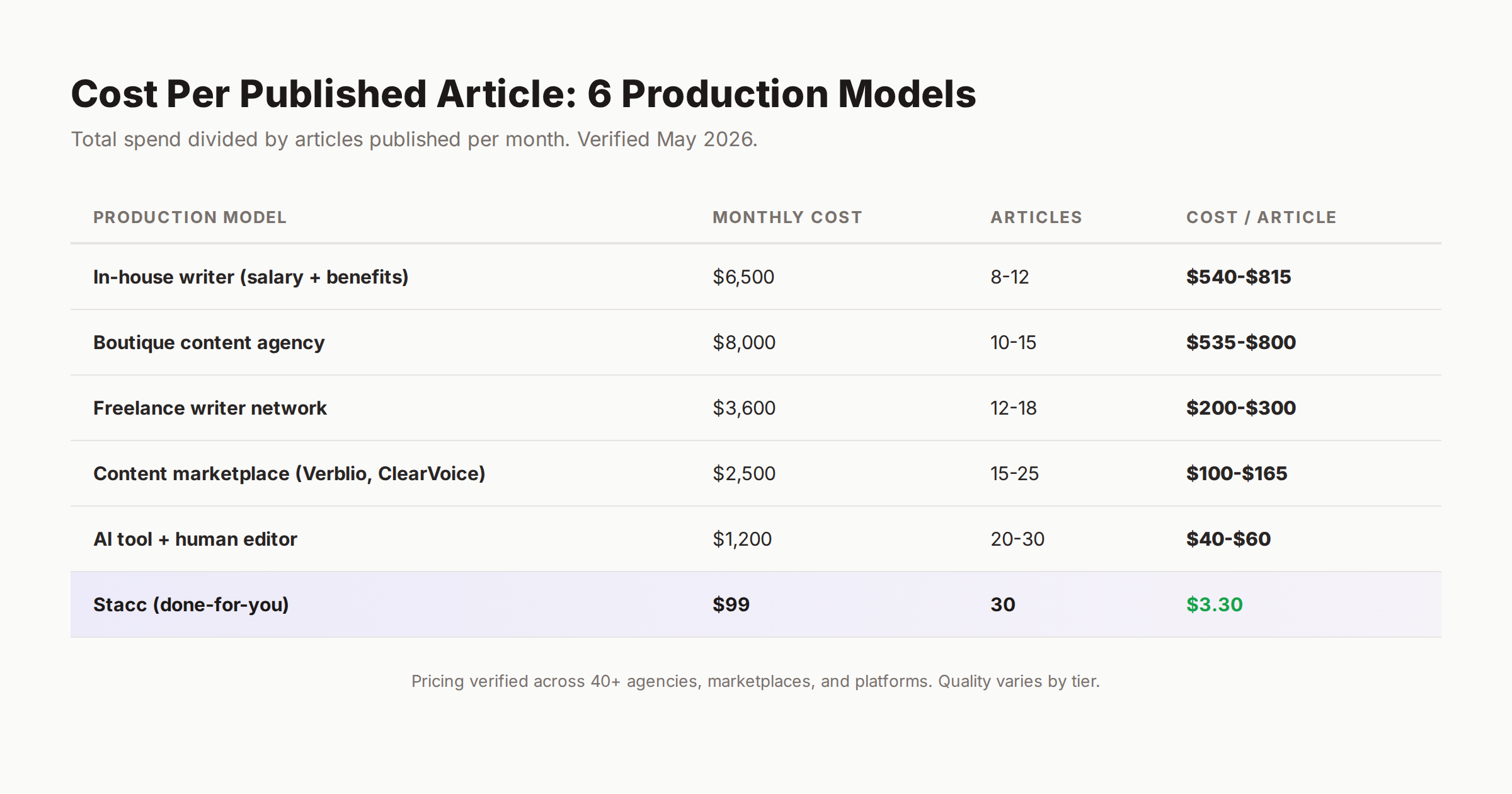
Here is what the math looks like across the most common production models.
| Production Model | Monthly Cost | Articles Output | Cost per Article |
|---|---|---|---|
| In-house writer (salary + benefits) | $6,500 | 8-12 | $540-$815 |
| Boutique content agency | $8,000 | 10-15 | $535-$800 |
| Freelance writer network | $3,600 | 12-18 | $200-$300 |
| Content marketplace (Verblio, ClearVoice) | $2,500 | 15-25 | $100-$165 |
| AI tool + human editor | $1,200 | 20-30 | $40-$60 |
| theStacc (done-for-you) | $99 | 30 | $3.30 |
These numbers come from actual SMB benchmarks, not list prices. An in-house writer earning $70,000 plus 25% benefits costs $87,500 a year, or $7,300 a month, to produce roughly 10 publishable posts.
Cost-per-article is not the only metric, but it is the most important one for budget planning. A $1,000 article that drives 500 organic visits a month is cheap. A $200 article that drives nothing is expensive. Quality, distribution, and SEO discipline determine the ROI, not the production cost in isolation.
For a deeper dive on production economics, see our breakdown of in-house vs outsourcing content teams.
Hidden Costs That Inflate the Real Number
The list-price cost is never the real cost. Three categories of hidden cost destroy content marketing budgets.
Management overhead. Every freelancer, agency, and tool requires management time. A marketing manager spending 10 hours a week managing 4 freelancers at $80/hour internal cost adds $3,200/month to the visible spend. This rarely shows up on the budget.
Revision cycles. Content agencies typically include 1 round of revisions. Most articles need 2-3. Each additional round costs $50-$300 in writer time or agency overage fees.
Tool sprawl. Companies sign up for 12 tools they use twice. SEO subscriptions, AI writing tools, project management apps, design tools. The average mid-market marketing team carries $1,500-$4,000/month in unused or underused tools.
Audit your stack quarterly. Cancel anything used less than weekly. The savings fund actual content.
How to Build Your Content Marketing Budget
A budget you cannot defend is a budget that gets cut. Build yours in this order.
Step 1: Set the Top-Line Number
Start with revenue and apply the percent-of-revenue framework. Take your annual revenue, multiply by 7-15% (based on your stage), then take 25-30% of that for content.
Example: A $2M revenue B2B company in growth stage.
- $2,000,000 × 12% marketing = $240,000 annual marketing budget
- $240,000 × 27% content = $64,800 annual content marketing budget
- $64,800 / 12 = $5,400 monthly content budget
This is your starting point. Adjust up if you are in a content-driven category (SaaS, ecommerce). Adjust down if you sell through partnerships or sales-led motion.
Step 2: Apply the 70-20-10 Split
Take your monthly number and split it across risk buckets.
Using the $5,400 example:
- 70% proven: $3,780/month on blog SEO and email
- 20% emerging: $1,080/month on video or podcasts
- 10% experimental: $540/month on one new channel per quarter
Step 3: Allocate by Category
Now split each bucket across the 4 spending categories (creation, distribution, tools, strategy).
The proven bucket ($3,780/month) might break down:
- $1,890 (50%) on content creation — writer + editor
- $945 (25%) on distribution — paid social + email infrastructure
- $567 (15%) on tools — SEO + CMS + analytics
- $378 (10%) on strategy — quarterly audits + research
Step 4: Map to Output Goals
Convert dollars to deliverables. With $1,890 for creation:
- 8 blog posts at $200/each = $1,600 (use a freelance network)
- $290 left for editing, graphics, formatting
This forces clarity. If your strategy requires 20 posts and your budget covers 8, something has to give: lower per-post cost, higher budget, or fewer posts.
Step 5: Build the Tracking System
A budget without tracking is wishful thinking. You need monthly tracking on 3 metrics: spend by category, output by category, and ROI by category.
For the ROI side, see our guide on how to measure content marketing ROI. Without this, you cannot defend the budget next quarter.
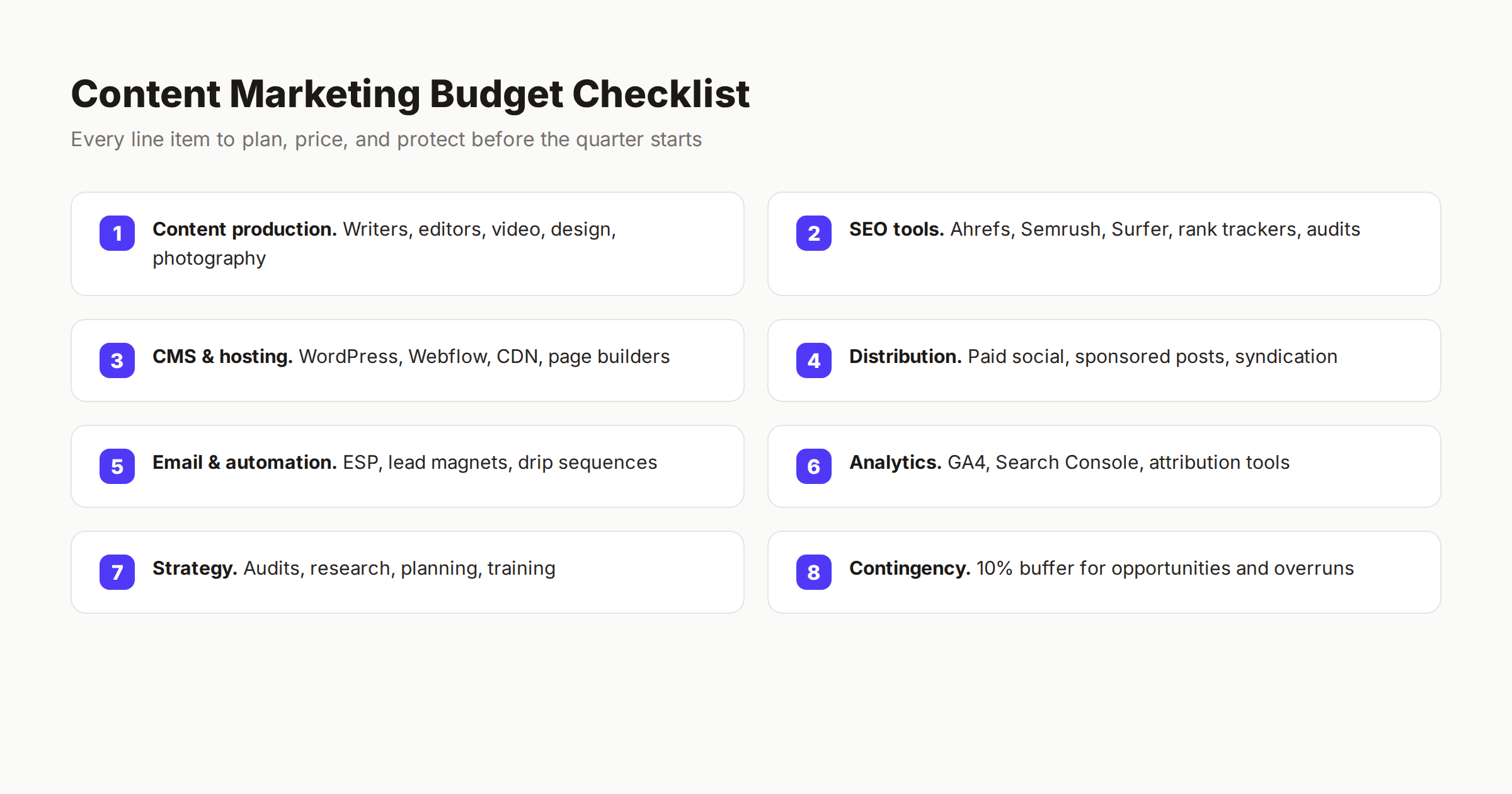
Common Budget Mistakes That Kill ROI
Most content marketing failures are budget allocation failures, not content failures. Avoid these patterns.
Mistake 1: Spending 90% on Creation, 10% on Everything Else
The most common mistake. You produce great content nobody reads because there is no budget for distribution, SEO tools, or analytics.
Rule of thumb: if your content-to-distribution ratio is worse than 70-30, you are publishing into a void.
Mistake 2: One Big Channel, Zero Backups
A team puts $10,000/month into LinkedIn organic. The algorithm changes. Reach drops 70%. Suddenly there is no plan B.
The 70-20-10 rule exists for this reason. The 20% bucket is your insurance policy.
Mistake 3: Confusing Cheap with Affordable
A $50 article that needs 6 hours of editing is more expensive than a $300 article that ships clean. Calculate total cost including management time, not just the invoice.
This is why we built theStacc. Articles arrive published, optimized, and on-brand. Internal management time approaches zero.
Mistake 4: No Quarterly Audit
Budgets drift. Tools accumulate. Freelancers underdeliver. Without a quarterly review, your budget becomes 40% legacy spend you cannot explain.
Schedule a 90-minute audit every quarter. Cancel, renegotiate, or replace anything that does not earn its line item.
Mistake 5: Treating Content as a Cost Center
Companies that hit content compounding stop treating the budget as expense and start treating it as investment. They track organic traffic, leads, and revenue attribution by month. The numbers force the budget conversation upstream.
Companies stuck in "content as cost" mode cut the budget the moment quarterly revenue dips. They never compound. They never rank.
In-House vs. Agency vs. Automation: The Budget Math
The choice between production models is a budget decision. Here is what each model looks like at scale.
In-House Content Team
The expensive option. Best for companies with strong product expertise and long-term content commitments.
- Content marketer. $65,000-$95,000/year + 25% benefits = $81,250-$118,750
- Content writer. $55,000-$80,000/year + 25% benefits = $68,750-$100,000
- SEO specialist. $70,000-$110,000/year + 25% benefits = $87,500-$137,500
- Designer (shared). $45,000-$75,000/year × 0.5 FTE = $22,500-$37,500
- Tools and overhead. $3,000-$6,000/month = $36,000-$72,000/year
Total annual cost for a 3-person in-house team: $296,000-$465,750. Monthly: $24,667-$38,813. Output: 25-40 articles per month plus other deliverables.
Mid-Tier Content Agency
The middle ground. Predictable, professional, but expensive per piece.
- Retainer. $4,000-$15,000/month
- Typical output. 8-15 articles/month
- Strategy hours. 5-10/month included
- Account management. Built in
- Tool costs. Sometimes included, sometimes passed through
Total monthly cost: $4,000-$15,000. Cost per article: $400-$1,500.
Freelance Network
The flexible option. Requires significant management but allows speed and scale.
- 3-5 freelance writers. $200-$500/article × 8-15 articles = $1,600-$7,500
- Editor. Either in-house or freelance ($50-$100/hour × 20 hours = $1,000-$2,000)
- Tools. $400-$800/month
- Management time. 20-40 hours/month from an internal manager
Total monthly cost: $3,000-$10,000. Cost per article: $300-$700 when management time is counted.
Done-for-You Automation (theStacc)
The newest model. Articles arrive published, optimized, and on-brand without writers or agency overhead.
- theStacc subscription. $99/month
- Output. 30 articles published
- Cost per article. $3.30
- Management time. Near zero
- Tools included. SEO, keyword research, publishing, internal linking
Total monthly cost: $99. The math is not subtle. If you are spending $4,000+ to get 8 articles per month, theStacc gets you 30 articles for a fraction. For deeper exploration, see content marketing agency alternatives.
Industry Benchmarks: What Top Performers Spend
The companies winning at content marketing spend differently. CMI's 2026 B2B research and the HubSpot State of Marketing report reveal clear patterns.
Top performers spend 40-50% more on content than their peers. But they spend it differently.
| Spending Category | Top Performers | Average Performers |
|---|---|---|
| Content creation | 38% | 52% |
| Distribution and amplification | 27% | 14% |
| Tools and software | 17% | 12% |
| Strategy, research, analytics | 18% | 9% |
| Internal team training | Higher | Lower |
The pattern: top performers spend less on creation as a percentage and more on distribution, tools, and strategy. They understand that producing content is the cheap part. Getting it read, ranked, and measured is the expensive part.
This is why companies that switch to automation for content production often see their ROI increase. They redirect the saved budget into distribution and analytics, where the return per dollar is higher.
The Content Compound Effect: Why Long-Term Budgets Win
Content marketing has a counterintuitive math problem. Short-term spending shows little ROI. Long-term spending compounds.
The data is consistent across every major study. Ahrefs research shows that a single blog post takes an average of 8-9 months to reach peak organic traffic. HubSpot's own data shows that 76% of total blog traffic comes from posts older than 6 months.
This creates a budget paradox. The companies that cut content budgets when results are slow never see the compounding. The companies that maintain budgets through the 12-month ramp see traffic, leads, and revenue accelerate after year 1.
Practically, this means your content marketing budget should be planned in 12-month commitments, not quarterly. Quarterly budgeting forces tactical decisions that kill long-term assets.
We have client cases where the same blog post we wrote in month 3 became their #1 lead driver in month 14. If the budget had been cut in month 6, that asset never gets built.
How theStacc Changes the Budget Math
Most of this guide describes how to build a content budget under traditional production constraints. theStacc breaks the constraints.
The traditional math. To publish 30 articles per month, you need either an in-house team ($25,000+/month), a mid-tier agency ($8,000-$15,000/month), or a freelance network ($4,000-$8,000/month plus management).
theStacc's math. Articles arrive published, optimized for SEO, internally linked, and on-brand for $99/month.
This is not a tool that helps you write faster. We are a service. We handle keyword research, draft generation, editing, internal linking, image generation, and publishing directly to your CMS. The articles ship without you writing them.
For businesses currently spending $4,000+ on content production, the switch redirects 80-95% of budget into other categories: paid distribution, video production, podcast equipment, conversion rate optimization, customer research. The total marketing impact grows even as the content line item shrinks.
For businesses currently spending nothing, theStacc adds a content engine at a price point that fits any budget. The $99 entry is cheaper than most teams' Notion subscription.
For agencies and consultants, theStacc handles the production layer so the agency can focus on strategy, distribution, and reporting. The same client pays the same retainer, the agency margin expands.
See the pricing page for full details, or Sign up for free →
What practitioners are saying on X
AI search advice ages quickly. Here is high-signal public discussion from SEO and growth operators — context for your roadmap, not a substitute for primary data.
- @varunram (Jul 2026): Critique of GEO slopfarm products that combine SEO clickbait with unresearched content marketing — quality and research still separate winners from farms. See the post on X.
- @jakezward (Feb 2026): 2026 SEO predictions emphasize AI Overview share-of-SERP, schema for LLM token efficiency, brand mentions in AI answers as a KPI, proprietary data as a moat, and content refresh beating net-new AI slop. See the post on X.
- @HlynurStefDev (Jul 2026): Public case: niche site traffic jumped from ~18 to 4,162 Google visits/month after focused technical/on-page SEO work (GSC screenshots claimed) — reminds that fundamentals still move numbers. See the post on X.
Grok, AI Overviews, and multi-engine visibility
Content topics like “content marketing budget” get AI citations when process steps, quality bars, and examples are concrete. Operator consensus on X is clear: research-backed pages beat unedited bulk generation — reflect that honestly.
- Google AI Overviews: Use passage-ready answers, tables, and FAQ schema where relevant.
- ChatGPT / Perplexity: Cite named sources next to key claims.
- Grok: Maintain accurate entity facts on-site and in high-signal X posts.
Frequently Asked Questions
The 70-20-10 rule allocates 70% of your content marketing budget to proven channels (blog SEO, email), 20% to emerging formats (video, podcasts, AEO), and 10% to experiments (new platforms, untested ideas). It was popularized by Coca-Cola and is now used by Google, IBM, and most enterprise marketing teams. The rule forces discipline around what to test versus what to scale.
The 3-3-3 rule splits your content budget equally across three categories: 33% on creation, 33% on distribution, and 33% on analysis and optimization. It exists to correct the common mistake of overspending on content creation and underfunding the distribution and analytics needed to make content actually work. It is most useful for early-stage businesses building their first content marketing system.
Small businesses typically spend $500 to $10,000 per month on content marketing. The right number depends on revenue, industry, and stage. A common benchmark is 7-12% of annual revenue on total marketing, with 25-30% of that allocated to content. For a $500K revenue business, that works out to $1,000-$1,500 per month on content marketing.
The 7 pillars of marketing typically refers to product, price, place, promotion, people, process, and physical evidence — also called the 7 Ps of marketing. When applied to budgeting, each pillar requires its own line items. Most content marketing budgets sit within "promotion" but draw resources from "people" (writers, editors) and "process" (tools, workflows).
Yes, when measured over 12+ months. Content marketing costs 62% less than outbound marketing and produces 3x the leads per dollar according to Demand Metric. The catch is the 6-12 month ramp. Companies that cut content budgets within the first 12 months almost never see the ROI. Companies that maintain consistent investment see compounding returns after year 1. For tracking guidance, see how to measure content marketing ROI.
Content marketing agencies charge $4,000 to $15,000 per month for mid-tier service, and $15,000 to $50,000+ per month for enterprise engagements. Boutique agencies serving small businesses can run as low as $2,000 per month. See our full breakdown in the real cost of a marketing agency. Most agencies deliver 8-15 articles per month at this price point.
You can produce content yourself for free, but the time cost is real. A founder writing 4 posts per month spends 20-30 hours of their own time, which is the most expensive labor in any business. Free tools like Google Search Console, ChatGPT free tier, and WordPress.com cover the basics, but you cap your output at what one person can produce. See our free SEO tools roundup for the starter stack.
Hire in-house when content is core to your competitive moat (think SaaS companies whose product education needs deep expertise). Outsource when content is supporting a sales or product motion that does not require unique knowledge. For most small and mid-market companies, a hybrid model works best: in-house strategist plus outsourced production. See our full comparison: in-house vs outsource content team.
The Bottom Line on Content Marketing Budgets
Content marketing budgets are not about how much you spend. They are about what you spend it on and how disciplined you are over time.
The companies that win allocate 25-30% of marketing budget to content, split it across the 70-20-10 risk buckets, spend 25%+ on distribution (not just creation), and commit to 12-month minimums. The companies that lose either underfund the category or pour money into production while starving distribution.
theStacc's model exists because the traditional math is broken for most businesses. Spending $5,000 a month to publish 10 articles is not a strategy. Spending $99 a month to publish 30 articles, then redirecting the saved $4,901 into paid distribution and conversion optimization, is.
If you want to see the math on your own business, Sign up for free → First 3 articles free, no credit card.
See your content engine running in 3 days
This article was researched and published by theStacc — the same service businesses use to publish SEO content automatically. We have published 3,500+ articles across 70+ industries. All cost data was verified against industry sources and current vendor pricing as of May 2026.
Related Reading
- How Much Does a Marketing Agency Cost in 2026?
- Content Marketing Statistics: 50+ Data Points
- How to Measure Content Marketing ROI
- In-House vs Outsource Content Team: The Decision Framework
- Content Marketing Strategy: The Complete Playbook
- Best Content Marketing Agency Alternatives
Related Tools & Resources
Free SEO Tools:
Best Lists:
Sources & references
- [1] Princeton / Georgia Tech et al. — GEO research (arXiv:2311.09735)
- [2] @varunram on X — Critique of GEO slopfarm products that combine SEO clickbait with unresearched content marketing — quality and research
- [3] @jakezward on X — 2026 SEO predictions emphasize AI Overview share-of-SERP, schema for LLM token efficiency, brand mentions in AI answers
- [4] @HlynurStefDev on X — Public case: niche site traffic jumped from ~18 to 4,162 Google visits/month after focused technical/on-page SEO work (G
- [5] Referenced source — www.siegemedia.com

Plan topics, review article drafts, and publish to a connected CMS.
Weekly local SEO teardowns
One practical email a week. Map Pack, GBP, AI Overviews. No fluff. Unsubscribe anytime.