The complete email marketing guide for law firms. Newsletter templates, automation, compliance rules, and ROI data. Updated March 2026.
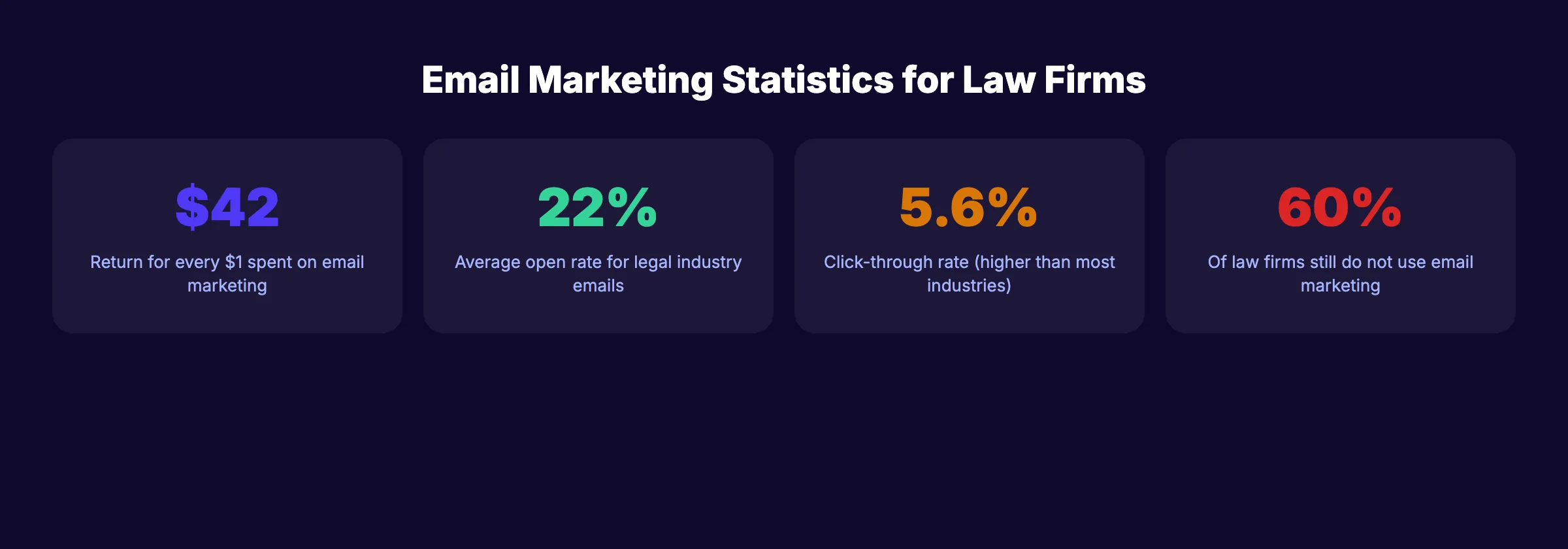
Email marketing generates $42 for every $1 spent. That is the highest ROI of any marketing channel. Yet 60% of law firms do not use email marketing at all. The firms that do enjoy a 22% average open rate, higher than most industries, and a 5.6% click-through rate that outperforms nearly every other sector.
Email marketing for law firms is not about blasting promotions. It is about staying top of mind with past clients, nurturing consultation leads who did not retain immediately, and positioning your firm as the authority in your practice area. When a former client's friend needs a lawyer, the firm that has been sending useful monthly updates gets the referral.
This guide covers everything law firms need to build an email marketing system that generates referrals, retains clients, and drives new business.
We have published 3,500+ blog posts across 70+ industries. This guide draws from our experience creating content systems for professional services firms.
Here is what you will learn:
- Why email marketing works better for law firms than most industries
- The 6 essential email types every firm should send
- How to build your email list ethically
- Newsletter content that clients actually read
- Automation sequences that nurture leads into retained clients
- Compliance rules every attorney must follow
Why Email Marketing Works for Law Firms
Law firms operate on trust and relationships. Email is the only marketing channel that lets you maintain 1-to-1 communication with hundreds or thousands of contacts simultaneously.
The Numbers
- $42 return for every $1 spent on email marketing across industries. Legal services often exceed this due to high case values.
- 22% average open rate for legal emails. Higher than retail (15%), technology (17%), and healthcare (19%).
- 5.6% click-through rate for legal emails. The cross-industry average is 2.6%.
- 72% of law firms use client email alerts. Only 41% send newsletters. The gap is an opportunity.
Why Email Outperforms Other Channels for Lawyers
Versus social media: Email reaches the inbox directly. Social media posts reach 5% to 10% of followers organically. Email open rates of 22% mean 4x more visibility per message.
Versus paid ads: Google Ads for legal keywords cost $50 to $200+ per click. A monthly newsletter costs pennies per contact and generates referrals that cost nothing.
Versus referral networks: Referrals still matter. Email amplifies them. A former client who receives your monthly newsletter remembers your name when a friend asks "do you know a good lawyer?"
Versus SEO: SEO and email work together. Blog content drives organic traffic. Email nurtures those visitors into clients. See our law firm SEO guide for the SEO side of this equation.
Your SEO team. $99/month. 30 optimized articles published automatically. Content for your newsletter included.
The 6 Essential Email Types for Law Firms
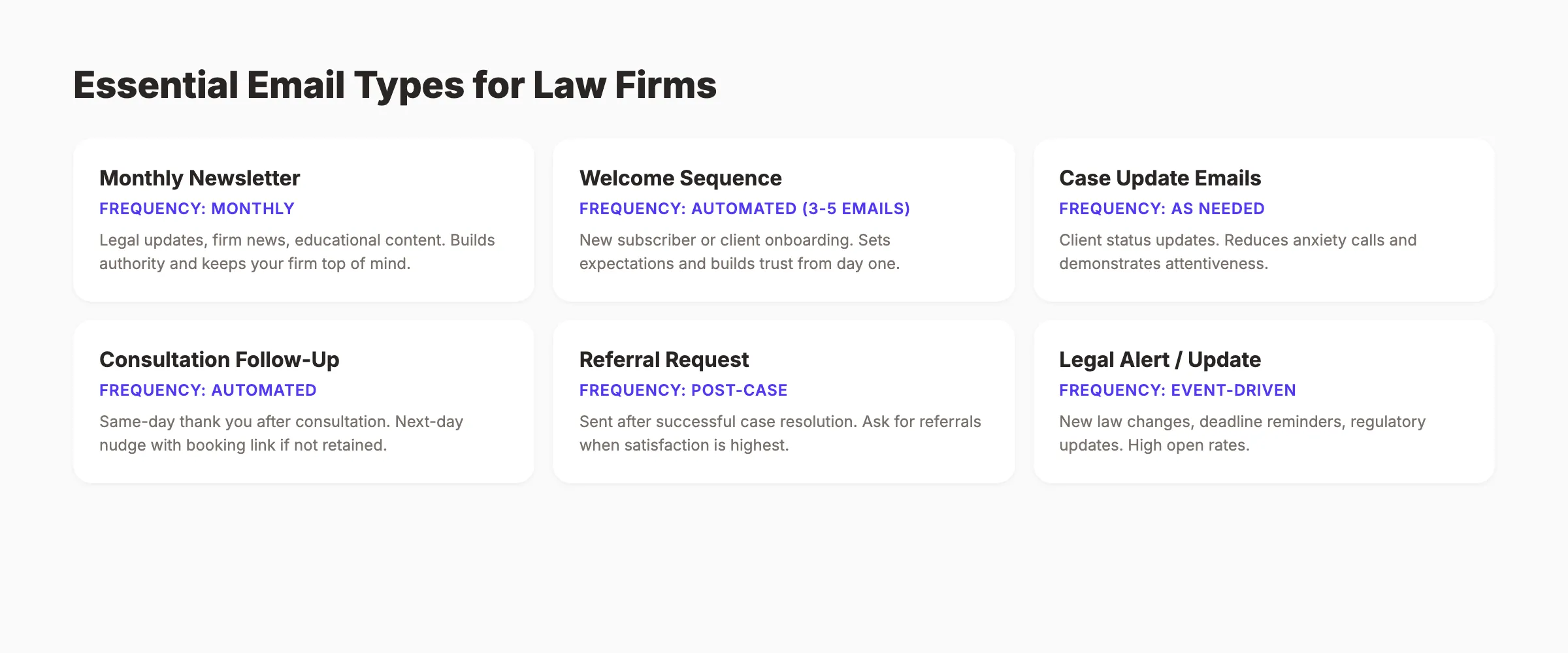
Most law firms send one type of email: the monthly newsletter. That covers only 1 of the 6 email types that a complete email strategy requires.
1. Monthly Newsletter
The foundation of law firm email marketing. Send once per month. Include 2 to 3 educational articles, firm news, and one clear CTA. Keep it under 600 words total.
What to include:
- A lead article explaining a recent legal change or ruling
- A practical tip relevant to your practice area
- A client success story (anonymized if necessary)
- A CTA: "Schedule a consultation" or "Share this with someone who needs help"
Subject line examples:
- "3 Estate Planning Mistakes That Cost Families Thousands"
- "New [State] Employment Law: What Employers Need to Know"
- "Tax Season Checklist for Small Business Owners"
2. Welcome Sequence (Automated)
When someone subscribes to your list or requests a consultation, send a 3 to 5 email welcome sequence over 7 to 14 days.
| Timing | Content | |
|---|---|---|
| 1 | Immediately | Welcome + what to expect from your emails |
| 2 | Day 3 | Educational content about your practice area |
| 3 | Day 7 | Client success story or testimonial |
| 4 | Day 10 | Helpful resource (checklist, guide, FAQ) |
| 5 | Day 14 | Soft CTA: "Ready to talk? Schedule a consultation" |
3. Consultation Follow-Up (Automated)
After a consultation that does not convert immediately, send a 3-email sequence:
- Same day: "Thank you for meeting with us. Here is a summary of what we discussed."
- Day 3: "Here is a resource that addresses your situation: [relevant blog post or guide]."
- Day 7: "We are here when you are ready. Schedule a follow-up at [booking link]."
4. Case Update Emails
For active clients, send milestone emails throughout the case. These reduce anxiety calls and demonstrate attentiveness.
- Case opened confirmation
- Key filing or hearing date reminders
- Status updates after major milestones
- Case resolution summary
5. Legal Alert / Update Emails
When a law changes, a deadline approaches, or a regulatory update affects your clients, send a targeted alert. These emails earn the highest open rates because they deliver timely, relevant value.
Example: "New IRS Deadline Extension: What Small Businesses Need to Know by April 15"
6. Referral Request Emails
Send 7 to 14 days after a successful case resolution when client satisfaction is highest:
"Thank you for trusting [Firm Name] with your case. If you know anyone facing a similar situation, we would appreciate the referral. [Forward this email or share our contact information.]"
Keep it short. Make sharing effortless. Include a link to your Google reviews page to earn a review at the same time. See our guide on getting more Google reviews.
How to Build Your Email List Ethically
Law firms face stricter list-building rules than most businesses. You cannot buy email lists. You cannot cold-email potential clients in most states. Every subscriber must opt in.
Ethical List-Building Methods
- Website contact forms. Add an email signup to your website footer, blog sidebar, and contact page. Offer a lead magnet (free checklist, guide, or FAQ) in exchange for the email.
- Consultation intake forms. Add a checkbox: "Yes, I would like to receive legal updates and firm news." Make it opt-in, not opt-out.
- Blog content upgrades. Offer downloadable resources (checklists, templates, guides) within blog posts. Readers provide their email to download.
- Event and webinar registrations. Host free legal education webinars. Attendees join your email list through registration.
- Social media. Promote your newsletter on LinkedIn, Facebook, and your Google Business Profile. Direct followers to a signup page.
- Client intake process. Add email consent to your standard intake paperwork.
What NOT to Do
- Never buy email lists. Purchased lists violate CAN-SPAM and bar ethics rules. They destroy deliverability.
- Never add people without consent. Meeting someone at a networking event does not mean they consented to marketing emails.
- Never send unsolicited emails to accident victims. Most state bars prohibit direct solicitation.
- Never scrape emails from websites or directories.
List Hygiene
Clean your list every 6 months. Remove subscribers who have not opened an email in 12 months. A smaller, engaged list outperforms a large, disengaged one. High bounce rates and low open rates damage your sender reputation.
3,500+ blogs published. Every article is SEO-scored before publish. See what theStacc can do for your law firm.
Newsletter Content That Clients Actually Read
Most law firm newsletters are boring. Dense legal language, firm announcements nobody cares about, and generic "we are here to help" messaging. The firms with high open rates do something different.
The 80/20 Content Rule
80% of your newsletter should educate, inform, or help the reader. 20% can promote your services. Flip this ratio and watch your unsubscribe rate climb.
Content Ideas by Practice Area
| Practice Area | Newsletter Topics |
|---|---|
| Family Law | "5 Things to Know Before Filing for Divorce in [State]" |
| Personal Injury | "What to Do in the First 48 Hours After a Car Accident" |
| Estate Planning | "3 Estate Planning Documents Every Parent Needs" |
| Business Law | "New [State] LLC Laws: What Changed This Year" |
| Criminal Defense | "Your Rights During a Traffic Stop: A Quick Guide" |
| Immigration | "Visa Processing Timeline Updates for [Year]" |
| Employment Law | "Can Your Employer Fire You for Social Media Posts?" |
| Real Estate | "Closing Cost Breakdown: What Buyers Pay in [State]" |
Subject Line Formulas That Get Opens
- Number + outcome: "5 Mistakes That Void Your Home Insurance Claim"
- Question: "Are You Paying Too Much in Property Taxes?"
- Deadline urgency: "New Filing Deadline: Act Before March 31"
- Local relevance: "[City] Zoning Changes: What Property Owners Need to Know"
Personalized subject lines (including the recipient's first name) increase open rates by 50%.
Format Guidelines
- Under 600 words total. Lawyers tend to over-write. Shorter emails get read.
- 1 to 3 short articles. Each under 200 words with a "Read more" link.
- Mobile-friendly design. 71% of email opens happen on mobile devices.
- Clear CTA. One primary call to action per email. Not 5.
- Plain text option. Some email clients strip HTML. A plain-text fallback ensures readability.
For help creating consistent content, see our content calendar guide.
Email Automation for Law Firms
Automation sends the right email at the right time without manual effort. Every law firm should automate at least 3 workflows.
1. New Subscriber Welcome
Trigger: Someone joins your email list. Sequence: 3 to 5 emails over 14 days introducing your firm, delivering value, and inviting a consultation.
2. Missed Consultation Follow-Up
Trigger: Someone books or attends a consultation but does not retain. Sequence: 3 emails over 7 days with a case summary, helpful resource, and soft follow-up CTA.
3. Post-Case Referral and Review
Trigger: Case closes successfully. Sequence: Thank-you email at day 7, referral request at day 14, Google review request at day 21.
Email Platforms for Law Firms
| Platform | Best For | Starting Price |
|---|---|---|
| Mailchimp | Small firms, easy setup | Free (500 contacts) |
| Constant Contact | Firms needing templates | $12/month |
| ActiveCampaign | Advanced automation | $29/month |
| HubSpot | CRM integration | Free (basic) |
| Clio Grow | Built for law firms | Varies by plan |
Choose a platform with CAN-SPAM compliance built in (all of the above include this).
Segmentation Strategies
Segmented email campaigns generate up to 760% more revenue than non-segmented sends. Segment your list by:
- Practice area. Personal injury clients receive different content than estate planning clients.
- Client status. Active clients, past clients, and prospects need different messaging.
- Geographic location. If you serve multiple areas, tailor content to local laws and events.
- Engagement level. Highly engaged subscribers receive more frequent communication. Inactive subscribers receive re-engagement campaigns.
The minimum viable segmentation is practice area plus client status. Even splitting your list into "current clients" and "past clients/prospects" dramatically improves relevance and engagement.
Compliance: Email Rules Every Attorney Must Follow
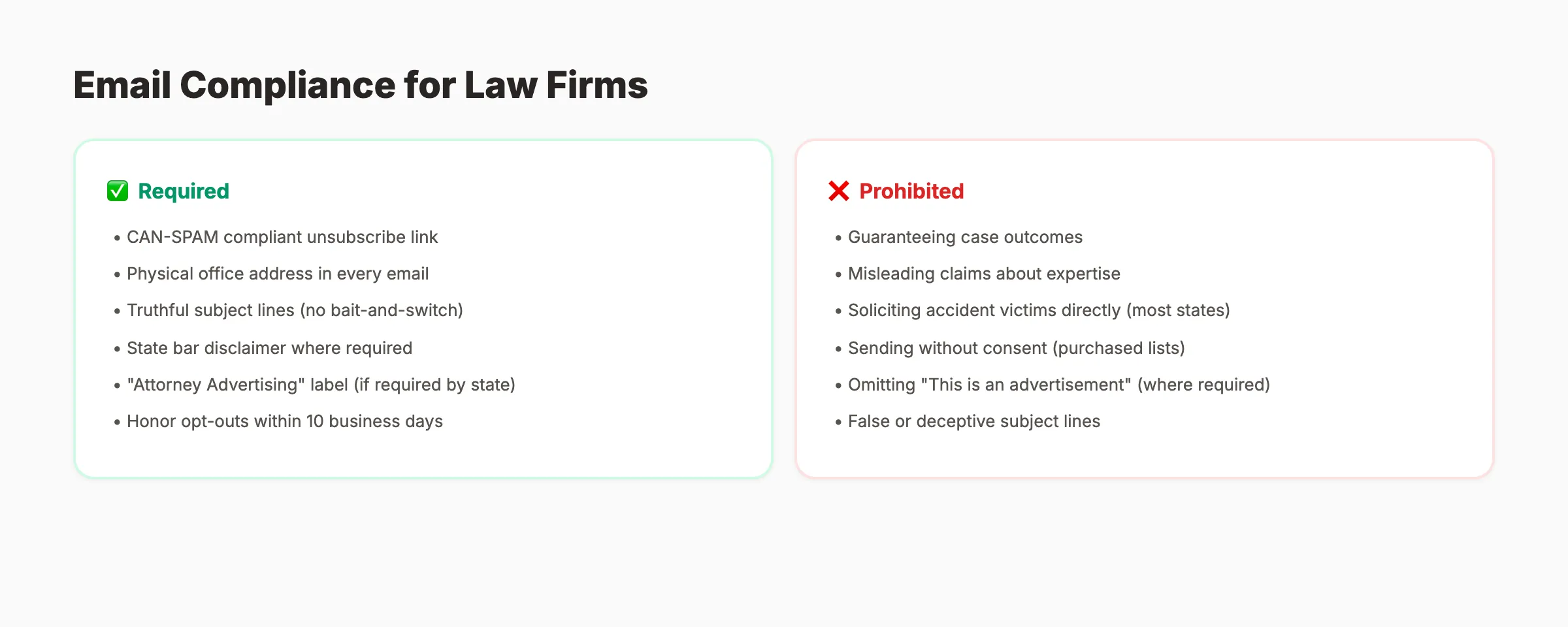
Law firm email marketing is subject to both federal regulations (CAN-SPAM Act) and state bar ethics rules. Violations can result in fines, bar complaints, and damaged reputation.
CAN-SPAM Requirements
Every marketing email must include:
- ✓ A clear, accurate "From" name and email address
- ✓ A truthful, non-deceptive subject line
- ✓ Your firm's physical office address
- ✓ A visible unsubscribe link that works
- ✓ Opt-out requests honored within 10 business days
State Bar Ethics Rules
ABA Model Rules 7.1 through 7.3 govern attorney advertising and solicitation. Key requirements:
- ✓ No false or misleading claims about your services or results
- ✓ No guarantees or predictions of case outcomes
- ✓ Include "Attorney Advertising" or "This is an advertisement" where required by your state
- ✓ Include your state bar number where required
- ✓ Do not directly solicit accident or disaster victims (varies by state)
- ✓ Keep copies of all marketing materials for your state's required retention period
Best Practices for Staying Compliant
- Review your state bar's specific advertising rules. They vary significantly between states.
- Have a compliance partner review your email templates before launching.
- Archive every email sent. Many states require retention for 1 to 3 years.
- When in doubt, keep content educational. Educational content about legal topics rarely triggers ethics concerns. Specific claims about your expertise or case outcomes do.
Rank everywhere. Do nothing. Blog SEO, Local SEO, and Social on autopilot. theStacc starts at $49/mo.
Measuring Email Marketing Performance
Track these metrics monthly to optimize your email marketing.
| Metric | Benchmark | What It Tells You |
|---|---|---|
| Open rate | 22% (legal industry average) | Subject line effectiveness |
| Click-through rate | 5.6% | Content relevance and CTA strength |
| Unsubscribe rate | Under 0.5% per send | List quality and content value |
| Bounce rate | Under 2% | List hygiene health |
| Consultation bookings | Track by source | Direct ROI measurement |
| Referral attribution | Ask new clients "how did you hear about us?" | Newsletter's referral impact |
Improving Performance
- Low open rate: Test different subject lines. Use personalization. Send on Tuesday or Thursday mornings.
- Low click-through rate: Make CTAs more specific. "Schedule a free estate planning review" outperforms "Contact us."
- High unsubscribe rate: Reduce frequency. Increase educational content. Reduce promotional content.
- Low referral attribution: Add a forward-to-a-friend link in every newsletter. Make referrals effortless.
A/B Testing for Law Firms
Test one variable at a time per email send:
- Subject lines: Test 2 versions on 20% of your list. Send the winner to the remaining 80%.
- Send times: Test Tuesday morning versus Thursday morning. Most legal emails perform best between 9 AM and 11 AM.
- CTA placement: Test a button CTA at the top versus the bottom of the email.
- Content format: Test a single-article newsletter versus a 3-article digest.
Track results for 3 months. Small improvements in open rate and click-through compound into significant ROI gains over a year of monthly sends.
What practitioners are saying on X
Marketing systems still win. Here is operator signal from X on SEO stacks and fundamentals.
- @jakezward (Feb 2026): 2026 SEO predictions emphasize AI Overview share-of-SERP, schema for LLM token efficiency, brand mentions in AI answers as a KPI, proprietary data as a moat, and content refresh beating net-new AI slop. See the post on X.
- @ConnorGillivan (Jul 2026): 2026 SEO stack favorite list: Semrush/Ahrefs, GSC, Surfer, KeywordInsights, ChatGPT, SEOwind, Screaming Frog, ClearScope, GA4, Notion/Airtable — tools amplify systems, they don’t replace them. See the post on X.
- @HlynurStefDev (Jul 2026): Public case: niche site traffic jumped from ~18 to 4,162 Google visits/month after focused technical/on-page SEO work (GSC screenshots claimed) — reminds that fundamentals still move numbers. See the post on X.
Grok, AI Overviews, and multi-engine visibility
For “email marketing for lawyers”, multi-engine visibility still starts with clear definitions, sourced numbers, and extractable section answers. Grok additionally factors live X discussion — keep public claims consistent with this page.
- Google AI Overviews: Use passage-ready answers, tables, and FAQ schema where relevant.
- ChatGPT / Perplexity: Cite named sources next to key claims.
- Grok: Maintain accurate entity facts on-site and in high-signal X posts.
Publish content built for Google and AI citations. theStacc’s Content SEO module ships SEO-scored articles structured for rankings and generative engines — including clearer entity pages models like Grok can quote.
FAQ
Yes. Email marketing generates $42 for every $1 spent. Legal emails have a 22% open rate and 5.6% click-through rate, both above industry averages. Only 41% of law firms send newsletters, which means the channel is underused and competition is low. Firms that email consistently generate more referrals and retain more past clients.
One newsletter per month is the minimum effective frequency. Add event-driven legal alerts and automated sequences (welcome, follow-up, referral). Sending more than twice per month without strong content leads to increased unsubscribes. Quality over frequency.
Follow the 80/20 rule: 80% educational content (legal updates, tips, FAQs) and 20% firm promotion (case wins, team updates, CTAs). Keep the total newsletter under 600 words. Include 1 to 3 short articles, one clear CTA, and mobile-friendly formatting.
CAN-SPAM allows commercial email to recipients who have not opted in, but most state bar rules impose stricter limitations on attorney solicitation. Direct solicitation of known accident victims via email is prohibited in most states. The safest approach is opt-in only. Build your list through website forms, content downloads, and client consent.
Mailchimp (free for small lists), Constant Contact (easy templates), ActiveCampaign (advanced automation), and Clio Grow (built specifically for law firms) are all strong options. Choose based on your firm's size, budget, and automation needs. All major platforms include CAN-SPAM compliance features.
Follow CAN-SPAM requirements (unsubscribe link, physical address, truthful subject lines) and your state bar's advertising rules (ABA Model Rules 7.1-7.3). Include "Attorney Advertising" labels where required. Never guarantee outcomes. Never solicit accident victims. Archive all emails. Have a compliance review before launching new campaigns.
Email marketing is the most underused channel in legal marketing. 60% of firms ignore it entirely. The firms that send a consistent monthly newsletter, automate their follow-ups, and stay compliant build a referral engine that compounds over years. Start with one newsletter per month. Add automation as you grow. The clients and referrals follow.
Related Tools & Resources
Free SEO Tools:
Best Lists:
Sources & references
- [1] Princeton / Georgia Tech et al. — GEO research (arXiv:2311.09735)
- [2] @hridoyreh on X — Widely shared SEO skill tree: foundations, research, technical, on-page, content, links, AI SEO/GEO, analytics, UX, bran
- [3] @jakezward on X — 2026 SEO predictions emphasize AI Overview share-of-SERP, schema for LLM token efficiency, brand mentions in AI answers

Plan topics, review article drafts, and publish to a connected CMS.
Weekly local SEO teardowns
One practical email a week. Map Pack, GBP, AI Overviews. No fluff. Unsubscribe anytime.