
Freshness Signals in AI vs Traditional Search
AI search engines weigh content freshness 25.7% more than Google. Learn how freshness signals differ across ChatGPT, Perplexity, and traditional search. Updated April 2026.
Siddharth Gangal • 2026-04-02 • SEO Tips
In This Article
Content cited by AI search engines is 25.7% fresher than content ranked by Google. That is 368 days newer on average. The gap between how AI platforms and traditional search engines evaluate freshness signals is growing wider every quarter.
Google built its freshness system in 2011. It affected 35% of queries overnight. The rules were clear: update your content, improve your publish date signals, and earn a ranking boost for time-sensitive queries. Most SEO teams still follow those rules.
AI search engines rewrote the playbook. ChatGPT, Perplexity, and Gemini do not use the same freshness signals as Google. They pull from different sources, weight recency differently, and penalize stale content more aggressively. A page ranking #1 on Google can be invisible to ChatGPT if its freshness signals do not match what AI platforms expect.
We publish 3,500+ blog posts across 70+ industries and track freshness signals across both search types. This guide breaks down every difference.
Here is what you will learn:
- How Google measures freshness vs how AI search engines measure it
- The 6 traditional freshness signals and the 5 AI-specific freshness signals
- Which query types trigger freshness boosts on each platform
- Side-by-side comparison data from real ranking studies
- The exact refresh cadence for ranking in both AI and traditional search
- 5 freshness mistakes that kill rankings across both systems
How Google Measures Content Freshness: 6 Traditional Signals
Google’s Query Deserves Freshness (QDF) system determines when a query needs fresh results. Google officially states: “We have various query deserves freshness systems designed to show fresher content for queries where it would be expected.”
That system relies on 6 distinct signals.
Document Inception Date
Google records when a page first appears in its index. This is not the publish date in your HTML. It is the date Google first crawled and stored the page. Changing the date tag in your frontmatter does not change the inception date.
A page published in 2022 with a date tag of 2026 still carries its original inception date. Google tracks the difference. Pages where the displayed date diverges significantly from the inception date can lose freshness trust.
Content Change Rate
Google measures how much of a page changes between crawls. Small changes (fixing a typo, updating a year) register differently from large changes (rewriting 40% of the content, adding 3 new sections).
Significant content changes signal genuine freshness. Cosmetic changes do not. According to Google’s documentation, meaningful updates to the core body content carry more weight than changes to sidebars, footers, or navigation elements.
Frequency of Updates
How often a page gets updated matters. A page updated quarterly shows a different freshness profile than one updated once in 3 years. Google uses this to assess whether the publisher actively maintains the content.
This does not mean daily edits help. There is a threshold. Updating content meaningfully every 3 to 6 months signals active maintenance. Updating it daily with minor changes signals manipulation.
Link Velocity
New backlinks pointing to a page signal that the content is currently relevant. A page gaining 15 new links this month sends a stronger freshness signal than a page whose most recent link is from 2023.
Link velocity is one of the strongest freshness signals for competitive queries. When multiple new sources link to a piece of content, Google interprets this as “something important is happening here.”
User Engagement Signals
Pages that maintain or increase their click-through rate over time send positive freshness signals. A page that earned a 4% CTR in 2024 and now earns a 2% CTR shows declining relevance — even if the content has not changed.
Google does not publicly confirm CTR as a ranking factor. But the correlation between declining engagement and declining rankings is well documented across multiple studies.
Anchor Text Freshness
When new links use updated anchor text that reflects current terminology, Google treats this as a freshness signal. A dental SEO page earning links with “dental SEO 2026 strategies” signals more freshness than one earning links with generic “click here” anchor text.
Stop refreshing content manually. Stacc publishes 30 optimized articles per month and keeps them fresh automatically. Start for $1 →
How AI Search Engines Measure Freshness
AI search engines like ChatGPT, Perplexity, and Google AI Overviews use a fundamentally different approach to freshness. They do not rely on a single index. They combine real-time web retrieval with training data — and each platform weighs recency differently.
Real-Time Retrieval Date
When ChatGPT or Perplexity answers a query, it fetches live web pages. The crawl date of those pages matters. 76.4% of ChatGPT’s top-cited pages were updated within the last 30 days. This is far more aggressive than Google’s freshness window.
Perplexity cites sources with visible dates. Users can see how recent the cited content is. This creates selection pressure: if your page shows a 2024 date, Perplexity may skip it for a competitor’s page dated March 2026.
Semantic Freshness Detection
AI search engines do not just check metadata dates. They read the content and detect whether the information itself is current. A page about “SEO statistics” that references 2024 data will be deprioritized even if the publish date says 2026.
This is a critical difference from Google. Google primarily checks metadata and structural signals. AI search engines actually understand whether the claims, statistics, and recommendations in your content reflect the current year.
Source Recency Weighting
AI platforms weight recently published sources more heavily in their citation algorithms. Reverse engineering of ChatGPT’s system revealed a use_freshness_scoring_profile parameter that scores topic freshness sensitivity on a 0 to 5 scale. Pages published or updated in the last 90 days receive measurably higher citation rates than older pages with identical content quality.
A Waseda University study tested 7 large language models and found that simply changing a publication date shifted rankings by up to 95 positions. Preference reversals reached 25.23% when only timestamps differed. This is not subtle. It is a systematic, measurable bias built into how AI models evaluate sources.
Cross-Source Verification
AI search engines compare the freshness of multiple sources before generating an answer. If 4 out of 5 retrieved sources say “the current best practice is X” and your page still says “the best practice is Y,” the AI platform will cite the majority.
This is different from Google, where a single authoritative page can rank #1 even if newer pages disagree. AI search engines operate on consensus. Outdated information gets filtered out during the synthesis step.
Training Data Cutoff
Every AI model has a knowledge cutoff date. Information from before that date exists in the model’s training data. Information after that date requires real-time retrieval. This creates a two-tier freshness system that traditional search does not have.
Content that aligns with the model’s training data and is reinforced by fresh web sources gets the strongest citation signal. Content that contradicts training data needs very strong freshness signals to override the model’s prior beliefs.
Side-by-Side: Freshness in AI Search vs Traditional Search
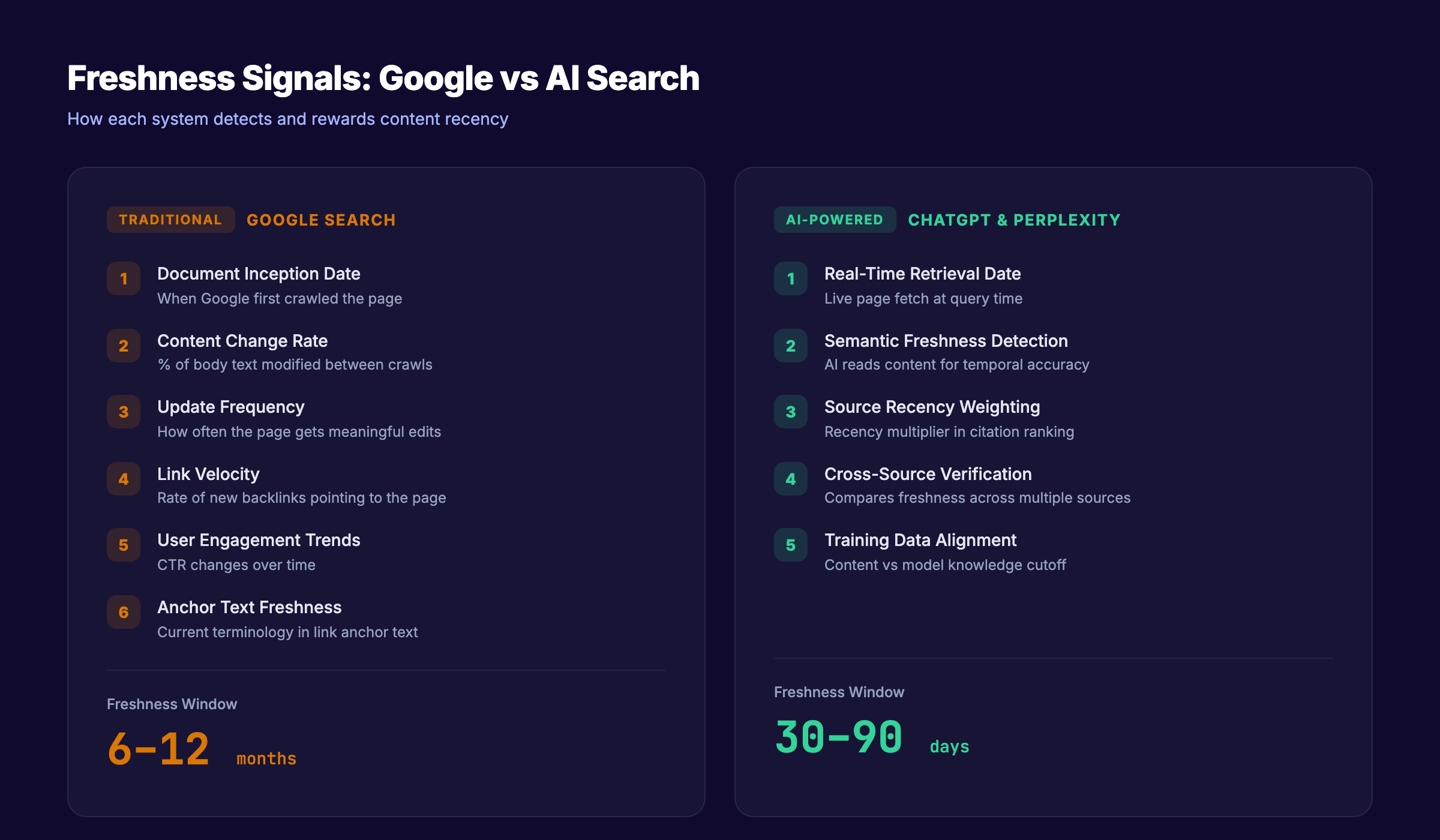
The differences between AI and traditional search freshness are not subtle. They require different content strategies.
| Freshness Factor | Google (Traditional) | AI Search (ChatGPT, Perplexity) |
|---|---|---|
| Primary freshness signal | Document inception date + content change rate | Real-time retrieval date + semantic content analysis |
| Date manipulation detection | Checks metadata vs inception date | Reads actual content for temporal accuracy |
| Freshness window for top rankings | 6-12 months for most queries | 30-90 days for competitive queries |
| How freshness is measured | Structural signals (dates, links, crawl changes) | Content-level understanding of information currency |
| Impact of stale content | Gradual ranking decline over months | Immediate exclusion from citations |
| Update threshold | Meaningful content changes needed | Any verifiable information update helps |
| Link velocity impact | Strong signal for freshness | Minimal direct impact on citations |
| User engagement role | Indirect freshness signal | Not a factor in citation decisions |
| Geographic freshness | Same signals across all regions | May vary by language model and retrieval system |
| Penalty for fake freshness | Ranking demotion possible | Content ignored if detected |
The 368-Day Gap
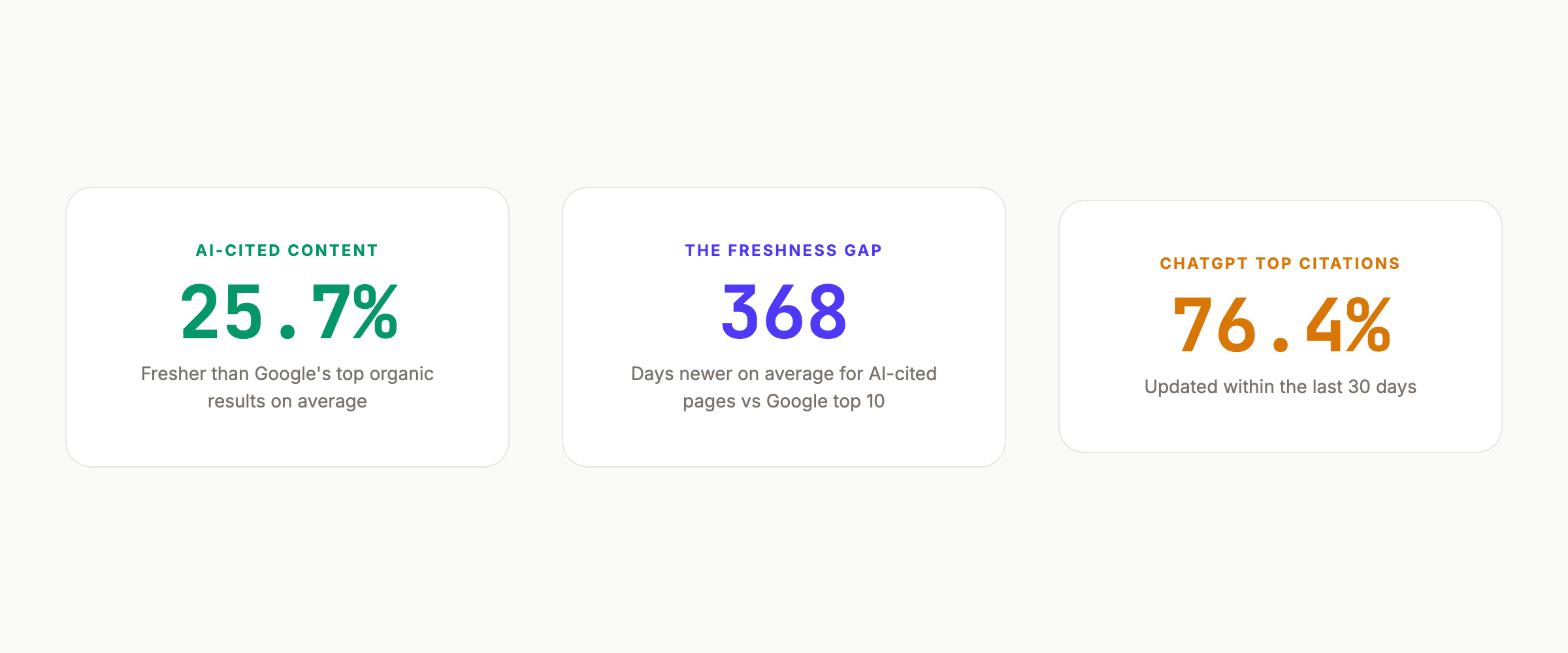
Research shows that AI-cited content averages 368 days fresher than Google’s top organic results. This means the content ranking #1 on Google is, on average, almost a full year older than the content being cited by ChatGPT.
For SEO teams targeting both channels, this gap is the central challenge. Content that is “fresh enough” for Google is often “too old” for AI platforms.
Platform-Specific Freshness Behaviors
ChatGPT: Prioritizes pages updated within 30 days. A Seer Interactive study of 5,000+ URLs found that 31% of ChatGPT citations come from current-year content, with 71% from the last 3 years. 90% of its citations come from pages beyond the first or second organic search result page. ChatGPT is not pulling from Google’s top results. It has its own freshness-weighted retrieval.
Perplexity: The most aggressive freshness preference of any AI platform. 50% of Perplexity citations come from current-year content alone. It shows source dates prominently. Pages without dates get deprioritized by approximately 35% in citation probability. Perplexity favors structured content with schema markup that includes datePublished and dateModified.
Google AI Overviews: Here is the counterintuitive finding. AI Overviews actually cite content that is approximately 16 days older than regular Google organic results. They cite top-10 organic results 93.67% of the time. This means AI Overviews reward established authority more than raw freshness. Freshness signals that work for Google organic also work here, but age is not penalized the way it is on ChatGPT or Perplexity.
Only 11% of websites appear in citations from both ChatGPT and Perplexity. The other 89% are exclusive to one platform. This means freshness optimization for one AI platform does not guarantee visibility on another.
Your SEO team. $99 per month. 30 optimized articles published automatically. Fresh content, every month. Start for $1 →
Which Query Types Trigger Freshness Ranking Boosts
Not all queries care about freshness. Understanding which ones do determines where to invest refresh effort.
Queries That Always Trigger Freshness (Both Systems)
Breaking news and current events. Searches about elections, natural disasters, stock movements, or product launches. Both Google and AI search engines prioritize the most recent information. Google activates QDF. AI platforms retrieve from live sources.
Annual or seasonal queries. “Best SEO tools 2026,” “tax deadlines 2026,” “holiday marketing ideas.” Any query with an explicit year or seasonal intent. Google and AI platforms both recognize these patterns and boost recent content.
Recently trending topics. When search volume for a topic spikes, both systems favor new content. A sudden increase in searches for a new Google algorithm update triggers freshness signals across both systems.
Queries Where Only AI Search Triggers Freshness
Statistical and data queries. “Average conversion rate,” “email marketing benchmarks,” “cost per click by industry.” Google may rank a 2023 study if it has strong authority. AI search engines almost always cite the most recent data available, regardless of domain authority.
How-to queries with evolving best practices. “How to optimize for AI Overviews,” “how to set up Google Analytics.” AI platforms detect when instructions reference outdated UI elements, deprecated features, or old process steps. Google relies more on authority signals.
Product and pricing queries. “Semrush pricing,” “Ahrefs vs Semrush.” AI search engines strongly favor current pricing and feature data. Google may rank older comparison pages if they have strong link profiles.
Queries Where Neither System Cares About Freshness
Evergreen educational queries. “What is topical authority,” “how does photosynthesis work.” These queries return the same answer regardless of when the content was published. Both Google and AI platforms prioritize E-E-A-T over recency for these topics.
Navigational queries. “Stacc login,” “Semrush pricing page.” Users want a specific page. Freshness does not affect which page they reach.
The Content Refresh Playbook for Both Search Types
Ranking in both AI and traditional search requires a dual refresh strategy. The cadence differs based on content type and target platform.
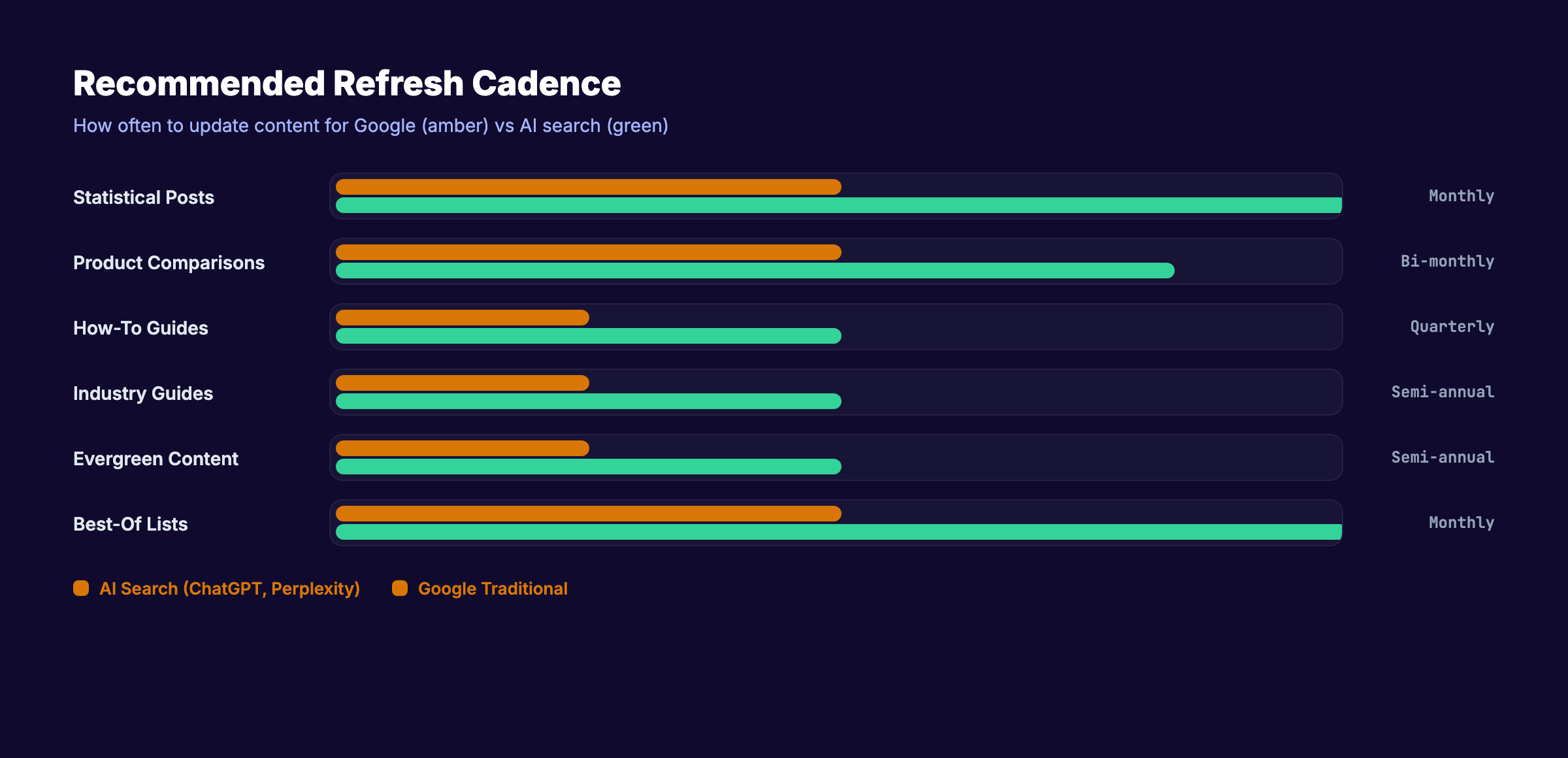
Refresh Cadence by Content Type
| Content Type | Google Refresh Cadence | AI Search Refresh Cadence | Combined Recommendation |
|---|---|---|---|
| Statistical/data posts | Every 6 months | Monthly | Monthly (serves both) |
| Product comparisons | Every 6 months | Every 2 months | Every 2 months |
| How-to guides | Annually | Quarterly | Quarterly |
| Industry guides | Annually | Every 6 months | Every 6 months |
| Evergreen content | Annually | Every 6 months | Every 6 months |
| News/trending posts | As needed | Real-time | As events occur |
| Best-of lists | Every 6 months | Monthly | Monthly |
The 5-Step Dual-Platform Refresh Process
Step 1: Audit temporal references.
Read every paragraph. Flag any mention of a specific year, statistic, tool version, pricing figure, or process step. For Google, update the metadata. For AI search, update the actual content with current data.
Step 2: Replace outdated statistics.
Find the most recent data available. AI search engines compare your numbers against other sources. If 4 competitors cite a 2026 study and you still reference 2024 data, AI platforms will deprioritize your page.
Step 3: Update structural signals for Google.
Update the dateModified in your schema markup. Update internal links to point to newer content. Add a “Last updated” note visible to both users and crawlers.
Step 4: Add new information for AI search.
AI platforms reward content that covers recent developments competitors miss. Add a new section about a recent trend, study, or tool update. This gives AI retrieval systems a reason to prefer your page over one that was merely date-bumped.
Step 5: Verify across platforms.
After refreshing, check your content in both Google Search Console and AI platforms. Search your target query in ChatGPT, Perplexity, and Google. Verify that your page appears in results across all platforms.
Automation at Scale
Manually refreshing content across 50 to 100 pages every month takes approximately 25 hours. That is a part-time job. Content teams that automate their publishing cadence avoid this problem entirely.
Publishing 30 fresh articles per month means your site always has recent content in the index. Google sees consistent update frequency. AI search engines see a steady stream of fresh, citable pages. Both systems reward the velocity.
Rank everywhere. Do nothing. Blog SEO, Local SEO, and Social on autopilot. Start for $1 →
5 Freshness Mistakes That Hurt Both AI and Organic Rankings
These mistakes are common. Every one of them costs rankings in both traditional and AI search.
Mistake 1: Changing the Date Without Changing the Content
Google’s inception date tracking catches this. If you change your publish date from 2024 to 2026 without modifying the body content, Google records the discrepancy. Your freshness signal weakens instead of strengthening.
AI search engines catch it even faster. They read the content. If the text references “2024 data” but the metadata says 2026, AI platforms flag the inconsistency and may exclude the page entirely.
Mistake 2: Updating Only the Title and Introduction
Some teams rewrite the first 200 words and leave the rest untouched. Google measures content change rate across the entire page. A 5% change does not signal the same freshness as a 40% change.
AI search engines scan the entire page during retrieval. Outdated information in paragraph 15 can override fresh information in paragraph 1. The whole page needs to reflect current data.
Mistake 3: Ignoring AI-Specific Freshness Requirements
Many SEO teams optimize exclusively for Google. They update metadata, build new links, and monitor Search Console. They never check whether ChatGPT or Perplexity cites their content.
In 2026, this is a gap most competitors also have. Teams that optimize for AI freshness now gain first-mover advantage. Track your AI search visibility alongside your organic rankings.
Mistake 4: Refreshing Everything at the Same Cadence
Not all pages need the same refresh frequency. A glossary page defining “content freshness” does not need monthly updates. A “best SEO tools” page does.
Match your refresh cadence to the query intent. Time-sensitive queries need frequent updates. Evergreen definitions do not. Wasting refresh effort on stable content means less time for pages that actually need it.
Mistake 5: Publishing Fresh Content Without Internal Links
A new page with zero internal links misses both signals. Google uses internal link structure to discover and value new content. AI search engines use link context to understand what a page covers and how it relates to other content on your site.
Every fresh page should link to 3 to 5 existing pages. Every existing page in the same topic cluster should link back. This amplifies the freshness signal across both traditional and AI search.
FAQ
What are freshness signals in search engines?
Freshness signals are ranking factors that measure how recently content was created, updated, or referenced. Google uses 6 structural signals including document inception date and content change rate. AI search engines use real-time retrieval dates and semantic analysis of the content itself.
Do AI search engines care more about freshness than Google?
Yes. AI-cited content is 25.7% fresher on average than Google’s top organic results. ChatGPT prioritizes pages updated within 30 days. Google tolerates content that is 6 to 12 months old for most non-news queries. AI platforms apply a more aggressive freshness filter.
How often should I update content for AI search visibility?
It depends on content type. Statistical posts and product comparisons need monthly updates. How-to guides need quarterly refreshes. Evergreen content needs updates every 6 months. The key is updating actual information, not just metadata dates.
Does Google AI Overviews use the same freshness signals as ChatGPT?
No. Google AI Overviews cite top-10 organic results 93.67% of the time. This means AI Overviews track closely with traditional Google rankings and freshness signals. ChatGPT and Perplexity use independent retrieval systems with more aggressive freshness weighting.
Can I optimize for both AI and traditional search freshness at the same time?
Yes. The fastest path is publishing fresh content consistently and refreshing existing content on a quarterly schedule. Google rewards the update frequency. AI search engines reward the content recency. Both systems benefit from a steady publishing cadence of 20 to 30 articles per month.
Content freshness is no longer one signal applied one way. It is two parallel systems with overlapping but distinct rules. The teams ranking in both AI and traditional search in 2026 are the ones treating freshness as a dual-channel strategy, not a single checkbox.
3,500+ blogs published. 92% average SEO score. See what Stacc can do for your site. Start for $1 →
Written and published by Stacc. We publish 3,500+ articles per month across 70+ industries. All data verified against public sources as of March 2026.
