
Content Freshness Ranking Factor (2026): Google's 6 Signals Explained
Content freshness affects 35% of queries. Google's 6 freshness signals, which queries trigger it, and the exact process to update content for higher rankings without full rewrites.
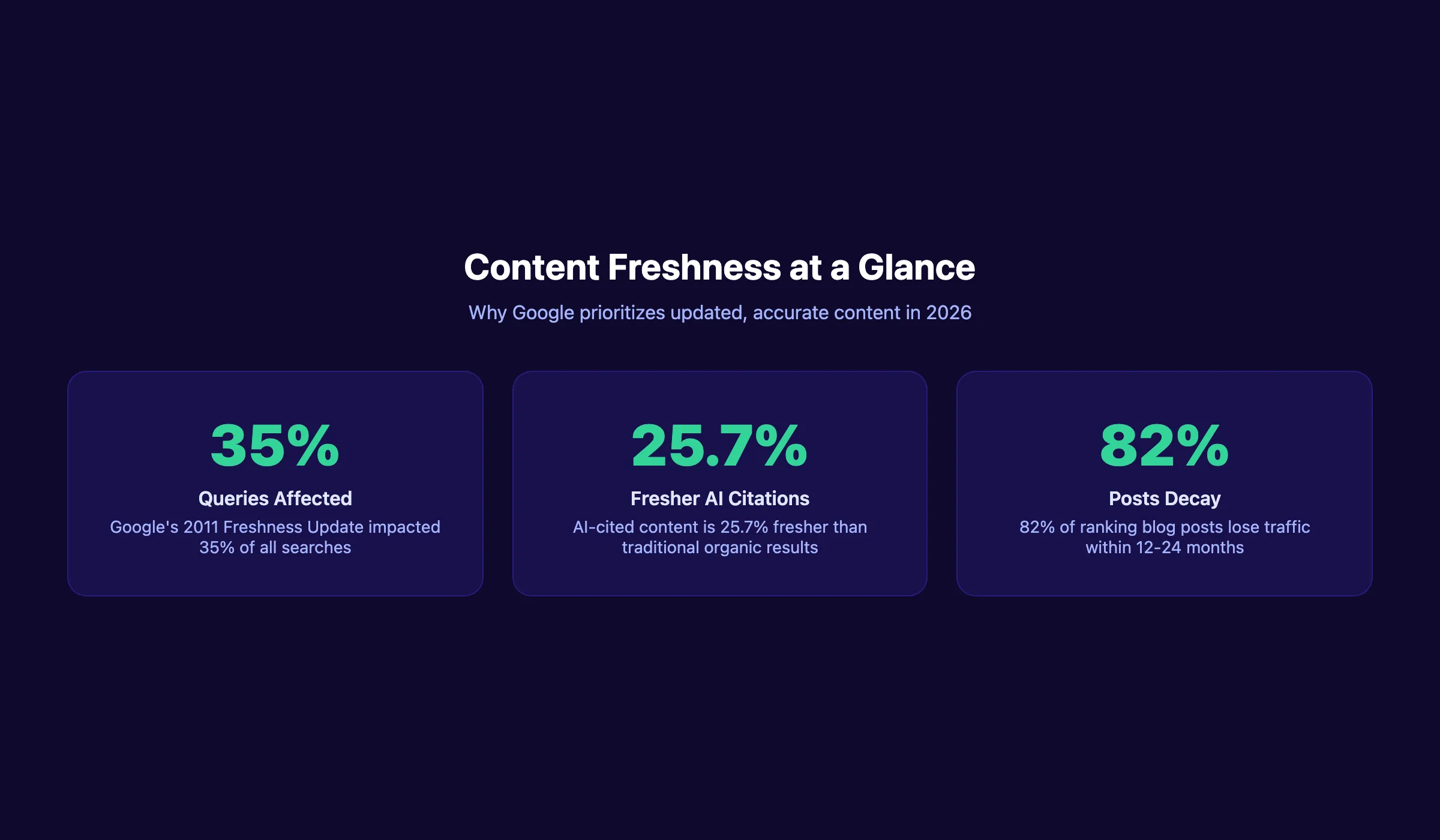
Google’s 2011 Freshness Update changed 35% of all search queries overnight. Pages with outdated information dropped. Pages with current, accurate data climbed. That single algorithm change made content freshness a ranking factor that no SEO team could afford to ignore.
In 2026, the stakes are higher. AI search engines like ChatGPT and Perplexity cite content that is 25.7% fresher than traditional organic results. Old content does not just lose rankings. It loses AI visibility entirely.
The problem is that most teams misunderstand what freshness means. They change a publish date. They swap “2025” for “2026” in the title. Google detects this. It does not work. Real content freshness requires meaningful updates that reflect the current state of a topic.
We publish 3,500+ blog posts across 70+ industries and maintain them at scale. This guide covers everything we know about the content freshness ranking factor.
Here is what you will learn:
- What content freshness actually means (and what it does not)
- How Google measures freshness across 6 distinct signals
- Which query types trigger freshness-based rankings
- Why AI search engines care more about freshness than Google does
- The exact process to refresh content for higher rankings
- 3 freshness mistakes that hurt rankings instead of helping
Table of Contents
- Chapter 1: What Is Content Freshness?
- Chapter 2: Is Content Freshness a Ranking Factor?
- Chapter 3: How Google Measures Content Freshness
- Chapter 4: Which Queries Trigger Freshness Rankings
- Chapter 5: Content Freshness in the AI Search Era
- Chapter 6: How to Improve Content Freshness for SEO
- Chapter 7: Content Freshness Mistakes That Hurt Rankings
- FAQ: Content Freshness Ranking Factor
Chapter 1: What Is Content Freshness? {#ch1}
Content freshness measures how accurately a page reflects the current state of its topic. It is not about when the page was published. It is about whether the information on that page is still correct, complete, and useful right now.
A blog post from 2021 can be fresh if the data is still accurate and the advice still works. A blog post from last week can be stale if it references outdated tools, dead links, or incorrect statistics.
Google’s own documentation describes freshness as a system that ensures “search results include the most up-to-date information.” The algorithm does not reward new content for being new. It rewards accurate content for being accurate.
How Google Defines Fresh Content
Google uses the word “freshness” to describe content that matches the current information needs of a query. Search intent determines whether freshness matters for a given keyword.
For the query “best SEO tools,” Google expects recent data. Tools change. Pricing changes. Features get added or removed. A list from 2023 is stale by definition.
For the query “what is a meta description,” freshness matters less. The definition has not changed in a decade. Google will rank the most authoritative answer regardless of publish date.
The distinction matters because it determines where to invest your update effort. Not every page needs refreshing on the same schedule.
Freshness vs. Recency vs. Frequency
These 3 concepts overlap but are not the same thing.
Freshness is about content accuracy. Does the page reflect current reality?
Recency is about timing. When was the page last published or modified?
Frequency is about cadence. How often does a site publish new content?
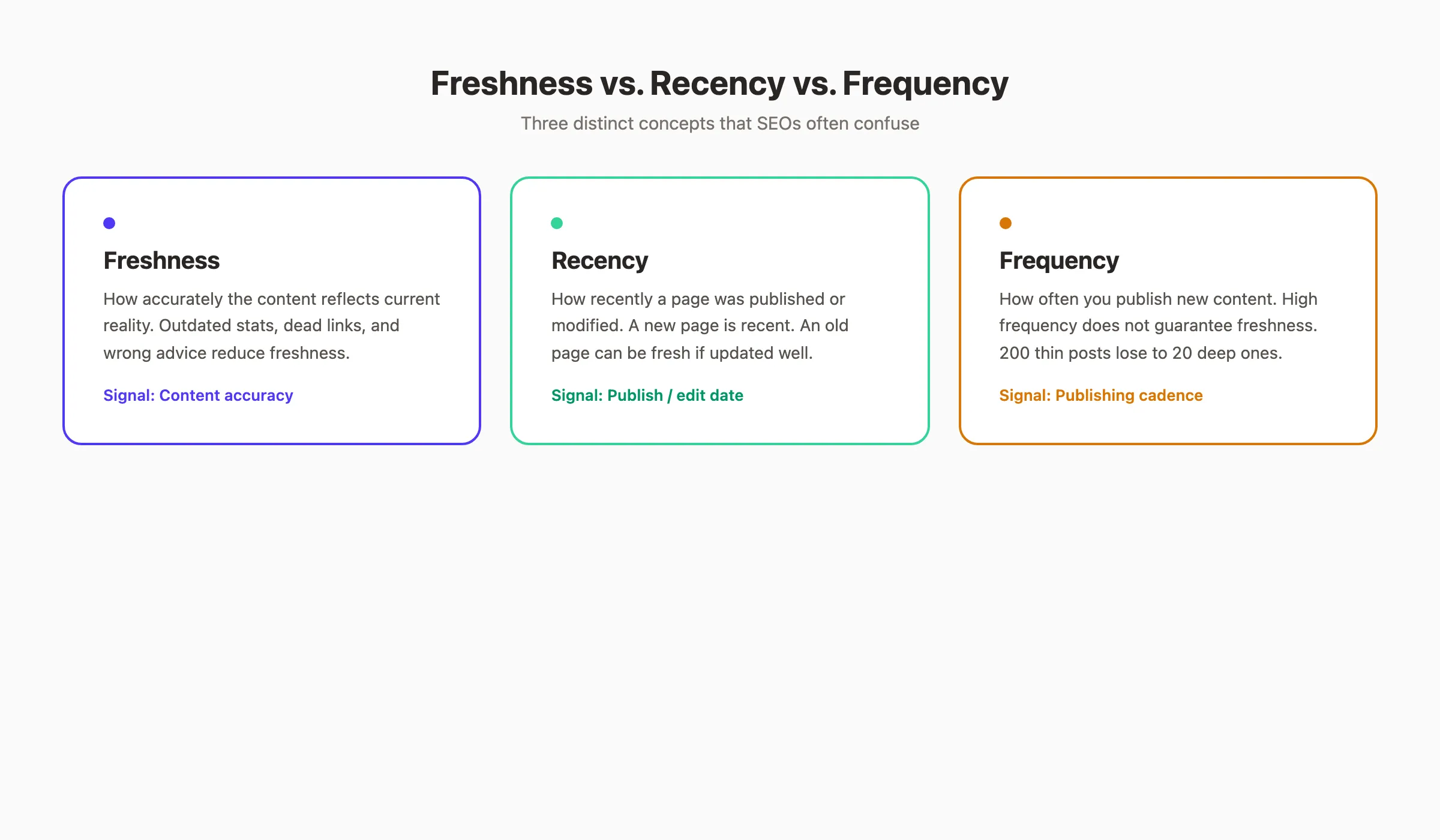
Semrush puts it clearly: “Your site can perform better with 20 pieces of genuinely helpful content than with 200 pieces of thin content.” Publishing frequency does not equal freshness. A site that publishes 5 posts per day can still have stale content on every page.
Google evaluates freshness at the page level, not the site level. One outdated guide does not drag down your entire domain. But one outdated guide will lose its own rankings to a competitor who updated theirs.
Your content stays fresh without you lifting a finger. Stacc publishes and maintains 30 SEO articles every month, with built-in freshness checks. Start for $1 →
Chapter 2: Is Content Freshness a Ranking Factor? {#ch2}
Yes. Content freshness is a confirmed ranking factor. Google has publicly acknowledged it multiple times, and the algorithm includes dedicated freshness systems.
The clearest evidence came in November 2011. Google announced the Freshness Update, which impacted roughly 35% of all search queries and noticeably changed results for 6 to 10% of queries. That is one of the largest single-factor updates in Google’s history.
The 2011 Freshness Update
Before 2011, Google’s Caffeine indexing system already crawled the web faster. But the Freshness Update went further. It specifically boosted newer, more recently updated content for queries where timeliness mattered.
Amit Singhal, then Google’s head of search, described it as helping users “find the latest relevant results for searches that benefit from fresh information.” The update targeted 3 categories of queries: recent events, regularly recurring events, and topics that change frequently.
This was not a one-time change. Google has continued to refine its freshness systems. The February 2026 update specifically rewarded topical authority, freshness, and engagement across all Google surfaces, including Discover.
Query Deserves Freshness (QDF)
QDF is the specific algorithm component that determines whether a query needs fresh results. Google first discussed QDF publicly in 2007. It works by monitoring search volume spikes and news coverage patterns.
When a topic suddenly trends (a product launch, a natural disaster, an election result), QDF activates. It temporarily boosts newer content in the search results for that query.
QDF is not permanent. Once the spike subsides, rankings return to normal weighting. But for the duration of the trend, older content gets pushed down regardless of its domain authority.
What the Data Shows in 2026
The content freshness ranking factor has evolved beyond its 2011 origins. Late 2025 updates shifted how Google evaluates freshness. The algorithm now prioritizes editorial authority and E-E-A-T signals over raw recency.
Content backed by subject-matter expertise ranks higher than newer, less credible material. Freshness alone does not win. But stale content from authoritative sources still loses to fresh content from authoritative sources.
The pattern is clear: freshness is a tiebreaker. When 2 pages have similar authority, backlinks, and content quality, the fresher page wins. When one page is far more authoritative, freshness alone cannot overcome that gap.
Chapter 3: How Google Measures Content Freshness {#ch3}
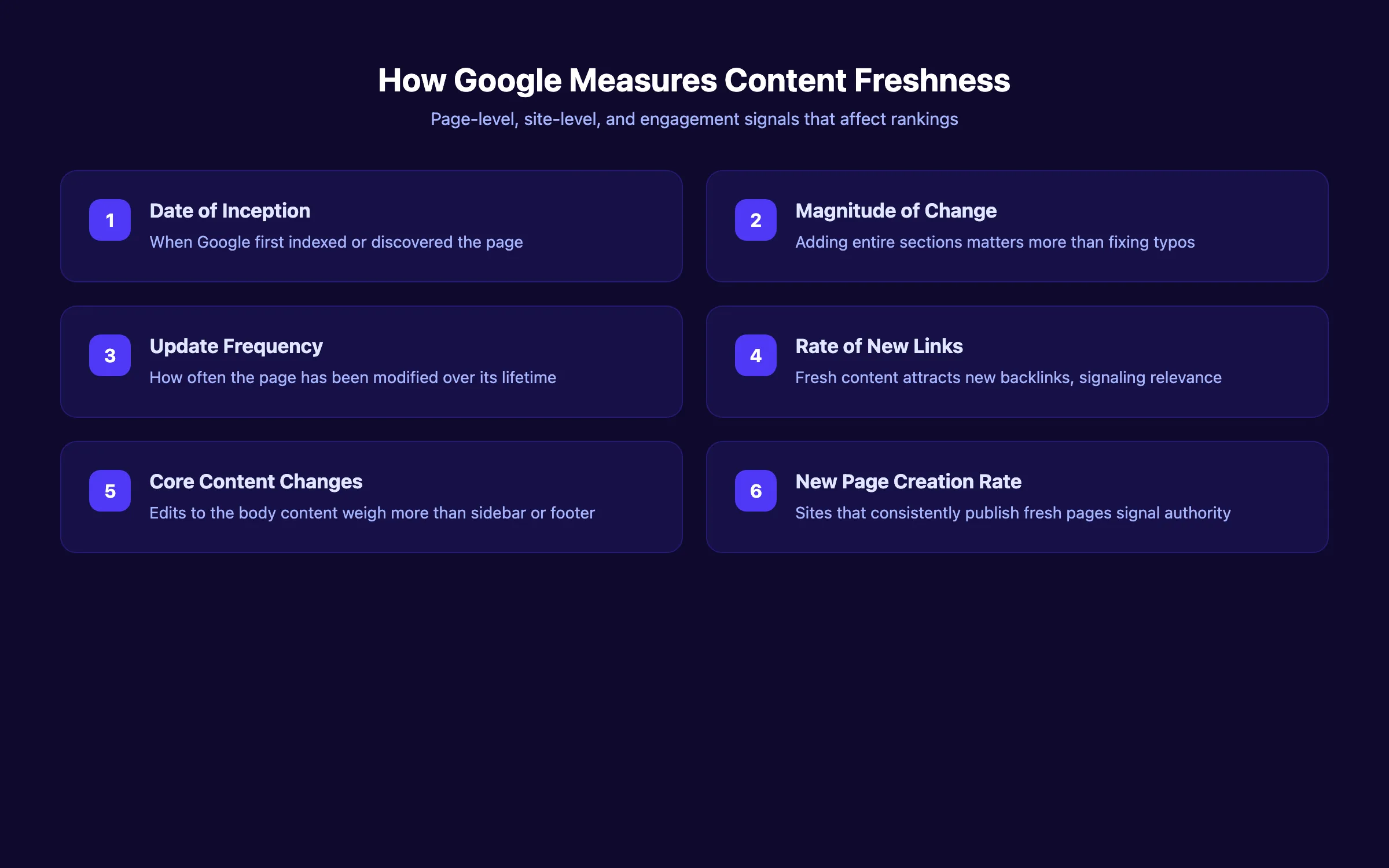
Google does not check a single date field and call it done. The algorithm uses at least 6 distinct signals to evaluate how fresh a page is. Understanding these signals helps you focus updates where they matter most.
Page-Level Freshness Signals
Date of inception. This is when Google first indexed the page. Not the publish date in your CMS. Not the date in your schema markup. The actual date Google’s crawler first encountered the URL. Older pages need stronger freshness signals from other factors to compete with newer pages for time-sensitive queries.
Magnitude of change. Google tracks how much of a page changed between crawls. Adding or removing entire sections counts more than swapping a few words. Rewriting 30% of the content sends a stronger freshness signal than fixing 2 typos.
This is why date swapping fails. If you change “2025” to “2026” and nothing else, the magnitude of change is near zero. Google sees it as the same page with a cosmetic edit.
Core content vs. boilerplate. Edits to the main body content carry more weight than changes to navigation, sidebars, or footers. Google can distinguish between template elements and the actual article. Updating your site-wide footer does not refresh any individual page.
Update frequency over time. Pages that get updated regularly build a history of freshness. A guide that has been updated every 6 months for 3 years signals to Google that someone actively maintains it. A guide that has not changed in 2 years looks abandoned, even if the information is still correct.
Site-Level Freshness Signals
New page creation rate. Sites that consistently publish new content signal to Google that they are active and authoritative. This does not mean you should publish thin content for volume. But a site that publishes 30 blog posts per month sends a stronger freshness signal than one that publishes once a quarter.
Crawl frequency response. When Google crawls your site and finds frequent changes, it adjusts its crawl schedule. Sites with higher freshness get crawled more often. Sites that rarely change get crawled less. This creates a compounding effect. Fresh sites get discovered faster when they do update.
Link and Engagement Signals
Rate of new backlinks. Fresh content attracts new backlinks. When a page suddenly gains several new links, Google interprets this as a signal that the content is relevant right now. Stale pages rarely attract new links organically.
User engagement patterns. While Google has been careful about confirming behavioral signals, pages with declining engagement (higher bounce rates, shorter time on page) over time correlate with freshness decay. Users leave stale pages faster than fresh ones.
These signals work together. A page with a recent update, meaningful content changes, and new incoming links will rank better for freshness-sensitive queries than a page with only one of those signals.
Stop losing rankings to content decay. Stacc monitors your content and publishes fresh articles on autopilot. 30 articles per month, $99. Start for $1 →
Chapter 4: Which Queries Trigger Content Freshness Rankings {#ch4}
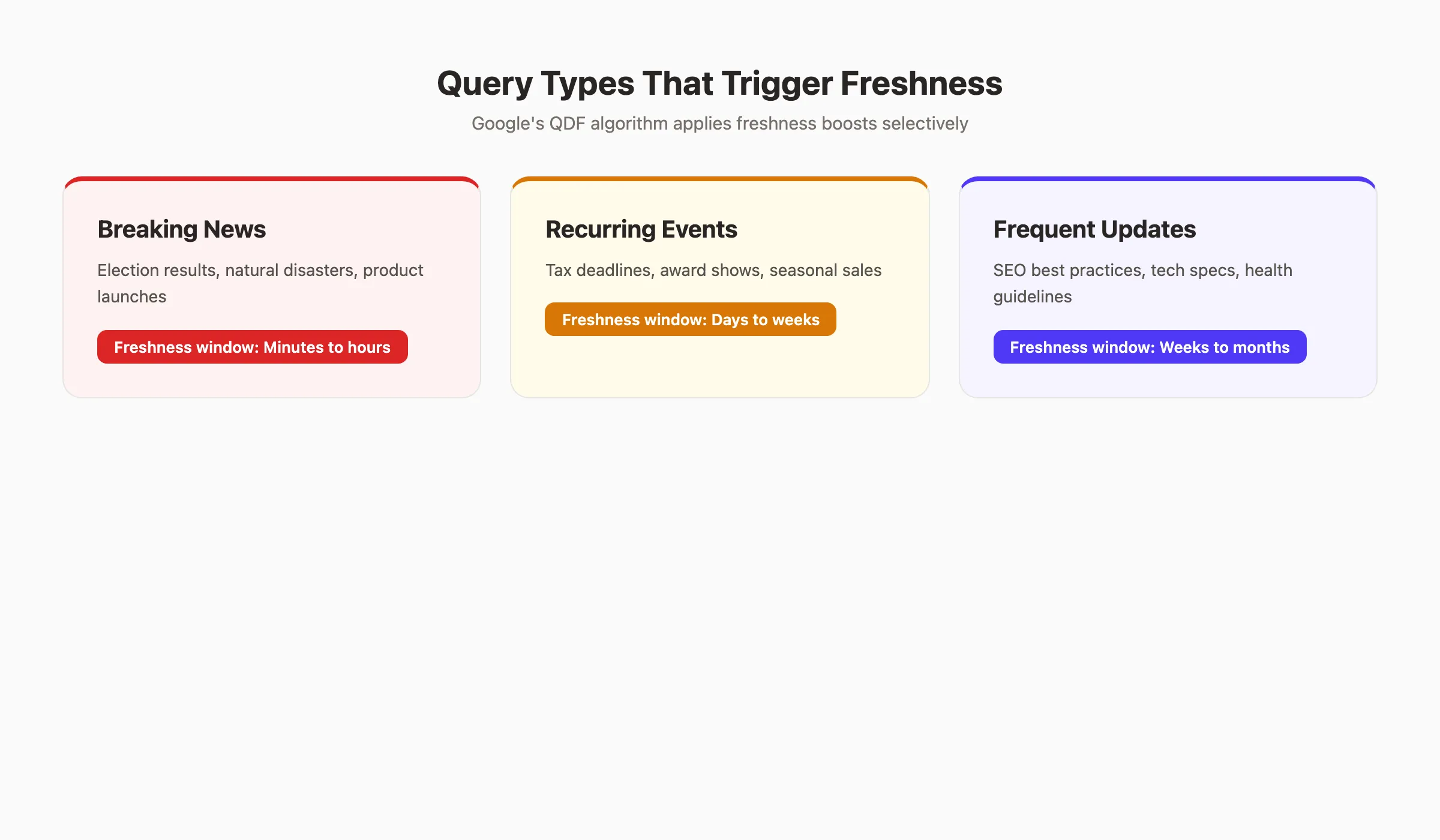
Not every Google query uses freshness as a ranking factor. The content freshness ranking factor applies selectively. Google’s QDF system identifies 3 broad categories of queries where fresh content gets a ranking boost.
Breaking News and Trending Topics
These are queries where something just happened. An earthquake. A product launch. A celebrity event. A major policy change.
For these queries, freshness dominates rankings. A 5-minute-old article from a credible news source will outrank a detailed guide published last month. The information need is immediate.
Examples: “Google March 2026 core update,” “iPhone 17 release date,” “new tax rules 2026.”
For blog SEO, breaking news is rarely the target. But recognizing it helps you understand why your evergreen content sometimes drops during trending events. It usually recovers once the spike subsides.
Recurring Events
Some queries repeat on a predictable schedule. Tax season. Black Friday. Award ceremonies. Annual industry conferences.
Google knows these patterns. It starts boosting fresher content weeks before the event. If your “Black Friday marketing strategy” post still says “2025,” it will lose ground to one that says “2026” and includes updated strategies.
This is where annual content updates pay the highest return. A single refresh before the seasonal peak can recapture thousands of visits. Creating a content calendar that accounts for recurring events ensures you never miss these windows.
Frequent Updates (Technology, Health, Finance)
Some topics change constantly without a specific triggering event. SEO best practices shift with every algorithm update. Medical guidelines evolve with new research. Financial regulations change quarterly.
Google applies a moderate freshness bias to these queries. Not as strong as breaking news, but persistent. A guide to “on-page SEO” from 2024 will gradually lose ground to one updated in 2026. The decline is slow but steady.
This category matters most for content marketers. Most B2B blog content falls here. The topics are not time-sensitive enough for QDF spikes, but they are time-sensitive enough that content from 2 years ago feels outdated.
| Query Type | Freshness Window | Example | Update Strategy |
|---|---|---|---|
| Breaking news | Minutes to hours | ”Google algorithm update today” | Publish immediately or skip |
| Recurring events | Days to weeks | ”Black Friday SEO strategy 2026” | Update 4-6 weeks before peak |
| Frequent updates | Weeks to months | ”Best SEO tools” | Refresh every 3-6 months |
| Evergreen / stable | Rarely matters | ”What is a 301 redirect” | Update annually or when accuracy drops |
The key question for every page on your site: does the target keyword fall into a freshness-sensitive category? If yes, that page needs a defined refresh schedule. If no, focus your update effort elsewhere.
Chapter 5: Content Freshness in the AI Search Era {#ch5}
Content freshness was already important for Google rankings. In 2026, it has become critical for a second reason: AI search engines show an even stronger preference for recent content than Google does.
AI Engines Prefer Newer Sources
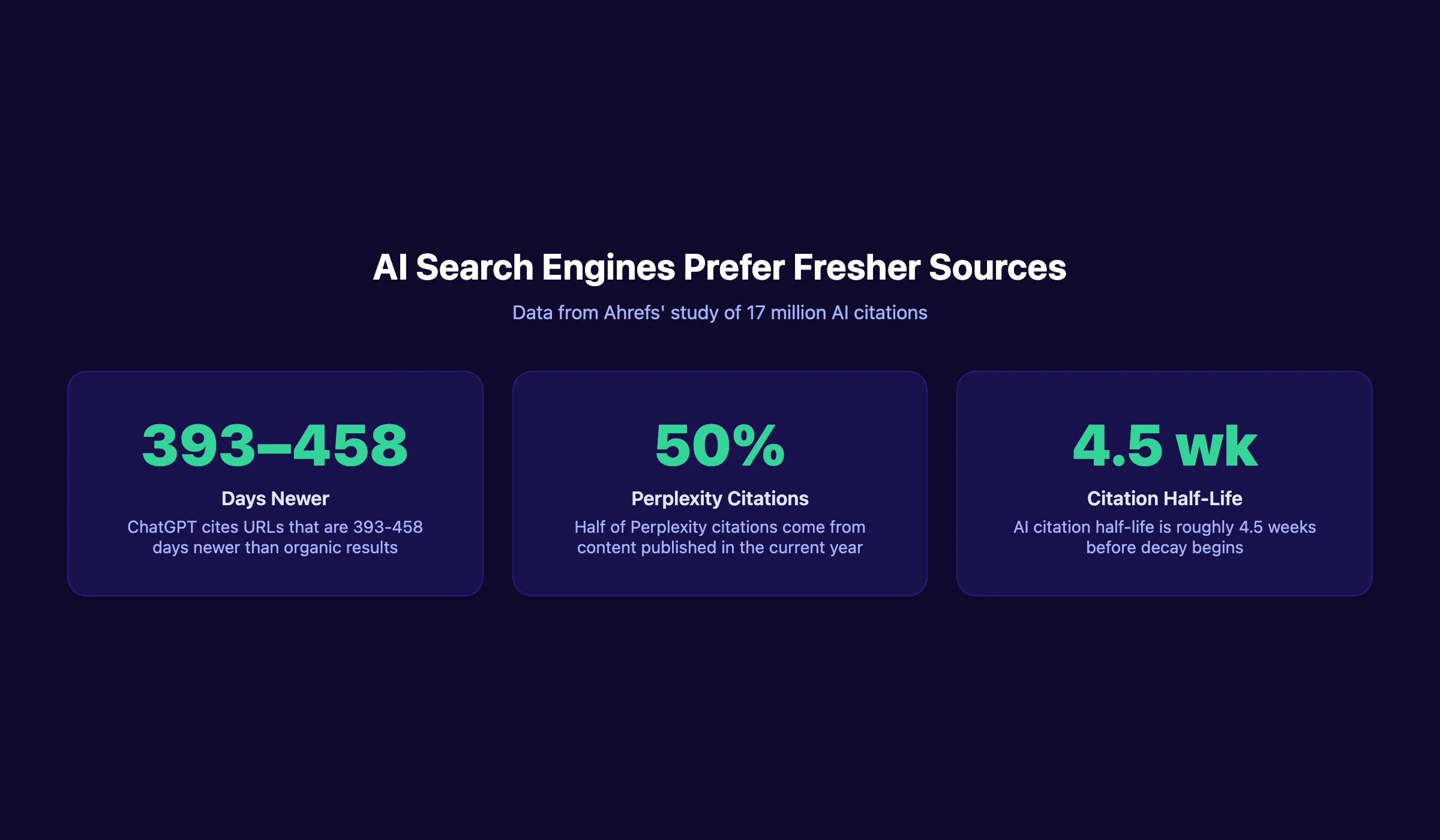
Ahrefs analyzed 17 million AI citations and found that AI-cited content is 25.7% fresher than organic Google results. ChatGPT shows the strongest preference, citing URLs that are 393 to 458 days newer than what ranks organically.
Perplexity’s bias is even more extreme. Roughly 50% of its citations come from content published or updated in the current year. Older content, even if it ranks on page 1 of Google, gets ignored by Perplexity.
This means your content now needs to satisfy 2 freshness thresholds. The Google threshold (moderate, depends on query type) and the AI search threshold (aggressive, applies broadly).
How Freshness Affects AI Citations
The AI citation half-life is roughly 4.5 weeks. After a page stops being updated, its probability of being cited by AI search engines declines by half every 4 to 5 weeks.
This creates a new form of content decay. A page can hold its Google rankings for months while losing AI citations week by week. If your traffic increasingly comes from AI referrals, freshness decay hits your bottom line faster than it did in the pre-AI era.
The practical implication: high-value pages need updates more frequently than the traditional 6 to 12 month refresh cycle. For pages targeting AI visibility, quarterly updates may be the new baseline.
Google AI Overviews and Freshness
Google AI Overviews also favor fresher sources. When Google generates an AI Overview for a query, it tends to cite recently updated content over older pages. This is consistent with Google’s broader freshness systems but amplified by the AI layer.
Optimizing for generative engine optimization now requires freshness as a foundational element. A page cannot rank in AI Overviews if its data is 2 years old, regardless of how strong its backlink profile is.
The February 2026 Google update reinforced this pattern. All Google surfaces (organic, Discover, AI Overviews) now reward topical authority combined with content freshness. Authority without freshness loses to authority with freshness.
| Channel | Freshness Sensitivity | Recommended Update Cycle |
|---|---|---|
| Google Organic | Moderate (query-dependent) | 6-12 months for most content |
| Google Discover | High | Monthly or event-driven |
| Google AI Overviews | High | Quarterly minimum |
| ChatGPT / Perplexity | Very high | Monthly for priority pages |
Rank in Google and get cited by AI search engines. Stacc publishes fresh SEO content every month so your pages never go stale. Start for $1 →
Chapter 6: How to Improve Content Freshness for SEO {#ch6}
Knowing that the content freshness ranking factor exists is not enough. You need a system to keep your content fresh at scale. Here is the process we use across 3,500+ blog posts.
Audit Existing Content for Decay
Start with a content audit. Open Google Search Console and compare your pages’ performance over the last 6 months versus the prior 6 months. Look for pages where clicks and impressions are declining.
Sort by the largest absolute decline first. A page that dropped from 500 monthly clicks to 300 is a higher priority than one that dropped from 50 to 30.
Flag pages that match any of these criteria:
- Traffic declined 20% or more over 6 months
- Page contains statistics from 2 or more years ago
- Page references tools, products, or processes that have changed
- Page has broken external links
- Competitors have published fresher content on the same topic
This audit should be a quarterly process. Waiting until a page has lost 50% of its traffic means you already missed the window where a quick refresh could have saved it.
Update Statistics, Examples, and Dates
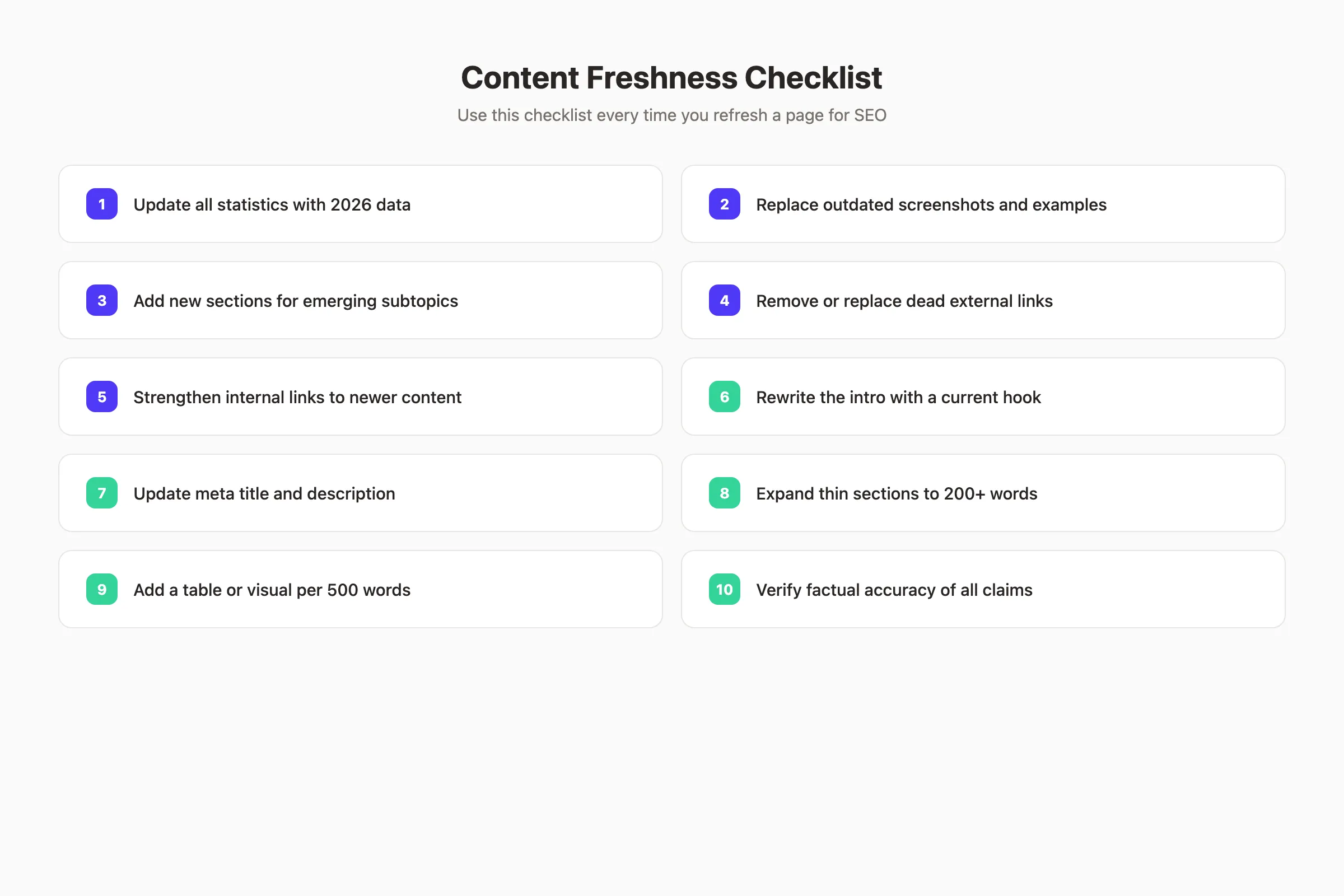
The highest-impact freshness update is replacing outdated data. Find every statistic on the page and verify it against the original source. If the source has published newer data, use it.
Do not just change the year. Replace the actual numbers. If your post says “61% of marketers say SEO is their top priority (HubSpot, 2023),” find the 2025 or 2026 version of that stat and use the new number.
Updated SEO statistics and content marketing statistics signal to both Google and readers that someone recently verified this content.
Add New Sections and Expand Coverage
The magnitude of change matters. Adding a new H2 section with 200+ words is a stronger freshness signal than rewriting existing sentences.
Look for content gaps that emerged since the page was last updated. Has a new tool launched? Did Google release a relevant update? Is there a new technique your competitors are covering that you are not?
Adding 1 to 2 new sections per refresh gives Google a clear signal that this is a meaningful update. It also increases organic traffic by targeting additional long-tail keywords.
Build a Content Refresh Calendar
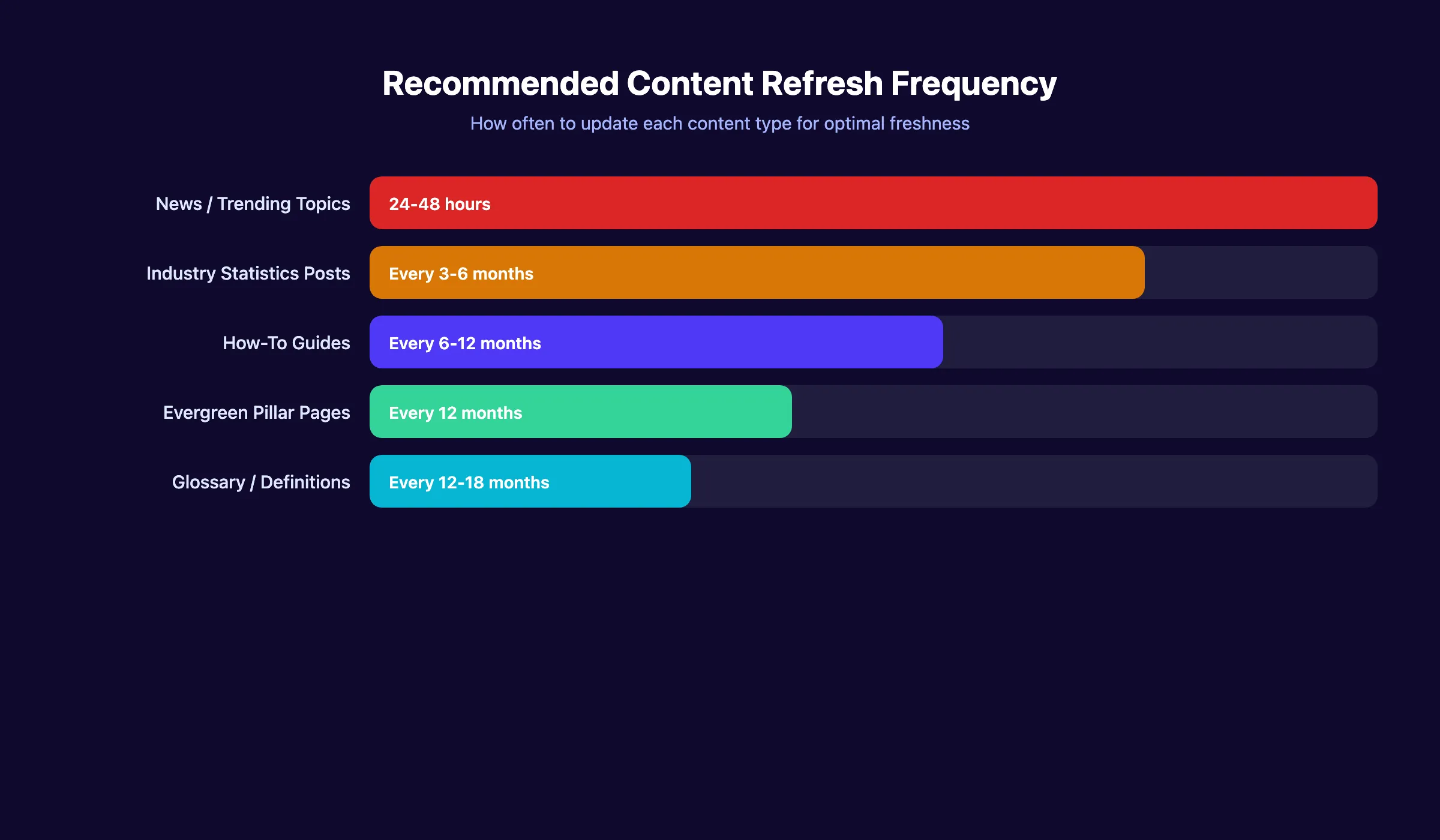
Random, reactive updates do not scale. Build a calendar that assigns every high-value page a refresh date. Group pages by their freshness sensitivity:
| Content Type | Refresh Frequency | Pages to Prioritize |
|---|---|---|
| Statistics posts | Every 3-6 months | Highest traffic stats pages first |
| Tool roundups | Every 6 months | Pages targeting “best” keywords |
| How-to guides | Every 6-12 months | Pages with declining clicks |
| Pillar pages | Every 12 months | Core cluster pages |
| Glossary entries | Every 12-18 months | Only when definitions evolve |
Use your content calendar tool to schedule these alongside new content production. A good ratio is 70% new content and 30% updates. This keeps your site growing while preventing existing pages from decaying.
Chapter 7: Content Freshness Mistakes That Hurt Rankings {#ch7}
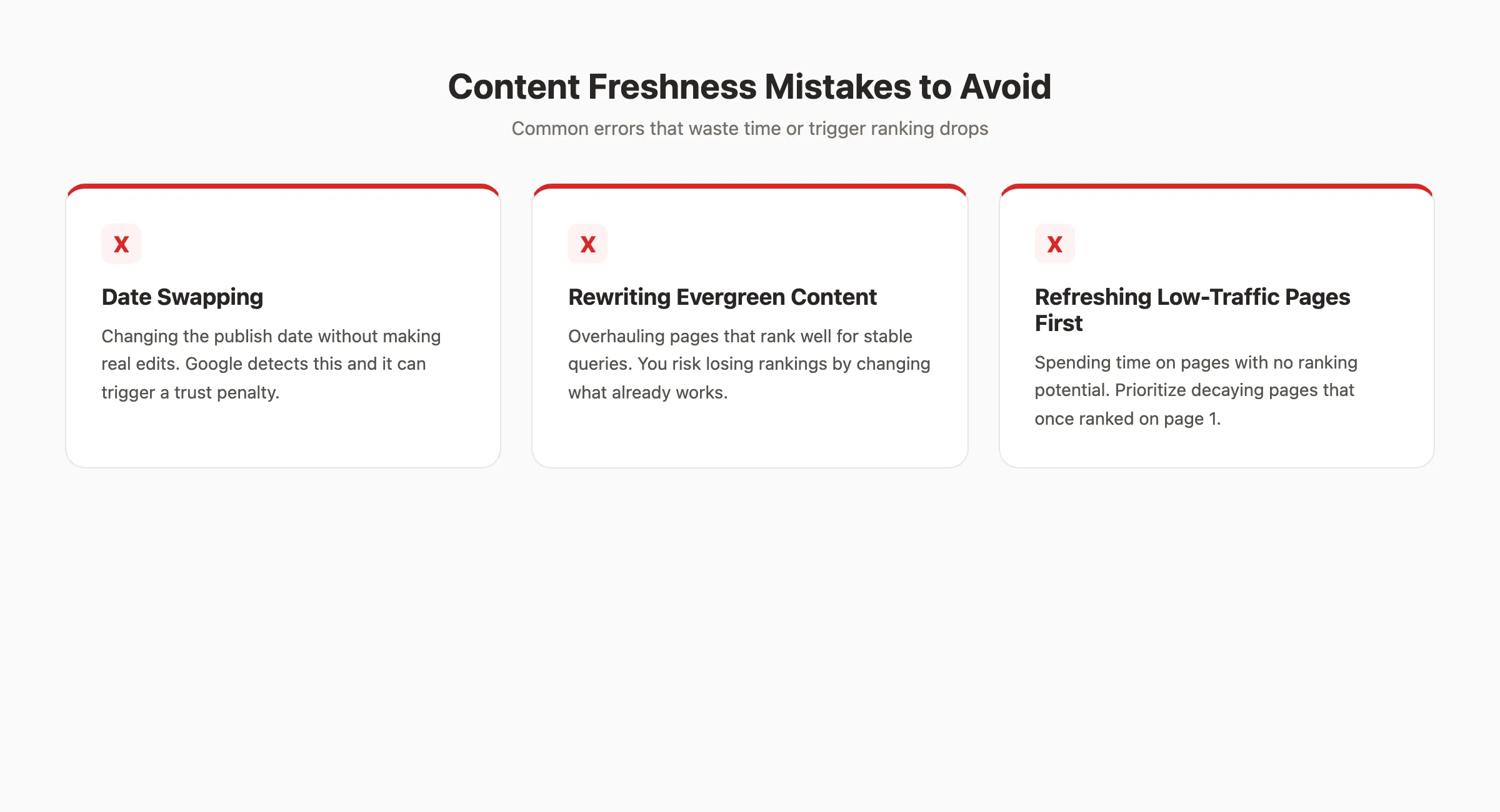
Not all freshness updates help. Some actively damage rankings. These 3 mistakes are common, and all are avoidable.
Changing the Publish Date Without Edits
This is the most common freshness mistake. A team changes “Published: January 2024” to “Updated: March 2026” without making any substantive edits. Some add “Updated for 2026” to the title.
Google can detect this. The algorithm compares cached versions of a page. If the content is 99% identical and only the date changed, the freshness signal is zero. In some cases, this pattern can reduce trust. Google sees it as an attempt to manipulate freshness without earning it.
The fix: never update a publish date unless you have made meaningful changes. A minimum of 20 to 30% of the content should be revised, added, or removed. If the page does not need that level of change, leave the date alone.
Rewriting Evergreen Content Unnecessarily
Some teams set calendar reminders to refresh every page every 6 months, regardless of performance. This leads to rewriting pages that are already ranking well for stable queries.
A page ranking position 2 for “what is a 301 redirect” does not need a quarterly rewrite. The definition has not changed. The ranking is stable. The content is fresh enough for its query type.
Unnecessary rewrites carry risk. Changing headings, removing sections, or restructuring a well-ranking page can cause ranking drops. Google had already decided that page was the best answer. Changing it tells Google to re-evaluate.
Only refresh pages that show signs of decay or target queries where freshness matters. How long SEO takes to recover from an unnecessary rewrite is often 2 to 4 months. That is wasted time.
Refreshing Low-Priority Pages First
Teams often start their content refresh cycle with the easiest pages: short posts, low-traffic definitions, or content that nobody reads. This feels productive but produces no measurable impact.
The right approach is the opposite. Start with your highest-traffic pages that show early signs of decay. A page losing 100 clicks per month deserves attention before a page that never had 100 clicks total.
Prioritize by potential recovery value:
- Current monthly traffic (higher = higher priority)
- Month-over-month traffic trend (declining = urgent)
- Keyword difficulty of target term (high KD = more valuable ranking to protect)
- Revenue attribution (pages that drive leads or sales go first)
This prioritization ensures every hour spent on content freshness delivers measurable SEO return.
Let Stacc handle your content production and maintenance. 30 fresh articles per month. Published automatically. Starting at $99. Start for $1 →
FAQ: Content Freshness Ranking Factor {#faq}
Is content freshness a confirmed Google ranking factor?
Yes. Google confirmed it with the November 2011 Freshness Update, which impacted 35% of all queries. Google’s documentation lists freshness systems as part of its ranking process. The algorithm uses multiple signals including page modification date, magnitude of changes, and rate of new backlinks to assess how fresh content is.
How often should I update blog posts for freshness?
It depends on the content type. Statistics posts need updates every 3 to 6 months. Tool roundups and “best of” lists should be refreshed every 6 months. How-to guides perform well with annual updates. Only update when you can make meaningful changes. Cosmetic edits do not improve freshness signals.
Does changing the publish date improve rankings?
No. Changing the date without making substantive content edits does not send a freshness signal. Google compares cached versions of pages and can detect when only the date changed. A minimum of 20 to 30% of the content should be revised for Google to register the page as updated.
Does content freshness matter for AI search engines?
Content freshness matters even more for AI search engines than for Google. Ahrefs data shows AI-cited content is 25.7% newer than traditional organic results. ChatGPT cites URLs that are 393 to 458 days newer than what ranks on Google. The citation half-life is about 4.5 weeks. Pages that stop being updated lose AI visibility faster than they lose Google rankings.
What is Query Deserves Freshness (QDF)?
QDF is Google’s algorithm component that identifies queries needing fresh results. It monitors search volume spikes and news coverage to detect trending topics. When QDF activates, newer content gets a temporary ranking boost. It applies to breaking news, product launches, natural disasters, elections, and other time-sensitive queries. QDF does not apply to stable, evergreen queries.
How do I know which pages need a freshness update?
Use Google Search Console to identify pages with declining clicks and impressions over the last 6 months. Check for outdated statistics, broken links, and references to tools or processes that have changed. Also review what competitors have published recently on the same topic. Pages showing 20% or more traffic decline over 6 months should be your first priority.
Keep Your Content Fresh or Lose Your Rankings
The content freshness ranking factor is not optional in 2026. Google uses it across organic search, Discover, and AI Overviews. ChatGPT and Perplexity use it even more aggressively. Pages that go stale lose traffic in ways that topical authority and internal linking alone cannot fix.
Build a refresh system. Audit quarterly. Update the pages that matter most. Publish new content consistently to keep your site signals strong.
Stacc publishes 30 fresh SEO articles every month. Your content stays current. Your rankings stay strong. No writers. No editors. No hassle. Start for $1 →
Related Tools & Resources
Free SEO Tools:
Best Lists:

Written by
Siddharth GangalSiddharth is the founder of theStacc and Arka360, and a graduate of IIT Mandi. He spent years watching great businesses lose organic traffic to competitors who simply published more. So he built a system to fix that. He writes about SEO, content at scale, and the tactics that actually move rankings.
30 SEO blog articles published every month
Keyword-optimized, scheduled, and live on your site. Automatically.
30-day trial · Cancel anytime
theStacc
Stop writing SEO content manually
30 blog articles, 30 GBP posts, and social media content. Published every month. Automatically.
Start Your $1 Trial$1 for 3 days · Cancel anytime