How local business owners build LinkedIn thought leadership in 90 minutes a week. 6-step system, post templates, and a 90-day plan for 2026.
LinkedIn thought leadership for a local business is the highest-return marketing channel that almost no local owner uses well. Most accountants, lawyers, consultants, and IT firms either post nothing on LinkedIn or post the same generic "happy Monday" content that disappears in 4 hours. Both habits waste the exact platform where your local buyers are already reading before they pick up the phone.
The numbers are blunt. 75% of decision makers say a piece of thought leadership prompted them to research a vendor they had not previously considered. 9 in 10 C-suite buyers are more receptive to outreach from companies that publish high-quality thought leadership. For a local CPA in Phoenix or a commercial real estate broker in Nashville, those numbers translate directly into who returns your call next month.
We publish 3,500+ blogs across 70+ industries. We have watched local owners turn a quiet LinkedIn profile into 3 to 8 qualified inbound calls a month using a system that takes 90 minutes a week. This guide gives you the exact 6-step build, the post types that work, the profile audit, and a 90-day plan you can start on Monday.
Here is what you will learn:
- Why LinkedIn thought leadership beats every other social channel for local B2B and service businesses
- The 6-step system that takes 90 minutes a week
- How to pick a local niche that actually attracts buyers
- The LinkedIn profile rewrite that turns visitors into leads
- 6 post templates with hooks, structures, and real examples
- The 5-3-2, 4-1-1, and 95-5 rules and which one to follow
- A 90-day plan with weekly tasks and realistic outcomes
- How to connect LinkedIn activity to local SEO and Google Business Profile results
What LinkedIn Thought Leadership Means for a Local Business
Thought leadership on LinkedIn is not a CEO posting "5 leadership lessons from my morning coffee." For a local business, thought leadership means publishing the kind of useful, specific, opinionated content that earns trust before a prospect ever calls you.
The working definition we use with local owners is simple. Thought leadership is content that proves you know the work, applied to a specific local audience, published consistently enough that the audience remembers you when a need shows up.
Three words matter in that definition.
Specific. Generic accounting advice loses to "tax planning for restaurant owners in Phoenix." Generic legal advice loses to "employment law for tech startups in Austin." The local lens is what separates you from the 800,000 other professionals on the platform.
Consistent. Posting twice in a week then disappearing for a month does not work. The algorithm forgets you. Your prospects forget you. The minimum viable cadence is 2 posts per week for 12 weeks. Below that, nothing compounds.
Useful. Every post needs to teach something, prove something, or shift the reader's thinking. "Just sharing some thoughts" is not useful. "Here is the 3-step process I use to value a service business" is useful.
Why Local Owners Get This Wrong
The most common mistake is treating LinkedIn like Facebook. Local owners post photos of their team at a charity walk, share generic motivation quotes, or repost the company holiday party. None of it positions you as the expert your buyer needs.
The second mistake is going too broad. A bookkeeper in Tampa writes generic posts about cash flow that compete with HubSpot, Bench, and every Big 4 firm. A bookkeeper in Tampa who writes specifically about cash flow for HVAC contractors with $500K to $3M in revenue competes with almost no one and ranks first in the minds of 200 prospects in her city.
The third mistake is hiding behind the company page. LinkedIn rewards personal profiles with up to 5x more reach than company pages. Local owners who post from the company page get ignored. Local owners who post from their personal profile compound.
theStacc publishes 30 SEO blogs a month, every month, for $99. Pair that with consistent LinkedIn thought leadership and you become the most-cited expert in your local niche within 6 months. Sign up for free →
Why LinkedIn Thought Leadership Works for Local Businesses
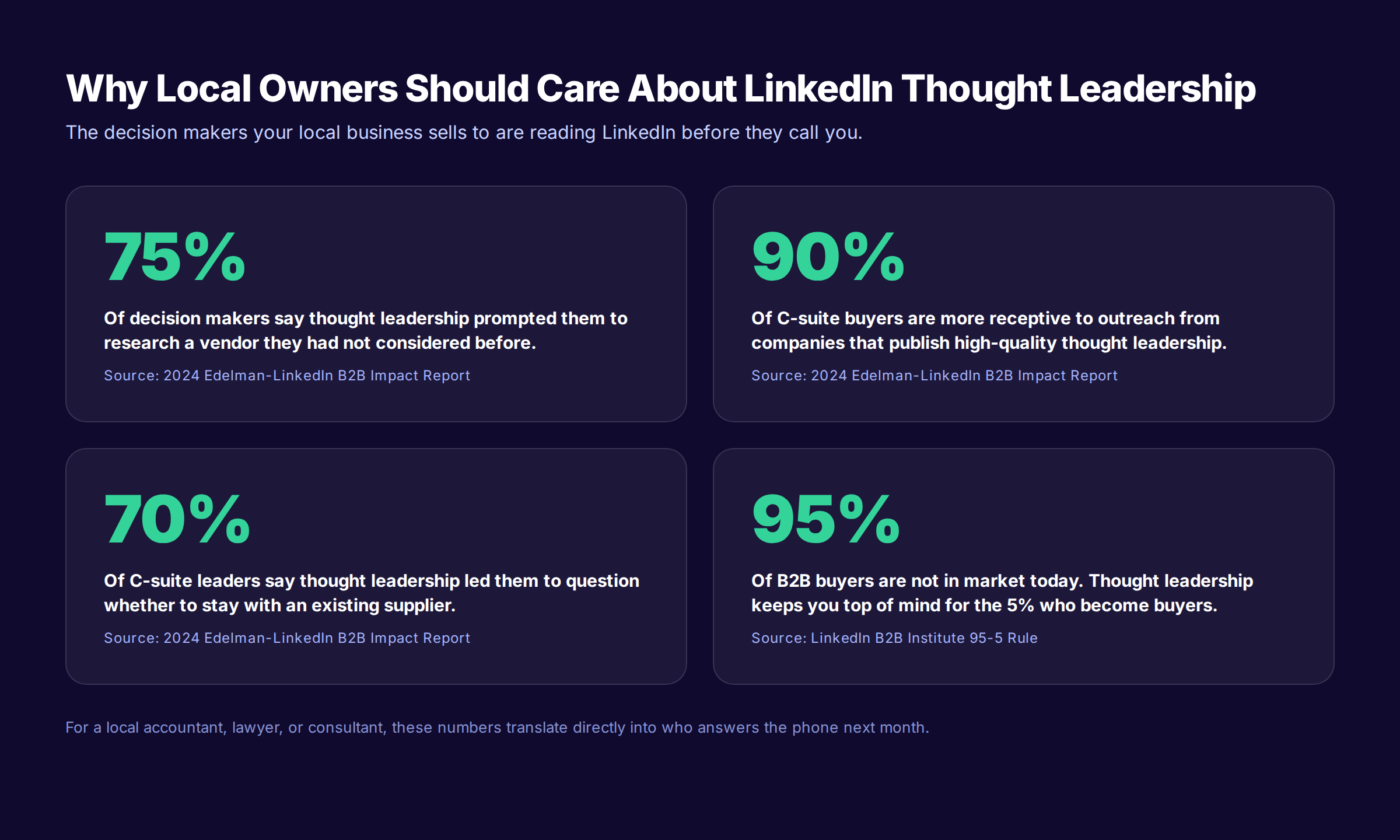
The case for LinkedIn thought leadership as a local owner rests on four data points and one platform behavior.
The 95-5 rule. LinkedIn's B2B Institute research shows that 95% of your potential buyers are not in market today. Only 5% are ready to buy this quarter. Most local marketing chases the 5%. Thought leadership earns mindshare with the 95%, so when they enter the market 4 to 18 months later, you are the first name they call.
The Edelman trust numbers. The 2024 Edelman-LinkedIn B2B Thought Leadership Impact Report found that 70% of C-suite leaders say a piece of thought leadership at least occasionally led them to question whether to stay with an existing supplier. For a local accountant or law firm, that means the right LinkedIn post can pull a client away from a competitor they have used for years.
The local match. LinkedIn lets you filter searches by industry, company size, geography, and seniority. A consultant in Charlotte can search and find 800 manufacturing executives within 50 miles, all reachable through the same content. No other social platform offers that targeting at zero cost.
The buyer behavior shift. Local buyers research vendors on LinkedIn before they call. They read your posts, scroll your About section, and check who else engages with your content. If the trail is empty, they assume you are not active or not credible. If the trail is rich, they assume you are the local expert.
The Platform Behavior That Locks This In
LinkedIn's algorithm rewards posts that earn engagement in the first 60 minutes. Comments outweigh likes by roughly 7x. Long dwell time on a post outweighs everything else.
What this means for local owners is unusual and underused. A post that gets 18 engaged comments from your local industry beats a post that gets 1,800 generic likes from strangers. You do not need a huge following. You need a tight one.
A solo CPA in Tucson with 400 connections who all work at local restaurants can outperform a national accounting firm's company page with 80,000 followers. The algorithm shows your content to people connected to the people who engage. Tight local networks compound fast.
The 6-Step Local Thought Leadership System
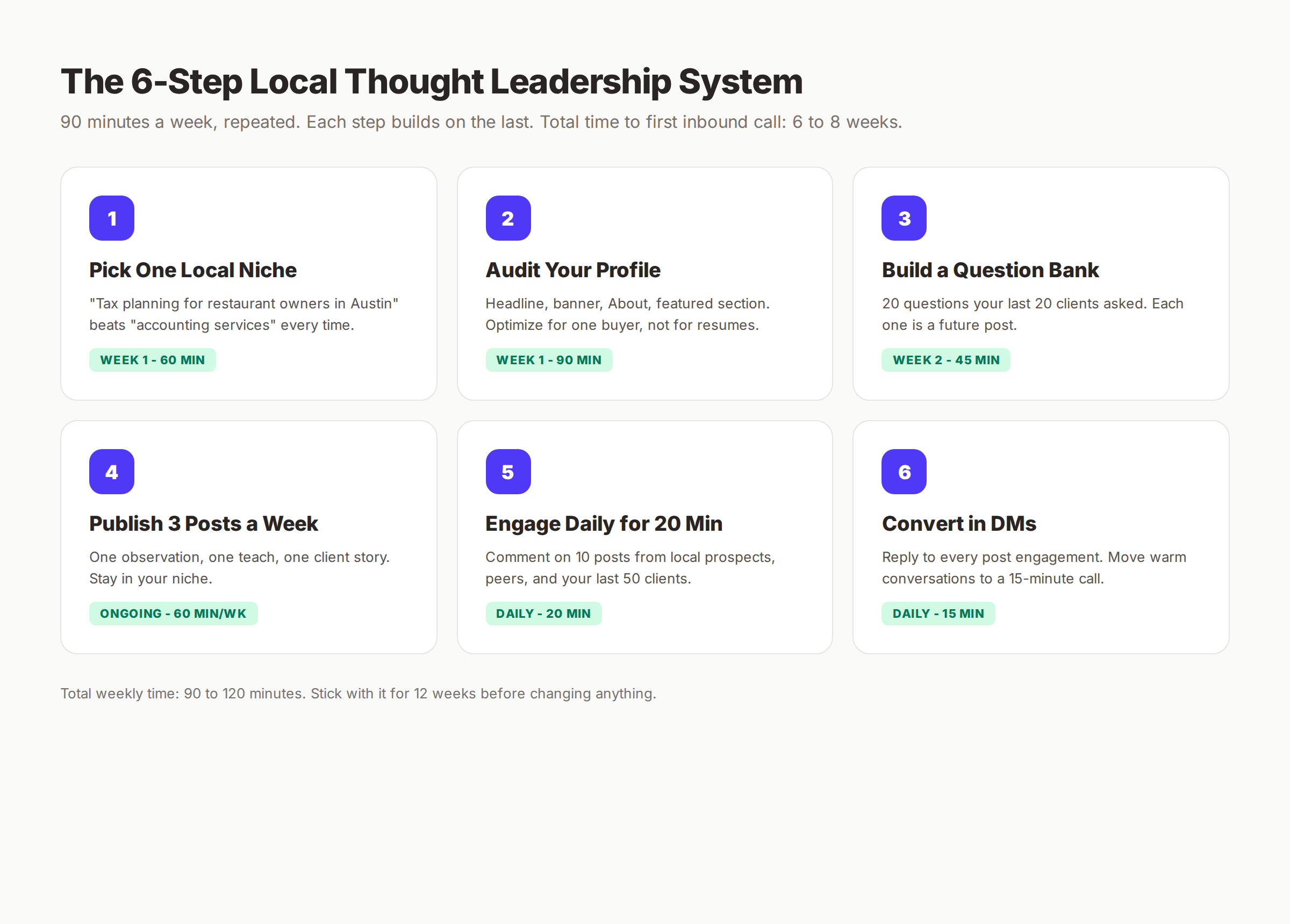
This is the system we run with local owners. Each step builds on the one before it. The full weekly time commitment is 90 to 120 minutes once the setup work is done.
Step 1: Pick One Local Niche
Niche is where everything begins. Without it, your content is one of 50,000 generic posts a day. With it, you are one of maybe 5 people writing about that exact thing in your city.
The format that works is [service] for [buyer] in [location].
- "Tax planning for restaurant owners in Phoenix"
- "Commercial leasing for medical practices in Nashville"
- "Cybersecurity for accounting firms in Charlotte"
- "Estate planning for second-generation business owners in Tampa"
The test is simple. If 3 of your last 10 ideal clients fit the description, you are too narrow. If 8 do, you are right. If all 10 do, you are too narrow again because you are describing your existing book, not your market.
Pick one. You can broaden later. You cannot earn authority while spreading thin.
Step 2: Audit and Rewrite Your Profile
Most LinkedIn profiles are resumes. Resumes are written for hiring managers. You are not looking for a job. You are looking for clients. Rewrite for them.
The 4 sections that matter:
| Section | What Hiring Manager Profiles Say | What Local Authority Profiles Say |
|---|---|---|
| Headline | "CPA, MBA, Partner at Smith & Associates" | "I help Phoenix restaurant owners cut tax bills by 20%" |
| Banner | Default LinkedIn blue | Custom banner with niche + city + phone |
| About | List of credentials and history | The result you deliver + 3 proof points + a soft CTA |
| Featured | Empty or random reposts | 3 items: lead magnet, top post, free consult link |
The headline carries the most weight because it shows everywhere. Every comment you make, every search you appear in, every connection request. Spend an hour getting it right.
Step 3: Build a 20-Question Bank
You do not need creative writing skills. You need to remember what your clients ask you.
Open a doc. List the last 20 questions your last 20 clients asked you in the discovery call, the first project, or a Slack message. Each question is a future LinkedIn post.
The questions are gold because they are real, they are specific to your niche, and they prove that other prospects with the same question exist. If 5 clients asked about S-corp elections, 500 prospects are searching for it.
Step 4: Publish 3 Posts a Week
The minimum cadence is 2 per week. The target cadence is 3. Above 4, most local owners burn out and quit.
Each post fits one of 3 buckets:
- Observation: "3 things I noticed in 14 returns I filed this month."
- Teach: "Here is the 4-step process I use to value a service business."
- Story: "A client called me Friday at 6pm with a 1099 emergency. Here is what we did."
Rotate the buckets so the feed stays varied. Stay inside your niche on every post.
Step 5: Engage Daily for 20 Minutes
This is the step that separates the owners who compound from the owners who plateau. Posting alone is not enough. You need to be visible in other people's feeds too.
The daily 20-minute routine:
- 5 minutes: Comment on 5 posts from local prospects (people you would like to work with)
- 5 minutes: Comment on 5 posts from local peers (other professionals in your network)
- 5 minutes: Reply to every comment on your own posts
- 5 minutes: Send 3 personalized connection requests to local people who engaged with your content
Do this 5 days a week. The compounding effect shows up around week 6.
Step 6: Convert Warm Conversations in DMs
LinkedIn DMs convert at 5 to 10x the rate of cold email when the conversation starts from organic content engagement. The playbook is short.
When someone comments on your post, reply to the comment first. If the comment shows real interest, send a follow-up DM within 24 hours. Keep it short.
A working template:
"Hey [name], your comment on my last post about [topic] was the most thoughtful one I got all week. Curious about your take on [related question]. Happy to compare notes over a 15-minute call if useful."
Half will ignore you. Half will reply. A third of the replies will book a call. A third of the calls will become clients.
The Three LinkedIn Ratios Local Owners Should Know
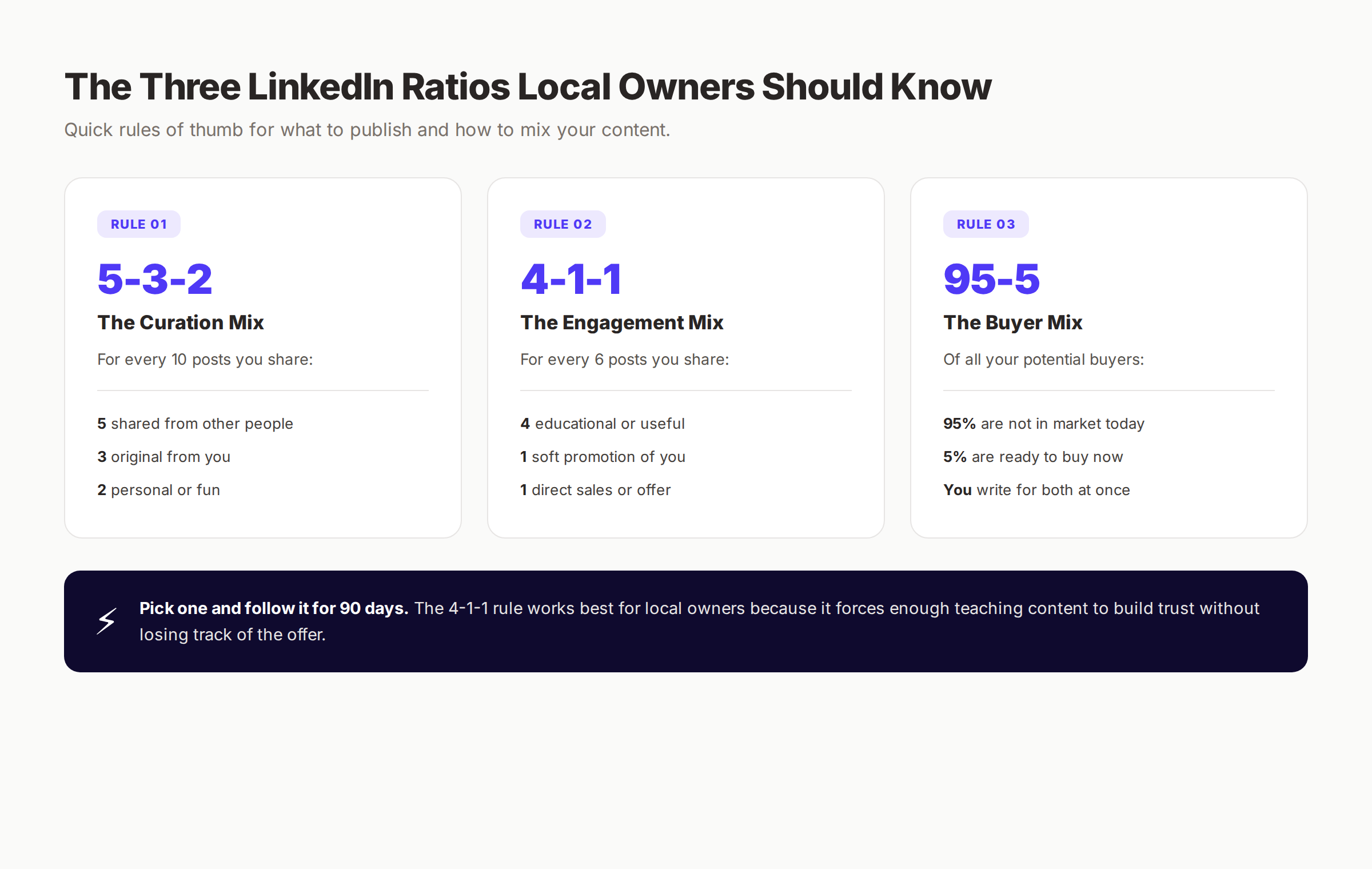
Three ratios get cited constantly in LinkedIn advice. Each one tells you something different about what to publish and how often.
The 5-3-2 Rule
For every 10 posts you share:
- 5 posts curated from other people (industry articles, peer content)
- 3 posts of original content from you
- 2 posts that are personal or fun
The 5-3-2 rule is too curation-heavy for local thought leadership. It made sense in 2015 when LinkedIn was a content-starved platform. Today, curation gets buried by the algorithm because it sends users off-platform. Skip this ratio.
The 4-1-1 Rule
For every 6 posts you share:
- 4 posts that are educational or useful
- 1 post that is a soft promotion of your work
- 1 post that is a direct sales offer or call to action
The 4-1-1 rule is the right ratio for local owners. The math works to roughly 18 posts a month with 12 teaching posts, 3 soft promos, and 3 direct offers. That is enough teaching to build trust without losing track of the offer.
The 95-5 Rule
This is not a posting ratio. It is a buyer ratio.
Research from the LinkedIn B2B Institute shows that 95% of your potential buyers are not in market today. Only 5% are ready to buy now.
The implication for local thought leadership is huge. If you only write content for the 5% who are ready to buy, your reach stays tiny and your pipeline stays seasonal. If you write content the 95% will save, share, or remember, you build mindshare that turns into pipeline 6 to 18 months later.
Mix every week. Some posts target the 5%. Most posts feed the 95%.
Six LinkedIn Post Types for Local Business Owners
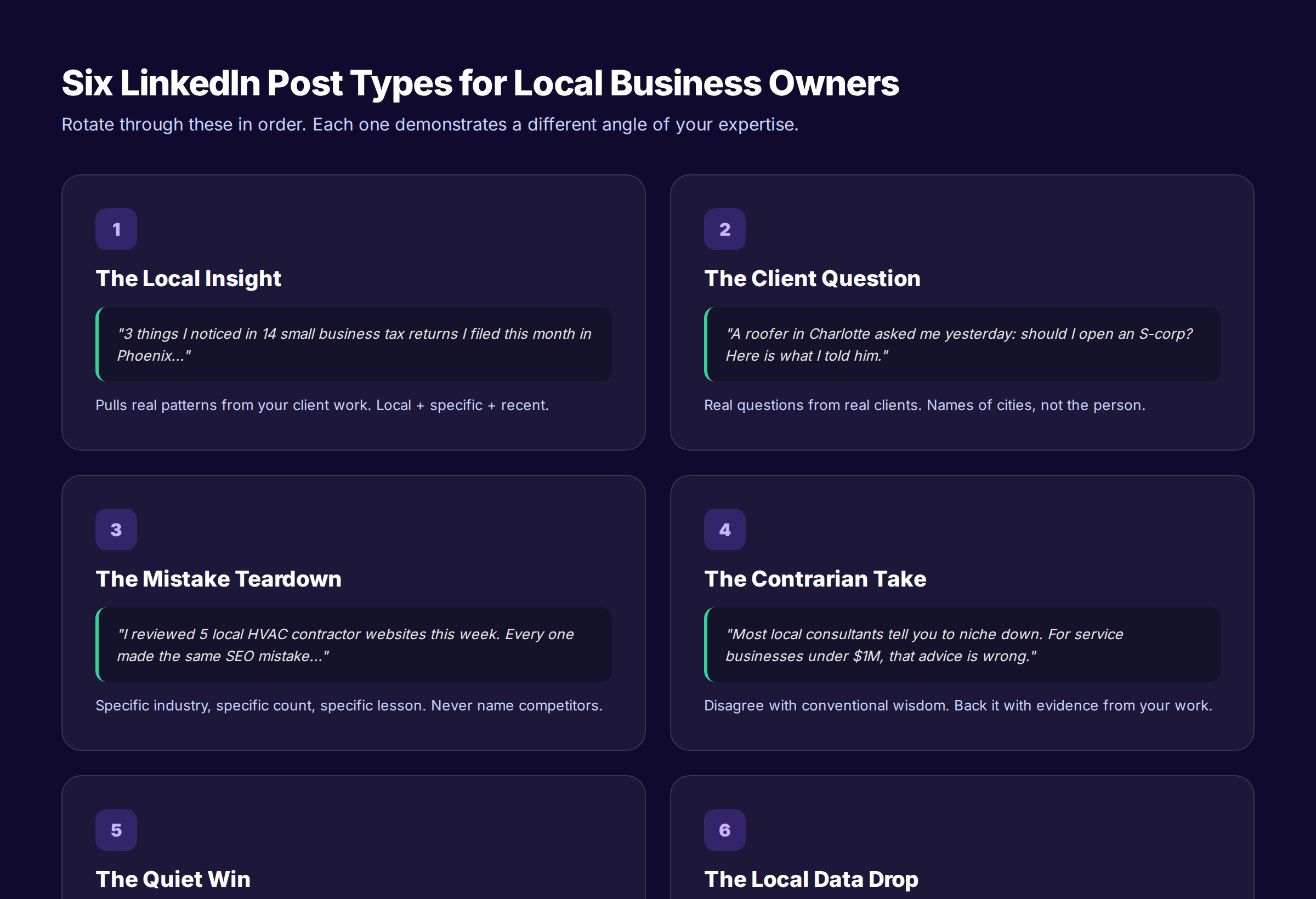
Stop staring at the blank page. These 6 post types cover 90% of what local owners should publish. Rotate through them. Keep them inside your niche.
Type 1: The Local Insight
You see patterns in your client work that nobody else sees. Pull them into a post.
Hook formula: "3 things I noticed in [N] [client interactions] I [action] this [time period]..."
Example: "3 things I noticed in 14 small business tax returns I filed this month in Phoenix. Every owner over $1M missed at least one of these deductions..."
Why it works: Specific numbers, recent timeframe, local geography, useful payoff. The reader assumes you know things they do not.
Type 2: The Client Question
The 20 questions from your question bank become posts.
Hook formula: "A [client type] in [city] asked me [time] : [question]. Here is what I told [him/her/them]."
Example: "A roofer in Charlotte asked me yesterday: should I open an S-corp at $480K in revenue? Here is exactly what I told him and the math behind it..."
Why it works: It tells the reader other people have the same question, gives a real answer, and proves you talk to real local clients.
Type 3: The Mistake Teardown
Audit work in your industry. Show what is broken. Never name competitors.
Hook formula: "I reviewed [N] local [business type] [items] this week. [Specific count] made the same [type of mistake]..."
Example: "I reviewed 5 local HVAC contractor websites this week. 4 of them missed the same Google Business Profile category that costs them roughly 30% of map pack visibility..."
Why it works: Specific count creates credibility. Naming the mistake teaches. Avoiding competitor names keeps you classy.
Type 4: The Contrarian Take
Disagree with conventional wisdom. Back it with what you have seen in your own work. Stay polite.
Hook formula: "Most [experts/advisors] tell [audience] to [common advice]. For [specific local segment], that advice is [wrong/incomplete/expensive]."
Example: "Most consultants tell local service businesses to niche down hard. For HVAC contractors under $1M doing residential work, the advice costs more than it makes..."
Why it works: It stops the scroll. It marks you as a thinker, not a parrot. It earns comments from people who agree and people who disagree.
Type 5: The Quiet Win
Short personal stories with specifics. No humble-brags.
Hook formula: A 1-line story opener. No setup.
Example: "A client just renewed for year 4. Our first meeting was a 22-minute coffee where I almost did not show up because my kid was sick. Lesson: show up anyway..."
Why it works: Specifics make it real. The lesson is universal. The post earns trust without performing emotion.
Type 6: The Local Data Drop
Numbers your prospects cannot easily find anywhere else. Pull from your client work or public local sources.
Hook formula: "[Local metric] moved [N]% in [time period]. Here is what that means for [audience]."
Example: "Average commercial lease rate in downtown Nashville moved 11% in 9 months. Here is what that means for tenants negotiating renewals this year..."
Why it works: Numbers create authority. Local numbers create uniqueness. The implication makes the post useful, not just informative.
Stop guessing what to write each week. theStacc Social handles 30 posts a month across LinkedIn, Instagram, and Facebook for $49. Pair it with our blog service and your local authority compounds. See Social Media plans →
How to Rewrite Your LinkedIn Profile
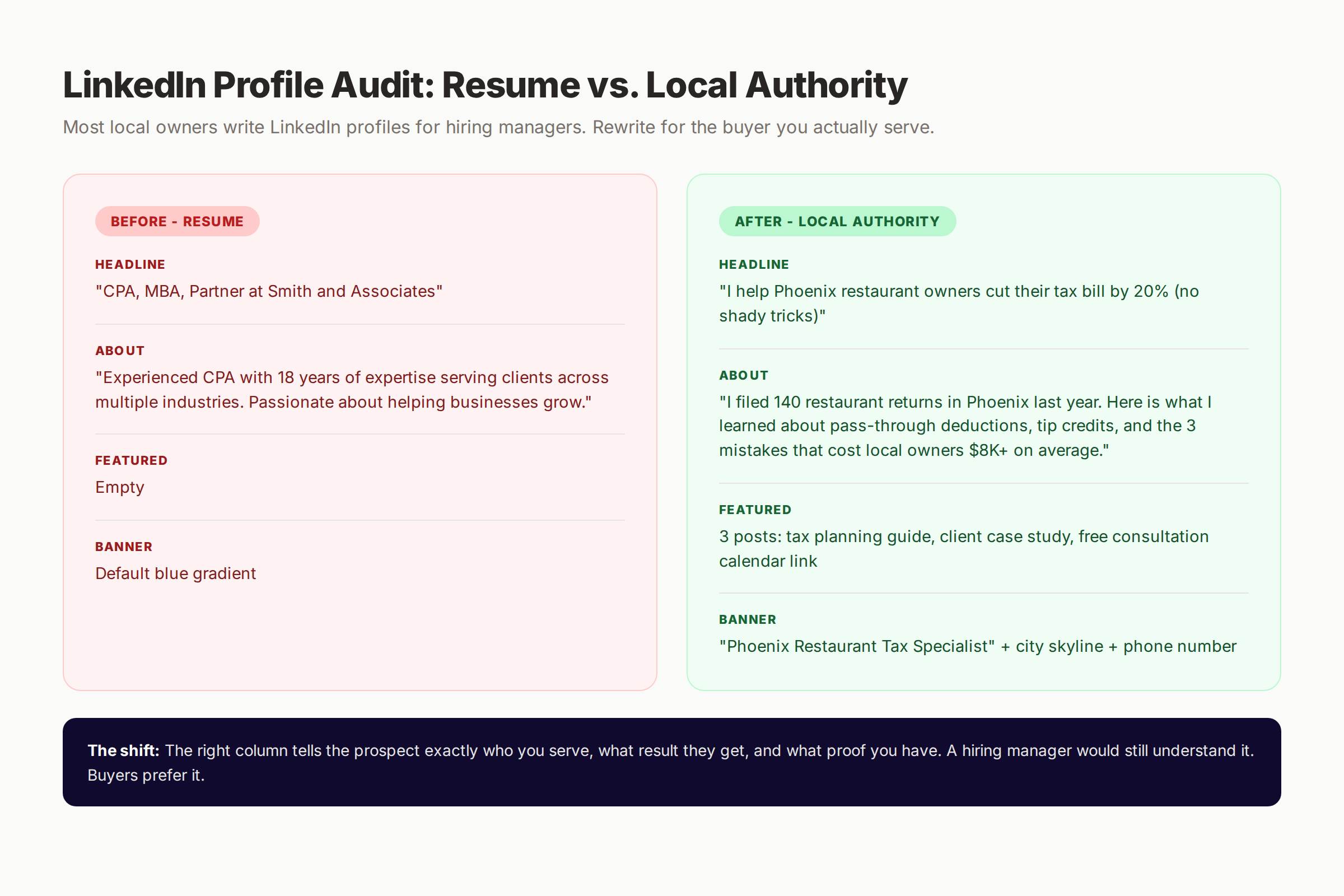
Profile rewrites take 60 to 90 minutes. Do it once and forget it for 6 months.
The Headline
You have 220 characters. The default urge is to list your title and credentials. Resist it.
The formula that works for local thought leadership:
[Verb] + [specific local buyer] + [specific result] + [proof or qualifier]
Examples:
- "I help Phoenix restaurant owners cut their tax bill by 20% (no shady tricks)"
- "Commercial leasing attorney for Nashville medical practices | 140+ deals closed"
- "Cybersecurity for Atlanta accounting firms | Former IRS auditor turned CISSP"
What to remove: MBA, MS, your firm name, the word "expert" (let the reader decide), generic words like "passionate" or "driven."
The Banner
The LinkedIn banner is the most underused screen on the platform. Build a custom one in Canva in 20 minutes.
What goes on it:
- Your niche restated visually ("Phoenix Restaurant Tax Specialist")
- Your city or skyline
- Your phone or booking link
- A subtle proof element (years experience, deals closed, clients served)
What to skip: stock photos of handshakes, generic motivation quotes, your face larger than the text.
The About Section
Most About sections read like a wedding speech written by a corporate lawyer. Rewrite in 4 short blocks.
Block 1 (1-2 sentences): Who you serve and the result you deliver. Mirror the headline.
Block 2 (3-5 lines): A specific number or story that proves you do the work. "I filed 140 restaurant returns in Phoenix last year. Here is what I learned about..."
Block 3 (3-4 bullet points): Specific services or focus areas.
Block 4 (1-2 sentences): A soft call to action. "If you run a restaurant in Phoenix and want a tax review before April, you can book a 20-minute call at [link]."
The total length should be 200 to 350 words. Beyond that, nobody finishes.
The Featured Section
Three featured posts is the magic number. Pick:
- Your highest-performing post of all time
- A lead magnet or guide
- A direct link to your calendar or contact form
Rotate the lead magnet every 60 days. Leave the highest-performing post for 6 to 12 months.
The 90-Day Local Thought Leadership Plan
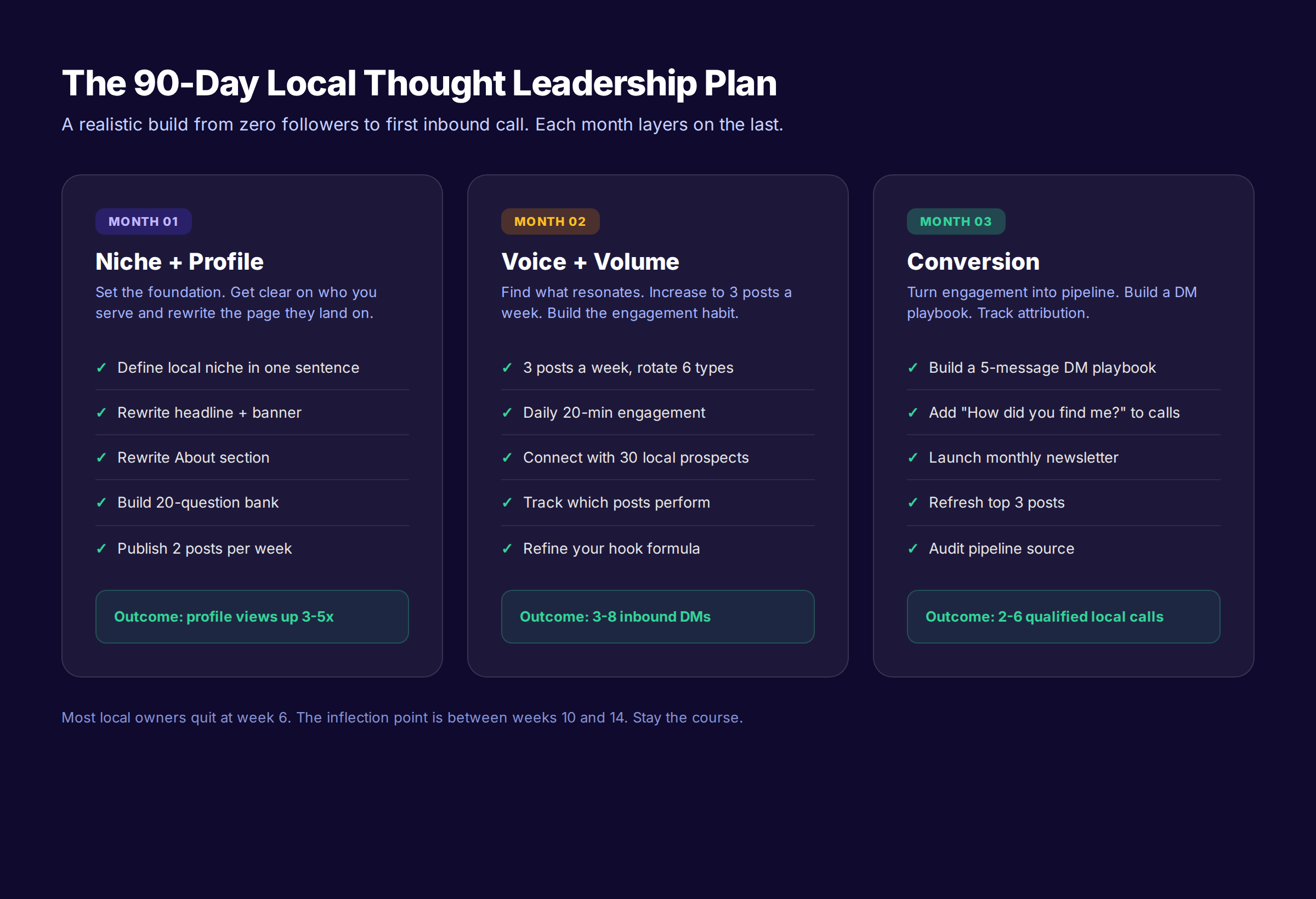
The system needs 90 days to compound. The first 4 to 6 weeks feel slow. The next 6 weeks earn quiet momentum. Weeks 10 to 14 are where most owners see their first qualified inbound call.
Month 1: Niche + Profile (Foundation)
Goal: Set the foundation. Get clear on who you serve. Rewrite the profile they land on.
Weekly tasks:
- ✓ Week 1: Define local niche in one sentence. Rewrite headline.
- ✓ Week 2: Rewrite About section and banner. Add 3 Featured items.
- ✓ Week 3: Build the 20-question bank. Publish 2 posts.
- ✓ Week 4: Publish 2 posts. Start daily 20-minute engagement.
Expected outcome: Profile views up 3 to 5x. First 5 to 10 inbound connection requests from local prospects.
Month 2: Voice + Volume (Optimization)
Goal: Increase to 3 posts a week. Test all 6 post types. Find what resonates with your local audience.
Weekly tasks:
- ✓ Week 5: 3 posts (rotate types 1, 2, 3). 20-min daily engagement.
- ✓ Week 6: 3 posts (rotate types 4, 5, 6). Connect with 10 local prospects.
- ✓ Week 7: 3 posts. Track which types perform. Refine your hook formula.
- ✓ Week 8: 3 posts. Refresh your top performer with a new angle.
Expected outcome: 3 to 8 inbound DMs. Profile views up 5 to 10x baseline. First call booked.
Month 3: Conversion (Pipeline)
Goal: Turn engagement into actual pipeline. Build a DM playbook. Track attribution back to LinkedIn.
Weekly tasks:
- ✓ Week 9: 3 posts. Draft 5-message DM playbook. Send 3 warm DMs.
- ✓ Week 10: 3 posts. Add "How did you find me?" to discovery calls.
- ✓ Week 11: 3 posts. Launch a monthly LinkedIn newsletter for your niche.
- ✓ Week 12: 3 posts. Audit pipeline source. Refresh top 3 posts.
Expected outcome: 2 to 6 qualified local calls per month. LinkedIn becomes a tracked pipeline source.
The owners who quit at week 6 miss the inflection point. The owners who finish week 12 build a compounding asset.
How to Connect LinkedIn to Local SEO and Google Business Profile
LinkedIn thought leadership does not exist in a vacuum. Pair it with your other local channels and the system compounds faster.
Link from LinkedIn to your blog. Drop the link to your local SEO guide or city-specific landing pages in the first comment of relevant posts, not the post itself. Comment-links keep your post reach intact while still driving traffic.
Cite your own content. When you publish a long-form blog on your site, share the key insight as a LinkedIn post 48 hours later. Your audience sees both. The blog ranks. The post earns engagement.
Mention LinkedIn in your Google Business Profile. Add your LinkedIn URL to your Google Business Profile listing as a social link. It rarely moves rankings, but local searchers who land on your GBP and want more proof will click through.
Repurpose for Instagram for local business and Facebook for local business. A good LinkedIn post becomes a square image quote for Instagram in 5 minutes. A 6-post LinkedIn week turns into 18 weekly assets across 3 platforms with 30 extra minutes of work.
Track attribution in every discovery call. Add one question: "How did you find me?" Most local owners skip this and lose visibility into which channels are actually driving pipeline. After 90 days, you will see exactly which LinkedIn posts are turning into clients.
Mistakes That Kill Local LinkedIn Thought Leadership
After watching hundreds of local owners try this, these are the mistakes that show up most often.
Mistake 1: Posting From the Company Page Only
The company page is for credentials and proof. The personal profile is for content. Personal profiles get up to 5x more organic reach. Post from your personal profile. Reshare from the company page if you want.
Mistake 2: Writing for a National Audience
A consultant in Charlotte writes about "remote work culture" and competes with 40,000 other consultants. A consultant in Charlotte who writes about "remote work culture in manufacturing companies in the Carolinas" competes with maybe 20. Niche wins.
Mistake 3: Linking Out of LinkedIn in the Post
LinkedIn buries posts with external links because it loses ad inventory. Put the link in the first comment instead. Reach stays high. Traffic still flows.
Mistake 4: Posting and Ghosting
A post you publish but never engage with after 60 minutes dies. The first hour is when the algorithm decides whether to amplify. Reply to every comment for the first hour. The bump in reach is real.
Mistake 5: Trying to Be Everywhere
LinkedIn, Instagram, TikTok, X, YouTube, podcasts, and blogs. Most local owners try all 7 and finish none. Pick LinkedIn plus 1 owned channel (blog) plus 1 social repurpose channel. Run that for 12 months before adding anything.
Mistake 6: Quitting at Week 6
The compounding shows up at week 10 to 14. Most owners quit at week 6 because they have not seen results yet. Tell yourself before you start that you will publish 36 posts before you evaluate. Then evaluate at post 36, not before.
theStacc takes content off your plate so you can focus on LinkedIn. Our blog service publishes 30 SEO articles a month so your owner-led LinkedIn presence stays where it should be: on you. See pricing →
Tools You Need (and the Ones You Do Not)
The tool stack stays small on purpose. Tool sprawl is what kills the system before it has a chance to work.
| Tool | What For | Cost |
|---|---|---|
| LinkedIn (native) | Posting, engagement, DMs | Free |
| LinkedIn Premium Business | Search filters, InMail, who-viewed-your-profile | $60/mo |
| Canva | Banner, image quotes, document carousels | Free or $13/mo |
| A simple doc or Notion | Question bank, content calendar | Free |
| Calendly or SavvyCal | Booking link in Featured section | Free or $12/mo |
What you do not need: AI writing tools, scheduling tools, analytics suites, automation tools. Scheduling tools actually hurt reach because native LinkedIn posts outperform scheduled posts by 12 to 30%. Post from the native app or website.
If you want to delegate content production while keeping the LinkedIn presence yours, our content strategy team handles the heavy lift on blog and social, leaving your personal profile fully owner-led.
What practitioners are saying on X
Marketing systems still win. Here is operator signal from X on SEO stacks and fundamentals.
- @jakezward (Feb 2026): 2026 SEO predictions emphasize AI Overview share-of-SERP, schema for LLM token efficiency, brand mentions in AI answers as a KPI, proprietary data as a moat, and content refresh beating net-new AI slop. See the post on X.
- @ConnorGillivan (Jul 2026): 2026 SEO stack favorite list: Semrush/Ahrefs, GSC, Surfer, KeywordInsights, ChatGPT, SEOwind, Screaming Frog, ClearScope, GA4, Notion/Airtable — tools amplify systems, they don’t replace them. See the post on X.
- @HlynurStefDev (Jul 2026): Public case: niche site traffic jumped from ~18 to 4,162 Google visits/month after focused technical/on-page SEO work (GSC screenshots claimed) — reminds that fundamentals still move numbers. See the post on X.
Grok, AI Overviews, and multi-engine visibility
Local topics like “linkedin thought leadership local” get cited when GBP, NAP, reviews, and service-area steps are concrete. Grok mixes those web facts with Map Pack operator advice circulating on X.
- Google AI Overviews: Use passage-ready answers, tables, and FAQ schema where relevant.
- ChatGPT / Perplexity: Cite named sources next to key claims.
- Grok: Maintain accurate entity facts on-site and in high-signal X posts.
Frequently Asked Questions
The 5-3-2 rule is an older content mix recommendation. For every 10 posts, share 5 pieces curated from others, 3 pieces of original content, and 2 personal or fun posts. It worked when LinkedIn was content-starved but is outdated today. The algorithm now penalizes external links and rewards original posts. Most local owners should ignore the 5-3-2 rule and follow the 4-1-1 rule instead.
The 95-5 rule comes from the LinkedIn B2B Institute. It states that 95% of your potential buyers are not in market today. Only 5% are ready to buy this quarter. The implication for thought leadership is that you should write most of your content for the 95% who will remember you when they enter the market in 6 to 18 months, not just the 5% looking right now.
Pick one specific local niche, rewrite your profile for that buyer, build a question bank from real client conversations, publish 3 posts a week using 6 rotating post types, engage 20 minutes daily, and convert warm conversations in DMs. Commit to 90 days before evaluating. Most local owners see their first inbound call between weeks 10 and 14.
The 4-1-1 rule is a posting mix. For every 6 posts you share, 4 should be educational or useful, 1 should be a soft promotion of you or your work, and 1 should be a direct sales call to action. The ratio works well for local owners because it forces enough teaching to build trust without losing track of the offer.
The post types that perform best in 2026 are document carousels (highest engagement rate), text-only posts with strong hooks (highest reach for personal profiles), and short native video (best for trust building). Posts that include specific numbers, recent timeframes, and a clear point of view outperform generic posts by a wide margin. For local owners, posts that name a specific city, a specific industry, and a specific result get the most engagement from qualified local prospects.
The honest timeline is 10 to 14 weeks before most local owners see their first inbound call. Profile views and connection requests start moving in week 2 to 4. Comment engagement picks up by week 6. DMs from prospects start arriving by week 8. The first qualified call usually arrives between weeks 10 and 14. Anyone telling you it happens faster is selling something.
Personal profile, almost always. LinkedIn's algorithm gives personal profiles up to 5x the organic reach of company pages. For local thought leadership, the owner's voice carries trust that a company page cannot match. Use the company page for credentials, case studies, and proof. Post original content from your personal profile.
Final Word
LinkedIn thought leadership is the cheapest, highest-return marketing channel a local business owner has access to in 2026. The setup is one weekend. The weekly maintenance is 90 minutes. The compounding is real but it only happens if you stay in the seat for at least 12 weeks.
Pick one niche. Rewrite your profile. Publish 3 posts a week. Engage 20 minutes a day. Reply to every DM. Track attribution. Do that for 90 days and you will become the most-cited local expert in your category before most of your competitors finish their first 5 posts.
The owners who win this channel are not the ones with the biggest networks or the cleverest writing. They are the ones who showed up every week for a year while everyone else gave up at week 6.
Sources & references
- [1] Princeton / Georgia Tech et al. — GEO research (arXiv:2311.09735)
- [2] @noelcetaSEO on X — Local SEO playbook still centers complete GBP, NAP consistency, quality citations, local keywords, location content, rev
- [3] @irentdumpsters on X — Most businesses have a GBP; few fully optimize every ranking-relevant section for Map Pack visibility.
- [4] @EldarCohenSEO on X — 2026 WhiteSpark-oriented reminder: primary Google Business category is a top Map Pack ranking factor — wrong primary cat
- [5] Referenced source — www.edelman.com

Researched, written, and published articles that compound organic traffic.
Weekly local SEO teardowns
One practical email a week. Map Pack, GBP, AI Overviews — no fluff. Unsubscribe anytime.