
Massage Therapy SEO: The Complete Guide (2026)
The complete massage therapy SEO guide. Google Business Profile, service pages, reviews, local keywords, and content strategy to book more clients. Updated April 2026.
Siddharth Gangal • 2026-04-02 • Local SEO
In This Article
The U.S. massage therapy industry generates $18.9 billion in annual revenue. 46% of all Google searches have local intent. When a potential client searches “massage therapist near me,” the 3 businesses in the Map Pack get the majority of clicks.
Most massage therapists rely on word-of-mouth and social media. Both work. Neither scale predictably. Massage therapy SEO builds a booking pipeline that grows every month without increasing your marketing spend.
88% of people who search for a local service on mobile visit a business within 24 hours. If your practice does not appear in local search results, you lose that client to the therapist who does. Every single time.
This guide covers every element of massage therapy SEO. From Google Business Profile optimization to service page structure, keyword strategy, reviews, and the content that attracts clients at every stage of the booking journey.
We have published 3,500+ blogs across 70+ industries. Our average SEO score is 92%. We work with wellness and healthcare businesses every day.
Here is what you will learn:
- How to optimize your Google Business Profile for the Map Pack
- The exact service page structure that ranks for massage keywords
- A keyword strategy built around treatment types and local intent
- How to turn Google reviews into a ranking and booking tool
- Content ideas that attract clients year-round
- Technical SEO basics every massage therapy website needs
- How to track results and measure SEO ROI
Why Massage Therapy SEO Beats Paid Ads
Google Ads for massage keywords cost $3 to $15 per click depending on your market. A therapist spending $1,000 per month on ads generates 70 to 300 clicks. At a 5% conversion rate, that is 4 to 15 new bookings.
The leads stop the moment the budget stops.
The Compounding Advantage
A service page ranking for “deep tissue massage in [city]” generates free clicks every month. After 6 months, you have multiple pages ranking for different treatments and locations. After 12 months, organic traffic can replace most of your paid spend.
SEO compounds. Paid ads do not. That is the core difference for a practice that wants to grow without endlessly increasing ad budgets.
The Local Search Opportunity
Massage therapy is inherently local. Clients choose a therapist within driving distance. Google understands this and prioritizes local SEO signals for “near me” and city-based searches.
The massage industry is fragmented. No single brand dominates local search in most markets. A solo practitioner or small practice with 10 optimized pages and 50+ Google reviews can outrank larger competitors in their area.
What Most Guides Miss
Most massage therapy SEO advice is surface-level: “claim your Google listing” and “post on social media.” This guide gives you the exact page structure, keyword categories, and process for every element. Including the treatment-specific content strategy that most guides skip entirely.
Google Business Profile: Your Map Pack Foundation
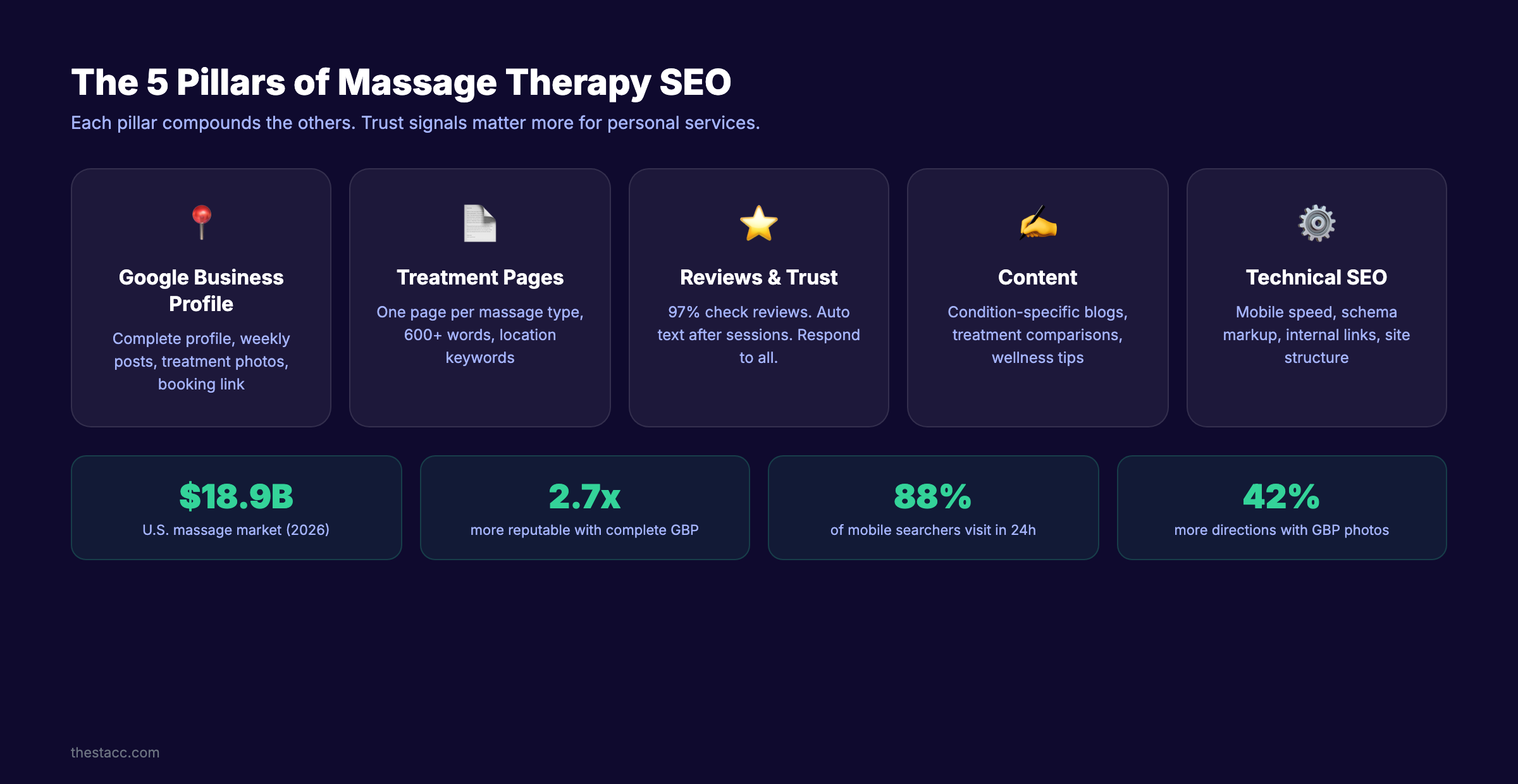
Your Google Business Profile (GBP) drives Map Pack visibility. Businesses with a complete GBP profile are 2.7x more likely to be considered reputable. For massage therapists, the Map Pack is where most new clients discover your practice.
Category Selection
Choose the right primary category. This determines which searches trigger your listing.
| Practice Type | Primary GBP Category | Secondary Categories |
|---|---|---|
| General massage | Massage Therapist | Massage Service |
| Sports-focused | Sports Massage Therapist | Massage Therapist |
| Medical/clinical | Massage Therapist | Medical Spa, Physical Therapy Clinic |
| Spa setting | Massage Service | Day Spa, Massage Therapist |
Complete Every Field
Incomplete profiles rank lower. Fill out everything Google provides.
- Business name: Exact legal name. Do not add keywords like “Best Massage Therapist Austin.”
- Description: 750 characters covering your specialties, credentials, location, and what makes your practice different.
- Services: List every treatment type with description and price range. Swedish, deep tissue, sports, prenatal, hot stone, trigger point, myofascial release.
- Appointment URL: Link directly to your online booking system. Remove friction from search to booking.
- Hours: Accurate hours including evening and weekend availability. Many clients book outside business hours.
- Photos: Treatment rooms, reception area, exterior of building, team photos. Businesses with photos get 42% more direction requests. Upload 5+ new photos per month.
Post Weekly
GBP posts signal an active business. Post at least once per week.
Post ideas for massage therapists:
- Tips for muscle recovery after workouts
- Benefits of specific massage types (deep tissue, prenatal, sports)
- Client success stories (with permission)
- Special offers (first-visit discount, package deals)
- Seasonal wellness tips (holiday stress relief, summer sports recovery)
Each post should include a call to action: “Book Now,” “Schedule Today,” or “Call to Reserve.”
Stop writing. Start ranking. Stacc publishes 30 SEO articles per month for $99. Plus Google Business Profile posts on autopilot. Start for $1 →
Massage Therapy Keywords: What Clients Search
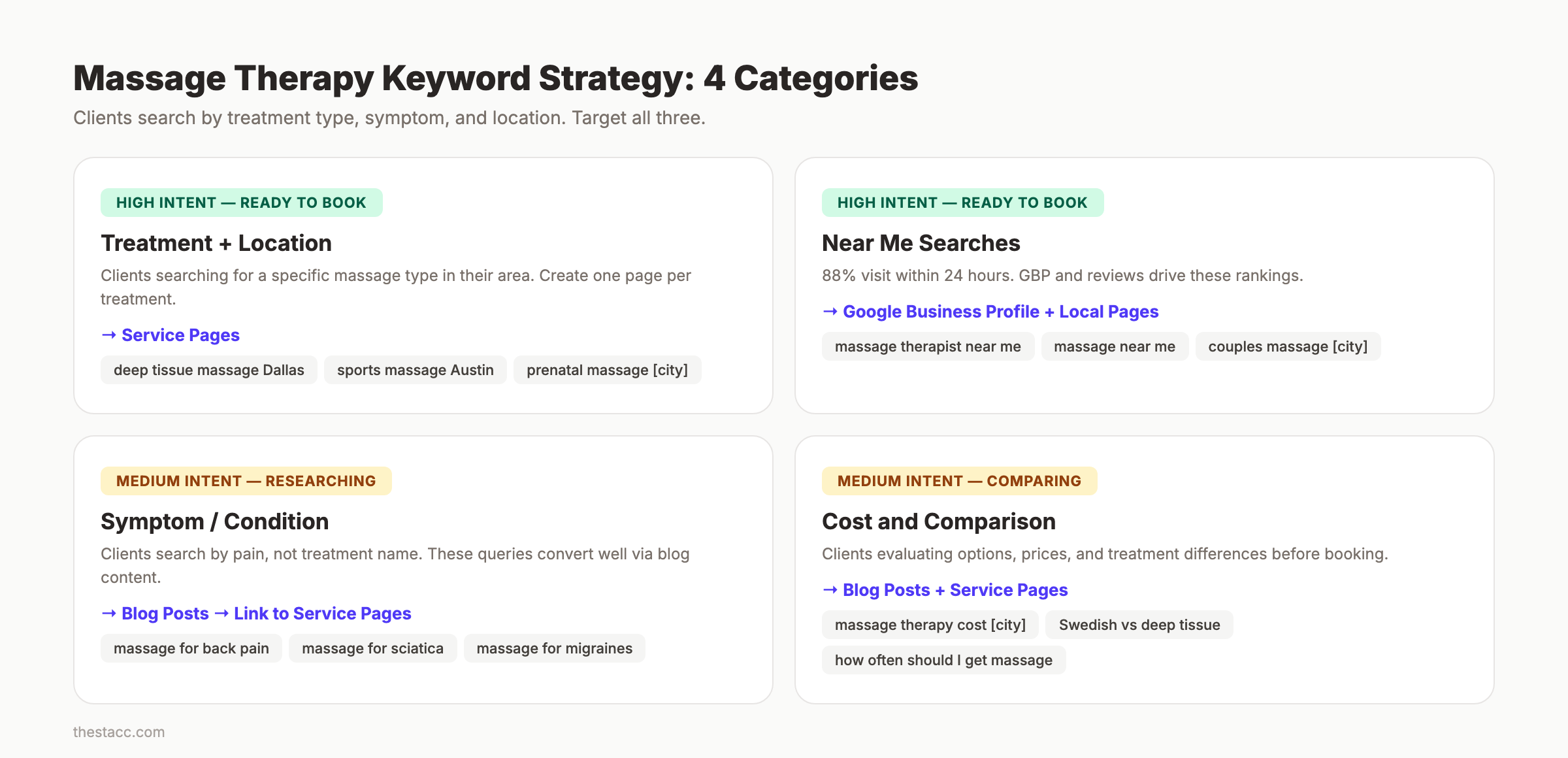
Keyword research for massage therapists follows client intent. People search by treatment type, symptom, and location. Understanding these patterns shapes your entire content strategy.
The 4 Keyword Categories
| Category | Example Keywords | Intent | Content Type |
|---|---|---|---|
| Treatment + Location | ”deep tissue massage Dallas,” “sports massage Austin” | High (ready to book) | Service pages |
| Near Me | ”massage therapist near me,” “massage near me” | High (ready to book) | GBP + local pages |
| Symptom/Condition | ”massage for back pain,” “massage for sciatica” | Medium (researching) | Blog posts |
| Cost/Comparison | ”massage therapy cost,” “Swedish vs deep tissue” | Medium (evaluating) | Blog + service pages |
High-Value Treatment Keywords
Each treatment type deserves its own dedicated service page.
Relaxation treatments:
- Swedish massage + [city]
- Relaxation massage + [city]
- Hot stone massage + [city]
- Aromatherapy massage + [city]
Therapeutic treatments:
- Deep tissue massage + [city]
- Sports massage + [city]
- Trigger point therapy + [city]
- Myofascial release + [city]
Specialty treatments:
- Prenatal massage + [city]
- Couples massage + [city]
- Lymphatic drainage massage + [city]
- Cupping therapy + [city]
Condition-specific (blog keywords):
- Massage for lower back pain
- Massage for neck and shoulder tension
- Massage for sciatica relief
- Massage for headaches and migraines
- Massage for runners/athletes
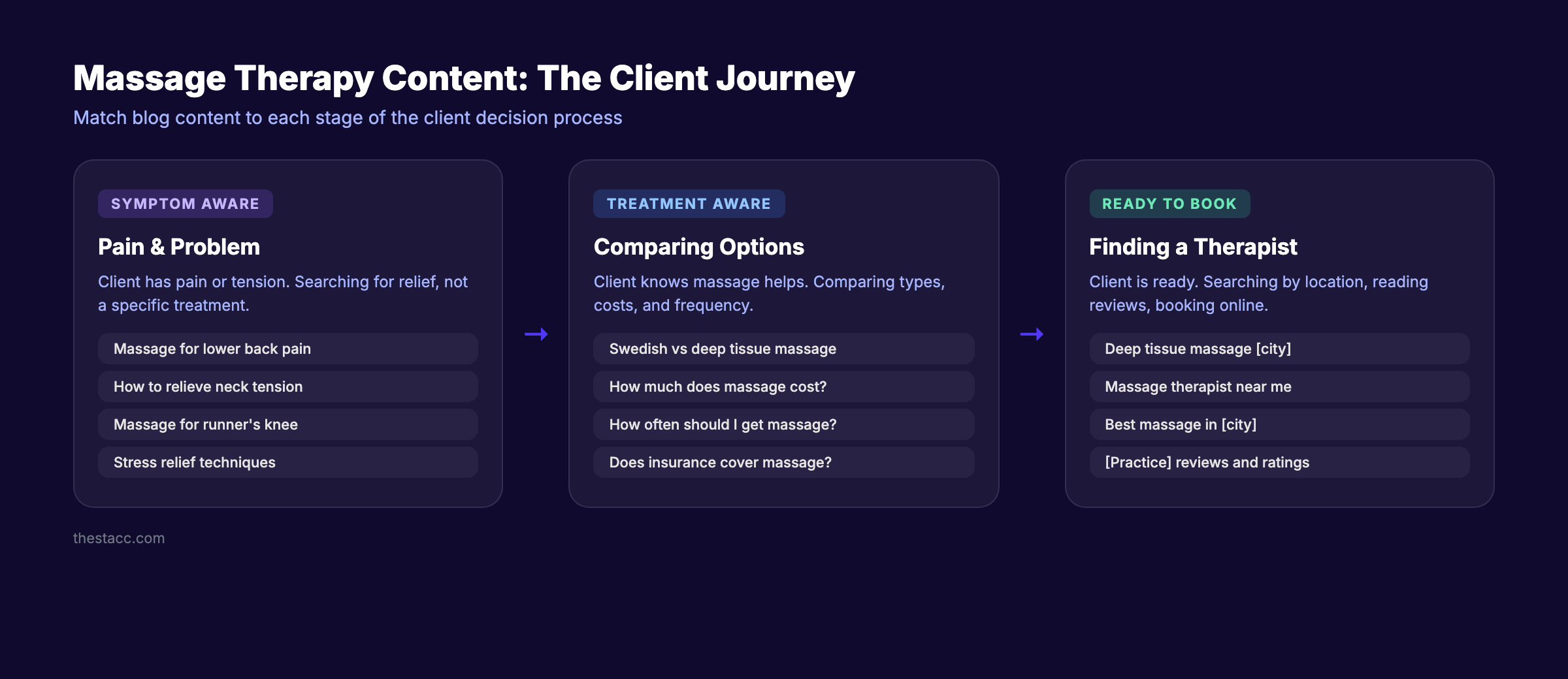
Symptom-Based Keywords Convert Well
Clients often search by symptom rather than treatment name. “Massage for lower back pain” gets searched far more than “myofascial release for lumbar region.”
Write blog content targeting these symptom-based queries. Then link from the blog post to the relevant service page. A client reading about massage for back pain is one click from booking a deep tissue session.
Target these through keyword-optimized blog posts that answer the exact question the client is asking.
Service Pages: One Page Per Treatment
A single “Services” page listing Swedish, deep tissue, sports, and prenatal massage together will not rank for any of those keywords individually. Each treatment needs its own page.
Why Individual Pages Win
Google ranks pages, not websites. A page titled “Deep Tissue Massage in Austin” targets that specific keyword. A page titled “Our Services” targets nothing.
Individual service pages give you:
- A unique URL ranking for each treatment keyword
- Space for treatment-specific content (600+ words)
- Schema markup for each service
- A dedicated landing page for ads
- Internal linking between related treatments
The Ideal Service Page Structure
1. H1 with treatment + location Example: “Deep Tissue Massage in Austin, TX”
2. Opening paragraph (60 to 80 words) What the treatment is, who benefits most, and why clients choose your practice. Include the primary keyword in the first sentence.
3. What to expect (H2) Walk the client through the experience. How long is the session. What do they wear. What does the therapist do. First-time clients search this because they want to feel prepared and comfortable.
4. Benefits (H2) List 5 to 8 specific benefits. Use bullet points. Pain relief, stress reduction, improved mobility, better sleep, faster recovery. Focus on outcomes the client cares about.
5. Who benefits most (H2) Athletes, office workers with desk posture, pregnant women, people recovering from injury. This helps Google match your page to specific search intent.
6. Pricing (H2) Clients search for pricing. “60-minute deep tissue massage: $90 to $120” is more useful than “Contact us for pricing.” Transparency builds trust and reduces friction.
7. FAQ section (H2) Answer 4 to 6 common questions. “How often should I get a deep tissue massage?” “Does deep tissue hurt?” Add FAQ schema for rich results.
8. Call to action “Book Your Session” with a direct link to your scheduling tool. Include phone number for clients who prefer calling.
Minimum Content Length
Each service page needs 600+ words. The top-ranking massage service pages average 800 to 1,200 words. Every sentence should educate, build trust, or move the client closer to booking.
Reviews: The Trust Signal That Books Clients
97% of consumers read online reviews before choosing a local business. For massage therapy, reviews carry extra weight. Clients are letting a stranger touch their body. Trust is not optional.
Why Reviews Matter More for Massage
Massage is a personal, physical service. Clients need to feel safe and confident before booking. A practice with 80 reviews and a 4.9 rating communicates professionalism and client satisfaction in a way that no website copy can.
Review velocity matters more than total count. A therapist who gets 5 new reviews per month outranks one with 100 total reviews but nothing recent.
How to Get Reviews Consistently
The best time to ask is right after a great session. The client is relaxed, satisfied, and grateful.
Review generation checklist:
- Ask at the end of the session while the client is still in the room
- Send an automated text or email 2 hours after the appointment
- Include a direct review link in follow-up messages
- Place a QR code at the front desk or checkout area
- Mention reviews during rebooking conversations
- Respond to every review within 48 hours
The automated text 2 hours after the session is the highest-converting method. The client has left but the positive experience is still fresh.
Responding to Reviews
Respond to every review. Positive and negative.
Positive: Thank the client. Mention their treatment or what they enjoyed. “Thanks for the kind words about your deep tissue session. We are glad the shoulder tension is improving.”
Negative: Acknowledge the concern. Apologize. Offer to resolve offline. Never argue or share client details. A professional response often impresses prospective clients more than the review itself.
For more strategies, see our guide on getting more Google reviews for local businesses.
Your SEO team. $99 per month. 30 optimized articles published automatically. Built for local service businesses like massage practices. Start for $1 →
Content Strategy: Blog Posts That Attract Clients
Massage therapy content serves 2 purposes: ranking for informational keywords and building topical authority that strengthens your service pages.
Content Topics That Work
Condition-specific content (highest conversion):
- “5 Ways Massage Helps Lower Back Pain”
- “Massage Therapy for Sciatica: What to Expect”
- “How Massage Reduces Migraine Frequency”
- “Massage for Runners: Recovery and Performance Benefits”
Treatment comparison content:
- “Swedish vs. Deep Tissue Massage: Which Is Right for You?”
- “Hot Stone vs. Swedish Massage: Benefits Compared”
- “How Often Should You Get a Massage?”
- “What to Expect at Your First Massage Appointment”
Cost and practical content:
- “How Much Does Massage Therapy Cost in [City]?”
- “Does Insurance Cover Massage Therapy?”
- “How to Choose a Massage Therapist”
- “Massage Therapy for Stress: What the Research Shows”
Seasonal and wellness content:
- “Holiday Stress Relief: How Massage Helps”
- “Pre-Marathon Massage: When to Book and What to Expect”
- “Desk Worker Stretches to Pair with Regular Massage”
- “Self-Care Between Sessions: At-Home Recovery Tips”
Publishing Frequency
The massage practices ranking highest publish 8 to 12 blog posts per month. Most therapists publish zero. That gap is your competitive advantage.
Consistent publishing builds topical authority. Google sees a site with 40 massage-related articles as more authoritative than one with 4. You do not need to write every post. A content automation approach lets you publish at volume without sacrificing treatment time.
Link Blog Posts to Service Pages
Every blog post should link to at least 1 relevant service page. A post about “massage for lower back pain” should link to your deep tissue massage service page. That internal link passes authority and creates a clear path from education to booking.
Technical SEO for Massage Therapy Websites
Technical SEO ensures Google can find, crawl, and rank your pages. Most massage therapy websites have fixable issues.
Mobile Optimization
Over 70% of “near me” searches happen on mobile. A client with a sore neck is searching on their phone. Your site must work perfectly on mobile.
Mobile checklist:
- Pages load in under 3 seconds
- Phone numbers are tap-to-call
- Online booking works on mobile
- Text is readable without zooming
- Images resize correctly
- “Book Now” button is visible without scrolling
Test with Google PageSpeed Insights. Fix anything below 80. Core Web Vitals are a confirmed ranking factor.
Schema Markup
Schema markup helps Google understand your business. For massage therapists, 3 types matter:
LocalBusiness schema: Name, address, phone, hours, service area. Use the more specific “HealthAndBeautyBusiness” type.
Service schema: Identifies each treatment you offer. Helps Google match your pages to service-specific queries.
FAQPage schema: Turns FAQ sections into rich results. Rich snippets generate 20 to 30% higher click-through rates.
Site Structure
A clean structure helps Google crawl efficiently and helps clients find what they need.
Recommended massage therapy site structure:
Homepage
├── Services (hub page)
│   ├── Swedish Massage
│   ├── Deep Tissue Massage
│   ├── Sports Massage
│   ├── Prenatal Massage
│   ├── Hot Stone Massage
│   └── [Each treatment type]
├── About / Meet the Therapist
├── Blog
│   ├── Condition-specific articles
│   ├── Treatment comparisons
│   └── Wellness tips
├── Testimonials
├── Pricing
└── Book Online / Contact
Link service pages to related blog posts. Link blog posts back to relevant service pages. This internal linking structure distributes authority across your entire site.
Local Citations and Directories
Citations are mentions of your practice on other websites. Consistent citations strengthen local ranking signals.
Priority Directories for Massage Therapists
Wellness-specific:
- MassageBook
- American Massage Therapy Association (AMTA) directory
- Associated Bodywork & Massage Professionals (ABMP)
- MassageEnvy (if franchise)
- Mindbody
Healthcare:
- Healthgrades
- Zocdoc
- WebMD
General local:
- Google Business Profile
- Yelp
- Apple Maps
- Bing Places
- YellowPages
- BBB
NAP Consistency
Your Name, Address, and Phone Number must match exactly across every listing. Inconsistent NAP confuses Google and reduces local rankings. If your GBP says “123 Main St, Suite 4,” every other listing must match exactly.
Audit all listings quarterly. Use a local citation management approach to stay synchronized.
3,500+ blogs published. 92% average SEO score. See what Stacc can do for your massage practice. Start for $1 →
Tracking Massage Therapy SEO Results
SEO without measurement is guesswork. Track these metrics monthly.
Key Metrics
| Metric | Tool | What It Tells You |
|---|---|---|
| Organic traffic | Google Analytics 4 | Visitors from search |
| Keyword rankings | Google Search Console | Which queries you rank for |
| Map Pack impressions | GBP Insights | How often you appear locally |
| Phone calls from GBP | GBP Insights | Direct leads from search |
| Online bookings | Booking software | Conversions from organic traffic |
| Review count and rating | Google Business Profile | Trust signals and ranking factor |
Realistic Timeline
Month 1 to 2: Technical fixes, GBP optimization, service page creation. Minimal ranking changes.
Month 3 to 4: New pages index. Long-tail keywords start ranking. GBP visibility improves with reviews and posts.
Month 5 to 6: Service pages gain traction. Blog content ranks for condition and comparison queries. Organic traffic increases 20 to 40%.
Month 7 to 12: Compounding effect. Multiple pages ranking across treatment types. Map Pack dominance builds. Organic traffic grows 50 to 100%+.
The timeline for SEO results depends on market competition. Solo practitioners in mid-size cities often see results faster than practices in major metros.
Common Massage Therapy SEO Mistakes
These mistakes cost rankings and bookings. Avoid all of them.
1. One page for all services. Swedish, deep tissue, sports, and prenatal massage need separate pages. A single “Services” page cannot rank for all treatments.
2. No online booking link. If a client has to call to book, you lose conversions. Mobile searchers expect to book in 2 taps. Add a booking button to every page.
3. Ignoring Google Business Profile. Your GBP is the single most important local SEO asset. An incomplete profile with no photos and no reviews is invisible in the Map Pack.
4. No review strategy. 97% of clients check reviews before booking. A practice with 5 reviews and a 4.2 rating loses to one with 60 reviews and a 4.8 rating.
5. Generic content. “We offer massage therapy services” is not content. Specific, detailed pages about each treatment type rank. Generic descriptions do not.
6. No blog. A website with 5 static pages cannot build topical authority. Practices that publish consistently dominate search.
7. Slow mobile site. Over 70% of searches happen on mobile. A site that takes 5 seconds to load loses clients before they see your booking link.
8. Missing schema markup. LocalBusiness and FAQPage schema directly impact rich result eligibility. Most massage therapy websites have none.
FAQ
How long does massage therapy SEO take to work?
Most practices see initial ranking improvements in 2 to 4 months. Long-tail keywords like “prenatal massage in [city]” can rank within 60 days. Competitive keywords in major metros take 6 to 12 months.
How much does SEO cost for a massage therapist?
SEO agencies charge $500 to $2,500 per month for massage therapy businesses. Automated content services like Stacc publish 30 optimized articles per month starting at $99. The right investment depends on your market and competition level.
What are the best keywords for a massage therapist?
Treatment + location keywords drive the most bookings: “deep tissue massage [city],” “sports massage near me,” “prenatal massage [city].” Condition-based keywords like “massage for back pain” attract clients in the research phase.
Do Google reviews help massage therapy SEO?
Yes. Review quantity, quality, and recency are confirmed local ranking factors. Practices with 50+ reviews dominate the Map Pack. Review velocity (new reviews per month) matters more than total count.
Should I create separate pages for each massage type?
Yes. Each treatment needs its own page with 600+ words of unique content. A page for “Deep Tissue Massage in [City]” targets that exact keyword. A combined “Services” page targets nothing specific.
Is blogging worth it for a massage therapist?
Yes. Blog content targets condition-specific and comparison keywords that service pages cannot. Posts like “Massage for Sciatica” and “Swedish vs. Deep Tissue” attract clients researching options. Those readers convert to bookings when they find your practice.
Massage therapy SEO is a system that compounds. Every service page, blog post, review, and GBP update adds to your local authority. The practices booking the most clients from Google in 2026 built this system 6 to 12 months ago.
Start with your Google Business Profile. Build individual treatment pages. Launch a review system. Publish content weekly. The bookings will follow.
Rank everywhere. Do nothing. Blog SEO, Local SEO, and Social on autopilot. Built for wellness and healthcare practices. Start for $1 →
Written and published by Stacc. We publish 3,500+ articles per month across 70+ industries. All data verified against public sources as of March 2026.
