Senior Care SEO: The Complete Guide (2026)
The complete senior care SEO guide for home health agencies. GBP, service pages, reviews, YMYL content, and local keywords to get more clients. Updated April 2026.
Siddharth Gangal • 2026-04-02 • Local SEO
In This Article
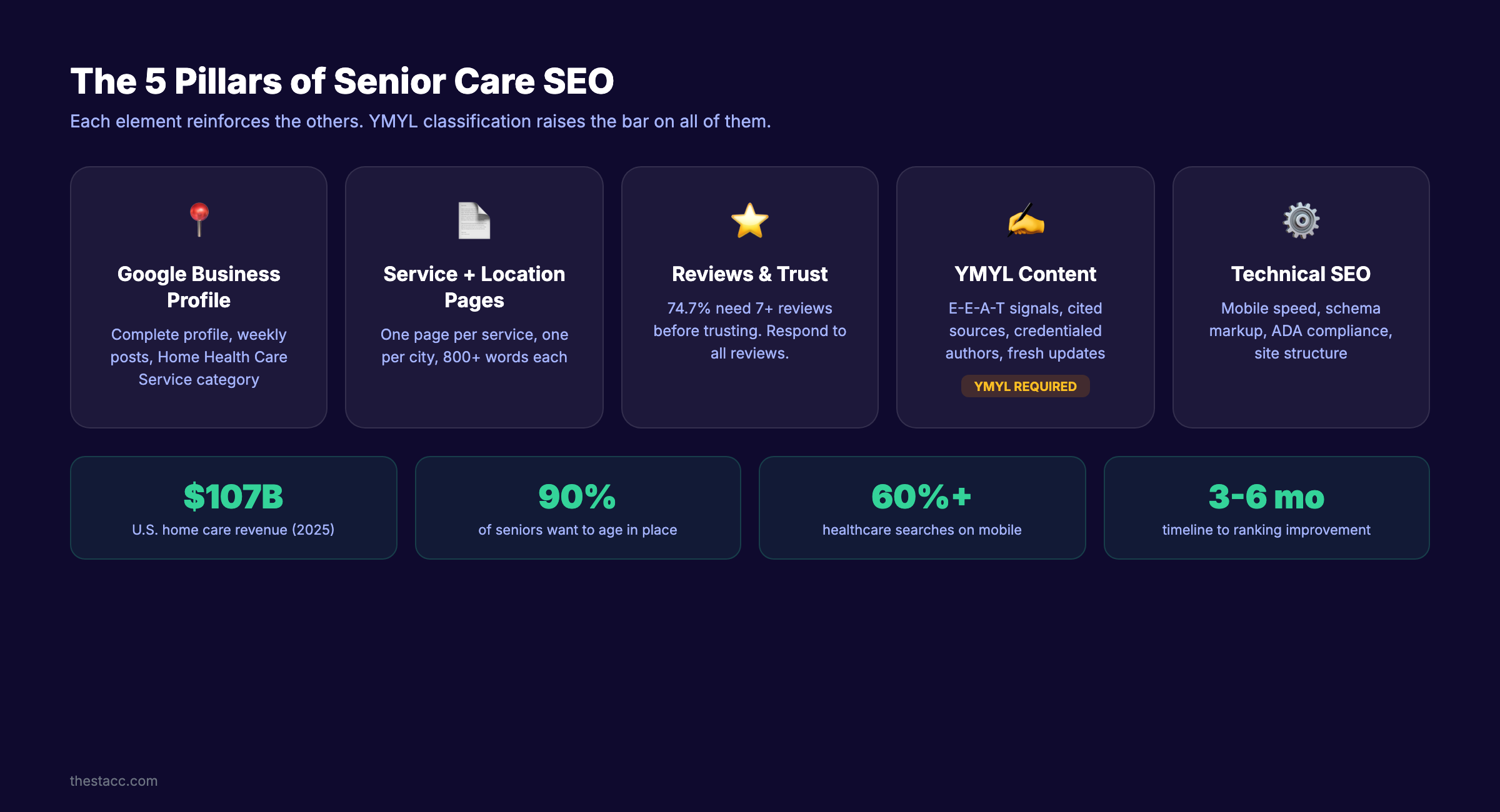
The U.S. home care industry generates over $107 billion in revenue. That number is projected to reach $176 billion by 2032. Every dollar of that growth intensifies competition for local search visibility.
Most senior care agencies rely on referrals and paid ads. Both work, but neither compound. The moment an ad budget stops, the leads stop. Referral networks dry up when a hospital discharge planner retires or changes roles. Senior care SEO builds a pipeline that grows every month without increasing your spend.
90% of seniors want to age in place. Their adult children search Google for “home care near me” and “senior care in [city]” when the need arises. If your agency does not appear in those results, you lose to the competitor who does. Every single time.
This guide covers every element of senior care SEO. From Google Business Profile to YMYL content standards, service page structure, local keywords, and the review strategy that drives Map Pack rankings.
We have published 3,500+ blogs across 70+ industries. Our average SEO score is 92%. We work with healthcare and home services businesses every day.
Here is what you will learn:
- Why senior care SEO differs from standard local SEO
- How to optimize your Google Business Profile for the Map Pack
- The YMYL content standards Google applies to senior care
- A keyword strategy built around family caregiver search behavior
- How to structure service pages and location pages that rank
- Content ideas that attract families at every stage of the decision
- Technical SEO requirements for home health websites
- How to track results and measure ROI
Why Senior Care SEO Is Different
Senior care is not a normal local service business. Google treats it differently. Families evaluate it differently. The search behavior is unique. Understanding these differences is the first step to ranking.
YMYL Classification
Google classifies senior care content as YMYL (Your Money Your Life). Inaccurate information about when a senior needs professional care, what Medicare covers, or how to choose a provider can cause real harm.
YMYL content faces stricter quality evaluation. Google’s quality raters assess E-E-A-T signals (Experience, Expertise, Authoritativeness, Trustworthiness) more aggressively on these pages. A blog post about “signs your parent needs home care” must demonstrate genuine expertise. Generic content copied from competitors will not rank.
The Decision Maker Is Not the Patient
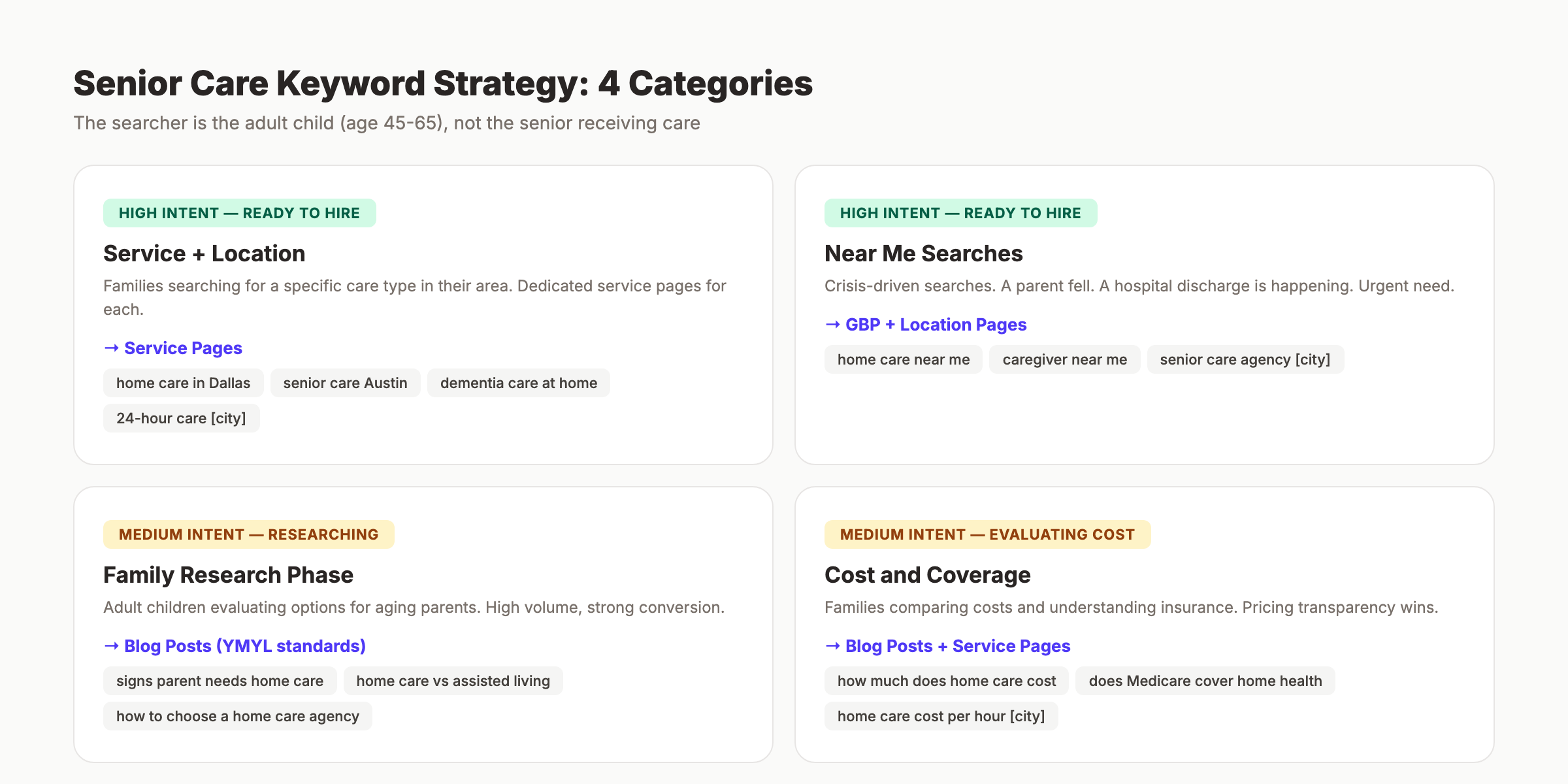
The primary searcher is typically an adult daughter or son, age 45 to 65, researching care for a parent. They are not the person receiving care. That distinction changes everything about your keyword strategy, content tone, and calls to action.
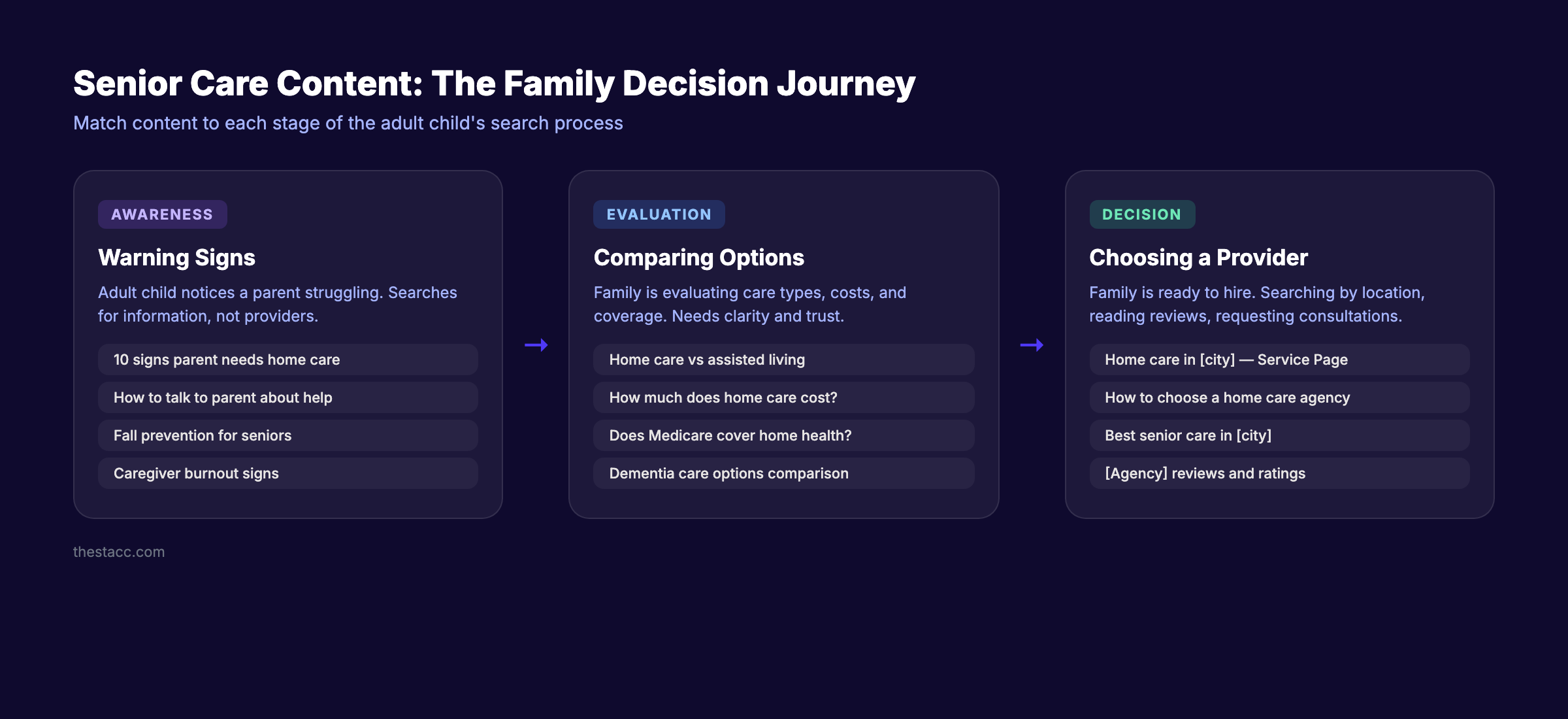
Families search during a crisis. A parent falls. A hospital discharge happens suddenly. A cognitive decline accelerates. The decision timeline is compressed. Your content must answer urgent questions directly and build trust fast.
Geographic Territory Model
Unlike a restaurant or salon, home care agencies serve ZIP codes and counties. Patients do not walk in. Caregivers drive to them. Your service area is a territory, not a radius around a pin on the map.
That means you need location-specific pages for every city and county you serve. A single “Service Area” page listing 15 cities will not rank for any of them individually.
Google Business Profile: Your Map Pack Foundation
Your Google Business Profile (GBP) drives Map Pack visibility. For senior care, the Map Pack is where families find and evaluate agencies before clicking through to a website.
Category and Service Setup
Select “Home Health Care Service” as your primary category. Add secondary categories based on your services:
| Service Type | Recommended GBP Category |
|---|---|
| Non-medical home care | Home Health Care Service |
| Skilled nursing | Home Health Care Service, Nursing Service |
| Alzheimer’s/dementia care | Home Health Care Service, Elder Care Service |
| Companion care | Caregiver, Home Health Care Service |
| Adult day care | Adult Day Care Center |
| Hospice | Hospice |
List every specific service in the GBP services section. Include: personal care, meal preparation, medication reminders, transportation, respite care, post-surgical care, and any specialized programs.
Complete Every Field
Incomplete profiles rank lower. Fill out everything.
- Business name: Exact legal name. No keyword stuffing.
- Description: 750 characters covering services, service area, licensing, and differentiators.
- Appointment URL: Link to your consultation request or intake form.
- Hours: Accurate hours. Many home care agencies operate 24/7. List it.
- Photos: Office, caregivers in uniform, branded vehicles, team photos. Profiles with 100+ photos get 520% more calls than profiles with fewer than 5.
Post Weekly Updates
GBP posts signal activity and relevance. Post at least once per week.
Post ideas for senior care agencies:
- Caregiver spotlight stories
- Seasonal safety tips (fall prevention, heat safety, holiday loneliness)
- Service announcements (new territory, new specialized program)
- Community event participation
- Educational tips for family caregivers
Each post should include a call to action. “Schedule a Free Consultation” or “Call Us Today” works best for this industry.
Stop writing. Start ranking. Stacc publishes 30 SEO articles per month for $99. Plus Google Business Profile posts on autopilot. Start for $1 →
Senior Care Keywords: How Families Search
Keyword research for senior care follows the family decision journey. The searcher is usually an adult child, not the senior. That shapes every keyword you target.
The 4 Keyword Categories
| Category | Example Keywords | Intent | Content Type |
|---|---|---|---|
| Service + Location | ”home care in Dallas,” “senior care Austin” | High (ready to hire) | Service pages |
| Near Me | ”home care near me,” “caregiver near me” | High (ready to hire) | GBP + local pages |
| Research Phase | ”signs parent needs home care,” “home care vs nursing home” | Medium (evaluating) | Blog posts |
| Cost and Coverage | ”how much does home care cost,” “does Medicare cover home care” | Medium (evaluating) | Blog posts |
High-Value Service Keywords
Each of these deserves a dedicated page on your website.
Core services:
- Home care + [city]
- In-home care + [city]
- Senior care + [city]
- Elder care + [city]
- Companion care + [city]
- Personal care services + [city]
Specialized services:
- Dementia care at home + [city]
- Alzheimer’s care + [city]
- Post-surgical home care + [city]
- Respite care + [city]
- 24-hour home care + [city]
- Hospice care + [city]
- Live-in care + [city]
Condition-specific:
- Parkinson’s care at home
- Stroke recovery home care
- Fall prevention for seniors
- Diabetes care at home
Family Caregiver Research Keywords
These are the queries families type during the decision-making process. They have high intent and low competition.
- “Signs my parent needs home care”
- “How to talk to a parent who refuses help”
- “Difference between home care and home health”
- “What does Medicare cover for home health”
- “How to choose a home care agency”
- “Adult day care vs. nursing home”
- “Home care for dementia patients”
- “How much does home care cost per hour”
Target these in blog posts. Each one represents a family at a specific stage of the decision journey. The agency that answers the question earns the trust. Trust converts to consultations.
Service Pages: One Page Per Service Per Location
A single “Our Services” page listing everything you do will not rank for anything specific. Each service needs its own page. Each major location needs its own page.
Service Page Structure
Every service page should follow this format:
1. H1 with service + location Example: “In-Home Dementia Care in Dallas, TX”
2. Opening paragraph (60 to 80 words) What the service is, who benefits, and why families choose your agency. Include the primary keyword in the first sentence.
3. What this service includes (H2) List specific tasks: medication reminders, meal preparation, bathing assistance, mobility support, cognitive stimulation activities. Families want to know exactly what the caregiver will do.
4. Who benefits from this service (H2) Describe the ideal client. A post-surgical patient recovering at home. A senior with early-stage dementia who needs supervision. A family caregiver who needs respite. This helps with search intent matching.
5. Our approach (H2) Explain your care philosophy, caregiver matching process, and supervision model. This is where E-E-A-T signals matter most. Mention credentials, training, and licensing.
6. Pricing or cost range (H2) Families search for pricing. “In-home care starts at $25 per hour” is more helpful than “Contact us for pricing.” Transparency builds trust. Include what insurance or Medicare may cover if applicable.
7. FAQ section (H2) Answer the 4 to 6 most common questions about this specific service. Use exact questions from Google autocomplete and “People Also Ask.” Add FAQ schema markup for rich results.
8. Call to action “Schedule a Free Care Consultation” with phone number and form. Make the phone number clickable on mobile.
Location Pages
If you serve 10 cities, create 10 location pages. Each page needs:
- Unique H1 with city name: “Home Care Services in [City], [State]”
- 800+ words of genuinely local content
- Mention of local hospitals, rehab centers, and senior centers you work with
- Specific neighborhoods and ZIP codes you cover
- Testimonials from clients in that area (if available)
- Embedded Google Map showing your service area
- Unique meta description for each page
Do not copy the same text across location pages and swap out city names. Google recognizes duplicate content. Each page needs original material specific to that community.
Reviews: The Trust Signal Families Depend On
Senior care involves letting a stranger into a parent’s home. The trust threshold is higher than nearly any other service. Reviews are how families evaluate that trust before ever calling you.
Why Reviews Matter More for Senior Care
74.7% of patients want to see at least 7 ratings before trusting reviews, according to NRC Health. For senior care specifically, families read reviews more carefully than for any other local service. They look for mentions of:
- Caregiver reliability and compassion
- Communication with family members
- Consistency of care
- How the agency handles problems
- Specific conditions managed (dementia, mobility, post-surgical)
How to Generate Reviews Consistently
Build a system. Do not rely on families to remember.
Review generation checklist:
- Send an automated email or text 1 week after care begins
- Follow up again at the 30-day mark (once trust is established)
- Ask during care plan review meetings
- Include a QR code on printed materials and invoices
- Train caregivers to mention the review option to satisfied families
- Respond to every review within 48 hours
Timing matters. Ask too early and the family has not formed an opinion. Ask at the 7-day and 30-day marks when the positive experience is established.
Responding to Reviews
Respond to every review. Positive and negative.
Positive reviews: Thank the family. Reference the specific care situation if they mentioned it. Mention the caregiver by first name if appropriate. This shows personalized attention.
Negative reviews: Acknowledge the concern. Apologize for the experience. Offer to resolve it privately (phone number or email). Never share patient or client details. HIPAA compliance applies to review responses.
For detailed strategies, see our guide on getting more Google reviews for local businesses.
Your SEO team. $99 per month. 30 optimized articles published automatically. Built for local service businesses like home care agencies. Start for $1 →
Content Strategy: What Families Need to Read
Senior care content serves 2 goals: ranking for informational keywords and building the topical authority that strengthens your service pages.
The Audience Is the Family Caregiver
Most senior care SEO guides miss this. Your content should speak to the adult child managing a parent’s care. Not to the senior. Not to healthcare professionals.
Family caregivers are stressed, overwhelmed, and searching for answers. They type questions like “should I hire home care or move mom to assisted living” at 11 PM. Your blog post needs to meet them at that moment.
Content Topics That Drive Traffic
Decision-stage content (highest conversion):
- “How to Choose a Home Care Agency: 10 Questions to Ask”
- “Home Care vs. Assisted Living: Which Is Right for Your Parent?”
- “How Much Does Home Care Cost in [City]?”
- “What Does Medicare Cover for Home Health?”
Education content (highest volume):
- “10 Signs Your Aging Parent Needs Help at Home”
- “How to Talk to a Parent Who Refuses Home Care”
- “Dementia Caregiver Guide: What to Expect at Each Stage”
- “Fall Prevention for Seniors: A Room-by-Room Checklist”
Seasonal and timely content:
- “Summer Heat Safety Tips for Seniors Living at Home”
- “Holiday Loneliness: How to Support Aging Parents During the Holidays”
- “Flu Season Preparation for Home Care Clients”
Local content:
- “Best Senior Resources in [City]”
- “Senior Care Options in [County]: A Family Guide”
- “How [City] Families Are Managing Elder Care in 2026”
Publishing Frequency
The agencies ranking highest for senior care keywords publish 8 to 16 blog posts per month. Most agencies publish 0 to 2. That gap is your opportunity.
Google rewards consistent publishing with stronger topical authority signals. A site with 50 senior care articles earns more authority than one with 5. You do not need to write every post yourself. A content automation approach lets you publish at volume without hiring a content team.
YMYL Content Standards
Because senior care is YMYL, your content must meet higher quality standards than a typical local business blog.
Required for YMYL content:
- Cite authoritative sources (NIH, CMS, state health departments)
- Name the author with relevant credentials
- Include dates and update regularly
- Avoid medical claims without evidence
- Link to official guidelines when discussing Medicare, Medicaid, or insurance
- Disclose if content is educational, not medical advice
A blog post about “signs of dementia” that cites the National Institute on Aging outranks one that makes unsourced claims. Every time.
Technical SEO for Senior Care Websites
Technical SEO ensures Google can crawl, index, and rank your pages. Most home care agency websites have fixable issues.
Mobile Optimization
Over 60% of healthcare searches happen on mobile. Family members often search on their phones during a hospital visit or while sitting in a waiting room.
Mobile checklist:
- Pages load in under 3 seconds
- Phone numbers are clickable (tap-to-call)
- Contact forms work on mobile
- Text is readable without zooming
- Buttons and links are large enough to tap
- No horizontal scrolling required
Test your site with Google PageSpeed Insights. Fix anything scoring below 80. Core Web Vitals are a confirmed ranking factor.
Schema Markup
Schema markup helps Google understand your content. For senior care, these types matter most:
HomeHealthCareService schema: Identifies your business type specifically. More precise than generic LocalBusiness.
LocalBusiness schema: Includes name, address, phone, hours, and service area. Required for local SEO.
FAQPage schema: Turns FAQ sections into rich results. More SERP visibility means more clicks.
BreadcrumbList schema: Helps Google understand your site structure. Especially useful for multi-location agencies.
Add schema to every service page, location page, and your homepage. Use JSON-LD format.
Site Structure
A clean structure helps Google crawl your pages and helps families find what they need.
Recommended senior care site structure:
Homepage
├── Services (hub page)
│   ├── Personal Care
│   ├── Companion Care
│   ├── Dementia Care
│   ├── Post-Surgical Care
│   ├── Respite Care
│   └── [Each service type]
├── Service Areas
│   ├── [City 1]
│   ├── [City 2]
│   └── [Each location]
├── About
│   ├── Our Caregivers
│   ├── Licensing & Credentials
│   └── Testimonials
├── Resources / Blog
│   ├── Family caregiver guides
│   ├── Condition-specific articles
│   └── Cost and coverage articles
├── Careers (caregiver recruitment)
└── Contact / Free Consultation
Link service pages to related location pages. Link blog posts to relevant service pages. This internal linking structure distributes authority across your site.
ADA and Accessibility Compliance
Senior care websites serve an older demographic. Accessibility is not optional.
- Use sufficient color contrast for readability
- Add alt text to every image
- Ensure forms are keyboard-navigable
- Include captions on videos
- Use heading hierarchy correctly (H1, H2, H3 in order)
ADA compliance also reduces legal risk. Healthcare-adjacent businesses face increasing accessibility lawsuits.
Local Citations and Directory Listings
Citations are mentions of your agency on other websites. Consistent citations strengthen local ranking signals.
Priority Directories for Senior Care
Not all directories carry equal weight. These are the highest-priority listings for home care agencies:
Healthcare-specific:
- A Place for Mom
- Caring.com
- Eldercare Locator (eldercare.acl.gov)
- Healthgrades
- AgingCare.com
General local:
- Google Business Profile
- Yelp
- Apple Maps
- Bing Places
- YellowPages
Industry and licensing:
- State licensing board directory
- Local Area Agency on Aging
- Better Business Bureau
- Chamber of Commerce
NAP Consistency
Your Name, Address, and Phone Number must be identical across every listing. If your GBP lists “123 Main Street, Suite 200,” every other listing must match exactly. Not “123 Main St. #200.” Not “123 Main Street Suite 200” without the comma.
Inconsistent NAP confuses Google and reduces local rankings. Audit your listings quarterly. Use a local citation management approach to keep everything synchronized.
3,500+ blogs published. 92% average SEO score. See what Stacc can do for your senior care agency. Start for $1 →
Tracking Senior Care SEO Results
SEO without measurement is guesswork. Track these metrics monthly.
Key Metrics
| Metric | Tool | What It Tells You |
|---|---|---|
| Organic traffic | Google Analytics 4 | Total visitors from search |
| Keyword rankings | Google Search Console | Which queries your pages rank for |
| Map Pack impressions | GBP Insights | How often you appear in local results |
| Phone calls from GBP | GBP Insights + call tracking | Direct leads from local search |
| Consultation requests | GA4 + CRM | Form submissions from organic traffic |
| Review count and rating | Google Business Profile | Trust signals and ranking factor |
| Cost per acquisition | CRM + budget tracking | SEO cost vs. paid ad cost per lead |
Realistic Timeline
Month 1 to 2: Technical fixes, GBP optimization, service page creation. Minimal ranking changes.
Month 3 to 4: New pages start indexing. Long-tail keywords begin ranking. GBP visibility improves.
Month 5 to 6: Service pages gain traction. Blog content starts ranking for family research queries. Organic traffic increases 20 to 40%.
Month 7 to 12: Compounding effect. Multiple pages ranking across service and location categories. Map Pack appearances increase. Organic traffic grows 50 to 100%+ from baseline.
The timeline for SEO results depends on market competition. Agencies in smaller metros see results faster. Major metro areas like Dallas, Phoenix, or Atlanta take longer due to competition from franchise networks.
SEO vs. Paid Ads: The Math
Paid search in home care costs $50 to $150 per inquiry. An agency spending $3,000 per month on Google Ads generates 20 to 60 leads. The moment the budget stops, leads stop.
A well-ranked service page generates free leads every month. After 12 months of SEO investment, most senior care agencies see 5x to 10x ROI. The cost per acquisition approaches zero as organic rankings compound.
The smartest agencies run both. Paid ads for immediate volume. SEO for long-term growth. After 6 months, the organic pipeline should start replacing paid spend.
Common Senior Care SEO Mistakes
These mistakes cost rankings and revenue. Avoid all of them.
1. Generic service pages. A single “Services” page listing 8 services cannot rank for any of them. Each service needs its own URL with 600+ words of unique content.
2. Duplicate location pages. Copying the same text across 10 location pages and swapping city names does not work. Google detects duplicate content. Each location needs original, locally relevant content.
3. Ignoring YMYL standards. Unsourced health claims, missing author credentials, and outdated content all hurt YMYL rankings. Cite authoritative sources. Name qualified authors. Update regularly.
4. No review strategy. Families read reviews more carefully for senior care than any other service. An agency with 5 reviews and a 3.8 rating loses to one with 50 reviews and a 4.7 rating. Build a system.
5. Writing for patients instead of families. The decision maker is the adult child, not the senior. Tone, vocabulary, and calls to action should address the family caregiver.
6. Inactive Google Business Profile. A GBP with no posts, no photos, and no recent reviews signals an inactive business. Post weekly. Add photos monthly. Generate reviews consistently.
7. No content strategy. A dormant blog tells Google your site is not active. The agencies dominating search publish 8 to 16 articles per month. Zero articles per month means zero growth.
8. Missing schema markup. HomeHealthCareService and FAQPage schema are easy to implement and directly impact rich result eligibility. Most senior care websites have none.
FAQ
How long does senior care SEO take to show results?
Most agencies see initial ranking improvements within 3 to 4 months. First-page rankings for competitive keywords take 6 to 12 months. Long-tail keywords like “dementia care at home [city]” often rank within 60 to 90 days.
How much does SEO cost for a home care agency?
SEO agencies charge $750 to $5,000 per month for senior care. Smaller markets start around $750 to $1,000. Major metros require $1,500 to $2,500 or more. Automated content services like Stacc publish 30 optimized articles per month starting at $99.
What keywords should a home care agency target first?
Start with service + location keywords: “home care in [city],” “senior care [city],” “in-home care near me.” These have the highest intent. Layer in family research keywords like “how much does home care cost” and “signs parent needs home care” for blog content.
Is senior care content subject to special Google rules?
Yes. Google classifies senior care as YMYL (Your Money Your Life). Content about healthcare, elder care, and medical coverage faces stricter quality evaluation. Pages must demonstrate E-E-A-T: Experience, Expertise, Authoritativeness, and Trustworthiness.
How do I get my home care agency in the Google Map Pack?
Optimize your Google Business Profile with complete information, accurate categories (Home Health Care Service), and weekly posts. Build consistent local citations. Generate a steady flow of Google reviews. These 3 factors drive the majority of Map Pack rankings.
Should I create separate pages for each city I serve?
Yes. Each city or county needs its own page with 800+ words of unique, locally relevant content. Mention local hospitals, senior centers, and neighborhoods. Do not duplicate text across locations. Google ranks individual pages for local queries, not your entire website.
Senior care SEO is a system built on trust. Families searching for care need to find you, trust your expertise, and contact you quickly. Every element of this guide strengthens one of those signals.
Start with your Google Business Profile. Build service pages for every care type. Create location pages for every city. Launch a review system. Publish content weekly. The agencies that execute all of these consistently will dominate local search in their markets.
Rank everywhere. Do nothing. Blog SEO, Local SEO, and Social on autopilot. Built for home health and senior care agencies. Start for $1 →
Written and published by Stacc. We publish 3,500+ articles per month across 70+ industries. All data verified against public sources as of March 2026.