Social media for accountants without breaking trust: what to post, how to handle compliance, and the formats that actually bring in new clients.
Social media for accountants without breaking trust: what to post, how to handle compliance, and the formats that actually bring in new clients. Most accounting firms either ignore social media entirely or post generic content that nobody reads.
Both approaches leave money on the table. 80% of B2B leads from social media come from LinkedIn. Small business owners actively search for accountants on Google and LinkedIn every January, every April, and every quarter-end. If your firm is invisible during those moments, your competitors win the client.
We have published content for professional service firms across 70+ markets. This guide covers what actually works for accountants on social media. Not generic tips. Specific strategies for CPAs, bookkeepers, and tax professionals who want more clients without spending 10 hours a week on content.
Here is what you will learn:
- Which platforms drive the most clients for accounting firms
- The 8 content types that build trust and generate referrals
- Why LinkedIn is your primary channel (and how to use it)
- A realistic posting schedule that takes under 2 hours per week
- Compliance considerations for CPA social media
- How social media connects to your local SEO strategy
Which Platforms Work Best for Accountants
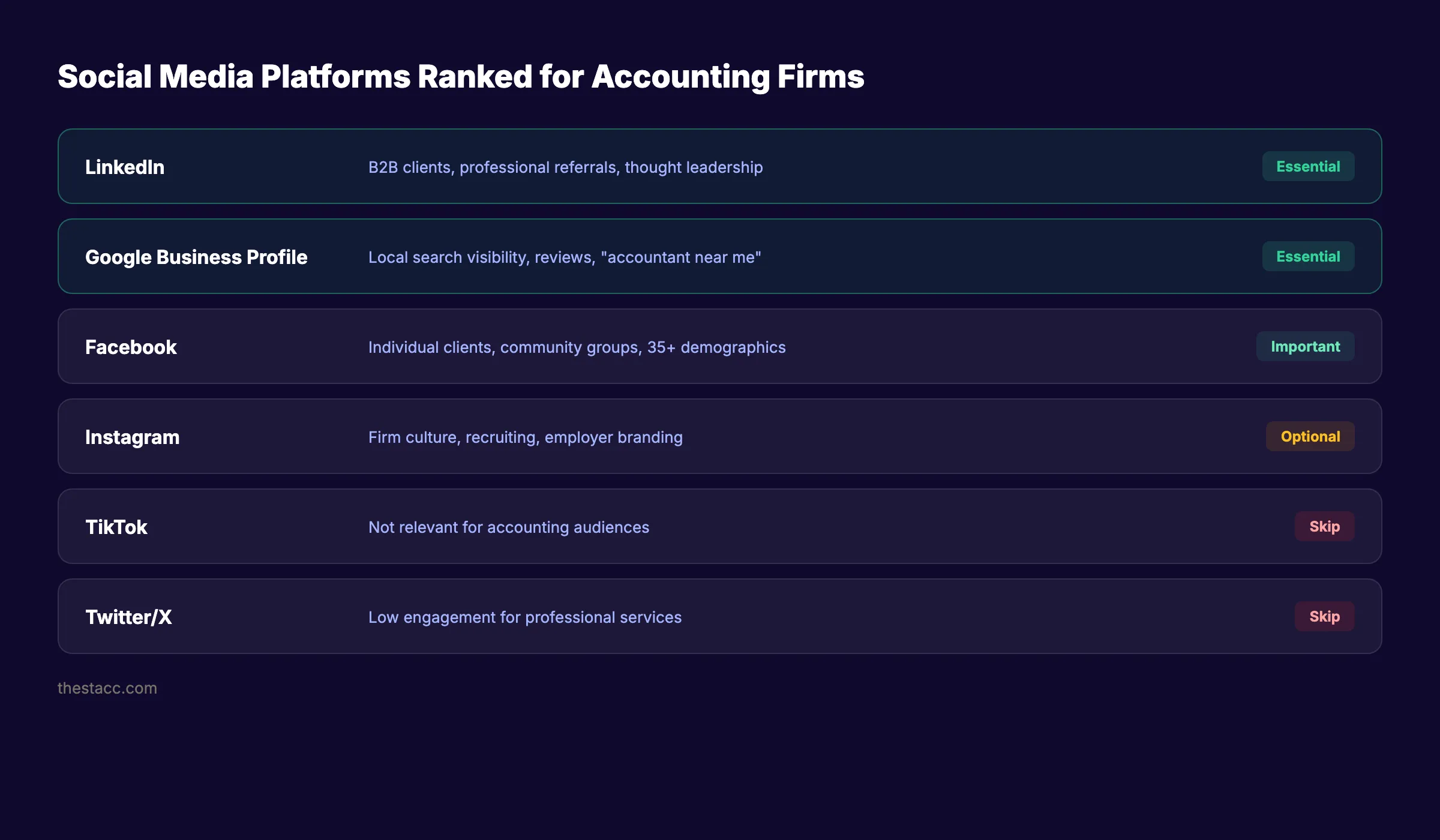
Accountants serve B2B and B2C clients. The platform mix depends on which type dominates your practice. Most accounting firms should focus on 2-3 platforms maximum.
| Platform | Priority | Best For | Posting Frequency |
|---|---|---|---|
| Essential | B2B clients, professional referrals | 3-4 posts/week | |
| Google Business Profile | Essential | Local search visibility, reviews | 2-3 posts/week |
| Important | Individual clients, community, 35+ demographics | 2-3 posts/week | |
| Optional | Firm culture, recruiting, younger audience | 2-3 posts/week | |
| TikTok | Skip | Not relevant for most accounting audiences | N/A |
| Twitter/X | Skip | Low engagement for local professional services | N/A |
LinkedIn Is Your Primary Platform
LinkedIn is where business owners, executives, and professionals make purchasing decisions about professional services. An accountant posting tax strategy tips on LinkedIn reaches the exact people who need accounting services. No other platform matches this targeting precision.
LinkedIn is 277% more effective for B2B lead generation than Facebook or Twitter. Personal profiles outperform company pages by 5x in organic reach. The founding partner or managing CPA should be the primary voice. Post from the personal profile 3-4 times per week. Repost the best content to the firm's company page. Read our complete LinkedIn for local business guide for the full strategy.
Google Business Profile Is Non-Negotiable
When a small business owner searches "accountant near me" or "CPA in Dallas," Google Business Profile results appear first. A complete GBP profile with recent posts, photos, and 50+ reviews outranks firms with better websites but dormant GBP listings.
Post weekly updates about tax deadlines, new services, and firm news. Respond to every review within 24 hours. Add new photos monthly. For more, read our guide on getting more Google reviews.
Facebook for Individual Tax Clients
Facebook works for firms serving individual tax clients, especially clients over 35. Facebook Groups for local business owners are a strong lead source. A CPA who answers tax questions in a local business group builds trust organically.
When to Skip Instagram and TikTok
Most accounting firms do not need Instagram or TikTok. These platforms reward visual content. Accounting is not visual. The exception: firms that invest heavily in employer branding and recruiting. Behind-the-scenes culture content on Instagram attracts young accountants. But for client acquisition, LinkedIn and GBP deliver faster results.
The accounting firms that win on social media are the ones that focus narrowly. Two platforms done well generates more clients than five platforms done poorly. LinkedIn and GBP cover the two moments that matter most: when a business owner is searching for an accountant (GBP) and when they are researching professional credibility (LinkedIn).
Platform Priority by Firm Type
| Firm Type | Primary | Secondary | Optional |
|---|---|---|---|
| Tax-focused (individuals) | GBP | ||
| Tax-focused (businesses) | GBP | ||
| Bookkeeping services | GBP | ||
| Advisory/CFO services | GBP | , | |
| Multi-service firm | GBP | ||
| Large regional firm | GBP | Instagram (recruiting) |
For a broader platform comparison, see our guide on best social media platforms for local businesses.
The 8 Content Types That Win Accounting Clients
Most accounting firm social media accounts post the same content: "Tax season is here." "Do not forget your estimated payments." Generic reminders that every firm posts do not differentiate you. These 8 content types do.
1. Tax Tips Tied to Calendar Events
Post specific, timely tax advice. "The Q1 estimated tax deadline is April 15. Here is how to calculate your payment in 3 steps." Tie every tip to a specific date or event. Calendar-driven content creates urgency and relevance.
Best timing: Post tax tips 2 weeks before each deadline. January (W-2s, 1099s), April (filing deadline), June (Q2 estimates), September (Q3 estimates, extension deadline), December (year-end planning).
2. Small Business Financial Tips
"3 expenses most small business owners forget to deduct." "Why your business needs a separate bank account." "The S-Corp election deadline is March 15. Here is who it benefits." Small business tips attract exactly the clients you want. Each tip demonstrates expertise without giving away the full strategy.
3. Industry-Specific Insights
Generic advice competes with every accountant online. "Tax implications of the new Austin restaurant wage requirements" competes with nobody. Local, industry-specific insights position you as the expert for that market. Pick 2-3 industries where you have deep expertise and create content specifically for them.
4. Client Success Stories (Anonymized)
"Helped a 20-person construction company save $67,000 in taxes through an R&D credit analysis." Specific numbers build credibility. The anonymity protects client privacy. Share the strategy, the result, and why it worked. This is the most persuasive content type for B2B accounting clients.
5. Behind-the-Scenes of Tax Season
Show the reality of busy season. The stacked files. The team working late. The celebration when April 15 passes. Tax season content humanizes your firm and resonates with other professionals who understand the grind. It also signals that your firm is active and in demand.
6. Common Financial Mistakes
"5 bookkeeping mistakes that trigger IRS audits." "Why mixing personal and business expenses costs you more than you think." Mistake-based content performs well because it triggers loss aversion. People engage more with content about avoiding problems than content about gaining benefits.
7. Regulatory Updates and Changes
New tax laws, IRS guidance changes, state-level rule updates. Accounting firms that post regulatory updates first establish authority. Most business owners do not read the Federal Register. They rely on their accountant to tell them what changed and what it means.
8. Team and Culture Content
Introduce team members. Celebrate certifications. Show the office. This content does not drive direct leads, but it builds the trust that converts referrals. A potential client who sees your team and culture feels more comfortable reaching out.
Stop writing. Start ranking. theStacc publishes 30 SEO articles per month for $99. Tax tips, financial guides, and local content. All optimized and published automatically.
A Realistic Posting Schedule for Accounting Firms
Most accountants barely have time to eat lunch during busy season. A social media schedule must fit the reality of running a practice.
Weekly Calendar (Non-Busy Season)
| Day | Platform | Content Type | Time |
|---|---|---|---|
| Monday | LinkedIn (personal) | Tax tip or business insight | 20 min |
| Tuesday | GBP | Weekly update or deadline reminder | 10 min |
| Wednesday | LinkedIn (personal) | Client success story or mistake post | 15 min |
| Thursday | Community post or regulatory update | 15 min | |
| Friday | LinkedIn (personal) | Behind-the-scenes or team content | 15 min |
| Weekend | , | Respond to comments and DMs | 10 min |
Total: 85 minutes per week.
Busy Season Adjustment (January to April)
During tax season, reduce to the minimum viable schedule:
- LinkedIn: 2 posts per week (pre-scheduled)
- GBP: 1 post per week (deadline reminders)
- Facebook: 1 post per week (cross-post from LinkedIn)
Pre-schedule all busy season content in December. Use a social media scheduling tool to automate publishing during the months when you have zero spare time.
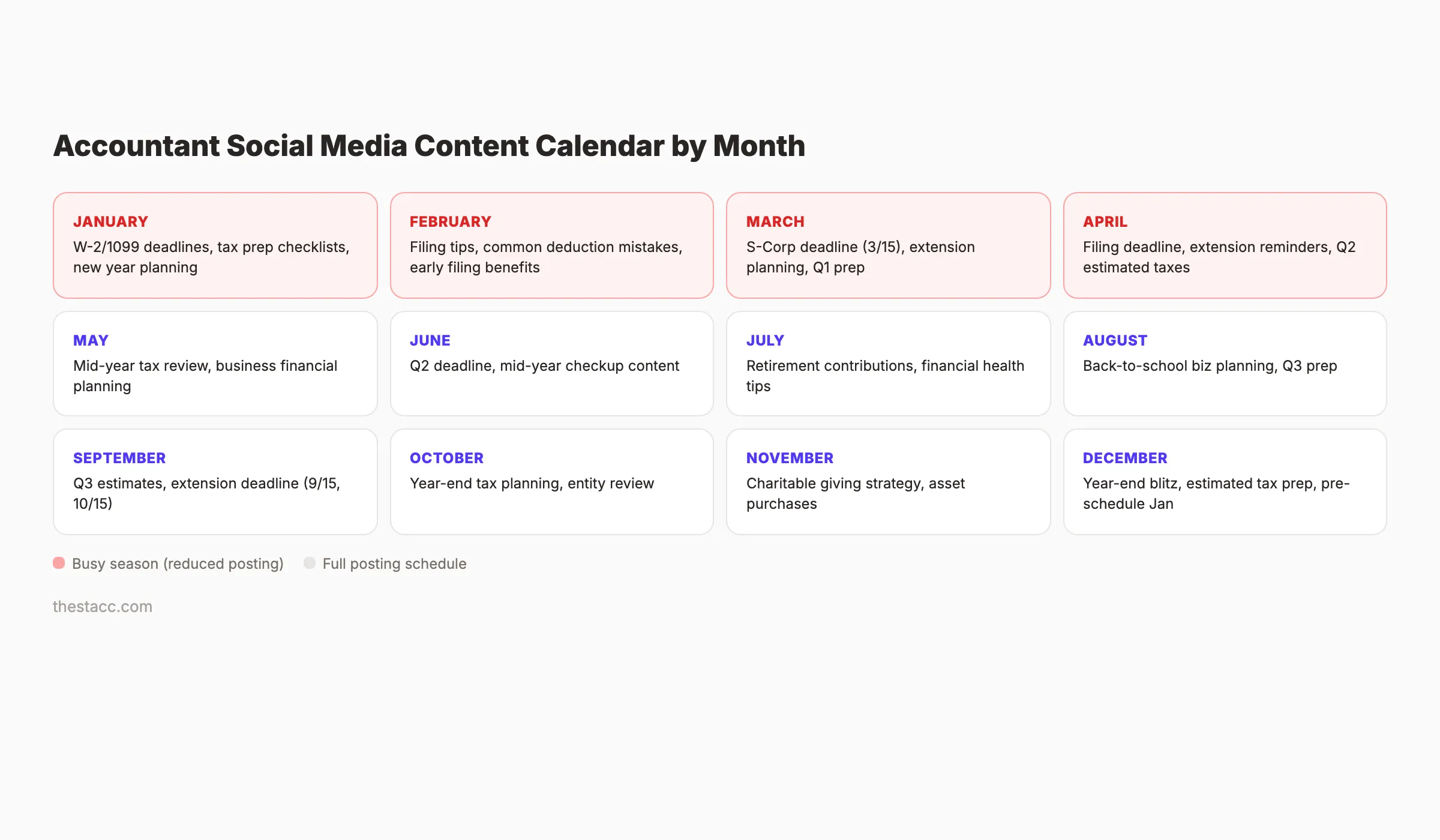
The Seasonal Content Calendar
| Month | Content Focus |
|---|---|
| January | W-2/1099 deadlines, tax prep checklists, new year financial planning |
| February | Tax filing tips, common deduction mistakes, early filing benefits |
| March | S-Corp election deadline (3/15), extension planning, Q1 prep |
| April | Filing deadline content, extension reminders, Q2 estimated taxes |
| May-June | Mid-year tax review, business planning, Q2 deadline |
| July-August | Mid-year financial checkup, retirement contributions, back-to-school business planning |
| September | Q3 estimates, extension filing deadline (9/15 for partnerships, 10/15 for individuals) |
| October | Year-end tax planning, Q3 deadline prep, business entity review |
| November | Charitable giving strategy, asset purchases before year-end |
| December | Year-end planning blitz, estimated tax prep, pre-schedule January content |
Planning content around the tax calendar means you never run out of topics. Every month has built-in urgency.
Compliance Considerations for CPA Social Media
Accountants operate under regulatory frameworks that restrict certain types of public statements. Social media content must comply with these rules.
IRS Circular 230
Circular 230 governs tax practitioners. The key rule for social media: do not make guarantees about tax outcomes. "We will save you $50,000" is a violation. "We helped a client save $50,000 through R&D credit analysis" is a factual statement about past results.
Avoid:
- Guaranteed outcomes ("We guarantee a refund")
- Specific tax advice directed at unidentified individuals
- False or misleading statements about qualifications
- Claims about IRS relationships or special treatment
State CPA Board Rules
Each state board of accountancy has rules about advertising and solicitation. Most states require that CPA firm advertising include the firm name and license number. Check your state board requirements before launching any paid social media campaigns.
Common requirements:
- Firm name and CPA designation in all advertising
- No false or misleading claims about services
- Proper disclosure when content is an advertisement
- Retention of advertising materials for a specified period
Client Confidentiality
Never reference specific clients, their financial situations, or their tax positions on social media. Even vague references ("Just saved a dentist $40,000 in taxes") can violate confidentiality if the client is identifiable. Always use fully anonymized case studies with the client's written permission.
Disclaimer Best Practices
Add a standard disclaimer to your LinkedIn profile and social media bios: "Posts are for educational purposes only and do not constitute tax advice. Consult a qualified professional for advice specific to your situation."
Your SEO team. $99 per month. 30 optimized articles about tax tips, financial planning, and accounting topics. Published automatically to your blog.
How Social Media Drives Accounting Clients
Social media for accountants does not generate clients through direct messages and cold pitches. It generates clients through trust-building that leads to referrals, Google searches, and phone calls.
The Accounting Client Journey
- Awareness: A business owner sees your LinkedIn post about S-Corp tax savings
- Interest: They visit your profile, read 3-4 more posts, check your firm credentials
- Research: They Google your firm name, read reviews on GBP, check your website
- Action: They call your office, fill out a contact form, or ask a mutual connection for an introduction
Social media covers steps 1 and 2. Local SEO and blog content cover step 3. Your intake process handles step 4.
The Referral Amplifier Effect
Most accounting clients come from referrals. Social media amplifies referrals in 2 ways. First, when an existing client recommends you, the prospect checks your LinkedIn before calling. An active profile with educational content confirms the referral. A dormant profile raises questions.
92% of business clients rank referrals as important when choosing an accountant. Social media amplifies that referral network. Your LinkedIn posts appear in the feeds of your existing clients' connections. A client who likes your post about year-end tax planning exposes their entire network to your firm. That organic exposure generates warm introductions without any outreach.
Social Media Feeds Local SEO
Active social profiles generate brand mentions. Brand mentions signal to Google that your firm is relevant. Consistent LinkedIn activity drives branded searches (people Googling your firm name), which strengthens your Google Business Profile rankings.
Blog content repurposed for social media drives website traffic. A LinkedIn post linking to your blog article about S-Corp elections sends qualified visitors to your site. Google rewards that traffic with improved search rankings.
For a deeper guide on content strategy, read our content marketing strategy guide.
Common Mistakes Accountants Make on Social Media
Only Posting During Tax Season
Only 22% of accounting firms produce regular video content, and an even smaller percentage posts consistently year-round. Posting in January and disappearing until next January teaches the algorithm to ignore you. It also tells potential clients that your firm is only active 4 months per year. Post year-round. Financial planning, business advisory, and bookkeeping topics fill the non-tax-season calendar.
Being Too Technical
A post about Section 179 depreciation thresholds does not resonate with a restaurant owner. Translate technical knowledge into business outcomes. "Buy that equipment before December 31 and deduct up to $1,160,000 this year" is the same information, written for your audience.
No Personal Brand
Firms that only post from the company page reach almost nobody. LinkedIn company page posts reach 1.6% of followers. The managing partner posting from a personal profile reaches 5-10x more people. Put a face and name on your content.
Ignoring Comments and Messages
A business owner who comments on your LinkedIn post is expressing interest. Ignoring that comment is like letting a phone ring unanswered. Respond to every comment within 24 hours. Answer every direct message within 48 hours. Engagement drives the algorithm and builds relationships.
No Call to Action
"Great tax tip" is not a CTA. "Book a free 15-minute tax review for your business. Link in my profile" is a CTA. Every 3rd or 4th post should include a clear next step for interested prospects. The other posts build trust. The CTA posts convert it. Without CTAs, you are educating prospects and sending them to a competitor who asks for the meeting.
For more marketing tools specific to accounting firms, see our guide to SEO tools for accountants.
Generic Content Without Local Focus
"5 Tax Tips for Business Owners" competes with every accountant on the internet. "How Austin's New Payroll Tax Affects Your Restaurant" reaches the exact audience you serve. Local, specific content outperforms generic advice every time.
What practitioners are saying on X
Marketing systems still win. Here is operator signal from X on SEO stacks and fundamentals.
- @jakezward (Feb 2026): 2026 SEO predictions emphasize AI Overview share-of-SERP, schema for LLM token efficiency, brand mentions in AI answers as a KPI, proprietary data as a moat, and content refresh beating net-new AI slop. See the post on X.
- @ConnorGillivan (Jul 2026): 2026 SEO stack favorite list: Semrush/Ahrefs, GSC, Surfer, KeywordInsights, ChatGPT, SEOwind, Screaming Frog, ClearScope, GA4, Notion/Airtable — tools amplify systems, they don’t replace them. See the post on X.
- @HlynurStefDev (Jul 2026): Public case: niche site traffic jumped from ~18 to 4,162 Google visits/month after focused technical/on-page SEO work (GSC screenshots claimed) — reminds that fundamentals still move numbers. See the post on X.
Grok, AI Overviews, and multi-engine visibility
For “social media for accountants”, multi-engine visibility still starts with clear definitions, sourced numbers, and extractable section answers. Grok additionally factors live X discussion — keep public claims consistent with this page.
- Google AI Overviews: Use passage-ready answers, tables, and FAQ schema where relevant.
- ChatGPT / Perplexity: Cite named sources next to key claims.
- Grok: Maintain accurate entity facts on-site and in high-signal X posts.
Publish content built for Google and AI citations. theStacc’s Content SEO module ships SEO-scored articles structured for rankings and generative engines — including clearer entity pages models like Grok can quote.
FAQ
LinkedIn is the best platform for most accounting firms. 80% of B2B social media leads come from LinkedIn. Pair LinkedIn with Google Business Profile for local search visibility. Facebook works for firms targeting individual tax clients over 35. Skip TikTok and Instagram unless you are focused on recruiting.
The 8 best content types are: calendar-driven tax tips, small business financial advice, industry-specific insights, anonymized client success stories, tax season behind-the-scenes, common financial mistakes, regulatory updates, and team/culture content. Tie every post to a specific deadline, industry, or problem.
Post 3-4 times per week on LinkedIn during non-busy season. Reduce to 2 posts per week during tax season (January to April) using pre-scheduled content. Post 2-3 times per week on Google Business Profile year-round. Total time investment: 85 minutes per week outside of busy season.
Social media builds trust that amplifies referrals and drives Google searches. It does not replace referrals as the primary client acquisition channel for accountants. It strengthens them. When a prospect receives a referral and checks your LinkedIn, an active profile with educational content converts at a higher rate than a dormant one.
Yes. IRS Circular 230 prohibits guaranteeing tax outcomes. State CPA boards require firm name and license information in advertising. Client confidentiality rules apply to all social media content. Never reference specific clients or their financial situations without written permission. Add a standard disclaimer that posts do not constitute tax advice.
DIY costs $0 plus 4-6 hours/month of partner or staff time. A social media agency charges $1,000-$3,000/month. A freelance social media manager costs $500-$1,500/month. theStacc automates social media for $49/month with 30 posts across 3 platforms. For blog SEO, theStacc publishes 30 optimized articles per month for $99.
The strongest accounting marketing strategy combines social media with blog SEO and local SEO. When prospects see your LinkedIn posts, read your tax planning articles, and find you at the top of Google Maps, the trust compounds across every channel.
Social media for accountants is not about going viral. It is about being visible to the right 200-500 business owners in your local market when they need financial help. Post consistently. Share expertise. Let the trust compound over time. The firms that show up on LinkedIn every week get the referrals and the search traffic that invisible firms do not.
Related Tools & Resources
Free SEO Tools:
Best Lists:
Sources & references
- [1] Princeton / Georgia Tech et al. — GEO research (arXiv:2311.09735)
- [2] @hridoyreh on X — Widely shared SEO skill tree: foundations, research, technical, on-page, content, links, AI SEO/GEO, analytics, UX, bran
- [3] @jakezward on X — 2026 SEO predictions emphasize AI Overview share-of-SERP, schema for LLM token efficiency, brand mentions in AI answers
- [4] Referenced source — www.cleverly.co

Manage Google Business Profile posts, review replies, and local rank tracking.
Weekly local SEO teardowns
One practical email a week. Map Pack, GBP, AI Overviews — no fluff. Unsubscribe anytime.
Explore this topic: Social Media Marketing · Keep your social calendar moving without starting from scratch..