Social Media for Veterinarians: Complete Guide
The complete social media guide for veterinary clinics. Platforms, post ideas, content calendar, and engagement tactics. With vet-specific data. Updated 2026.
Siddharth Gangal • 2026-03-29 • Content Strategy
In This Article
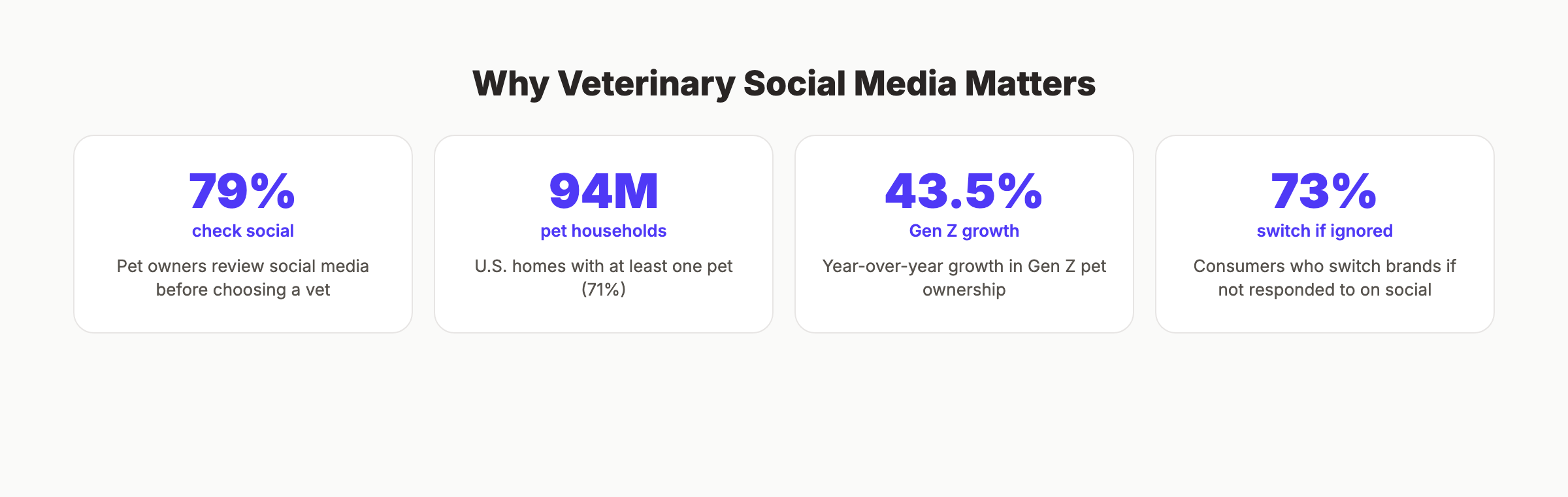
Social media for vets is the most underused marketing channel in veterinary medicine. 79% of pet owners check social media and online reviews before choosing a veterinarian. Yet most clinics post sporadically, go silent for months, and wonder why new clients call the practice down the street instead.
The math is simple. 94 million U.S. households own a pet. Americans spend $39.8 billion annually on veterinary care. And the fastest-growing pet owner demographic, Gen Z, grew 43.5% in one year. These younger pet owners do not ask their parents for a vet recommendation. They search Instagram, check Google reviews, and watch TikTok.
This guide covers which platforms to use, what to post, how often to post, and how to turn followers into booked appointments. Every recommendation is built specifically for veterinary practices.
We have published 3,500+ SEO articles across 70+ industries, including veterinary clinics, animal hospitals, and specialty practices. For SEO-specific strategies, see our veterinary SEO guide.
Here is what you will learn:
- Which platforms drive the most engagement for vet clinics
- The content mix that builds trust and fills your schedule
- 10 post ideas that consistently generate pet owner engagement
- How to batch-create a month of content in 2 hours
- How to handle negative comments and privacy concerns
- How to connect social media to actual booked appointments
Which Platforms Work Best for Vet Clinics
Not every platform deserves your time. Vet clinics should focus on 2 to 3 platforms where pet owners actively spend time and make decisions.
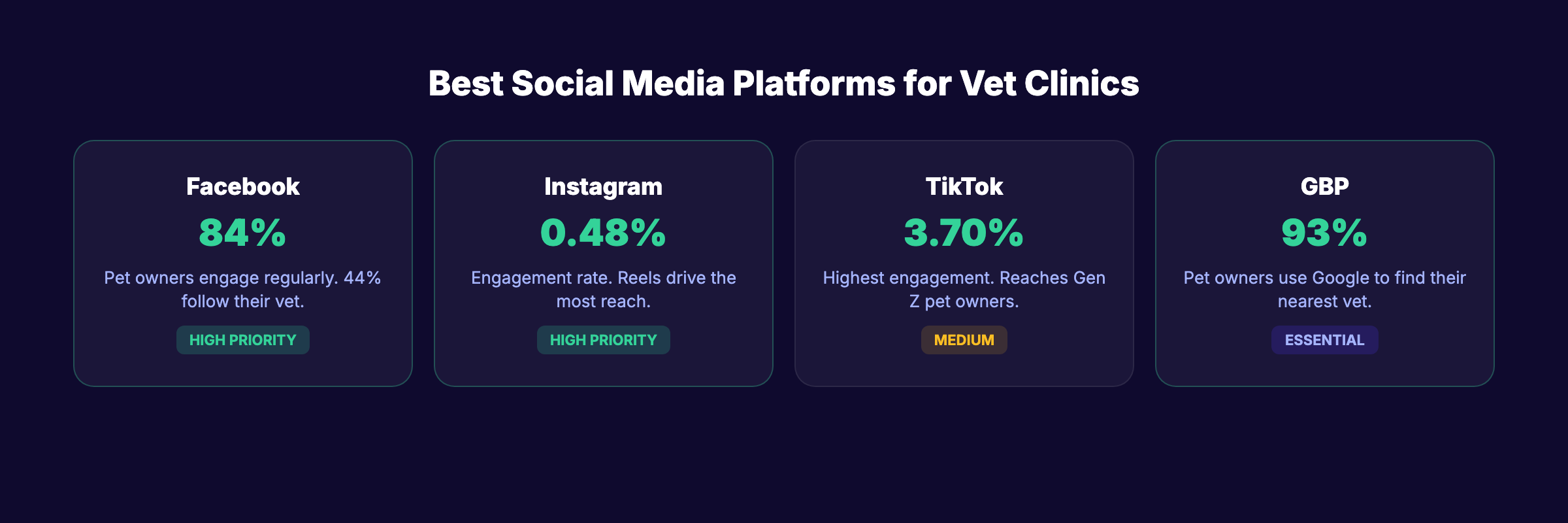
Platform Priority for Veterinary Practices
| Platform | Best For | Audience | Effort | Priority |
|---|---|---|---|---|
| Community, reviews, local targeting | Pet owners 30-65 | Medium | High | |
| Visual stories, Reels, patient features | Pet owners 25-50 | Medium | High | |
| TikTok | Viral reach, behind-the-scenes, Gen Z | Pet owners 18-40 | Low-Medium | Medium |
| Google Business Profile | Local search, map pack visibility | Active searchers | Low | Essential |
Facebook: Your Community Hub
84% of pet owners engage with Facebook regularly. 43.7% follow their vet practice on Facebook. 58% of veterinary marketers say Facebook is a top-3 ROI driver. Facebook is where pet owners share recommendations, ask for vet advice, and check reviews.
Post 4 to 5 times per week. Join local pet owner groups. Respond to every comment and review. Run boosted posts for $100 to $200 per month targeting pet owners within 10 miles of your clinic.
Instagram: Visual Storytelling
Instagram works for vet clinics because the content is inherently visual. Cute patient photos, treatment transformations, and team spotlights perform well. Instagram Reels (short video) now drive the most reach on the platform.
Post 3 to 4 feed posts per week plus daily Stories. Use carousel posts for educational content (tick prevention steps, dental care tips). For scheduling tools, see our guide on free social media tools for local businesses.
TikTok: The Gen Z Connection
TikTok has the highest engagement rate of any platform at 3.70%. Gen Z pet ownership grew 43.5% last year. If your clinic wants younger clients, TikTok is where they discover new businesses.
The content that works: day-in-the-life videos, funny pet moments, behind-the-scenes of surgeries (tasteful), and “things your vet wants you to know” educational clips.
For a deeper platform comparison, see our guide on best social media platforms for local businesses.
Your SEO team. $99 per month. Social media management starts at $49 per month. 30 posts across 3 platforms. Start for $1 →
The Content Mix That Builds Trust
Most vet clinics fall into one of 2 traps: posting only promotions (annoying) or posting only cute photos (nice but does not drive appointments). The fix is a balanced content mix.
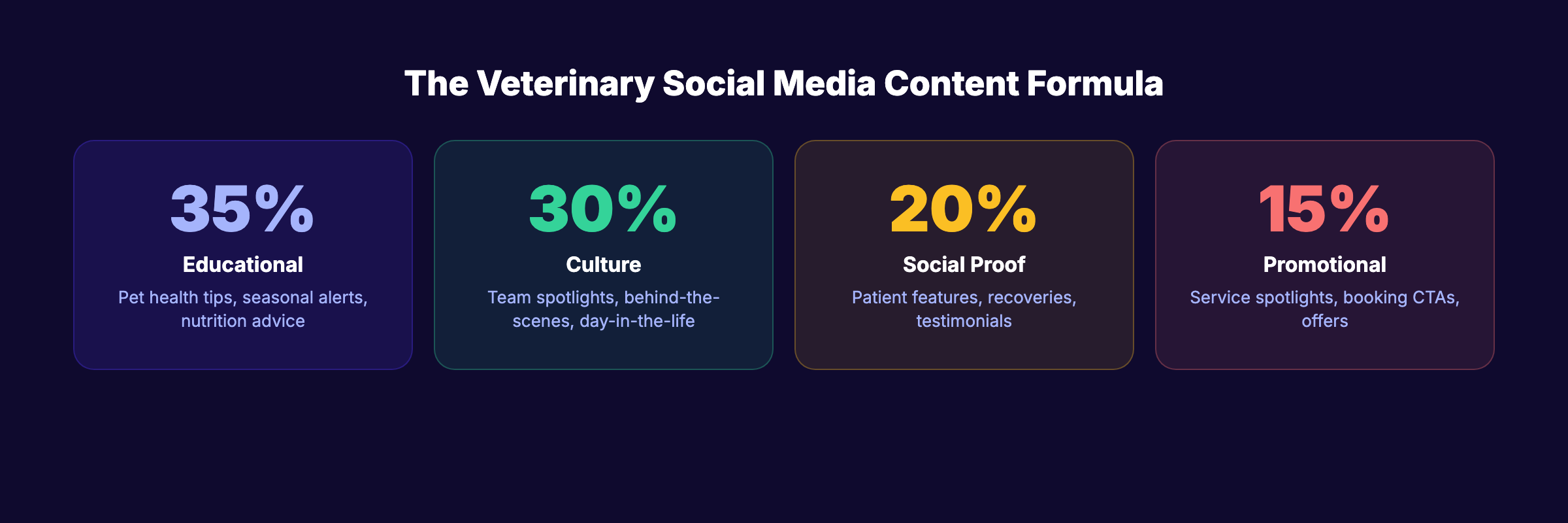
The Veterinary Content Formula
| Category | % of Posts | Examples |
|---|---|---|
| Educational | 30-40% | Pet care tips, seasonal hazards, nutrition advice, “what to do if…” |
| Culture and behind-the-scenes | 30% | Team spotlights, day-in-the-life, staff pets, clinic tours |
| Patient features and social proof | 20% | Before/after recoveries, client testimonials, review screenshots |
| Promotional | 10-20% | Service spotlights, new equipment, booking CTAs, special offers |
Educational content builds expertise. Culture content builds connection. Patient features build trust. Promotional content drives action. All 4 work together.
The biggest mistake: going 100% promotional. Nobody follows a vet clinic to see “Book your dental cleaning today” every day. They follow for pet health tips, cute animals, and a sense of community with their vet team.
10 Post Ideas That Generate Engagement
These 10 content types work for every vet clinic, on every platform. They never run dry because new patients, new seasons, and new stories happen every week.
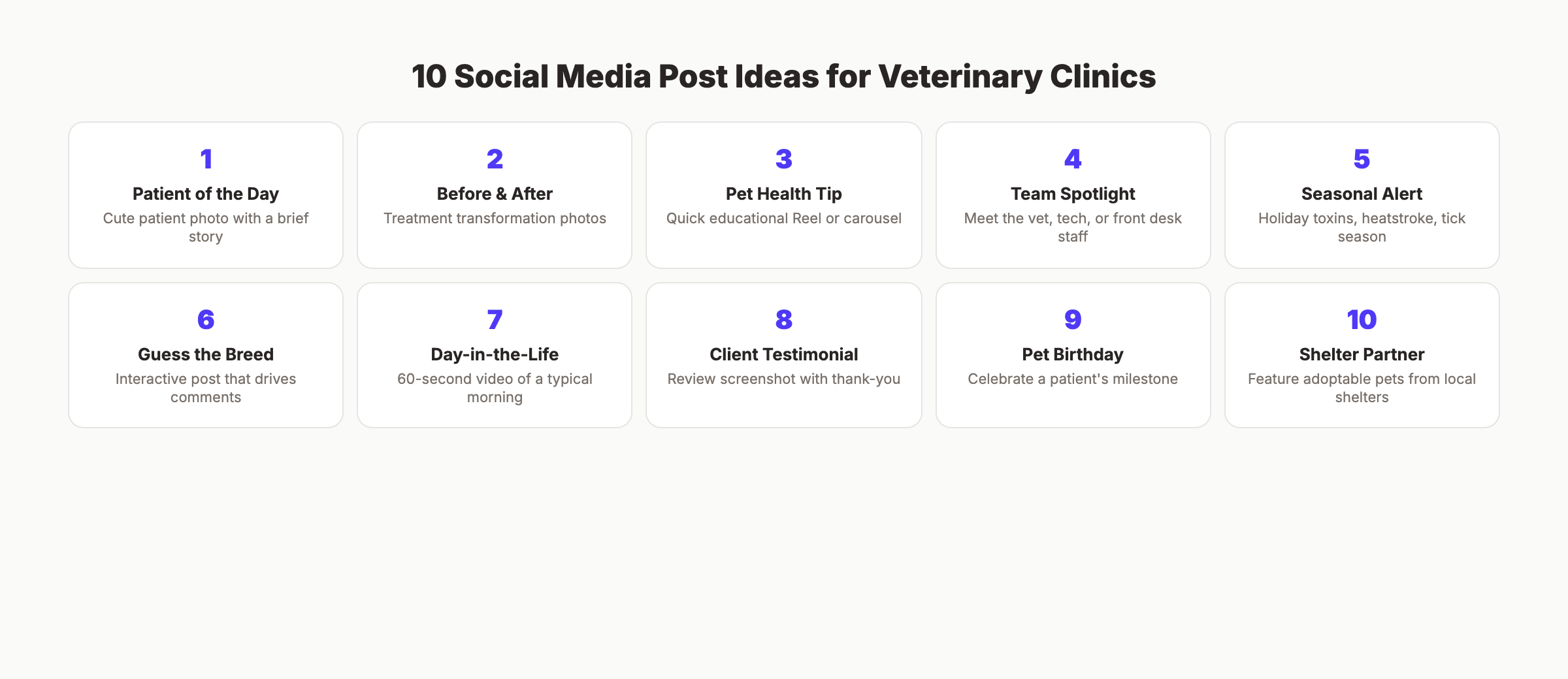
| # | Post Type | Example | Best Platform |
|---|---|---|---|
| 1 | Patient of the day | ”Meet Luna. She was brave during her vaccinations today.” | Instagram, Facebook |
| 2 | Before and after treatment | Dental cleaning transformation or skin condition recovery | Instagram, TikTok |
| 3 | Quick pet health tip | ”3 signs your dog needs a dental cleaning” | Instagram Reels, TikTok |
| 4 | Team spotlight | ”Meet Dr. Sarah. She specializes in feline medicine.” | Facebook, Instagram |
| 5 | Seasonal safety alert | ”Chocolate is toxic to dogs. Here is what to do if your pet eats it.” | Facebook, Instagram Stories |
| 6 | Guess the breed | Post a puppy photo and ask followers to guess | Instagram, Facebook |
| 7 | Day-in-the-life video | 60-second clip of a typical morning at the clinic | TikTok, Instagram Reels |
| 8 | Client testimonial | Screenshot of a 5-star review with a thank-you caption | Facebook, Instagram Stories |
| 9 | Pet birthday or adoption anniversary | Celebrate a patient’s milestone with a photo and congratulations | Instagram, Facebook |
| 10 | Shelter partnership | Feature adoptable pets from your local shelter | Facebook, Instagram |
Patient photos are the #1 engagement driver. Always get written consent from the pet owner before posting. Create a simple consent form that clients sign at check-in.
Seasonal Content Calendar for Vet Clinics
Plan content around pet health awareness months. These give you ready-made topics that pet owners actively search for.
| Month | Awareness Theme | Content Ideas |
|---|---|---|
| February | National Pet Dental Health Month | Dental cleaning before/afters, brushing tips, dental disease signs |
| April | Heartworm Awareness Month | Prevention tips, testing reminders, treatment FAQ |
| May | Responsible Animal Guardian Month | Wellness exam reminders, spay/neuter awareness |
| June-August | Summer safety | Heatstroke prevention, tick/flea tips, water safety |
| October | National Pet Wellness Month | Wellness checkup promotions, senior pet care |
| November-December | Holiday toxins | Chocolate dangers, holiday plant toxicity, travel tips |
Build your content calendar around these themes. Prepare seasonal content 2 to 4 weeks in advance so you are ready when the awareness month starts.
For more content ideas, see our guide on social media content ideas and our post on writing posts that drive engagement.
How to Batch-Create a Month of Content
Veterinary staff are busy. Between appointments, surgeries, and emergencies, social media falls to the bottom of the priority list. The fix: batch creation. One dedicated session per month replaces daily scrambling.
The 2-Hour Monthly System
Week 1-4 (during work hours): Capture content as you go.
- Take 2 to 3 patient photos per day (with consent)
- Film 1 short video per week (15 to 30 seconds)
- Save 2 positive reviews per week (screenshots)
Monthly batch session (2 hours):
- Sort photos into categories: patients, team, educational, seasonal (15 min)
- Write captions for each post. Keep them short. 1 to 3 sentences. (30 min)
- Create 4 to 5 educational carousels in Canva using templates (30 min)
- Schedule everything using Meta Business Suite (free) or Buffer (15 min)
- Plan next month’s themes around pet health awareness dates (15 min)
Posting Frequency Guide for Vet Clinics
| Platform | Minimum | Optimal | Maximum |
|---|---|---|---|
| 3x/week | 5x/week | Daily | |
| Instagram Feed | 3x/week | 4x/week | Daily |
| Instagram Stories | 3x/week | Daily | Multiple daily |
| TikTok | 2x/week | 4x/week | Daily |
| GBP Posts | 1x/week | 2-3x/week | Daily |
Start with 3 posts per week on your primary platform. Build consistency before adding volume. For scheduling help, see our social media calendar guide.
3,500+ blogs published. 92% average SEO score. Every article passes a 40-point quality audit before it goes live. Start for $1 →
Handling Negative Comments and Privacy Concerns
Two fears stop vet clinics from posting: negative comments and patient privacy. Both are manageable with simple systems.
Negative Comment Protocol
73% of consumers will switch to a competitor if a brand does not respond on social. Not responding is worse than a negative comment.
For general complaints:
- Respond publicly within 4 hours during business hours
- Acknowledge the concern without being defensive
- Move the conversation to a private channel: “We want to make this right. Please send us a direct message or call [number].”
- Never discuss patient medical details publicly
For trolls or misinformation:
- Do not engage in arguments
- Provide a brief, factual correction if needed
- Hide or delete comments that are abusive, spam, or contain false medical claims
- Block repeat offenders
For more on managing your online reputation, see our guide on getting more Google reviews and responding to negative reviews.
Patient Privacy Guidelines
- Create a photo consent form and include it in your new-client paperwork
- Never share identifying client information (last names, addresses)
- Get verbal or written permission before filming video in the clinic
- Avoid posting images of euthanasia, severe injuries, or distressing situations
- If in doubt, do not post. Trust is more valuable than one piece of content
Short-Form Video: The Highest-Performing Format
85% of consumers say video convinced them to purchase a product or service. For vet clinics, video content outperforms static images on every platform.
What to Film
- Clinic tours. Walk through your facility in 30 seconds. Show the waiting room, exam rooms, and surgery suite.
- Day-in-the-life. Follow a vet or tech through a morning. Real moments. No scripts.
- Treatment time-lapses. Dental cleanings, grooming, or bandage changes compressed into 15 seconds.
- “Things your vet wishes you knew.” Quick educational clips. 1 tip per video.
- Pet reactions. Dogs happy to see the vet. Cats being dramatic. Authentic moments that pet owners relate to.
Filming Tips
- Use your phone. No professional equipment needed.
- Film vertically (9:16) for Reels and TikTok.
- Keep videos under 30 seconds for maximum reach.
- Add text overlay so viewers understand without sound.
- Post during lunch (12 to 1 PM) or evening (7 to 9 PM) when pet owners scroll.
TikTok’s 3.70% engagement rate means a video with 10,000 views generates 370 interactions. Some of those interactions turn into appointment calls from pet owners in your area.
Hashtag Strategy for Vet Clinics
Use 5 to 10 hashtags per post. Mix veterinary, pet, and local tags.
Veterinary hashtags: #VetLife, #VeterinaryMedicine, #AnimalHospital, #PetHealth, #VetTech Pet hashtags: #DogsOfInstagram, #CatsOfInstagram, #PetCare, #PuppyLove, #RescueDog Local hashtags: #[City]Vet, #[City]Pets, #[City]Dogs, #[City]AnimalHospital
Avoid generic tags with billions of posts (#dog, #cat). Use specific combinations that match your content and location. Rotate hashtag sets weekly to avoid appearing repetitive to the algorithm.
Social Media and Local SEO for Vet Clinics
Social media does not directly boost Google rankings. But it creates signals that support your local SEO in measurable ways.
1. GBP posts increase map visibility. Post updates to your Google Business Profile 2 to 3 times per week. Clinics that post regularly appear in more local map pack results. See our guide on GBP posting frequency.
2. Social proof drives Google reviews. Pet owners who follow your clinic on social media are more likely to leave Google reviews when asked. Reviews account for 20% of local pack rankings.
3. Brand searches lift local authority. When pet owners search your clinic name on Google after seeing an Instagram post, Google registers that brand interest. Increased brand search volume signals authority.
For the full connection between social and search, see our post on does social media help SEO. For more on repurposing social content into blog posts, see our content repurposing guide.
Rank everywhere. Do nothing. Blog SEO, Local SEO, and Social on autopilot. Stacc starts at $99 per month with a $1 trial. Start for $1 →
Measuring Social Media ROI for Vet Clinics
The hardest part of veterinary social media: proving it works. Here is how to connect posts to booked appointments.
4 Attribution Methods
1. “How did you hear about us?” Ask every new client at check-in. Track answers monthly. Simple and effective.
2. Social-only promotions. Run an offer exclusive to your Instagram or Facebook followers. “Mention this post for a free nail trim with your wellness visit.” Count redemptions.
3. Booking link tracking. Add UTM parameters to the link in your social bio. Google Analytics shows exactly how many visitors came from each platform.
4. Direct inquiries. Count appointment requests from Facebook Messenger, Instagram DMs, and post comments. These are direct social media conversions.
Metrics to Track Monthly
| Metric | Target | Why It Matters |
|---|---|---|
| Follower growth | 5-10% monthly | Growing audience for future posts |
| Engagement rate | 2%+ Instagram, 1%+ Facebook | Content resonates with pet owners |
| Website clicks from social | Upward monthly trend | Social drives traffic to booking page |
| New client inquiries from social | Track total count | Direct ROI measurement |
| Review count growth | 2-3 per week | Social presence drives review activity |
Budget Expectations
| Budget Level | Monthly Spend | What You Get |
|---|---|---|
| DIY (free) | $0 + staff time | 3 posts/week using free scheduling tools |
| Boosted posts | $100-$200/month | Expanded reach to local pet owners beyond your followers |
| Professional management | $49-$500/month | Consistent posting, strategy, and content creation |
Most independent vet clinics should allocate 1% to 2% of revenue to marketing. For a practice generating $1 million annually, that is $10,000 to $20,000 per year. Social media at $100 to $500 per month uses a small fraction while reaching the audience that matters most.
FAQ
Why is social media important for veterinary practices?
79% of pet owners check social media before choosing a vet. Social media builds trust by showing your team, your facility, and real patient outcomes. Clinics with active social profiles attract more new clients because pet owners feel they already know the practice before their first visit.
Which social media platform is best for veterinarians?
Facebook for most practices. 84% of pet owners use it. 43.7% follow their vet on Facebook. It drives reviews, community discussion, and local ad targeting. Add Instagram for visual content (patient photos, Reels). Add TikTok if you want to reach Gen Z pet owners.
How often should a vet clinic post on social media?
3 to 5 times per week on your primary platform. Start with 3 posts per week to build consistency. Use daily Instagram Stories for low-effort, high-engagement content. Batch-create content monthly to avoid daily pressure. One 2-hour session per month produces enough content for 4 weeks.
What type of content should veterinarians post?
Follow the 30/30/20/20 mix: 30% educational (pet health tips), 30% culture (team spotlights, behind-the-scenes), 20% patient features (with consent), and 20% promotional (services, booking CTAs). Patient photos and short video consistently outperform all other content types.
How do veterinarians handle negative comments on social media?
Respond within 4 hours. Acknowledge the concern. Do not be defensive. Move the conversation private: “Please DM us or call [number] so we can help.” Never discuss patient details publicly. For persistent trolls, hide the comment and block the account.
How much should a vet clinic spend on social media marketing?
Start with $0 using free tools (Meta Business Suite for scheduling). Add $100 to $200 per month for Facebook boosted posts targeting local pet owners. For full social media management, budget $49 to $500 per month depending on volume and platforms. Most independent practices see positive ROI from social within 3 months.
The vet clinics filling their schedules in 2026 are the ones that show up where pet owners scroll. Every patient photo, every health tip, and every team spotlight builds a relationship before the first appointment. Start posting consistently and the appointments follow.
Skip the agency. Keep the results. Stacc starts at $99 per month with a $1 trial. Social media from $49 per month. Start for $1 →
Written and published by Stacc. We publish 3,500+ articles per month across 70+ industries. All data verified against public sources as of March 2026.